AI Product Management is exploding right now.
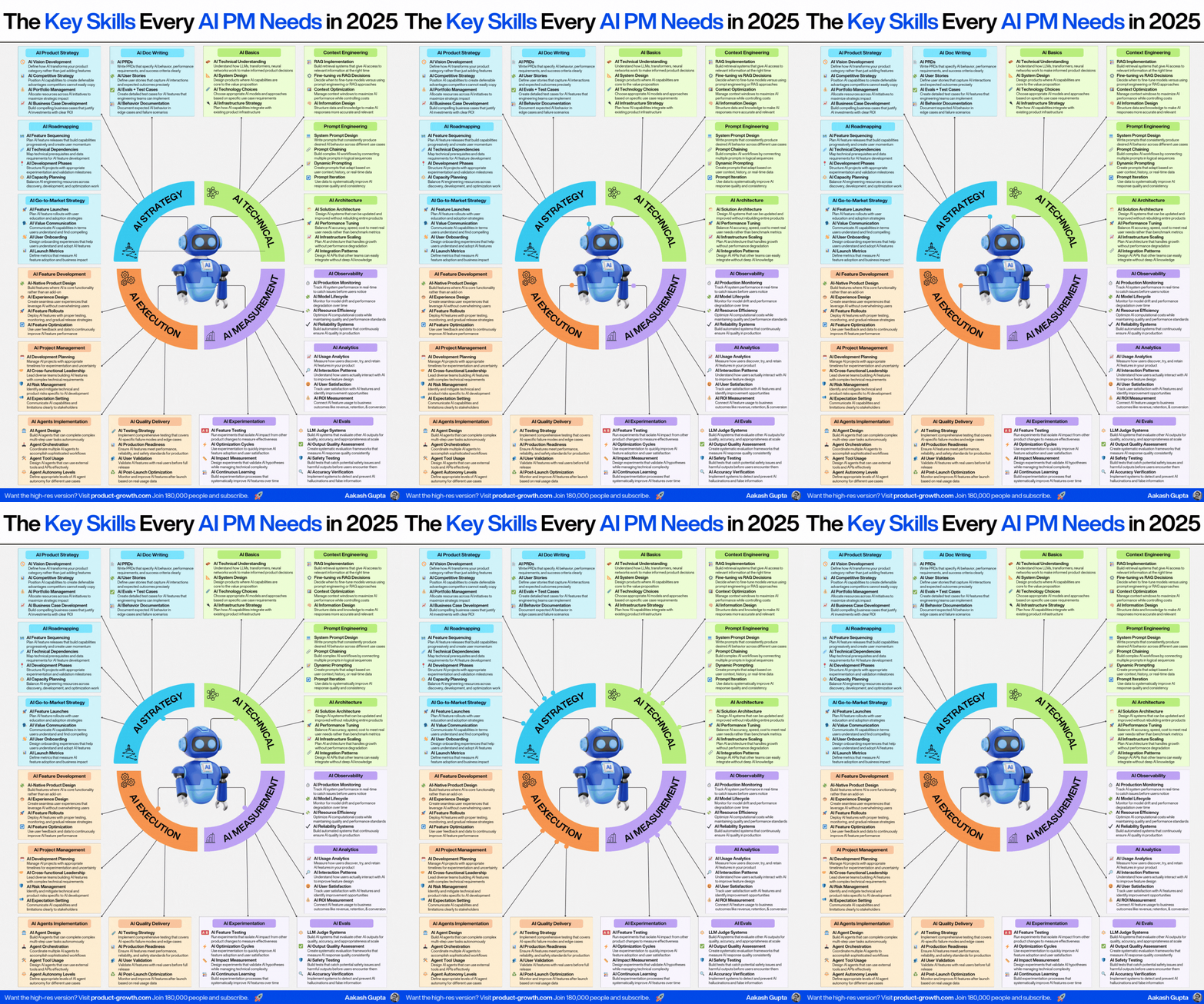
The skills are clear. The resources are out there.
But nobody tells you what order to learn them in.
That’s what this curriculum does. It takes everything from the infographic and gives you a clear learning path.
(Save this before anything else ♻️)
How This Curriculum Works
Think of this like school grades.
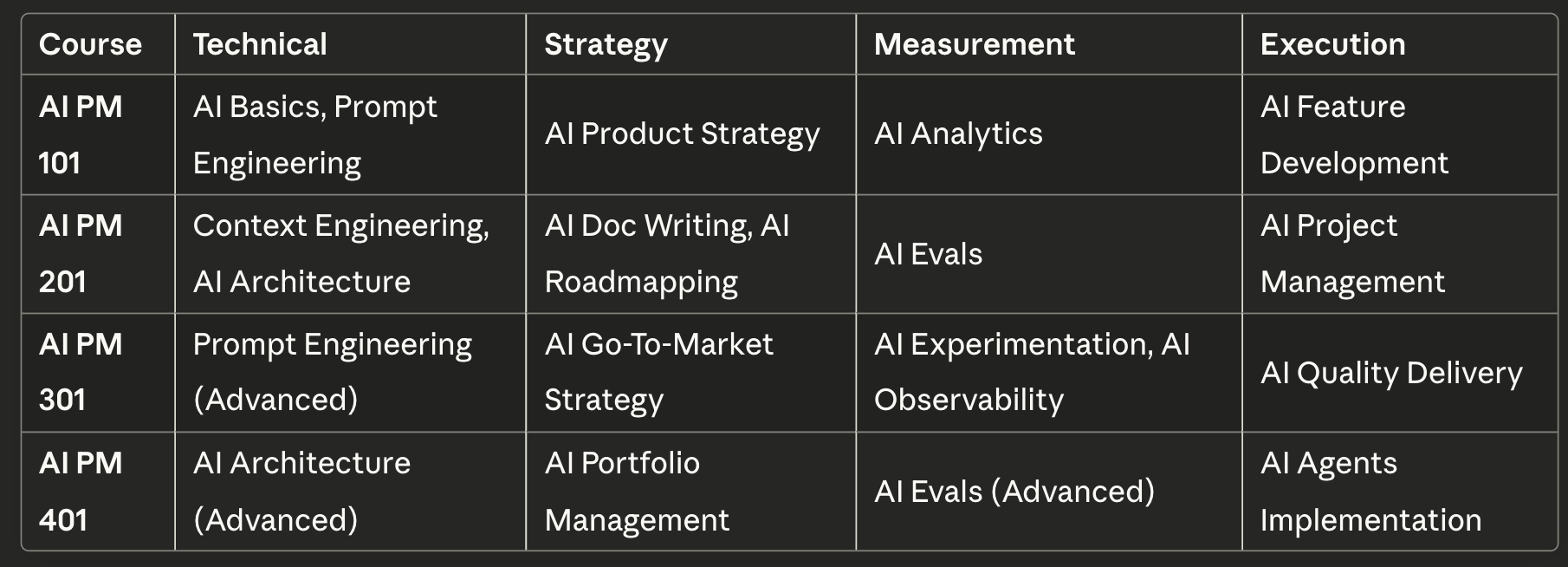
Each course level mixes skills from different categories. You learn strategy alongside technical skills alongside measurement. That’s how you actually build AI products in the real world.
AI PM 101: Your Foundation
You’re starting from zero. This level gets you from “I don’t understand AI” to “I can ship basic AI features.”
The sequencing here matters because you can’t think strategically about what you don’t understand technically. Start with AI Basics so you know what LLMs can and can’t do. Once you understand the technology, jump into Prompt Engineering so you can actually prototype ideas yourself. Most PMs wait for engineers to test their ideas. You’ll move 10x faster if you can validate concepts in minutes with good prompts.
Now that you can use the technology, you need to think about what to build. That’s where AI Product Strategy comes in. This teaches you how to identify high-value problems worth solving with AI. You’ll waste months building the wrong thing if you skip this step.
Next comes measurement. Learn AI Analytics early because you need to know how you’ll prove success before you start building. Too many PMs build features and then scramble to figure out metrics. Define them upfront.
Finally, study AI Feature Development to understand the actual patterns of building AI products. This isn’t just adding a chatbot to your app. AI-native features work fundamentally differently.
After 101, you’ll be able to identify good AI opportunities, prototype solutions, and ship basic features that users actually want.
AI PM 201: Getting Professional
You’ve shipped some features. Now you need to go deeper so you can handle complex production systems.
The jump from 101 to 201 is about moving from “I can use AI” to “I can architect AI systems.” Start with Context Engineering because this determines whether your product is accurate, fast, and affordable. Most AI PMs don’t understand the tradeoffs between RAG and fine-tuning, so they build expensive systems that don’t work. This guide shows you when to use each approach and why it matters for your product’s economics.
Once you understand context, you need AI Architecture to see how all the pieces fit together. Vector databases, retrieval pipelines, model orchestration. You don’t need to build these systems yourself, but you need to spec them clearly for engineers. Bad specs cause months of rework.
Now you can build complex systems, but can you communicate them? That’s where AI Doc Writing becomes critical. Your PRDs need to specify behavior and edge cases, not just happy paths. AI products are non-deterministic, so your documentation style has to evolve. These examples show you how to write specs that actually work.
With documentation skills, you can now plan quarters effectively. AI Roadmapping teaches you how to balance foundation work with user-facing features. You can’t ship value every sprint when you need infrastructure quarters. This guide helps you sequence work so engineering stays productive and stakeholders stay happy.
Before you ship complex features, you need AI Evals to measure quality pre-launch. This is your new QA process. Build eval sets that catch issues before users do. Most teams skip this and end up with embarrassing launches.
Finally, learn AI Project Management because AI projects are different. They involve research, experimentation, and uncertainty. Traditional sprint planning doesn’t work. This teaches you planning approaches that account for the unknown.
After 201, you’ll be leading complex AI product development with realistic timelines and clear specs that engineers can execute against.
AI PM 301: Advanced Execution
You’re shipping regularly. Now you need to optimize everything and scale your impact.
The 201 to 301 jump is about operational excellence. You know how to build, now you need to build better and faster. Circle back to Prompt Engineering but go deeper. System prompts, chain-of-thought reasoning, few-shot learning at scale. The basics got you started, but mastery separates good AI PMs from great ones. Advanced prompting techniques can improve your product’s accuracy by 20-30% without changing a single line of code.
Now that your products work well, you need to launch them well. AI Go-To-Market Strategy shows you how through the Warp case study. AI products require user education and trust-building. You can’t just ship and hope for adoption. This video breaks down how a successful company actually launched AI features.
To improve products post-launch, you need AI Experimentation running constantly. Test prompt variations, model choices, context strategies. The best AI PMs run 10x more experiments than traditional PMs because the solution space is so large. Learn how to test fast and ship winners.
Experiments generate data, but you need AI Observability to understand what’s happening in production. Monitor model performance, latency, cost per query. Set up dashboards that alert you to issues before they become problems. You can’t optimize what you can’t see.
Finally, you need AI Quality Delivery at scale. Use LLM judges and automated testing to maintain quality without manually reviewing every output. This is how you go from shipping one feature to shipping ten without your quality collapsing.
After 301, you’ll be running high-performing AI products with tight optimization loops. You’ll ship more, faster, with better quality than 95% of AI PMs.
AI PM 401: Industry Leadership
You’re an expert. Now you define best practices and push the entire industry forward.
The 301 to 401 jump is about becoming a thought leader. Return to AI Architecture with fresh eyes. Study multi-model systems, agentic workflows, distributed inference patterns. The advanced architectures that most companies won’t need for another year, you’ll be ready to build today.
At this level, you’re not just managing one product. You need AI Portfolio Management to allocate resources across multiple initiatives. Which bets pay off? Which to kill? How do you balance quick wins with long-term platform investments? This strategic muscle separates individual contributors from executives.
Your evaluation game needs to level up too. Go deeper on AI Evals with custom benchmarks, adversarial testing, and red teaming. You’re not just measuring whether your product works. You’re stress-testing it against edge cases that haven’t happened yet.
Finally, master AI Agents Implementation. Agents are the future of AI products. Multi-step reasoning, tool use, autonomous decision-making. Most PMs haven’t touched this yet. You’ll be designing agent-based products with proper guardrails while your competitors are still building chatbots.
After 401, you’re leading AI product organizations, defining industry standards, and fielding recruiter calls for $300K+ roles.
Your Path Forward
Most PMs try to learn everything at once. They bounce between topics and never build depth.
Don’t do that.
Pick your level. Work through those skills in parallel. Move up only when you’ve shipped real projects using what you learned.
The full curriculum takes 6-12 months. But the sequencing is what makes it work. Each level builds on the last. Skip ahead and you’ll have gaps that come back to haunt you.
📌 Want help figuring out which level to start at? Comment ‘curriculum’ + DM me.
The $300K+ AI PM jobs are waiting.
P.S. Which course level are you starting at?
