The fastest way to get ahead in product management today is to master AI. Not just the buzzwords, but the specific, tactical skills required to build, launch, and scale intelligent products. This isn't about becoming a machine learning engineer; it's about becoming the strategic leader who can connect complex AI capabilities to real business value.
This guide is your tactical playbook. We'll skip the high-level fluff and jump straight into the frameworks, job market data, and skill-building resources you need to transition into an AI PM role or level up in your current one.
Let's start with the core operational difference. A traditional PM defines features with deterministic logic—if a user clicks X, Y always happens. An AI PM guides systems with probabilistic logic—if a user does X, the system predicts the best Y based on data, and it's not always perfect. This distinction changes everything.
Consider the difference between a simple "sort by price" button (deterministic) and Spotify's "Discover Weekly" playlist (probabilistic). The button is predictable. The playlist is a living product, constantly learning from user data to get smarter. Your job as an AI PM is to manage that learning process.
The Actionable Framework: The AI PM Trinity
To succeed, you must master the "AI PM Trinity": Data, Models, and User Experience. These are the three pillars of any successful AI product. If one is weak, the entire product fails. Your job is to be the connective tissue between them, ensuring high-quality data feeds effective models, which in turn power a user experience that feels like magic.
Here is the operational checklist for managing the Trinity:
- Data Strategy:
- Acquisition: Do we build our dataset, buy it, or generate it from user interactions? (e.g., Tesla's fleet data collection).
- Labeling: Will we use an in-house team, or a service like Scale AI? What is our quality assurance protocol for labels?
- Ethics & Compliance: Have we vetted the data for bias? Does it comply with GDPR/CCPA?
- Model Management:
- Problem Framing: Have we translated the business problem ("users can't find relevant content") into a specific ML task ("build a classification model to predict article click-through rate")?
- Success Metrics: What does "good" look like? Is it 95% accuracy for fraud detection, or a 10% lift in engagement from a recommendation engine? Define this before development starts.
- Trade-offs: What is the business cost of a false positive versus a false negative (precision vs. recall)?
- User Experience (UX) for AI:
- Managing Uncertainty: How does the UI communicate when the AI is not 100% confident? How do we allow users to correct the AI? (e.g., thumbs up/down on a recommendation).
- Feedback Loops: How do we capture user corrections and feed them back into the model for retraining? This is the engine of product improvement.
- Building Trust: How do we explain why the AI made a certain recommendation?
The workflow is non-negotiable: Great data builds great models, and great models enable a great user experience. Your leadership across these three areas is the core of AI product management.
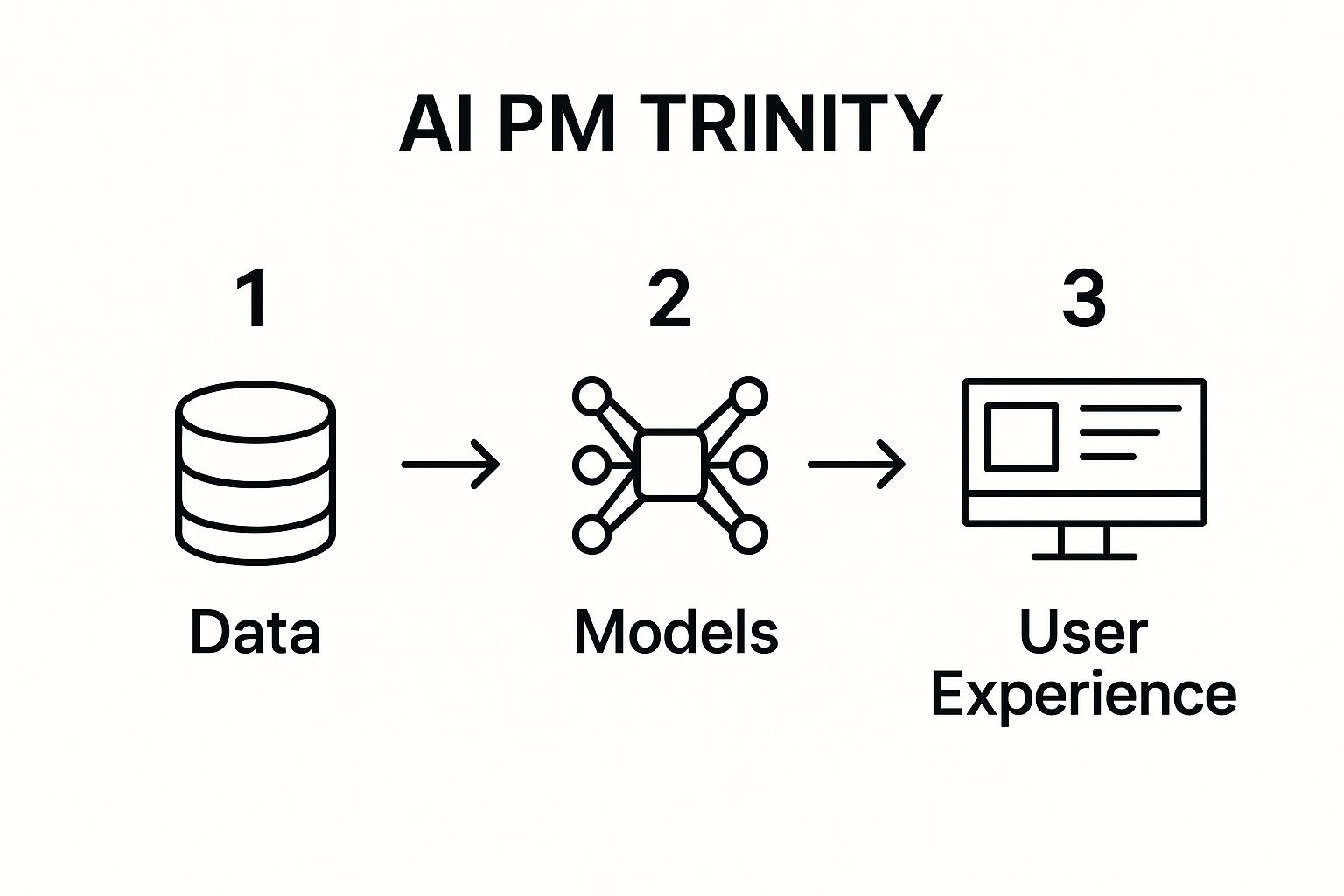
This process shows why everything has to start with a solid data foundation. Without it, even the most advanced model will fail to deliver an experience that users love. To get a deeper look at the role's specifics, check out this guide on defining what an AI PM is.
Let's ground this in reality by comparing the roles directly.
Traditional PM vs AI PM Key Differences
| Responsibility | Traditional Product Manager (e.g., building a settings page) | AI Product Manager (e.g., building a recommendation engine) |
|---|---|---|
| Core Focus | Defining features with fixed, predictable logic. | Guiding a system with probabilistic, evolving logic. |
| Data Usage | Uses analytics to measure feature adoption and usage. | Defines data collection, labeling, and quality strategy to train models. |
| Success Metrics | User engagement, conversion rates, task completion. | Model accuracy, precision/recall, user trust, feedback loop quality. |
| Technical Collaboration | Works with engineers to implement defined specs. | Partners with data scientists to select models and manage uncertainty. |
| User Experience | Designs clear, deterministic user flows. | Manages user expectations for an imperfect system and designs feedback loops. |
| Launch Strategy | Ship a complete, "finished" V1 feature. | Launch a "minimum viable model" that improves with user data over time. |
This table makes it clear: the AI PM role demands a deeper, more continuous engagement with data and a fundamentally different approach to what a "product" even is.
Why This Shift Matters to Your Career Now
The demand for product managers who understand AI is exploding. By 2025, it's projected that as many as 97 million people will be working in the AI space worldwide. This isn't a future trend; it's the current reality of the job market.
The reason is simple: 83% of companies now state AI is a top strategic priority. This has created a massive opportunity for PMs who can lead these initiatives.
This shift has broader ripple effects, too. Understanding the full scope of AI Product Management means acknowledging things like AI's impact on the workforce, which is reshaping what it means to have a white-collar career.
At companies like Google, Meta, and OpenAI, AI fluency is no longer a niche specialization; it's the new standard for product leadership. In today's market, the ability to manage the AI product lifecycle is what separates a good PM from a hireable, promotable, and truly great one.
Navigating the AI Product Lifecycle
Building an AI product isn’t a linear process like traditional software development. It’s a cyclical, iterative loop focused on continuous learning—both for the model and the team. The classic software development lifecycle (SDLC) is insufficient for the probabilistic nature of AI.
As an AI PM, you must guide your team through five interconnected phases. Mastering this loop is a core competency that separates top-tier AI product leaders from the rest.
Phase 1: Problem and Data Framing
This is the most critical stage. A mistake here guarantees product failure. Before any data is analyzed or a model is trained, you must frame the user problem as a machine learning problem.
Your job is to translate a vague business need into a precise ML task. For example, "Users struggle to find relevant articles" becomes, "We will build a classification model to predict which articles a user is most likely to click, optimizing for engagement."
Actionable Checklist for Problem Framing:
- Translate the Business Need: Convert the business goal into a specific ML problem type: classification, regression, clustering, or generation.
- Define Success Metrics Upfront: Be specific. What does "good" mean? Is it achieving 95% accuracy for a fraud detection model? Is it a 20% increase in user engagement for a recommendation feed? This must be defined and agreed upon before work begins.
- Conduct a Data Feasibility Audit: Do we have the required data? Is it accessible? If not, what is the specific plan to acquire or generate it? What are the estimated costs and timeline?
Phase 2: Data Sourcing and Preparation
With the problem framed, you now focus on the fuel for your AI: data. This is often the most time-consuming phase but is absolutely critical. A key decision here is the build-vs-buy analysis for your datasets.
Will you invest in building a proprietary dataset (a potential competitive moat), or is it more efficient to buy or license data from a third-party vendor? For many teams, leveraging specialized data labeling services is the only path to achieving the required quality at scale.
The old adage "garbage in, garbage out" is the fundamental law of AI product management. A world-class model from Google or OpenAI is useless if fed a low-quality, biased dataset. Investing heavily in data quality at this stage will prevent massive headaches later.
Platforms like Scale AI provide the managed infrastructure for this, handling the heavy lifting of data annotation so product teams can focus on their core models and user experience.

Services like this provide the foundational data layer, letting companies focus on their unique AI capabilities instead of building labeling tools from scratch.
Phase 3: Model Experimentation and Validation
Now your data science team begins training and testing various models. As the PM, you are not building the models. Your role is to be the strategic guide, ensuring the team remains focused on solving the user problem, not just optimizing a technical metric. You will facilitate critical trade-off discussions, such as choosing between higher precision or higher recall for a medical diagnostic tool, and translating the implications of that choice for the user experience.
Phase 4: Deployment and Integration
Once a model performs well in a lab environment, it's time to integrate it into the live product. A critical component here is Human-in-the-Loop (HITL) design. For many AI products, especially in their early stages, having a human review and correct the AI's outputs is essential. This serves two purposes: it builds user trust by preventing egregious errors, and it generates perfectly labeled training data to continuously improve the model.
Phase 5: Continuous Monitoring and Retraining
An AI model is a dynamic asset, not a static feature. The real world changes, user behavior shifts, and data patterns evolve. This leads to model drift, where a model’s predictive accuracy degrades over time because the new, live data it's seeing no longer matches the data it was trained on.
For example, a fraud detection model trained before a new payment method becomes popular will quickly become obsolete. Your job is to implement monitoring systems to detect this drift and trigger a retraining cycle with fresh data. Understanding the full journey, like the steps involved in building a mobile app for your business using AI, helps put this entire lifecycle into a practical context.
Building Your AI Product Manager Skillset
Getting hired or promoted into an AI product management role at a company like Google or Meta requires a specific, demonstrable skill set. Generic product management experience is no longer enough.
This isn't about becoming a data scientist. It’s about developing the technical fluency to lead world-class engineering teams, the strategic acumen to connect models to revenue, and the market knowledge to build a competitive product.

Developing Your Technical Acuity
For an AI PM, technical acuity is not about writing code. It's about deeply understanding the core concepts to the point where you can challenge assumptions and meaningfully contribute to technical discussions. Without this, you are merely a project manager, not a product leader.
To be credible with your engineering counterparts, you must internalize these fundamentals:
- Classification vs. Regression: Are you predicting a category (e.g., "spam" vs. "not spam") or a continuous value (e.g., "house price")? This is the most basic distinction.
- Precision vs. Recall: This is a critical product trade-off. For a medical diagnosis model, is it worse to have a false positive (low precision) or a false negative (low recall)? The answer dictates your model optimization strategy and has profound user impact.
- Supervised vs. Unsupervised Learning: Are you training a model with a clean, labeled dataset (supervised), or asking it to discover hidden patterns in raw data on its own (unsupervised)? This choice dictates your data strategy from day one.
The best starting point for a non-technical PM is Coursera's "AI for Everyone" by Andrew Ng. For approximately $49 per month, it provides the essential conceptual framework without requiring any coding. For a more structured plan, follow this detailed AI PM learning roadmap.
Mastering AI Business Strategy
A technically brilliant model that doesn't generate revenue or reduce costs is a science project, not a product. Your primary responsibility is to connect AI development to tangible business outcomes. This starts with building a comprehensive business case and ROI model.
An effective AI product strategy is grounded in economic reality. You must be able to articulate not just the potential upside but also the unique, often hidden, costs associated with building and maintaining intelligent systems.
Your ROI model must account for these AI-specific costs:
- Data Acquisition & Labeling: This can be a significant, recurring operational expense. What is the cost per label? How many labels do we need?
- Compute Costs (Training & Inference): Training large models requires immense GPU power, translating to large bills from cloud providers like AWS or Google Cloud. Inference costs are incurred every time the model is used.
- Ongoing Monitoring & Retraining: Models are not "set it and forget it." You must budget for the engineering resources required to monitor for model drift and retrain the model regularly just to maintain baseline performance.
Decoding Real AI PM Job Descriptions
Let’s analyze the market. Job descriptions from top tech companies reveal a consistent pattern of required skills.
A recent posting for an AI Product Manager at Google required candidates to "define and analyze metrics that inform the success of products" and "understand the technical architecture of complex and highly scalable machine learning systems."
Similarly, a role for a PM on Meta's Generative AI team demanded experience "shipping products with a heavy reliance on machine learning" and a "deep understanding of the AI/ML space."
The message is clear: companies are hiring PMs who are bilingual, speaking the languages of both product strategy and machine learning. They need leaders who can bridge the gap between user needs, business goals, and the probabilistic world of AI.
To get you there, here is a curated list of high-impact resources.
Top AI PM Skill Development Resources
| Resource Type | Recommendation | Focus Area | Approximate Cost |
|---|---|---|---|
| Course | AI for Everyone (Coursera) | Foundational AI concepts for non-technical leaders | ~$49/month |
| Book | Inspired by Marty Cagan | Core product management principles (essential foundation) | ~$20 |
| Book | Designing AI-Powered Products | Practical UX and design for intelligent systems | ~$40 |
| Community | Lenny's Newsletter & Slack | Product growth, strategy, and networking with top PMs | Free to $150/yr |
| Course | Reforge – AI for Product | Advanced, cohort-based program on AI product strategy & execution | ~$2,000+ |
| Newsletter | The Batch by DeepLearning.AI | Curated weekly AI news and analysis from Andrew Ng's team | Free |
This list is your starting point. The objective is not to collect certificates, but to build a deep, intuitive understanding of how to create business value with artificial intelligence.
The Modern AI Product Management Toolkit
Execution is everything. The right tools don't just make you more efficient; they enable entirely new workflows and a deeper level of analysis. Your tech stack is the command center for navigating the complex lifecycle of an AI product.
Mastering an AI-powered product toolkit has become table stakes. The competitive landscape has shifted from simply building features to creating AI-driven feedback loops that accelerate learning and compound value. This is only possible with a modern stack designed for this new paradigm.
Let's break down the essential tool categories for any serious AI PM.
Tools for Data Analysis and Visualization
As an AI PM, data is your native language. You must be able to explore, visualize, and communicate insights from complex datasets. Spreadsheets are not enough. You need professional-grade business intelligence (BI) platforms.
- Tableau: The ideal tool for exploratory data analysis. Its drag-and-drop interface allows you to create powerful visualizations and dashboards to uncover patterns in raw data without writing SQL.
- Looker (Google Cloud): Best for establishing a single source of truth for metrics across the organization. Looker uses a centralized modeling layer (LookML) to ensure consistency in definitions, making it perfect for operational reporting and scaled BI.
The choice often depends on the task: Tableau for ad-hoc exploration, Looker for standardized, company-wide reporting.
Tools for Model Experimentation Tracking
When your data science team is running hundreds of model experiments, the process can become chaotic. As the PM, you need a centralized system to track what’s working, what’s failing, and why. This is the domain of MLOps (Machine Learning Operations) tools.
Think of these platforms as the "Jira for machine learning." They provide the necessary governance and visibility into the iterative process of model development, giving you a clear line of sight into progress and performance.
Two platforms dominate this space:
- Weights & Biases (W&B): A comprehensive platform for tracking experiments, visualizing model performance, and collaborating with your team. It logs everything from hyperparameters to dataset versions, making results fully reproducible.
- MLflow: A powerful open-source alternative that provides similar core functionality. Its flexibility makes it a favorite among teams that prefer to build and customize their own MLOps stack.
AI Integration in Core PM Tools
The most significant recent trend is the embedding of AI capabilities directly into the core PM tools you use daily. Platforms like Productboard and Jira are evolving from static organizers into intelligent partners.
You can gain a significant productivity advantage by mastering targeted prompts to automate analysis within these tools.
Actionable Prompts for Your PM Tools:
- In Productboard: "Analyze all user feedback from the last 60 days tagged with 'search' and identify the top three most requested improvements. Summarize the sentiment for each."
- In Jira: "Review all bug reports for our 'Checkout Flow' component in the last quarter. Categorize them by root cause and identify any recurring patterns or critical failure points."
Mastering these tools and techniques is how you go from just managing a process to actively shaping outcomes with data-driven precision. For a more exhaustive list, check out our guide to the essential AI tools for product managers.
Lessons from Real-World AI Products
The best way to learn AI product strategy is to deconstruct the products that are already winning in the market. By analyzing the decisions behind iconic AI-powered experiences, we can extract repeatable patterns for success.
Let's dissect three distinct examples to understand how elite product teams solve the unique challenges of building with AI.
These are not just features; they are core business engines. The investment is massive because the returns are astronomical. The global AI market hit an estimated $638.23 billion in 2025 and is projected to reach $3,680.47 billion by 2034. You can explore these explosive AI market projections to grasp the scale of this opportunity.
Netflix Personalization Engine
The Netflix recommendation system is arguably one of the most commercially successful AI products ever created. The system influences over 80% of hours streamed and is estimated to generate over $1 billion in annual value through increased customer retention.
- The Problem: In a sea of content, how do you prevent decision fatigue and reduce customer churn?
- The PM Decisions: The product team's brilliant insight was to personalize more than just the content recommendations. They invested in a complex AI system that personalizes the artwork shown for each title based on a user's viewing history. If you watch romantic comedies, you might see the Good Will Hunting poster featuring Matt Damon and Minnie Driver. If you watch stand-up, you'll see the poster with Robin Williams. This is a masterclass in using AI to keep the user experience feeling fresh and relevant.
- The Business Impact: By anchoring their entire AI strategy to the single, high-value business metric of retention, Netflix built a powerful competitive moat. The AI engine is the product.
Tesla Autopilot
Tesla’s Autopilot provides a compelling case study in managing a safety-critical AI system in the physical world. When a model's error can have life-or-death consequences, the product management playbook changes dramatically.
- The Problem: How do you safely build and deploy a self-driving system that must learn from the chaotic and unpredictable real world? This requires an immense volume of diverse training data while navigating a complex regulatory and ethical landscape.
- The PM Decisions: Tesla's strategic masterstroke was to turn its entire customer fleet into a distributed data collection network. Every Tesla on the road acts as a sensor, feeding petabytes of real-world driving data back to train the core neural networks. This "fleet learning" approach created a data advantage that competitors are still years away from matching. They also applied a software-style iterative release cycle (over-the-air updates) to a hardware product, enabling continuous improvement.
- The Business Impact: This strategy created a virtuous cycle, or data flywheel. More miles driven generates more data, which makes the system smarter, which makes the product more valuable, driving more sales and generating even more data.
A key takeaway from Tesla is the importance of designing a product that generates its own high-quality training data as a natural byproduct of its use. This creates a self-improving loop that accelerates development.
Duolingo AI Tutor
Duolingo has masterfully integrated generative AI to make language learning more personalized and effective. Its premium feature, Duolingo Max, is a prime example of applying a Large Language Model (LLM) to a specific pedagogical need.
- The Problem: Standardized, one-size-fits-all lessons are an inefficient way to learn a language. How can you provide millions of users with personalized feedback at scale without hiring an army of human tutors?
- The PM Decisions: The team didn't just plug in a generic chatbot. They fine-tuned OpenAI's GPT-4 model specifically for language education, creating features like "Explain My Answer" and "Roleplay." Critically, they defined success not just by user engagement but by learning efficacy. They implemented a rigorous measurement framework to ensure the AI was a genuine teaching tool, not just a novelty.
- The Business Impact: Duolingo Max created a new premium subscription tier, directly monetizing the company's investment in AI. This differentiated their product in a crowded market and proved that generative AI can be a powerful engine for both user value and new revenue streams.
Your AI Product Management Questions Answered
If you're aiming to break into or level up in AI product management, you have critical questions. The stakes are high, the technical details are important, and the career rewards are significant.
Here are direct, no-fluff answers based on my experience hiring, mentoring, and leading AI product teams.
How Technical Do I Really Need to Be?
You do not need a computer science degree. You do not need to be able to code a neural network.
However, you absolutely cannot be technically illiterate. Your job is not to be an engineer; it is to be a credible, technically fluent leader who can guide engineering teams effectively. Think of yourself as a film director: you don't need to operate the camera, but you must understand the principles of cinematography to direct the shot.
Here is the required baseline:
- Must-Know Concepts: You must have a solid grasp of the fundamentals. This means a clear understanding of supervised vs. unsupervised learning, the precision vs. recall trade-off, and the basics of what "training data" entails.
- High-Value Skills: While not mandatory, basic proficiency in SQL to query data yourself or the ability to read a Python notebook gives you a significant advantage and builds immense credibility with your technical team.
Your goal is to be able to ask insightful, probing questions: "What is the confidence threshold for this classification?" "What is our strategy to mitigate model drift as user behavior evolves?" Your value lies in spotting hidden assumptions and challenging them with technical and business acumen.
What Is the Career Path and Salary for an AI PM?
The career trajectory for an AI PM mirrors the traditional PM ladder—Associate PM, PM, Senior PM, Director, VP—but with a significant compensation accelerator. AI PMs consistently command a salary premium of 15-30% over their non-AI counterparts at the same level, due to the specialized skill set and smaller talent pool.
Let's look at real-world total compensation data from Levels.fyi for major tech hubs:
| Role Level | Traditional PM (Total Compensation) | AI PM (Total Compensation) |
|---|---|---|
| Mid-Level PM (L4) | $180,000 – $250,000 | $220,000 – $300,000 |
| Senior PM (L5) | $260,000 – $380,000 | $320,000 – $450,000 |
| Principal PM / Director | $400,000 – $700,000+ | $500,000 – $850,000+ |
These figures represent the market's clear valuation of this skill set. Companies are competing fiercely for leaders who can translate complex AI technology into business impact. This premium reflects both talent scarcity and the massive financial upside of successful AI products.
During salary negotiations, your leverage comes from specific AI project experience. Highlighting projects where you owned the data strategy, defined model success metrics, or managed probabilistic user experiences is what will place you in the higher compensation band.
How Do I Transition from a Traditional PM Role?
Transitioning from a traditional PM role into AI is a deliberate process. It's about proactively building relevant experience in your current role rather than waiting for the perfect "AI PM" job title to appear.
Here is a tactical framework for making the switch:
For an Internal Transition (Highest Probability of Success):
- Become the Data Expert: Go deeper into product analytics than anyone else on your team. Master your company's data tools (e.g., Amplitude, Looker) and become the go-to person for quantitative insights into user behavior.
- Lead an "AI-Adjacent" Project: Volunteer for any project that involves machine learning, however small. This could be optimizing a search algorithm, implementing a basic recommendation feature, or even running a predictive A/B test. Get hands-on experience.
- Build Alliances with Data Science: This is non-negotiable. Proactively connect with your company's data scientists. Take them to coffee. Ask about their projects, challenges, and goals. Learn to speak their language.
For an External Move (Requires a Portfolio):
- Reframe Your Resume with AI Keywords: Audit your past projects and rewrite your accomplishments through an AI/data lens. Instead of "Launched a new sorting feature," write, "Increased content discovery by 15% by implementing a data-driven personalization algorithm that prioritized user engagement signals."
- Build a Public Portfolio Project: This is your proof of work. Find an interesting dataset on Kaggle, perform a basic analysis (even in Google Sheets), and write a 1-page PRD outlining a potential AI feature based on your findings. This demonstrates that you can think like an AI PM.
- Prepare for the AI Interview Loop: Practice AI-specific case studies. You will be asked to "Design an AI product to solve X" or "How would you define and measure success for a new fraud detection model?" Structure your answers around the AI product lifecycle, from data acquisition to monitoring for model drift.
Making this transition is about proving you can manage the ambiguity and probabilistic nature of intelligent systems. You must demonstrate that you are not just a feature manager, but a systems thinker capable of guiding an AI product to success.
At Aakash Gupta, we're dedicated to helping you master these skills and advance your product career. For more deep dives, frameworks, and career strategies from an experienced product leader, explore the insights available at https://www.aakashg.com.
