Let's cut to the chase. You're here to learn how to manage AI products, not to read a history of machine learning. The most critical skill for an AI Product Manager is translating a vague business objective into a solvable machine learning problem. Everything else flows from that.
Here’s a practical, step-by-step framework you can apply today:
- Start with the Business Goal: What needle are you trying to move? (e.g., "Reduce customer churn by 10% in the next quarter.")
- Frame the User Problem: Why are users churning? (e.g., "Users get overwhelmed and can't find relevant content.")
- Formulate an ML Hypothesis: How can a model solve this? (e.g., "We believe a personalized content recommendation engine will increase user session time by 15%, leading to a 10% reduction in churn.")
- Define Success Metrics (Dual): How do you measure victory for both the model and the business?
- Model Metric: Achieve a click-through rate (CTR) of over 25% on recommended items.
- Business Metric: Reduce 30-day churn by a statistically significant margin in an A/B test.
- Identify Data Requirements: What data is essential for this model? (e.g., User clickstream data, content metadata, session duration, historical user preferences.)
This problem-framing process is the core of artificial intelligence product management. It's what distinguishes AI PMs at companies like Google and Meta from traditional PMs. They don’t just write user stories; they architect intelligent systems.
Defining the AI Product Manager Role

Think of a traditional PM as a chef executing a proven recipe. They manage known ingredients (code libraries) and a predictable process (sprints) to deliver a defined dish (UI/UX). The result is deterministic.
An artificial intelligence product management role is fundamentally different. This PM is a culinary inventor creating a new dish with unpredictable ingredients. Their job is to:
- Run the farm (Data Pipelines): AI models are built on data. An AI PM is obsessed with the quality, sourcing, and labeling of the data pipelines that feed the model. Garbage in, garbage out is the first rule of machine learning. A real-world example: Netflix's recommendation engine doesn't just use viewing history; it uses pause times, rewind events, and even time-of-day data to train its models.
- Design the Kitchen (ML Infrastructure): They partner with ML Engineers to build the complex systems needed for model training, deployment, and real-time inference at scale. This isn't just about servers; it's about MLOps, versioning, and monitoring.
- Lead the Taste Tests (Model Evaluation): It’s not enough for a model to be technically accurate. The AI PM continuously evaluates its performance against business outcomes. A model with 99% accuracy that doesn’t impact user retention is a failure.
This role requires a comfort with ambiguity. AI models provide probabilistic answers, not certainties. A core part of the job is designing user experiences that build trust in a system that will inevitably make mistakes. For a deeper look into this unique role, you can learn more about what an AI PM is and how the responsibilities differ.
From User Stories to Problem Framing
The day-to-day reality of an AI PM looks quite different from their traditional counterparts. Instead of writing detailed user stories for every button and screen, an AI PM’s main job is framing business problems in a way that data science teams can turn into a solvable machine learning puzzle.
"Product managers are shifting from pure problem solvers to AI orchestrators. Our job now is to harness fleets of agents and all of our complexity so that scale becomes a competitive advantage instead of something that slows us down." – Tim Simmons, SVP & Chief Product Officer, Walmart International
This means your primary deliverable often shifts from a detailed feature spec to a crystal-clear problem statement. This includes defining the metrics for success, outlining the data you'll need, and even specifying what an acceptable rate of failure looks like.
Comparing Traditional PM and AI PM Responsibilities
To make this distinction really sharp, let's put the core responsibilities side-by-side. The following table shows just how much the focus shifts—from managing a predictable software development process to steering an experimental, data-hungry, and constantly evolving system.
Traditional PM vs AI PM Core Responsibilities
| Responsibility Area | Traditional Product Manager | AI Product Manager |
|---|---|---|
| Problem Definition | Writes detailed user stories and feature specifications for engineering teams. | Frames business problems as solvable ML tasks and defines data requirements for data science teams. |
| Core Deliverables | Product Requirements Documents (PRDs), user flows, and wireframes. | Model performance targets, data labeling strategies, and ethical guardrails for model behavior. |
| Success Metrics | Tracks feature adoption, user engagement, conversion rates, and churn. | Measures model accuracy (precision/recall), business impact (cost savings/revenue lift), and user trust. |
| Development Cycle | Manages linear sprints with predictable outputs based on defined logic. | Oversees an iterative, experimental cycle of data collection, model training, evaluation, and retraining. |
| Risk Management | Focuses on bugs, technical debt, and usability issues. | Manages data bias, model drift, unexpected outputs, and the ethical implications of algorithmic decisions. |
| Collaboration Focus | Primarily collaborates with Engineering, Design, and Marketing. | Collaborates deeply with Data Scientists, ML Engineers, Data Engineers, and Legal/Compliance teams. |
| User Experience (UX) | Designs clear, intuitive interfaces for deterministic features. | Designs experiences that build trust in probabilistic outcomes and handle potential model errors gracefully. |
As you can see, the AI PM isn't just managing a product; they're curating an intelligent system. This requires a unique blend of strategic thinking, technical understanding, and a deep appreciation for the nuances of working with data and algorithms.
Developing Your AI Product Manager Skill Stack
Making the jump into AI product management isn't just about adding a buzzword to your resume. It's a fundamental skills upgrade. When companies like Google and OpenAI post job descriptions for AI PMs, they're not looking for classic PMs. They're hunting for a specific hybrid who can live at the intersection of business strategy, data, and machine learning.
The bedrock skill is deep technical literacy. This doesn’t mean you need to write production-level Python code. It means you can have credible, high-bandwidth conversations with your data science and ML engineering teams about technical trade-offs.
Building Foundational Technical Literacy
Your first mission is to internalize the end-to-end machine learning workflow. You must speak the same language as your technical counterparts.
Start by mastering these core concepts:
- Model Training vs. Inference: Understand the critical difference between training a model with historical data (computationally expensive, done offline) and inference, where the trained model makes live predictions (needs to be fast and efficient). This distinction dictates your infrastructure, budget, and user experience.
- MLOps (Machine Learning Operations): This is the operational backbone for deploying, monitoring, and maintaining ML models in production. Familiarize yourself with concepts like model versioning, automated retraining pipelines, and performance monitoring.
- Model Architectures: You don't need to be an expert, but you should know the basic landscape. Know when a simple logistic regression model is sufficient versus when you need a complex deep neural network or a Large Language Model (LLM). Understand the trade-offs in terms of cost, performance, and explainability.
A great AI PM doesn't need to be a data scientist, but they absolutely must be the best translator in the room. Your job is to take a fuzzy business goal, turn it into a clear, solvable machine learning problem, and then translate the model's messy, probabilistic outputs back into something that means real business value.
Developing Deep Data Acumen
Here's a hard truth about AI product management: data isn't just a resource. It is the product. A weak data strategy guarantees a weak AI product. Your ability to own this strategy is what separates top-tier AI PMs from the rest.
Focus on these key areas:
- Data Quality and Sourcing: Become obsessed with data quality, relevance, and cleanliness. Constantly ask: Where is this data from? How was it collected? What biases are inherent in this dataset? A famous example of this going wrong is Amazon's recruiting AI, which had to be scrapped because it was trained on historical data that was biased against female candidates.
- Labeling and Annotation Strategy: For supervised learning, the quality of your data labels is paramount. As the PM, you will define the labeling strategy, write the guidelines for annotators, and make the budget trade-offs between quality and cost.
A crucial part of any AI PM’s toolkit is learning effective risk mitigation planning to handle the wild uncertainties that come with AI development.
Translating Business Problems into ML Use Cases
This is the single most important skill. You are the bridge between the business and the technology. You must be able to take a vague objective like, "we need to improve customer engagement," and translate it into a specific, measurable, and solvable machine learning problem.
This translation is about defining victory for both the model and the business. For example, "improve engagement" becomes "build a recommendation model that increases the click-through rate on suggested content by 15% with a precision of at least 80%."
Here is an actionable plan to build these skills:
- Foundation First: Start with Andrew Ng's "AI for Everyone" on Coursera (approx. $49/month). It provides the best conceptual, non-technical overview of AI capabilities and limitations.
- Strategic Application: Enroll in Reforge's "AI-Native Product Strategy" program (requires membership, typically ~$2,000/year). This course teaches the frameworks senior leaders at top tech companies use to build AI-first products.
This combination—foundational knowledge plus strategic application—is the direct path to building a real career in artificial intelligence product management.
The AI Product Development Lifecycle Explained
Building a traditional software product can feel like a straight line, but building an AI product is something else entirely. It's a deeply iterative, cyclical process. Think of an AI model less like a finished piece of software and more like a living system that needs constant care and feeding. To manage this complexity, you need a structured, repeatable framework.
This lifecycle breaks that journey down into six core stages. This isn't just theory; it's the operational blueprint teams at companies like Spotify use to turn a vague idea like "let's make playlists better" into a global phenomenon like Discover Weekly.
Stage 1: Problem Framing
This is, without a doubt, the most critical stage. A brilliant model solving the wrong problem is a colossal waste of time and money. Before a single line of code is written or a single piece of data is touched, you have to translate a fuzzy business goal into a sharp, machine-learnable problem.
Your job is to get from "we want to improve user retention" to a specific, testable hypothesis like, "We believe we can increase 30-day retention by 5% by creating a personalized weekly playlist that introduces users to new music they will love."
Key Questions & Deliverables:
- What is the user problem? The deliverable is a crystal-clear problem statement from the user's perspective. (e.g., "I find it hard to discover new music outside of my usual artists.")
- What is the business objective? You need a specific, measurable business goal. (e.g., Increase active listening hours by 10%.)
- Is this actually an ML problem? Could you solve this with a few simple rules? The deliverable here is a solid justification for why an AI approach is truly necessary.
Stage 2: Data Strategy
Data is the fuel for your model. Without a robust data strategy, your product is dead on arrival. This stage is all about figuring out what data you need, where you're going to get it, and how you'll ensure its quality. This is where you build your competitive "data moat."
For Spotify's "Discover Weekly," this meant homing in on crucial data sources: user listening history, playlist creations, and even tracking which songs users skipped. That skip data is pure gold.
Key Questions & Deliverables:
- What data do we need? Deliverable: A detailed data requirements document that specifies features, sources, and formats.
- How will we acquire and label it? Deliverable: A data acquisition plan and a clear annotation strategy, including guidelines for any human labelers.
- What is our data moat? How is our data proprietary and tough for competitors to replicate? Deliverable: A clear statement on your unique data advantage.
Stage 3: Model Prototyping and Evaluation
Alright, now the data scientists get to work their magic. They'll start building and training initial models to see if the problem is even solvable with the data you have. As the PM, your job isn't to build the model, but to define what "good" looks like.
You’ll work with your team to set baseline performance targets. It’s absolutely vital to connect technical model metrics (like precision and recall) to the actual user experience. For example, low precision for "Discover Weekly" might mean recommending songs a user actively dislikes, which completely erodes their trust in the product.
You must define dual success metrics from the very beginning. A model can have 99% accuracy but be a total failure if it doesn't drive the target business outcome. Success is always measured by both model performance and product impact.
This is also the perfect time to explore the complete product development lifecycle stages to make sure your AI-specific steps integrate smoothly with your company's bigger development processes.
Stage 4: Human-in-the-Loop Design
Let's be clear: AI models will make mistakes. The question isn't if they will fail, but how you're going to handle it when they do. This stage is all about designing the user experience to manage the probabilistic, sometimes unpredictable, nature of AI. You need to build feedback loops that not only help the user in the moment but also generate valuable data to retrain and improve the model.
Key Questions & Deliverables:
- How do we handle incorrect predictions? Deliverable: UX mockups for error states and flows that let users easily make corrections.
- How do we collect user feedback? Deliverable: A plan for gathering both implicit feedback (like song skips) and explicit feedback (like "like" or "dislike" buttons).
Stage 5: Productionization
Taking a model from a data scientist's tidy notebook to a live production environment serving millions of users is a massive engineering lift. This stage, often wrangled by ML Engineers, is about building the nuts-and-bolts infrastructure for deploying, monitoring, and scaling the model.
Your role as the PM is to ensure this heavy technical work stays aligned with product goals, like latency requirements. A recommendation that takes 30 seconds to load is useless, no matter how perfect it is.
Stage 6: Iteration and Monitoring
Once you launch, the real work is just beginning. Models degrade over time as user behavior and the world changes—a concept known as model drift. You must have systems in place to continuously monitor performance and a clear plan for retraining the model with fresh data to keep it sharp.
This shift toward ongoing management is reshaping the PM profession. By 2025, product managers are increasingly being judged on AI-driven outcomes rather than traditional output metrics. This trend is confirmed by a recent industry report where a majority of product professionals reported prioritizing outcome-based KPIs, with AI-centric product strategy named as the most valuable job for PM teams. You can find more insights in the 2025 State of Product Management report. Following this lifecycle ensures you're set up to manage that long-term value from day one.
How to Build and Lead High-Performance AI Teams
An AI product is only as strong as the team behind it. This isn't your typical software setup where roles are neatly defined and stay in their own lanes. Building for AI means managing a complex, overlapping web of highly specialized talent.
Success hinges on understanding who does what and how you, the AI Product Manager, act as the central hub—the one who translates messy business problems into technical reality.
The modern AI product team is a mix of deep specialists. A weakness in any one of these roles can put the entire project at risk.
- Data Scientists: Think of them as the explorers and experimenters. They dive into complex data, prototype models, and test hypotheses to figure out what’s even possible.
- Machine Learning (ML) Engineers: These are your builders and architects. They take a data scientist’s validated model and engineer it into a robust, scalable system that can handle the real world.
- Data Engineers: The plumbers of the AI world, and I mean that in the best way. They build and maintain the data pipelines that are the absolute lifeblood of any AI product, making sure a constant flow of clean, reliable data is always available.
- Research Scientists: These are the visionaries. They’re often focused on long-term R&D, pushing the boundaries of what AI can do by developing new algorithms that might just become your next big product.
The AI PM as the Central Hub
Your job as the AI PM is to conduct this highly technical orchestra. You are the single person who holds the end-to-end context, from the user's frustration and the business goal all the way down to the data limitations and model performance trade-offs.
This means you have to master the art of cross-functional team management and keep every specialist pointed toward the same product vision.
This isn't always easy. You'll find yourself moderating some intense, high-stakes debates. A data scientist might be pushing for a more complex model to squeeze out another 0.5% in accuracy, while an ML engineer is warning that its slow inference speed will completely tank the user experience. You have to be the one to make the final call, balancing that desire for technical perfection with business reality.
The flowchart below gives a simplified view of the AI lifecycle, showing the key stages your team will navigate together.
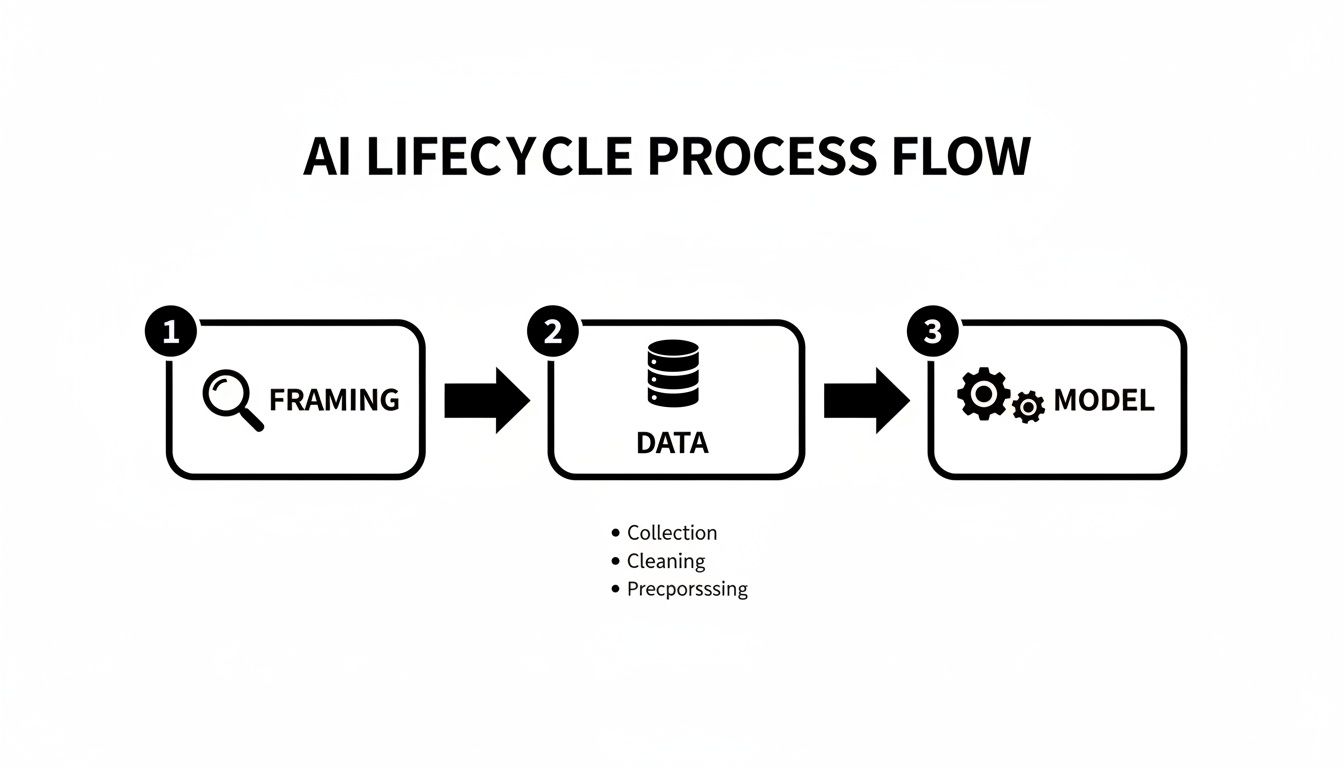
As you can see, success depends on seamless collaboration across the problem (product), data (data engineering), and model (data science & ML engineering) phases. It's a continuous loop, not a linear handoff.
Clarifying Roles with a RACI Chart
To prevent confusion and ensure critical tasks are not dropped, a RACI chart is an indispensable tool for an AI PM. It clearly maps out ownership for a complex project, like launching a new recommendation engine.
| Task/Deliverable | AI PM | Data Scientist | ML Engineer | Data Engineer |
|---|---|---|---|---|
| Define Business Goal & KPIs | A | R | C | C |
| Source and Clean Initial Data | C | C | C | R/A |
| Prototype & Validate Model | C | R/A | I | I |
| Define Model Performance Metrics | A | R | C | I |
| Build Production ML Pipeline | C | I | R/A | C |
| Deploy and Monitor Model | I | I | R/A | C |
| Analyze Post-Launch Impact | R/A | C | C | I |
This kind of structure is vital because, frankly, organizational readiness is still a massive bottleneck for AI adoption. Many companies have skills gaps right at the leadership level, which creates huge challenges when trying to scale AI products.
In fact, industry analyses in 2025 found that only about 29% of executive teams felt they had enough in-house expertise to adopt generative AI responsibly. You can see how this impacts team dynamics and overall readiness. By mastering team leadership and structure, you’re directly tackling one of the biggest failure points in the entire industry.
Launching and Measuring Your AI Product

Launching an AI product is not like shipping a standard software feature. You are releasing a probabilistic system that learns and evolves. A successful launch requires a go-to-market (GTM) strategy that embraces this uncertainty and a measurement plan that connects model performance directly to business impact.
Your launch plan must account for the model's learning curve and its potential for unexpected behavior. This is where a phased rollout is non-negotiable. Instead of a "big bang" launch, release the feature to a small, controlled user segment first. This allows your team to monitor real-world performance, identify edge cases, and gather feedback before exposing your entire user base to a potentially flawed model.
The A/A/R Framework For AI Metrics
To prove your AI product is delivering value, you need to track the right metrics. Relying solely on traditional metrics like Daily Active Users can be misleading. A more robust approach is the A/A/R Framework, which connects technical performance to user behavior and business goals.
- Accuracy (Model Performance): These are the core technical metrics that data scientists use to evaluate a model's performance on a technical level. Key metrics include precision, recall, and F1-score.
- Adoption (User Engagement): This layer measures how users are interacting with the AI's output. High adoption is a strong signal that the model is providing real-world value.
- Return (Business Impact): This is the bottom line. It connects model performance and user adoption directly to C-level concerns like revenue growth, cost savings, or customer retention.
A model can boast 99% accuracy but still be a total flop if users don't engage with it or if it fails to move the needle on a single business goal. The A/A/R framework keeps you honest by forcing you to connect technical wins to strategic outcomes.
This framework ensures you’re not just building a cool piece of tech, but a product that gives your company a real edge.
Building Your AI Metrics Dashboard
Your dashboard is your mission control. It needs to be the one place you go to understand the health of your AI product. The best ones visualize all three parts of the A/A/R framework, making it easy to see how they influence each other. For example, you might notice a dip in model precision (Accuracy), which causes a drop in how often the feature is used (Adoption), and a few weeks later, a slide in user retention (Return).
This table shows how you could set up the A/A/R framework for a fraud detection model.
The A/A/R Framework for AI Product Metrics
| Metric Category | Key Performance Indicators (KPIs) | Example (For a Fraud Detection Model) |
|---|---|---|
| Accuracy | Precision, Recall, F1-Score | 98% precision (few false positives), 92% recall (catches most fraud) |
| Adoption | User override rate, Feature interaction | <2% of flags are manually overridden by fraud agents |
| Return | Cost savings, Revenue protected | $1.2M in fraudulent transactions blocked per quarter |
Putting this structure in place helps you tell a complete story about your product's impact.
It’s also smart to keep an eye on what others are doing. Using Competitor AI Analysis Tools before and after launch helps you understand where you stand in the market. This context is invaluable for setting realistic goals for your own product's metrics.
Go-to-Market Strategies For AI Products
Your GTM strategy has to be tailored to your specific AI product. Beyond just doing a phased rollout, there are a couple of other critical moves to make.
First, be totally transparent about the AI's limitations. Let users know upfront that it’s not perfect. Grammarly is a master at this. It offers suggestions, not commands, which keeps the user in control and builds a ton of trust.
Second, create powerful feedback loops. Make it dead simple for users to flag when the AI gets something wrong or isn't helpful. This feedback isn't just for making the user experience better; it's pure gold for retraining and improving your model over time. To make sure you've covered all your GTM bases, from internal prep to your external messaging, a solid product launch checklist template like this one is a lifesaver: https://www.aakashg.com/product-launch-checklist-template/
Charting Your Course in AI Product Management
The demand for sharp AI product managers is through the roof, carving out some seriously lucrative career paths. It doesn't matter if you're trying to break in, a mid-career PM looking to specialize, or a senior leader tasked with building an AI division—there’s a clear path forward. You just need to know what to focus on at each stage.
And this isn't just hype. The generative AI market alone is projected to rocket from US$59.0 billion in 2025 to nearly $400 billion by 2031. When you zoom out, the broader AI space is set to unlock trillions in business value. As you can probably guess, this kind of commercial explosion is exactly why companies are desperate for PMs who can actually ship real-world AI products. You can read more about these AI market trends to get the full picture.
Your Roadmap at Every Career Stage
Your strategy must evolve as you progress. The skills that land you your first AI PM role are different from what you'll need to lead an AI organization.
For Aspiring AI PMs (0-2 Years Experience)
Goal: Prove potential and demonstrate a foundational understanding of the AI lifecycle. A portfolio project is non-negotiable.
- Actionable Project Idea: Find a compelling public dataset on Kaggle. Frame a real user problem (e.g., predicting customer churn for a subscription service), scope a simple ML solution, and write a one-page product brief. Document your process—how you defined metrics, considered biases, and thought about the user experience. This document is more valuable than a functioning model.
- Networking Strategy: Target PMs at companies with mature AI products (Google Search, Meta Ads, TikTok). Reach out on LinkedIn with specific questions about their challenges, such as data quality issues or model monitoring. This shows you're thinking about the real, hard problems.
For Mid-Career AI PMs (3-7 Years Experience)
Goal: Develop deep, marketable expertise in a high-demand domain to increase your impact and compensation.
- High-Demand Domains: Move beyond being a generalist AI PM. Develop deep expertise in a specific area like Natural Language Processing (NLP) for LLM-powered applications, Computer Vision for autonomous systems, or Recommendation Systems for e-commerce and media. This specialization makes you a rare and valuable asset.
For Senior AI PMs & Leaders (8+ Years Experience)
Goal: Shift from building individual products to scaling an entire AI ecosystem and strategy. Your focus becomes organizational and strategic.
- Strategic Focus: Your role is to build the machine that builds the machines. This involves creating frameworks for ethical AI development, managing large MLOps and data infrastructure budgets, setting the long-term AI vision, and mentoring the next generation of AI product leaders.
Anchoring Your Career in Market Reality
To make this concrete, let's look at compensation. Salary data is a clear indicator of market value.
According to data from Levels.fyi, AI Product Manager roles at top tech companies consistently pull a premium. A mid-level PM (L4/L5) at a place like Google or Meta can expect total compensation in the $250,000 to $400,000+ range. Senior roles often blow past $500,000. This isn't an accident; it shows just how much the market values PMs who can successfully navigate the crazy complexities of getting AI products built and out the door.
Common Questions About AI Product Management
Let's dig into some of the most frequent questions that come up for PMs navigating the world of artificial intelligence.
Do I Need a Computer Science Degree to Be an AI PM?
No, but strong technical literacy is non-negotiable. Your job isn't to code the models yourself. It's to deeply understand core ML concepts—things like training, inference, and the nuances of evaluation metrics.
You need to know enough to be the bridge. You have to translate real business needs into problems the data science team can actually solve, and then turn around and explain the model's limitations to leadership without getting lost in the weeds.
The most effective AI PMs are translators, not coders. Their value comes from their ability to frame the right questions for the data science team and interpret the model's answers for the rest of the business.
What Is the Biggest Mistake New AI PMs Make?
The classic rookie mistake is treating an AI model like a regular software feature. They expect it to have predictable, deterministic outputs, just like a button in an app.
New AI PMs often get a rude awakening when they face the immense challenges of data quality, the inherent randomness of model performance, and the absolute necessity of continuous monitoring and retraining after launch. They learn pretty fast that shipping the model is just the starting line, not the finish.
How Do I Get AI Product Experience Without a Job?
Build something. Start a side project that forces you to think like an AI PM.
Grab a public dataset from a platform like Kaggle, pick a clear user problem you want to solve, and then scope out a potential ML solution. Your output doesn't need to be a working model; it should be a detailed product brief.
Document your entire thought process. What success metrics did you define? What potential data biases did you consider and how would you mitigate them? This kind of artifact proves you can think through the entire AI product lifecycle, which is exactly what hiring managers are desperate to see.
At Aakash Gupta, we provide the frameworks and insights you need to excel in your product management career. Explore our resources to deepen your expertise at https://www.aakashg.com.
