Breaking into product management is about strategically translating your current skills into the language of product, building targeted experience through projects, and activating your network with precision.
It’s not about waiting for permission. It's about proactively demonstrating your product sense on real projects—long before "Product Manager" is in your title. As someone who has hired and mentored PMs at Google and high-growth startups, I can tell you that successful candidates follow a systematic, three-pillar approach: building skills, showcasing projects, and activating a strategic network.
Your Battle-Tested PM Career Launchpad
Forget the generic advice. Breaking into product management isn't a mystical art; it's a systematic process of proving you can do the job before you get the job.
This guide is your launchpad, built from real-world hiring experience. We're skipping the fluff and getting straight to an actionable framework. This isn't just theory—it’s a concrete system to go from an aspiring PM to a compelling, hirable candidate who genuinely stands out. Part of this is also understanding the modern hiring landscape and new initiatives focused on ending the broken job search.
Pinpoint Your PM Archetype
Your current background isn't a weakness; it's your unfair advantage. The first step is identifying your PM "archetype" to target roles where you already have a competitive edge.
- The Engineer-Turned-PM: You have deep technical credibility. Target roles at developer-first companies like Stripe or on infrastructure teams at Google where technical empathy is mandatory.
- The Marketer-Turned-PM: You understand user acquisition and go-to-market. Target growth PM roles focused on optimizing onboarding funnels or driving user engagement loops. A real example: a Growth PM job at Duolingo requires expertise in A/B testing and user psychology, a natural fit for a data-driven marketer.
- The Designer-Turned-PM: Your superpower is user empathy and UX. Look for consumer-facing product roles at companies like Airbnb or Spotify where user delight is the core business metric.
- The Consultant/Analyst-Turned-PM: You excel at data analysis and strategic thinking. Target B2B or platform PM roles that require rigorous market analysis and complex problem-solving, such as a platform PM role at Salesforce.
I break down the transition into a simple, three-step process: Assess, Plan, and Launch.
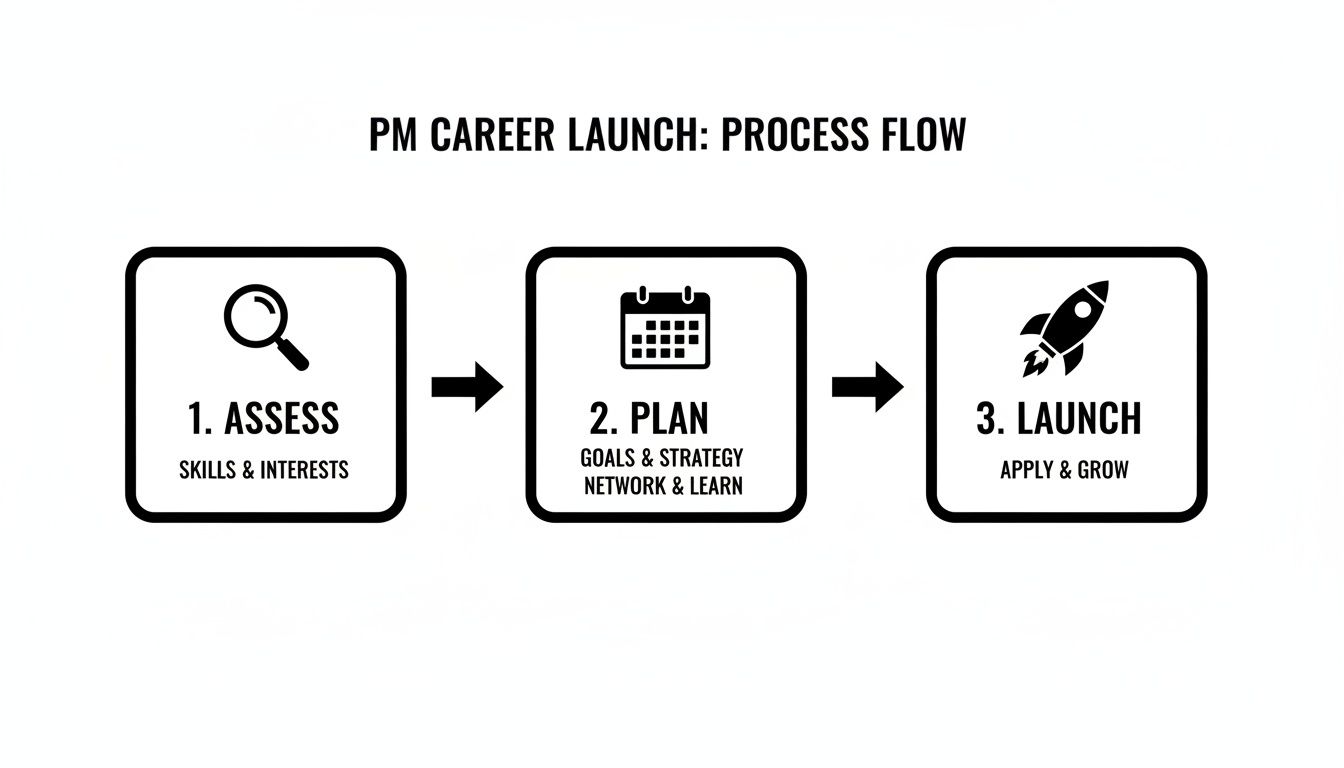
This framework forces you to start with a clear-eyed self-assessment, build a structured plan, and then execute that plan to land the role you want.
Seizing the Market Opportunity
Right now is a strategic time for breaking into product management. After market corrections, hiring is becoming more targeted and sophisticated.
Recent data shows product hiring has rebounded significantly, with a particular surge in senior-level roles—an 87% year-over-year increase. Entry-level positions are also recovering, opening a window for new talent.
The current PM job market isn’t about mass hiring; it's about strategic placement. Companies are looking for specific skill sets to solve specific problems. This means a well-defined archetype is more valuable than ever, as you can position yourself as the perfect solution to their needs.
Companies are not just filling seats; they are hunting for specific talent. If you want a more detailed look at structuring your job search, our guide on how to become a PM provides a tactical roadmap.
Build a PM Skillset That Gets You Hired
Product management is a craft. As a hiring manager, I can tell you that ambition alone is insufficient. I need tangible proof that you can think, act, and execute like a product manager—even without the official title. The most effective way to do this is by creating your own experience.
Forget waiting for permission. The best candidates I've interviewed are those who started doing the job long before they were hired. They demonstrated their product sense and execution skills through "proxy experience."

This means you must get your hands dirty. We'll walk through exactly how to build a side project, conduct a product teardown that showcases your analytical depth, or spearhead a feature launch at your current company. These aren't just resume fillers; they are the artifacts that prove you can do the work.
Create Your Own PM Experience
The "chicken-and-egg" problem of needing experience to get a job is entirely solvable with proactive effort. Here are three powerful ways to build a portfolio that gets you noticed, complete with examples from people I’ve hired.
-
Spearhead an Initiative at Your Current Job: This is the most direct path. Identify a pain point within your team and own the solution from discovery to delivery. It doesn't need to be a major software launch. For instance, a data analyst I hired automated a cumbersome reporting process, saving her team 10+ hours weekly. She documented the problem, interviewed colleagues (her "users"), defined requirements, and measured the impact. That's a perfect product management narrative.
-
Build a Side Project (No Coding Required): You don't need to be an engineer to ship a product. A candidate I hired built a solution for freelance writers entirely in Airtable and Zapier. She conducted user interviews, created simple mockups in Figma, and onboarded a small group of beta testers. This demonstrated her ability to identify a user pain point and ship a V1—core PM skills.
-
Execute a High-Quality Product Teardown: Go beyond a simple UX review. Pick a product like TikTok or a B2B tool like Notion and analyze it like a PM. One of the best teardowns I've seen didn't just critique the UI; it reverse-engineered the entire business strategy. The candidate analyzed user segments, monetization models, and engagement loops, then proposed a data-backed feature improvement with mockups and a hypothetical go-to-market plan. This showed strategic depth, not just surface-level critique.
Mastering the Core PM Competencies
Proxy experience must be built on a solid skill foundation. Focus your learning on these four non-negotiable areas, leveraging modern tools like AI project management tools to accelerate your work.
- User Research & Empathy: You must become obsessed with the "why" behind user behavior. Practice by conducting informal interviews with friends about products they love or hate. Use open-ended questions to uncover their core motivations and pain points.
- Data Analysis: You don't need to be a data scientist, but data literacy is mandatory. Learn basic SQL. Get comfortable with analytics platforms like Amplitude or Mixpanel. The goal is to translate raw data into actionable insights that inform product decisions.
- Roadmap & Prioritization: This is the art of strategic trade-offs. Learn a framework like RICE (Reach, Impact, Confidence, Effort) to justify why one feature should be prioritized over another. Create a mock roadmap for a product you know well, forcing yourself to defend your choices based on a clear business objective.
- Technical Literacy: You cannot lead an engineering team effectively without speaking their language. You don't need to code, but you must understand concepts like APIs, system architecture, and the software development lifecycle. This builds credibility and enables substantive technical discussions. Our guide offers more insight into the most crucial product manager skills required for success.
Documenting Your Work in a Portfolio
Your projects are useless if not presented compellingly. A simple portfolio—a personal website or polished PDF—should document your work using a clear, story-driven framework.
For each project, don't just show the final result. Walk the reader through your process. Start with the problem, explain your research and user insights, detail your solution and the trade-offs you made, and conclude with the impact or learning. This storytelling is what separates a good portfolio from a great one.
Here’s a simple structure to follow for each piece in your portfolio:
| Section | What to Include | Example |
|---|---|---|
| Problem Statement | A concise, user-centric description of the problem you solved. | "Freelance writers struggle to track pitches and manage follow-ups, leading to missed opportunities." |
| User Research | Key insights gathered from interviews, surveys, or data analysis. | "Interviewed 15 writers; 80% used messy spreadsheets and forgot to follow up on at least 3 pitches per month." |
| Solution & Rationale | Your proposed solution, mockups, and the reasoning behind your decisions. | "Designed a simple Airtable base to automate follow-up reminders and visualize the pitch pipeline." |
| Impact & Results | Quantifiable outcomes or key learnings from the project. | "Beta testers reported a 50% reduction in missed follow-ups and saved an average of 2 hours per week." |
Building this skillset and portfolio is your primary mission. It shifts you from being someone who wants to be a PM to someone who has already demonstrated they can do the work.
Reframe Your Resume for a PM Role
Your resume and LinkedIn profile are your primary marketing assets. When breaking into product management, they have one job: to scream "Product Manager," not "Engineer exploring a change" or "Marketer who might be a good PM."
A hiring manager spends an average of 7.4 seconds scanning a resume. You have to make the right impression immediately.
The most common mistake is listing job responsibilities. No one cares what you did. They care what you achieved. Your mission is to translate every accomplishment into the language of product, focusing relentlessly on impact, users, and business outcomes.
The Impact-Driven Resume Framework
To reframe your experience, every bullet point must answer three questions from a product perspective:
- What was the problem? (The user or business Why)
- What did you do about it? (The How)
- What happened as a result? (The measurable Impact)
This transforms your resume from a list of tasks into a powerful narrative of your product potential. It proves you already think like a PM.
Let's look at a real-world transformation.
Before (Marketing Manager):
- Managed email marketing campaigns for new product launches.
- Wrote copy for landing pages and social media.
- Collaborated with the design team on creative assets.
This is a passive list of duties that tells me nothing about your capabilities.
After (Aspiring Product Manager):
- Drove a 15% lift in user sign-ups by identifying customer pain points through A/B testing email subject lines and CTAs, leading to a revised messaging strategy.
- Improved landing page conversion by 8% by conducting user feedback sessions on copy and collaborating with UX to simplify the sign-up flow.
- Led a cross-functional launch campaign that generated $50K in initial revenue by aligning marketing, design, and sales on a unified go-to-market plan.
The "After" version is packed with PM keywords: user pain points, A/B testing, user feedback, cross-functional, go-to-market plan. More importantly, every point is anchored to a quantifiable business result.
Tuning Up Your Digital Presence
Your LinkedIn profile is as critical as your resume. Recruiters from Google, Meta, and every major startup use LinkedIn as their primary sourcing tool.
Start with your headline. "Seeking Product Management Opportunities" is weak. Frame your current role through a product lens.
- From: "Software Engineer at Acme Corp"
- To: "Software Engineer building user-centric solutions | Passionate about product management, AI, and developer tools"
This simple change instantly repositions you as someone who thinks about users and is engaged in the product world.
Your "About" section should tell your PM story. Don't just rehash your resume. Connect the dots for the reader. Explain why your specific background in engineering, design, or marketing makes you a uniquely qualified PM candidate.
Use the "Featured" section to show, not just tell. Link to your product teardowns, side projects, or case studies. This is tangible proof of your abilities. For a deep dive, check out this product manager resume template.
Finally, optimize your skills section. It's not just about listing keywords; it's about getting endorsements for Product Strategy, Roadmapping, User Research, Agile Methodologies, and Data Analysis. These keywords are what help you appear in recruiter searches. This process builds a professional brand that sends one clear message: you are ready to be a Product Manager.
Network Strategically to Land Interviews
Cold applying online is the least effective way to break into product management. It feels productive, but it's a black hole for your resume.
Having hired dozens of PMs, I can tell you a warm referral from a trusted colleague is worth more than a hundred random applications. A referral is a powerful signal that someone on my team is willing to stake their reputation on you.
In a competitive market, your network is your greatest advantage. But "networking" isn't about spamming connections. It's about building real relationships by offering value first. The goal isn't just to get an interview—it's to find advocates who will champion you internally.
The Give Before You Get Principle
The number one mistake aspiring PMs make is leading with an ask. "Can you help me get a job?" is an instant turn-off.
You must flip the script: lead with value. This is a live demonstration of your product sense. Before you connect, do your homework.
- Analyze their product. Spend an hour using it. Find one specific, thoughtful point of feedback. Where is there friction in the user journey? What small feature could impact a key metric?
- Engage with their content. Did they just write a LinkedIn post or appear on a podcast? Find a specific point they made that genuinely resonated with you.
- Research their company. What's the latest news? Did they just launch something? Form an educated opinion on their strategy.
This research is the raw material for a conversation starter that gets a reply.
Crafting Outreach That Works
Once you've done your homework, craft a message that is short, specific, and valuable. Forget generic templates.
Here’s a framework for a LinkedIn connection request that works:
Subject: Quick thought on [Product Name]'s onboarding flow
Hi [Name], I've been following your work on the [Product Name] team at [Company] and was really impressed by the recent [Feature Launch].
As a user, I noticed [specific, constructive insight about a part of the product]. It made me think about how a small tweak like [your specific suggestion] could potentially improve [a relevant metric, like activation rate].
Not looking for anything, just a fan of what you're building. Keep up the great work.
This isn't an ask; it's a gift. You're offering free product thinking and demonstrating your skills without asking for anything in return. This approach opens the door to a real conversation.
Turning Contacts into Advocates
Once connected, the next step is the informational interview. Your goal is not to ask for a job. It's to learn, build rapport, and plant a seed.
Prepare questions that go deeper than a Google search.
- "What's the most unexpected challenge your team has faced with [Recent Project]?"
- "How does your team actually measure success for the [Product Area] you own?"
- "What skill do you think is most underrated for PMs at [Company]?"
As you wrap up, your ask should be simple: "This was incredibly helpful. Based on our conversation, are there one or two other people on your team you think it would be valuable for me to talk to?"
This question turns a single contact into a node, allowing you to expand your network organically. By consistently leading with value, you create a web of advocates. When the right role opens, you won't be another applicant; you'll be the first person they think of.
Master the PM Interview Gauntlet
The product manager interview is a gauntlet designed to test your product sense, execution skills, and leadership potential. This is where your preparation culminates. As a hiring manager, I'm not looking for perfect answers; I'm testing your thought process. Can you deconstruct an ambiguous problem, articulate a user-centric vision, and defend your decisions with logic?
Deconstructing the Product Sense Interview
The classic "design a product for X" question from Google or Meta tests creativity, user empathy, and strategic thinking. Don't jump into features. Use a framework like the CIRCLES method:
- Comprehend the situation: Ask clarifying questions. Who are the users? What are the business goals? What are the constraints?
- Identify the customer: Create a specific user persona. What are their pain points and unmet needs?
- Report the customer's needs: Frame use cases as "user stories."
- Cut, through prioritization: You can't build everything. Use a prioritization framework to decide what to tackle first.
- List solutions: Brainstorm a few solutions for the highest-priority problems.
- Evaluate tradeoffs: Discuss the pros and cons of your proposed solutions. Why is one better? What are the risks?
- Summarize: Conclude with a clear recommendation and a sketch of how you'd measure success.
This structured approach shows you have a repeatable process for product thinking.
Nailing the Behavioral Questions
Behavioral questions ("Tell me about a time…") test your soft skills. Use the STAR method (Situation, Task, Action, Result) with a PM-specific spin to highlight core competencies.
Prompt: "Tell me about a time you disagreed with an engineer."
- Situation: "Our engineering lead wanted to use a new, less-tested database technology for a key feature to handle future scale."
- Task: "My responsibility was to ensure we shipped a reliable product on schedule while managing the risks of unproven tech."
- Action: "I scheduled time to understand his perspective on future-proofing our system. I then researched the new tech's adoption rates, documented potential failure points, and presented this as a shared risk assessment. I proposed a compromise: we'd use stable tech for the MVP but dedicate a future sprint to a proof-of-concept with the new technology."
- Result: "The engineer felt heard, we de-risked the launch and hit our deadline. The PoC later validated the new tech, and we migrated six months later with minimal disruption."
This answer demonstrates influence without authority, data-informed decision-making, and a win-win approach—all critical PM skills. For more, this guide to product manager interview prep has excellent resources.
Demystifying the Technical Round
For most PM roles, the technical interview is not a coding test. It's a test of technical fluency. Can you have an intelligent conversation with engineers about system design, APIs, and data models?
To prepare:
- Understand System Design Basics: Learn the high-level architecture of common apps like a social media feed or a ride-sharing service.
- Know Your APIs: Explain what an API is, the difference between REST and GraphQL, and how they enable products to communicate.
- Talk About Data: Get familiar with how data is stored (SQL vs. NoSQL) and how you might query it to answer a product question. An AI PM, for example, would need to discuss training data pipelines and model evaluation metrics.
This level of understanding builds huge credibility and proves you can be a true partner to engineering.
Remember, every interview question is a chance to showcase your product thinking. Always bring it back to the user, the business goal, and the data.
Mastering this gauntlet leads to significant financial rewards.
PM Entry Path Compensation Snapshot
A comparison of average base salaries in the US for common entry points into product management, illustrating the financial landscape for aspiring PMs.
| Role Title | Average Annual Base Salary (USD) |
|---|---|
| Entry-Level Product Manager | $79,601 |
| Associate Product Manager | $69,000–$108,000 |
| AI Product Manager (Entry) | $155,000 |
Source: Ravio.com
The data shows a clear and lucrative path to six-figure earnings early in your product career, with specialized roles like AI Product Manager commanding a significant premium.
Got Questions About Breaking Into Product?
After hiring and mentoring aspiring PMs for years, I’ve seen the same questions repeatedly. Here are direct, no-fluff answers.

Do I Need a Computer Science Degree to Become a PM?
No, a CS degree is not a hard requirement, especially for roles outside of deeply technical companies like Datadog. However, technical literacy is non-negotiable.
You must understand the fundamentals of how software is built to hold credible conversations with engineers about system architecture, APIs, and technical trade-offs.
Build this skill without a four-year degree:
- Take an accessible course. Harvard's CS50 is an excellent starting point for core concepts.
- Build a side project. Partner with a developer to experience a real build cycle.
- Lean in at your current job. Volunteer for technical projects to learn the engineering language through practice.
For AI PM roles, a stronger technical or data science background provides a significant competitive advantage. For most product roles, demonstrated literacy matters more than the degree itself.
Is a PM Certification or a Project Portfolio More Important?
The portfolio, every time.
A certification signals interest, but a portfolio proves you can do the work. I've interviewed countless certified candidates who couldn't dissect a real product problem.
A well-documented project—even a conceptual one—is tangible proof of your product sense. It demonstrates user empathy and your ability to think through a complex problem from start to finish. It provides the source material for your best interview stories.
If you must choose where to spend your time, build the portfolio. One great product teardown is worth more than five certifications on your resume.
How Do I Get PM Experience When Every Job Requires It?
You manufacture "proxy experience" by thinking and acting like a PM before you have the title.
Start within your current company. Volunteer to help with a feature launch, run user interviews for the marketing team, or analyze product usage data for insights. Frame these accomplishments on your resume using product management language.
Next, build your own experience. Use a no-code tool like Glide to create a simple app. Write a detailed teardown of a product you love (or hate). Draft a full proposal for a new feature for an app like Duolingo. Document everything in your portfolio to showcase your initiative and product thinking. Impact is impact, even on a small scale.
Is an MBA a Good Path Into Product Management?
An MBA can be an effective path, particularly for career switchers from non-tech fields like consulting or finance. Top-tier programs at Stanford or Harvard have established recruiting pipelines into Big Tech.
However, it is an extremely expensive and time-intensive option. It is not a golden ticket, and many of the best PMs I know succeeded without one by leveraging deep domain expertise, building a stellar portfolio, and networking strategically.
An MBA enhances business acumen and provides a powerful network, but it cannot replace demonstrated core product skills. As you weigh the decision, consider the ROI; understanding the typical entry-level product manager salary can help put the high cost of tuition into perspective.
At Aakash Gupta, we're here to help you master the craft of product management. Whether you're just breaking in or leveling up to a leadership role, we provide the actionable strategies you need to build a successful career. Explore our insights and join a community of top-tier product professionals.
