A product manager's career is a journey of ever-expanding influence. You start by mastering the tactical, day-to-day execution of features and grow into owning the strategic vision for a whole line of business.
The path begins as an Associate Product Manager (APM), progresses to leading complex products as a Senior PM, and can culminate in setting a company's direction as a VP or CPO. This isn't just about titles; it's about the tangible, measurable impact you create at every step. This guide provides the actionable frameworks, real-world examples, and salary data you need to navigate each stage, with a focus on the AI skills that are now table stakes for career advancement.
Your Product Manager Career Roadmap
To navigate your PM career, you need a crystal-clear map of what's expected at each level. Don't think of it as just climbing a ladder. It's more like graduating through distinct phases, where each new phase demands a higher level of strategic thinking, leadership, and business savvy. The road from an APM to the C-suite is a marathon, not a sprint, and it's defined by your ability to scale your influence from a single feature team to an entire product portfolio.
The Stages of PM Growth
Your growth is measured by the scope of your responsibility. An APM might own a single feature. A PM owns a whole product. A Senior PM owns a product area, and a VP owns an entire business line. This expansion requires a conscious effort to develop skills that go way beyond just writing user stories or managing a backlog.
To really bring this to life, the diagram below breaks down the typical hierarchy, from the user-focused entry-level roles all the way up to the strategy-driven executive positions.
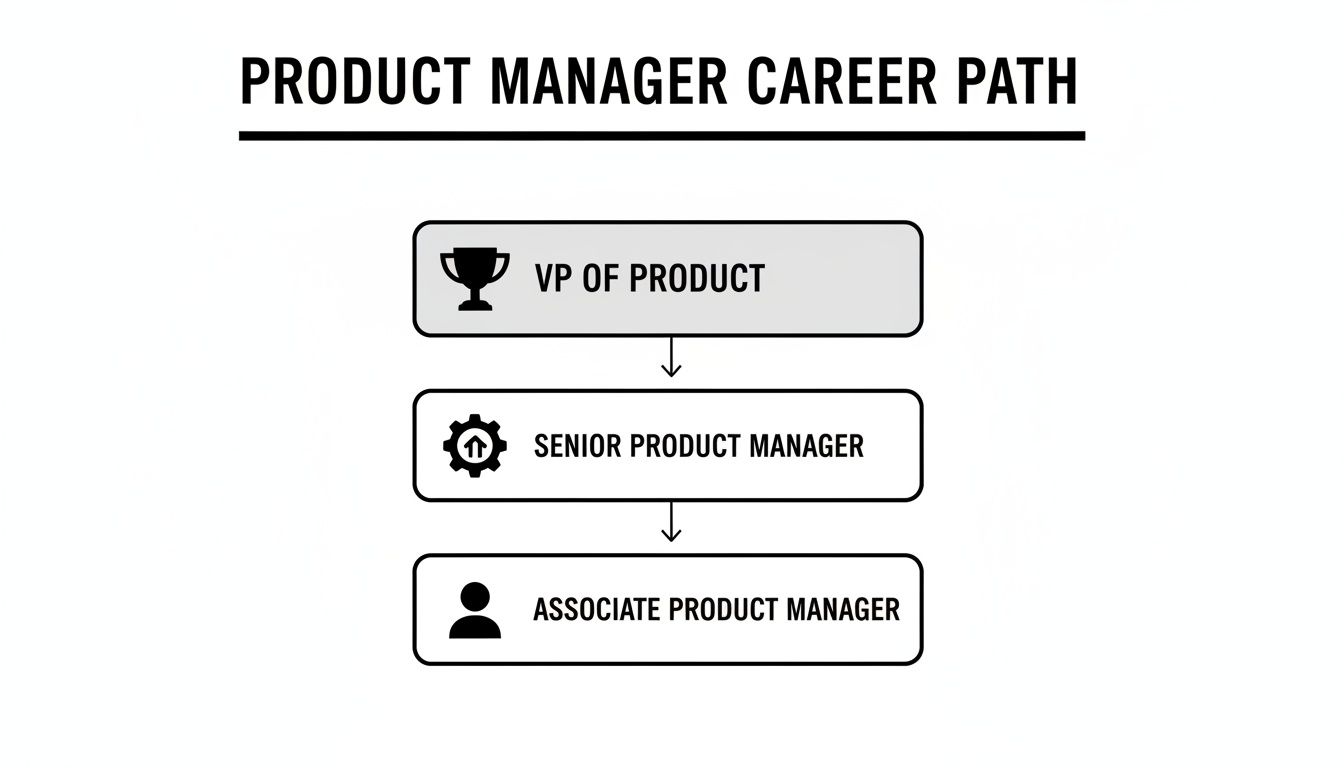
As you can see, the focus shifts dramatically. You start with direct user interaction and feature execution as an Associate PM, then move to broader strategic planning as a Senior PM, and finally to high-level business leadership and market impact as a VP.
To give you a clearer picture, let's break down the typical responsibilities, skills, and salary expectations you'll encounter at each stage of your product career.
Product Manager Career Path At a Glance
| Role Level | Core Responsibilities | Key Skills to Master | Typical Experience | Average Base Salary (US) |
|---|---|---|---|---|
| Associate PM | Manages features, writes specs, supports a senior PM. Focus is on execution and learning. | User story writing, backlog grooming, data analysis, cross-functional communication. | 0-2 years | $69,000 – $108,000 |
| Product Manager | Owns a small product or major feature set. Defines the "why" and manages the entire lifecycle. | Roadmapping, prioritization, market research, stakeholder management, basic strategy. | 2-5 years | $101,000 – $158,000 |
| Senior PM | Owns a complex product or product area. Drives strategy, mentors junior PMs. | Advanced strategy, user research mastery, business acumen, influencing without authority. | 5-9 years | $125,554+ |
| Staff/Principal PM | Leads high-impact, cross-functional initiatives. A deep individual contributor expert. | Technical depth, systems thinking, platform strategy, executive communication. | 7+ years | $156,000 – $244,000 |
| Director/VP | Manages a team of PMs and a product portfolio. Sets vision and aligns product with business goals. | People management, portfolio strategy, P&L ownership, organizational leadership. | 10-15+ years | $175,000 – $290,000+ |
This table provides a high-level overview, but remember that these numbers and timelines can vary based on company size, location, and industry. Still, it paints a clear picture of the growth trajectory.
Timelines and Compensation Expectations
It's smart to have a grasp on the time and financial commitments involved as you plan your next move. The journey from a junior role to an executive position is both rewarding and intense, often taking over a decade of hard work and non-stop learning.
The career progression in product management is a dynamic path that typically spans 10-15 years to reach leadership.
- Associate PMs start with a US base salary between $69,000–$108,000.
- After 2-5 years, they transition to mid-level PMs, earning $101,000–$158,000.
- With 5-9 years of experience, Senior PMs average around $125,554.
- Group PMs (7+ years) command $156,000–$244,000.
- This path culminates in VP ($175,000–$249,000) or CPO ($186,000–$290,000) roles after 15+ years in the field.
For more detailed compensation data, you can check out the latest product manager salary benchmarks on CPO Club.
Key Takeaway: Your salary and title are lagging indicators of your impact. Focus first on expanding your scope and delivering measurable business results—the promotions will follow. The most successful PMs are the ones who consistently operate at the next level before they officially have the title.
Think of this guide as your career GPS. Use it to pinpoint where you are right now, identify the skills you need for your next destination, and build a concrete plan to get there. The following sections will dive deep into each stage, giving you the frameworks, checklists, and insider knowledge to accelerate your journey and secure your place as a product leader.
Mastering the Foundational Years from APM to Senior PM
The journey from an Associate Product Manager (APM) to a seasoned PM is where you really earn your stripes. This is where you forge the core skills that will define the rest of your career.
Forget about grand strategy for a minute. This phase is all about mastering the craft—the day-in, day-out tactical excellence that builds credibility and earns your team's trust. Your goal is simple: become undeniably reliable.

This means you need to graduate from being an "order-taker" who just executes assigned tasks. You have to become a true feature owner, someone who can be handed a messy customer problem and see it all the way through to a successful launch. It's about building a reputation for crisp communication, meticulous execution, and a deep, genuine empathy for your users.
The First 90 Days: An Actionable APM Checklist
Your first three months can make or break your trajectory. Don't try to boil the ocean. Instead, pour your energy into these high-leverage activities to build a rock-solid foundation. This checklist is all about learning fast, building relationships, and shipping something that matters—quickly.
Month 1: Learn the Landscape (Days 1-30)
- Product Deep Dive: Get your hands dirty. Use every single feature of your product. Read all the documentation you can find, and go through the last six months of release notes to see how it's evolved.
- Meet Your Engineers: Schedule 1-on-1s with every engineer on your team. Ask them two simple questions: "What's the biggest pain point in our current development process?" and "What excites you most about what we're building?" This builds instant rapport.
- Master the Tech Stack: You don't need to code, but you do need to understand how the pieces fit together. Ask an engineering lead for a high-level system architecture diagram and have them walk you through it.
Month 2: Build Credibility (Days 31-60)
- Own the Backlog: Take full ownership of grooming the Jira or Linear backlog. Every ticket needs to be crystal clear, prioritized, and ready for development. A clean backlog is the calling card of a sharp PM.
- Write Your First PRD: Volunteer to write the Product Requirements Document for a small, well-defined feature. Obsess over clarity, focusing on the "what" and the "why," not just the "how."
- Listen to Customers: Get on at least five customer calls (sales or support). Your only job is to listen, not talk. Capture direct, verbatim quotes about user pain points.
Month 3: Deliver Your First Win (Days 61-90)
- Ship a Small Feature: Shepherd one small feature or improvement from scribbled idea to live in production. This proves you can execute end-to-end.
- Analyze the Data: Don't just ship it and forget it. Partner with an analyst to measure the impact of your launch. Understanding the data shows you care about outcomes, not just output.
- Present Your Learnings: Share the results—good or bad—with your team and key stakeholders. This demonstrates accountability and a real commitment to learning.
From Feature Owner to Product Strategist
The leap from PM to Senior PM is probably the biggest mindset shift you'll make in the early part of your career. It’s no longer enough to just flawlessly execute on features. You have to start thinking strategically about a whole product area.
The transition to Senior PM is about changing your perspective from "how can we build this feature right?" to "are we building the right features to achieve our business goals?" It's a move from execution mastery to strategic influence.
You'll know you're making this shift when you start to influence the roadmap, not just manage it. Think about a company like Spotify. A PM might own the execution of a feature within a "Squad," like a new playlist sharing function. A Senior PM, on the other hand, is expected to influence the entire "Tribe's" strategy for music discovery, connecting their squad's work to the bigger company objectives.
This requires a whole new set of muscles. You have to learn to articulate a vision for your product area, start mentoring more junior PMs, and build strong alliances with your leads in design, engineering, and marketing. Mastering the foundational product manager skills required for success is the bedrock for all of this. Your career progression hinges on proving you can think beyond the next sprint and tie your team's work directly to the company's bottom line.
Navigating the Mid-Career Fork in the Road
Once you’ve hit your stride as a Senior Product Manager, you'll find yourself at a major crossroads. This is a classic inflection point in a product manager's career. The path forward isn't a straight line anymore; it splits into two very different, very high-impact tracks. It’s less about climbing the next rung on the ladder and more about making a conscious choice about where you want to go, based on what you're truly great at and what you want your future to look like.
You have to decide: do you want to become a master of your craft as an individual contributor (IC), or do you want to multiply your impact by leading people? This isn't just about a new title—it’s a fundamental change in how you deliver value to the company.

This decision will literally set the course for the next decade of your work life. Picking the wrong path can lead to serious frustration and burnout. But aligning your career with your natural talents? That’s where you’ll find incredible growth and a deep sense of satisfaction.
Path 1: The Individual Contributor Expert
The first option is the IC path, which leads to titles like Staff PM or Principal PM. Think of this as the master craftsperson track. It’s for PMs who live to solve the company's gnarliest, most ambiguous, and technically dense problems. You don't manage people; you manage problems that no one else can crack.
Picture a Principal PM at Google who’s been tapped to spearhead a brand-new AI platform from the ground up. Their job is to wade into extreme uncertainty, define the entire technical and product strategy for a foundational service, and influence dozens of engineering and product teams—all without any direct reports.
The Principal PM is a force multiplier. They don't scale through a team; they scale through their deep expertise, systems thinking, and ability to steer massive, cross-functional initiatives toward a successful outcome. Their influence is their primary currency.
This path is perfect if you thrive on deep, hands-on product work and want to stay close to the metal, the code, and the user problems. Your success is measured by your knack for delivering groundbreaking products and shaping the company's long-term technical direction.
Path 2: The People Leader
The second route is the management path, taking you to roles like Group Product Manager or Director of Product. Here, your world shifts entirely. You stop building products and start building the teams that build products. Your main job is no longer the product backlog; it’s hiring, coaching, and developing a killer team of PMs.
A Director at Meta, for instance, isn't just shipping a single feature. They're setting the vision for an entire product area, like all of Instagram's creator monetization tools. Their day is filled with navigating tricky stakeholder politics, divvying up resources across multiple squads, and making sure their team's roadmap plugs into the bigger company goals.
This leap requires a totally different set of skills. You have to get great at:
- Hiring and Talent Development: Finding, attracting, and growing top-tier product talent.
- Setting Vision: Creating and selling a compelling, multi-squad product vision that gets your team fired up.
- Organizational Navigation: Building alliances, fighting for budget, and being the face of your product area in front of executive leadership.
This path is for people who get a genuine buzz from mentoring others and find fulfillment in watching their team win. To learn more about this shift, check out my thoughts on becoming more of a generalist leader. It's no longer about your solo contributions; it's all about the collective output of your team.
Making Your Choice: A Decision Framework
Choosing between these two paths is one of the biggest calls you'll make in your product career. To get it right, you need to be brutally honest with yourself. Forget which title sounds fancier. Think about what truly gives you energy and where you consistently shine.
Use this simple decision tree to guide your thinking:
- Where do you get your energy? Is it from wrestling with a complex user problem all by yourself (IC)? Or from coaching a junior PM through a tough stakeholder meeting (Leader)?
- What feedback do you get? Do people praise your brilliant product insights and killer strategy docs (IC)? Or do they rave about your ability to mentor others and build consensus (Leader)?
- What work would you miss most? Would you miss that deep satisfaction of shipping a feature you personally spec'd out (IC)? Or would you be happy to let that go to focus on team strategy and career paths (Leader)?
Your answers will point you toward the path where you’re most likely to flourish. Both are valuable, respected, and lucrative tracks for a successful career, but they demand different superpowers. Choose the one that best matches yours.
Ascending to the Executive Ranks of VP and CPO
The leap from Director to Vice President of Product is probably the most dramatic shift in a product manager's entire career. Seriously, it's a whole different ballgame. You're no longer just leading a team to ship a great product line; you're architecting an entire product organization and owning its slice of the company's P&L.
This is the point where you trade in your roadmap presentations for board meetings. The questions you grapple with change completely. It’s less about "What should we build next?" and more about "Where should we bet our next $10 million in R&D to win the market?"
At this level, your primary product is the business. You're not managing a portfolio of features; you're managing a portfolio of investments.
The Core Competencies of Executive Product Leadership
Making this jump isn’t an accident. It requires a deliberate rewiring of your skills, shifting from tactical execution and team leadership to strategic business ownership. The competencies that make a great VP or Chief Product Officer (CPO) are fundamentally different from those that got you to the Director level.
Your world boils down to three critical arenas:
- Portfolio and P&L Management: You're on the hook for the financial performance of your products. This means setting revenue targets, managing budgets, and making the tough calls on which products to fund, maintain, or kill based on their contribution to the bottom line.
- Organizational Design: You stop building product teams and start designing the whole product organization. This is about defining roles, carving out career paths, setting up reporting structures, and building a culture that top talent flocks to. Your job is to build the engine, not just drive the car.
- Board-Level Communication: You become the chief storyteller for the product vision, but your audience is now the board, investors, and the C-suite. You have to distill complex product strategies into crisp, compelling narratives that clearly connect what you're building to shareholder value.
A Director makes sure a product line wins. A VP makes sure the entire product business wins. One is about product-market fit; the other is about strategic capital allocation and organizational design.
From Management to True Leadership
This transition is the ultimate test of moving from management to leadership. A Director manages teams and processes. A VP, on the other hand, leads the entire organization through ambiguity and inspires everyone to commit to a long-term vision. Getting the nuance between these two is critical. To dig deeper, check out the key distinctions between leadership vs. management; it’s a framework that can really help shape this evolution.
For any PM with their eye on the exec suite, mastering strategic frameworks is non-negotiable. Concepts like strategic goal setting with OKRs for founders become second nature, giving you the machinery to align the entire product org around measurable business outcomes.
Case Study: The CPO as a Strategic Influencer
Think about any well-known CPO at a public tech company. If you trace their career, you'll see a pattern: they actively sought out roles with more and more P&L responsibility. They didn't just climb the product ladder; they strategically took on general manager roles or positions that forced them to own a complete business unit.
Listen to how they talk in public or in shareholder letters. They almost never talk about features. They talk about market trends, competitive moats, total addressable market (TAM), and capital efficiency. They've built a powerful personal brand not as a "product person," but as a "business leader who runs product."
That's the blueprint. To get to the C-suite, you have to prove you can be trusted with a big piece of the company's future, not just a product. Your network and personal brand become the tools you use to signal that capability and land those top-tier roles.
Future-Proofing Your Career with AI Product Management
Let's be blunt: AI literacy has gone from a "nice-to-have" to a "must-have" for any product manager who wants to stay relevant. If you're not actively folding AI into how you work, you're already falling behind. This isn't about learning to be a machine learning engineer overnight. It's about learning how to wield AI as a powerful tool to build better products, faster.
Your plan to get up to speed can't be some vague idea for "later." It needs to be concrete, and you need to start now. The best place to begin is with the fundamentals. A great first step is Coursera's "AI for Everyone" by Andrew Ng (the subscription is around $49/month). It’s designed to demystify AI for non-technical pros, giving you the vocabulary to have intelligent conversations with your engineering team.

Gaining Hands-On AI Experience Now
Reading about AI is one thing, but rolling up your sleeves and using it is where the real learning happens. You don't need to wait for a new job to do this. You can start today.
- Speed Up Research with AI Tools: Use tools like Perplexity AI to digest market research or crank out a competitor analysis in minutes, not hours.
- Draft User Stories with Prompts: Turn to ChatGPT to generate initial user stories. A simple prompt can get you 80% of the way there: "Act as a product manager. Write three user stories for a new mobile banking app feature that allows users to set savings goals. Include acceptance criteria for each."
- Volunteer for AI Projects: See an AI-related initiative at your company? Raise your hand. Even if it’s small, this kind of hands-on experience is gold on your resume and shows you're serious about the future.
AI is the new technical stack. A PM who can't speak intelligently about LLMs, vector databases, or prompt engineering will be at a severe disadvantage within the next 24 months. Mastering these concepts is as critical as understanding APIs was a decade ago.
The job market for PMs is shifting. While overall tech hiring has cooled, LinkedIn data still showed a 30% annual increase in recent years, with a noticeable trend toward promoting from within. This means the best way to move up is to become indispensable where you are. Volunteering for strategic projects—especially in AI—gives you a massive leg up on external candidates. Given that 33% of PMs have less than 4 years of experience, specializing in a high-demand area is the fastest way to stand out. You can read more about these PM job market trends on Noble Desktop.
Targeting High-Demand PM Specializations
Once you start building your AI knowledge, think about where you want to specialize. A few PM roles are seeing explosive demand and come with a serious salary bump.
AI Product Manager: This is, without a doubt, the hottest specialization right now. Just look at job postings from places like OpenAI or Anthropic. They're hunting for PMs who can navigate technically ambiguous problems, truly understand what the models can (and can't) do, and translate bleeding-edge research into products people can actually use. For a deeper dive, check out our guide on the fundamentals of AI Product Management.
Growth Product Manager: At companies like Duolingo or DoorDash, Growth PMs live and breathe metrics like user acquisition, activation, and retention. They are masters of experimentation—constantly running A/B tests and digging into data to find ways to optimize the user journey and move the needle on business goals.
Platform Product Manager: This is a deeply strategic role you'll find at tech giants like Meta and Google. Platform PMs don't build features for external customers; they build the internal tools, APIs, and services that other product teams rely on. Their "customers" are their fellow developers, and their success is measured by the leverage and efficiency they unlock for the entire company. This path demands strong systems thinking and a solid technical foundation.
How to Secure Your Next Promotion or Role
Ambition gets you started, but tactical execution is what actually lands you the next title. Whether you're chasing an internal promotion or making a strategic leap to a new company, you need to build a clear, data-backed case for why you're the right person. This isn't about crossing your fingers and hoping for the best; it's about building an undeniable argument.
For internal moves, your secret weapon is the ‘brag document’. Think of this as a living log of your accomplishments where you consistently track what you've done, tying every win directly to a business KPI. This simple habit turns vague contributions into measurable, impossible-to-ignore impact.
Instead of, "I led the redesign of the checkout flow," you frame it as, "I led the redesign of the checkout flow, which cut cart abandonment by 12% and added a $1.2M lift in annualized revenue in Q3."
This document becomes the rock-solid foundation of your promotion case. For a deeper dive into building this kind of evidence-based argument, I've laid out the whole process in my guide on how to get promoted.
Crafting Your External Pitch
When you're looking outside your current company, your resume and LinkedIn are your billboards. They need to scream results, not just list responsibilities.
- Resume Template: Every single bullet point should follow a simple formula: "Achieved [Metric] by doing [Action]." For instance, "Boosted user engagement 25% by launching a personalized recommendation engine."
- LinkedIn Optimization: Your headline is your value proposition, not just your job title. Ditch "Senior Product Manager at Company X" for something like, "Senior Product Manager | Driving Growth for B2B SaaS Products | AI & Machine Learning."
As you map out your next move, understanding strategies for creating a strong personal brand is absolutely essential for standing out in a crowded field.
Mastering Salary Negotiations and Interviews
Smart negotiation always starts with data. In the US, a Junior Product Manager can expect a base salary around $79,601. This jumps to $125,554 for senior roles and all the way to $182,000 for Directors. Keep in mind, total compensation is often much higher, with 44% of PMs getting bonuses. Knowing these numbers gives you a powerful anchor for your salary talks.
Finally, you have to nail the interview, and that means mastering structured storytelling. For a classic question like, "Tell me about a product you launched," use the STAR method:
- Situation: Quickly set the scene and explain the business context.
- Task: What was the specific goal you were tasked with?
- Action: Detail the concrete steps you personally took to tackle the challenge.
- Result: Quantify the outcome with clear, impressive numbers.
For today's AI-focused roles, get ready for strategy questions about model selection, data moats, and the ethical side of your product. This shows you're not just executing on features—you're a forward-thinking product leader who understands where the industry is headed.
Your Product Manager Career Questions Answered
We’ve mapped out the climb from APM to CPO, but let's be real—the day-to-day journey is full of specific, tricky questions. So, let’s get into the nitty-gritty. Here’s some direct, actionable advice pulled from years in the trenches at top tech companies.
How Long Should I Stay in a PM Role Before a Promotion?
Forget the clock. Focus on impact.
While you’ll often hear 18-24 months tossed around as an industry benchmark, the real signal for a promotion is when you're consistently performing at the next level. Are you shipping products that are actually moving business metrics in a big way? Are you already leading projects with the scope and complexity a Senior PM would typically handle?
When you can build a strong, data-backed case that you've outgrown your current title, that’s your moment. Your promotion packet shouldn’t be a request; it should be an undeniable summary of the value you're already delivering.
Is an MBA Necessary to Reach a Director or VP Level?
Short answer: Nope. An MBA is not the golden ticket to the C-suite it once was.
It can be a great tool for networking or for someone switching careers entirely, but it's absolutely not a prerequisite for leadership. Top-tier companies like Google and Meta care far more about your track record of shipping successful products and leading teams than they do about a specific degree.
Investing your time in building deep domain expertise—especially in hot areas like AI—and honing your ability to influence strategy will almost always give you a better ROI for your career.
What Is the Most Critical Skill for Senior Leadership?
If I had to pick just one, it’s strategic influence.
As you climb higher, your job morphs from managing backlogs to shaping the entire product direction. This means you have to master the art of telling compelling stories with data, rallying executives around a vision, and getting buy-in without ever needing to pull rank.
It’s the subtle skill of making everyone in the room feel like your brilliant idea was also their own. That’s what truly separates a senior-level doer from a genuine product leader.
Ready to accelerate your career with insider knowledge from a seasoned product leader? Subscribe to the Aakash Gupta newsletter and podcast for exclusive insights on product growth, strategy, and landing your dream job. Join the community at https://www.aakashg.com.
