Let’s cut straight to the chase. When I'm hiring, the difference is crystal clear. The Product Manager (PM) is the strategic owner of the product's market success. They're obsessed with the ‘why’—identifying the right customer problem to solve to drive revenue and growth. The Product Owner (PO) is the tactical owner of the development backlog. They master the ‘how’ and the ‘when,’ translating the PM’s vision into executable work for the engineering team.
One builds the business case; the other builds the product. Understanding this distinction is non-negotiable for advancing your product career.
The Decisive Difference: A PM Leader's Framework
The PM vs. PO confusion is everywhere, mostly because their roles can and do overlap, especially in smaller companies. But at scale—think Google, Meta, or any company serious about product—their core functions are distinct. Here’s the framework I use to mentor my teams: the PM sets the destination (e.g., "Increase user retention by 15% in the next six months"), while the PO is in the car with the engineering team, providing the turn-by-turn directions from the backlog to get there.
Product Owners are deep in the weeds of tactical execution. Their world revolves around the development team’s sprint cadence, grooming the backlog in Jira, and hitting sprint goals. Product Managers operate at a higher altitude, working with senior leadership on the P&L, defining the long-term product vision, and defending the roadmap. For more on how these roles play out, check out this piece from BairesDev.com.
Core Differences PM vs PO at a Glance
To cut through the noise, here's a side-by-side breakdown I share with new hires to clarify ownership from day one. This table breaks down the fundamental split between their domains.
| Dimension | Product Manager (Strategic) | Product Owner (Tactical) |
|---|---|---|
| Primary Goal | Define the product vision and ensure it solves customer problems while meeting business objectives (e.g., P&L, market share). | Maximize the value delivered by the development team each sprint. |
| Key Artifacts | Product Roadmap, Business Case, Market Requirements Document (MRD), Go-to-Market (GTM) Plan. | Prioritized Product Backlog, User Stories, Sprint Goals. |
| Core Tools | Amplitude, Looker, Gong, Aha!, PowerPoint/Google Slides. | Jira, Confluence, Miro, Slack. |
| Success Metrics | Revenue, Market Share, Customer Lifetime Value (CLV), Net Promoter Score (NPS), P&L. | Team Velocity, Sprint Burndown Rate, Cycle Time, Delivered Story Points. |
| Primary Question | "Are we building the right thing to win the market?" | "Are we building the thing right, according to spec?" |
This table gives you the high-level theory, but visuals often make it click.
This infographic really drives home the separation of focus, metrics, and day-to-day interactions between the two roles.
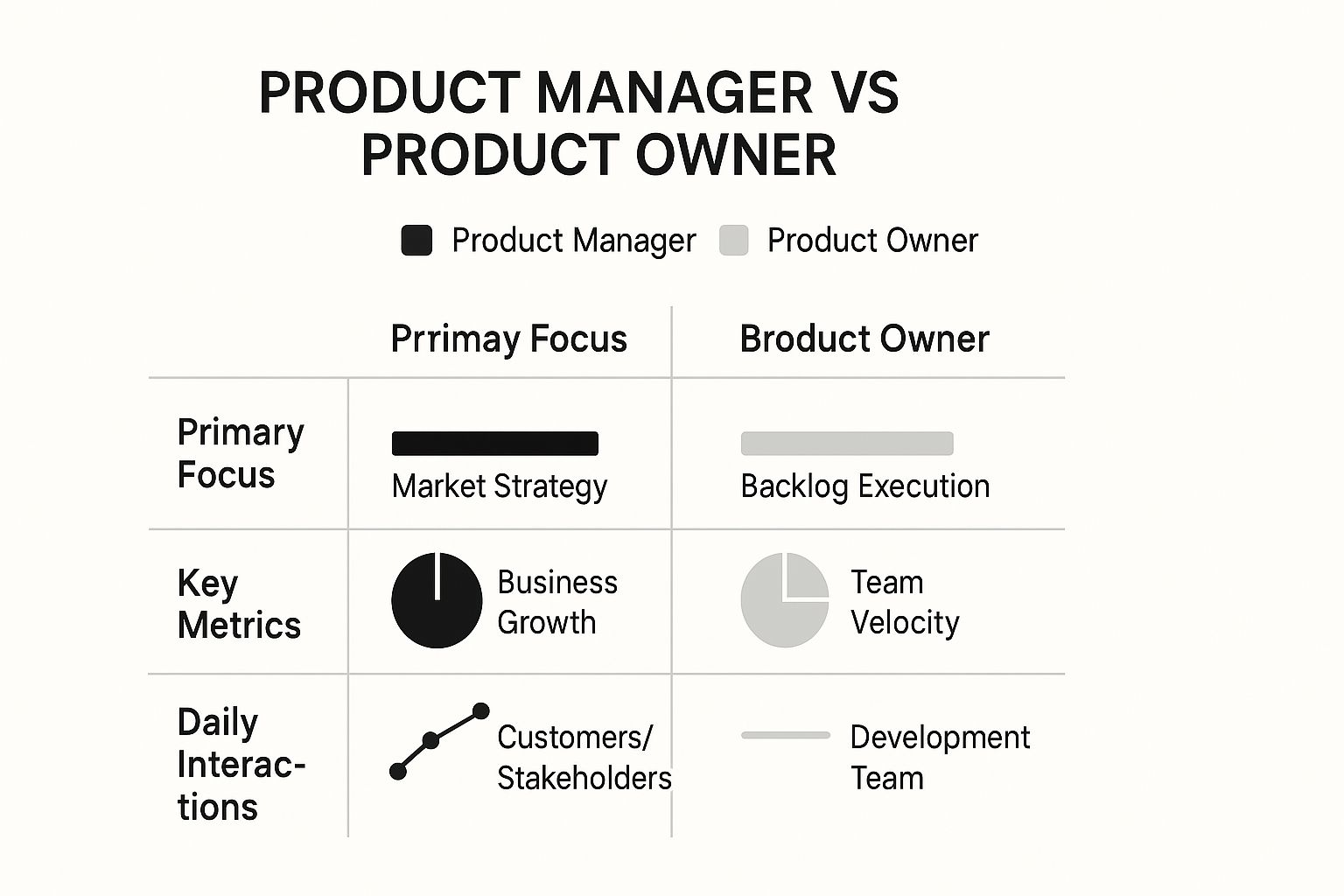
You can see the PM’s world is oriented outward, toward the market and company strategy. The PO’s world is laser-focused inward, on the development team and the immediate work at hand. It's a partnership, but one with very distinct responsibilities.
A Day in the Life of a PM and PO
Let’s move past the theory. The best way to understand the difference between a Product Manager and a Product Owner is to look at their calendars. Here's a real-world snapshot from a Tuesday at a fast-moving SaaS company I advise. It’s not just about the titles; it’s about the rhythm and focus of their day.
This tangible, day-to-day contrast shows you exactly where their energy goes and how their roles play out in the real world.
The Product Manager’s Day: Strategic Outlook
A Product Manager’s day is a constant balancing act between the external market and internal stakeholders. Their schedule is often intentionally fluid to accommodate deep thinking and unexpected customer calls that can change a quarter's strategy.
Here’s a typical day:
- 9:00 AM: Deep dive into product analytics in Amplitude to analyze the adoption funnel for last week’s feature launch. Goal: Identify drop-off points and formulate a hypothesis for an A/B test.
- 10:30 AM: Join a sales call with a major enterprise prospect. Purpose: Listen for objections, understand competitive pressures, and gather intel for the next business case.
- 1:00 PM: Conduct a one-on-one user interview with a power user to validate a hypothesis for the Q3 roadmap.
- 3:00 PM: Sync with the marketing team to align on the go-to-market plan for the next major release.
- 4:30 PM: Update the quarterly product roadmap in Aha! and draft a summary for the executive team, tying the plan back to revenue targets.
The PM’s day is defined by massive context-switching. They jump from data analysis to customer empathy to executive-level communication, all before signing off.
The Product Owner’s Day: Tactical Execution
On the flip side, the Product Owner’s day is deeply embedded in the development team’s sprint cadence. Their schedule is far more structured, built around the Agile ceremonies that keep engineering on track. To really get it, you should explore what it means to define the Product Owner role and their core duties.
A PO's day looks more like this:
- 9:15 AM: Lead the daily stand-up. Listen for blockers and clarify acceptance criteria for user stories in the current sprint.
- 10:00 AM: Run a backlog refinement session. Break down epics into well-defined user stories in Jira, ensuring each has clear acceptance criteria and is estimated by the team.
- 1:30 PM: Conduct a desk-side demo with a developer to validate a newly completed feature against the acceptance criteria before it moves to QA.
- 3:00 PM: Huddle with the lead engineer and UX designer to review technical feasibility and user flows for stories planned for the next sprint.
- 4:00 PM: Remain active in the engineering team’s dedicated Slack channel, answering clarifying questions to unblock developers in real time.
A simple way to see the difference is by looking at their primary tools. The PM lives in Amplitude, Gong, and PowerPoint. The PO practically sleeps in Jira, Confluence, and Slack. Their toolset is a dead giveaway of their core focus.
While the Product Manager is constantly asking, "Are we building the right thing?" the Product Owner is relentlessly focused on, "Are we building the thing right?" This distinction, reflected in their daily grind, is the clearest indicator of how each role contributes to a product's success.
Owning the Market vs Owning the Backlog
The cleanest way to slice the difference between a Product Manager and a Product Owner is to look at what they own. It really boils down to one owning the problem space (the market) and the other owning the solution space (the backlog).
Once you get that distinction, everything else about how these two roles operate—and why they’re both essential—just clicks into place.
The Product Manager Owns the Market
The Product Manager is on the hook for the product's P&L and market success. They are obsessed with the external world: customers, competitors, and the overall business case that justifies the team's existence.
PMs live and breathe the market. Their key deliverable is the product roadmap, a strategic document that outlines where the product is headed and why it will win. A huge chunk of their time is spent wrestling with the big questions, like which major initiatives will actually move the needle for the business. This is a tough, ongoing process you can learn more about in guides on how to prioritize a roadmap.
Ultimately, a PM is responsible for making sure the team is building something people will pay for. Their world is filled with outward-facing activities that define the why and the what:
- Customer Discovery: Conducting user interviews and analyzing market data to find unmet needs.
- Market Analysis: Tracking competitors, identifying industry trends (like the impact of new AI models), and sizing up new opportunities.
- Business Case Development: Building financial models, forecasting revenue, and securing budget for new initiatives.
- Stakeholder Alignment: Selling the vision to executives, sales, and marketing to ensure company-wide buy-in.
The PM’s success is measured by hard business metrics: revenue growth, market share, and customer retention. Think of them as the CEO of the problem.
The Product Owner Owns the Backlog
The Product Owner, on the other hand, is accountable for maximizing the value delivered by the development team. They own the solution space, translating the PM’s strategic vision into a concrete, sprint-by-sprint plan. Their world revolves around the product backlog.
Their days are internally focused, working shoulder-to-shoulder with the dev team. A massive part of this is Mastering the Art of Writing User Stories so that every task is crystal clear to the engineers who have to build it.
The PO’s core activities are all about execution:
- Translating Vision into Tasks: Breaking down large roadmap epics into small, well-defined user stories with clear acceptance criteria.
- Backlog Prioritization: Continuously grooming and reordering the backlog to ensure the dev team is always working on the highest-value items.
- Clarifying Requirements: Acting as the single source of truth for the engineering team, answering every question about user stories and acceptance criteria.
- Accepting Completed Work: Reviewing finished work to ensure it meets the definition of done and truly solves the user's problem.
A PO’s success is measured by the team's output and efficiency. You’re looking at things like team velocity and whether they consistently hit their sprint goals.
A common refrain I use with my teams is this: "The PM ensures we build the right product; the PO ensures we build the product right." This simple phrase captures the essence of their distinct yet symbiotic relationship.
How Company Structure Defines the Roles
The clean separation between a Product Manager and a Product Owner often gets blurry in the real world. That textbook definition gets bent by a company’s size, its stage of growth, and its Agile maturity. There's no one-size-fits-all model here. Context is everything.
At a Series A startup, a single person is almost always playing both roles. One morning, this "Product Person" is deep in strategic market analysis; that afternoon, they’re writing user stories for the engineering team. The focus is pure survival, making specialization a luxury.
But as a company scales, this combined role quickly becomes a massive bottleneck. One person cannot effectively manage long-term strategic discovery and the daily tactical needs of a growing engineering team. This is the breaking point where the roles must split.
The Enterprise Model at Scale
Now, jump over to a large, mature organization like Google or Atlassian. A Group Product Manager might own an entire product line, say "Jira Software." Reporting to them are several PMs, each owning a specific feature area like "Boards" or "Reporting."
Each of those PMs then partners with one or more Product Owners. Every PO is embedded with a single Scrum team, their entire job being to translate the PM's strategic roadmap for "Boards" into a perfectly prioritized backlog. This layered structure allows the organization to scale. For a deeper look into how leadership shapes these roles, check out these insights from a Chief People Officer on role definition.
Job Descriptions Tell the True Story
The clearest proof of this divide is in the job postings. Let’s look at two recent, real-world examples:
-
HubSpot Product Manager (Go-to-Market): A recent posting emphasized skills like "building business cases for new market entry," "conducting pricing and packaging analysis," and "developing go-to-market strategies." The focus is purely commercial and strategic.
-
Atlassian Product Owner (Jira Platform): A posting for a similar-level role demanded "deep expertise in Scrum and Agile methodologies," "experience managing a backlog for a team of 8+ engineers," and "proficiency in writing detailed technical user stories in Jira." The focus is entirely on team-level execution.
The keywords in the job description are your best guide. If you see "market share," "P&L," and "business case," you're looking at a Product Manager role. If you see "sprint planning," "velocity," and "acceptance criteria," it’s a Product Owner role.
This distinction isn't just academic; it's critical for your career. Knowing how to tailor your resume—highlighting strategic impact for PM roles or execution excellence for PO roles—will make all the difference in landing your next opportunity.
Career Paths and Salary Expectations
When you're mapping out a career in product, you have to think about the long game. Where does this path lead? What's the real earning potential? The trajectories for Product Managers and Product Owners are fundamentally different, and knowing this upfront is crucial for aligning your career with your ambitions.
Let's talk numbers. The salary gap between a PO and a PM shows up early and widens over time. Based on recent market data from sites like Glassdoor and Levels.fyi for the US market:
- Product Owner (Mid-Level): Average base salary around $115,000.
- Product Manager (Mid-Level): Average base salary around $140,000.
At the senior level at a top tech company like Meta or Google, a Senior PM's total compensation can easily exceed $300,000, while a Senior PO's compensation is typically lower. This isn't an accident. The market places a premium on the PM's direct responsibility for business outcomes.
Average US Salary Comparison PM vs PO
Here’s a breakdown of what you can expect at different stages of your career. Notice how the gap grows with seniority. This data reflects base salary ranges and can be higher with equity and bonuses.
| Experience Level | Product Manager Salary Range (Base) | Product Owner Salary Range (Base) |
|---|---|---|
| 0-3 Years | $95,000 – $125,000 | $85,000 – $110,000 |
| 4-7 Years | $125,000 – $160,000 | $110,000 – $135,000 |
| 8+ Years | $160,000+ | $135,000+ |
As you can see, both paths offer solid earning potential, but the ceiling for Product Managers is significantly higher, reflecting the direct line to business ownership and strategic impact.
Product Owner Career Progression
The Product Owner's career is built on a foundation of flawless execution. Growth means becoming a master of turning ideas into shipped software.
A typical PO ladder looks something like this:
- Senior Product Owner: Manages a more complex product, a portfolio of backlogs, or mentors junior POs.
- Agile Coach: Moves from guiding one team to coaching the entire organization on Agile best practices.
- Transition to Product Manager: A common and highly successful pivot. A PO's deep understanding of the development process is a huge asset. If you're considering this, it's worth digging into how to become a PM.
Product Manager Career Progression
The Product Manager track is a straight shot toward business leadership. Your success is tied to market outcomes, paving the way for a seat at the executive table.
A Product Manager’s career is a journey from owning a feature, to owning a product, to owning a portfolio of products, and finally, to owning the entire product organization. Each step requires a greater command of business strategy.
The PM career ladder is steep and points directly toward the C-suite:
- Senior Product Manager: Owns large, ambiguous problem spaces with major business impact.
- Director of Product: Manages other PMs and guides the strategy for a major product line.
- VP of Product / Chief Product Officer (CPO): Sets the product vision and strategy for the entire company.
The core difference is clear. The PO path develops deep expertise in how to build products right. The PM path develops expertise in what products to build to win.
Common Questions About PM and PO Roles
The lines between Product Manager and Product Owner can get blurry, and that ambiguity often sparks the same set of questions. I get these all the time from product folks trying to figure out their teams and careers. Here are the answers I give to help cut through the confusion.
Can One Person Be Both a Product Manager and a Product Owner?
Yes, and it’s incredibly common in early-stage startups where one person has to wear multiple hats. A single product leader finds themselves jumping from high-level market strategy one minute to the nitty-gritty tactical needs of the dev team the next.
But this hybrid role has an expiration date. As a company scales, managing the backlog and running sprint ceremonies becomes a full-time job. To prevent burnout and ensure both strategy and execution get the attention they deserve, splitting the job into two distinct PM and PO roles becomes essential for growth.
Who Does the Product Owner Report To?
There’s no single answer here. The PO's reporting structure depends on the company's org chart. However, a few common patterns emerge:
In many product-led organizations (like Atlassian), the Product Owner reports to a Product Manager or Group Product Manager. This creates a clear hierarchy, ensuring the PO’s tactical execution is tightly aligned with the strategic vision. In other, more engineering-driven companies, the PO might report to an Engineering Manager to keep them woven directly into the development process.
Is a Product Owner a Good Entry-Level Role to Become a Product Manager?
Absolutely. The Product Owner role is one of the best training grounds for a future in strategic product management. It’s an immersive, hands-on education in the mechanics of building software.
As a PO, you get a deep dive into:
- Working with engineers: You learn their language, their workflows, and how to translate customer problems into technical requirements.
- Backlog management: You master prioritization and dependency mapping in tools like Jira.
- The Agile process: You live and breathe sprint planning, stand-ups, and retrospectives.
Many of the best PMs I've ever hired came up through the PO ranks. They built an unshakable foundation in execution before expanding their scope to the market-facing, strategic work of a Product Manager.
Which Role Is More Technical?
Day-to-day, the Product Owner role is almost always more technically engaged. They are the primary link to the engineering team and must be comfortable discussing implementation details, understanding technical constraints, and writing user stories with sharp, often technical, acceptance criteria.
A Product Manager needs to be technically literate—enough to understand what’s possible and have credible discussions with engineering leaders. A Product Owner needs to be technically fluent—enough to answer a developer's detailed question about a specific user story on the spot.
While a PM has to understand the technical implications of their roadmap, the PO is the one swimming in the technical details of execution every single day. That distinction is key to understanding where each role focuses their energy.
Ready to level up your product career with proven frameworks and real-world advice? I provide the in-depth content you need to go from an aspiring PM to a product leader. Explore the newsletter and podcast today.
