Check out the conversation on Apple, Spotifyand YouTube.
What Are Gemini Gems? (0:00)
Aakash: You created Gemini Gems, Lisa. What are they? How would you describe them?
Lisa: Gemini Gems are custom versions of Gemini that you can create for your specific use case. Everybody knows that LLMs today are really powerful. But the key problem that they all have is that they lack context. What ends up happening is that as people use these LLMs repeatedly, they’re just entering in the information that’s needed to make sure that the LLM gives the right answer, whether it’s your role, your company’s strategy, your writing style, the history of your product. Having to type this in again and again is a little bit of a pain.
You can think of Gemini Gems as the difference between a general contractor versus a master craftsman. Standard Gemini or standard LLMs are kind of like your general contractor. They’re super powerful, really capable, but you’re going to have to give them detailed instructions every time you hire them, and you have to give them your project’s blueprints. Compare this to the Gemini Gem. It’s kind of like a specialist, your master craftsman. It already knows everything about your house, understands your preferences, understands where all those little pieces of your furniture are. So when you ask it for something, it can craft the exact thing for you without having to be retold all of the basics.
Gemini Gems hold all of your context, keep your personalised tone and style, and are really tailored to your specific use case. The important thing is you can create so many different ones. People have been talking about a personal CTO. You can create a coding gem, a writing style gem.
The 3 Must-Have Gems for Every PM (3:47)
Aakash: What are the most important gems for product managers to create?
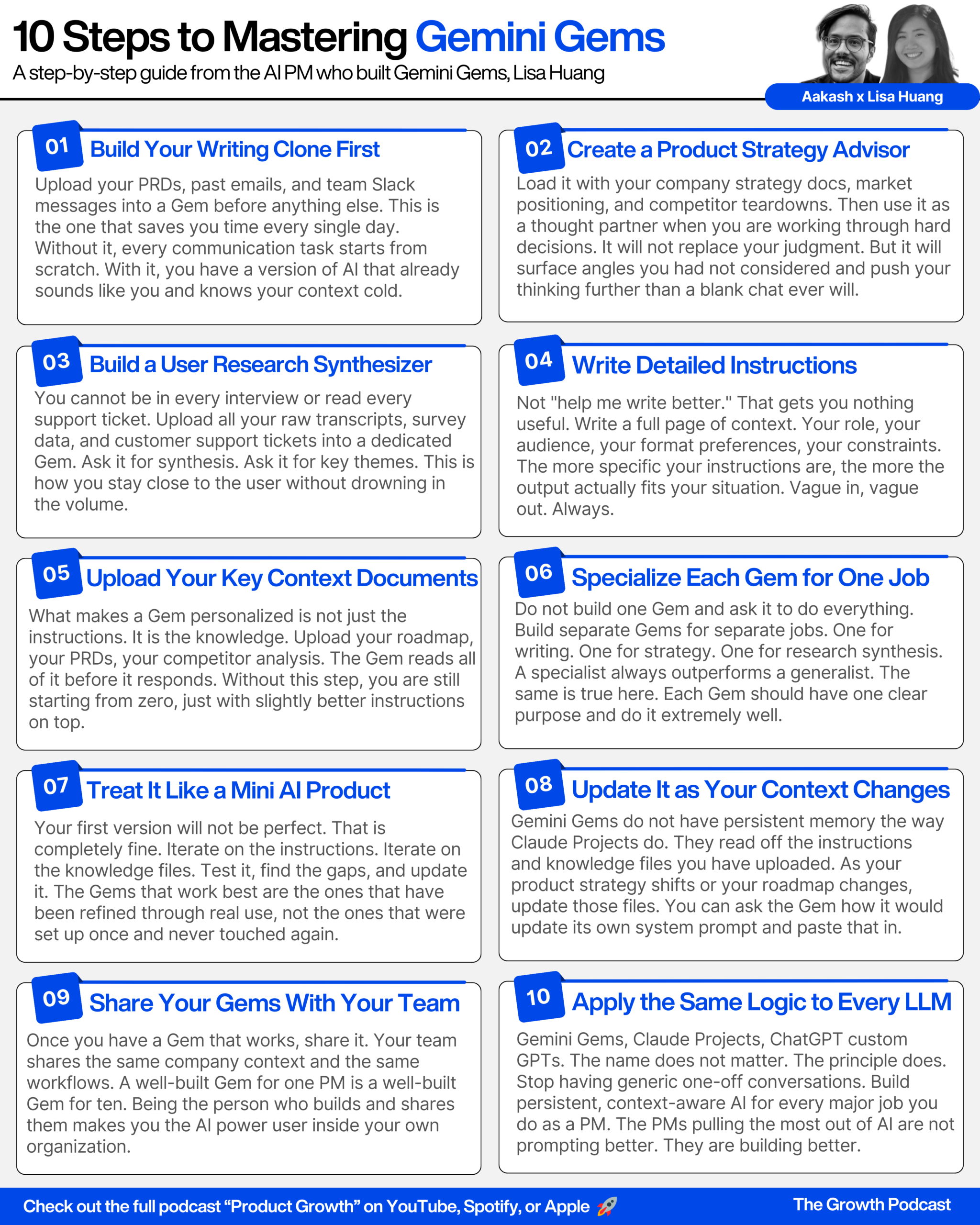
Lisa: I think there are 3 must-have gems for every product manager. Let’s call them the writing clone, the product strategy advisor, and the user research synthesiser.
On the writing clone, one of the key jobs of PMs is to communicate all day, every day to lots and lots of people with different contexts. So what you can do here is create a gem that sounds like you to help you accelerate those communication tasks. Upload your key files like your PRDs, maybe some of your emails, some of your team Slacks, and then you can have a version of Gemini that sounds like you to create those nice first drafts.
The second gem is something that can help partner with you to be a strategic partner in your thinking process. Think of this as your product strategy advisor. You can include your company’s strategy documents, market position, go-to-market, and give it some competitor analysis. Then it can be a little thought partner for you as you’re thinking through different decisions and helps you think through maybe some angles that you hadn’t thought about before.
And then lastly, on the user research synthesiser, obviously as a PM you have to stay really close to the source. What are those user needs, what are users saying? But there’s quite a lot going out there. And you can’t always be in all those conversations, all the interviews. So instead, upload all of those user interview transcripts, survey data, maybe some customer support tickets, and just ask the Gemini Gem to synthesise all of that for you. You can ask Q&A, ask it for key insights, to help you sort through all of that data.
How to Create a Gemini Gem (5:30)
Aakash: What is the process of creating one? Can you show us?
Lisa: Sure, it’s actually really simple. When you go to Gemini, there’s a little tab you can click on which is Gems, then you click on create a new gem. Three key things you want to do. Number 1, give it some clear instructions. Number 2, add knowledge, so upload your key context documents. And then thirdly, make sure to test and iterate. It may not be perfect the first time, but as you use it more and you iterate on those instructions and that knowledge, it’ll get closer to what you’re looking for.
When you can go to the left panel, you’ll see there’s a little link called Gems, and there are some pre-built gems for you if you want to try out. Click on New Gem, and let’s say we want to go ahead and build that product strategy buddy. Someone to help you think through your product strategies.
In the instructions, you do want to create very detailed instructions. The more detailed your instructions are, the better output you’ll get. For knowledge, add some key company files. Some competitive teardowns, your strategy, and then a recent roadmap. And then what you could do is actually just take it out for a test on the right side.
Aakash: Is this something you can share with your team? Like as a product leader, could I create a gem and then say, hey team, here’s a gem resource you could use?
Lisa: One of the key use cases we do see is for personal productivity, and that extends beyond you yourself to your broader team. Especially for a given function or inside a given company, you all have very shared context. So create them, share them around, you can be that power user in your own company to build it for your teams, and I’m sure your colleagues would be really happy to use your gems.
The Story Behind Gemini Gems (9:01)
Aakash: So what’s the story behind this feature? A lot of people are being asked to build AI features even if they haven’t before. How did you guys do that?
Lisa: I worked on this back in 2023, which at this point feels like a long time ago. But at that time, even then we realised LLMs are so powerful. There’s so many things they can do. But the average user was having a hard time discovering all of the capabilities that were possible. So we brainstormed as a team, thinking about how do we unlock people to discover more of what it can do? Perhaps we could give Gemini different personas, different instructions, and maybe let users customise that for themselves so they can save it in a way that better fits their mental models.
Instead of just big Gemini for everything you want to ask it, maybe I have my Doctor Jen when I want to ask for medical advice. And then maybe I have my writing tutor when I need to write something really nice. We wanted to offer up these tools to help people better discover the different capabilities of Gemini, and also create a way for people to share, just like sharing with colleagues or others in a similar industry, as a way to discover more of the things that Gemini can do.
How Gemini Gems Differentiated From Custom GPTs (11:42)
Aakash: Did this come before or after custom GPTs on ChatGPT?
Lisa: It’s such an interesting story because we started working on this, it kind of came up organically in the team. And then in the middle of it, ChatGPT, OpenAI, they launch custom GPTs. So suddenly we were, OK, I think we have to go faster with our launches, go faster with how we’re developing this. And we were off to the races.
Aakash: How, if at all, did you try to make it different from what they had launched?
Lisa: When OpenAI launched GPTs, the framing of that product launch was really around this can become kind of like the new 3P app ecosystem. They launched custom GPTs, but then also the GPT Store, they talked about there’s a way they will offer tools to monetise over time. Very much the same paradigm as an app store.
When we looked at the capabilities and how we thought people might use this, we took a bit of a different approach. Our perspective at the time was there’s not that much proprietary about each of these gems. The instructions are easily copied. Yes, you can give it custom data and knowledge, but at the time it wasn’t clear that you couldn’t just easily prompt a gem to spit out what some of that custom knowledge was. So it wasn’t clear that this would really foster that burgeoning ecosystem.
Instead, we really focused on how can we support Gemini Gems as a personal productivity tool. Something you customise for yourself to really amplify your productivity, things you create for your own teams, your colleagues, that can really amplify all of your collective productivity.
Aakash: I think that’s an important takeaway. A “me too” feature doesn’t always do as well versus coming up with the first principles of what you’re trying to accomplish and then working backwards from that. And it seems like it turned out prescient because not too many people are monetising custom GPTs.
The 20-Gem Mind Map Every PM Should Build (13:53)
Aakash: Whether people are building a gem, a ChatGPT project, or a Claude project, if we were to build a mind map together, what would be the most important projects or gems every PM should be creating?
Lisa: When you think about what are the key skill sets of PMs, I might break it down to 4 big categories. You certainly need to own the overall product strategy. You’ll need to own execution for that with your teams. But also very importantly, you need to communicate that to a lot of different stakeholders. And then informing that product strategy, you’ve probably done a lot of research on competitors, on users, and those are key data signals to input as well.
Aakash: So really, if you’re using this feature to its best, you probably have something like 20 Gemini Gems or projects created.
Lisa: Yep, absolutely.
The Biggest Mistakes People Make With Gems (14:47)
Aakash: What are the biggest mistakes people are making with these?
Lisa: I’ll flag a few. First, you got to be really clear with your instructions. Not a vague thing like “help me write better,” but the more detail you can give it, the more examples, the better. Do spend time on those instructions.
Related to this, you also want to make sure you have the key context uploaded. What is it that makes it personalised to you and your circumstance and not just general instructions? Key company documents, example emails, whatever it is you’re looking for. Make sure those are uploaded.
I do recommend specialised gems for different jobs. Just like we talked about, break down the different tasks you have and create a specific gem for each of those.
And then, as with all good products, the first version is never going to be perfect. Make sure that you are iterating, testing it, and as you use it, continue to add those tweaks along the way to make it even better over time.
Aakash: Does the gem have persistent memory in it, or do you need to make those changes to the system prompt and context files?
Lisa: It will read off of what the instructions are and the context files. So if things change over time, then you should update that as well.
Aakash: That is one distinction maybe with Gemini Gems and Claude Projects. With Claude Projects, you can kind of train the project. Even if you’re training it, you can probably ask the gem, “Hey, how would you update your system prompt to accommodate the types of edits we made today?” And then it can probably give you a system prompt back. Iteration is key. Treat it like an AI mini product that you’re creating for yourself.
Lisa’s Career Lessons From McKinsey to Apple to Meta to Google to Xero (16:45)
Aakash: Lisa’s kind of been collecting these like infinity stones. She’s got McKinsey, private equity, Apple, Meta, Google, now Xero. What are the key lessons you’ve learned from navigating through all these amazing companies in your career?
Lisa: Every time I get that question, it makes me smile a little bit because I never planned any of this. I’m not someone that knew what I wanted to be when I grow up. The principle I’ve always used in my career is really curiosity. What’s the thing I’m interested in learning next? How do I want to grow next? And that’s led me to every opportunity. Looking back on a nice slide like this, it looks like a nice plan, but in reality, every step of the way, you’re kind of figuring out the next step.
Make Your PM Career Your Own (18:00)
Aakash: You’ve said make your PM career your own. What do you mean by that? What are the practical takeaways for a more junior PM?
Lisa: PM is so different, company to company, role to role, product to product. The responsibilities are quite varied. I like to think of there being different archetypes of PM. Some that are really good at 0 to 1, some that have that craftsmanship and really love consumer, some that really think about platform.
The important thing is to figure out what are your strengths, what are the things you enjoy about product. Where do you want to play in that product space, and then set out to find those roles, those opportunities, the people that will support you to really hone that part of your craft. And then also figure out what additional tools you want to add on top of that to round out the skill set. That’s how you can make product your own.
Apple vs. Meta vs. Google Product Cultures (18:58)
Aakash: Apple, Meta, Google. They seem to have completely different product cultures from the outside looking in. What can you confirm or deny about the product culture at Apple versus Meta versus Google?
Lisa: They’re quite different. But one thing I really appreciate is what I’ve taken from each place. I take what I like the best and kind of carry it with me into my future roles.
Apple, the thing that I really liked is product is just supreme there. Everything bends to the will of that amazing product. We don’t care which teams we have to drive crazy for it. We don’t care that it’s just a submillimetre off. We will fix it until it’s perfect. That love of craft, that detail, that every little detail really matters, and holding an extremely high bar on product, that’s something I do take with me.
On Meta, yes, it is very experimentation driven. The thing I love about Meta is it’s very, very data driven. One of the best data cultures I’ve been in anywhere. Really, really impact driven. Not just the perfect strategy, we also have to execute fast. We have to compete. That execution muscle and really focusing on metrics and data.
At Google, Google is the most technical of all the companies I’ve worked in, and that applies to PM as well. PMs are expected to be very, very technical. They’re expected to partner very, very deeply with their engineering counterparts. I grew a tonne technically in my time at Google, and that’s something, especially as you look at AI and the future of where things are going, that’s going to be an expectation of every PM. You really have to get much more technically deep.
What Lisa Looks for When Hiring AIPMs (21:17)
Aakash: Now you’re in the unique position as an SVP of hiring lots of AIPMs. What are you looking for in an AIPM?
Lisa: There are maybe some core things and then some additions. On the core, it’s your standard 101 skill sets. Do they understand product strategy? Do they have a good vision? Can they understand metrics? Can they work well with different teams to execute upon that strategy? And the cross-functional skills, can they work well with others, influence without authority? These are standard.
The things I always look for, which are a little bit extra, are that grit, that growth mindset, the willingness to push beyond. Not just what’s expected, but do you care deeply enough about this to solve it and you’ll let nothing stand in your way. Some people do have it, you can tell pretty easily as you talk to them about their past projects. Those are folks who learn really fast, you’re able to put them in any environment. Things are constantly changing really rapidly. They’re really good folks to have around because they’re just able to solve problems and push through things.
Building the First-Gen Meta AI Assistant for Ray-Ban Smart Glasses (22:35)
Aakash: These Meta glasses are really taking over as the most successful AR product out there. You worked on one of the coolest AI features for AR. You worked on the first generation Meta AI assistant for Ray-Ban Smart Glasses. What was the story behind this feature?
Lisa: It’s a really awesome product today. I will say there was definitely a long road in getting here. I worked on this product back in 2019 through 2021, for the first version. At the time, I was a part of the Meta Assistant team. I had a really strong vision that the AI assistant would become the singularly most important feature on these glasses, but it’s definitely not true that everybody agreed with that. There were folks who thought the AI thing is just going to be a voice input. That’s nice. But we also have other input mechanisms.
I was very convinced that we needed to invest a lot more here and that this would become that future intelligence and interface layer for this hardware, even though the technology was not fully there at that time. Long story short, we did manage to get it funded. We worked very closely with the Ray-Ban team. As with all 0-to-1 products, lots of learnings there. This was the first time we were working so closely with a major eyewear company like Luxottica. So lots of executive involvement on both sides, a lot of joint collaboration, lots of unknowns.
From “Is this going to have product-market fit?” to “What are the real use cases?” We put a camera on people’s faces. What about privacy? How might bystanders feel about that? What’s the user interaction on this thing? And then the engineering complexity was extreme. You’re talking about lots and lots of technology in a very, very small space, and you still have to make it fashionable, and you have to make it comfortable to wear for many hours.
Building AI for Wearables and AR (25:04)
Aakash: How does building for a wearable impact the type of AI features you can build? What are the ways to get around the constraints?
Lisa: A lot of today’s models are through cloud, but a lot of models are getting much, much better. I personally believe there’s going to be a wave towards on-device for a lot of reasons. Privacy, people don’t really want to share their data out there. Once you do make it small enough that it can be on device, there’s a lot more places you can put it. It reduces battery and other technical constraints as well.
Personally, I think the future of AI for AR is that a lot more of it, maybe the vast majority of what you want to use it for, will be on device. It’ll make everyone feel more comfortable using it as well, that what’s on your private device and what it’s capturing day to day stays local and secure.
Aakash: We see at least 3 big players investing heavily in this space: OpenAI, Apple, and Meta. What would be your advice to PMs working in those roles? How do you truly build successful features in this space?
Lisa: It’s probably similar advice for really any product or any AI feature. Don’t fall too much in love with the technology, but also deeply, deeply understand it. The best products are created when you deeply understand the user need and the product value, but then also deeply understand the technology and find that perfect little intersection in the middle that does both. It leverages the technology in the right ways that are actually really useful for people.
Step two is just test and ship and learn. Everything is developing so quickly. I don’t think it’s worth it personally to overthink too much because whatever your assumptions are today, in 1 month, in 2 months, it’s going to change. Just build, go fast, see what people are doing. User behaviour is also changing really quickly. Have your hypotheses, stay close to the product and user needs, stay close to technology, and then just build and iterate.
Building Jax, the Financial Super Agent at Xero (27:43)
Aakash: I want to talk about the latest AI features you have been building. This is Jax at Xero. Can you walk us through what this feature is?
Lisa: Xero is a finance platform for small businesses. We do accounting, payments, payroll, and other financial services for small businesses globally. We serve about 4 million businesses. We’re about an $18 billion market cap company. For small businesses, this financial system is their lifeblood. How they understand what’s happening with their business, how they get cash in, how they make payments out. That’s why we are quite deeply embedded with a lot of these small businesses.
The key product I’ve been working on, I joined Xero to lead AI as a whole, and the key product I’ve been building is really around this umbrella of Jax as a financial super agent. What it means is we map out all of the financial workflows that small businesses use, their key jobs to be done, and we look in detail at which parts of those can we automate with agents, with other AI, what can we do to offload a lot of that manual work for small businesses.
But on top of that, what can we do to understand the deep insights embedded in those businesses. On a platform like Xero, we have transaction-level data of each of these businesses. Every invoice, every bill, every payroll run that happened. We know a lot of detail about what’s happening in that business. This gives us an opportunity to really leverage that data, understand those deep insights and help our small businesses grow their businesses better, help them survive, thrive, and really achieve what they want to do.
Hard Lessons From Building an Agent Into Your Product (29:33)
Aakash: Everybody’s been trying to build agents into their products. What have been some of the harder lessons learned? I know sometimes people talk about unreliability of MCP for tool calling, customers having higher expectations than what their early versions could do, the non-deterministic nature of agents configuring a product wrong. And in accounting, I imagine that’s doubly an issue.
Lisa: What’s really interesting about working in this space is when you’re talking about finance, the accuracy to the decimal really matters. Accuracy is not a nice to have. It’s a core part of our differentiation. And what we know is that LLMs out of the box are not that great at math, accounting, tax, etc.
The thing that we bring is two things to make sure that our AI is really accurate and really reliable.
Number one, the domain knowledge that we apply. We are in a position to deeply understand what these workflows are that small businesses actually use, what matters to them, what doesn’t. Every step along the way, what accuracy level is required and what is acceptable at different task and subtask levels. We understand which stakeholders need to be looking at that data and using it in which ways. We fine-craft our Jax experience to make sure that it is well suited and plugs into users’ existing workflows.
The second thing is we have a lot of data on our system. This gives us a leg up in terms of, one, we can personalise to every business much better. And number two, we’re able to use that data collectively to understand key trends, benchmarks happening across small businesses by subregion, sub-industry, and really offer much more helpful AI built on top of that.
We do use a hybrid system. We leverage LLMs in multi-agent workflows in different ways, but then also importantly use programmatic code and really hybrid structures where we need more control over things to ensure that we have high quality. We’ve taken a lot of care in building out really robust quality measurement, eval, and flywheel systems, as well as a team of expert annotators from the finance space that can really make sure our AI is behaving the way it’s supposed to when we’re talking about financial data.
How to Measure Success for an AI Agent Feature (32:22)
Aakash: How do you measure success for this feature? Talk about both the evals, because that’s a really hot topic for AIPMs right now, and the basic success metrics.
Lisa: I would break it down to 3 phases or 3 areas that need to build upon each other.
Number 1 is just baseline quality. Is the AI doing what it’s supposed to be doing?
Number 2 is regular product metrics around user engagement. Are people adopting the product? Are they liking it?
And then your third metric, which hopefully all of this ladders up to, is the business impact. Are we making money? Are we driving the right revenue? Are we hitting those business metrics?
On the first one on quality, we have a pretty robust framework internally. It’s something we’ve developed, but also will continue to evolve over time, because for different use cases, you are going to need different evaluation criteria. They’re not always the most straightforward, and you need to get clever with how you measure it. We definitely do leverage annotators, human evaluators, along the way, but of course that doesn’t scale. So we also build LLM judges and other eval metrics to help us understand the real quality of the product. That’s something we track very regularly across all of our use cases.
On user engagement metrics, very similar to regular products. Usage, MAU, depending on the use case it could be weekly or daily. Adoption, usage, retention, and then the qualitative side. CSAT, we talk to our customers very regularly, we get a lot of anecdotal feedback as well, on social media channels or in customer conversations.
And then on monetisation, every company may have different ways that they attribute revenue. We have a system internally to attribute the revenue we’re making from AI, and that’s something we track as well.
Is Agent-Led Growth a Valid Thesis? (34:38)
Aakash: Sequoia had this really interesting thesis that they presented on TVPN about agent-led growth, where agents are going to be talking to agents, agents are going to be picking what tools and software in the future. Is that a valid thesis? What do you think about this concept of agent-led growth?
Lisa: I do see it happening in the future, but I think we’re pretty far away from it, to be honest. I know that in Silicon Valley, people do tend to live in the future. But if you take a step out of that, and a lot of our customers are certainly not Silicon Valley homegrown businesses, they’re their mom-and-pop stores globally, you do get a view that people are very excited and they want to use AI. But the adoption curve is still going to take time because people have to trust AI, they have to adopt it over time, they need to train their staff on it.
Before you get to agent-led growth, you first need to get companies to actually delegate more and more to agents. Right now, even where there are agents, there’s still quite a lot of human monitoring. People are not necessarily, especially in the finance space, going to let these agents go and pay your bills for you without someone looking at it. I think we’ll get there over time, but it’s still quite a ways away. We’re still very squarely in the phase of getting people to adopt and really leverage what AI can already do today.
Should Every B2B SaaS Build an Agent? (36:39)
Aakash: Should most B2B SaaS product leaders be thinking about building an agent into their product? Or what is the framework to understand whether you should?
Lisa: 100%. In some sense, everybody is already behind. The technology is moving so quickly. User adoption and company adoption is still behind where the technology actually is. My advice for every B2B SaaS is you should be deeply integrating agents and AI everywhere because the future of software is not going to look like it does today. And that future’s coming very, very fast.
Will AI Replace Product Managers? (37:23)
Aakash: What is the future of AI product management?
Lisa: Let me answer this with two questions.
Number 1, will AI replace product managers? I don’t think so. Yes, AI is great at specific tasks and the PM role is going to change. PMs will be expected to use AI for a lot of things that some people still manually do today. But I don’t pay PMs just to write PRDs or just to create mocks or to manage roadmaps. I pay them for their product judgement. And that’s not something I see going to an AI anytime soon, because there’s not a clear right answer. A lot of these things, there are a bunch of signals, they’re not super clear, and you have to give your product opinion. What should we do? What shouldn’t we do? Why is this the right answer? What is the taste and the judgement?
I don’t think this is going away anytime soon, and that is a key skill that we’re still going to need PMs for, but they’ll just be supercharged by using AI in some of the more executional tasks they do today.
The Future of the PM Role (39:45)
Aakash: There are a lot of PMs feeling anxiety about this. The layoffs might be disproportionately hitting PMs. Getting a junior PM role is harder than ever. The director level might be getting compressed. What’s your take on the future of this role?
Lisa: I do think the structure of PM and engineering and design is going to change. You don’t need as big of teams to go do stuff. The structure is definitely going to change and historically, if you look at PM-to-engineer ratios, that will certainly compress. If you don’t have as many engineers, you’re not going to need as many PMs either.
But I think PM and UX design is going to become more of a hybrid. It will become the expectation that PMs are also builders. They’ve got to go understand the product, propose it, champion it, but then also create the first designs, create the first prototype, go build it, go code it. You can go do it with all the tools that are here now.
The roles will evolve. We’re still going to need product people in the future. Yes, I think the change can cause anxiety because it’s changing so rapidly right now. It is a more competitive market because there are fewer roles. There was kind of a glut over the last few years of hiring into the space.
My advice would be, if this is your passion, just go learn the tools, reinvent yourself. Now is a time of transformation and everyone has the ability to go do that. I would still encourage people to follow this career path if they’re interested.
“But I’m Not Working on AI Features at My Company” (41:41)
Aakash: The biggest but I hear is “but I’m not working on AI features or products at my company and we don’t have access to many AI tools.” If that’s the case, how do you lean in?
Lisa: Personally, I think that’s not an acceptable excuse. And the reason I say that is everyone in the whole world mostly has access to AI tools now. It’s not very expensive. You can get a subscription, use Claude Code, use OpenAI’s tool, use Gemini’s tool. A lot of stuff is free. The vast majority of companies are not fine-tuning models. They’re using it off the shelf, and places like Claude, OpenAI, Gemini offer really good ways to access the latest.
I would 100% encourage people, if your company is not officially giving you a role to build AI products, why do you need them to build AI products? Just go use the tools yourself. You can build your own AI products. You can build your own gems. Just do all that stuff yourself. There’s no one stopping you. It’s never been more easy to access these AI tools than it is now. For those that are really interested, please lean in and just go build stuff.
How to Stand Out as an AIPM Job Seeker (43:14)
Aakash: You get to see the flip side of how people are marketing themselves. What is the way as a job seeker to stand out to a hiring manager and showcase that you are using AI tools?
Lisa: One is just doing the work. A lot of people are still talking about it, but not really doing it. So even that gives you a bit of a leg up.
The second thing is you’re going to have to check the box on the foundations. Product strategy, execution, cross-functional stakeholder management. But the extras, not everybody has those extras. If you are passionate about the space and you want to show that you’re really leaned in, there are lots of ways to demonstrate that.
I’ll give you an example. One of the recent people I hired, we were assessing them for an AI role. They actually didn’t have AI experience before. I was not sure they’d be the right fit. But this person really impressed me. In our first interview, they said, “OK, looks like you’re trying to build financial tools for small businesses. Well, I went through and I watched 3 hours of TikTok videos from these coaches that coach small businesses. And here’s a summary of all the things that they said about what these small business needs are and advice from a finance standpoint.”
I was just like, whoa. I hadn’t met a single other candidate who’d done that. It showed the passion, the willingness to roll up your sleeves and go deep. By the way, this was a very senior person. The fact that they were willing to do deep IC work themselves really spoke to me.
Staying on the Bleeding Edge as an AIPM (44:52)
Aakash: What are the vectors you’re looking at to see that an AIPM is staying on the bleeding edge? What are you encouraging your AIPMs to do?
Lisa: The best thing you can do as a PM is just to use the tools. You can apply them either in your job or in your personal life. That’s typically what I’ve tended to do because there are less restrictions on using my personal data for a lot of these tools versus company data.
Really just trying out the horizontal LLMs, they provide a lot of new tools and capabilities all the time. They’re really at the bleeding edge of a lot of things. But on top of that, in your day to day, are you using design prototyping tools to create your own designs?
I have a PM who actually, everything that we talk about, he always pulls up something in our actual code base, our company code base, and he will go prototype the idea he’s talking about. So it looks like it’s inside our actual product, which is pretty impressive.
Whatever you can do to use AI tools for your product thinking, for research, competitive analysis, user research, use it for design prototyping, create your own designs, and then build it yourself. The more of that you can do, you’ll naturally use these tools and notice the little details of what’s working well, not working well, and why. This will keep you on the cutting edge.
Beyond that, there’s a million news articles about AI these days. Subscribe to just 3 high-quality ones that you follow week to week and you’ll get all the key information you need. Don’t overload yourself with unlimited content. Spend more time actually testing out the tools, using your personal data so that you aren’t restricted by what your company is doing.
The Roadmap to Becoming an AIPM (46:43)
Aakash: If you had to put together a roadmap for somebody, what would be the roadmap to becoming an AIPM?
Lisa: If you have the opportunity to do it in your job, that’s great because you have to go through all the regular challenges of working with the team. There may be constraints from a resourcing standpoint, from a how do you go to market. If you have the opportunity, definitely lean in there.
If you don’t have those opportunities, or even if you do, you could still continue to do things on the side because that gives you the maximum flexibility to explore all kinds of things that you may not be doing specifically in your current role.
The other thing I would do is continue investing in building your network. Sometimes that can give you a leg up into some of these companies. Do continue to meet people, build relationships, keep in touch. And that relationship building starts in your current role. Whoever you’re working with, they often go off to do great things in the future. So make sure you’re showing up well in your own teams and keeping in touch with people you’ve worked with in the past.
And the last thing, if you are targeting one of these big companies, they tend to have fairly standard interview processes. Interviews are themselves a skill. You may be a great PM, but if you can’t communicate that in an interview in the structure and format with the time constraints, it just may not come across. When you are getting ready to actually interview, you just have to practise interviewing. Do mock interviews, ask your friends who are in those companies to help you, practise over and over, just drill it, and that will set you up for the best possible success.
Tips for Case Interviews at FAANG (49:15)
Aakash: Do you have any tips for people preparing for case interviews at FAANG?
Lisa: Repetition would be my main advice. The more you do it, the more it’ll just feel like second nature, and you’ll have seen a breadth of different types of questions. So just practise, practise, practise. If you can get folks who work at or used to work at those companies to do mock interviews, that’s great. And then for additional time, there are a bunch of sites that offer example questions. Just do them yourself, as if it was a real interview. Speak out loud, write down what you want to, and then look at some of the example answers at the end to help you.
Final Advice (49:52)
Aakash: Is there anything I didn’t ask you that I should have about landing a career in PM?
Lisa: I think passion and grit really shows through. The more you are truly interested in that role, in that company, in that product, it will show. Do your research. I personally think you should always go for something that you’re truly interested in, not just because of a name or something on your resume. The more passion you have for the product, both it’ll help you do better in the interview, and once you’re in the role, you’ll do a better job.
Aakash: All right, everyone, we got so many different things we learned about today. We talked about how to create great AI features. We did deep dives into Gemini Gems and the AI assistant for Meta Ray-Ban. We talked about how to use Gemini Gems, and we talked about how to become an AI product manager and navigate your career. Hope you enjoyed this. There’s more details in the newsletter, and we’ll see you in the next episode.