Cracking a case interview isn't about memorizing frameworks; it's about building a system for structured thinking under pressure. As a PM leader who has hired, mentored, and worked with top-tier talent, I've seen the process boil down to three core phases: building a solid foundation, diving into deliberate practice, and finally, refining your approach with sharp, targeted feedback.
This isn't just theory. It’s the actionable, step-by-step plan I give to aspiring PMs at Google, Meta, and OpenAI to help them walk into any case interview and confidently handle whatever prompt they throw their way.
Your Action Plan for Case Interview Mastery
The path from application to offer in top-tier product management roles is brutally competitive. The case interview is the single most important gatekeeper, designed to filter for clear, structured, and quantitative thinking under fire.
Too many candidates with incredible resumes stumble here because they underestimate the rigor. Success isn't an accident; it's the direct result of a structured, deliberate preparation plan. Landing a PM role at a top tech firm like Meta can mean a total compensation package well over $180,000 for an entry-level position, scaling to $300,000+ for senior roles. The stakes are high, and your preparation needs to match.
Understanding the Competitive Landscape
Let's be direct about the numbers, because they frame why a disciplined approach is non-negotiable. The odds are daunting: for every 1,000 applications, only about 5 to 15 people get an offer. That's a razor-thin 0.5-1.5% overall success rate.
Most get cut in Round 1, where pass rates hover between 10-20%. Interviewers are trained to spot red flags quickly. This brutal filter is exactly why winging it is not an option if you're serious about landing a top PM role.
The timeline below breaks down a typical prep journey into its core components.
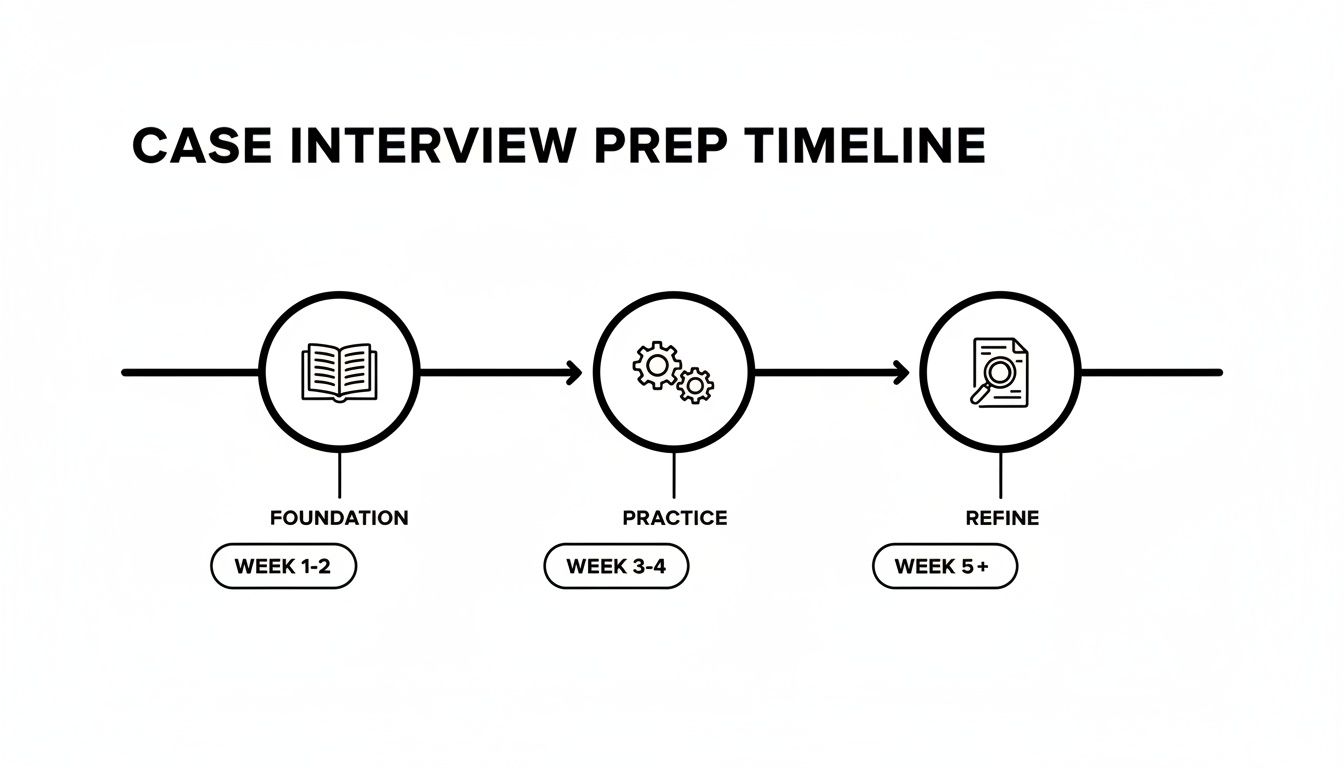
Success is built sequentially. You start with core knowledge, then move into application and refinement. The good news? This process is adaptable whether you have a few weeks or a few months.
Structuring Your Preparation Timeline
Whether you have three months or are cramming into three weeks, the pillars of your prep stay the same—only the intensity changes. Think of it as developing fluency across four key domains:
- Framework Fluency: Your goal is to internalize core problem-solving structures, not just memorize them. You need to be able to adapt them on the fly to fit unique prompts. These PM interview cheat sheets are a great place to start.
- Quantitative Agility: Get comfortable doing quick math. Market sizing, revenue estimates, and ROI calculations are table stakes. Being fast and accurate with numbers is a massive differentiator.
- Clear Communication: Practice thinking out loud. A brilliant analysis is useless if you can’t walk the interviewer through your logic clearly and concisely.
- Strategic Practice: Focus on quality, not quantity. A dozen mock interviews that you deeply debrief are far more valuable than 50 superficial run-throughs.
As a hiring manager at major tech companies, the biggest mistake I see candidates make is treating frameworks like a script. The interviewer wants to see how you think, not how well you can recite a formula. Your framework should be a flexible tool, not a rigid cage. This adaptable mindset is what separates a good candidate from a great one.
Here’s a structured timeline to guide your preparation, which you can adapt for 1-month, 2-month, and 3+ month schedules.
Your Case Interview Preparation Timeline
| Phase | Focus Area | Key Activities (1-Month Plan) | Key Activities (3+ Month Plan) |
|---|---|---|---|
| Phase 1: Foundation | Learning the Ropes | Week 1: Master 1-2 core frameworks (e.g., profitability, market entry). Watch 5-10 example case videos. Read 1 key case prep book. | Weeks 1-4: Deep dive into 4-5 frameworks. Complete 2 case prep books. Drill business math and estimation daily for 15 minutes. |
| Phase 2: Practice | Applying Knowledge | Weeks 2-3: Complete 10-15 practice cases (solo and with partners). Record yourself to analyze communication. Drill math problems 2-3 times per week. | Weeks 5-10: Complete 25-40 practice cases. Find 3-5 regular mock interview partners. Focus on specific case types (e.g., pricing, growth). |
| Phase 3: Refine | Polishing and Peaking | Week 4: Do 5-7 high-stakes mock interviews with experienced partners or coaches. Identify and fix 1-2 key weaknesses. Review all notes and create a one-page "cheat sheet." | Weeks 11-12+: Conduct 10+ mock interviews, simulating real interview conditions. Get feedback from industry professionals. Taper practice volume in the final week to rest. |
This table provides a roadmap, but remember to adjust it based on your personal pace and the time you have before your interviews. The key is consistent, focused effort.
Building Your Product Manager Interview Toolkit
Cracking a product case interview isn’t about reciting frameworks you memorized from a book. It’s about having a flexible set of mental models you can whip out to deconstruct any problem they throw at you.
As a hiring manager at top tech companies, I can spot a candidate who just memorized CIRCLES from a mile away. They apply it like a blunt instrument, miss all the critical nuances of the problem, and ultimately fail to show any real product sense.
The actual goal is to develop first-principles thinking. Your toolkit should be a collection of adaptable, powerful models you can combine on the fly. This section is all about equipping you with the core tools I’ve seen the best PMs at Google and Meta use to break down tough problems—moving you from rote memorization to genuine problem-solving.
Core Frameworks, Reimagined for Modern PM Cases
First things first, forget about finding a single "perfect" framework. The candidates who impress have a few core structures they can bend and shape to fit the question at hand. Think of these as different lenses for viewing any product challenge.
Your starting lineup should cover the main types of interview questions:
- Problem & Solution (Product Design): This is for your classic "Design an X for Y" prompts. The CIRCLES method (Comprehend, Identify, Report, Cut, List, Evaluate, Summarize) is a decent starting point, but it desperately needs a modern PM upgrade, especially for AI products.
- Metric Diagnosis (Analytical): You'll get these for prompts like, "Metric Z at Meta just dropped by X%, why?" A solid root-cause analysis approach is your best friend here.
- Strategic Decisions (Business Acumen): Think "Should Google enter Market B?" or "How should OpenAI price its next API tier?" For these, you’ll need a mix of market analysis and business model evaluation.
Let's get into how you’d actually apply these in the wild.
Applying a Modified CIRCLES for an AI Product
The standard CIRCLES framework is a good skeleton, but for modern AI product questions, it feels pretty dated. A typical candidate might just list out a few user types. A top-tier one will layer on the technical and ethical considerations unique to AI.
Let's take a prompt: "Design a new AI-powered feature for Spotify's Discover Weekly."
Applying CIRCLES rigidly here would be a huge mistake. Here’s how you adapt it:
- Comprehend & Clarify: Dig deeper than just the business goal. Ask about the AI-specific constraints. "Are we limited to existing user data, or can we pull in new inputs like mood or location? What are the ethical guardrails around using biometric data if we go down that path? What's our latency budget for inference?"
- Identify Users: Go beyond simple demographics. Start thinking about user intent and context. For example, segmenting users into "active explorers" versus "passive listeners." Don't forget internal users, like the music curators who might need to interact with this AI to fine-tune its outputs.
- Report Needs & Pain Points: You have to frame user needs with AI possibilities in mind. A need isn't just "help me find new music." It's "find music that perfectly matches my current, hyper-specific mood for a long-haul flight, without me having to build a playlist from scratch."
- Cut & Prioritize: This is where you really show your strategic chops. Instead of just prioritizing user segments, prioritize problem areas that AI is uniquely positioned to solve. Focus on novelty and creating new value, not just incremental improvements.
- List Solutions (with AI in mind): Now you can brainstorm features like "AI-generated mood mixes based on listening velocity" or "Proactive playlist suggestions for upcoming calendar events." For each idea, briefly mention the potential data inputs (e.g., listening history, time of day, calendar integration) and the type of model you might leverage (e.g., a recommendation or a generative model).
- Evaluate Trade-offs: This is the most critical step. A great PM will naturally start discussing the trade-offs between model accuracy and user experience, personalization versus the "creepy" factor, and the engineering cost of different AI models (e.g., fine-tuning a large model vs. building a smaller, specialized one).
- Summarize: Wrap it up with a crisp recommendation. Make sure you link it back to the original business goal, justify your solution with user impact, and call out the key risks—especially anything related to AI bias, data privacy, or potential hallucinations.
The interviewer doesn't expect a perfect solution. They want to see how you navigate ambiguity and make reasoned trade-offs. Your ability to talk through the 'why' behind your design choices, especially the tricky trade-offs in AI products, is what sets you apart.
Diagnosing a Metric Drop with Root Cause Analysis
Another PM interview classic is the dreaded metric drop. "User engagement on Instagram Reels is down 10% week-over-week. What do you do?"
A panicked candidate starts guessing wildly. A prepared one uses a structured, diagnostic approach. This isn't just about listing possibilities; it's about systematically ruling them out.
Your mental model should flow from clarifying to concluding:
- Clarify the Metric: First, define the terms. "Is 'engagement' measured by likes, comments, shares, or total watch time? Is this drop hitting a specific user segment, region, or platform like iOS vs. Android?"
- Internal vs. External Factors: This is a great way to structure your investigation.
- Internal: Did we just ship a new feature or introduce a bug in the latest release (check version control logs)? Did a big marketing campaign end (check with marketing team)? Was there a server outage (check infra dashboards)?
- External: Did a competitor like TikTok launch something big? Is it a holiday? Is there a major news event distracting everyone?
- Drill Down: Once you have a working hypothesis (e.g., "I suspect a recent iOS app update is the culprit"), explain how you'd validate it. "First, I'd query our analytics in a tool like Mixpanel to see if the drop correlates specifically with the rollout of version X. Then, I'd segment the data by OS to confirm that Android users are unaffected."
Having a strong grasp of the best product management tools can help you ground your thinking in how real-world data analysis and reporting works, which makes your answers feel much more authentic. This systematic approach shows the interviewer you can troubleshoot methodically—a non-negotiable skill for any PM.
The Art of Deliberate Practice and Feedback

There’s a dangerous myth that grinding through 50+ practice cases is the golden ticket to a PM offer. This is a fast track to sounding like a robot. I’ve seen more candidates fail from over-rehearsed, generic responses than from a lack of framework knowledge.
The real differentiator isn’t volume; it’s deliberate practice. This is the art of practicing with a laser-focused goal, relentlessly hunting for feedback, and systematically crushing your weaknesses. It’s the difference between mindlessly running laps and training with a coach to shave seconds off your time.
This system is all about quality. Fifteen deeply analyzed and debriefed cases will make you a far stronger candidate than 50 superficial run-throughs that just reinforce your bad habits.
Quality Over Quantity in Practice Cases
You've heard the war stories—candidates bragging about the sheer volume of cases they've churned through. While some older data pointed to a magic number of 40-50 cases, the truth is that overkill breeds rigidity. A more recent analysis reveals that 15-20 structured cases with feedback from senior PMs consistently outperform 50 peer-level ones.
The key is depth. Blitzing through cases just turns your frameworks into a rigid script, which is a massive red flag for any interviewer looking for adaptive, first-principles thinking. You can dig into more of these insights on forums like Wall Street Oasis.
Your goal with each case isn't to "pass." It's to diagnose a weakness. Treat every session like a surgical operation on one specific skill.
- Is your initial structuring weak? Dedicate three full sessions just to framing the problem and pressure-testing your approach with a partner.
- Do you freeze up on market sizing? Run five back-to-back quantitative drills, focusing only on speed and sanity-checking your assumptions out loud.
- Is your final recommendation wishy-washy? Practice delivering a concise, confident, data-backed conclusion in under two minutes. Over and over again.
This targeted approach stops you from simply repeating the same mistakes and calling it "practice."
Finding High-Caliber Practice Partners
Who you practice with matters far more than how many times you practice. Your feedback loop is only as strong as the person on the other side of the table.
- Peers (Good for Volume): Practicing with other candidates is great for getting your reps in and becoming comfortable thinking aloud. It builds confidence and helps you internalize the basic frameworks.
- Senior PMs or Coaches (Essential for Quality): This part is non-negotiable. A peer can tell you if your answer sounds right. An experienced PM can tell you if your answer is strategically sound and how it would actually land in a real interview at Google or Meta. They've been the interviewer and can spot the subtle red flags your peers will completely miss. A great resource is Lewis Lin's Slack community for finding practice partners.
As a hiring manager, I’m not just evaluating your answer. I'm evaluating your thought process, your coachability, and your business judgment. A senior PM gives you feedback on these meta-skills, which is where most interviews are truly won or lost.
Hunt down mentors on LinkedIn or through your network. Offer to buy them coffee for 45 minutes of their time. The targeted feedback from one session with a seasoned pro is worth more than ten sessions with a fellow novice.
The Feedback System That Drives Improvement
Getting feedback is only half the battle. You need a system to process it and, most importantly, act on it. A vague "that was good" is totally useless. You need specific, actionable critiques. For more on this, check out our guide on how to get the most from feedback for PMs.
Use this template to structure your debrief after every single mock interview. Have both you and your partner fill it out to compare notes.
Mock Interview Debrief Template
| Category | Partner's Feedback (Strengths & Weaknesses) | Self-Assessment (What felt strong? Where did I struggle?) | Action Item for Next Session |
|---|---|---|---|
| Problem Structuring | "Initial framework was logical but too generic. Didn't tailor it enough to the AI aspect of the prompt." | "I defaulted to a standard profitability framework instead of leading with user needs for a product design question." | "For the next case, I will spend the first 90 seconds brainstorming clarifying questions specific to the prompt." |
| Quantitative Analysis | "Math was accurate, but you seemed hesitant. Took a long time to calculate market size, slowing momentum." | "I panicked when I couldn't remember the exact population of Germany. I need a better way to handle unknown data points." | "Drill three market sizing questions focusing on making and stating clear, logical assumptions for unknown figures." |
| Communication | "Great job thinking out loud. But, you didn't summarize your findings before moving to the next part of the case." | "I felt like I was rambling during the brainstorming phase. My ideas weren't bucketed clearly." | "I will pause and explicitly state, 'To summarize my findings so far…' before moving between sections of the case." |
| Recommendation | "The final recommendation was clear, but you didn't mention any risks or next steps." | "My conclusion felt rushed. I need to reserve the last 3-4 minutes specifically for a strong close." | "Practice delivering a 2-minute summary that includes the recommendation, key supporting data, risks, and next steps." |
This entire process—diagnosing weaknesses, seeking expert feedback, and methodically addressing each flaw—is what separates the candidates who get offers from those who just grind. It transforms your prep from a stressful slog into a focused system for improvement.
Mastering Quantitative Analysis and Market Sizing
Your ability to handle numbers under pressure is a massive signal to interviewers. As a hiring manager, I’m not testing your calculus skills; I’m watching to see if you have the business acumen to make logical estimations. When a candidate smoothly breaks down a market sizing question, it tells me they can think structurally about opportunity and scale—a core PM skill.
Conversely, panic during a quantitative question is one of the most common red flags. It completely derails the interview's momentum and eats away at your credibility. This section is your tactical guide to conquering the quant parts of your PM case interviews.
Top-Down vs. Bottom-Up Estimation
The two classic ways to tackle any estimation question are the top-down and bottom-up approaches. A good candidate picks one. A great candidate uses both to cross-validate their answer, which shows a much deeper level of analytical rigor.
Let’s use a real-world prompt I’ve seen pop up for roles at Google and other big tech companies: “Estimate the annual revenue for YouTube Premium in the US.”
Top-Down Approach (Starting Broad): This is where you begin with a huge, known population and start carving it down with logical assumptions.
- Start with the total population: The US is home to roughly 330 million people.
- Filter for internet access: Let's assume about 90% of them are online, which gets us to ~297M.
- Segment for YouTube users: From there, maybe 80% use YouTube regularly. Now we're at ~238M users.
- Estimate Premium adoption: This is your key assumption. Let's hypothesize a 10% adoption rate among active users, giving us ~24M subscribers.
- Calculate revenue: Finally, multiply subscribers by the annual price. If Premium is $14/month ($168/year), the annual revenue is 24M * $168, or roughly $4 billion.
Bottom-Up Approach (Starting Small): Here, you build up your estimate from individual user segments instead.
- Segment the user base: Break down the population into groups with different spending habits (e.g., 18-34, 35-54, 55+).
- Estimate adoption per segment: Assign a specific adoption rate to each group. The tech-savvy 18-34 demographic might have a higher adoption rate (15%), while the 55+ group might be lower (5%).
- Calculate revenue per segment: Figure out the revenue from each demographic slice and then add them all together for a more nuanced final number.
- Sanity Check: Does the final number from your bottom-up math align reasonably with your top-down estimate? If they're worlds apart, it's time to question your assumptions.
The final number is less important than the logic you use to get there. Always state your assumptions clearly. Saying, "I'm assuming a 10% adoption rate because it's a mature but competitive market with ad-supported alternatives" is far better than just pulling a number out of thin air.
Sharpening Your Mental Math and Data Recall
You don't have to be a math genius, but you do need to be quick on your feet. I've seen candidates get dinged with feedback like, "pace too slow, not quantitative enough," and it haunts them. The solution is simple: drill your mental math until it's second nature.
Being able to calculate percentages quickly or spot relationships in data without a calculator is a superpower in these interviews. It’s what separates the candidates who get offers from those who don't. This skill translates directly to the real world of product, where you're constantly making quick calculations about revenue or user growth.
Having a few key numbers memorized also prevents awkward pauses and makes your estimates much more credible. You don't need a PhD in statistics, just a few foundational data points to anchor your logic.
Essential Market Sizing Data Cheat Sheet
Think of this as your baseline data for almost any market sizing question. Committing these few numbers to memory will make your estimations faster and far more accurate.
| Data Point | US Value | Global Value | Notes for PM Interviews |
|---|---|---|---|
| Population | ~330 Million | ~8 Billion | The absolute foundation for most top-down estimations. |
| Households | ~130 Million | ~2 Billion | Useful for products sold on a per-household basis (e.g., smart home devices, family software plans). |
| Life Expectancy | ~80 years | ~73 years | Helps to quickly estimate population sizes in different age brackets (assuming even distribution). |
| Median Household Income | ~$75,000 | Varies widely | Critical for pricing, willingness to pay, and premium product adoption assumptions. |
| Smartphone Penetration | ~85-90% | ~85% | Essential for any mobile-first product case. Always clarify if you're talking about smartphones vs. all cell phones. |
Memorizing these numbers is just the starting point. The real skill is weaving them into a logical narrative that supports your product thinking. To learn more about gathering and using this type of data, check out our guide on market research techniques.
Navigating Modern Product and AI Case Interviews
Let me be blunt: your standard consulting frameworks will only get you so far in a modern product management interview. As a hiring manager at Google and Meta, I can spot a candidate using a one-size-fits-all approach from a mile away.
A "design a product" case for Google flexes a completely different muscle than a "diagnose a metric drop" case for Meta. The game has gotten even more specialized with the explosion of AI. To ace your interview, you need to recognize the specific case archetype you're facing and adapt your approach on the fly.
The Four Core Product Case Archetypes
While the prompts can feel endlessly varied, they almost always boil down to one of four categories. Knowing which sandbox you're playing in is the first step to structuring a killer response.
- Product Design: This is the classic "Design an X for Y." Think prompts like, "Design a better alarm clock app for shift workers." It’s a test of your user empathy, creativity, and ability to spin needs into a coherent product vision.
- Strategy: These questions are all about business acumen. "Should Netflix enter the video game streaming market?" Here, you'll need to dissect market dynamics, size up the competition, and talk business models.
- Growth: This is about scaling an existing product. You might get asked, "How would you grow Duolingo's user base in emerging markets?" Your answer needs to show you live and breathe acquisition, activation, and retention loops.
- Analytical: Get ready for a problem like, "Engagement on Facebook Marketplace is down 15%. What do you do?" This tests your ability to form hypotheses, use data to find the root cause, and lay out a logical investigation plan.
The New Frontier: AI PM Interviews
The single biggest shift I've seen in PM interviews is the rise of the AI case. A prompt like, "Develop a product strategy for OpenAI's next multimodal model," demands a totally different vocabulary and set of considerations.
Honestly, I’m no longer just looking for user stories and wireframes. I need to see that you have a fundamental grasp of the technology and its unique, often messy, challenges. How you talk about these topics tells me if you can actually lead an AI product team.
Proving Your AI Product Acumen
When I'm interviewing for an AI PM role, I'm listening for very specific signals. A strong candidate doesn't just bolt AI onto a generic product answer; they weave these concepts into the core of their thinking.
- Technical & Data Literacy: You don't need to be a machine learning engineer, but you absolutely must speak the language. This means talking about the trade-offs between models (like speed vs. accuracy), the critical role of high-quality training data, and why a "data moat" is a real competitive advantage. Use an AI tool like ChatGPT to generate a summary of the latest AI model papers to stay current.
- Go-to-Market Strategy for AI: How do you launch something that might be unpredictable? A top-tier candidate will discuss phased rollouts, beta testing with specific user groups, and building rock-solid feedback loops to learn from model failures.
- Ethical and Safety Considerations: This is non-negotiable. A great answer proactively brings up potential landmines like algorithmic bias, data privacy, and the risk of misuse. Mentioning the need for a "red teaming" process to find potential harms shows a maturity that immediately sets you apart.
- User Experience for Probabilistic Systems: How do you design an interface for a product that isn't always right? You should be talking about managing user expectations, designing graceful failure states, and being transparent about the AI's limitations.
Your goal in an AI case isn't just to act like a product manager working on an AI feature. It's to prove you are an AI Product Manager. The difference is your ability to bake the unique technical, ethical, and user experience challenges of AI directly into your strategy from day one.
To get comfortable with these new interview types, you need to use every tool at your disposal. This can even include specialized MUN AI tools for research that help structure complex information and build a data-driven narrative.
Answering an AI product case well means showing you can think at the intersection of user needs, business goals, and the nitty-gritty realities of machine learning. You can dive deeper into this specialization by exploring the fundamentals of AI product management. Getting this right will prepare you for the most challenging—and rewarding—interviews in tech today.
Common Questions About Preparing for Case Interviews
After years of hiring Product Managers, I've seen the same questions and anxieties pop up again and again. It's totally normal. Candidates often get stuck on specific parts of their prep, second-guessing their entire strategy.
This section is all about giving you direct, no-nonsense answers to the most common sticking points I've seen from the other side of the table. Think of it as a peek behind the curtain, designed to give you clarity and confidence as you head into your final prep.
How Many Mock Interviews Are Enough?
This is easily the most common question I get, and my answer is always the same: it's about quality, not just the raw number.
I recommend aiming for 15-20 high-quality mock interviews. The key part of that sentence is "high-quality." Each session needs to be followed by a detailed, actionable debrief. That's where the real learning happens.
This approach is so much more effective than just grinding through 50+ superficial run-throughs. Doing too many without proper feedback just reinforces bad habits. As you get closer to the real thing, try to prioritize practicing with experienced PMs or coaches over your peers. Seriously, one deep session with a senior PM is worth five with a fellow candidate.
What Are the Biggest Red Flags for Interviewers?
Interviewers are trained to spot specific warning signs that a candidate isn't quite ready for the role. I've seen candidates who look amazing on paper get rejected for these mistakes, and they're almost always avoidable.
Here are the most common red flags that make me pause:
- A rigid, "cookie-cutter" approach: If you just slap a framework onto a problem without adapting it to the specific nuances, it's a huge red flag. It tells me you can't think from first principles.
- A lack of a clear, structured thought process: You have to communicate your structure clearly and bring the interviewer along with you. If I get lost following your logic, you've already lost me.
- Poor communication: This is a big one. It includes not clarifying your assumptions upfront or failing to synthesize your key findings as you go. You should be thinking out loud, but do it with structure.
- Panicking during quantitative questions: Getting visibly flustered by a bit of math signals you'll struggle under pressure. The key is to stay calm, state your assumptions out loud, and walk through the logic step-by-step.
The case isn't just a test of your analytical skills; it’s a simulation of how you'd actually perform on the job. We're looking for someone who is calm, structured, and coachable under pressure. A candidate who can take a hint or pivot based on feedback is incredibly valuable.
How Should I Structure My Final Recommendation?
Your final recommendation is your chance to end the interview on a high note. It should be concise, confident, and rooted in the analysis you just spent the last 30 minutes working through. Stick to a simple, powerful structure.
Start with a direct answer to the initial prompt. No beating around the bush. Then, back it up with two or three key reasons based on the data and insights you uncovered during the case.
Finally, briefly touch on potential risks and suggest concrete next steps to validate your recommendation. Keep the entire summary under two minutes. Short, sweet, and impactful.
At Aakash Gupta, we focus on providing the actionable insights and career strategies you need to excel as a product leader. For more in-depth guidance on navigating your PM career, check out my newsletter and resources at https://www.aakashg.com.
