A killer job description for a product manager isn't a list of duties—it's your first sales pitch to top-tier talent. It’s your magnet for attracting the kind of PMs who have offers from Google and high-growth startups. It needs to sell the opportunity to solve a meaningful problem and own a business outcome, not just fill a seat.
Your PM Job Description is Your First Product
Staring at a blank page to define a PM role is paralyzing. The temptation is to copy-paste a generic template. Don't. Generic JDs attract generic candidates. As a hiring manager, I can tell you that the best job descriptions are strategic assets. They act as a filter, attracting candidates who think in outcomes, not just tasks.

Think of it this way: your job description is the very first product your candidate experiences. A vague, poorly defined JD signals a lack of clarity in your own product strategy. But a sharp, compelling one? That shows you have a crystal-clear vision for what success looks like. For a great deep dive on getting the basics right, check out this guide on How to Write a Job Description.
A winning PM job description is built on four core pillars. Getting these right is the difference between attracting candidates who are merely qualified and those who are the perfect fit for your team and culture.
Let's break down the key components you need to nail.
This table summarizes the core sections of an effective PM job description, outlining what each part should achieve and the essential details to include.
Key Components of an Effective PM Job Description
| Section | Purpose | Key Information to Include |
|---|---|---|
| Magnetic Role Summary | Your hook. To grab attention and quickly convey the role's core purpose and impact. | A concise explanation of why the role exists, the key problem the PM will solve, and the product area they will own. Mention the business impact. |
| Outcome-Driven Responsibilities | To detail the "what" and "why" of the job, focusing on impact rather than just tasks. | Bullet points framed around outcomes (e.g., "Drive a 15% increase in user retention" instead of "Manage the backlog"). |
| Precise Qualifications | To set clear expectations and filter for the right experience level and skill set. | A clear distinction between "must-have" and "nice-to-have" qualifications. Include years of experience, domain knowledge, and technical fluency. |
| Authentic Cultural Pitch | To give candidates a real sense of the team environment and company values, ensuring a good cultural fit. | Insights into team dynamics, communication styles (e.g., "We value concise writing over long meetings"), and unique company perks or benefits. |
By building your job description around these four pillars, you create a comprehensive and compelling picture that attracts the right people for the right reasons.
Let's break down each of these sections.
Pillar 1: A Magnetic Role Summary
This is your hook. It needs to concisely explain why this role exists and the critical problem the new PM will be hired to solve. Skip the corporate jargon and get straight to the point. What’s the mission?
Pillar 2: Outcome-Driven Responsibilities
This is where most job descriptions go wrong. Don’t just list tasks. Instead of writing "manage the backlog," frame responsibilities around the impact you expect. Think something like, "Own the roadmap for our core user engagement features, with the goal of driving a 15% increase in daily active users." See the difference? One is about process; the other is about results.
Pillar 3: Precise Qualifications
Be crystal clear about what’s a deal-breaker and what’s a bonus. Separating "must-haves" from "nice-to-haves" is crucial. This simple step prevents you from accidentally filtering out incredible candidates who might have a non-traditional background but possess all the core skills you need.
Pillar 4: An Authentic Cultural Pitch
Finally, give candidates a real taste of what it's like to work with you. Talk about your team's values, your communication style, and what a typical week looks like. This isn’t about fluff; it’s about ensuring a strong cultural alignment from the very beginning, saving everyone time and potential heartache down the road.
Defining Responsibilities and Daily Impact
The responsibilities section is the heart of your job description. Let's be honest, top-tier candidates aren't scanning for a laundry list of tasks. They’re looking for a mission. They want to know the problems they’ll get to solve and the impact they’ll make.
Generic duties like “manage the product backlog” or “write user stories” are just table stakes. They do nothing to convey the strategic weight of a great product manager. This is your chance to sell the "why" behind the daily grind. Frame every responsibility as an outcome that moves the business forward, and you’ll attract people who are driven by results, not just process.

From Tasks to Outcomes
Let’s look at how to transform a few common, uninspired tasks into compelling, outcome-focused responsibilities. It’s a subtle shift in language, but it makes a world of difference.
-
Instead of: "Write user stories and manage the backlog."
-
Try: "Translate complex user needs and strategic business goals into a compelling, prioritized product backlog that galvanizes the engineering team to ship with purpose and velocity."
-
Instead of: "Gather requirements from stakeholders."
-
Try: "Champion a customer-centric vision by synthesizing insights from user research, data analytics, and cross-functional stakeholders to define a product roadmap that addresses critical market needs."
-
Instead of: "Work with engineering and design."
-
Try: "Lead a dedicated product squad, fostering a culture of rapid iteration and data-informed decision-making to deliver high-quality features that measurably improve user engagement."
A great job description answers the question, “What is a product manager?” by showing, not just telling. It paints a picture of a leader who guides products from ambiguity to impact, working closely with engineers and designers. The best PMs you’ll hire are focused on the "why" behind the work.
Tailoring Responsibilities by Specialization
The modern PM role isn't one-size-fits-all; it comes in many flavors. Your description has to reflect the specific challenges of the position, whether you’re hiring a Growth PM, an AI PM, or a more traditional Core PM.
While there’s plenty of overlap, the distinctions are crucial. For a deeper dive, check out our guide on the difference between a Product Owner and a Product Manager.
Here’s how you can tailor responsibilities for a few specialized roles:
For a Growth Product Manager:
- Focus: User acquisition, activation, and retention.
- Example Responsibility: "Design and execute a high-tempo A/B testing program across the user onboarding funnel, with a clear goal of improving new user activation by 20% quarter-over-quarter."
For an AI/ML Product Manager:
- Focus: Data, models, and ethical considerations.
- Example Responsibility: "Define data requirements and success metrics for machine learning models, partnering with data science to build and launch intelligent features that personalize the user experience."
For a Core Product Manager (at a larger company like Google or Meta):
- Focus: Platform stability, user satisfaction, and incremental innovation.
- Example Responsibility: "Own the vision and execution for our core user profile service, ensuring 99.9% reliability while shipping enhancements that improve data privacy and user control."
When you frame responsibilities in terms of specific, measurable impact, your job description will resonate deeply with the kind of high-achievers you want on your team.
Nailing the Qualifications and Skills Section
So, how do you spell out what you're looking for in a product manager without accidentally scaring off great people? The trick is to draw a clear line in the sand between the absolute must-haves and the "would be awesome if you also had" bonuses. This section is your filter, setting expectations for anyone who applies and making sure you get a pool of candidates who can actually do the job.
You want to be laser-focused when describing experience, technical chops, and education. Think of it like a Venn diagram—you’re searching for that rare person who sits smack in the middle of strategic thinking, technical fluency, and a deep sense of customer empathy.
Distinguishing Must-Haves from Nice-to-Haves
Clarity here isn’t just important; it’s everything. Vague requirements open the floodgates to a ton of unqualified applicants, which wastes your time and theirs. I’ve found a simple two-tier system works wonders for keeping this section clean and effective.
Must-Have Qualifications: These are the absolute deal-breakers. If a candidate doesn't have these, they're not a fit.
- Experience Level: Be super specific. Instead of "product experience," say something like, "3-5 years of dedicated product management experience shipping B2B SaaS products."
- Core Competencies: List the non-negotiable skills. For instance, "Demonstrated experience developing product roadmaps and defining specs from scratch."
- Technical Fluency: Define exactly what "technical" means for this role. Maybe it's, "Ability to hold a credible technical discussion with engineers about API integrations."
Nice-to-Have Qualifications: These are the tie-breakers, the things that make a great candidate truly exceptional for your team.
- Domain Expertise: If you're in a specific niche, mention it. "Previous experience in the FinTech or payments space is a plus."
- Tool Proficiency: Call out the software your team lives in. "Familiarity with Amplitude, Jira, and Figma."
- Advanced Degrees or Certifications: These can be a signal, but aren't always necessary. It can be useful to check out the best certifications for product managers to see what skills top candidates are actively building.
Articulating the Three Tiers of PM Skills
To find someone who can both dream up a vision and get their hands dirty to make it happen, you have to describe skills in terms of their real-world impact. A company like OpenAI, for example, isn't going to just ask for "good communication." They'll want someone with the "ability to articulate complex technical concepts to both technical and non-technical audiences." Big difference.
Here’s a practical way to frame the skills you need:
-
Core Hard Skills: These are the fundamental mechanics of product management.
- Data Analysis: Frame it around action. "Proven ability to query data using SQL and leverage analytics tools to derive actionable insights that inform product decisions."
- Roadmap Development: Connect it to the bigger picture. "Experience creating and maintaining a product roadmap that aligns with company-level strategic objectives and communicates a clear 'why' to the team."
-
Critical Soft Skills: These are the force multipliers that separate the good PMs from the truly great ones.
- Stakeholder Influence: Show, don't just tell. "A track record of successfully influencing and aligning cross-functional teams (Engineering, Design, Marketing, Sales) around a shared product vision."
- Storytelling: This is about more than just talking. "Exceptional written and verbal communication skills, with the ability to craft compelling narratives for users, team members, and executives."
Setting Competitive Salaries with Confidence
Let's be blunt: in a hot hiring market, the salary range you post is more than just a number. It's a powerful signal. A well-researched salary in your product manager job description is a statement about how much you value the role.
It sets clear expectations right out of the gate, respects a candidate’s time, and frankly, it just brings a more qualified, relevant pool of applicants to your doorstep. You spend less time wading through mismatched candidates.
Tossing a vague phrase like "competitive salary" into your job description is a huge missed opportunity. Top candidates often filter jobs by salary, and with pay transparency laws becoming the norm, being upfront is now a strategic advantage. It shows you’re confident in your offer and fair in your process, which helps you stand out immediately.
Benchmarking Product Manager Salaries
Figuring out the right salary range isn't a shot in the dark. It requires looking at a few critical factors that directly shape what the market expects. Compensation isn’t one-size-fits-all; it’s a living number that shifts based on some key variables.
Think about how these factors change the equation:
- Seniority and Scope: The paycheck for an Associate PM working on a single feature set is going to look a whole lot different than one for a Principal PM who owns the P&L for an entire product line.
- Geographic Location: A PM role in San Francisco or New York City will naturally command a much higher salary than the exact same job in a lower cost-of-living area. You have to adjust for the local market.
- Industry and Company Stage: A product manager at a high-growth FinTech or AI startup will often see a different compensation mix—think more equity—than someone at a stable, massive enterprise company.
Getting a handle on these nuances is your first step. It's how you build a compensation package that actually connects with reality. The PM role has morphed so much with new tech and product complexity, leading to a huge spread in what people get paid.
In the United States, an average base salary for a product manager hovers around $116,963 a year. But this can easily climb as high as $223,000 at top tech companies once you factor in bonuses and equity. The global picture is much more varied, with averages of $81,723 in the UK, $76,814 in Germany, and ₹11,84,102 (around $15,300) in India. For a deeper dive, you can explore a detailed global breakdown in this product manager salary guide.
Building Your Compensation Package
Once you’ve got your data, it’s time to turn it into a clear, compelling range. The goal isn't just to be fair; it's to make an offer that feels genuinely attractive to the talent you want.
A strong offer is usually built on a few key pillars:
- Base Salary: The guaranteed, predictable part of their annual pay.
- Performance Bonus: An annual or quarterly bonus that’s tied to both individual and company wins.
- Equity: Stock options or RSUs, which are absolutely critical for luring top talent to startups.
- Benefits: The full suite—comprehensive health insurance, retirement plans, and other perks that make a real difference.
By laying these pieces out clearly, you give candidates the full picture of their total compensation. It empowers them to make an informed decision and proves you’ve put real thought into what you’re offering.
Tailoring Descriptions for Each Seniority Level
One of the most common traps I see hiring managers fall into is using a generic, one-size-fits-all template for their product manager job descriptions. They'll just swap out "Associate" for "Principal," tack on a few more years of experience, and call it a day. That's a surefire way to attract a flood of mismatched candidates.
The reality is, the scope, the language, and the core expectations for an entry-level PM versus a seasoned product leader are worlds apart. Your job description has to reflect that. Think about it: you hire an Associate Product Manager (APM) to learn and execute, but you hire a Senior Product Manager to own outcomes and be a force multiplier for the entire team. That fundamental difference needs to be crystal clear from the very first sentence.
For an APM, you want to talk about tasks and support. For a Senior PM, it's all about strategic ownership and influence.
Articulating the Scope of Impact
The real heart of the difference between seniority levels is the scope of their influence and ownership. A junior PM is thinking at the feature level, grinding away on the details. A senior PM is operating at the product line or even the entire business level, connecting the dots to the bigger picture.
- Associate PM: The language here should be all about execution and support. Use phrases like, "assist in backlog grooming," "write detailed user stories," and "support the product team in market research." Their job is to be a reliable doer, learning the ropes under the guidance of a more senior PM.
- Senior PM: Here, the language needs a major shift towards strategy and leadership. Think phrases like, "own the product vision and roadmap," "drive alignment with executive stakeholders," and "mentor and develop junior product managers." Their role is to define the why and empower the team to figure out the how.
A great way to think about it is this: An Associate PM is given a destination and a map. A Senior PM is asked to identify a new continent to explore and then draw the map for everyone else to follow.
The different expectations across seniority levels are not just about day-to-day tasks; they represent a fundamental shift in responsibility, strategic thinking, and leadership. To help clarify these distinctions, let's break down what's expected at each stage of a product manager's career.
Product Manager Role Expectations by Seniority Level
| Attribute | Associate Product Manager | Mid-Level Product Manager | Senior/Principal Product Manager |
|---|---|---|---|
| Primary Focus | Feature-level execution, learning the craft | Owning a product or major feature set | Defining product vision, strategy for a product line or business area |
| Key Responsibilities | Writing user stories, backlog grooming, data gathering | Creating and managing a product roadmap, stakeholder management | Setting multi-year strategy, influencing C-suite, mentoring other PMs |
| Strategic Scope | Tactical, focused on "how" to build a defined feature | Manages a product's lifecycle, contributes to strategy | Defines the "why" and "what," owns business outcomes, market positioning |
| Stakeholder Interaction | Works primarily with their direct scrum team and manager | Manages communication with cross-functional teams (eng, design, marketing) | Drives alignment across departments and with executive leadership |
| Autonomy | Works under close guidance and mentorship | Operates with significant autonomy on their product area | Highly autonomous, expected to identify and pursue new opportunities |
| Success Metrics | Delivery of features on time, quality of user stories | Product adoption, user engagement, meeting roadmap goals | Business impact (revenue, market share), team growth and performance |
This table highlights the progressive expansion of a PM's role. It’s a journey from mastering the tactical elements of product development to steering the strategic direction of the business. Understanding these nuances is key to writing a job description that attracts the right talent for the specific role you need to fill.
This infographic gives a great visual breakdown of the core factors that influence a product manager's salary, with seniority being a huge piece of the puzzle.
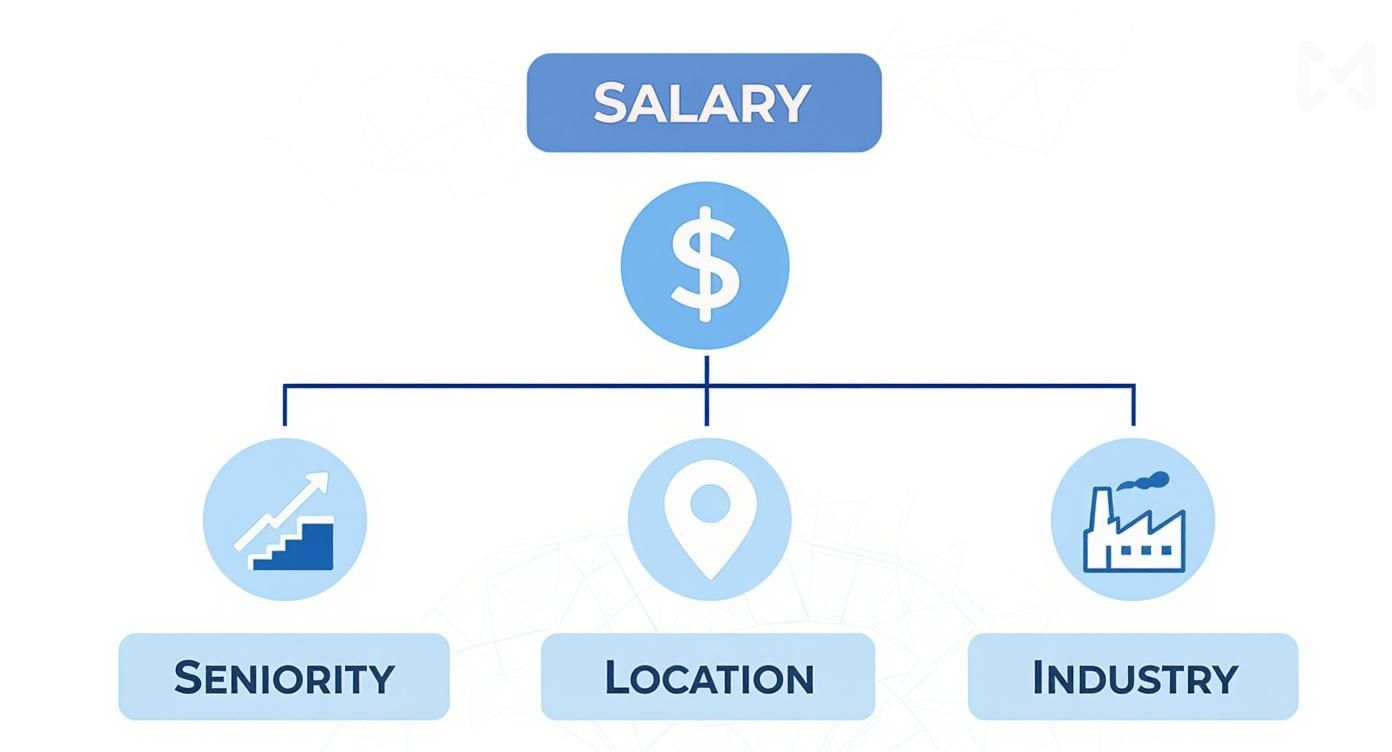
As you can see, while things like location and industry play a part, seniority is the main lever that drives compensation growth. That’s because more seniority directly translates to greater strategic responsibility and a bigger impact on the business.
Reflecting Seniority in Salary Benchmarks
It should come as no surprise that compensation scales directly with these responsibilities. A junior product manager in the United States, for instance, might expect an average salary around $79,601. That number jumps to about $104,583 for mid-level PMs, and senior PMs can command $125,554 or more.
Of course, at top-tier tech companies, these figures can skyrocket, with median total compensation for a PM at Google or Meta often exceeding $223,000. And for the most experienced global product leaders managing international portfolios, salaries can reach as high as $164,000 annually. For a deeper dive, you can explore more detailed insights on how these product manager salaries vary by role and experience.
Adapting for Specialized Product Manager Roles
The idea of a single, one-size-fits-all product manager is a myth. As companies get bigger and products become more complex, specialized PM roles naturally emerge. Your job description has to keep pace with this evolution.
Slapping a generic "Product Manager" title on a listing just won't cut it when you're trying to hire for a nuanced role like AI/ML, Growth, or Technical Product Management. You're not just looking for a PM; you're hunting for a specialist who speaks a different language and tackles a very different set of problems. This means you need to get surgical with your job description.
Highlighting Niche Responsibilities
If you want to grab the attention of these experts, your responsibilities section needs to go way beyond the standard PM duties. You have to speak their language and show them you actually get what their day-to-day looks like.
-
For an AI/ML Product Manager: Drop the vague stuff. Get specific with accountabilities like, "Defining data requirements for model training and validation." Or try, "Partnering with data science to manage the full machine learning lifecycle, from concept to deployment." This kind of language instantly signals that you understand the unique grind of building intelligent products.
-
For a Growth Product Manager: Their entire world is built on metrics and rapid experimentation, and your description should scream that from the rooftops. Use punchy, action-oriented phrases like, "Designing and running a high-tempo A/B testing program to optimize user acquisition funnels" or "Analyzing user behavior data to identify and prioritize growth opportunities." If you want to go deeper on this role, check out our detailed guide on what a Product Growth Manager does.
Specifying Unique Qualifications
The skill set for these specialized roles isn't interchangeable. What you need from an AI PM is worlds apart from a Platform PM. Be crystal clear about these qualifications to weed out the wrong candidates from the get-go.
Over the last decade, the product manager’s job has ballooned in complexity, mirroring how much more intricate and global modern business has become. This digital boom has paved the way for more specialization, making roles like Technical Product Manager and Growth Product Manager commonplace, each with its own distinct salary range.
Just look at the numbers. Product Owners in the US bring in an average of $110,000 a year, while Group and Principal Product Managers can clear $195,000 and $189,000, respectively. You can discover more insights about PM salary trends on Coursera.org.
When you demonstrate a real, sophisticated understanding of what these specialized roles truly demand, you send a powerful message. It tells top-tier specialists that your company is a place where their unique talents won't just be understood—they'll be valued and put to good use.
A Few Lingering Questions
When it comes to writing a great product manager job description, a few questions always seem to pop up. Nail these, and you're well on your way to attracting the right person. Get them wrong, and you'll likely get lost in a sea of so-so applications.
Let's clear up the most common ones I hear from hiring managers and recruiters.
How Long Should a PM Job Description Be?
Keep it in the 400-700 word ballpark. That's the sweet spot. You need to provide enough detail to be genuinely helpful, but not so much that you overwhelm someone just trying to get the lay of the land. A great candidate should be able to scan it and quickly get the gist of the role.
Structure is your best friend here:
- Use clear, bold headings for each section.
- Lean on bullet points for responsibilities and what you're looking for.
- Keep your paragraphs short and tight, focused on a single idea.
This gives you just enough room to sell the role’s impact, list the must-haves, and offer a taste of your company culture—all while respecting the candidate’s time.
Should I Include the Salary Range?
Yes. Absolutely. In today's market, posting a salary range isn't just a nice-to-have; it’s a strategic move. Being upfront about compensation does a few critical things right away.
First, it signals fairness and transparency, which is a massive plus for top-tier talent who have plenty of options. Second, it saves everyone a ton of time. You set clear expectations from the get-go, making sure you only attract candidates who are genuinely aligned with what you can offer.
What Is the Biggest Mistake to Avoid?
By far, the most common and damaging mistake is writing a generic "laundry list" of tasks. Job descriptions that just rattle off duties—"manage the backlog," "write user stories," "attend meetings"—are incredibly uninspiring.
Great candidates aren't motivated by checking off tasks; they're driven by solving meaningful problems and making an impact. You have to frame the responsibilities around the outcomes they will create for the product, the team, and the company’s mission.
Instead of just listing what they will do, tell them what they will achieve. That single shift in perspective is what turns a boring job ad into a compelling pitch that grabs the attention of truly great product managers.
For more expert insights on product management careers, skill development, and landing top-tier roles, check out the resources from Aakash Gupta at https://www.aakashg.com.
