To advance as a Product Manager in the age of AI, you must shift your focus from tactical execution to strategic leadership. This isn't just about learning a new tool; it's about fundamentally re-architecting how you work. The core principle of PM + AI is automating low-value tasks to free up your cognitive bandwidth for high-impact strategy.
This guide provides the frameworks and actionable steps to make that transition, starting with the immediate changes you can implement in your daily workflow.
Let's begin with a practical, side-by-side comparison of a typical PM workflow, with and without AI augmentation. Imagine you need to figure out why a specific feature's engagement dropped last quarter.
- The Traditional PM: Spends hours exporting user feedback from various tools, wrestling with spreadsheets, tagging comments by hand, and then trying to spot patterns in the noise. They might schedule multiple meetings with data analysts and user researchers, waiting days—or weeks—for the insights they need.
- The AI-Augmented PM: Uses a tool to ingest all the relevant feedback and runs a prompt like, "Analyze all user feedback for 'Feature X' from the last 90 days. Identify the top 5 negative themes and provide verbatim examples for each." They get a synthesized, actionable report in minutes and can immediately start working with their team to craft solutions.
This isn't a futuristic fantasy; it's the current reality for top-tier product teams. The efficiency gain is massive, but the real win is the shift in focus. By offloading cognitive burdens, the AI-powered PM has more mental bandwidth for the deep, strategic work that defines the role: shaping product vision, aligning stakeholders, and anticipating market shifts.
Why PM + AI Is The New Standard For Product Leaders
The role of a product manager is undergoing a seismic shift. Mastering AI is no longer a niche specialty—it’s the new baseline for career growth and impact. For those who adapt, this change presents a massive opportunity. We're moving beyond simply adding AI features and are now fundamentally rethinking how products are conceived, built, and managed.

This transformation is already happening inside leading tech companies. PMs at Google and Meta now use AI to automate competitive analysis, condensing weeks of manual research into hours. They synthesize thousands of user feedback tickets from tools like Zendesk and Intercom, extracting core themes and sentiment without reading every entry.
The Shift From Manual Tasks To Strategic Focus
The difference between a traditional PM and an AI-augmented PM is stark: one spends their day chasing down information, while the other directs AI to gather it for them. This frees up critical time for what actually moves the needle: strategy, vision, and deep customer obsession. The old way of working is quickly becoming a competitive disadvantage.
This industry-wide pivot is backed by data. An Airtable report on product team predictions found that 76% of product leaders plan to increase their AI investments. This signals a clear move from optional experimentation to a competitive necessity for survival and growth.
The core responsibility of a PM isn’t changing—it’s still about building products customers love. What is changing is the toolkit. An AI-augmented PM can achieve in a day what used to take a week, creating an almost unfair advantage in the market.
This table breaks down how the daily grind changes when you incorporate AI into your product management workflow.
Traditional PM vs AI-Augmented PM Workflow
| Task Area | Traditional PM Approach (Manual & Time-Intensive) | AI-Augmented PM Approach (Automated & Strategic) |
|---|---|---|
| User Research & Synthesis | Manually reads through hundreds of support tickets, reviews, and survey responses. Spends hours tagging and categorizing feedback in spreadsheets. | Runs a prompt to analyze thousands of data points from multiple sources. Gets a summarized report on top pain points, feature requests, and user sentiment in minutes. |
| Competitive Analysis | Spends days visiting competitor websites, reading G2 reviews, and compiling feature lists manually. The analysis is often outdated by the time it's complete. | Deploys an AI agent to continuously monitor key competitors. Receives automated alerts on new feature launches, pricing changes, and shifts in market positioning. |
| Requirement Definition | Writes user stories and PRDs from scratch, often spending significant time on boilerplate sections and formatting. | Uses an AI assistant to generate first drafts of user stories based on research summaries. Focuses on refining acceptance criteria and strategic context. |
| Data Analysis | Relies on data analysts for queries, which can involve a multi-day turnaround. Has limited ability to perform ad-hoc analysis independently. | Uses natural language to query databases and generate dashboards. Can ask questions like, "What was the conversion rate for users in Germany last month?" and get an instant answer. |
| Roadmap Prioritization | Gathers input through meetings and manual stakeholder surveys. Prioritizes based on a mix of gut feel, HiPPO, and cumbersome scoring models. | Feeds business goals, user feedback themes, and effort estimates into an AI model. Gets a data-backed list of prioritized initiatives based on RICE or other frameworks. |
As you can see, the AI-augmented approach doesn't just make things faster; it elevates the PM's role, allowing for deeper strategic thinking and more informed decision-making. As one of our recent articles explains, AI is set to disrupt software in a way that’s comparable to how the internet disrupted media.
Decoding AI Concepts For Product Managers
To lead AI product development, you don't need to be an engineer, but you must speak the language. The technical jargon can seem intimidating, but the core ideas are straightforward when framed correctly. Your goal isn't to code the models but to build enough technical intuition to guide your engineering team with confidence and make sharp strategic trade-offs.
This is your Rosetta Stone for discussing AI with your technical counterparts.
Machine Learning: The Pattern Spotter
At its heart, Machine Learning (ML) is about teaching a computer to find patterns in data. Instead of a developer writing a million "if-then" rules, you feed the system a mountain of data and let it figure out the connections on its own.
A classic real-world example is Netflix's recommendation engine. Netflix doesn't have PMs manually creating rules like, "If a user watches Stranger Things, then show them Black Mirror." That's impossible at scale.
Instead, they feed their ML models millions of data points—what you watch, when you pause, what you add to your list—and the model learns to predict what you’ll want to watch next with uncanny accuracy.
For a product manager, understanding ML means you can spot opportunities where historical data can predict future outcomes.
Generative AI: The Creative Collaborator
While ML is great at prediction, Generative AI is built to create something new. This is the magic behind tools like ChatGPT and Midjourney. It uses its training on immense archives of text, images, and code to generate original content that feels genuinely human.
Think of a Large Language Model (LLM) as a brilliant intern. You can ask it to draft an email, write a user story, or brainstorm marketing slogans. But, just like an intern, it needs crystal-clear instructions (prompts) to deliver quality work. Its output is based on learned patterns, not true understanding.
As a PM leading AI initiatives, your job is to become an expert at giving instructions. The quality of your prompts directly dictates the quality of the AI's output. Mastering this is a non-negotiable skill.
Retrieval-Augmented Generation: The Fact-Checking Specialist
One of the biggest risks with Generative AI is its tendency to "hallucinate," or invent information. This is where Retrieval-Augmented Generation (RAG) is critical. RAG is a system that gives your creative intern access to a curated, trusted library before it answers a question.
Imagine building a customer support chatbot. Without RAG, it might generate a plausible-sounding but completely wrong answer about your company's refund policy.
With RAG, the system first retrieves the official refund policy from a specific knowledge base and then uses the LLM to write a friendly answer based only on that verified information.
This powerful technique ensures the response is both conversational and factually correct. Understanding this is critical for any PM working on products that demand high trust and accuracy, like internal knowledge tools or customer-facing support bots. Building this kind of technical literacy is a huge differentiator, a topic we explore more deeply in our guide on the distinctions between a traditional PM and an AI PM.
Grasping these three concepts will shift you from a spectator in technical discussions to an active, influential participant, ready to shape your AI products.
The AI Product Development Lifecycle: A New Playbook
Trying to build an AI product with the same playbook as traditional software is a recipe for failure. The old, linear product development lifecycle wasn't designed for the probabilistic and data-hungry nature of AI systems.
As a product manager, you need a new framework—one built around experimentation, obsessed with data quality, and with continuous model evaluation baked in from day one.
This isn't about slotting a "data science" step into your existing process. It’s a completely different way of thinking. With traditional software, you write deterministic logic. With AI, you guide a system to recognize patterns. Your role shifts from writing precise specs to defining clear goals, curating the right data, and relentlessly measuring outcomes.
This diagram shows how the core concepts in AI build on each other, moving from basic pattern recognition to creating sophisticated, context-aware content.
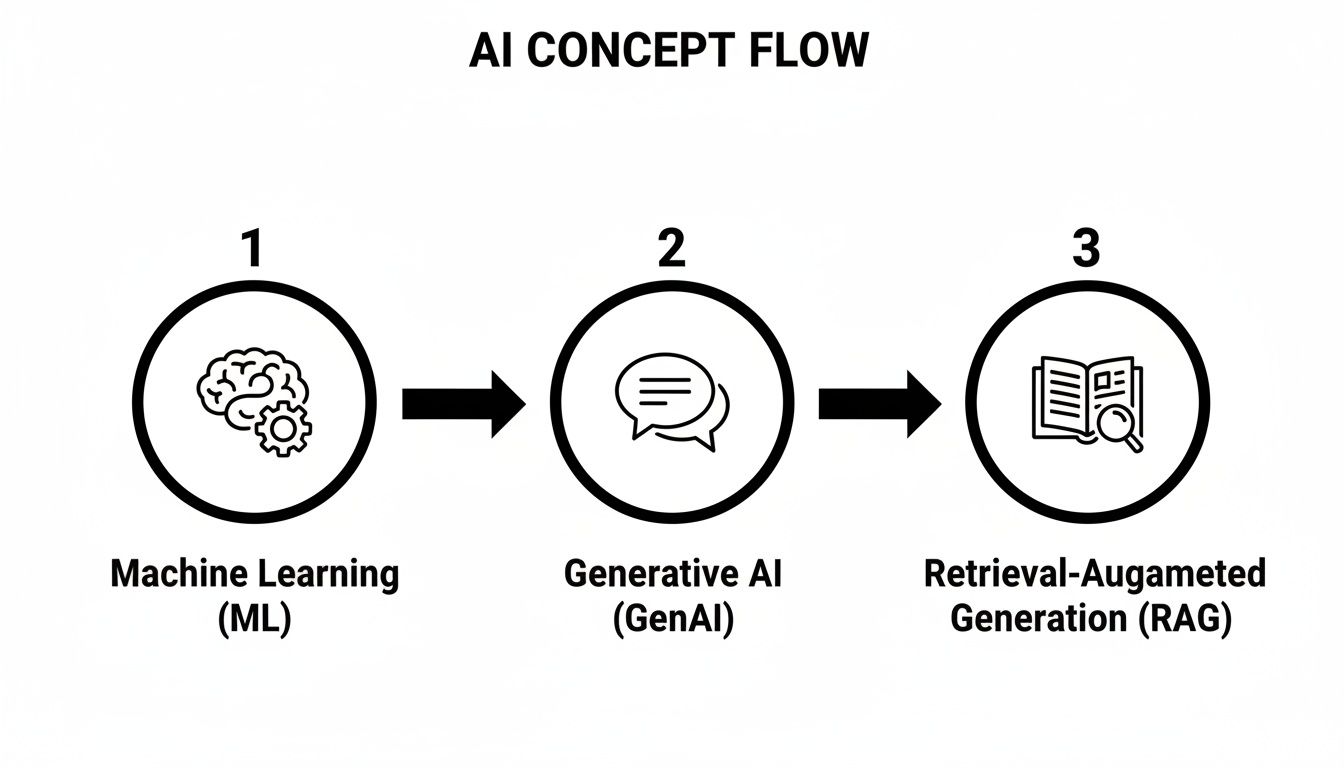
You can see the progression here: from foundational Machine Learning (ML) making predictions, to Generative AI creating brand new content, and finally to Retrieval-Augmented Generation (RAG), which grounds that creativity in a solid foundation of factual data.
Stage 1: Opportunity and Data Discovery
Before writing any code, ask the most important question: Do we actually need AI for this? It’s easy to get caught in the hype and apply AI to a problem where it doesn't belong. Always start with the user problem and the business goal. The best AI products solve a real pain point, not just a technical curiosity.
Once you’ve validated the opportunity, your focus must shift to data. Data is the lifeblood of any AI model.
- Data Availability: Do we have the data needed to train a model?
- Data Quality: Is our data clean, properly labeled, and a true representation of our users? Remember: biased data guarantees a biased product.
- Data Volume: Do we have enough of it? Many models require massive datasets to perform well.
Take Stripe’s fraud detection. It didn’t start with a groundbreaking algorithm; it started with their unique access to a gigantic, high-quality dataset of global transactions. That was their unfair advantage.
Stage 2: Model Selection and Training
With a clear opportunity and good data, you'll face a critical decision: build versus buy. Building a model from scratch isn't always the right answer.
- Buy (Use an API): For common tasks like text-to-speech or sentiment analysis, using an API from a provider like OpenAI or Google Cloud is almost always faster and cheaper. Your team can focus on integration instead of reinventing the wheel.
- Build (Custom Model): If your problem is unique to your business and your proprietary data is your competitive moat, then building a custom model might be worth the investment in time, money, and ML talent.
This stage is intensely iterative. Your data science team will run countless experiments with different models and training approaches. As the PM, your job is to be the anchor, ensuring all experimentation stays tethered to the product goals and user experience you defined in stage one.
Stage 3: Human-in-the-Loop Integration
AI models are rarely perfect out of the gate. That's why one of the most critical components of a successful AI product is a Human-in-the-Loop (HITL) system. This is a formal process for people to provide feedback that corrects, labels, and ultimately improves the model's performance over time.
Think of HITL as the direct feedback channel that teaches your AI. When Spotify’s Discover Weekly playlist serves up a song you can't stand, hitting "skip" is a powerful feedback signal. It helps refine future recommendations not just for you, but for everyone with similar taste.
As a PM, designing these feedback loops is a core product design task. Do you use simple thumbs up/down icons? A freeform text box? These aren't minor UI decisions; they directly determine the quality of the data you'll get back to make your model smarter.
Stage 4: Continuous Evaluation and Monitoring
With traditional software, you launch and then mostly monitor for bugs and uptime. For AI products, the launch is just the beginning. A model’s performance can—and will—drift over time as the real world changes. What worked perfectly in your test environment can start failing in unpredictable ways in production.
This means you need a rock-solid system for continuous evaluation.
- Performance Metrics: Keep a close eye on technical metrics like accuracy, precision, and recall.
- Business Metrics: More importantly, tie model performance back to the business outcomes that matter. Is that "better" recommendation model actually driving up user engagement and retention?
- Guardrail Metrics: You also need to monitor for unintended negative consequences, like fairness issues, harmful outputs, or other ethical blind spots.
This AI-centric approach is a new layer built on top of product management fundamentals. To see how these stages map to more traditional development, check out our breakdown of the classic product development lifecycle stages. This playbook is your guide for navigating the unique challenges of building intelligent products that evolve and deliver lasting value.
Essential Skills For The Modern AI Product Manager
To succeed as an AI Product Manager, you need to move beyond the standard PM playbook. The role now demands a potent mix of sharp analytical skills, strong technical intuition, and the ability to think strategically about ethical implications. This isn't about becoming a data scientist overnight; it's about building the right expertise to confidently lead complex, data-driven projects.
The demand for these skills is exploding. Generative AI job postings surged roughly 10x from mid-2023 to mid-2024—an unbelievable 75x jump in just two years. Industry data is clear: positions like 'AI product manager' are among the fastest-growing in tech, from Silicon Valley to Bangalore. Product School has more great insights on this career trend.
Let's break down the four pillars that every modern AI PM must master.
Pillar 1: Data Acumen
For a traditional PM, "data acumen" might mean reading a Mixpanel dashboard. For an AI PM, it’s a whole different ballgame. You must understand the entire data lifecycle and how each step dramatically affects your product’s performance and fairness.
You must be able to ask the hard questions about your data:
- Data Quality: Is this data clean, consistent, and labeled correctly? The old saying "garbage in, garbage out" isn't just a cliché in machine learning; it's an unbreakable law.
- Data Bias: Does our dataset reflect our user base? Or is it skewed in a way that will lead to unfair or discriminatory results? Remember, a model trained on biased data will always create a biased product.
- Data Relevance: Is this even the right data to solve the user's problem? Your job is to point the team toward sourcing and prepping data that ties directly to the goal you're trying to hit.
Pillar 2: Technical Intuition
No, you don't need to learn to code. But you absolutely must build a strong technical intuition. This means you can grasp what's possible with AI, understand the basic architecture of your system, and have credible conversations with your engineering team. This skill is a constant fixture in job descriptions from places like OpenAI and Google.
An AI PM with solid technical intuition can:
- Translate business needs into technical requirements that actually make sense.
- Understand the tradeoffs between different models, like choosing between a faster, less accurate one and a slower, more precise one.
- Ask smart, probing questions about a model's performance and its blind spots.
This intuition is your bridge to the engineering team. It builds trust and makes sure the product vision doesn't get lost in technical translation. Without it, you're flying blind.
Pillar 3: Ethical Judgment
AI products don't just sit there; they learn and act on their own in ways that traditional software never could. This opens up a Pandora's box of ethical risks around fairness, privacy, and accountability. As the PM, you are on the front lines of managing this. This isn't something you can pass off to the legal team after a crisis hits—it's a core part of your job from day one.
You need to be the one constantly asking the tough questions:
- How could someone misuse this feature to cause harm?
- What are the potential unintended side effects for different groups of users?
- How are we being transparent and giving users real control over their data?
At companies like Meta, PMs working on recommendation algorithms must think deeply about the societal ripple effects of their product's design. Ethical judgment has become a non-negotiable skill.
Pillar 4: Systems Thinking
Finally, an AI product isn't a static feature you ship and forget. It's a living, breathing system. A small tweak in one place—like updating a dataset or adjusting an algorithm—can cause unpredictable chaos somewhere else. Systems thinking is the ability to see how everything is interconnected.
You have to see your product as a continuous learning loop, not a finished piece of art. This means designing for constant feedback, watching for performance drift, and understanding how every user interaction is, in fact, training the model over time. You're managing a probabilistic system that is always learning—for better or for worse.
AI PM Skill Progression by Career Level
These skills evolve as you grow in your career. An entry-level PM will focus on the fundamentals, while a senior leader must think about these concepts at a much broader, strategic level.
The table below breaks down how these skills and responsibilities typically progress as an AI Product Manager moves up the career ladder.
| Skill Area | Aspiring / Entry-Level PM | Mid-Career PM | Senior / Principal PM |
|---|---|---|---|
| Data Acumen | Understands core concepts like data quality, labeling, and bias. Can articulate basic data requirements for a feature. | Defines data strategy for a product line. Proactively identifies and mitigates data bias in complex datasets. | Drives organizational data strategy. Champions data governance and quality standards across multiple product areas. |
| Technical Intuition | Grasps the difference between model types (e.g., classification vs. generation). Can participate in technical discussions with guidance. | Leads trade-off discussions (e.g., precision vs. recall, latency vs. accuracy). Understands model evaluation metrics deeply. | Influences technical architecture and model choices. Mentors other PMs on technical concepts and communicates with senior engineering leadership. |
| Ethical Judgment | Can identify obvious ethical risks (e.g., PII in training data). Follows established ethical guidelines. | Develops frameworks for assessing fairness and mitigating harm for their product. Leads pre-mortem and red-teaming exercises. | Sets the ethical vision and principles for the product organization. Engages with legal, policy, and external stakeholders on complex ethical issues. |
| Systems Thinking | Maps out the basic user feedback loop for an AI feature. Understands the concept of model monitoring. | Designs systems for continuous model improvement (A/B testing, online learning). Manages the full lifecycle of a model from training to deprecation. | Oversees a portfolio of interconnected AI systems. Anticipates second-order effects and long-term ecosystem impact of AI product decisions. |
Think of this as a roadmap for your own development. No matter where you are in your journey, there's always a next step to take in deepening your expertise and becoming a more effective leader in the world of AI products.
Your AI Toolkit: Prompts, Templates, and Must-Have Tools
Theory is one thing; getting your hands dirty is another. To thrive as a product manager working with AI, you need a go-to toolkit that helps you move faster and think smarter. This is your bookmarkable resource hub—packed with prompts you can copy and paste, my favorite tool recommendations, and a powerful evaluation template.
Think of these tools not as replacements for your own judgment, but as incredibly powerful assistants. They can handle the heavy lifting of synthesis, drafting, and analysis. This frees you up to focus on the truly human parts of product management: setting the vision, building empathy, and getting everyone aligned.
Actionable Prompts For Core PM Tasks
The quality of an AI’s output is a direct reflection of your input. It's that simple. Vague prompts give you generic, useless results. But specific, context-rich prompts generate genuine strategic assets.
Here are a few starter templates for tools like ChatGPT or Claude that you can adapt for your specific product challenges.
Example 1: Generating User Personas
Act as a Senior Product Manager at a B2B SaaS company. I am developing an AI-powered travel app that helps remote teams plan and book company offsites.
Using the following raw user interview notes [paste 3-5 snippets of user feedback here], generate three distinct user personas.
For each persona, include:
- A name and a role (e.g., 'Erin the Executive Assistant')
- Key goals related to team travel planning
- Major pain points with the current manual process
- A direct quote that captures their primary frustration
Example 2: Drafting a PRD Outline
Act as a Principal Product Manager. I need to draft a Product Requirements Document (PRD) outline for a new predictive analytics feature for our e-commerce platform.
The feature's goal is to predict customer churn risk based on user behavior data (e.g., login frequency, pages visited, purchase history).
Generate a comprehensive PRD outline that includes these specific sections:
- Problem Statement & User Pain Points
- Business Goals & Success Metrics (OKRs)
- Target User Persona
- User Stories & Functional Requirements
- Data Requirements & Sources
- Assumptions & Constraints
- Out-of-Scope Items
Curated AI-Native Tools For Your Workflow
Beyond general-purpose LLMs, a new class of AI-native tools is emerging to supercharge specific PM functions. Building these into your daily workflow can give you a serious edge. To build your toolkit well, it's smart to stay on top of the various AI tool options available and see how they stack up.
Here are a few top-tier tools I've seen teams at leading companies adopt:
- User Research Synthesis: Dovetail AI is a lifesaver for analyzing hours of user interview transcripts. It can automatically pull out key themes, cluster related insights, and find those perfect customer quotes. This literally saves teams dozens of hours of manual work.
- Roadmapping & Discovery: Jira Product Discovery now uses AI to help you connect product ideas directly to user feedback and business impact. It helps you turn a messy backlog into a prioritized, evidence-backed roadmap.
- Prototyping & Design: Uizard is pretty magical. You can go from a simple hand-drawn sketch to a high-fidelity, clickable prototype in minutes. Its AI generates screens, components, and themes from text prompts, which radically speeds up the whole ideation process.
For a deeper dive, our detailed guide on AI tools for product managers has a much more extensive list and analysis.
The AI Feature Evaluation Checklist
Not every problem needs an AI solution. A critical pm ai skill is knowing when to apply this powerful—but expensive—technology. Use this checklist before committing engineering resources.
Key Takeaway: Your goal is not to ship AI features. It's to solve customer problems in the most effective way possible. Sometimes, a simpler, non-AI solution is the right answer.
AI Feature Evaluation Checklist:
- Viability (The Business Case): Does this AI feature actually align with our core business strategy? Can we clearly measure its impact on a key metric like revenue, retention, or engagement?
- Feasibility (The Technical Case): Do we have access to the right volume and quality of data to train this model? Do we have the talent in-house, or will we need to buy a third-party solution?
- Desirability (The User Case): Does this feature solve a real, high-value user problem in a way that’s way better than what they do now? Is the UX intuitive, or does it force users to completely change their behavior?
- Ethical Considerations: Have we considered potential biases in our data? What are the risks of the model producing harmful outputs, and how will we stop that from happening?
Leading AI Teams And Managing Stakeholder Expectations
As a PM on an AI project, your role becomes less about writing specs and more about being an educator and translator. Your stakeholders, from the C-suite to the marketing team, won't have the same nuanced understanding of the technology as you and your team. Your success depends on your ability to manage their expectations, get genuine buy-in, and protect your team from unrealistic demands.
The organizational model I've seen work best is the dedicated AI 'pod'—a small, cross-functional crew typically made up of a PM, an ML engineer, a data scientist, a designer, and a software engineer. This tight-knit structure keeps communication direct and everyone laser-focused on a single AI-driven outcome.
Translating Probabilities Into Business Certainty
One of the toughest parts of your job is explaining the probabilistic nature of AI. Stakeholders are accustomed to deterministic software—you click a button, and the exact same thing happens every time. AI doesn't work that way.
You must shift the conversation away from technical jargon and anchor it firmly in business impact. For instance, instead of saying, "The model has a 95% precision rate," you need to reframe that for a business leader:
"This fraud detection feature will correctly flag 95 out of every 100 fraudulent transactions. That means we can expect to prevent an estimated $2.1M in losses next quarter, even though it will occasionally miss one."
This approach connects the model's performance to a real, tangible business outcome. It acknowledges imperfection while highlighting the massive value it delivers. This is a critical skill, especially when you need to present your AI strategy to executives.
The pressure on PMs is intense. A recent Atlassian report found that 84% of teams are worried their current products won't succeed, and product leaders are spending over 66% of their week on manual tasks. That's not sustainable. AI is the only way to automate that grunt work and get back to focusing on strategy.
Securing Buy-In For Ambitious Projects
To get the green light for a major AI investment, you have to speak the language of ROI. Your pitch can’t just be about cool technology; it must be about building a competitive advantage and delivering clear financial returns.
Use this simple framework for your next executive pitch:
- The Cost of Inaction: "If we don't build this recommendation engine, we project a 5% churn increase over the next year as competitors with better personalization steal market share. This represents a potential loss of $3M in ARR."
- The Projected Upside: "By implementing this feature, we project a 10% increase in user engagement and a 2% lift in average order value, leading to a net revenue gain of $4.5M in the first year."
- The Strategic Moat: "This isn't just a feature; it’s a data asset. The more users interact with it, the smarter our system gets, creating a powerful competitive moat that becomes harder for others to replicate over time."
Common PM AI Questions Answered
Pivoting into AI product management brings up a lot of questions. I hear them all the time from PMs trying to make the leap. Let's tackle the big ones with straight, actionable advice.
Do I Need To Learn To Code To Become An AI PM?
No, you absolutely do not need to become a programmer. Full stop.
But you do need to build what I call ‘technical intuition.’ This isn't about writing Python; it's about understanding the moving parts—machine learning models, data pipelines, APIs—at a conceptual level.
Your job is to know what’s possible, ask the right questions, and translate business needs into a clear brief for your engineering team. Focus on learning the language and strategic trade-offs of AI, not the syntax.
How Do I Get My First AI PM Job With No Direct Experience?
You have to start "AI-ifying" your current job. Don't wait for a new title.
- Automate Your Own Work: Use tools like ChatGPT to handle your own grunt work, like summarizing user research or writing first drafts of PRDs. Then, document the efficiency gains with actual numbers.
- Lead a Small AI Project: Find a low-risk internal problem and champion an AI-powered solution. Even integrating an existing API from a provider like OpenAI shows you can take initiative and lead.
- Reframe Your Resume: Filter your experience through an AI lens. Highlight your data analysis skills, your ability to think in systems, and how you’ve led teams through ambiguous projects. That's the core of the AI PM role.
Hiring managers care more about seeing you apply AI thinking to real problems than they do about a course certificate. Build that track record now.
What Is The Biggest Mistake PMs Make With AI Products?
The single biggest, most expensive mistake is ‘tech-first’ thinking. This is the classic "solution in search of a problem." A team gets mesmerized by the latest, coolest LLM and then runs around trying to jam it into the product somewhere.
An effective AI PM is technology-agnostic but customer-obsessed. You always, always start with a deep understanding of the user's pain point. Only after you’ve nailed that do you ask, "Is AI the most effective, scalable, and defensible way to solve this?"
Your job isn't to be an AI evangelist. It's to be a ruthless champion for the user. Never let shiny new tech distract you from what your customers actually need.
Ready to accelerate your career and master the skills that define the next generation of product leaders? The Aakash Gupta newsletter and podcast provide the expert insights, frameworks, and career strategies you need to excel in the age of AI.
Join thousands of PMs from top tech companies and get the guidance to not just keep up, but to lead. Subscribe now to get actionable advice delivered directly to your inbox.
