Forget the abstract theories. In today's market, career growth for both aspiring and seasoned Product Managers hinges on mastering a core set of actionable disciplines. As a product leader who has hired and mentored talent at companies like Google and Meta, I've seen firsthand what separates the top 1% from the rest. It's not about knowing the jargon; it's about applying specific, battle-tested systems. This guide isn't another theoretical overview; it's a tactical playbook designed for immediate application.
We will break down the 10 essential product management best practices that top-tier PMs use daily to build impactful products and accelerate their careers. This is the operational system for excellence in product, moving beyond simple definitions into the "how" and "why." You will learn the specific methods for conducting customer-centric discovery, the frameworks for ruthless prioritization, and the communication strategies that secure stakeholder buy-in.
Each section is designed to give you concrete frameworks, real company examples, and implementation steps you can apply within the next 48 hours. Our goal is to equip you with the tools to demonstrate immediate value, whether you're aiming for your first PM role or your next promotion to Director. This article will serve as a resource you can bookmark and reference repeatedly as you navigate the complexities of product development. Let's move beyond the buzzwords and into the practical skills that define elite product management.
1. Customer-Centric Product Discovery
At the heart of all exceptional product management best practices lies a non-negotiable principle: you cannot build a valuable product for a user you do not understand. Customer-Centric Product Discovery is a continuous and structured process for deeply understanding user needs, motivations, and pain points before a single line of code is written. It shifts the focus from building features to solving real, validated problems, dramatically reducing wasted engineering cycles and increasing the likelihood of achieving product-market fit.
This approach, championed by thought leaders like Teresa Torres and Marty Cagan, moves teams away from assumption-based roadmaps. Instead, it prioritizes direct, ongoing engagement with customers through interviews, surveys, and observation to uncover unmet needs and opportunities.

Why It Works and How to Implement It
The core benefit is de-risking product development. By validating problems upfront, you ensure you’re building something people actually want. For instance, Amazon’s famous ‘working backwards’ process forces teams to write a press release for a product before development begins. This simple exercise crystallizes the customer benefit and value proposition, ensuring every subsequent decision serves that end goal. Similarly, Airbnb's founders famously lived with their hosts to intimately understand their experiences, a practice that directly shaped their platform's foundational features.
"Fall in love with the problem, not the solution." – Marty Cagan, Author of Inspired
Actionable Steps for Implementation:
- Schedule Weekly Customer Conversations: Block off time every week for your product trio (PM, Designer, Tech Lead) to speak with at least one customer. Use tools like UserTesting.com (starts ~$20k/year) or Respondent.io (pay-per-interview) to find participants if you don't have a direct channel.
- Master Open-Ended Questions: Avoid leading questions like "Would you use a feature that does X?" Instead, ask "Tell me about the last time you tried to accomplish Y" to uncover their actual behaviors and workarounds.
- Build a Research Repository: Use a tool like Dovetail, Condens, or even a shared Notion database to centralize all customer interview notes, recordings, and survey results. Make it accessible to the entire company to foster a shared understanding of the user.
- Observe, Don't Just Listen: Distinguish between what customers say they want and what their actions reveal. Usability tests and session recordings can expose pain points that users may not even be able to articulate.
2. Data-Driven Decision Making
While understanding the customer provides the "why," data-driven decision making provides the "what" and "how much." This core discipline among product management best practices involves using quantitative metrics, analytics, and controlled experiments to inform decisions, moving beyond intuition and personal opinion. It’s the practice of formulating a hypothesis, testing it with real user behavior, and using the results to guide the product roadmap, ensuring every change is measurable and impactful.
This approach, popularized by tech giants like Google and Netflix and formalized by movements like Lean Startup, treats product development as a scientific process. It relies on a robust data infrastructure and a culture of experimentation to validate assumptions, optimize user experiences, and objectively measure progress toward business goals.

Why It Works and How to Implement It
The fundamental benefit is a massive reduction in risk and resource waste. Instead of debating feature ideas in a conference room, teams can let user behavior reveal the most effective path forward. For example, Booking.com runs thousands of A/B tests concurrently, allowing them to continuously optimize conversion rates with high statistical confidence. Similarly, Spotify uses deep data analysis of listening habits to power its hyper-personalized playlists like Discover Weekly, a key feature that drives user engagement and retention.
"If we have data, let’s look at data. If all we have are opinions, let’s go with mine." – Jim Barksdale, former CEO of Netscape
Actionable Steps for Implementation:
- Define Success Metrics First: Before starting development on any new feature, define the key metrics you expect it to move. For example, will this increase user retention, decrease churn, or improve a specific conversion funnel?
- Establish Leading and Lagging Indicators: Track lagging indicators like revenue or monthly active users, but focus your team's day-to-day efforts on leading indicators you can directly influence, such as weekly feature adoption or task completion rates.
- Instrument and Analyze: Use product analytics tools like Amplitude, Mixpanel, or Heap to track user behavior. Set up dashboards to monitor key funnels and user segments, making data accessible to your entire team.
- Run Controlled Experiments: For any significant change, run an A/B test to isolate its impact. Use a clear hypothesis format ("We believe that changing X for Y will result in Z") and pre-determine your statistical significance threshold. Use tools like Optimizely or build an in-house solution.
3. Outcome-Based Roadmapping
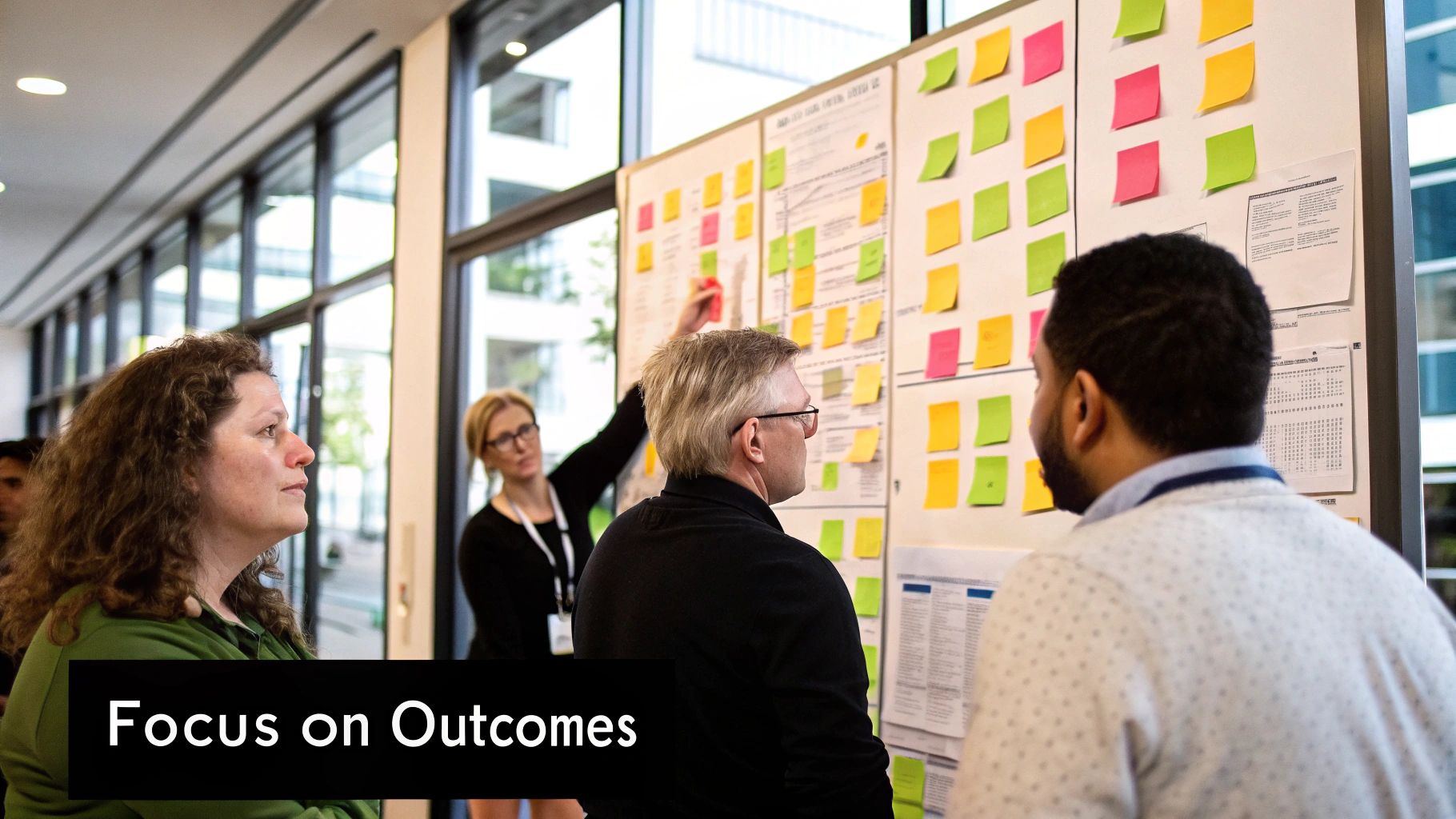
Traditional product roadmaps often become a laundry list of features and timelines, trapping teams in a cycle of "shipping" rather than "solving." Outcome-Based Roadmapping fundamentally flips this model. Instead of committing to building a specific solution, this approach commits to achieving a measurable customer or business outcome, providing one of the most essential product management best practices for agile, high-impact teams.
This methodology, advocated by leaders like John Cutler and Janna Bastow, shifts the conversation from outputs ("build a new dashboard") to outcomes ("reduce customer support tickets by 15%"). It empowers product teams to explore, test, and iterate on the best possible solution to achieve a defined goal, fostering genuine innovation and preventing wasted resources on features that don't move the needle.
Why It Works and How to Implement It
The primary benefit of outcome-based planning is strategic flexibility. It aligns the entire organization around solving problems, not just hitting deadlines. For example, Google’s renowned OKR (Objectives and Key Results) system is built on this principle. A product team’s objective might be to "Improve new user engagement," with a key result of "Increase Week 1 retention by 10%." How they achieve that KR is up to them, encouraging experimentation and discovery rather than rigid adherence to a pre-defined feature list. Spotify’s use of mission-based squads and bets embodies a similar philosophy.
"Product roadmaps should be a statement of intent and direction, not a Gantt chart of features." – Janna Bastow, Co-founder of ProdPad
Actionable Steps for Implementation:
- Frame Initiatives as Problems: Start every roadmap discussion with the question, "What customer problem or business opportunity are we trying to address?" Ensure every item is linked to a clear "why."
- Define Success Metrics First: Before a single solution is proposed, agree on the key metrics that will prove success. This ensures alignment and provides a clear benchmark for evaluating different ideas.
- Adopt a Now, Next, Later Framework: Replace rigid date-based roadmaps with a fluid structure. Now covers high-confidence work for the current cycle, Next outlines priorities for the upcoming cycle, and Later contains validated problems for future exploration. Use tools like Productboard or Aha! to manage this visually.
- Communicate Roadmaps as Themes and Bets: Present your roadmap to stakeholders as a series of strategic themes and bets you are making to achieve key outcomes. This manages expectations and frames the work as a learning process, not a list of guaranteed deliverables.
4. Continuous Product Discovery
Where traditional product management often treats discovery as a distinct, upfront phase, the modern best practice is to embrace it as an ongoing, parallel activity. Continuous Product Discovery is the process of consistently engaging with customers to understand their needs, test assumptions, and validate ideas throughout the entire product development lifecycle. It ensures that learning and building happen in tandem, not sequentially.
This approach, popularized by thought leaders like Teresa Torres, moves teams from a project-based mindset to a continuous feedback loop. It's about making small, frequent bets based on direct customer input, rather than placing large, risky bets based on quarterly plans. This methodology is fundamental to creating products that evolve with user needs, making it a cornerstone of effective product management best practices.
Why It Works and How to Implement It
The primary benefit is a drastic reduction in the risk of building the wrong thing. By maintaining a constant pulse on customer problems, teams can pivot quickly and efficiently. For example, Figma's product development is deeply intertwined with its user community; their active engagement and beta testing programs allow them to co-create features with real users, ensuring new releases land with immediate value. Similarly, Atlassian’s regular customer advisory boards provide a direct channel for validating their roadmap against the evolving needs of their power users. For those looking to dive deeper, you can explore more about balancing agility and effectiveness in product discovery.
"The goal of discovery is not to create a specification. It’s to create a shared understanding." – Jeff Patton, Author of User Story Mapping
Actionable Steps for Implementation:
- Schedule Weekly Discovery Time: Block 2-3 hours on the calendar each week dedicated solely to discovery activities like customer calls, prototype testing, or assumption mapping. Protect this time fiercely.
- Involve the Product Trio: Ensure the Product Manager, Designer, and Engineering Lead participate in discovery activities together. This builds a shared context and accelerates decision-making.
- Create a Discovery Backlog: Maintain a separate backlog of assumptions, questions, and opportunities to investigate. This runs parallel to your delivery backlog and feeds it with validated ideas.
- Test with Low-Fidelity Prototypes: Validate concepts using the simplest possible artifact, whether it's a sketch, a wireframe, or a text-based prompt. Use a tool like Balsamiq for wireframes or Figma for interactive prototypes. This maximizes learning while minimizing investment.
5. Cross-Functional Collaboration and Product Trios
Building products in a silo is a recipe for failure. One of the most impactful product management best practices is to embed collaboration directly into the team structure. This approach moves away from linear, waterfall-style handoffs and instead champions a model where product managers, designers, and engineers work as a unified, empowered team from discovery through delivery. This powerful dynamic is often called the 'product trio'.
Popularized by thought leaders like Teresa Torres, the product trio ensures that business, user experience, and technical perspectives are continuously balanced. By working together on problems from day one, the team reduces miscommunication, eliminates costly rework, and builds a shared sense of ownership over the outcomes, not just the output.
Why It Works and How to Implement It
The fundamental benefit of the product trio is speed and quality. When engineers understand the 'why' behind a customer problem and designers understand the technical constraints, the team can iterate toward a viable, feasible, and desirable solution much faster. Spotify's renowned squad model is a prime example, where small, autonomous, cross-functional teams have the authority to solve user problems as they see fit, driving both innovation and accountability.
As cross-functional collaboration increasingly spans geographical boundaries, mastering the art of managing remote product teams becomes critical to maintaining this high-bandwidth communication and shared context, regardless of physical location.
"We need teams of missionaries, not teams of mercenaries." – John Doerr, Author of Measure What Matters
Actionable Steps for Implementation:
- Establish a Trio Cadence: Schedule dedicated, recurring meetings for the product trio (PM, Design, Tech Lead) at least twice a week to review discovery insights, discuss potential solutions, and align on next steps.
- Include Engineers in Discovery: Make it a rule that engineers join customer interviews and research sessions. This first-hand exposure to user pain points is invaluable and builds deep empathy that informs better technical decisions.
- Create a Shared Workspace: Use tools like Miro, Figma, or a dedicated Slack channel to create a central, transparent hub for all discovery work, prototypes, and technical discussions. This ensures everyone has access to the same information.
- Define Decision-Making Frameworks: Not every decision requires consensus. Use a framework like RACI (Responsible, Accountable, Consulted, Informed) or DACI (Driver, Approver, Contributor, Informed) to clarify who makes which calls, preventing bottlenecks.
6. Ruthless Prioritization and Strategic Saying No
One of the most defining product management best practices is the disciplined art of focusing on what truly matters. Ruthless Prioritization is not just about making a list; it is the strategic practice of channeling finite resources toward the highest-impact opportunities while actively and transparently declining requests, even seemingly good ones. It means accepting that you cannot do everything and that true progress comes from doing fewer things better.
This philosophy, famously embodied by Steve Jobs’s radical simplification of Apple's product line upon his return, shifts a product team from a reactive "feature factory" to a proactive, outcome-driven unit. By establishing a clear, defensible 'why' behind every 'yes', you also create a powerful framework for every strategic 'no'.
Why It Works and How to Implement It
The primary benefit is focus and velocity. A team trying to do ten things at once will accomplish little, but a team focused on one or two critical initiatives can achieve significant breakthroughs. For example, 37signals (now Basecamp) built its entire business on the philosophy of shipping simpler, more focused products than its competitors. They strategically say 'no' to feature requests that would add complexity, allowing them to maintain a lean team and a profitable product.
This approach prevents resource fragmentation and ensures engineering, design, and marketing efforts are concentrated on initiatives that directly drive key business outcomes. It transforms the product manager from a request-taker to a strategic leader. For a deeper dive into specific frameworks, you can learn how to prioritize a product roadmap.
"People think focus means saying yes to the thing you’ve got to focus on. But that’s not what it means at all. It means saying no to the hundred other good ideas that there are." – Steve Jobs
Actionable Steps for Implementation:
- Adopt a Framework (and Stick to It): Consistently use a prioritization framework like RICE (Reach, Impact, Confidence, Effort) or Value vs. Effort to bring objectivity to decisions. This gives you a data-informed way to compare disparate ideas.
- Explain the 'Why,' Not Just the 'No': When declining a stakeholder's request, never just say "no." Instead, say "not now, and here's why." Explain the trade-offs by showing them what the team is working on instead and why that work has a higher strategic priority.
- Create a "Parking Lot" or "Maybe/Later" List: Acknowledge good ideas without derailing the current roadmap. A dedicated list shows stakeholders their ideas are valued and captured, even if they aren't being actioned immediately.
- Quantify Opportunity Cost: Frame your priorities in terms of what the business loses by pursuing lower-impact work. For example, "If we build feature X for this one client, we delay feature Y, which our data suggests will reduce churn by 3%."
- Limit Work-In-Progress (WIP): Cap the number of major initiatives your team works on at any given time to two or three. This forces hard choices and ensures projects are actually completed and shipped.
7. Rapid Prototyping and Iterative Development
The most expensive way to discover if an idea is bad is to build the full, production-ready version of it. Rapid Prototyping and Iterative Development is a core product management practice that systematically avoids this costly mistake. It centers on creating tangible, testable, and low-fidelity versions of a concept quickly to gather user feedback before committing significant engineering resources. This approach isn't about shipping unfinished products; it's about maximizing the rate of learning.
This philosophy, heavily influenced by Eric Ries's Lean Startup methodology and IDEO's design thinking principles, embraces failure as a learning opportunity. By building, measuring, and learning in tight, fast cycles, teams can methodically de-risk their assumptions and steer their solutions toward what users truly need and value, ensuring every development cycle adds validated customer value.
Why It Works and How to Implement It
The fundamental benefit is speed-to-learning. This practice shortens the feedback loop from months to days, allowing teams to pivot or persevere with high confidence. For example, Dropbox famously validated its entire concept with a simple explainer video MVP. The video demonstrated the proposed functionality, and the resulting sign-up explosion proved market demand before they had a working product. Similarly, Buffer tested its core value proposition with a simple landing page that collected email sign-ups, confirming people wanted the solution before a single line of code was written.
"The only way to win is to learn faster than anyone else." – Eric Ries, Author of The Lean Startup
Actionable Steps for Implementation:
- Define Your Hypothesis: Before building anything, clearly state what you believe to be true. For example: "We believe users will sign up for a premium plan if we offer automated report generation."
- Choose the Right Fidelity: Start with paper sketches or low-fidelity wireframes in a tool like Balsamiq to test concepts and flows. Progress to high-fidelity, interactive prototypes in Figma or Framer only after validating the core idea.
- Timebox Your Efforts: Constrain prototype creation to hours or a few days, not weeks. This forces a focus on the most critical assumptions you need to test and prevents premature optimization.
- Test with a Small User Group: You can uncover the vast majority of usability issues by testing your prototype with just 5-7 target users. Focus on observing their behavior rather than listening to their opinions.
8. Regular Stakeholder Communication and Alignment
A brilliant product strategy executed in a vacuum is destined for failure. Regular Stakeholder Communication and Alignment is a systematic, proactive process for keeping leadership, cross-functional partners, and other key stakeholders informed on product strategy, progress, and key decisions. It transforms communication from a reactive, ad-hoc activity into a structured discipline that builds trust, manages expectations, and prevents the costly misalignments that derail projects.
This approach, emphasized by leaders like Ken Norton and Shreyas Doshi, moves teams away from surprise announcements and siloed work. Instead, it fosters a culture of transparency where feedback is a continuous loop, ensuring the product team’s efforts remain tightly coupled with broader business objectives and market realities.
Why It Works and How to Implement It
The primary benefit is building political capital and organizational momentum. When stakeholders feel heard and informed, they become advocates rather than obstacles. Amazon's famous PR/FAQ process is a prime example of proactive alignment; it forces teams to articulate value and address stakeholder concerns before significant resources are invested. Similarly, Spotify's bi-weekly product demos, open to the entire company, create a shared sense of progress and purpose, turning launches into company-wide celebrations rather than last-minute scrambles.
"Communicate with a crisp and regular cadence. Don’t be a black box." – Shreyas Doshi, Product Advisor
Actionable Steps for Implementation:
- Establish a Communication Cadence: Create a predictable schedule. This could be a weekly email update for the core team, a monthly deep-dive for leadership, and quarterly business reviews for executive sponsors.
- Create a Stakeholder Map: Identify all key stakeholders and categorize them by their interest level and influence. Tailor the frequency, format, and depth of your communication for each group.
- Lead with Outcomes, Not Activities: Structure updates around progress toward goals (OKRs) and key customer insights, not just a list of completed tasks. Explain the "so what" behind your team's work.
- Document and Centralize Decisions: Use a shared space like Confluence or Notion to document key decisions, meeting notes, and strategy documents. This creates a single source of truth and reduces repetitive questions. For a powerful method of visualizing and communicating your product strategy, you can explore OKP-based roadmaps.
9. Product Analytics and Instrumentation from Day One
One of the most impactful product management best practices is treating data not as an afterthought, but as a foundational component from the very beginning. Product Analytics and Instrumentation from Day One is the discipline of building comprehensive tracking and measurement capabilities into your product from its initial release. This ensures that every feature launch and user interaction generates data, enabling rapid, evidence-based decisions about user behavior and product performance.
This practice moves teams away from making decisions based on gut feelings or anecdotal evidence. Instead, it embeds a culture of quantitative learning directly into the development lifecycle. By instrumenting core user journeys and critical events before launch, you create a feedback loop that immediately tells you what's working and what isn't, dramatically accelerating your path to product-market fit.
Why It Works and How to Implement It
The primary benefit is eliminating the "I don't know" factor post-launch. Without data, you can't definitively answer why a feature is failing or how a change impacted user retention. For example, LinkedIn's hyper-growth was fueled by meticulous event tracking on every interaction, allowing their growth teams to identify and optimize the key actions that led to user activation and engagement. Similarly, Airbnb's robust experimentation platform, built on comprehensive analytics, enables them to run thousands of A/B tests concurrently, validating every significant product change with real user data.
"What you measure is what you’ll end up optimizing for. If you don’t measure it, you can't improve it." – A common saying in data-driven product circles.
Actionable Steps for Implementation:
- Define a Tracking Plan First: Before writing any implementation code, create a simple document outlining what you need to measure. Define key user funnels (e.g., signup, activation, purchase) and the specific events within them.
- Instrument the Core Journey: Don't try to track everything at once. Focus on the most critical user actions that define success for your product. Track both success states (e.g.,
_purchase_completed_) and failure states (e.g.,_payment_failed_). - Use a Consistent Naming Convention: Implement a clear, simple naming convention for your events (e.g.,
Object_Action_Context). This makes your data understandable and usable for everyone in the company, not just engineers. - Test Your Analytics: Just as you test features, you must test your analytics implementation. Use tools like Amplitude's or Mixpanel's live event viewers to confirm events are firing correctly with the right properties before you release to users.
10. Building and Leveraging Product Strategy
A product strategy is the connective tissue that links a company's high-level vision to the daily execution of the product team. It is a documented, coherent set of choices that define where to play and how to win, providing a clear rationale for why specific initiatives will lead to desired business outcomes. This crucial practice moves teams beyond a reactive, feature-factory mindset to proactive, strategic decision-making, ensuring that every effort is a deliberate step toward a defined goal.
Great strategy, as outlined by experts like Richard Rumelt and Gibson Biddle, isn't a vague wish list. It's a focused plan that diagnoses a challenge, establishes a guiding policy to address it, and outlines coherent actions to carry out that policy. It forces clarity and alignment, becoming the ultimate tool for resolving prioritization debates and empowering autonomous teams.
Why It Works and How to Implement It
The power of a clear strategy lies in what it enables you to say "no" to. By defining a specific path to victory, it makes trade-offs explicit and prevents resources from being scattered across disconnected opportunities. For example, Netflix’s early strategy to dominate streaming involved a conscious decision not to compete with cable bundles on live sports, focusing every resource on building a superior on-demand content library and experience. Similarly, Microsoft’s "cloud-first, mobile-first" pivot under Satya Nadella was a powerful strategy that re-oriented the entire company, dictating everything from acquisitions to engineering priorities.
"Good strategy is not a long list of things to do. It is a thoughtful and focused approach to tackling a critical challenge." – Richard Rumelt, Author of Good Strategy/Bad Strategy
Actionable Steps for Implementation:
- Follow a Framework: Use a structured framework like Roger Martin's "Playing to Win" or Gibson Biddle's DHM (Delight Customers, Hard-to-Copy, Margin-Enhancing) model to guide your strategy development. This ensures you cover all critical components.
- Write It as Testable Hypotheses: Frame your strategic pillars as "If we do X, then we expect Y to happen because of Z." This makes your strategy measurable and falsifiable, not just a set of aspirational statements.
- Connect Strategy to Execution: Directly link your quarterly objectives and key results (OKRs) back to your product strategy. Every key result should clearly advance a specific strategic pillar. When building and leveraging a robust product strategy, it's essential to understand various business models and how to implement effective revenue optimization strategies.
- Communicate and Reference It Constantly: A strategy document that sits in a folder is useless. Make it a living document. Refer to it in every roadmap meeting, planning session, and feature debate to ensure it guides real-world decisions.
Top 10 Product Management Best Practices Comparison
| Approach / Practice | Implementation Complexity 🔄 | Resource Requirements ⚡ | Expected Outcomes 📊 | Ideal Use Cases 💡 | Key Advantages ⭐ |
|---|---|---|---|---|---|
| Customer-Centric Product Discovery | High – Time-intensive; needs skilled researchers | Dedicated research team; continuous customer access | Higher product-market fit; validated assumptions early | Products needing deep customer understanding; early-stage | Reduces risk; increases loyalty; deep customer insight |
| Data-Driven Decision Making | High – Requires advanced analytics setup | Technical infrastructure; data analysts | Objective decision-making; measured impact | Data-rich environments; scaling products | Removes bias; clear metrics; scalable decisions |
| Outcome-Based Roadmapping | Medium – Requires cultural shift and strong communication | Cross-functional alignment and flexible planning | Focus on measurable business and customer outcomes | Strategic planning; adaptable roadmaps | Encourages creativity; reduces feature factory; adaptive |
| Continuous Product Discovery | High – Ongoing discipline; regular customer engagement | Consistent team time and organizational support | Reduced risk; faster pivots; shared team understanding | Agile teams focused on iterative learning | Continuous validation; prevents tunnel vision; team alignment |
| Cross-Functional Collaboration and Product Trios | Medium to High – Coordination effort across roles | Time investment across PM, design, engineering | Higher solution quality; faster delivery | Multidisciplinary teams aiming for alignment | Diverse perspectives; reduces rework; accelerates delivery |
| Ruthless Prioritization and Strategic Saying No | Medium – Requires firm decision frameworks and communication | Leadership time and stakeholder management | Focused execution; maximized impact | Resource-constrained environments; managing competing priorities | Maximizes impact; prevents overload; builds discipline |
| Rapid Prototyping and Iterative Development | Medium – Requires quick design and test cycles | Design and user testing resources | Faster time-to-market; validated ideas | Early validation; fast-learning cycles | Cheap validation; reduces risk; enables pivoting |
| Regular Stakeholder Communication and Alignment | Medium – Needs scheduled communication routines | Time for updates, meetings, documentation | Increased trust; reduced surprises | Complex stakeholder environments; cross-functional teams | Builds credibility; facilitates decisions; improves coordination |
| Product Analytics and Instrumentation from Day One | High – Upfront engineering and ongoing maintenance | Engineering and analytics tooling | Data-driven insights; rapid problem identification | Products requiring robust analytics from launch | Evidence-based decisions; trend analysis; supports optimization |
| Building and Leveraging Product Strategy | Medium to High – Requires strategic thinking and alignment | Cross-functional leadership involvement | Clear decision framework; aligned organization | Long-term planning; competitive markets | Clarity; prioritization; reduces wasted effort |
From Practice to Mastery: Your Next Steps
We've explored ten foundational product management best practices that separate high-impact teams from the rest. From embedding customer discovery into your weekly rhythm to crafting an outcome-based roadmap, each principle is a lever you can pull to drive meaningful results. The common thread is a shift from reactive task management to proactive, strategic leadership.
Great product management isn't about having a single revolutionary idea. It's about the disciplined, consistent application of these systems day in and day out. It’s the PM who insists on one more customer interview before finalizing requirements, the one who meticulously instruments a feature before launch, and the one who has the courage to say "no" to a stakeholder request to protect the product vision.
Turning Knowledge into Actionable Skill
Reading about product management best practices is the easy part. The real challenge, and where career growth accelerates, is in the implementation. The path from a good PM to a great PM, the kind of PM who gets hired at top-tier companies like Google or Meta and commands a top-decile salary (typically $250k+ in major US tech hubs, according to Levels.fyi), is paved with deliberate practice.
Don’t try to boil the ocean. Your goal for the next 90 days should be to internalize just one of these practices. Choose the area where you or your team faces the most friction and commit to a systematic change.
Here are some concrete starting points:
- If you struggle with focus: Implement a ruthless prioritization framework from item #6. For the next month, force-rank every new initiative using a RICE score (Reach, Impact, Confidence, Effort) in a shared spreadsheet. Document every "no" and the strategic reason behind it.
- If you feel disconnected from users: Block off two hours on your calendar every single week, dedicated solely to customer conversations as outlined in item #1. No exceptions. Use a specific AI prompt in ChatGPT or Claude to synthesize your interview notes: "Act as a senior product manager. Review the following customer interview transcript and extract 3-5 key insights, unmet needs, and direct user quotes that highlight pain points. Format as a one-page summary for my engineering team."
- If your roadmap feels like a feature factory: Rework your next quarterly roadmap using the outcome-based model from item #3. Instead of listing features, define the key customer or business outcome you aim to influence (e.g., "Increase new user activation by 15%") and frame your initiatives as experiments to achieve it.
- If data feels like an afterthought: Before writing a single line of code for your next feature, create a detailed instrumentation plan as detailed in item #9. Define the key user actions to track and the success metrics you'll monitor from day one.
The Compounding Effect of Excellence
Mastering these concepts is not merely about shipping better products; it's about building a reputation as a world-class product leader. When you can confidently walk into an interview and describe how you used a rapid prototyping loop to de-risk a major launch or how your stakeholder communication cadence prevented a last-minute fire drill, you are demonstrating a level of operational excellence that sets you apart.
The journey to becoming a top 1% product manager is a marathon, not a sprint. It’s built on a foundation of solid habits and a relentless commitment to improvement. Pick your focus, apply the frameworks we've discussed, measure your progress, and then move on to the next. By embedding these product management best practices into your core workflow, you transform them from abstract concepts into the very engine of your career growth and product success.
For ongoing, deep-dive analysis into these topics from a PM leader who has hired and mentored hundreds of Product Managers, I highly recommend the newsletter and podcast by Aakash Gupta. His work provides the specific, tactical advice needed to navigate the modern PM career and is a staple resource for top performers. You can find his invaluable insights at Aakash Gupta.
