A product management career is about steering a product to success, from the first spark of an idea to its launch and beyond. This path offers incredible growth, taking you from hands-on execution to shaping a company's entire product vision. As a PM leader who has hired and mentored hundreds of PMs, I can tell you it's one of the most rewarding and impactful careers in tech today.
This guide provides an actionable framework for navigating your career, whether you're breaking in or climbing to the C-suite. We'll cover the career ladder, salary benchmarks, and the critical skills you need at each stage, with a special focus on the rise of the AI Product Manager.
What Is The Product Management Career Path?
Think of a Product Manager as the CEO of a product. Early on, you’re focused on a single feature. As you grow, you start leading a whole product line. Eventually, you're responsible for the company's full product portfolio. An early-career PM at a company like Meta might spend their time optimizing the user onboarding flow for a single app. A decade later, that same person could be a VP of Product at Google, deciding which new global markets the entire Google Workspace suite should enter.
This journey from tactical execution to strategic leadership is the heart of the product management career path. It’s a ladder that rewards you for your growing ability to influence outcomes, navigate complexity, and drive real business results.
From Tactical Execution To Strategic Ownership
The climb up the PM ladder is fundamentally about shifting your scope and impact. Your focus moves from the "how" (execution) to the "what" (product strategy), and eventually, to the "why" and "where next" (portfolio and company vision).
Here’s a breakdown of what that evolution looks like.
The Product Management Career Ladder
The journey from an entry-level PM to a C-suite executive is well-defined. Each step brings a broader scope of responsibility and a shift from tactical work to high-level strategy. This table breaks down the typical roles, their core responsibilities, and expected salary ranges based on current market data (primarily U.S. tech hubs like SF Bay Area and NYC; adjust for location).
| Role Title | Years of Experience | Core Responsibilities | Key Focus Area | Total Compensation (Base + Bonus + Equity) |
|---|---|---|---|---|
| Associate Product Manager (APM) | 0-2 | Writing user stories, managing backlogs, analyzing data, conducting user research. | Feature-level execution and learning PM fundamentals. | $110,000 – $150,000 |
| Product Manager (PM) | 2-5 | Owning a feature or small product, defining requirements, working with cross-functional teams. | Owning a product area and delivering on the roadmap. | $150,000 – $220,000 |
| Senior Product Manager (SPM) | 5-8 | Defining product strategy, mentoring junior PMs, owning a larger product area or multiple features. | Strategic planning, cross-team influence, and mentorship. | $220,000 – $350,000 |
| Group PM / Product Lead | 8-12 | Managing a team of PMs, setting the vision for a product line, owning key business metrics. | People management and multi-product strategy. | $350,000 – $500,000+ |
| Director of Product | 10+ | Leading a larger product organization, resource allocation, defining long-term product vision. | Organizational leadership and portfolio management. | $450,000 – $700,000+ |
| VP of Product | 12+ | Setting company-wide product strategy, managing the entire product function, aligning with executive team. | Executive leadership and business impact. | $600,000 – $1,000,000+ |
| Chief Product Officer (CPO) | 15+ | Driving the company's overall product innovation and vision, reporting to the CEO. | C-suite strategy and corporate direction. | $750,000 – $2,000,000+ (highly variable) |
As you can see, the progression is clear. You start by mastering the craft of building a single feature and gradually expand your influence until you're shaping the destiny of the entire company's product portfolio.
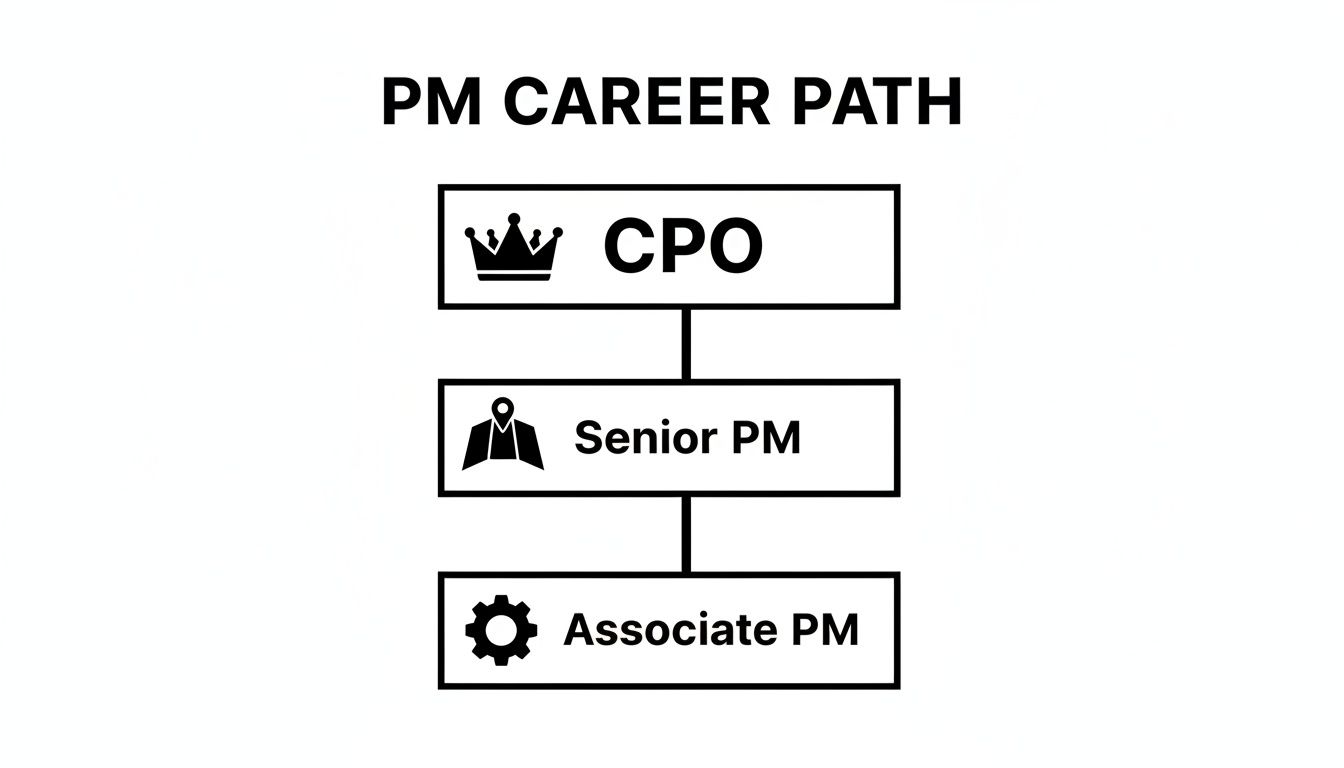
This visual shows how the role's focus shifts perfectly—from the gears of execution as an Associate PM, to roadmapping as a Senior PM, and finally to setting the crown vision as the CPO.
Charting Your Own Trajectory
Understanding this ladder isn’t just an academic exercise; it’s a powerful tool for planning your career. It helps you pinpoint the skills you need to develop for that next promotion and gives you the confidence to know when you’re ready for more responsibility.
To get a full picture of your potential path, it's also smart to look at how companies think about employee growth. Understanding how they craft effective talent management strategies can give you an inside track on how to position yourself for advancement. When you see how the system is designed, you can navigate it much more effectively.
Navigating the PM Salary and Job Market Landscape
Let's talk business reality. You can't plan a career without understanding the numbers, and for product managers, those numbers tell a fascinating story right now. Whether you're trying to break in or move up, knowing the financial and job market landscape is key to competitive positioning.
The market isn't static—it's a living, breathing thing. Compensation, demand, and the skills companies are hunting for are always in flux.

Right now, the job market has a split personality. On one side, the competition for entry-level and junior roles has gotten fierce. On the other, there’s an almost insatiable hunger for experienced, senior product talent, especially at bigger, more established companies. It makes for a challenging terrain, but a very rewarding one if you know the map.
The Great Divide: Junior Versus Senior Roles
The demand for seasoned product leaders has absolutely exploded. Recent hiring data shows a market where senior product roles have swelled, with some reports pointing to an 87% jump in recent cycles. This isn't happening everywhere, though. The growth is concentrated in mid-size firms and massive multinational corporations (MNCs), some of which have boosted their senior hiring by over 250%. Companies like Microsoft, Amazon, and Salesforce are constantly seeking experienced PMs who can manage complex product lines and drive significant revenue.
These companies are putting a premium on proven product leadership and are more than willing to pay for it. For experienced PMs, this has created an incredibly competitive—and lucrative—environment.
This trend directly shapes compensation. Senior and leadership roles now command huge salaries that only get bigger with demonstrated impact and experience.
Here's the bottom line: the market is heavily skewed toward rewarding proven experience. Getting your foot in the door is tougher than it used to be, but the financial and career payoff for reaching the senior level has never been better.
For aspiring PMs, this means the first big hurdle is higher, but the prize on the other side is bigger. It just hammers home how important it is to build a solid foundation and a portfolio of real wins early on.
Understanding Compensation Across Levels
In a product management career, your salary is a direct reflection of your impact and responsibility. But compensation isn't just a single number. It's a total package, typically made up of a base salary, performance bonuses, and equity (like stock options or RSUs). That equity piece can be a game-changer, especially at high-growth tech companies.
A typical compensation structure breaks down like this:
- Entry-Level PM (APM/PM): Your package is built around a solid base salary with a smaller annual bonus. You'll likely get some equity, but it will be a relatively small grant.
- Mid-Career PM (Senior PM): As you move into a Senior PM role, your base salary takes a significant leap. Your bonus becomes a much bigger slice of the pie, and your equity grants grow to match your expanding strategic influence.
- Leadership (Group PM/Director/VP): Once you're in a leadership position, your total compensation is heavily weighted towards performance bonuses and equity. Your financial rewards are directly tied to your ability to drive major business outcomes.
Of course, entry-level PM salaries can swing wildly based on location, company size, and industry. Knowing the benchmarks for the roles you're targeting is crucial for negotiating effectively and planning your career path. For a deeper look, check out our guide on entry-level product manager salary expectations.
Arming yourself with this knowledge lets you have smarter conversations and set realistic financial goals. The key is to stop thinking about compensation as just a salary and see it as a complete package that grows in step with the value you bring to the business.
Essential Skills for Each Product Management Level
Becoming a successful product manager isn't about mastering one single skill. It's about developing the right skills at the right time. The competencies that make you a killer Associate PM are just the entry ticket for becoming an effective product leader.
This journey is really a shift from tactical execution to strategic influence. Early on, your world revolves around doing things right—flawless execution is your currency. As you climb the ladder, your value shifts to doing the right things and rallying the entire organization behind that direction.
The Associate PM: The Execution Expert
As an Associate Product Manager (APM) or a junior PM, your job is to be the reliable engine for your team. You provide clarity, maintain momentum, and earn credibility by nailing the fundamentals. Your day-to-day life is centered on the product backlog and your development team.
Actionable Checklist for APMs:
- Write Pristine User Stories: Use a tool like ChatGPT with this prompt: "Act as a product manager. Here is a feature requirement: [Describe feature]. Generate 5-7 detailed user stories in the format 'As a [user type], I want to [action] so that [benefit],' including clear acceptance criteria for each."
- Master Data Analysis: Use tools like Amplitude, Mixpanel, or Google Analytics to answer key questions: "What is the completion rate for our new user onboarding flow?" or "Which user segment has the highest churn rate this month?"
- Run a Flawless Backlog: In a tool like Jira, ensure every ticket has a clear description, acceptance criteria, and is correctly prioritized for the next sprint. Work with your engineering lead daily to remove blockers.
- Conduct User Interviews: Partner with a designer to talk to at least 2-3 customers every week. Record the sessions and synthesize key takeaways for the team.
The Senior PM: The Strategic Influencer
As a Senior Product Manager, the game changes. Execution is table stakes. Your primary focus pivots to strategy, influence, and mentorship. You're no longer just shipping features; you're owning a significant product area and its business outcomes. Your success is measured by your ability to paint a compelling vision and get buy-in from stakeholders across the company.
At this level, you absolutely must develop:
- Strategic Roadmapping: Build a multi-quarter roadmap that tells a story about where the product is going. It must be tightly aligned with high-level company objectives (OKRs). A great SPM can articulate how their Q3 roadmap directly contributes to the company's annual recurring revenue (ARR) goal.
- Cross-Functional Leadership: This is the art of getting buy-in from leaders in engineering, design, marketing, and sales—none of whom report to you. It's all about building strong relationships, communicating a clear "why," and mastering negotiation.
- Mentorship: You're now expected to guide and coach more junior PMs. A big part of your role is helping them grow their own skills and navigate the challenges of their product management careers.
To really get a handle on what companies look for at each stage, it helps to go deeper. For a full breakdown, check out this guide on the essential skills required for a product manager.
As you can see, the expectations shift dramatically as you progress. What starts as a focus on the "what" and "how" evolves into a deep concern for the "why" and "who."
How PM Skills Evolve with Seniority
| Competency | Associate PM (Execution Focus) | Senior PM (Strategic Focus) | Director/VP (Leadership Focus) |
|---|---|---|---|
| Product Strategy | Executes on a pre-defined strategy and roadmap. | Defines the roadmap for a specific product area, aligning it with company goals. | Sets the vision and strategy for an entire product portfolio, making investment decisions. |
| Communication | Clearly communicates requirements and sprint goals to the immediate team. | Influences cross-functional stakeholders and presents product strategy to leadership. | Communicates the product vision to the entire company, the board, and external partners. |
| Data & Analytics | Pulls usage data and tracks feature-level metrics (e.g., adoption, engagement). | Conducts market analysis, defines KPIs, and connects product metrics to business outcomes. | Owns the P&L for a product line and uses data to make portfolio-level decisions. |
| Leadership | Manages the backlog and ensures the dev team is unblocked and productive. | Mentors junior PMs and leads cross-functional teams through influence, not authority. | Builds and scales the product organization, hires talent, and creates a culture of innovation. |
Ultimately, this table shows a clear transition: from managing a product backlog to managing a product line, and finally, to managing the entire product organization.
The Product Leader: The Visionary and Multiplier
By the time you reach the Director, VP, or CPO level, your job has transformed again. You're less focused on a single product and more concerned with the entire product portfolio and the organization that builds it. You're now a multiplier, responsible for creating an environment where other PMs can thrive.
Your primary product is now the product team itself. Your job is to design an organization, hire the right talent, and set a vision that empowers your teams to build world-class products that drive the business forward.
Your focus is almost entirely on high-level strategy and organizational health. The most critical competencies here are:
- Portfolio Management: Making the tough strategic calls about which products or initiatives to fund, which to scale, and which to sunset based on the broader business strategy.
- P&L Ownership: Taking full responsibility for the revenue and costs tied to your product lines. You are making decisions that directly impact the company's bottom line.
- Organizational Design: Structuring the product team effectively, defining clear roles and responsibilities, and creating career ladders that attract and retain the very best talent.
The Rise of the AI Product Manager
The biggest shift in the product management career path isn't a new title on the ladder; it's a fundamental change in the skills required to build valuable products. AI is no longer a niche specialty—it is the new core competency. Companies from startups to FAANG are scrambling to find product leaders who can speak the language of machine learning.
This isn't just another trend. We're seeing a market-wide shakeup in what companies are looking for. The AI Product Manager is quickly becoming one of the most critical and sought-after roles in tech.

What an AI PM Actually Does
So, what does an AI PM at a place like OpenAI or Google DeepMind really do day-to-day? It's a whole different ballgame from managing a standard SaaS product. Instead of defining features with clear, predictable inputs and outputs, you're constantly managing uncertainty and probability.
An AI PM's world is built around the Machine Learning (ML) model lifecycle. Your job is to frame the problem the model needs to solve, work with data scientists to get the right training data, and—most importantly—define what "good" even means for an algorithmic product. You’re not just asking, "Did we build the feature?" You’re asking, "How accurate is the model, and what’s an acceptable margin of error for our users?"
The Explosive Demand for AI Product Talent
The demand for this skill set is blowing past the supply of people who have it. While the overall job market for PMs is still healthy, AI-focused roles are growing exponentially. Market trackers in 2024-2025 spotted between 20,000 to 26,000 open product manager jobs globally. Inside that massive pool, one count found nearly 700 open AI PM roles. That’s a clear signal of the gold rush as companies race to bake generative AI and ML into their products.
PMs with a solid technical grasp and hands-on experience in AI product lifecycles are commanding a premium. This is creating a huge advantage for anyone willing to invest in these skills. This shift isn't just about hiring AI experts; it's about leveling up the entire product organization. To get a feel for companies in this space, you could check out Parakeet AI's initiatives.
Foundational Skills for Aspiring AI PMs
Switching to an AI PM role takes a focused effort to build a very specific set of skills. You don't need a Ph.D. in data science, but technical literacy is absolutely non-negotiable. You have to be able to hold your own in conversations about model training, APIs, and data pipelines.
Here are the essentials you need to start building now:
- Machine Learning Fundamentals: You have to get the core concepts down. I recommend Andrew Ng's "AI for Everyone" course on Coursera (approx. $49/month) as a starting point. Understand supervised vs. unsupervised learning, classification vs. regression, and the basics of how neural networks work.
- Data Literacy and SQL: AI products are all about the data. You need to be good enough with SQL to pull from databases, check datasets for bias, and understand the quality of the data your team is using to train models.
- API and Systems Thinking: AI models are often delivered through APIs. Understanding how they work, what makes for a good developer experience, and how your model fits into the bigger picture is crucial.
- Defining Algorithmic Success: You need to define success with metrics that go beyond the usual business KPIs. This means getting comfortable with model-specific metrics like precision, recall, and F1 score, and then connecting them back to real value for the user.
A great AI PM doesn't just manage a backlog; they manage a portfolio of experiments. Their core job is to guide the team through the uncertainty of model development to find a solution that is not only technically feasible but also solves a real-world customer problem.
For anyone serious about making this pivot, our complete guide on AI product management goes much deeper into the frameworks and knowledge you'll need to succeed. Building these skills is the single best way to future-proof your product career.
How to Break Into Product Management
Trying to land your first product management job can feel like a classic chicken-and-egg scenario. You need PM experience to get hired, but how do you get experience without the job? It’s a frustrating loop.
Here’s the good news: thousands of successful PMs have walked this path. There are proven, tactical playbooks for breaking in.

Let’s be real, the market is tough. There are over 2.6 million people on LinkedIn with "Product Manager" in their title. Yet in recent years, the number of open PM roles has been floating between 20,000 and 26,000. That's a huge gap. This means you can't just apply and hope. You have to be deliberate and start acting like a PM long before you have the title. You can dig into more of these product management career statistics to get a clearer picture of the landscape.
Path 1: The Internal Transfer
This is, hands down, the most common and effective way to break in. You already have a massive advantage: you know the company, the products, and the people. You're a known quantity. Your goal is to become the obvious, no-brainer choice when a PM spot opens up.
Your Action Plan:
- Become the Go-To Expert: Master your current role. If you’re in customer support, become the undisputed voice of the customer. If you’re an engineer, be the one who deeply understands the why behind the what.
- Act Like a PM Now: Don’t wait for permission. Start solving problems that are bigger than your job description. Volunteer to lead a small project. Write a one-pager for a feature you believe in. Pull some usage data to find a hidden opportunity. Document everything.
- Build Your Network: Schedule coffee chats with the PMs on your team. Ask about their biggest headaches and see if you can help. Let your manager and the product leadership know you're serious about making the switch.
Path 2: Transitioning From an Adjacent Role
Folks in engineering, marketing, design, and data analysis are already halfway there. You come with a "T-shaped" skill set—deep expertise in one area and a growing understanding of the others. Your job is to consciously fill in the gaps in your product knowledge.
A great transition candidate doesn't just show they can do their old job; they show they've already started doing the new one. They bring solutions, not just skills.
For instance, a sharp marketer can shift from just promoting features to defining them based on deep market analysis. A great engineer can move from just building the solution to first identifying the core user problem that truly needs to be solved. Aakash Gupta has a great breakdown on how to become a PM from a wide range of backgrounds.
Path 3: The APM Program
Think of Associate Product Manager (APM) programs as a PM apprenticeship. Big companies like Google, Meta, and Uber created these structured, rotational programs to mint their next generation of product leaders. They're designed specifically for new grads or career changers.
APM programs are incredibly competitive, but they offer some of the best training and mentorship in the industry.
How to Position Yourself:
- Show, Don't Tell: You need to demonstrate product sense. The best way is to build a portfolio. Do a teardown of your favorite app, write a detailed spec for a new product idea, or—even better—build and launch a small side project.
- Highlight Leadership: PMs are leaders. Dig up every example you have of leading a team, a project, or an organization, even if it wasn't in a formal work setting.
- Ace the Interview: APM interviews are notoriously tough. They grill you on product sense, analytical reasoning, and behavioral questions. Practice frameworks for product design ("How would you design a toaster for kids?"), metrics, and strategy questions until they're second nature.
Product Management Career Questions Answered
Navigating a career in product is a maze of questions. Having spent years hiring, mentoring, and leading product teams at both startups and large tech companies, I've heard them all. Here’s some candid, actionable advice.
Do I Need a Technical Background for a Product Management Career?
Let’s settle this: you don't need a computer science degree for every PM role. But technical literacy is absolutely non-negotiable. You must be able to hold your own in detailed conversations with your engineering team about system architecture, APIs, and technical trade-offs.
It’s not about writing code yourself. It’s about earning the respect of your engineering counterparts, deeply understanding constraints, and making strategically sound decisions.
If you’re an AI PM at a company like Anthropic, you’d better understand the basics of machine learning. If you’re a Platform PM at Stripe, you need to know how microservices communicate. You can learn this from online courses, but nothing beats getting your hands dirty and working side-by-side with engineers on real projects.
What Is the Difference Between a Product Manager and a Project Manager?
This comes up constantly. The distinction is simple when you focus on outcomes versus outputs. The Product Manager owns the “what” and the “why,” while the Project Manager owns the “how” and the “when.”
- Product Manager (Owns the Outcome): Their focus is market success. They are obsessed with the product vision, user needs, and feature priorities. They are ultimately accountable for whether the product achieves its business goals (e.g., increases revenue, improves retention).
- Project Manager (Owns the Output): Their focus is execution. They live in timelines, resource plans, and risk mitigation spreadsheets. Their job is to ensure the product is delivered on time and on budget.
A Product Manager decides to build a bridge because people need to cross a river. A Project Manager makes sure that bridge gets built correctly, on schedule, and without the budget spiraling out of control. Both are critical, but they are playing fundamentally different games.
How Can I Gain Product Experience Without Being a PM?
You have to start acting like a PM long before you have the title. Cultivate a "product mindset" in your current role by proactively solving customer problems. This builds a portfolio of what I call "product side projects," which are gold during interviews.
Here are a few tactical examples:
- In Marketing? Dive into user behavior data in Mixpanel. Find a drop-off point in the conversion funnel, propose a simple A/B test to fix it, write a one-page spec for the engineering team, and measure the results.
- An Engineer? Don’t just build what you're told. Ask "why" to understand the user problem. Before your next project, talk to a few users to understand their pain points and suggest a technical approach that better solves the core problem.
- In Customer Support? You’re on the front lines. Use a spreadsheet to systematically track and categorize customer feedback for 30 days. Present a data-backed case to the product team for a specific change that will reduce support ticket volume by 15%.
Document everything. Write a one-pager, track the results, and be ready to talk about it. That kind of proactive ownership is product management. When you're ready to tell that story, frame it perfectly for interviews using a guide on product manager interview prep.
What Are the Most Important Tools for a Modern Product Manager?
A PM's toolkit is always evolving, but there are categories of tools you're simply expected to know. While the specific app may vary, the function is what matters.
Your core stack will almost certainly include:
- Roadmapping & Tracking: Jira and Asana are the industry standards for managing backlogs and development workflows. You must be proficient.
- Analytics & Data: You need to speak the language of data. That means hands-on experience with tools like Amplitude, Mixpanel, or Google Analytics to understand user behavior.
- Design & Collaboration: Figma is the universal language for working with designers. You'll live in it for reviewing wireframes, prototypes, and user flows.
- AI & Productivity: This is no longer a "nice to have." Modern PMs are using tools like ChatGPT or Claude to draft PRDs, summarize user feedback, and generate user stories. It makes you faster and more effective, period.
Mastering these tools isn't about being efficient for efficiency's sake. It's about using technology to make faster, smarter, and more impactful decisions for your product.
