The product management career path isn’t a straight line—it's a journey that takes you from mastering tactical details to shaping company-wide strategy. It generally kicks off with an Associate Product Manager (APM) role, where you're deep in the weeds on specific features. From there, you climb through Product Manager (PM) and Senior PM levels before hitting a fork in the road: leadership tracks like Director, VP of Product, and eventually, Chief Product Officer (CPO).
Each step up the ladder requires a real shift in how you think, what you own, and the kind of influence you have. As a PM leader who's hired and mentored product managers at every level, I've seen firsthand what separates those who climb quickly from those who plateau.
Your Roadmap From APM to CPO
Figuring out the PM career path isn't just about gunning for the next title. It’s about understanding your own evolution from someone who perfects a single gear in the machine to the person who designs the entire system.
You start by getting the fundamentals down cold—writing user stories, digging into analytics, and jamming with your engineering squad. As you grow, your perspective has to zoom out. You'll go from owning a feature to an entire product line, then a whole portfolio of products, and ultimately, the grand product vision that steers the entire company.
The Stages of Product Career Growth
The path has its twists and turns, but it generally follows a clear arc of expanding responsibility and impact.
- Execution-Focused Roles (APM, PM): Your mission, should you choose to accept it, is to ship great features that make users' lives better. Success is all about working with your team to get things built, shipped, and out the door. If you're aspiring to break in, our guide on how to become a product manager provides a step-by-step framework.
- Strategy-Focused Roles (Senior PM, Principal PM): This is where you graduate from owning features to owning outcomes. You’re the one defining the "why" behind what gets built, wrangling stakeholders, and helping junior PMs find their footing. Your success is measured by whether you can actually move the needle on key business metrics.
- Leadership Roles (Director, VP, CPO): Suddenly, your job is less about the product and more about the people and the organization. You're hiring top talent, coaching your team, setting multi-year strategies, and making sure the entire product portfolio is pointed in the right direction. A Director at Google isn't just managing a product; they are building the team and systems that manage a whole portfolio of products.
This flowchart lays out the typical journey from a hands-on execution role to a senior leadership position.
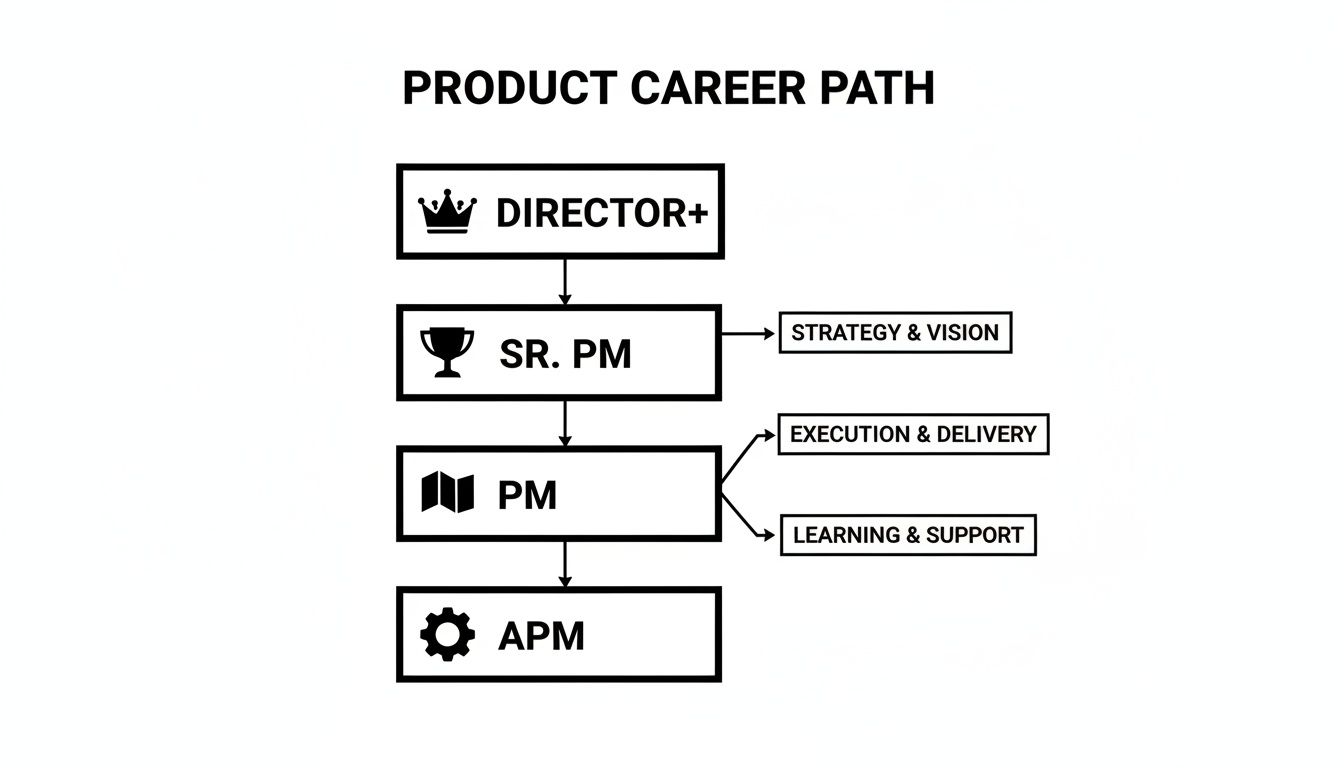
As the diagram shows, you start with a narrow focus on tactical feature work as an APM and gradually expand your scope to strategic direction and team leadership at the Director level and beyond.
To give you a clearer picture, here’s a quick breakdown of what to expect at each stage.
The Product Management Career Ladder At A Glance
| Role Level | Core Focus | Typical Years of Experience |
|---|---|---|
| APM / Junior PM | Feature-level execution, learning the ropes | 0-2 years |
| Product Manager | Owning a product or feature set, core execution | 2-5 years |
| Senior PM | Owning a complex product area, defining strategy | 5-8 years |
| Principal PM / Lead PM | Deep domain expertise, major strategic initiatives | 8-12 years |
| Group PM / Director | Managing a team of PMs, product line strategy | 8-12+ years |
| VP of Product | Managing the entire product org, portfolio strategy | 12-15+ years |
| Chief Product Officer | Executive leadership, company-wide product vision | 15+ years |
This table maps out the general timeline, but remember, great PMs can often accelerate this journey. Your mileage may vary depending on the company, your performance, and the opportunities that come your way.
A Growing and Structured Profession
The explosion in demand for sharp product thinkers has turned product management into a well-defined career. The number of PMs shot up from just over 146,000 in the US in 2014 to nearly 700,000 globally by 2020.
This isn't just a niche role anymore. It's why Glassdoor ranked product manager as the 4th best job in the US in 2023. The field is also maturing, with a solid mix of experience levels: 26% of PMs have 3-5 years of experience, and another 24% have 6-10 years under their belt.
Mastering the Core Skills for Each PM Level
Climbing the product management ladder isn't about patiently waiting for someone to tap you on the shoulder. You get the promotion after you’ve already started operating at the next level. Your title changes when your skillset proves you can handle that higher altitude.
Think of it less like a corporate ladder and more like a video game. You have to master the skills and beat the boss at your current level before you can unlock the next one.
The journey demands a real shift in focus at each stage. An APM’s world is all about flawless execution. A PM takes ownership of outcomes for a feature. And a Senior PM starts steering the strategic direction for an entire product line. This isn't just about logging more hours; it's about fundamentally changing how you create value.

Associate Product Manager: The Execution Expert
As an Associate Product Manager (APM), your prime directive is simple: be the most reliable person on the team for getting things done. Your world is tactical, and you’re measured by the quality and speed of your execution. You’re learning the raw mechanics of building products from the ground up.
Your life revolves around these key responsibilities:
- Writing Flawless User Stories: You’re the one translating the PM’s vision into crystal-clear user stories and acceptance criteria. When an engineer picks up one of your tickets, there's zero ambiguity.
- Mastering Your Team's Data: You need to become the go-to person for how your feature is performing. That means you can jump into tools like Amplitude or Mixpanel and not just pull numbers, but explain what they actually mean.
- Managing the Backlog: You’re in the trenches with your engineering lead, making sure the backlog is groomed, prioritized, and ready for sprint planning. Your job is to ensure the dev team is never, ever blocked.
Core Mission: Become an indispensable execution engine. Your entire goal is to build unshakable trust with your engineering team and your manager by delivering on your promises, every single time.
Product Manager: The Feature Owner
Once you graduate to the Product Manager (PM) level, your scope blows up. You're no longer just executing tasks; you’re owning outcomes. You are now directly responsible for the success or failure of a feature or a small product area. The focus pivots from "how" to "what" and "why."
This is where you cut your teeth on stakeholder management. You become the central hub, translating business goals for engineers while explaining technical realities to marketing and sales. You’ll find yourself saying "no" a lot more than "yes," and you'll get good at backing up those decisions with hard data and customer insights. To get a better handle on this, you can explore the full set of product manager skills required for success.
Your primary goals now include:
- Owning a Feature Roadmap: You build and defend a roadmap for your product area that spans the next 1-2 quarters, making sure it lines up with the bigger company objectives.
- Making Data-Backed Decisions: You go beyond just reporting data. Now you use it to form hypotheses, run A/B tests, and make the tough calls on what gets built next.
- Mastering Stakeholder Communication: You learn to code-switch. You develop completely different communication styles for different audiences—deep technical dives for engineering, business impact summaries for leadership, and go-to-market plans with marketing.
Senior and Principal PM: The Strategic Influencer
At the Senior and Principal PM levels, the game completely changes. Your value isn't measured by the number of features you ship anymore. It's measured by your ability to define and drive product strategy. The expectation is that you will influence teams and product lines far outside your direct control.
You operate with a huge amount of autonomy, sniffing out new opportunities and building the business cases to chase them. A Senior PM at a company like Meta, for example, might be tasked with defining the entire strategy for a major piece of the News Feed algorithm, influencing dozens of engineering teams in the process.
This level demands a mastery of:
- Defining Product Strategy: You're the one writing the strategy docs—like Amazon's famous six-pagers—that lay out a compelling vision, dissect the market, and chart a multi-year course to win.
- Mentoring and Leadership: You’re now actively mentoring junior PMs, helping them sharpen their skills and navigate the org chart. You lead by example, setting the bar for what great strategic thinking looks like.
- Influence Without Authority: This becomes your most critical skill. You have to persuade VPs, GMs, and peer teams to rally behind your vision, even when you have zero direct authority over them. You achieve this through data, irrefutable logic, and building strong, trust-based relationships across the company.
How AI Is Reshaping the PM Career Path
Let's be clear: Artificial intelligence isn't just another new tool on the block. It's the single biggest force changing the product management career path right now. Getting a handle on AI isn't some future-proofing exercise—it’s the new baseline for being a top-tier PM today.
Think of AI as a massive accelerator for the core PM workflow. Tasks that used to eat up your week can now be done in the time it takes to grab a coffee. Instead of painstakingly combing through dozens of user interview transcripts by hand, you can now use AI to pull out the key themes in seconds. This shift is huge, freeing you up to focus on the strategic work that actually moves the needle.
From Manual Work to AI Augmentation
The modern PM’s toolkit is getting a serious upgrade with generative AI. Tools like ChatGPT and Claude are quickly becoming the secret weapons for supercharging daily tasks and cranking up your output.
Here are a few ways you can start using them right now:
- Synthesizing User Research: Dump hours of interview transcripts into an AI model. With the right prompt, it can instantly spit back insights, pinpoint customer pain points, and even draft up some surprisingly solid user personas.
- Drafting Product Requirements Documents (PRDs): Feed an AI your rough notes, user stories, and business goals. It can generate a comprehensive first draft of a PRD, complete with acceptance criteria, giving you a massive head start.
- Conducting Competitive Analysis: Need a quick competitive overview? AI can scan competitor websites, customer reviews, and news articles to whip up a SWOT analysis or a feature-by-feature comparison table. What used to take days now takes minutes.
Actionable Prompt for ChatGPT or Claude: "Analyze the following [10] user interview transcripts for our [mobile banking app]. Identify the top 5 recurring user pain points related to [money transfers]. For each pain point, provide 3 direct quotes from the transcripts as evidence."
The Rise of the AI Product Manager
Beyond just helping with existing tasks, AI has carved out a whole new specialization: the AI Product Manager. This is easily one of the hottest and best-paying roles in the product world. Companies like Google, Meta, and OpenAI are snapping up talent for these positions, often with a hefty salary premium. A quick search on LinkedIn for "AI Product Manager" at OpenAI shows roles like "Product Manager, Superalignment" focused on steering AI towards beneficial outcomes.
An AI PM lives at the crossroads of product, data science, and engineering. They aren't just building features; they're building intelligent systems from the ground up. This demands a different skillset than traditional PM roles. If you're curious, you can go way deeper in our complete guide to AI product management.
To make it as an AI PM, you’ll need to get smart in a few key areas:
- Understanding Data Pipelines: You have to know how data is collected, cleaned, and prepped to train machine learning models. Garbage in, garbage out.
- Model Evaluation: You need to speak the language of metrics like precision, recall, and F1 score to know if a model is actually performing well.
- Navigating Ambiguity: You'll be working on problems where there’s no clear answer. Your job is to guide the team through cycles of experimentation to find a path forward.
And as AI gets more sophisticated, knowing about specific tools is becoming part of the job. For instance, PMs in the media space might need to understand the capabilities of things like AI reel generators to stay competitive.
Ultimately, it doesn't matter if you become a dedicated AI PM or simply weave AI into your current role. Mastering these skills is no longer a "nice-to-have." It’s how you’ll stay relevant, deliver massive impact, and position yourself to lead the next wave of tech products. Your ability to use AI is your new competitive edge.
Understanding Product Manager Salary and Compensation
Let's talk money.
Climbing the product management ladder isn't just about gaining more influence and shipping cooler products; it's also about understanding your market value. Your compensation is more than just a paycheck—it's a signal of the impact you're expected to drive.
Typically, your pay is a mix of base salary, performance bonuses, and—this is the big one—equity. For senior folks, equity often becomes a massive wealth-building engine.
Your total compensation isn't a single, fixed number. It's a moving target influenced by a few key variables. Knowing what these levers are is the first step toward maximizing your earnings throughout your career.
Key Factors Influencing PM Salaries
Three big things really dictate what you can expect to earn.
First, company stage is a huge differentiator. An early-stage Series A startup might offer a modest base salary but dangle potentially life-changing equity. On the other hand, a FAANG giant like Google or Meta will come in with a high base, juicy annual bonuses, and a hefty grant of Restricted Stock Units (RSUs) that vest over time.
Second, location still plays a big role, even with the rise of remote work. A PM in San Francisco or New York City will naturally command a higher salary than someone in a lower-cost-of-living area. That said, top-tier remote companies are increasingly competitive and often pay well regardless of where you call home.
Finally, specialization is becoming more and more valuable. A generalist PM can earn a great living, but specialized roles are now commanding a serious premium. This is especially true for AI Product Managers, who are in such high demand they can often negotiate a 15-20% bump over their non-AI counterparts.
As you climb the ladder, your pay structure changes dramatically. Early in your career, it's all about the base salary. But once you hit senior and leadership roles, equity often becomes the largest piece of the pie, tying your financial success directly to the company's performance.
Compensation Growth Across PM Levels
Salaries scale—fast. Data from Product School shows that Associate PMs start out with a base salary somewhere between $69K and $108K. By the time you reach the VP of Product level, that base can jump to $159K-$249K, and a Chief Product Officer can pull in up to $290K in base pay alone.
For those in hot specialties like AI, the growth is even steeper. An AI PM can expect a salary in the $130K-$200K range. At top tech firms, when you factor in stock and bonuses, total compensation can easily push past $200K for mid-level PMs and soar over $1M for top-tier leaders who can prove they move the needle.
If you're just starting, our deep dive on the typical entry-level product manager salary is a great resource.
To give you a clearer picture, I've put together a table breaking down the average compensation you can expect at each level in the US market.
Product Manager Compensation By Role Level (US Market Average)
| Role | Average Base Salary Range | Average Total Compensation Range (incl. Bonus/Equity) |
|---|---|---|
| Associate PM | $85,000 – $115,000 | $100,000 – $140,000 |
| Product Manager | $120,000 – $150,000 | $145,000 – $210,000 |
| Senior PM | $150,000 – $185,000 | $200,000 – $300,000+ |
| Director of Product | $190,000 – $240,000 | $280,000 – $450,000+ |
| VP of Product | $220,000 – $280,000+ | $400,000 – $700,000+ |
As you can see, the real financial jump happens when you step into senior and leadership roles. The base salary grows steadily, but the explosive growth in bonuses and equity is what truly accelerates your earning potential. It's what makes the product management career path so rewarding for those who reach the top.
Strategies for Your Next Promotion or Job Search
Knowing the product management career path is one thing; actually navigating it is a whole different ball game. Whether you’re gunning for a promotion or landing a new job, it all comes down to building a powerful story around your business impact. Sitting around and waiting for opportunities just doesn't work anymore—you have to create them.
This is especially true in the current hiring climate. The PM job market is clawing its way back after the big correction in 2023, and recruiters are now laser-focused on candidates who can show tangible, outcome-driven results. Bonus points if those results involve AI.
While many startups slammed the brakes on hiring, we're seeing targeted growth return. In this cautious market, climbing the ladder internally can often be a faster path than jumping ship. And don't forget your network—it's responsible for a staggering 60% of all hires.
Building Your Internal Promotion Packet
Getting that next title isn't just about working harder; it’s about making your impact impossible for leadership to ignore. This is where a "promotion packet"—or what some call a "brag document"—comes in. This isn't about ego. It's about arming your manager with the specific, quantifiable proof they need to go to bat for you.
Think of it as a living document you update every quarter. It becomes an undeniable record of your contributions, tied directly to the metrics the business actually cares about.
Here’s a simple way to structure it:
- Project/Initiative: Give it a clear name. (e.g., "AI-Powered Search Recommendations Launch").
- Business Goal: What was the big-picture objective? (e.g., "Increase user engagement by 15%").
- My Role & Actions: Get specific about what you did. Use strong action verbs. "I ran 20 customer interviews to validate the user need, authored the PRD, and led the cross-functional pod of 8 engineers and 2 designers."
- Quantifiable Outcome: This is the most critical part. Connect your work to a number. "We launched on schedule, driving a 17% spike in search engagement and a 5% lift in user retention in Q3."
- Leadership Skills Demonstrated: Spell out how you operated at the next level. "Demonstrated strategic influence by getting the marketing and sales teams aligned on the new feature, which resulted in a unified GTM strategy."
For a much deeper dive on building your case, check out our full guide on how to get promoted as a product manager. It breaks down exactly how to operate at the next level before you get the title.
Optimizing Your Job Search for the Modern Market
When you’re on the hunt for a new role, your resume and LinkedIn are your billboards. Recruiters spend an average of just 7 seconds scanning a resume, so you have to make an immediate impression with pure, unadulterated impact.
Your resume isn't a list of your job duties. It’s a highlight reel of your greatest hits, quantified with hard numbers. Treat it like a series of mini-case studies that prove your value.
Here's a step-by-step process to sharpen your application materials:
- Rewrite Your Bullets with the XYZ Formula: Frame every point as "Accomplished [X] as measured by [Y], by doing [Z]." So instead of a boring "Managed the product roadmap," you get: "Increased user retention (Y) by 12% in 6 months (X) by launching a redesigned onboarding flow and personalized feature tutorials (Z)."
- Tailor for AI and In-Demand Keywords: Pull up a few job descriptions from companies like OpenAI or Google. You'll see terms like "LLMs," "data pipelines," "model evaluation," and "go-to-market strategy" pop up again and again. Weave these naturally into your resume and profile to get past the automated screeners (ATS) and catch a real human’s eye.
- Juice Up Your LinkedIn Headline: Your headline is prime real estate. Ditch the generic "Product Manager" for something that screams expertise, like "Senior AI Product Manager | Building Generative AI Experiences | Ex-Meta."
To really run an effective search, you need to treat it like a product launch. You wouldn't launch a feature without a plan, right? The same logic applies here. A strategic job search plan can help you stay organized, track your leads, and ultimately land a role that truly fits your career goals.
Common Questions About the PM Career Path
Anyone trying to map out a career in product management runs into the same set of questions. I know I did. After hiring and coaching dozens of PMs over the years, I've heard just about every variation.
Here are some straight-up, no-fluff answers to the questions that pop up most often.

What Is the Difference Between a Product Manager and a Product Owner?
This is probably the single most common point of confusion out there, especially for teams using Agile frameworks like Scrum. The cleanest way I've found to explain it is strategy vs. tactics.
-
The Product Manager (PM) is all about strategy. Think of them as the CEO of the product, totally focused on the big picture—the "what" and the "why." Their days are filled with market research, customer interviews, shaping the product vision, and ultimately, owning the business results. A PM at Meta, for example, is the one arguing why the company needs to pour resources into a new Instagram Reels feature, armed with data on user engagement and potential revenue.
-
The Product Owner (PO) is all about tactics. They live inside the development team, zeroed in on the "how" and the "when." Their job is to translate the PM's grand vision into a perfectly groomed, actionable backlog. They write the nitty-gritty user stories and make sure the engineering team has a crystal-clear, prioritized queue of work for every single sprint.
Sure, in a tiny startup, one person might be forced to wear both hats. But at a larger company like Google or Amazon, the roles are distinct. The PM points the ship in the right direction, and the PO is the master navigator making sure the crew executes every maneuver flawlessly.
How Long Does It Take to Become a Senior Product Manager?
You'll often hear the number 3-5 years, but honestly, that's one of the biggest myths about the product career path. Time in the seat is not what gets you promoted. Impact is. I’ve seen sharp PMs make the leap to Senior in two years flat, while others are still at the PM level after six.
The PMs who climb the ladder fastest are the ones who demonstrate ownership that extends way beyond their assigned features. They don't just ship tickets; they lead.
If you want to fast-track your promotion, you need to:
- Own a major initiative from the back-of-the-napkin idea all the way to a successful launch. This proves you can wrestle with complexity and ambiguity.
- Influence cross-functional teams without any formal authority. Can you get stakeholders from engineering, design, and marketing to line up behind your vision?
- Tie everything you do back to business metrics. You have to prove how your feature launches actually moved the needle on revenue, user retention, or engagement.
A little inside baseball? The sharpest PMs I know proactively build their own "promotion packet" or "brag doc." You can't just hope your manager notices all your wins; you have to package them up and make the case yourself.
The jump to Senior PM happens when the organization trusts you to take a big, messy business problem and drive it to a successful outcome with minimal hand-holding.
Do I Need an MBA or a Technical Degree?
The short answer is no, neither is a mandatory golden ticket. But let's be real—they can definitely open some doors.
A technical degree, like Computer Science, is a massive advantage at engineering-first companies like Google or Microsoft. It gives you instant credibility with your engineering team and lets you get into the weeds on technical trade-offs.
An MBA, on the other hand, can be an accelerant for your business and strategic thinking. It’s often a fast track for people looking to jump into senior leadership roles later in their careers.
But here’s the thing: many of the absolute best PMs I’ve ever hired came from completely different worlds—design, data analytics, marketing, even consulting. What hiring managers really care about are your core skills:
- Deep, almost obsessive, customer empathy
- The ability to make decisions with data
- Exceptional communication skills
- A strong sense of business and strategy
Showing you have these skills through side projects, past work, or a killer portfolio will always outweigh a specific degree on your resume.
What Is the Most Important Skill for Career Growth?
If we're talking about long-term growth—moving up the entire product management career path—the one skill that matters more than any other is strategic influence.
Early on, your success is judged by your execution. Can you get features shipped on time and to spec? But as you get more senior, that's just table stakes. To make it to the Director, VP, and CPO levels, your value is measured by your ability to shape company-wide strategy, often by influencing people who don't report to you.
This means building a data-backed vision so compelling that executives fight to fund it. It means getting engineering, marketing, and sales aligned around a shared goal, even when their priorities are pulling them in different directions. Mastering this art is what separates a great Senior PM from a future Chief Product Officer.
Ready to put your career on the fast track with proven frameworks and expert insights? I’m a product leader with over 15 years in the trenches, and I share what actually works for product growth, management, and career strategy. Join thousands of other PMs and subscribe to my newsletter and podcast at Aakash Gupta.
