Cracking the product management interview isn't about memorizing 100 different questions. As a hiring manager who has built teams at both startups and FAANG companies, I can confirm that interviewers are not looking for rehearsed, perfect answers. Instead, we are pressure-testing your thinking process. We want to see how you deconstruct a problem, apply structured frameworks, communicate your logic, and demonstrate genuine product sense. This is why a small handful of core product management interview questions appear in nearly every loop. They are versatile tools used to assess your capabilities across the entire product development lifecycle.
This comprehensive guide is built on a simple premise: if you can master the frameworks for the 8 foundational question types outlined here, you can handle 90% of what any interviewer will throw at you. Forget rote learning. We are going to equip you with a repeatable system for each question, covering the strategic intent behind it, a step-by-step approach to structure your answer, and a real-world example of what a strong response looks like. Think of this less as a list of questions and more as a toolkit for demonstrating elite product thinking under pressure.
We will focus exclusively on the specific challenges of the PM interview process, from initial screens to final rounds. However, a successful interview also hinges on universal best practices like clear communication, confident body language, and effective storytelling. For a holistic approach to preparing for any job interview, including those for product management, consult an ultimate interview guide. By mastering both the general art of interviewing and the specific science of PM case studies, you'll be prepared to land your target role. Let’s dive into the questions that truly matter.
1. Tell me about a product you launched from idea to market
This is arguably one of the most comprehensive product management interview questions you will face. It’s a favorite at companies like Google, Meta, and Amazon because it’s not a hypothetical exercise; it’s a direct request for evidence of your end-to-end product leadership. The interviewer wants to see your entire toolkit in action: from identifying an opportunity and building a strategic case, to navigating development, and ultimately, delivering measurable market impact.

Your goal is to tell a compelling story that showcases your ability to own the entire product lifecycle. This question tests your strategic thinking, execution skills, stakeholder management, and your grasp of what it truly takes to bring a product to life.
How to Structure Your Answer
A linear, chronological narrative is often confusing. Instead, structure your response using a proven framework like STAR (Situation, Task, Action, Result). This method ensures your story is concise, impactful, and hits all the key points the interviewer is listening for.
- Situation: Briefly set the scene. What was the business context? What user problem or market opportunity did you identify?
- Task: Clearly state your role and the specific goal. What were you tasked with achieving? (e.g., "My goal was to increase user engagement for our core feature by 15% within two quarters.")
- Action: This is the core of your answer. Detail the specific steps you took. Discuss how you validated the problem with user interviews and data, worked with design and engineering to prototype and develop a solution, managed the roadmap tradeoffs, and coordinated with marketing and sales for launch. Emphasize your personal contributions and leadership.
- Result: Quantify the outcome. What was the impact on the business and the user? Use hard numbers (e.g., "We achieved a 20% increase in the target engagement metric, which translated to a 5% uplift in user retention and an estimated $500k in ARR."). Discuss what you learned, including failures, and how they shaped your approach on subsequent projects.
Pro Tip: Prepare two to three different launch stories. Have one for a successful product, one for a product that faced significant challenges or failed (highlighting your learnings), and one that demonstrates a specific skill, like data-driven decision-making or exceptional stakeholder management. This prepares you for any follow-up questions.
2. How would you prioritize features for our product?
This is a classic strategic thinking question that gets to the heart of a product manager's role: making difficult trade-offs with limited resources. Interviewers at companies like Intercom and Netflix use this question to assess your ability to balance user needs, business goals, and technical constraints. They want to see a structured, logical approach to decision-making, not just a gut feeling.
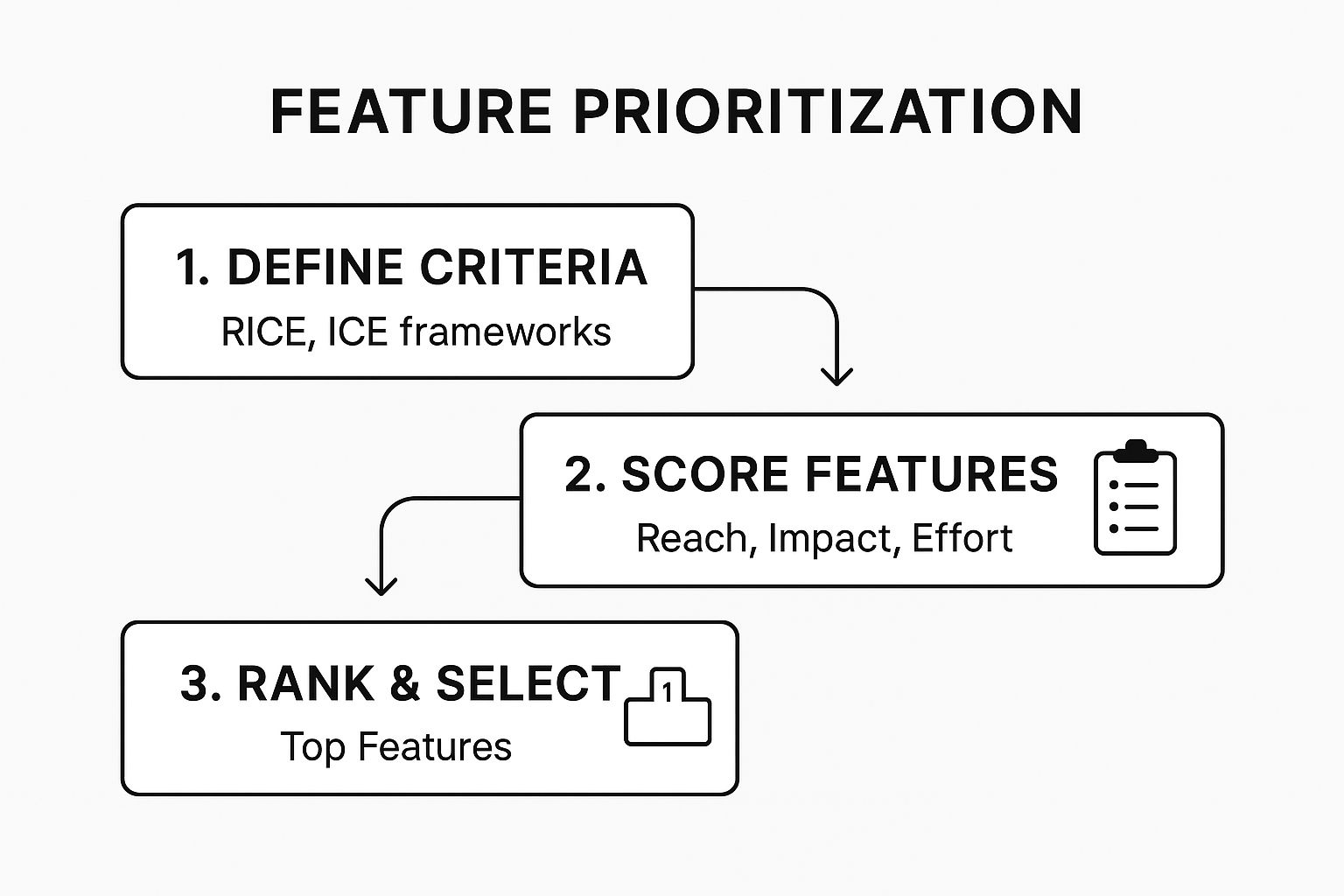
Your goal is to demonstrate that you can create order from chaos. This question tests your understanding of prioritization frameworks, your ability to ask clarifying questions, and your capacity to align feature development with overarching company strategy. A strong answer shows you can defend your roadmap with data and reason.
How to Structure Your Answer
Instead of jumping straight to a framework, first, gather context. Show the interviewer you wouldn't make decisions in a vacuum. After clarifying the goals, you can introduce a framework to structure the rest of your response.
- Clarify and Align: Start by asking clarifying questions. "Before I prioritize, I need to understand our primary goal for this quarter. Are we focused on user acquisition, retention, or revenue growth?" Also ask about any known technical constraints or resource limitations. This shows you prioritize based on strategy, not just a list of features.
- Introduce a Framework: Name a specific, well-known prioritization framework. Common choices include RICE (Reach, Impact, Confidence, Effort), ICE (Impact, Confidence, Ease), or a simple Value vs. Effort matrix. Explaining why you chose a particular framework for the situation is key. For example, "For a mature product like this, I'd use the RICE framework because it forces us to quantify our assumptions and make data-informed decisions, which is crucial for optimizing impact."
- Walk Through an Example: Apply the framework to a few hypothetical features. For instance, using RICE, explain how you would estimate the Reach (number of users affected), Impact (on a key metric like conversion rate), Confidence (in your estimates, from 1-100%), and Effort (engineering person-weeks).
- Synthesize and Decide: Explain how you would use the framework's output to make a final decision. Discuss how you’d balance high-scoring features with other strategic considerations like technical debt, bug fixes, or long-term platform investments. Mention how you would communicate these priorities and the rationale to stakeholders.
Pro Tip: Mention multiple frameworks to show the breadth of your knowledge, but commit to one for your detailed walkthrough. For instance, you could say, "While frameworks like Kano are great for understanding customer delight, for this scenario, I'd use the RICE framework because it forces us to quantify our assumptions and make data-informed decisions."
3. Design a product for [specific user group]
This is the quintessential product design question, a staple in interviews at Apple, Meta, and Google. It’s designed to test your user empathy, creativity, and structured thinking from a blank slate. The interviewer isn't looking for a perfect, market-ready idea; they want to see your process. Can you start with a broad user group, uncover their nuanced needs, and methodically build a product vision?
![Design a product for [specific user group]](https://cdn.outrank.so/9ee9a844-8950-485a-88e3-3f1bebeef535/c93654db-508a-4cf1-9201-b8df8dcaca1f.jpg)
Your goal is to demonstrate a user-centric approach and a logical framework for problem-solving. This question reveals how you handle ambiguity, validate assumptions, and connect user problems to potential business value, making it a critical test of core product management skills.
How to Structure Your Answer
Don't just jump into features. A structured, user-first approach is key. A common and effective framework is the CIRCLES Method™ (Clarify, Identify, Report, Cut, List, Elicit, Summarize) or a simplified version focusing on user needs, solutions, and prioritization.
- Clarify and Define: Start by asking clarifying questions to narrow down the user group. For "the elderly," ask about age range, tech-savviness, and physical abilities. State your assumptions clearly (e.g., "I'll focus on users aged 70-85 who live independently but have some mobility challenges and are comfortable using a smartphone.").
- Identify User Needs and Pain Points: Brainstorm potential user personas and their core problems or unmet needs. Think about their daily routines, goals, and frustrations. For example, for "busy parents," a key pain point might be coordinating family schedules and ensuring children get to their activities safely and on time.
- Ideate and Prioritize Solutions: Brainstorm a range of solutions that address the top pain points. Don't self-censor at this stage. Once you have a few ideas, prioritize them based on impact and feasibility. Select one core solution to develop further.
- Design and Detail: Flesh out the chosen solution. Describe the core features of the MVP. Create user stories to illustrate how the product works. For a "fitness app for the elderly," you might detail features like low-impact exercise tracking, medication reminders, and a simple one-touch emergency contact button with fall detection.
- Summarize: Briefly recap the user group, the problem you solved, your solution, and how you would measure success (e.g., "Success for our MVP would be measured by daily active users and a reduction in self-reported missed medication doses.").
Pro Tip: Always talk to your interviewer as if they are a collaborator. Say things like, "Here are the user groups I'm considering, does one stand out to you as more aligned with our strategic goals?" This makes the exercise interactive and shows your ability to work with a team to build a shared understanding.
4. How would you measure the success of [specific product/feature]?
This is a classic analytics-focused question designed to probe your data fluency and strategic thinking. Companies like Netflix, Spotify, and Airbnb use it to see if you can connect product features to tangible business outcomes. The interviewer isn't just looking for a list of metrics; they want to see your framework for defining and measuring value for both the user and the business.
Your ability to answer this question demonstrates your analytical rigor. It shows you can move beyond vanity metrics and identify the key performance indicators (KPIs) that truly reflect a product's health and impact. This is a core competency for any product manager, as it's the foundation of data-driven decision-making and iterative development.
How to Structure Your Answer
Avoid simply listing metrics. Instead, build a coherent measurement framework that demonstrates a structured, goal-oriented approach. A strong framework will clarify the "why" behind your metrics.
- Clarify the Goal: Start by asking clarifying questions to understand the product's or feature's primary objective. Is the goal to drive user engagement, increase revenue, improve retention, or enhance user satisfaction? State the goal clearly (e.g., "The primary goal of Instagram Stories was to increase daily user engagement and defend against competition from Snapchat.").
- Identify User Actions: Brainstorm the key user behaviors that align with this goal. For a feature like Spotify’s recommendation algorithm, this would include actions like playing a recommended song, saving it to a playlist, or following the recommended artist. These are the leading indicators of success.
- Define Your Metrics (HEART Framework): Categorize your metrics to show a comprehensive view. A great model is Google's HEART framework (Happiness, Engagement, Adoption, Retention, Task Success).
- Happiness: Qualitative and quantitative measures of user satisfaction (e.g., NPS, app store ratings, user survey feedback on recommendation quality).
- Engagement: How often and intensely users interact (e.g., daily active users, session duration, stories created/viewed per user).
- Adoption: New user growth for the feature (e.g., % of DAUs who create a story for the first time).
- Retention: How many users return to use the feature over time (e.g., Day 7 and Day 30 cohort retention for story viewers).
- Task Success: Efficiency and effectiveness (e.g., time to create a story, error rates).
- Connect to Business Impact: Conclude by tying your product metrics to high-level business KPIs like customer lifetime value (LTV), revenue, or market share. Effective tracking often relies on insights from well-designed business intelligence dashboard examples to visualize performance. Also, mention counter-metrics to watch for (e.g., "Did launching Stories cannibalize engagement with the main feed? We'd need to monitor time spent on feed vs. stories to ensure a net positive impact on overall engagement.").
Pro Tip: For any given feature, define a "North Star" metric that represents the single most important measure of success. Then, support it with a balanced scorecard of secondary and counter-metrics to tell the full story. This shows you can prioritize while also understanding the broader ecosystem.
5. Estimate the market size for [specific product category]
This classic case question, often called a Fermi problem, is a staple in interviews at top consulting firms and tech giants like Google. It's not about getting the exact right number; it’s a test of your structured thinking, comfort with ambiguity, and ability to break down a complex, abstract problem into logical, manageable components. The interviewer wants to see how you reason, not whether you know a specific market statistic by heart.
![Estimate the market size for [specific product category]](https://cdn.outrank.so/9ee9a844-8950-485a-88e3-3f1bebeef535/6b1725ac-7413-4a78-8e72-835dee78c7b2.jpg)
Your goal is to demonstrate a clear, systematic approach to problem-solving. This question evaluates your analytical horsepower, business acumen, and your ability to make and state reasonable assumptions. It reveals whether you can build a logical case from first principles, a critical skill for any product manager sizing up a new opportunity.
How to Structure Your Answer
A clear, step-by-step framework is essential. Walk the interviewer through your logic, stating your assumptions aloud as you go. This shows them how you think.
- Clarify and Define: Start by asking clarifying questions to narrow the scope. For "electric vehicle charging stations," are we talking about residential or public? Are we measuring in dollars (annual revenue), number of stations, or electricity consumed? Defining the market is the first step. Let's assume the question is about the annual revenue from public DC fast charging in the US.
- Choose Your Approach: Decide whether to use a top-down or bottom-up approach. A top-down approach starts with the total population and narrows it down. A bottom-up approach starts with individual segments and builds up. For this, bottom-up is often clearer.
- Break Down the Problem: Deconstruct the estimate into a logical equation. For example: (Total number of EVs in the US) x (% using public fast charging) x (Avg. charging sessions per year) x (Avg. revenue per session).
- State Assumptions and Calculate: Plug in reasonable estimates for each variable, explaining your reasoning. (e.g., "Let's assume there are 4M EVs in the US. Let's say 50% use public fast charging regularly. They might charge once a week, so ~50 sessions/year. An average session might be $15."). Then, do the math: 4M * 0.5 * 50 * $15 = $1.5B.
- Sanity Check and Conclude: Once you have a final number, critically assess it. Does it seem reasonable? You might compare it to the revenue of a known charging network like Electrify America to see if it's in the right ballpark. Acknowledge potential market dynamics, like the rapid growth of EV adoption, that could affect the number.
Pro Tip: Always communicate your thought process. It’s better to have a slightly off answer with flawless logic than a "correct" answer with no explanation. The journey is more important than the destination in this type of product management interview question.
6. Tell me about a time you had to make a difficult product decision
This behavioral question is a staple in product management interviews, especially at companies like Amazon that heavily weigh leadership principles like "are right, a lot." It's designed to probe your judgment, your ability to handle trade-offs under pressure, and your leadership when faced with ambiguity or conflict. The interviewer isn't just looking for the outcome; they want to deconstruct your decision-making process.
This question tests how you navigate competing priorities, manage stakeholder expectations, and use data and intuition to make a tough call that aligns with broader business goals. It reveals your maturity as a leader and your ability to take ownership of a challenging situation, communicate the rationale clearly, and move the team forward.
How to Structure Your Answer
Your response should be a compelling narrative that demonstrates a structured and thoughtful approach to problem-solving. Using the STAR (Situation, Task, Action, Result) method will help you organize your story effectively and ensure you cover all the critical elements the interviewer is listening for.
- Situation: Set the stage by describing the context. What was the product? What was the specific scenario that forced a difficult decision? This could be conflicting stakeholder demands, a technical constraint, or an unexpected market shift.
- Task: Clearly articulate your role and the core conflict you had to resolve. What were the competing options or pressures? (e.g., "I had to decide whether to sunset a legacy feature that a small, vocal group of power users loved, or allocate engineering resources to maintain it, delaying our strategic roadmap.")
- Action: This is the most critical part of your answer. Walk the interviewer through your decision-making framework step-by-step. Detail how you gathered data (e.g., "I pulled usage data showing only 2% of our user base had used the feature in the last 90 days"), who you consulted (engineering leads, sales, executive leadership), and what trade-offs you considered ("The engineering cost was three person-months, which directly conflicted with our top priority of launching our new AI-powered workflow."). Explain the rationale behind your final choice.
- Result: Quantify the outcome of your decision. What was the impact on the product, the team, and the business metrics? Importantly, reflect on what you learned. Discuss how you managed the fallout (e.g., "We created a migration path for the power users and communicated the change three months in advance"), communicated the decision to stakeholders, and what you might do differently in the future.
Pro Tip: Choose a real story where the "right" answer wasn't obvious. The best examples involve significant trade-offs with no perfect solution, such as choosing between user experience and short-term revenue, or prioritizing one customer segment over another. Showcasing your process in a gray area is more powerful than describing an easy choice.
7. How would you improve our product?
This is a classic product sense question and a staple in interviews at companies like Spotify, Airbnb, and LinkedIn. It’s designed to test your ability to quickly analyze a product, identify meaningful user problems, and propose creative yet feasible solutions. Interviewers use this to evaluate your product thinking, user empathy, strategic alignment, and business acumen all at once.
Your goal is not to find a "correct" answer but to demonstrate a structured, user-centric, and business-aware thought process. The interviewer wants to see how you think, not just what you think. Can you deconstruct a product, connect user needs to business goals, and articulate a compelling vision for improvement?
How to Structure Your Answer
Avoid jumping straight to solutions. A structured approach shows methodical thinking and is far more impressive. A great framework is to first clarify, then diagnose, then propose, and finally, evaluate.
- Clarify & State Assumptions: Start by acknowledging the product's mission and business model. Then ask clarifying questions. "My understanding is that Airbnb's current focus is on growing the 'Experiences' offering. Is that the area you'd like me to focus on, or should I consider the core 'Stays' product?" State any assumptions you're making (e.g., "I'll focus on improving the onboarding experience for new hosts, assuming growth is a key company objective.").
- Identify User Personas & Pain Points: Who uses the product? Outline 2-3 key user personas and their primary goals or "jobs-to-be-done." Brainstorm potential pain points for each persona. For example, for LinkedIn, a pain point for a job seeker might be the lack of transparency in the application process after hitting "Apply."
- Propose Solutions: Brainstorm a few solutions that directly address the pain points you identified. Prioritize them based on potential impact and effort. Select one or two to detail further, explaining how they would work and why they are the best options. For the LinkedIn example, a solution could be a "Job Application Tracker" feature that provides status updates.
- Define Success & Next Steps: How would you measure the success of your proposed improvement? Define key metrics (e.g., "Success would be a 15% increase in job applications submitted through LinkedIn and a higher NPS score from job seekers."). Briefly touch on potential risks and how you would validate your idea with an MVP or experiment.
Pro Tip: Before the interview, use the company's product extensively. Come prepared with a thoughtful critique and at least one well-reasoned improvement idea. Frame your feedback constructively, acknowledging the existing product's strengths before suggesting changes. This shows respect for the team's work and positions you as a collaborative future colleague.
8. Walk me through how you would investigate a sudden drop in a key metric
This question is a high-stakes stress test for any product manager. When a key metric like daily active users, conversion rate, or revenue suddenly plummets, the business is in a reactive, "all hands on deck" mode. Interviewers at data-intensive companies like Netflix, Airbnb, and Spotify use this scenario to gauge your analytical rigor, structured thinking, and grace under pressure.
They aren't just looking for a correct answer; they are evaluating your diagnostic process. Can you systematically break down a complex, ambiguous problem? Can you form logical hypotheses, direct data analysis, and communicate clearly during a crisis? This question reveals your ability to move from panic to a plan of action, a core skill for leading data-driven product teams.
How to Structure Your Answer
A panicked, rambling response is a major red flag. Instead, present a calm, methodical, and structured investigation plan. A great approach is to segment your investigation into logical phases: Clarify, Hypothesize, Investigate, and Act.
- Clarify & Validate: Start by asking clarifying questions to define the problem's scope. "First, I'd confirm this isn't a data instrumentation or dashboard error. How much did it drop? When exactly did the drop start? Does it affect all users or specific segments (e.g., iOS vs. Android, new vs. returning, specific geos)?" This shows you validate the data before jumping to conclusions.
- Hypothesize (Internal & External): Systematically list potential causes. Group them into categories.
- Internal Factors: Did we just ship a new release or run an A/B test? Was there a recent marketing campaign change? A server outage? An API dependency failure?
- External Factors: Was there a major news event? A competitor launch? A holiday? A change in a partner platform's policy (like an App Store algorithm update)? A browser update causing compatibility issues?
- Investigate & Triage: Detail how you would validate or invalidate each hypothesis. "I'd ask engineering to check deployment logs and server health dashboards. I'd work with data science to segment the metric drop by user attributes and technical attributes like app version or browser. I'd check our social media and support tickets for a spike in user complaints."
- Act & Communicate: Conclude with your action plan. "Based on the root cause, I would propose a solution, such as an immediate hotfix or a full rollback. Crucially, I'd establish a clear communication plan to keep stakeholders informed of our findings and next steps, and I would lead a post-mortem to prevent this from happening again."
Pro Tip: When answering, use phrases like "My first step would be to collaborate with the data science team to…" and "Next, I would partner with engineering to check…" to demonstrate a collaborative and action-oriented mindset. This shows you understand that you aren't solving this alone; you are leading a cross-functional team through a crisis.
Product Management Interview Questions Comparison
| Question / Aspect | Implementation Complexity 🔄 | Resource Requirements ⚡ | Expected Outcomes 📊 | Ideal Use Cases 💡 | Key Advantages ⭐ |
|---|---|---|---|---|---|
| Tell me about a product you launched from idea to market | High: covers full product lifecycle | High: requires broad experience | Comprehensive insight into candidate’s PM skills | Evaluating end-to-end product management and execution | Deep practical experience; storytelling; strategic thinking |
| How would you prioritize features for our product? | Medium: strategic decision-making | Medium: knowledge of frameworks | Clear view of prioritization skills and trade-offs | Assessing framework knowledge and daily prioritization tasks | Practical framework application; reveals thought process |
| Design a product for [specific user group] | Medium to high: creative & user-centric | Medium: user research & design thinking | Innovative, user-focused solutions | Testing design thinking and empathy for specific demographics | Demonstrates creativity; structured problem-solving |
| How would you measure the success of [specific product/feature]? | Medium: understanding metrics & data | Medium: analytics & KPI knowledge | Analytical evaluation of product impact | Measuring product or feature effectiveness via data | Shows analytical rigor; data-driven decision-making |
| Estimate the market size for [specific product category] | Medium: structured problem-solving | Low to medium: analytical thinking | Logical, quantitative market sizing | Evaluating analytical and business acumen for market sizing | Demonstrates structured thinking; business intuition |
| Tell me about a time you had to make a difficult product decision | Medium: behavioral & situational | Low: experience-based | Insights into decision-making and leadership under pressure | Assessing judgment, conflict management, and resilience | Reveals emotional intelligence; real-world problem-solving |
| How would you improve our product? | Medium: product teardown & strategy | Medium: company/product research | Actionable product improvement suggestions | Testing role-specific analysis and strategic thinking | Shows preparation; practical product sense; user empathy |
| Walk me through how you would investigate a sudden drop in a key metric | Medium to high: analytical troubleshooting | Medium: data analysis expertise | Systematic problem diagnosis and resolution | Crisis management and root cause analysis in product metrics | Demonstrates analytical depth; crisis handling capability |
Your Action Plan for Acing the Interview
Navigating the landscape of product management interview questions can feel like a high-stakes exam. You've now seen the eight core archetypes that form the backbone of nearly every PM interview loop, from Google and Meta to high-growth startups. We've deconstructed questions on product launches, prioritization, design thinking, metric setting, market estimation, tough decisions, product improvement, and metric debugging.
The key takeaway is that the how of your answer is far more important than the what. Interviewers are not looking for a single "correct" solution. Instead, they are evaluating your thinking process: your ability to apply structured frameworks, your obsession with the user, your comfort with data, and your knack for balancing business goals with technical constraints. Each question is a window into how you would operate as a product manager on their team.
From Theory to Practice: Building Your Interview Arsenal
Simply reading about these questions is not enough. True confidence and competence are forged through deliberate practice. Your goal is to move from passively understanding these concepts to actively demonstrating them under pressure. Here is a concrete, step-by-step action plan to translate the insights from this article into a job offer.
1. Create Your "Story Bank"
This is your most critical asset. For every behavioral and execution question we covered, you need to prepare specific, compelling stories from your own experience. Don't just think of them; write them down.
- Behavioral Questions: For questions like "Tell me about a time you made a difficult decision," prepare 2-3 unique examples. Structure each story using a framework like STAR (Situation, Task, Action, Result) or STARL (adding a "Learning" at the end).
- Execution Questions: For "Tell me about a product you launched," have a detailed narrative ready. Document the initial problem, the user research, the prioritization tradeoffs you made, the key metrics you tracked, and the ultimate business impact. Quantify everything you can.
Pro-Tip: Your Story Bank should be a living document. Refine your stories after every mock interview. Tailor the emphasis based on the company's specific product and values. For an analytics-heavy company like Netflix, highlight the data-driven aspects of your story; for a design-led company like Airbnb, emphasize user research and empathy.
2. Conduct Product Teardowns
For the design and strategy questions ("Design a product for X," "How would you improve our product?"), passive knowledge is useless. You must actively flex these muscles.
- Select Three Products: Choose one product from the company you're interviewing with, one direct competitor, and one best-in-class product you admire (like Notion, Figma, or a recent app that impressed you).
- Apply the Frameworks: Go through the exact frameworks we discussed. For "Improve our product," start by defining the company's mission and business goals. Identify user personas and their pain points. Brainstorm solutions, prioritize them using a RICE or similar framework, and define success metrics.
- Document Your Thinking: Write out your full teardown in a shareable format (e.g., Google Doc, Notion page). This forces you to be structured and articulate, turning a vague idea into a coherent product strategy. This exercise is the single best way to prepare for these open-ended case questions.
3. Master the Mock Interview
You wouldn't run a marathon without training runs, and you shouldn't walk into a PM interview without mock sessions. This is where you pressure-test your Story Bank and teardowns.
- Peer Practice: Find other aspiring or current PMs to practice with on platforms like Lewis C. Lin's PM interview community on Slack. Give and receive honest, constructive feedback.
- Professional Coaching: If you have the resources, platforms like Exponent offer mock interviews with experienced PMs from top tech companies for around $200-$250 per session. The feedback from a seasoned hiring manager is invaluable.
- Record Yourself: It might feel awkward, but recording your answers on video will reveal your pacing, your use of filler words ("um," "like"), and your overall executive presence.
Mastering these eight product management interview questions isn't about memorizing answers. It's about internalizing a versatile, first-principles approach to solving product problems. This is the mindset that separates good candidates from great hires. By systematically preparing your stories, practicing your strategic thinking, and refining your delivery, you are not just preparing for an interview; you are preparing to be an exceptional product manager.
For continuous, expert-level insights that go far beyond a single article, consider subscribing to the newsletter from Aakash Gupta. Aakash, a former product leader at Google and Affirm, provides some of the most tactical, in-depth breakdowns on product strategy, career growth, and exactly how to think like the top 1% of PMs. His content is an essential resource for acing your product management interview questions and excelling in your career. You can find his work at Aakash Gupta.
