A product management roadmap is supposed to be your strategic north star, connecting the big-picture vision to the actual work your teams are shipping. Too often, though, it morphs into a static, outdated feature list that just creates confusion and becomes a tool for micromanagement.
The root of the problem? Treating the roadmap as a project plan instead of a powerful communication tool. As a PM leader who has hired and mentored product managers at Google and Meta, I can tell you that mastering the outcome-driven roadmap is one of the clearest signals of a PM ready for senior leadership.
This guide provides a tactical playbook to transform your roadmapping process. You’ll get actionable frameworks, AI prompts, and real-world examples you can apply immediately to build roadmaps that secure buy-in, align teams, and accelerate your career.
Why Your Product Roadmap Is Failing (And How to Fix It in 24 Hours)

You know the feeling. You present your quarterly roadmap, having meticulously detailed every feature. The CEO immediately asks how this plan drives market share. The Head of Sales demands to know why a key customer's request from a multi-million dollar deal isn't on it. The engineering lead just looks confused, wondering how any of these features connect to the tech debt they’ve been flagging for months.
This disconnect is the number one reason product roadmaps fail. They become a "feature factory" backlog—a laundry list of outputs to ship rather than outcomes to achieve. This approach creates a document that's rigid, uninspiring, and almost instantly irrelevant in a fast-moving market. A PM stuck in this mode is seen as a project manager, not a product leader.
From Outputs to Outcomes: The Critical Mindset Shift of a Top 1% PM
The best product managers at places like Google, Meta, and OpenAI don't build roadmaps around features. They build them around a compelling story that answers one simple question for every single stakeholder: "Why are we doing this?"
This requires a fundamental shift in thinking:
- Output-Focused (The Old Way): "We will ship a new dashboard in Q3." This tells people what you're building but gives them zero strategic context. It’s an open invitation for nitpicking on features and timelines. A junior PM manages a feature list.
- Outcome-Focused (The Modern Way): "In Q3, we will increase user retention by 5% by simplifying our data visualization experience. We believe this is the highest-leverage way to impact our North Star metric." This tells people why the work matters and what success actually looks like. It aligns everyone on a shared goal, giving the team the autonomy to find the best solution. A senior PM owns a business outcome.
This isn't just a semantic game; it's a strategic one. An outcome-driven roadmap is your best defense against random feature requests and constantly shifting priorities.
When a salesperson asks to squeeze in a "quick feature," your response isn't "we don't have time." It's, "How does that help us achieve our primary goal of increasing retention by 5% this quarter?" It completely changes the conversation from a debate about resources to a strategic discussion about impact.
Feature Factory Roadmap vs. Outcome-Driven Roadmap
| Characteristic | Ineffective 'Feature Factory' Roadmap (Career Stagnation) | Effective Outcome-Driven Roadmap (Career Acceleration) |
|---|---|---|
| Primary Focus | Outputs: "Ship feature X by Y date." | Outcomes: "Achieve Z business goal." |
| Unit of Value | Features and Epics | Problems to Solve, User Needs, Opportunities |
| Success Metric | On-time delivery, scope completion | Business KPIs (Revenue, Retention, Engagement), customer impact |
| Stakeholder Conversation | Debates over timelines and specific features | Discussions about strategy, trade-offs, and priorities |
| Flexibility | Rigid and brittle; changes cause chaos | Adaptable; solutions can evolve as you learn |
| Team Motivation | "Just build what's on the list." | "Let's figure out how to hit our goal." |
| PM's Role | Project Manager, Ticket Taker | Strategic Leader, Business Owner |
Moving from the left column to the right is one of the most important transitions a product manager can make. It elevates your role from a ticket-taker to a true strategic partner in the business, a prerequisite for promotion to Senior PM and beyond. The average Senior Product Manager salary in the US now exceeds $160,000, and this strategic capability is a key differentiator.
Your Roadmap as a Communication Tool
The reality is, most teams operate with a pretty short-term focus. Only about 13% of companies maintain a detailed product roadmap that extends beyond one year, which really highlights a widespread preference for near-term planning. This makes your ability to communicate the strategic narrative even more critical.
Your product management roadmap isn’t a promise of features on a timeline. It's an artifact of your strategy, designed to create alignment and spark conversations about trade-offs and priorities.
By framing your plan around clear business outcomes, you transform your roadmap from a source of friction into your most valuable alignment tool. Mastering this is a non-negotiable skill for getting ahead in your career. An effective roadmap is less about perfect predictions and more about creating a shared understanding of what matters most. For a closer look at making those tough calls, check out this guide on how to prioritize a roadmap.
Choosing The Right Roadmap For Your Audience: A Tactical Framework
Your product roadmap is a communication tool first and a plan second. A classic mistake I see junior PMs make is creating one monster, super-detailed roadmap and then blasting it out to everyone.
This never works. Your CEO cares about wildly different things than your lead engineer. And your sales team needs a completely different level of detail than your customers. Trying to create a single roadmap to serve all of them is a recipe for confusion, misaligned expectations, and a whole lot of wasted time.
The key isn’t to create different strategies for everyone. It’s about presenting the same strategy in different ways to build alignment and get the buy-in you need.
Think about a company like Miro. When their product leaders present to investors, the roadmap is all about vision and market opportunity. It's likely a theme-based view showing how they plan to expand into new enterprise use cases over the next 18 months. It’s light on specific features but heavy on strategic goals and potential revenue impact.
But if they show that same roadmap to their platform engineering team, it’s basically useless. That team needs a detailed, dependency-focused view for the next two quarters. They need to see the specific initiatives, understand the technical requirements, and flag cross-team blockers.
It's the same core strategy, just presented through a completely different lens.
Tailoring Your Roadmap To The Stakeholder
The art of roadmapping is knowing what to show and what to leave out. Different audiences operate at different altitudes. Here’s a practical guide to adjusting your roadmap for the people who matter most.
-
For Executives & The Board: This group needs the 30,000-foot view. They care about business outcomes, not a laundry list of features. Focus on strategic themes tied directly to company OKRs or KPIs. An Outcome-Driven Roadmap works best here. It needs to answer the question: "How will this work help us win the market and hit our revenue targets?" Keep the timeline broad—think quarters or half-years—and constantly hammer home the "why."
- Real-World Example: At Google, a roadmap for the Ads leadership team would focus on themes like "Increase Advertiser ROI in Retail" or "Improve Small Business Self-Service," directly linking initiatives to revenue growth and market penetration goals.
-
For Engineering Teams: Your engineering partners need clarity on what they're building, but they also need the flexibility to solve problems effectively. The Now-Next-Later format is perfect for this. It gives them a crystal-clear view of immediate priorities ("Now"), a good sense of what's on deck ("Next"), and a vision for the future ("Later") without locking them into rigid, long-term dates that everyone knows will change anyway. You can learn more about how to effectively structure a Now-Next-Later roadmap to give your team both direction and autonomy.
-
For Sales, Marketing & Customer Support: These teams are on the front lines. They need to know what they can talk about with customers and prospects, and roughly when. A Theme-Based Roadmap with loose quarterly timelines is often the right call. Group features into customer-centric themes like "Improving Onboarding" or "Streamlining Reporting." This gives them a compelling narrative to share without committing engineering to hard release dates months in advance.
-
For Customers (External): This one is tricky. You want to generate excitement and show you're listening, but you absolutely cannot create a list of promises you might not keep. An external roadmap should be very high-level, focusing on broad problem areas you are committed to solving. I’d advise avoiding timelines altogether. Frame it as "What we're exploring" or "Areas of focus" to manage expectations properly.
A Practical Decision Framework
Choosing the right format isn't just about picking one from a list. It's a strategic decision. Before I walk into any roadmap presentation, I always ask myself three questions.
- What decision do I need from this audience? Am I trying to secure budget approval? Get alignment on priorities for the next quarter? Solicit technical feedback on a complex initiative? The answer dictates the level of detail you need to provide.
- What is their primary metric of success? Do they live and breathe revenue growth? User engagement? System stability? Customer satisfaction? You have to frame your roadmap initiatives in their language.
- What is the appropriate time horizon for this group? Executives think in years and quarters. Engineers think in sprints and quarters. Sales thinks in months. Adjust your timeline to match their perspective.
And beyond just identifying your primary audience, sometimes you need to get more granular. Digging into more advanced audience segmentation strategies can help you sharpen your communication even further, ensuring your message lands perfectly every time.
The goal is to make your audience feel like the roadmap was built specifically for them. When you achieve that, you're no longer just presenting a plan—you're building a coalition.
Building Your Roadmap From The Ground Up: A Step-by-Step System
Creating a product roadmap that actually works isn't some dark art. It’s a repeatable, methodical process. This is the playbook I've used and taught to build roadmaps that get results, connecting the daily grind of your teams to the big-picture business objectives.
This visual gives you a simple way to think about the first steps. It's about asking the right questions before you even start drafting anything.
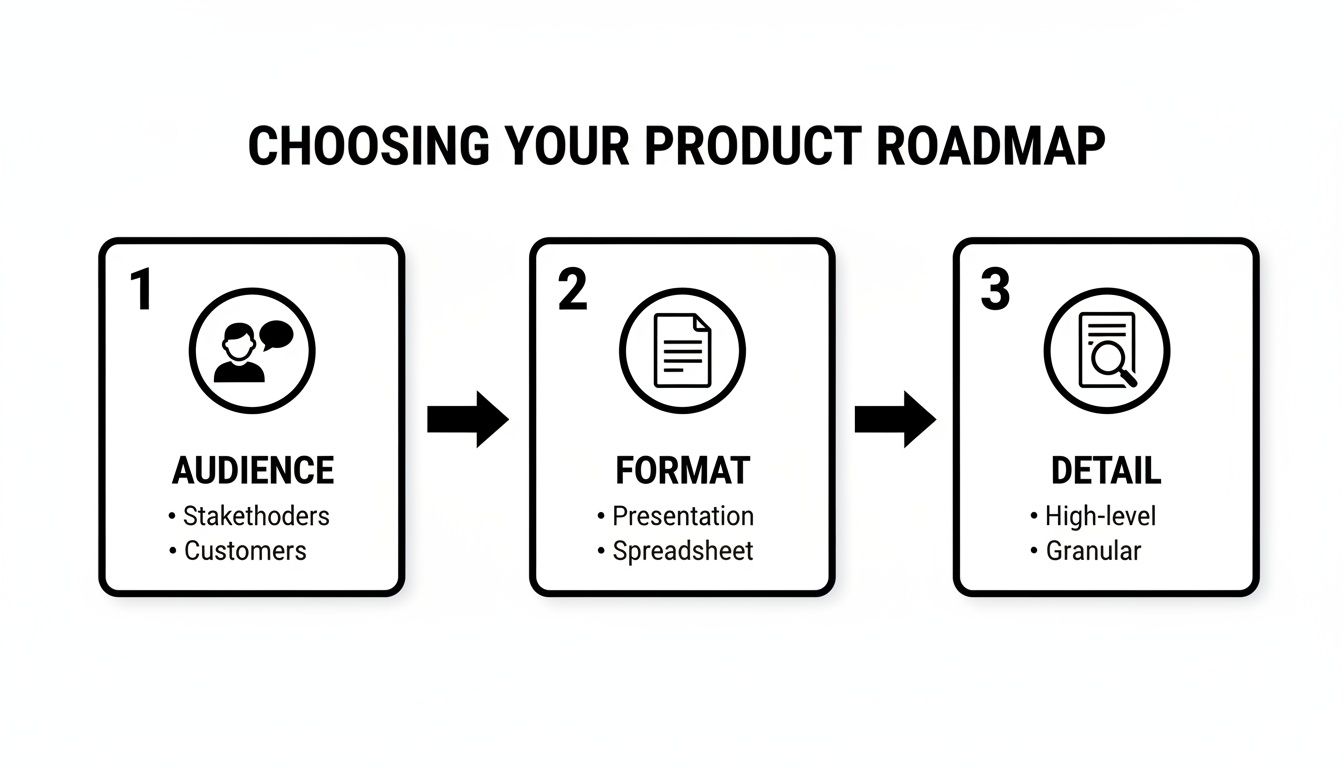
Before a single feature gets on a list, you have to be crystal clear on who you're talking to, what format will actually persuade them, and how deep into the weeds you need to go.
Phase 1: Synthesizing Your Inputs with AI leverage
Your roadmap doesn't start in Jira or Miro. It starts with you becoming the central intelligence hub, synthesizing signals from every direction. Don't just collect—synthesize.
Your key inputs should include:
- Customer Feedback: This is your ground truth. Dig through everything—Gong call transcripts, Zendesk tickets, notes from the sales team in Salesforce, and your own user research. You’re looking for the recurring themes and deep-seated pain points, not just one-off feature requests.
- Market & Competitive Analysis: What are your competitors shipping? Where are the broader market trends headed? Tools like Crayon can automate this, but even just diligently tracking press releases and product updates is non-negotiable.
- Quantitative Product Data: Time to get cozy with your analytics tools like Amplitude or Mixpanel. Where are users dropping off? Which features drive engagement? What actions correlate with long-term retention?
- Company Strategy: What are the C-suite's top priorities this year? Is it all about breaking into a new market, boosting profitability, or pure user growth? Your roadmap must be a direct line to these goals.
The biggest mistake I see is product managers treating these inputs like a grocery list. Your job is to be a detective, finding the patterns that point to the most meaningful problems and opportunities.
AI PM Pro Tip: Use ChatGPT or Claude to accelerate synthesis. Don't just ask it to "summarize." Get specific and strategic with your prompts to pull out insights.
Actionable AI Prompt:"Act as a Senior Product Manager at a B2B SaaS company. Analyze these 50 customer support tickets from Zendesk. Ignore minor bugs and one-off complaints. Identify the top 3 recurring themes related to user frustration with our reporting dashboard. For each theme, provide 5 direct quotes that best represent the user's problem and suggest a potential user problem statement for each theme."
This prompt shifts the AI from a simple summarizer to a strategic partner. It saves you hours and helps build a data-backed case for your initiatives. As AI PM roles become more common, with companies like OpenAI and Google posting jobs with salaries over $250,000, proficiency with these tools is no longer optional.
Phase 2: Translating Strategy Into Product OKRs
You've got your themes. Now you have to connect them to what the business actually cares about: measurable outcomes. This is where you translate the big company strategy into specific, measurable Objectives and Key Results (OKRs) for your product.
An Objective should be aspirational (e.g., "Become the go-to platform for enterprise collaboration"). The Key Results must be cold, hard numbers (e.g., "Increase weekly active users in enterprise accounts by 15%," or "Reduce time-to-create a new project by 20%").
Do not skip this step. It forces you to define what success looks like before you get bogged down in features. Your OKRs become the "why" that anchors your entire roadmap and gives you a legitimate foundation for prioritization.
Phase 3: Prioritizing With Ruthless Focus
This is where roadmaps are made or broken. You have limited time, money, and people. You have to make tough calls, and those calls better be backed by a framework, not just who yells the loudest.
-
RICE Scoring: A simple, powerful model for quantitative comparison.
- Reach: How many users will this touch in a given period?
- Impact: How much does this move the needle for a user? (Massive=3x, High=2x, Medium=1x)
- Confidence: How sure are you about your estimates? (High=100%, Medium=80%, Low=50%)
- Effort: How many "person-months" will this take from the team?
- Formula: (Reach x Impact x Confidence) / Effort
-
Weighted Scoring: A more adaptable model where you define your own criteria based on current strategy (e.g., Drives Revenue, Increases Retention, Improves User Satisfaction) and assign a weight to each one.
Whichever framework you choose, the goal is the same: create a stack rank of initiatives that is objective and defensible. This changes the conversation from "I feel like we should do this" to "This initiative has the highest projected impact on our goals, and here's the math to prove it."
Phase 4: Visualizing And Communicating The Roadmap
With your prioritized list in hand, it's time to bring it to life visually. As we covered, the format depends entirely on your audience. For your internal team, a Now-Next-Later roadmap is usually best. It gives them clarity without the false precision of specific dates that will inevitably change.
The entire industry is shifting this way. An Airtable report on 2025 product management trends found that a whopping 92% of product leaders now own revenue outcomes. This is a massive leap, confirming that roadmaps are no longer just feature lists; they are strategic documents tying work directly to business value. You can check out more in the full report on product management trends.
Tools like ProductPlan or even a well-organized Miro board work great for creating compelling visuals. The key is to keep it simple, always focus on the "why" (the outcome), and tailor the view for whoever is looking at it.
If you're just getting started and need a solid foundation, grabbing a versatile free product roadmap template can save you a ton of time. You can adapt it for presenting to execs, aligning with engineering, or anything in between.
Securing Stakeholder Buy-In For Your Roadmap
You’ve built a brilliant, data-backed, outcome-driven roadmap. Congratulations. Unfortunately, that’s only half the battle.
An incredible roadmap that lives only on your laptop is worthless. The real work begins when you have to sell that vision to everyone from skeptical engineers to time-strapped executives.
As a PM leader, I've seen more roadmaps die from poor communication than from poor strategy. Securing buy-in isn't a single presentation; it's a continuous campaign of influence, alignment, and strategic communication. Your goal is to transform the roadmap from a static plan you defend into an ongoing strategic conversation you lead.
Tailoring Your Pitch For Different Audiences
Never give the same roadmap presentation twice. Each audience has a different currency of concern, and you absolutely must speak their language.
-
For Executives: Their time is their most valuable asset. Be crisp and get straight to the point. Start with the business outcome. Connect every major theme on your roadmap directly to a company-level OKR or KPI. Instead of saying, "We're building a new onboarding flow," say, "We're investing in a new onboarding experience to increase user activation by 15% in Q3, which will directly impact our revenue growth target." Our detailed guide offers more specific tactics for how to present to executives and win them over.
-
For Engineering Leads: They need to understand the 'why' to build the best 'how.' But they also live in a world of trade-offs and technical debt. Frame your presentation as a collaborative planning session, not a decree. Come prepared to discuss dependencies, scope, and potential architectural challenges. They are your most important partners in assessing feasibility.
-
For Sales and Go-to-Market Teams: They want to know what they can sell and when. Provide them with customer-centric themes and broad, quarterly timelines. The key here is to avoid committing to specific release dates for anything more than a quarter out. Give them a narrative they can use, like "This quarter, our focus is on making our platform faster and more reliable for our enterprise customers."
Navigating Conflict And Last-Minute Requests
You will inevitably get that "urgent" feature request from sales, often tied to a big deal. Or you'll face conflicting priorities from two different department heads. Your roadmap is your best defense against chaos.
When confronted, the worst thing you can do is just say "no." Instead, use the roadmap to illustrate the trade-offs.
Your Response Framework:
"That's an interesting idea. Right now, our capacity is focused on [Initiative A], which we prioritized because it's projected to impact [Business Goal X]. To take on your request, we would need to deprioritize [Initiative A or B]. Can we look at the data together to see if this new request has a higher strategic value than what's currently planned?"
This approach completely reframes the discussion. It shifts from a personal conflict to a shared, objective decision about business priorities. You become a strategic partner helping them solve a problem, not a gatekeeper blocking their request.
Establish A Continuous Communication Loop
Buy-in isn't a one-time event. Establish a simple, predictable communication cadence to keep everyone aligned and prevent surprises.
Actionable Communication Plan:
- Monthly Roadmap Update Email: Send a concise, bulleted email to all stakeholders at the beginning of each month.
- What We Shipped: Briefly celebrate the wins from the previous month.
- What We're Building Now: Reiterate the current priorities.
- Key Learnings & Changes: Transparently communicate any shifts in the roadmap and explain the "why" behind the change. This builds immense trust and reinforces that the roadmap is a living document, guided by strategy and data.
The Modern PM's Roadmapping Toolkit
Your roadmap is only as good as the tools you use to build and share it. Today's product manager needs a tech stack that can centralize feedback, simplify prioritization, and make communication feel effortless. Don't just chase the fanciest software; find the right fit for your team's workflow and stage.
Dedicated Roadmapping Platforms
Once your organization matures, dedicated platforms become invaluable. They create a single source of truth from feedback to strategy.
- Productboard: My go-to recommendation if your main struggle is making sense of customer feedback. Its superpower is linking insights from sales calls, support tickets, and surveys directly to feature ideas.
- Aha!: Think of Aha! as the comprehensive, all-in-one suite. It’s built for larger organizations juggling multiple product lines and excels at tying roadmaps back to high-level corporate strategy.
- Roadmunk: If you find yourself constantly presenting to different stakeholders, look at Roadmunk. Its key strength is visualization, allowing you to spin up beautiful, audience-specific views in minutes.
Flexible Powerhouses for Agile Teams
For startups and fast-moving teams, flexible, canvas-style tools offer the speed and adaptability you need.
- Airtable: Incredibly versatile for building custom prioritization models (like RICE or Weighted Scoring), tracking user feedback, and creating dynamic roadmaps you can slice and dice.
- Miro: More than a digital whiteboard; it’s a collaboration hub. It’s perfect for the messy, early stages of roadmapping—think brainstorming workshops, user story mapping, and creating visual Now-Next-Later roadmaps.
A tool is just a means to an end, never the solution itself. The best PMs understand that clear communication and solid leadership are what truly matter. They often invest in resources like executive coaching and leadership training to cultivate teams that can execute brilliantly on any roadmap, regardless of the software they use.
Modern Product Roadmapping Tool Comparison
Here’s a quick comparison of the top players to help you choose.
| Tool | Best For | Starting Price | Key Feature |
|---|---|---|---|
| Productboard | Teams focused on centralizing and acting on customer feedback. | $25/maker/month | Linking user insights directly to feature prioritization. |
| Aha! | Large enterprises managing complex product portfolios and strategies. | $74/user/month | All-in-one suite for strategy, roadmapping, and idea management. |
| Roadmunk | PMs who need to create custom roadmap views for diverse audiences. | $19/editor/month | Powerful and beautiful roadmap visualization options. |
| Airtable | Agile teams needing a highly customizable, database-driven tool. | Free tier available | Unmatched flexibility for custom workflows and prioritization models. |
| Miro | Collaborative teams in the early stages of ideation and planning. | Free tier available | Real-time visual collaboration for brainstorming and story mapping. |
Weaving AI into Your Workflow
The biggest shift in the PM toolkit is the arrival of AI. These tools don't build the roadmap for you, but they act as incredible accelerators for the inputs that feed into it.
- Dovetail: If you're drowning in user research, Dovetail is a lifesaver. It transcribes user interviews and uses AI to automatically surface and tag key themes across dozens of conversations, turning days of manual synthesis into hours.
- ChatGPT or Claude: Use these AI assistants to get a running start on your documentation. You can feed them a roadmap theme and a pile of user feedback, then ask for a first-draft project brief or PRD. This is a core skill for the modern AI PM.
For a deeper look at the software that can support your entire product lifecycle, check out this comprehensive guide to the best product management tools on the market today.
Your Roadmap Questions, Answered
After years of navigating these situations, I've seen the same challenges pop up time and again. Here's my no-nonsense advice for the most common ones.
How Often Should I Update My Product Roadmap?
Think of your roadmap as a living document. A quarterly review and refresh hits the sweet spot for most teams, aligning with business planning cycles like OKRs.
But the "Now" part of a Now-Next-Later roadmap is more dynamic. You'll likely tweak it monthly, or even every couple of weeks, to reflect what you're learning. The key isn't the formal cadence, it's communication. The second a significant change happens, tell your stakeholders. Don't wait for the quarterly meeting.
How Do I Handle Pressure From Sales To Add a Feature?
This is a test of your strategic discipline. Shift the conversation from the feature to the customer problem.
Start with "why." What specific problem is this feature solving? For which customer? Then, use your prioritization framework. Pull up your RICE scores or Weighted Scoring model and evaluate the request against your current priorities. When you can show the data-driven trade-offs—"Look, to build this, we'd have to punt on the project that's directly tied to our core retention goal"—it's a collaborative, strategic choice, not a personal conflict.
What’s The Difference Between a Roadmap and a Release Plan?
It all comes down to altitude.
Your product roadmap is the 10,000-foot strategic view. It's all about the "why." It shows the major themes and business outcomes you're driving toward over the next several quarters.
A release plan is the ground-level tactical view. It's the "how" and the "when." It breaks down the specific user stories and features for the very next release, often organized sprint by sprint.
- Roadmap Theme: "Improve User Onboarding Experience in Q3"
- Release Plan Features: "Add interactive product tour (Sprint 1-2)," "Redesign sign-up flow (Sprint 3)," "Implement welcome email sequence (Sprint 4)."
Can I Create A Roadmap Without Specific Dates?
Not only can you, but you absolutely should. Slapping a specific date like "October 15th" on something six months away is a recipe for broken promises and shattered trust.
The Now-Next-Later format is brilliant for this. It communicates priority and sequence without the false precision of a hard deadline for items in "Next" and "Later." When pushed for timelines, use broad horizons: "Q3," "Q4," or "H1 2025." Always frame them as targets based on what you know today, not unbreakable commitments.
At Aakash Gupta, we're dedicated to helping you master these skills. Get more expert insights and career-advancing frameworks by visiting https://www.aakashg.com.
