The most common point of confusion in product roles comes down to a single distinction: scope and focus. As a PM leader who has hired both roles at top-tier companies, I've seen organizations succeed or fail based on how well they understand this difference.
The framework I use to mentor my teams is simple:
- The Product Manager (PM) is strategic and outward-facing. They own the why: Why are we building this? What market problem are we solving? What is the business case and P&L impact? Their primary output is a market-validated product roadmap.
- The Product Owner (PO) is tactical and inward-facing. They own the how and when: How will the engineering team execute this vision? When will the specific features be delivered? Their primary output is a prioritized and actionable product backlog.
A Practical Framework for Understanding the Roles
If you're looking to break into product or advance to a senior role, mastering this distinction is critical for your career trajectory. These roles, while often blended in startups, serve fundamentally different functions in mature tech organizations.
The Product Manager is the CEO of the product. They are obsessed with the big picture: setting the long-term vision, understanding the competitive landscape at a granular level (e.g., pricing, feature parity), and ensuring the product is not just valuable to customers but viable for the business. They are the voice of the customer and the business to the entire organization.
The Product Owner, a role defined by the Agile/Scrum framework, is the voice of the customer to the development team. Their world revolves around maximizing the value produced by the engineering team sprint-over-sprint. They own, prioritize, and articulate the product backlog with extreme clarity. For a deep dive, see this detailed guide on what a Product Owner does.
Let's ground this in a real-world scenario. Imagine an AI Product Manager at Google identifies a market opportunity to reduce model inference latency for enterprise clients, projecting a potential $50M ARR increase. That’s the strategic goal, backed by market analysis and a business case presented to leadership.
The PO takes this high-level vision and translates it into actionable work for the engineering team. They’ll work with engineers to create specific user stories in Jira, such as: "As a machine learning engineer, I need to implement quantization-aware training to reduce model size by 30% without impacting accuracy by more than 1%." This translation ensures the grand strategy is directly connected to the code being written today. The PM is looking out at the market; the PO is embedded with the builders.
Core Distinctions: A Side-by-Side Comparison
To give you an immediately usable reference, here is a breakdown of where these roles differ most.
| Attribute | Product Manager (Strategic) | Product Owner (Tactical) |
|---|---|---|
| Primary Focus | The 'Why' – Market viability, business outcomes, P&L, and long-term product vision. | The 'How' & 'When' – Translating vision into actionable tasks and maximizing development value. |
| Key Artifact | Product Roadmap, Business Case, P&L Statement, Go-to-Market (GTM) Plan. | Prioritized Product Backlog, User Stories, Sprint Goals. |
| Main Stakeholders | Executive Leadership, Marketing, Sales, Customers, Legal. | Engineering Team, Scrum Master, QA, Internal Stakeholders. |
| Success Metrics | Revenue, Market Share, Customer Lifetime Value (CLV), Net Promoter Score (NPS), Churn Rate. | Velocity, Sprint Goal Completion, Cycle Time, Minimizing Rework, Story Points Delivered. |
| Core Question | "Are we building the right product to win the market?" | "Are we building the product right and on schedule?" |
Ultimately, the PM is accountable for the product's success in the marketplace. The PO is accountable for the development team's success in building that product efficiently and effectively. One cannot succeed without the other.
A Day in the Life: Strategic vs. Tactical Realities
Let's move beyond definitions. To truly understand the difference between a Product Owner and a Product Manager, you need to see what they actually do day-to-day. Their calendars, tools, and outputs are worlds apart.
Imagine a B2B AI SaaS company. We'll follow a PM and a PO through a typical Tuesday. This is where theory meets reality.
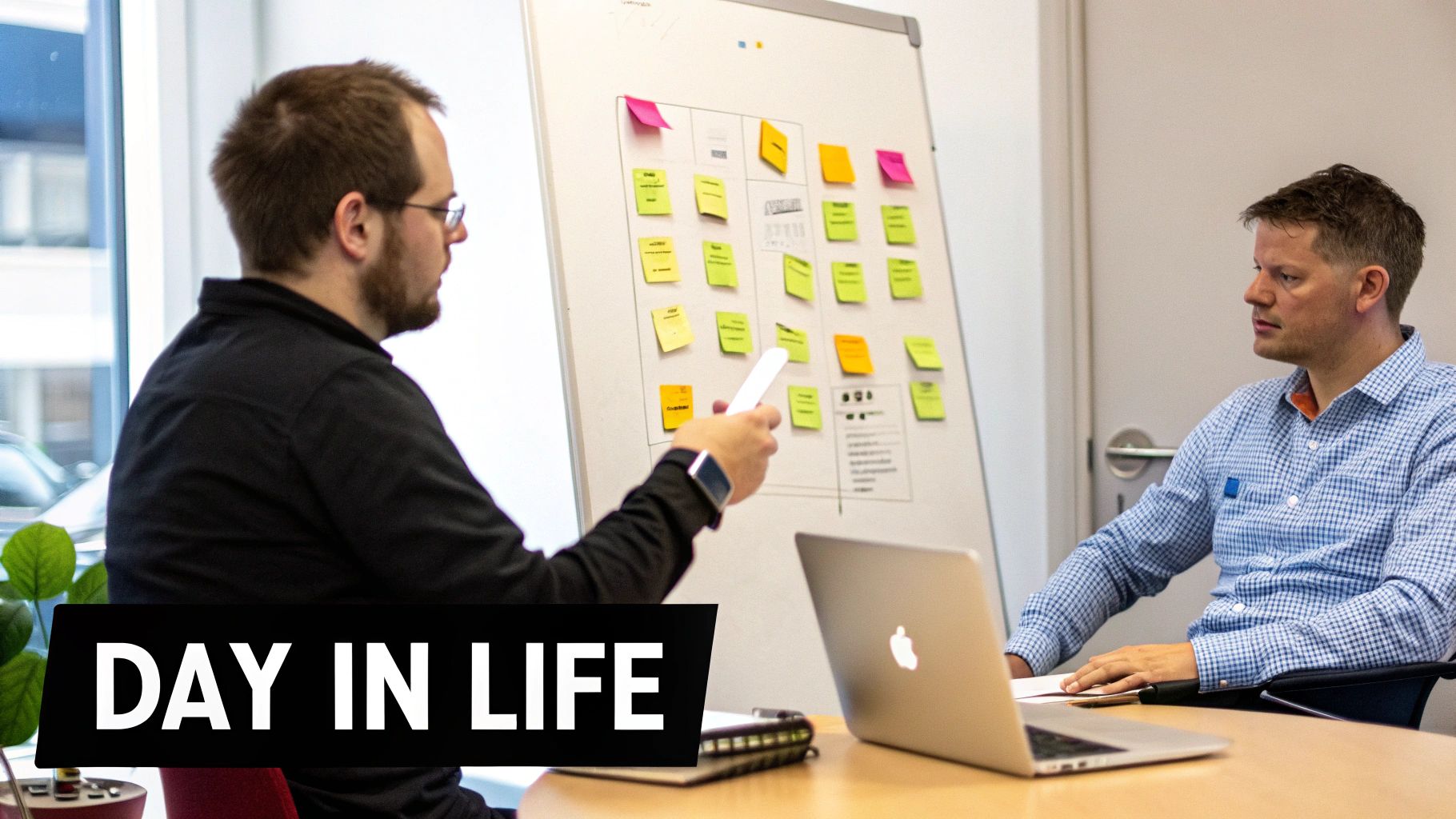
The fundamental split: a Product Manager spends most of their time facing outward—to the market, customers, and business stakeholders. A Product Owner spends almost all their time facing inward—to the development team and the specifics of product delivery.
The Product Manager’s Strategic Grind
A PM’s calendar is dictated by the market. They are in a constant state of intelligence gathering to answer the critical question: "What problem should we solve next to achieve our business goals?"
A typical day might look like this:
- Morning (9 AM – 12 PM) Market & Customer Focus: The day starts with a customer discovery call with a key enterprise account to validate pain points around AI model deployment. This is followed by a competitive analysis of a new feature launched by a rival like OpenAI. The morning ends with a sync with the marketing team to review the lead generation from the latest GTM campaign.
- Afternoon (1 PM – 5 PM) Internal Strategy & Alignment: The afternoon is dedicated to building the business case for a new generative AI feature. This involves creating a revenue projection model in Excel, defining success metrics (e.g., "Increase user engagement by 15% in Q3"), and preparing a presentation for the executive team to secure engineering resources. Their key output is the strategic product roadmap.
"A Product Manager's job is to represent the problem to the team. They must become the world's foremost expert on that problem, armed with qualitative customer stories and quantitative data from tools like Amplitude or Mixpanel."
This outward-facing work ensures the company builds products people will actually pay for. A PM who isn't talking to customers and analyzing the market is simply managing a feature factory. Their world is ambiguous, requiring them to synthesize conflicting signals into a clear vision. To grasp the full scope, see this deep dive into the full scope of a product manager's responsibilities.
The Product Owner’s Tactical Execution
The Product Owner lives by the development team's rhythm, typically a two-week sprint cycle. They are the gatekeeper, protecting engineers from distractions so they can focus on building. Their central question is, "What is the most valuable thing we can build right now, and is it clearly defined?"
Here’s a snapshot of a PO’s day:
- Morning (9 AM – 12 PM) Sprint & Backlog Focus: The day begins with the daily stand-up, identifying and resolving any blockers for the engineers. The rest of the morning is dedicated to backlog grooming in a tool like Jira. They break down large epics from the PM's roadmap into small, well-defined user stories with explicit acceptance criteria.
- Afternoon (1 PM – 5 PM) Clarification & Validation: The afternoon is spent in deep-dive sessions with developers and QA to clarify the technical details of a story currently in the sprint. Later, they might perform user acceptance testing (UAT) on a newly completed feature, giving the final approval or providing specific feedback for rework.
The PO’s world is one of precision, ruthless prioritization, and constant communication within the dev team. They are the undisputed owner of the product backlog, ensuring every item is defined, estimated, and ordered to maximize value delivery, sprint after sprint. Their success is measured by the team's velocity and the quality of what gets shipped.
Comparing Core Skills and Decision Authority
Beyond the daily tasks, the core of the Product Owner vs. Product Manager debate lies in skills and authority. Where does one's decision-making power end and the other's begin?
Their domains are separate but interlocking. One owns the strategic "what and why," while the other commands the tactical "how and when." When companies fail to define these boundaries—and many do—it leads to friction, stalled projects, and confused teams.
A Product Manager's authority is strategic and commercial. They are accountable for the product's business outcomes, giving them the power to make high-stakes decisions that determine its market trajectory.
A Product Owner's authority is tactical and delivery-focused. They are the final arbiter of what the dev team builds next, ensuring the product vision is executed correctly and efficiently.
The Strategic Domain of the Product Manager
A PM operates at the intersection of business, technology, and user experience. Their authority is earned through deep market knowledge and direct responsibility for the product's P&L.
Their key decision-making powers include:
- Setting the Product Vision and Strategy: They define the product's North Star, answering, "Where will this product be in one to three years, and how will it win against competitors?"
- Owning the Business Case: They have the authority to greenlight, pivot, or kill a product based on financial models, market analysis, and alignment with company strategy.
- Go-to-Market (GTM) Decisions: The PM collaborates with marketing and sales to determine pricing, positioning, and launch strategy—decisions that directly impact revenue.
These responsibilities require a specific toolkit. The most critical product manager skills required are market analysis, financial modeling, and the ability to communicate a compelling vision to executives. For AI PMs, this also includes understanding the technical trade-offs of different models (e.g., cost vs. performance).
The Tactical Command of the Product Owner
The Product Owner’s authority is concentrated within the Agile framework. They are the single person empowered to manage the product backlog, translating the PM's high-level roadmap into a prioritized list of work for the engineering team.
Their authority in this domain is absolute:
- Final Say on the Product Backlog: The PO decides the priority of every user story, bug fix, and technical task. No one—not a VP, not the PM—can force the development team to work from a different list.
- Accepting or Rejecting Completed Work: At the end of a sprint, the PO has the final power to review the work and decide if it meets the acceptance criteria. If it doesn't, it’s not "done."
- Shielding the Development Team: A great PO acts as a buffer, protecting engineers from external requests and scope creep so they can maintain focus and velocity.
At Meta, we empower both roles by creating clear 'lanes of authority.' The PM owns the 'problem space'—the market opportunity and business goals. The PO owns the 'solution space'—how we solve that problem within the engineering team. This prevents gridlock and accelerates execution by ensuring decisions are made by the person with the most relevant context.
While both roles must prioritize, the scale is different. A PM prioritizes multi-million dollar market opportunities. A PO uses tactical strategies for effective task prioritization within the backlog to maximize the value delivered in each two-week sprint.
How Company Structure Defines the Roles
The "Product Owner vs. Product Manager" dynamic is not theoretical; it's a practical reality shaped by a company's structure, size, and commitment to a specific Agile methodology. Where you work dictates what you do.
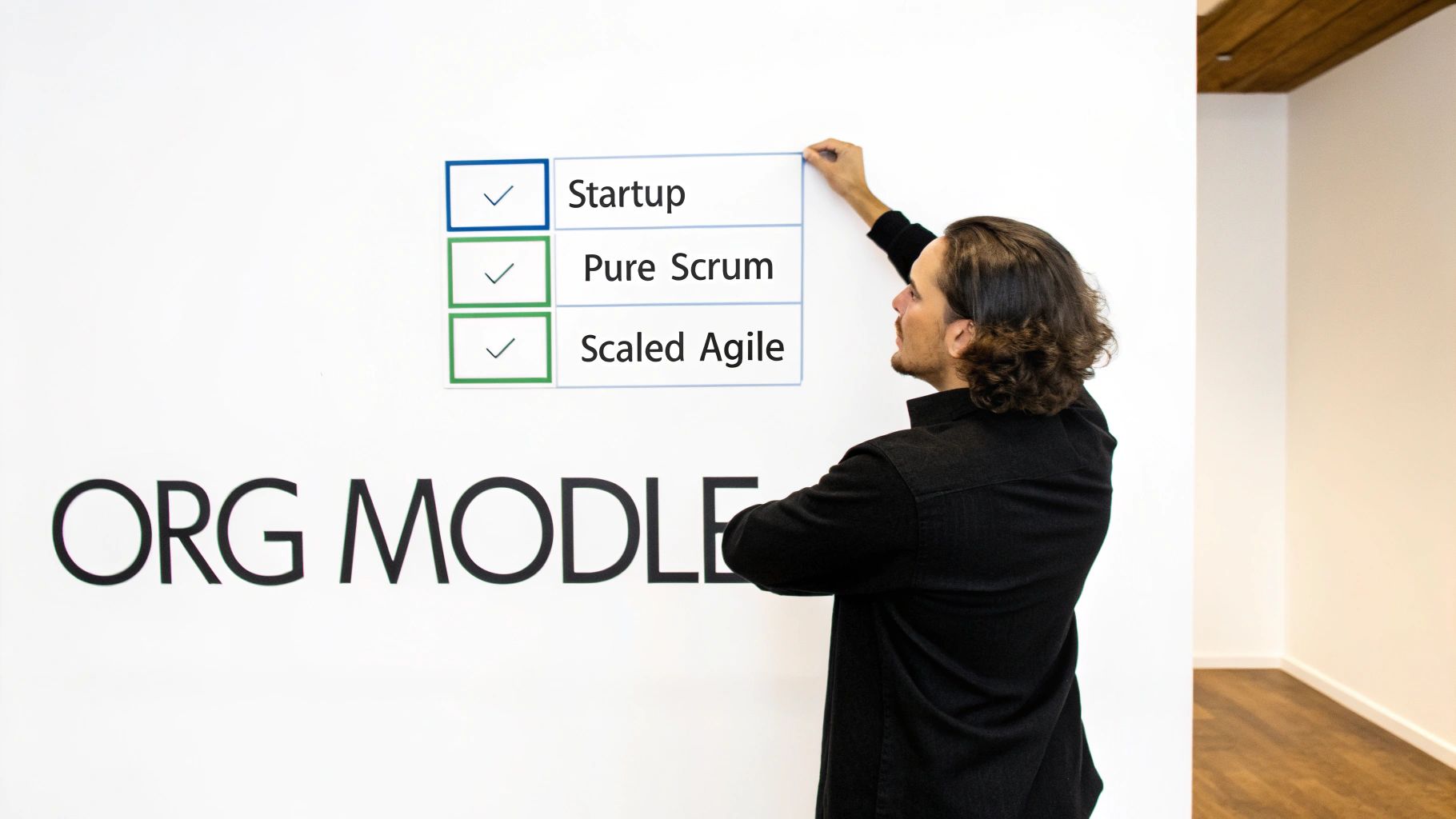
There isn’t one "correct" model. The responsibilities of PMs and POs are molded by business needs. Here are the three most common structures you will encounter in your career.
The Startup Model: One Role Wears Both Hats
In the fast-paced, resource-constrained environment of an early-stage startup, it's rare to find separate PM and PO roles. A single Product Manager is responsible for everything, from pitching the long-term vision to investors to writing detailed acceptance criteria in Jira.
This person is both strategist and tactician out of necessity. It’s a blended model that prioritizes speed and direct communication over formal processes.
- Who it’s for: Individuals who thrive on context-switching between high-level strategy and hands-on execution.
- Key Challenge: The risk of burnout is high. Urgent tactical work (like unblocking a developer) can easily overshadow important strategic work (like customer research).
The Pure Scrum Model: The Empowered Product Owner
This model is common in mature tech companies or software development agencies that are fully committed to the Scrum framework. Here, the Product Owner is a distinct, empowered role focused squarely on serving the development team.
In this setup, the PO is the undisputed owner of the product backlog. They translate the strategic vision—often set by a separate Product Manager or Head of Product—into a perfectly prioritized pipeline of work. Their primary allegiance is to the development team, ensuring they have everything needed to build the right features efficiently.
The success of a project rarely comes down to the technical team or the project manager. It often comes down to the Product Owner. Their singular focus on the team's backlog is what turns a good implementation into a great one.
The Scaled Agile (SAFe) Model: The Enterprise Duo
In large, complex organizations like major banks (e.g., JPMorgan Chase) or Fortune 500 companies (e.g., AT&T), the Scaled Agile Framework (SAFe) is often used. This model formally separates the PM and PO roles to manage complexity across numerous teams.
Here’s the division of labor:
- The Product Manager (Strategic): The PM operates at a higher level, defining broad business initiatives called 'Features.' They focus on market analysis, building the business case, and securing budget for large-scale efforts.
- The Product Owner (Tactical): Each Agile team has a dedicated PO. Their job is to break down the PM's strategic 'Features' into smaller, team-specific 'User Stories' that can be completed within a single sprint.
This creates a clear hierarchy, ensuring that the work of dozens of development teams aligns with a cohesive product strategy. Understanding the dynamics of both feature teams and delivery teams is crucial for success in this environment.
Analyzing Career Trajectories and Salary Potential
When planning your career, it's critical to look beyond your first role. While Product Owner and Product Manager positions may start with similar salaries, their long-term growth trajectories and earning potential diverge significantly. One path is optimized for execution excellence, the other for strategic business impact.
Mapping the Product Owner Career Path
The Product Owner's career ladder is rooted in Agile execution. This is the path for those who excel at translating a vision into a flawlessly delivered product and maximizing the output of a development team.
A typical PO progression:
- Product Owner: Manages the backlog for a single team, mastering sprint planning and stakeholder communication. (Avg. Salary: ~$115,000)
- Senior Product Owner: Mentors junior POs and manages the backlog for multiple teams or a more complex product. (Avg. Salary: ~$135,000)
- Agile Coach or Principal PO: Focuses on optimizing Agile processes across the entire organization, coaching teams and leadership.
The common thread is improving how products are built. Success is measured by team velocity, efficiency, and output quality.
Charting the Product Manager Career Path
The Product Manager's journey is a climb toward greater strategic ownership and direct accountability for business results. You're not just influencing a product; you are steering the financial direction of the business.
This progression is geared toward owning the P&L:
- Product Manager: Owns a specific product or feature and is accountable for its market success. (Avg. Salary: ~$125,000)
- Senior Product Manager: Manages a larger, more strategic product area and begins guiding other PMs. (Avg. Salary: ~$160,000)
- Group / Principal PM: Leads a team of PMs and is responsible for an entire product portfolio. (Avg. Salary: ~$200,000+)
- Director / VP of Product: Sets product vision for a business unit or the entire company, reporting to the C-suite. (Avg. Salary: ~$250,000+)
This path is explicitly tied to metrics like revenue growth, market share, and profitability. A successful product management career is built on a portfolio of commercial wins.
A Data-Driven Look at Compensation
Salary data tells a clear story: the market places a premium on strategic, revenue-generating skills over tactical, execution-focused skills, and this gap widens dramatically with experience.
Compensation Growth: Product Owner vs. Product Manager
| Experience Level | Average Product Owner Salary | Average Product Manager Salary | Approximate Salary Gap |
|---|---|---|---|
| 1-4 Years | $77,656 | $74,000 | ~$3,600 (PO higher) |
| 5-9 Years | $92,619 | $117,000 | ~$24,400 (PM higher) |
| 10-15+ Years | Varies (limited data) | $154,000 | $60,000+ (PM higher) |
This table, drawing from Glassdoor and other sources, is a career map. Initially, a PO may have a slight salary edge due to the specific technical demands. However, by the mid-career stage, the PM track pulls away significantly. At senior levels, the gap often exceeds $60,000 annually because the PM is directly accountable for the financial success of the business. For a more detailed breakdown, you can review Product Owner vs Product Manager salary data.
The takeaway is clear: while both roles are critical, the market rewards strategic ownership more generously over the long term.
When I'm hiring senior product leaders, I'm not just looking at their ability to ship features. I'm looking for a track record of owning a P&L and delivering measurable business impact. That is the key differentiator for top-tier compensation and career advancement.
Choosing the Right Product Path for You
Deciding between a Product Owner and Product Manager career isn't about which title sounds better. It requires an honest self-assessment of what energizes you. Do you get a bigger thrill from perfecting a team’s internal workflow or from discovering a new external market opportunity?
Your answer reveals your ideal path. Are you driven by the satisfaction of shipping flawless features on a predictable schedule? Or are you obsessed with ensuring those features achieve a specific business goal, even if the path is ambiguous?
An Actionable Framework for Your Decision
To make this tangible, read these two profiles and identify which one resonates more with you:
- The Execution Expert: You thrive on tactical clarity and execution excellence. Translating a big vision into perfectly groomed user stories excites you. You love the rhythm of a high-velocity sprint and the satisfaction of a clean, organized backlog. Your path leans toward Product Owner.
- The Strategic Optimizer: You thrive on strategic ambiguity and market impact. You are energized by digging through customer feedback, competitive analysis, and financial models to find the next big opportunity. Tying every feature directly to revenue growth or user acquisition is what motivates you. Your path points directly to Product Manager.
This flowchart maps out the typical career and salary progression for both roles, from entry-level to senior leadership.
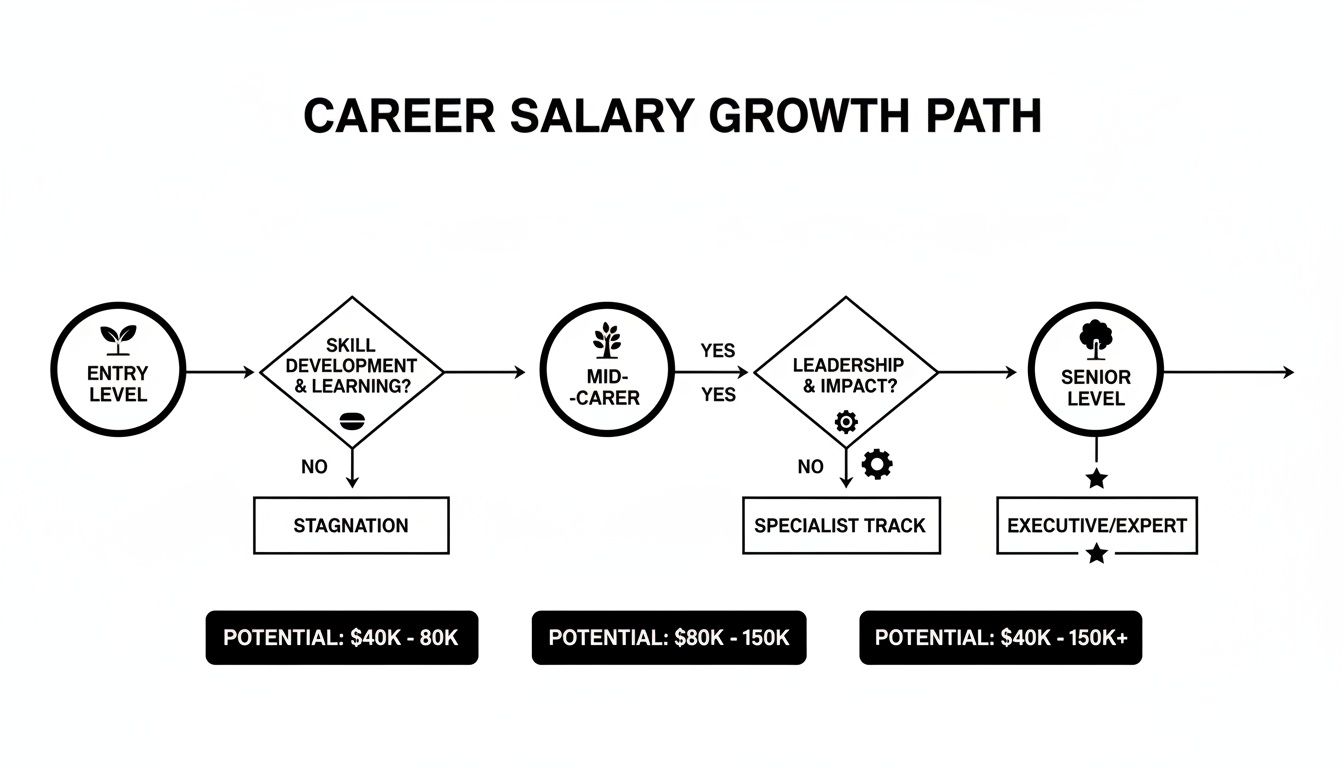
As the graphic shows, both paths offer solid growth. However, the Product Manager track often has a higher ceiling because it is tied directly to business strategy and P&L ownership.
Actionable Plan: Transitioning from PO to PM
If you are a PO aspiring to become a PM, the move requires a deliberate pivot from an internal to an external focus. You must prove you can think beyond the backlog and connect your team's work to business results.
Here is a 3-step action plan you can start implementing within the next 48 hours:
- Lead Customer Discovery Calls: Don't just attend customer calls—ask to lead them. Shift your questions from "How should we build this?" to "What is the underlying business problem you're trying to solve?" Record these calls using a tool like Gong or Grain to analyze later.
- Build a Mini Business Case: Select a feature from your current backlog. Create a one-page document outlining its potential business impact. Include target user persona, success metrics (e.g., a 5% increase in conversion), and a simple ROI estimate. Present this to your PM to show initiative.
- Master Product Analytics Tools: Gain proficiency in tools like Amplitude, Mixpanel, or Pendo. Go beyond tracking sprint velocity and start analyzing how shipped features impact user behavior and key business KPIs.
Once you have this experience, use a sharp Product Manager Resume Template to frame these new strategic skills in a way that will capture a recruiter's attention.
Frequently Asked Questions
Even with clear definitions, common questions arise when untangling the Product Owner vs. Product Manager roles. Here are the most frequent ones I get from aspiring PMs.
Is Product Owner a Good Stepping Stone to Product Manager?
Yes, it's one of the most effective and common paths into product management. A great PO already has deep domain knowledge, credibility with the engineering team, and a proven track record of execution—all highly valuable assets.
To make the leap, you must proactively build your strategic skillset.
Actionable Steps:
- Volunteer for Market Research: Offer to lead a competitive analysis project for your PM.
- Shadow Sales Calls: Listen to unfiltered customer objections to understand real business needs.
- Build a Financial Model: Create a simple ROI projection for a feature to connect your team's work to business value.
These actions demonstrate that you can think beyond the backlog and are focused on market outcomes, not just team output.
Do I Need a Technical Background for Either Role?
A computer science degree is not a strict requirement for either role, but technical literacy is non-negotiable. You must be able to have credible conversations with engineers about technical trade-offs and constraints.
For AI PM roles, this is table stakes. You need to understand concepts like model training, inference, and the trade-offs between different architectures (e.g., transformers vs. CNNs). Without this, you cannot effectively guide an AI product strategy.
To build your AI literacy, I recommend:
- Course: Andrew Ng's "AI for Everyone" on Coursera (Approx. $49/month). It provides a foundational, non-technical overview of AI concepts and their business applications.
- Practice: Use ChatGPT or Claude 2 to experiment with prompting for product use cases. For example:
Act as a Product Manager. Generate three user stories for an AI-powered email assistant that helps sales teams prioritize leads.
In a Company with Both Roles, Who Does the PO Report To?
While organizational structures vary, the most effective model I've implemented has the PO reporting directly to the Product Manager or a Group Product Manager.
This structure ensures that the tactical execution within the engineering team (owned by the PO) is always tightly aligned with the product strategy and business goals (owned by the PM). A direct reporting line prevents strategic drift and ensures the entire product organization is moving in the same direction.
Ready to accelerate your career? Aakash Gupta provides in-depth analysis, frameworks, and career advice for product managers at every level. Join the largest community of PMs and leaders by subscribing at https://www.aakashg.com.
