How AI-powered testing infrastructure is cutting debug time from hours to minutes
The future of software isn’t just intelligent—it’s self-correcting.
Imagine your AI recommendation engine starts suggesting out-of-stock items to customers. In a traditional development workflow, this triggers a familiar cascade: a test fails, an engineer gets paged at 2 AM, they spend hours investigating the issue, manually write a fix, and retest everything before deploying.
Time to resolution? Two hours minimum. Often much longer.
But there’s a fundamentally different approach emerging—one where your testing infrastructure doesn’t just identify problems, it solves them.
The Traditional Bottleneck
Let’s break down what actually happens when an AI system fails today:
Test fails → Engineer gets alert → Manual investigation → Code fix → Manual retest → Deploy
Each step requires human decision-making. Each handoff creates delay. And in the probabilistic landscape of AI systems, debugging is exponentially more complex than traditional software.
Why? Because AI systems fail differently.
A traditional bug is deterministic: the same input produces the same broken output. But AI systems operate in a probabilistic landscape. Your recommendation engine might work perfectly 99% of the time, then suddenly start surfacing out-of-stock items because of a subtle data staleness issue that only manifests under specific conditions.
Finding these issues requires understanding the interaction between multiple systems: your AI model, your data pipeline, your inventory API, your caching layer. An engineer needs to trace through logs, check API responses, investigate timing issues, and piece together what went wrong.
This is why testing has become the primary bottleneck in AI development.
The Self-Healing Architecture
Now consider the alternative approach:
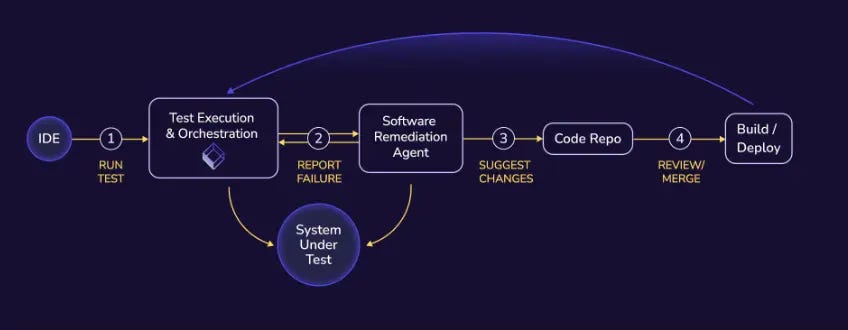
Test fails → AI analyzes root cause → Suggests specific fix → Auto-creates pull request → Validates fix → Deploys
Time to resolution: 15 minutes.
Here’s what actually happens in this architecture:
1. Intelligent Failure Analysis
When the test fails, an AI agent doesn’t just flag the error—it investigates. It examines the test output, traces through the system to identify the root cause, and diagnoses: “Inventory API returning stale data, affecting recommendation accuracy.”
This isn’t simple pattern matching. The AI understands your system architecture, recognizes the relationship between your recommendation engine and inventory service, and identifies that the caching interval is the actual problem.
2. Specific Fix Recommendation
Instead of vague alerts like “recommendation test failed,” you get actionable solutions: “Update inventory refresh interval from 1 hour to 15 minutes in recommendations.config”
The AI doesn’t just identify what’s broken—it proposes how to fix it, including the specific configuration file and the exact parameter change needed.
3. Automated Pull Request Creation
The system auto-generates a pull request with the proposed change. The PR includes context about the failure, explains the root cause, and documents why this fix addresses the issue.
Human engineers still review and approve, but they’re not starting from scratch. They’re validating a solution instead of hunting for a problem.
4. Validation Loop
Before the fix even reaches production, the system re-runs the full test suite to confirm the change resolves the issue without introducing new problems. Failed fixes get flagged immediately, not after deployment.
Why This Changes Everything for AI Teams
Self-healing systems transform testing from a bottleneck into an accelerant.
Traditional testing slows you down. You write tests, they fail, you stop to investigate and fix. The faster you ship AI features, the more tests fail, the more you slow down. It’s a negative feedback loop.
Self-healing testing creates a positive feedback loop instead.
The more tests you write, the more your system learns about failure patterns. The more failures it encounters, the better it gets at diagnosing and fixing them. Your testing infrastructure becomes smarter over time, not just more complex.
This is particularly powerful for AI systems because:
AI failures are harder to debug manually. Probabilistic outputs, emergent behaviors, and complex system interactions make traditional debugging exponentially more difficult. AI-powered debugging handles this complexity natively.
AI systems change constantly. You’re not shipping a stable product—you’re iterating on prompts, updating models, adjusting parameters. Each change can introduce subtle failures. Self-healing systems catch and fix these issues continuously.
Speed matters competitively. In AI development, the team that can iterate fastest wins. Self-healing infrastructure removes the primary constraint on iteration speed: debugging time.
The Technical Stack
Building self-healing systems requires three foundational layers:
AI Testing Infrastructure
Modern testing platforms are integrating AI to understand not just what failed, but why it failed. This means test frameworks that can analyze AI outputs semantically, not just compare exact strings. Platforms like Testkube are building this capability directly into their core architecture.
AI Observability
You need visibility into how your AI systems are actually behaving in production. This goes beyond traditional monitoring—you need semantic analysis of AI outputs, latency tracking for model inference, and quality metrics that capture AI-specific failure modes.
Traditional APM tools weren’t built for this. You need observability systems that understand concepts like hallucination rates, prompt injection attempts, and output quality degradation over time.
AI Evals and LLM Judges
Self-healing systems need automated quality assessment. LLM judges can evaluate whether an AI output is correct, helpful, and safe—without human labeling. This creates the feedback loop that powers self-correction.
Evals aren’t just for pre-deployment testing anymore. They’re the runtime quality layer that enables systems to detect, diagnose, and fix their own issues.
Putting It All Together: The Closed-Loop System
Here’s how these pieces integrate into a complete self-healing architecture:
- Continuous Testing: Your AI systems are constantly evaluated against quality benchmarks using automated evals
- Intelligent Detection: When quality degrades, AI observability tools identify the specific component or interaction causing the issue
- Root Cause Analysis: AI testing infrastructure traces through the system to diagnose why the failure occurred
- Automated Remediation: The system generates fixes, validates them, and creates PRs for human review
- Learning Loop: Each fix improves the system’s ability to diagnose and resolve similar issues in the future
This isn’t theoretical. Teams are building this today.
What This Means for Product Managers
If you’re building AI products, self-healing systems change your calculus on technical debt, iteration speed, and team structure.
You can ship faster. The traditional constraint—debugging time—shrinks dramatically. Your team can iterate on AI features without the compounding burden of manual testing and debugging.
You need fewer specialized debuggers. Instead of engineers spending 40% of their time debugging AI system interactions, that work happens automatically. Your team focuses on building new capabilities.
Quality improves continuously. Self-healing systems don’t just maintain quality—they improve it. Each failure teaches the system something new about how your AI behaves and how to fix common issues.
But you also need to rethink your development process. Self-healing systems work best when you:
- Write comprehensive test suites (the system needs tests to self-correct against)
- Instrument your AI systems thoroughly (observability enables diagnosis)
- Maintain clear system architecture documentation (AI agents need to understand your systems)
- Preserve human oversight on critical changes (automation accelerates, doesn’t replace judgment)
The Competitive Advantage
The companies that will win in AI aren’t necessarily those with the best models or the most data. They’re the ones that can iterate fastest while maintaining quality.
Self-healing systems are how you achieve both simultaneously.
When your testing infrastructure becomes self-correcting, you remove the primary constraint on AI development speed. You transform debugging from a time sink into a learning loop that makes your systems more robust over time.
The question isn’t whether to build self-healing systems. It’s how quickly you can adopt this architecture before your competitors do.
Because in a world where AI systems can fix themselves, the teams still debugging manually aren’t just slow—they’re obsolete.
Ready to dive deeper? Check out my complete AI testing guide for frameworks, tools, and implementation strategies to start building self-healing systems today.Retry
