Why features lost and craft won.
The Craft Crisis
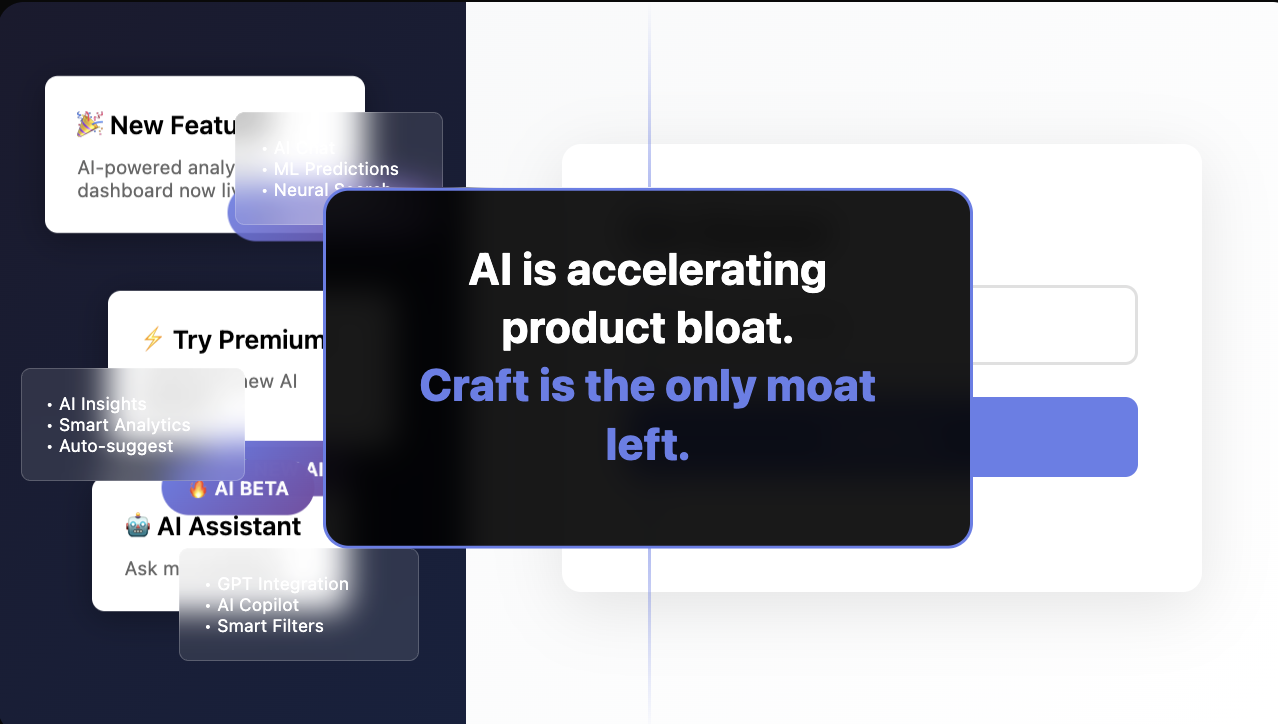
The Gemini Head of Product said it best: AI is accelerating product bloat.
We’re in the middle of a feature arms race. Every product is adding AI. Every company is shipping ChatGPT wrappers. Every PM is chasing the competition.
And users? They’re drowning.
The result is a sea of mediocre products that do everything poorly instead of one thing exceptionally well. Products that feel like Frankenstein’s monster. Bolted together with duct tape and desperation.
Craft has become the key differentiator now, not features.
This isn’t about being a pixel-pusher or obsessing over rounded corners. It’s about a fundamental shift in how we think about product development. It’s about recognizing that in a world where everyone has access to the same AI models, the same tools, and the same playbook, the only sustainable advantage is building things people love.
Not things they tolerate. Not things they use because they have to. Things they love.
This guide will show you how.
What Is Product Craft?
Product craft is the relentless pursuit of quality in every decision you make.
It’s the difference between Jiro’s sushi and grocery store sushi. Between a Linear interface and Jira. Between Stripe’s API documentation and… literally any other API documentation.
Paul Graham captured it perfectly in his essay “Taste for Makers”: Good design is often strange. Some of the very best work has an uncanny quality. Not just beautiful, but strangely beautiful.
Craft shows up in three dimensions:
1. What you build – The courage to say no to features that don’t serve your core value proposition
2. How you build it – The obsessive attention to detail in execution
3. Why you build it – The principled thinking that guides every product decision
Most PMs focus exclusively on #1. Great PMs understand all three are inseparable.
Why Craft Matters More Than Ever
The AI Bloat Problem
AI has made it easier than ever to ship features. You can prototype an entire product in a weekend with tools like Cursor and Claude. You can add AI to anything in hours.
But here’s the paradox: Ease of creation has led to an explosion of mediocrity.
Every SaaS product now has:
- An AI chatbot (that users ignore)
- AI-powered search (that’s worse than CMD+F)
- AI writing assistance (that produces slop)
- AI analytics (that nobody understands)
As Madhu Gurumurthy said, your job as a PM is to cut through the feature bloat and solve real user problems. Not add to the noise.
The Craft Advantage
When everyone can ship AI features in days, craft becomes the moat.
Look at the companies winning right now:
Linear – Karri Saarinen’s company built its entire brand on craft. While competitors added features, Linear obsessed over speed, keyboard shortcuts, and the feeling of using the product. Result? They’re eating Jira’s lunch despite having 10% of the features.
Stripe – Their API design philosophy is legendary. They didn’t just build payment processing. They made it delightful for developers. Their documentation became the gold standard not because it was comprehensive, but because it was crafted.
Arc Browser – In a world of feature-bloated browsers, they rethought the entire paradigm from first principles. They said no to tabs. They built something strange and opinionated. And they built a cult following.
These companies understand what Frank Chimero wrote in “The Web’s Grain”: What would happen if we stopped treating the web like a blank canvas to paint on, and instead like a material to build with?
Craft is about respecting your medium. Understanding its grain. Working with it, not against it.
The 5 Pillars of Product Craft
Pillar 1: Subtraction Over Addition
The hardest skill in product is knowing what to kill.
Your first instinct as a PM is to add. Sales wants this feature. Support needs that integration. The CEO read about this trend.
But every addition has a cost:
- Cognitive load for users
- Maintenance burden for engineering
- Dilution of your core value proposition
The best PMs are masters of subtraction.
Instagram killed features to win. In their early days, they had location check-ins, plans for messaging, and dozens of filters. Kevin Systrom and Mike Krieger stripped it down to one core loop: take photo, apply filter, share. They killed everything else.
Dropbox said no to features for years. Drew Houston famously rejected feature requests that didn’t serve the core job: sync files across devices. While competitors added wikis, calendars, and project management, Dropbox stayed focused.
Addition by subtraction isn’t just about saying no to new features. It’s about actively killing existing ones.
The Feature Killing Framework:
- Audit ruthlessly – Which features have <10% adoption? Which ones confuse new users?
- Calculate the true cost – What’s the maintenance burden? What’s the cognitive load? What’s the opportunity cost of not building something better?
- Test the removal – Can you hide the feature for 10% of users? Does anyone notice?
- Document the why – When you kill a feature, explain your reasoning. This builds trust and sets precedent.
Google famously fails at this. They rename products, kill beloved features, and confuse users with overlapping offerings. Don’t be Google.
Pillar 2: Taste and Aesthetic Judgment
Taste is knowing what good looks like and having the courage to pursue it.
Paul Graham argues that taste isn’t subjective. Good design has objective qualities:
- Good design is simple
- Good design is timeless
- Good design solves the right problem
- Good design is often strange
But here’s the catch: You can’t develop taste from frameworks. You develop it by immersing yourself in great work.
How to Develop Taste:
Study the masters – Analyze products you love. Why does Linear feel fast? Why is Stripe’s documentation so good? Why does Notion’s editor feel magical? Don’t just use these products. Deconstruct them.
Examine 25 product designs – Watch how great teams handle signups, onboarding, sharing, and upgrades. Notice the small details. The micro-interactions. The copy. Like Kate Syuma showed, the best products make you feel something before you understand them.
Learn from other crafts – Watch Jiro Dreams of Sushi. The documentary isn’t about sushi. It’s about the relentless pursuit of perfection. Jiro spends 45 minutes massaging octopus. He adjusts sushi size based on customer hand size. That’s craft.
Build an opinion – Don’t just say “I like this.” Articulate why. What makes this interaction delightful? What makes this layout work? The more you can articulate good taste, the more you can build with it.
Pillar 3: Obsessive Attention to Detail
The details aren’t the details. They make the product.
Brian Chesky learned this from Steve Jobs. When Airbnb was struggling, Chesky studied how Jobs ran Apple. He discovered something crucial: Founder Mode means caring about details that scale.
Jobs cared about the inside of the Mac, even though users would never see it. He cared about the packaging experience. He cared about the font rendering.
Why? Because details create the overall feeling of quality.
Where Details Matter Most:
The first 60 seconds – How fast does your app load? What’s the first thing users see? Is your empty state delightful or depressing? Most PMs optimize the happy path. Great PMs obsess over the entry experience.
Error states – When something breaks, how does your product respond? Is the error message helpful or hostile? Does it suggest next steps? Error states are where most products fall apart and where craft shines.
Edge cases – What happens when a user has 1,000 items in their list? What if they have zero? What if their name has special characters? Edge cases reveal whether you built for perfection or just to ship.
Micro-interactions – How does that button feel when clicked? Does the page transition smoothly? Do loading states reduce anxiety? These details seem small, but they compound into the overall experience.
Elizabeth Laraki, who designed Google Search and Maps, shared her framework: Design isn’t just about the happy path. It’s about designing for reality. The messy, unpredictable ways people actually use your product.
Pillar 4: Design-PM Partnership
You can’t build great products without great designers. And designers can’t build great products without great PMs.
The best products come from tight PM-design partnerships where the lines blur:
- PMs who can sketch and prototype
- Designers who understand metrics and strategy
- Shared ownership of the user experience
How to Partner with Design for Success:
Involve design early – Don’t bring designers a feature spec and ask them to “make it pretty.” Bring them a problem and co-create the solution.
Learn their craft – Understand design systems. Learn Figma. Appreciate the constraints designers work within. The more you understand their craft, the better you’ll collaborate.
Give creative freedom within constraints – Set clear goals and guardrails, then let designers explore. “Increase checkout conversion by 20%” is better than “Add a bigger button here.”
Prototype together – With AI tools, PMs can now build functional prototypes. Use this to explore ideas quickly with designers, not to replace them.
Defend good design – When stakeholders push for features that break the experience, fight for craft. Your job is to protect the user experience from internal politics.
The best PM-designer pairs finish each other’s sentences. They debate fiercely but respect each other’s expertise. They ship products that feel cohesive because they were built as a team.
Pillar 5: Principled Decision-Making
Craft requires principles. Without them, you’re just reacting to stakeholder requests.
The best product teams have clear principles that guide every decision:
Stripe’s API Principles:
- Developers are our users
- Make the simple case simple and the complex case possible
- Optimize for clarity over cleverness
Intercom’s Product Principles:
- Simple is hard work
- Charge for value
- Communicate honestly
Linear’s Principles (from Karri Saarinen):
- Quality is rare. Be the rare exception.
- No committees. Small, high-quality teams ship better work.
- Everyone owns quality. No handoffs.
How to Build Your Product Principles:
- Identify your core belief – What do you believe about how products should work that most disagree with?
- Make it specific – “Be user-centric” is meaningless. “Optimize for power users, not beginners” is a principle.
- Test against reality – Would this principle actually help you make a hard decision?
- Communicate relentlessly – Principles are useless if your team doesn’t know them. Repeat them until you’re sick of saying them.
When Julie Zhuo talks about product management in the AI era, she emphasizes this: In a world where AI can execute faster than ever, having strong principles becomes your competitive advantage. Taste and judgment are the human elements AI can’t replicate.
Craft in the AI Era
The New Reality
AI changes everything and nothing.
It changes how fast you can ship. It changes the feasibility of complex features. It changes user expectations.
But it doesn’t change the fundamentals of craft.
What AI Enables:
Faster prototyping – You can test ideas in hours instead of weeks. This means you should have higher quality bars, not lower. Ship 10 prototypes and pick the best one.
Better design systems – AI can help maintain consistency at scale. Use it to enforce your design patterns, not to generate soulless interfaces.
Deeper personalization – AI can tailor experiences to individual users. But personalization without craft is just algorithmic chaos.
What AI Threatens:
Homogenization – When everyone uses the same AI tools, products start looking the same. Craft is how you differentiate.
Feature bloat – It’s never been easier to ship features. Which means saying no is more important than ever.
Soulless experiences – AI-generated interfaces often lack the human touch that makes products delightful.
The Craft Response
The best AI products marry cutting-edge technology with obsessive craft.
ChatGPT – The interface is brutally simple. No bells and whistles. Just a text box that works. The craft is in the speed, the natural responses, and the trust they’ve built.
Perplexity – They took AI search and made it feel different. The citations, the related questions, the clean interface. They didn’t just build AI search. They crafted an experience.
Claude – Anthropic’s focus on safety, constitution AI, and helpful/harmless/honest responses is craft. They chose principles over features.
The AI Craft Principles:
- Use AI to enhance craft, not replace it – Let AI handle the tedious parts so you can focus on the details that matter.
- Set higher quality bars – If you can ship faster, ship better, not more.
- Build guardrails – AI is probabilistic. Craft means understanding where AI fails and protecting users from those failures.
- Maintain human judgment – AI can suggest. Humans must decide. Your taste and principles are what make your product unique.
Learn how to build AI products right with these principles baked in from the start.
The Craft Mindset
It Takes Time
Craft can’t be rushed.
Jiro Ono has been making sushi for 75 years. He’s still trying to improve.
Linear spent months on their keyboard shortcuts. Stripe rewrote their documentation seven times.
This doesn’t mean you should ship slowly. It means you should have the courage to keep improving even after launch.
Ship fast, but iterate with care.
It Requires Courage
Craft means saying no:
- No to stakeholder pet features
- No to cargo-culting competitors
- No to the easy path
Brian Chesky rebuilt Airbnb’s entire roadmap when he realized they were shipping features instead of experiences. He killed projects. He fired managers. He went back to basics.
That takes courage.
It’s Never Done
The best products are always evolving:
- Notion ships weekly improvements
- Linear deploys multiple times per day
- Stripe continuously refines their docs
Craft isn’t a destination. It’s a practice.
Your Craft Action Plan
Week 1: Audit
- List every feature in your product
- Identify which ones <10% of users touch
- Calculate the maintenance cost of each
Week 2: Subtract
- Pick one feature to kill
- Run an experiment hiding it from 10% of users
- Measure if anyone complains
Week 3: Study
- Spend 10 hours analyzing products you love
- Write down why they feel good to use
- Share your analysis with your team
Week 4: Partner
- Schedule a working session with design
- Bring a problem, not a solution
- Prototype three approaches together
Week 5: Principles
- Write your first product principle
- Test it against your last three shipped features
- Refine until it’s actually useful
Week 6: Details
- Pick your most-used flow
- Obsess over every error state, edge case, and micro-interaction
- Ship improvements weekly
The Craft Manifesto
We believe:
Quality compounds. Mediocrity multiplies.
Saying no is more important than saying yes.
Details aren’t details. They’re the product.
Speed matters, but craft matters more.
Users can’t always tell you what’s wrong, but they can always feel it.
The best products are opinionated, not flexible.
AI makes craft more important, not less.
We commit to:
Killing features that don’t serve our core value.
Obsessing over the details others ignore.
Building taste by studying greatness.
Partnering deeply with design.
Choosing principles over popularity.
Shipping with pride, not just velocity.
The Bottom Line
In a world drowning in AI slop and feature bloat, craft is your moat.
Not because it’s hard to copy (though it is). Not because it’s expensive (though it can be).
Because craft requires something AI can’t replicate: Taste. Judgment. Courage.
The courage to say no when everyone’s saying yes.
The judgment to know what details matter.
The taste to build something strange and beautiful.
That’s the path forward.
Not more features. Not faster shipping. Not AI for AI’s sake.
Better craft.
