Ever wondered what a product manager actually does day-to-day? Forget the vague "CEO of the product" cliché. The reality is a high-stakes role at the intersection of strategy, execution, and user obsession. A great PM is the driving force ensuring a product solves a real user problem while hitting critical business targets.
Let's cut through the theory. A Product Manager at Netflix isn't just brainstorming show ideas; they're analyzing user binge patterns to develop a feature that reduces churn by 3%. A PM at Stripe isn't just writing tickets; they're on calls with CFOs to understand payment processing pain points that will define the next billion-dollar product line.
Think of them as the captain of a ship. They don't row the oars (engineering) or design the sails (design), but they are the one with the map (strategy), charting the course and ensuring everyone is working together to reach the destination (market success).
The Three Pillars of Modern Product Management

To really get what a PM does day-to-day, we need to move past vague job descriptions. The role isn't about being a mythical "CEO of the product" or just managing a Jira backlog.
Instead, it's a constant balancing act across three core areas. These pillars define a PM's impact and are the lens through which you can understand every decision they make, from big strategic bets down to the nitty-gritty of feature prioritization.
Pillar 1: Product Strategy
This is the foundational "why." Before a single line of code gets written, the PM has to figure out what winning looks like. It’s their job to define the product's vision and how it will carve out its space in the market. This means digging deep into market analysis, sizing up the competition, and crafting a clear vision that gets the whole team excited and aligned with the company’s bigger goals.
The output here isn't just a collection of cool ideas. It's a coherent strategy, often captured in things like product roadmaps, vision documents, and go-to-market plans. For example, a PM at Airbnb might build a strategy around capturing the "digital nomad" market, clearly outlining the problems those users face and why solving them is a huge business opportunity.
Pillar 2: Flawless Execution
A brilliant strategy is just a PowerPoint presentation without great execution. This pillar is all about the "how" and "when"—turning that grand vision into a real, tangible product that people can use.
Here, the PM is in the trenches with engineering and design. They translate those high-level strategic goals into actionable user stories and a well-groomed, prioritized backlog.
"As a PM, your ability to work with designers is as essential as your ability to work with engineers. In the best technology companies, PM, Design, and Engineering combine to form the essential core of a product team."
This is where relentless prioritization and crystal-clear communication come into play. It involves things like:
- Prioritizing features: Using frameworks like RICE or the Kano model to make tough calls about what to build next based on customer impact and business value.
- Managing the backlog: Making sure the engineering team always has a clear, well-defined list of tasks ready to go.
- Clearing roadblocks: Proactively sniffing out and solving any problem—technical, organizational, or resource-related—that could slow the team down.
Pillar 3: Unwavering User Advocacy
Finally, and perhaps most importantly, the product manager is the voice of the customer within the company. This pillar is all about developing a deep, almost obsessive understanding of user needs, frustrations, and behaviors. Their core responsibility is to ensure the team is solving a genuine problem for a real group of people.
This means getting out of the office and talking to users. It involves conducting interviews, diving into usage data, and collecting feedback from customer-facing teams like sales and support. A PM at Slack, for example, might spend hours just observing how different teams communicate to uncover those subtle, unmet needs that could spark the next big feature. This is how the product stays relevant and continues to evolve with its users.
To bring it all together, here's a quick look at how these three pillars function in practice.
The Three Pillars of Product Management
| Pillar | Key Responsibilities | Example Activities |
|---|---|---|
| Strategy | Defining the product vision, market positioning, and long-term roadmap. | Conducting competitor analysis, defining target user personas, creating a 12-month roadmap. |
| Execution | Translating strategy into actionable tasks and guiding the development process. | Writing user stories, prioritizing the backlog, running sprint planning meetings, unblocking engineers. |
| User Advocacy | Representing the user's voice and ensuring the product solves real problems. | Conducting user interviews, analyzing product usage data, reviewing customer support tickets. |
Ultimately, a great product manager lives in the center of this framework, constantly shifting their focus between the long-term vision, the immediate needs of the development team, and the ever-present voice of the customer.
A Day in the Life of a Product Manager
Alright, let's pull back the curtain and move from theory to reality. If you ask a product manager what a "typical day" looks like, most of them will just laugh. The job isn’t a neat checklist; it’s a dynamic, often chaotic, series of context switches.
One minute you're deep in the weeds with an engineer talking about API latency, and the next you're on a call with marketing debating campaign messaging. Let's walk through what a day might look like for a PM at a fast-growing software company. This ground-level view is where high-level strategy gets broken down into the daily grind of building something great.
Morning: Stand-ups and Stakeholder Syncs
9:00 AM – 9:15 AM: The Engineering Stand-up
The day kicks off with the daily engineering stand-up. You’re not here to micromanage tasks—that's the engineering manager's job. Your role is to listen. You’re scanning for blockers, listening to progress updates, and connecting the dots.
Today, an engineer mentions a snag with an API integration for a key feature launching next month. Red flag.
This immediately triggers a mental checklist. How does this delay impact the marketing launch? Do I need to tell the sales team their demo environment won't be ready on time? Your job is to instantly translate that technical hiccup into its business impact.
9:30 AM – 10:30 AM: Translating for the Masses
Right after the stand-up, you head to Slack to give an update to the marketing and sales leads. You skip the technical jargon about API endpoints—they don't need it. Instead, you focus on what they do need to know: the feature will be ready for internal demos a week later than planned.
You don't just drop the bad news; you propose a new timeline to adjust the go-to-market plan. This is a classic PM move: you're the central information hub, shielding other teams from complexity while giving them the clarity they need to do their jobs.
Mid-Day: Data-Driven Debates
11:00 AM – 12:00 PM: The Strategy Session with Marketing
Next up, a meeting with the marketing team. They're fired up and want to build the next campaign around a new feature. Your job is to bring a healthy dose of reality, backed by data.
You pull up a dashboard in a tool like Looker or Amplitude, showing that a similar feature we launched last quarter has pretty low engagement. You're not there to kill their idea, but to reframe the conversation.
The question isn't "Should we market this feature?" but rather "What specific user problem are we solving here, and how can our message actually communicate that value to get people to use it?"
Suddenly, the meeting shifts from a simple promotional plan to a much deeper strategic discussion about user needs and product positioning. That's you, guiding the conversation with cold, hard facts instead of just gut feelings and enthusiasm.
Afternoon: Execution and Customer Intel
1:30 PM – 2:30 PM: Deep Work in Jira
After grabbing a quick lunch at your desk, you block off an hour for focused work. This is where you translate all that strategy into something the engineering team can actually build. You open up Jira and get to work writing clear, well-defined user stories for the next sprint.
A good user story isn't just a to-do item. It’s a mini-brief.
- A clear user persona: "As a freelance designer…"
- The specific need: "…I want to export my projects as high-resolution PDFs…"
- The desired outcome: "…so that I can easily share them with clients for print."
- Acceptance criteria: A simple, testable checklist that defines exactly what "done" looks like.
This focused hour is absolutely critical. It ensures the engineering team has the clarity they need to build the right thing, preventing weeks of wasted effort.
3:00 PM – 4:00 PM: Mining for Gold with the Sales Team
Your day winds down with a call with a senior sales manager. The sales team is on the front lines, getting direct, unfiltered feedback from prospects every single day. You're there to listen.
They mention losing three deals this month to a competitor because your product is missing a specific integration. This is qualitative data gold. You immediately document this, linking it to a bigger strategic initiative about becoming more enterprise-ready. This kind of raw feedback from the field provides the powerful "why" behind your roadmap, making sure you’re building what the market actually wants to buy.
The Core Competencies Every Product Manager Needs
To really get what a product manager does, you have to look past the day-to-day grind of managing tickets and roadmaps. The real magic, what separates the truly great PMs from the merely good ones, lies in a unique blend of skills. At places like Google and OpenAI, they aren't just hiring backlog jockeys; they’re looking for people who are masters of both hard analytics and soft influence.
Think of these competencies as the engine that drives a successful PM career. Let's break down the skills you absolutely have to build, getting past the corporate buzzwords to what actually works. Mastering these is how you turn a good strategy into a product people love.
Hard Skills Where the Details Matter
These are the concrete, teachable skills that ground your product decisions in reality, not just gut feelings. While you don't need to be a senior engineer, you do need to speak their language and understand the data that tells you if you're winning or losing.
- Data Analysis and Interpretation: Great PMs are data-fluent. This is more than just glancing at a dashboard; it's about asking the right questions of your data. You should be comfortable enough to run basic SQL queries yourself or, at the very least, partner with an analyst to dig into complex user behavior. A huge part of the job is using this analysis for effective customer experience optimization.
- A/B Test Interpretation: You’ve got to understand the basics of designing an experiment and what "statistical significance" actually means. It's your call to decide if a 3% lift in conversions is a real signal or just random noise before you ask engineering to ship it.
- Technical Literacy: No, you don't need a computer science degree. But you absolutely must understand core concepts like APIs, system architecture, and how databases work. When an engineer tells you a feature is blocked by "service dependencies," you need to know what that implies for your timeline and how to brainstorm a workaround.
Soft Skills That Drive Influence
Hard skills might get you the interview, but soft skills get the job done. The PM role is a bit of an oddball—you have all this responsibility for the product's success but zero direct authority over the engineers, designers, or marketers you need to build it.
Your entire job hinges on your ability to persuade, align, and lead through sheer influence.
A product manager's authority doesn't come from the org chart; it comes from their credibility, their data-driven arguments, and their unwavering focus on the customer.
Building that kind of clout takes a very specific set of people skills. For a much deeper dive into what those are, check out this fantastic breakdown of the most critical product manager skills required for success.
Ruthless Prioritization Frameworks
One of the most important things a PM does is say "no." A lot. You will always have more ideas, feature requests, and stakeholder demands than you have time or people to build them. Prioritizing ruthlessly isn't about being a jerk; it’s about protecting the team’s focus.
To make these tough calls without it turning into a shouting match, you need a framework. A simple but powerful one is RICE, which scores ideas based on four factors:
- Reach: How many users will this actually touch in a set period? (e.g., 5,000 users/month)
- Impact: How much will this move the needle for an individual user? (Score on a simple scale: 3 for massive, 2 for high, 1 for medium, 0.5 for low)
- Confidence: How sure are you about your estimates for Reach and Impact? (100% for high confidence, 80% for medium, 50% for a low-confidence guess)
- Effort: How much engineering and design time will this consume? (Estimate this in "person-months")
The final RICE score gives you an objective way to compare totally different features, turning emotional debates into data-informed conversations.
Actionable Roadmap for Skill Development
Knowing you need these skills is the easy part. Building them is where the work comes in. Here’s a no-fluff plan to get started:
- For Data Analysis: Don't just read about SQL. Sign up for an interactive course on a site like Codecademy or DataCamp. Their beginner courses run about $20-$40 per month and give you a real console to practice writing queries.
- For Technical Literacy: Take a foundational course like Harvard's "CS50's Introduction to Computer Science," which you can audit for free on edX. It won't make you a coder, but it will give you the mental models to understand how software gets made.
- For Prioritization: Start using the RICE framework on your current work today, even if it's just for yourself. Open a simple spreadsheet and score your team's next three feature ideas. That exercise alone will sharpen your strategic thinking and force you to put numbers to your assumptions.
Unpacking Product Manager Salary and Compensation
Knowing what a product manager does is one side of the coin. The other is knowing your market value. Let’s be honest: compensation is a huge part of career planning, negotiating, and figuring out if you're on the right track. Good salary data turns those conversations from "what I feel I deserve" into objective, market-driven discussions.
There’s no single magic number for a product manager's salary. It’s a wide range that hinges on your experience, where you live, the type of company you work for, and any specialized skills you bring to the table. A PM at a seed-stage startup in London will have a very different pay package than a Group PM at Meta in Silicon Valley.
Benchmarking Your Salary Across Levels and Locations
Product management is a hot field, and the pay reflects that. Since the role directly plugs into a company's revenue and strategy, top companies are willing to pay a premium for talented PMs. But just looking at "average" salaries can be seriously misleading if you don't have the full picture.
Product managers are in demand globally, and their paychecks show it. A 2025 salary guide reports the average annual salary for a product manager in the United States is $124,000, with senior roles pulling in around $125,554. Over in the UK, the average is £55,000, and in Canada, it’s CA$91,000.
But location is everything. Those averages get blown out of the water in major tech hubs. For instance, a senior PM in New York City can make up to $307,650, which shows you the kind of premium companies will pay for talent in the right market. For a deeper dive, check out the full product manager salary report from CPO Club.
How Experience and Company Type Impact Earnings
As you climb the ladder from an Associate Product Manager (APM) to a senior leader, your pay structure changes dramatically. Early-career gigs are usually heavy on the base salary. But as you get more senior, a much bigger chunk of your compensation shifts to equity and performance bonuses.
- Associate PM (0-2 years): Your main job is to learn the ropes and execute. Compensation is almost all base salary, maybe with a small annual bonus.
- Product Manager (2-5 years): You’re owning a feature or a small product. This is where equity and performance bonuses start to become a real part of your package.
- Senior PM (5+ years): Now you're driving the strategy for a major product area. Your total compensation takes a big leap, and stock options (like RSUs at public companies) become substantial.
- Group/Principal PM (8+ years): You're leading multiple product teams or a whole product line. Your pay is heavily weighted toward equity and hitting company-wide goals.
This career and salary growth is fueled by developing core competencies in data, technology, and strategy, as the infographic below shows.
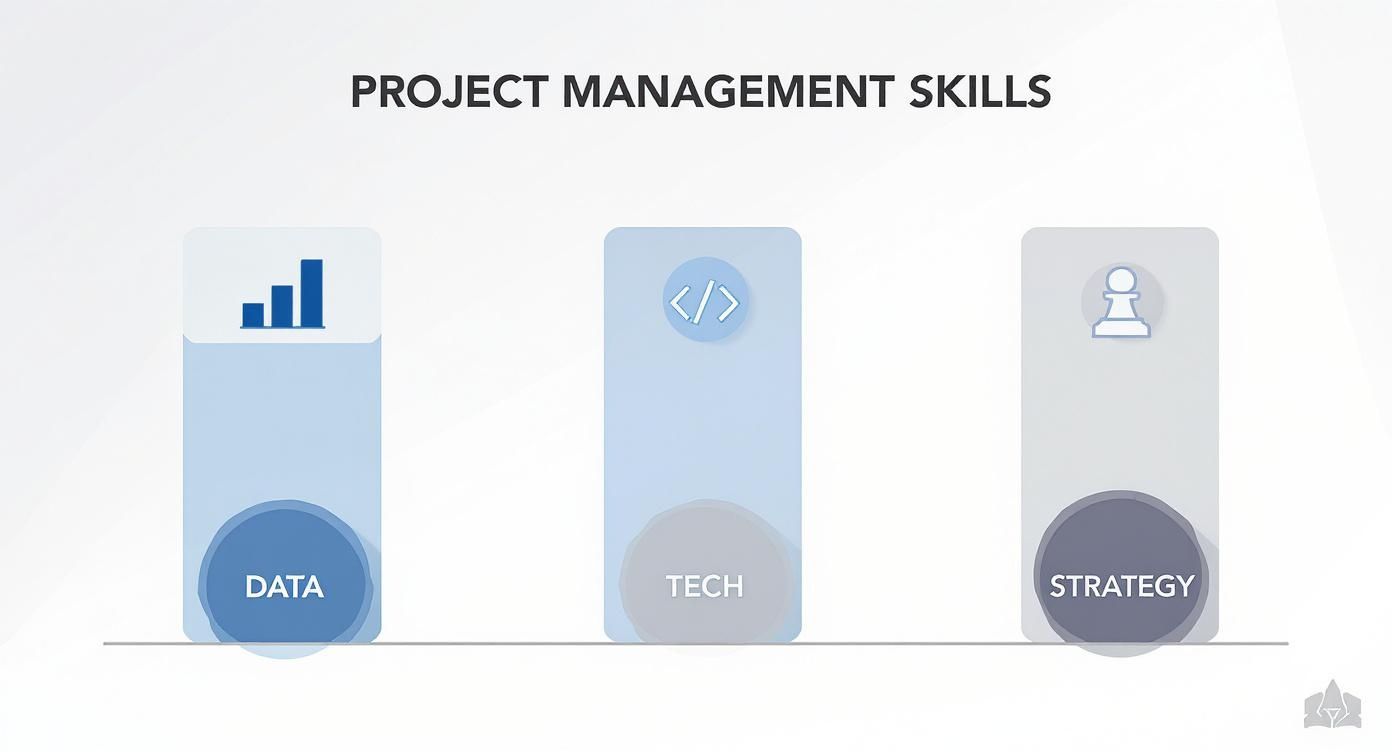
As the graphic illustrates, mastering strategy, data analysis, and technical literacy isn't just about getting better at your job—it's the key to unlocking those higher-paying senior roles.
The Rise of Specialized Skills and Their Salary Premiums
In the current market, specialization is your superpower. Product managers with deep expertise in booming fields like AI/ML, fintech, or cybersecurity can command a significant salary bump—often 15-25% higher than their generalist peers.
Companies aren’t just looking for PMs who can groom a backlog. They're desperate for people who truly understand the nuances of large language models or the complexities of global payment regulations.
For aspiring and mid-career PMs, developing a specialization is one of the most direct paths to accelerating your career and earning potential. It transforms you from a general problem-solver into an indispensable expert.
This is especially true for entry-level roles where you need to stand out. Getting the compensation piece right from the start is critical, which is why we put together a detailed guide on navigating the entry-level product manager salary. Speaking the language of a specific domain makes you a far more compelling candidate right out of the gate.
The Product Manager Career Path From APM to CPO
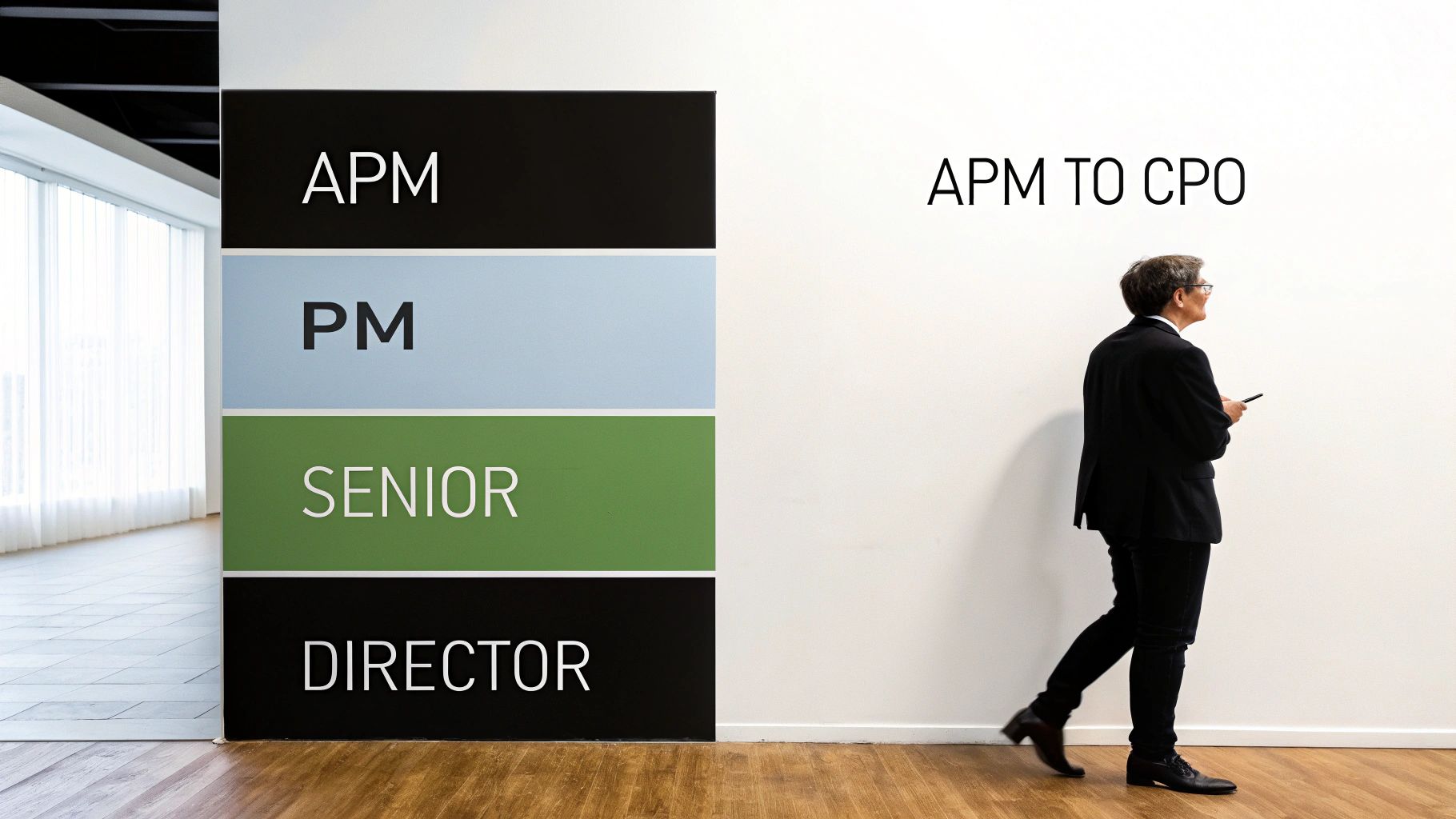
The job of a product manager changes dramatically as you move up the ladder. It’s not one static role but a journey of ever-expanding scope, shifting from the nitty-gritty of shipping features to the high-level world of strategic ownership.
Getting a handle on this trajectory is key, whether you're trying to break into the field or you're a PM gunning for that next promotion.
This isn’t just about getting a fancier title. It’s a fundamental shift in how you create value for the company. Early in your career, your success is measured by how well you ship. Later on, it’s all about how well you shape markets and build powerhouse teams.
Associate Product Manager (APM): The Executor
The APM role is the classic entry point, made famous by companies like Google and Meta. Think of an APM as an apprentice, learning the craft under the wing of a more seasoned PM. Their entire world revolves around a specific feature or a tiny slice of a much larger product.
Their number one job? Execution. They live and breathe in tools like Jira, cranking out user stories, answering endless questions from engineers, and digging into the data from the latest release. An APM's success is simple: can they reliably get well-defined features out the door on time?
At this stage, your job is to be a world-class executor and a sponge. You soak up everything you can about the process, the product, and the customer, proving you can be trusted with more.
If you're just starting out, our guide on how to become a PM breaks down exactly how to land this first role. The goal is to nail the fundamentals of the product development lifecycle, from the ground up.
Product Manager (PM): The Feature Owner
Once an APM has proven they can execute, they graduate to a full-blown Product Manager. Here, the scope widens from a single feature to a whole feature set or a small product area. The big change is the shift from focusing on the "how" to owning the "what" and "why."
A PM owns the roadmap for their domain. This means they're the ones talking to users, analyzing what competitors are up to, and using data to decide what the team should build next. They become the go-to person for their product area, wrangling stakeholders across engineering, design, and marketing.
Senior Product Manager: The Strategic Driver
Making the leap to Senior PM is a big deal. It’s less about shipping more features and more about driving real, measurable business outcomes. A Senior PM takes on a larger, more ambiguous product area and is expected to work with a ton of autonomy.
Their focus zooms out from feature-level details to product-level strategy. They're wrestling with the big questions:
- How does our part of the product actually help the company hit its overall goals?
- What are the major threats and opportunities we need to tackle in the next 12-18 months?
- Which customer segments should we go after to unlock the most growth?
Senior PMs are also mentors, responsible for leveling up the more junior folks on the team. They lead by influencing others, shaping the product's direction through rock-solid strategy docs and convincing presentations to leadership. For anyone looking to make this jump, sharp product manager interview preparation is absolutely essential.
Director, VP, and CPO: The Organization Builder
Once you hit the leadership levels—Director, VP of Product, and Chief Product Officer (CPO)—the job transforms completely. You're no longer managing products; you're managing the people and the systems that build those products.
Your success is now measured by the success of your team. The day-to-day is all about hiring and growing talent, setting the high-level product vision for the entire company, and managing the product portfolio like a set of strategic investments.
The role gets deeply cross-functional, involving close collaboration with other executives to make sure the product strategy aligns with the company's financial and market ambitions. This is a globally recognized role critical to business growth. In 2025, for instance, the average product manager salary in the UK is £67,000, with senior roles hitting £109,100. Over in Germany, the average is €71,500.
Common Myths About the Product Manager Role
The product manager role is notoriously tough to pin down. Ask ten people what a PM does, and you'll probably get ten different answers. This ambiguity has created a fog of myths around the job.
These misconceptions can set up aspiring PMs for a rough landing and create friction for those already in the role. So, let's cut through the noise and bust a few of the biggest myths I've seen in my career.
Getting clear on what the job isn't is the first step to understanding what a great product manager actually does.
Myth 1: The PM Is the CEO of the Product
This is the classic, the one everyone hears. And it's probably the most damaging. It sounds great, doesn't it? Empowering, even. But it's dead wrong because it implies a level of authority that product managers simply don't have.
A CEO can give direct orders. A product manager almost never can. Your engineers, designers, and marketers don't report to you. You can't tell them what to do.
The reality is that PMs lead through influence, not authority. Your real power comes from your ability to paint a compelling vision, to back up your arguments with solid data, and to earn the trust of your team. You succeed by persuading, not commanding.
Myth 2: PMs Just Come Up with the Ideas
This one is almost as common. People imagine the PM sitting in a corner, dreaming up brilliant features, then tossing them over the wall to engineering to build. If only it were that easy.
Ideas are cheap. Seriously. The best ones often come from engineers, customer support, sales, and most importantly, directly from customers themselves.
The real work isn't coming up with ideas; it's rigorous problem validation. A PM’s most critical job is to sift through the endless stream of "good ideas" to find the most important user problems—and then prove that solving them will actually move the needle for the business. You own the "why," not just the "what."
A product manager's primary responsibility is to filter the endless stream of ideas through the lens of customer need and business impact, ensuring the team is always working on the right thing.
Myth 3: You Must Have a Computer Science Degree
I see this belief stop so many talented people from even considering a career in product. The thinking goes: "I can't be a PM because I can't code." While being technically literate is non-negotiable, it's a huge leap to say you need to write production-level code.
In fact, some of the best PMs I've known have backgrounds in business, design, data, or even psychology. Their diverse perspectives are a huge asset.
The key is understanding the technical world well enough to have smart, credible conversations with your engineering team. You need to grasp the basics of how things are built so you can weigh in on tradeoffs and complexity. This is about communication, not coding.
The market reflects this, valuing strategic skills just as much as technical ones. For instance, in 2025, the average product manager salary in Australia is $118,652 per year. In tech hubs like Sydney and Melbourne, those numbers climb even higher, proving that companies are willing to pay a premium for strategic thinkers. You can dig into more details on Australian product manager salaries on Product Compass.
A Few Lingering Questions
Alright, we've walked through the ins and outs of a product manager's world—the core duties, the daily grind, and the path ahead. But a few practical questions always seem to pop up, whether you're just starting out or a few years into the role.
Let's clear those up.
Do I Need an MBA to Become a Product Manager?
Short answer? No.
While you'll find some folks who pivot from top-tier consulting or finance into product using an MBA as a bridge, they're the exception, not the rule. The vast majority of PMs at places like Google, Meta, and Stripe don't have one.
These days, hiring managers are hunting for demonstrated skill, not a specific degree. A portfolio of side projects you've built, a certification in something tangible like data analysis, or a clear track record of shipping features speaks volumes more than a business degree. Focus on building real experience; it's a far better investment.
What Is the Difference Between a Product Manager and a Project Manager?
This one trips up a lot of people. It’s a classic point of confusion, but the distinction is actually pretty clear once you see it.
Think of it like this:
- A Project Manager owns the timeline. They live in the world of the how and the when. Their job is to get a predefined project across the finish line on time and on budget, armed with Gantt charts, resource plans, and risk assessments.
- A Product Manager owns the problem and the vision. They are obsessed with the what and the why. Their job is to make sure the team is building the right solution for a real user need that also moves the business forward.
Basically, a project manager executes a known plan. A product manager is responsible for figuring out what that plan should be in the first place.
How Much Technical Skill Do I Really Need?
You absolutely do not need to be a former software engineer. But you must be technically literate.
What does that mean? It means you can hold your own in a conversation about core concepts. You should know what an API does, understand the basics of a database, and grasp the difference between front-end and back-end development.
The goal isn't to write code; it's to have credible, intelligent conversations with your engineers about complexity and trade-offs. You need to understand what is possible and why one approach might take three weeks while another takes three days.
Without this literacy, you can't effectively prioritize or earn the respect of your engineering team.
What Are the Biggest Challenges a PM Faces?
The single biggest challenge, without a doubt, is leading through influence rather than authority. You are ultimately held accountable for the success of the product, but you have zero direct reports on the team building it.
This means your entire job hinges on your ability to persuade. You have to align stakeholders with competing priorities, communicate a vision that inspires and motivates, and build deep, authentic trust with your engineering and design partners.
It’s a constant, demanding exercise in communication, data-driven storytelling, and old-fashioned relationship building.
Ready to dive deeper and accelerate your career? Aakash Gupta offers a world-class newsletter and podcast packed with actionable insights on product growth, management strategy, and career advancement from a seasoned industry leader.
