An AI Product Manager (AI PM) is a specialized product leader who builds, launches, and scales products powered by machine learning. Unlike a traditional PM who manages predictable, rule-based software, an AI PM stewards systems that learn, evolve, and operate on probabilities.
The core difference is managing deterministic features vs. probabilistic systems. A traditional PM at Salesforce might ship a new dashboard where clicking a button always produces the same result. An AI PM at Netflix manages the recommendation engine, a complex system that makes intelligent guesses based on user data. This shift requires a fundamentally different skill set and product development process.
This guide provides an actionable framework for aspiring and practicing PMs to master the AI PM role, from core skills to career advancement strategies.
What an AI PM Actually Does and Why It Matters Now

The demand for AI PMs is exploding because companies are no longer just experimenting with AI; they are building their core business strategy around it. With global AI adoption in enterprises hitting 78%, PMs who can navigate this landscape are now a business necessity.
This specialization means wrestling with a new class of problems that traditional PMs rarely face:
- Data Strategy: Is our training data clean, unbiased, and sufficient to solve the user's problem? How will we acquire more data to create a competitive moat?
- Model Uncertainty: Our model will inevitably be wrong sometimes. How do we design a user experience that gracefully handles a 15% failure rate and builds user trust?
- Ethical Guardrails: What are the societal and ethical risks of this technology? How do we build in fairness, transparency, and safety from day one, not as an afterthought?
The core shift is from managing features with predictable outcomes to managing systems that learn and evolve. Think of it as a chef following a fixed recipe versus a chef designing a system that invents new recipes based on available ingredients and user feedback.
Traditional PM vs. AI PM: A Tactical Breakdown
This table breaks down the fundamental differences in responsibilities and mindset. It's not just a title change; it's a different discipline.
| Area of Focus | Traditional Product Manager | AI Product Manager |
|---|---|---|
| Primary Goal | Build and ship features based on defined user requirements. | Define user problems and guide ML models to achieve desired outcomes. |
| Success Metrics | User adoption, feature usage, conversion rates. | Model performance (precision/recall), data quality, and user trust. |
| Core Skillset | User empathy, roadmap planning, stakeholder management. | Technical literacy (ML intuition), data strategy, and ethical judgment. |
| Product Logic | Deterministic: "If user does X, then Y happens." | Probabilistic: "If user does X, Y will probably happen with 92% confidence." |
| Development Cycle | Linear sprints: design, build, test, ship. | Iterative loops: data collection, training, evaluation, and tuning. |
| Key Dependencies | Engineering and design resources. | Data availability, quality, and computational resources. |
| User Experience | Focus on intuitive interfaces and predictable workflows. | Designing for uncertainty, explainability, and building user trust. |
| Biggest Challenge | Prioritizing features and managing scope creep. | Managing the "cold start" problem and handling model failures gracefully. |
As you can see, the AI PM's world is more experimental and deeply tied to the data that fuels their products.
Why This Role Matters Right Now
For everyone from Meta and Google to the scrappiest startups, the competitive edge now comes from building intelligent, adaptive products. A traditional PM can optimize an existing workflow, but an AI PM can unlock entirely new capabilities, creating non-linear growth. Understanding this distinction is crucial for your career; it's what separates the next generation of product leaders from the rest. To really get a handle on this, it helps to understand how Artificial Intelligence (AI) software development will change the future.
This isn't just a fancy title. It's a new discipline at the intersection of product, data, and engineering. For a deeper dive, check out the key distinctions between a PM and an AI PM right here: https://www.aakashg.com/pm-vs-ai-pm/what-is-an-ai-pm/.
The Core Skillset Every AI PM Must Master

Becoming a top-tier AI PM isn't about becoming a machine learning engineer. It’s about cultivating a specialized, three-pronged skillset that enables you to lead technical teams, make sound strategic bets, and build products users trust. The best AI PMs I've hired at companies like Google and Meta can navigate these three pillars with confidence, bridging the gap between deep technology and real-world user problems.
1. Technical and ML Intuition
You don't need to code a neural network, but you must have a strong intuition for the trade-offs involved in machine learning. This "ML intuition" is the ability to grasp what's technically feasible, what's computationally expensive, and where the hidden risks lie. It starts with understanding different model types, such as knowing when a classification model ("Is this email spam?") is more appropriate than a regression model ("How much will this user spend next month?").
You need to lead an intelligent conversation with your data science lead about precision vs. recall. A high-precision model makes fewer false positive errors, while a high-recall model catches more true positives. The right balance is a product decision, not just a technical one.
For example, a PM working on a medical diagnostic tool at a health-tech startup might demand extremely high recall to avoid missing any potential tumors, accepting more false alarms for doctors to review. Conversely, a PM at Meta responsible for content moderation might prioritize high precision to avoid incorrectly censoring legitimate posts, even if some harmful content slips through. Your job as the AI PM is to define that crucial business and user trade-off.
2. Data Acumen and Strategy
Data is the fuel for any AI product. Your ability to build a strategy around it is what separates good AI PMs from the great ones. This goes beyond looking at dashboards; it's about mastering the entire data lifecycle. An effective data strategy boils down to three key areas:
- Sourcing: Where will you get the data to train your model? This could involve using internal product logs, purchasing third-party datasets, or designing product features that cleverly incentivize users to provide the labeled data you need.
- Labeling: You need a crystal-clear, consistent strategy for labeling your training data. A PM at a self-driving car company like Waymo must create meticulous guidelines for human labelers to identify pedestrians, traffic lights, and road signs. Poor labeling directly leads to a poor model.
- Flywheels: This is the strategic core. It's about building systems where the product's use generates more labeled data, which in turn improves the model, creating a better user experience that drives more usage. TikTok's algorithm is a masterclass in this—every "like" and "share" is a feedback signal that refines the user's feed, making the product stickier and creating a powerful competitive moat.
Related: the context engineering approach behind a bootstrapped startup’s 60-day run to 10M ARR.
3. Product and Ethical Judgment
AI PMs must have exceptional judgment, especially when navigating model bias and ethical landmines. AI models are reflections of their training data. If that data contains historical biases, your product will amplify them. A PM at a company like Zillow working on a home valuation model must be vigilant about data that could perpetuate historical redlining or other discriminatory housing practices.
For a complete roadmap on building these skills, a well-structured AI PM curriculum guide can provide an invaluable framework for your learning journey.
This means defining success metrics beyond simple accuracy. The PM for Netflix's recommendation engine must balance engagement ("what is this user most likely to click?") with the need for content diversity and discovery to avoid creating a massive echo chamber. Your product sense and ethical compass are your most important tools.
Related: Nesrine Changuel’s masterclass on engineering delight into AI products.
How AI PMs Drive Real Business Value
An AI PM's value isn't measured in model accuracy; it's measured by connecting that technology to concrete business outcomes. Leadership invests in AI to drive growth, efficiency, and competitive advantage. Your job is to translate the probabilistic language of machine learning into the deterministic language of revenue, retention, and cost savings.
This means shifting the conversation from technical jargon like "F1 scores" towards metrics the C-suite understands. A great AI PM demonstrates how a new recommendation engine lifts conversion rates or how a forecasting model reduces operational waste.
From Model Metrics to Business Impact
It’s easy for junior AI PMs to get fixated on hitting 95% accuracy. But a senior AI PM asks the harder, better question: "What's the business impact of that last 5%? Is it actually worth the cost and time?"
Sometimes, an 80% accurate model that you can ship in a month is infinitely more valuable than a 95% accurate one that takes a year to build. Time-to-market is a weapon.
To make this connection, ground your product strategy in metrics the business values:
- Increased Revenue: How does this feature directly grow the top line? Examples include dynamic pricing at Uber, sharper personalization at Stitch Fix, or better lead scoring at Salesforce.
- Improved User Retention: Does the AI make your product stickier? Spotify's Discover Weekly is a core reason many users maintain their subscription.
- Enhanced Operational Efficiency: Can AI automate slow, expensive, manual work? Examples include intelligent support ticket routing at Zendesk or supply chain optimization at Amazon.
Focusing here helps you secure buy-in and prove the ROI of your work. Our guide on differentiating objectives versus outcomes has a great framework for this.
Case Study: The Amazon Recommendation Engine
Amazon's recommendation engine is a masterclass in turning machine learning into billions of dollars. It isn't a "nice-to-have" feature; it's a core driver of their entire e-commerce machine.
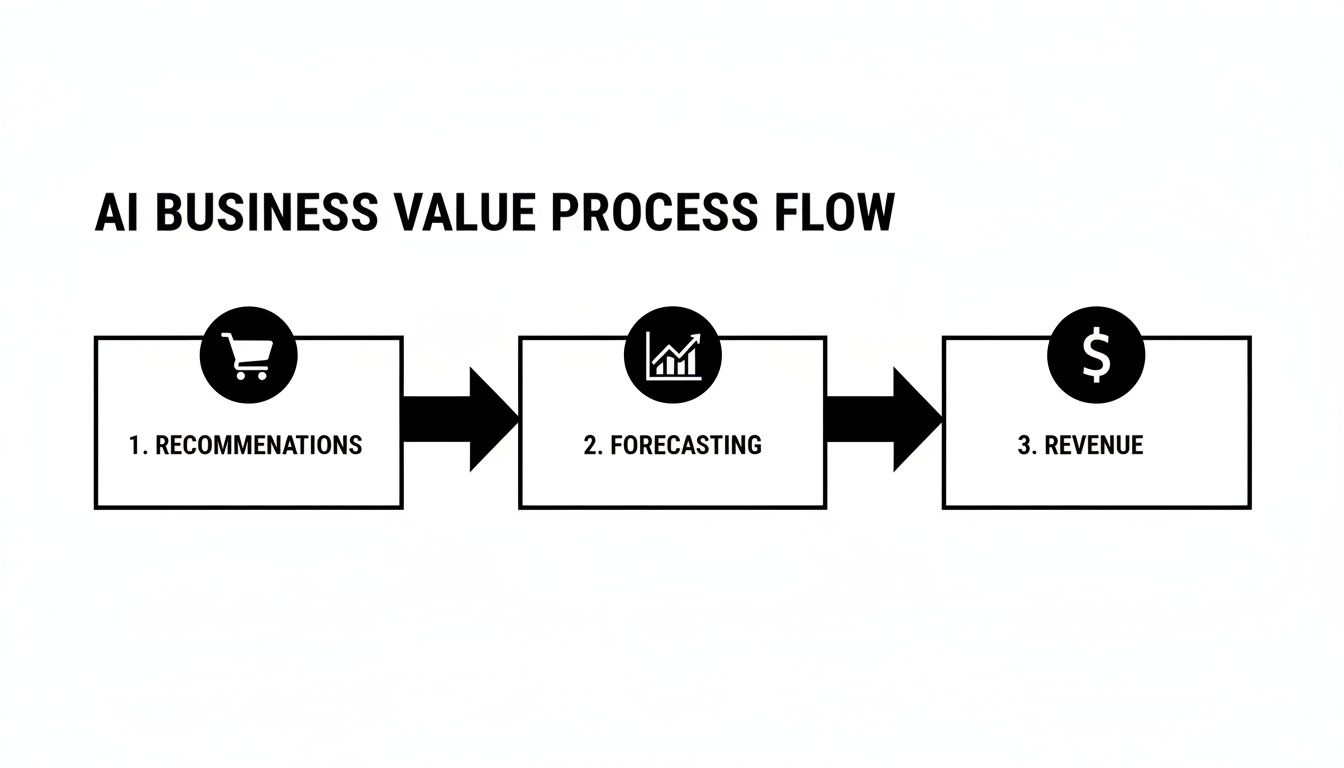
Amazon’s system—suggesting what’s “frequently bought together” and curating personalized “recommendations for you”—perfectly illustrates using AI to hit specific business targets. The AI PMs behind this use machine learning for product recommendations and sales forecasting, driving numbers you can take to the bank. Amazon's engine is estimated to power a staggering 35% of its annual sales. You can discover more insights about these AI statistics on fullview.io.
This isn't just a technical achievement; it's a core pillar of Amazon's business model. The AI PMs behind this system didn't just build a smart algorithm—they built a revenue-generating machine that fundamentally shapes the customer experience and drives immense commercial value.
Your success as an AI PM boils down to building the bridge between what’s technically possible and what’s commercially valuable. When you focus on measurable business outcomes, you become a driver of strategic growth.
An Actionable AI Product Development Framework
Building an AI product is less like assembling a predictable machine and more like training a skilled apprentice. The process is a continuous loop of experimenting, learning, and refining, entirely dependent on the quality of the data you provide.
To navigate this ambiguity, AI PMs need a repeatable playbook. This five-stage framework is designed specifically for the unique challenges of AI product development, from data sourcing to long-term model monitoring.
Stage 1: Opportunity Identification & Problem Framing
Before writing any code, you must rigorously define the problem. The critical question isn't, "Can we use AI here?" but, "Is this a problem where AI offers a unique and defensible advantage over a simpler, rule-based solution?" Many problems are better and more cheaply solved with basic logic.
Key Questions to Ask:
- What's the user pain point? Does solving it require prediction, classification, or generation at a scale impossible for humans?
- What is the non-AI alternative? If a simple "if-this-then-that" engine achieves 80% of the solution, is the immense complexity of an ML model worth the extra 20%?
- How do we define success? Define the business metric (e.g., reduce support ticket resolution time by 30%) before defining the model metric (e.g., 95% classification accuracy).
Stage 2: Data Sourcing and Feasibility
This is where most AI products live or die. Without the right data, the most sophisticated model is useless. As an AI PM, you must act as a data detective, assessing the availability, quality, and strategic value of potential data sources.
An AI product is only as good as the data it’s trained on. This stage is where you address the "cold start" problem: what is our plan to acquire the necessary data if we don't already have it?
This often involves designing product features that encourage users to provide labeled data, creating a virtuous cycle or "data flywheel." For a deep dive on this, check out the complete guide to product craft in the AI era.
Stage 3: Model Prototyping and Evaluation
Here, the data science team begins building and testing early model versions. Your role is not to build the model but to define its "performance contract" by translating user needs into quantitative metrics like precision and recall.
For example, a PM for a fraud detection model must specify the acceptable trade-off: high recall is needed to catch every fraudulent transaction, even if it means flagging some legitimate ones for review (lower precision). This trade-off is a product decision driven by the desired user experience.
Essential Tools for This Stage:
- Experiment Tracking: Tools like MLflow or Weights & Biases are non-negotiable. They log every experiment, track model versions, and allow for performance comparisons, bringing order to the chaotic development process.
Stage 4: Human-in-the-Loop Integration
No model is perfect. A mature AI product strategy includes systems for user feedback and correction. A human-in-the-loop (HITL) system allows users to correct the AI's mistakes. This provides a dual benefit: it improves the immediate user experience and generates high-quality training data.
This can be as simple as a "Was this helpful?" thumbs-up/down button or a full interface for experts to review and correct model outputs. This feedback loop is key to building user trust and ensuring your model improves over time.
Stage 5: Iterative Deployment and Monitoring
Launching an AI model is the starting line, not the finish. Unlike traditional software, AI models can degrade over time due to model drift—when the live data in the real world no longer matches the training data.
As the AI PM, you must establish a robust monitoring system to track model performance and data statistics. When drift is detected, it's time to retrain the model with fresh data. This deploy-monitor-retrain cycle is fundamental to a successful, long-lasting AI product.
Navigating the AI PM Job Market and Career Path
The demand for PMs who speak the language of machine learning is exploding. As companies from Google and Meta to emerging startups place AI at the core of their strategy, the need for specialized AI PMs has created a fiercely competitive—and lucrative—job market. This is a fundamental reshaping of the product management career path.
To get your foot in the door, you'll need to know how to leverage AI-powered job boards to find the right opportunities.
Decoding AI PM Compensation
This intense demand translates directly into top-tier compensation. AI PMs are consistently among the highest-paid in product, with companies offering a premium for the rare blend of product sense, technical intuition, and data strategy.
AI PM Salary Benchmarks (Major US Tech Hubs)
| Experience Level | Typical Base Salary Range (USD) | Common Total Compensation (Base + Bonus + Equity) |
|---|---|---|
| Product Manager | $150,000 – $185,000 | $200,000 – $275,000+ |
| Senior PM | $185,000 – $225,000 | $280,000 – $400,000+ |
| Principal PM | $220,000 – $270,000+ | $400,000 – $650,000+ |
Note: Total compensation at leading AI companies like OpenAI or Anthropic can be significantly higher due to aggressive equity grants. These figures reflect the market's high value on a PM's ability to de-risk complex and expensive technical investments.
Cracking AI PM Job Descriptions and Resumes
To land one of these roles, your resume must speak the language of AI recruiters and pass through Applicant Tracking Systems (ATS). Job descriptions from companies like Google AI, Microsoft, and NVIDIA consistently seek a specific set of skills.
Keywords to Weave into Your Resume:
- Machine Learning (ML), Deep Learning, LLMs, Generative AI
- Data Strategy, Data Pipelines, Data Governance
- Model Evaluation, Precision/Recall, A/B Testing
- ML Lifecycle, MLOps, Model Drift
- Ethical AI, Bias Detection, Responsible AI
Simply listing these terms is not enough. You must quantify your impact with AI-specific metrics.
Old Resume Bullet: "Led the launch of a new recommendation feature."
New AI PM Bullet: "Led development of a new content recommendation engine, improving model recall by 15% and driving a 5% lift in user session time, which directly contributed to a 2% increase in quarterly user retention."
This framing demonstrates that you understand the direct line connecting model metrics to business outcomes.
Preparing for the AI PM Interview
The AI PM interview loop is notoriously challenging, blending traditional product sense questions with deep dives into your technical and data intuition.
Common Interview Question Archetypes:
- AI Product Sense: "You’re the PM for Spotify's Discover Weekly. The model is creating an 'echo chamber' by over-indexing on a user's past listening history. How would you diagnose this, what metrics would you track, and what product changes would you propose to introduce novelty?"
- Model Evaluation Trade-offs: "We're building a fraud detection system for an e-commerce platform. Would you optimize for precision or recall? Walk me through your reasoning and the user experience implications of your choice."
- Data Strategy & The Cold Start Problem: "You're tasked with building a personalized news feed for a brand-new app with zero users. Outline your step-by-step strategy for data acquisition and building a data flywheel from day one."
Success hinges on demonstrating a structured, first-principles approach. Show that you can navigate the inherent uncertainty of AI products and make sound judgments that balance user needs, technical feasibility, and business goals.
Your AI PM Questions Answered
These are the practical, real-world questions I hear most often from PMs looking to transition into AI roles.
Do I Need a Computer Science Degree to Become an AI PM?
No, but deep technical literacy is non-negotiable. A formal CS degree is not required, but you must build what we call ML intuition. This is the ability to understand how models are trained, where they fail, and why data is their lifeblood. You need the credibility to engage in technical trade-off discussions with data scientists and ML engineers.
Actionable Step: Immediately enroll in Andrew Ng's "AI for Everyone" on Coursera ($49/month). The goal is not to become a practitioner but to master the core concepts: APIs, data pipelines, and evaluation metrics like precision and recall. This course is the fastest way to build foundational credibility.
How Do I Get AI PM Experience if My Company Lacks AI Products?
You create the opportunity yourself. Act like an intrapreneur within your organization. Identify a manual, inefficient process and frame an AI solution as a clear business win. Don't pitch "let's use AI"; pitch "let's save money and time."
For example: "Our support team spends 200 hours per month manually tagging tickets. By using an off-the-shelf text classification API, we can automate 80% of this work, saving the company $X annually." This frames the project around ROI, not technology for its own sake.
Actionable Step: Write a concise, one-page Product Requirements Document (PRD) for your idea. Outline the user problem, the proposed AI approach (e.g., using OpenAI's API for classification), success metrics, and key risks. This document becomes a tangible portfolio piece and a powerful talking point for your next interview.
What Are Some Common Mistakes New AI PMs Make?
The most common mistake is treating an AI feature like deterministic software. This leads to three classic traps:
- Chasing Model Metrics, Not User Value: Obsessing over hitting 99% accuracy while losing sight of whether the model actually solves the user's problem.
- Ignoring the "Cold Start" Problem: Underestimating the difficulty of acquiring quality training data and failing to build a data acquisition strategy from day one.
- Failing to Design for Uncertainty: Launching a model that is 85% accurate without designing a user experience that gracefully handles the 15% of cases where it will inevitably fail, thus eroding user trust.
These errors stem from a lack of experience with the probabilistic nature of machine learning.
Actionable Step: Always build a simple, non-ML baseline or heuristic model first. This validates user value and sets a performance benchmark before your team invests months in a complex deep-learning solution. From day one, build a robust user feedback loop into your product—it’s the only way your system will get smarter.
Ready to dive deeper and accelerate your product management career? The Aakash Gupta newsletter and podcast provide the actionable insights and frameworks you need to become a top-tier product leader in the AI era. Join the world's largest PM community at https://www.aakashg.com.
