Amazon builds its interview loop around 16 Leadership Principles. Interviewers are assigned specific principles, ask about your past work, and keep following up until you run out of detail. A Bar Raiser from outside the hiring team sits in the loop. For product managers, Amazon’s own prep page describes a 60-minute phone screen (half Leadership Principles, half functional PM questions), a writing assessment and five 55-minute interviews. Each interviewer typically asks two or three behavioral questions.
This page covers what each principle asks of a PM, which questions come from named sources, what Amazon says about the Bar Raiser, and how to build stories that hold up under follow-ups. Every Amazon page cited here was read on October 11, 2026.
Where I’m coming from: as of April 2026, I had coached 200+ PM candidates, and 30+ landed AI PM offers in the previous 12 months at OpenAI, Anthropic, Google, Meta and Amazon (my AI PM interview guide). Questions marked “reported” below come from candidate debriefs in that work or from a former Amazon bar raiser. Questions marked “practice” I wrote for this page, and I’m not claiming Amazon asks them word for word.
The Amazon PM interview loop, step by step
Here is what Amazon’s own pages say about the PM loop, with what candidates reported next to it.
| Step | What Amazon says | What candidates reported |
|---|---|---|
| 1. Phone screen | 60 minutes with a senior leader on the team. Half the time goes to behavioral questions on the Leadership Principles, half to functional questions on your PM experience. | Nothing step-specific in my debriefs. |
| 2. Writing assessment | The recruiter sends a writing assessment, which Amazon’s process chart places 2 days before the loop. | A PR/FAQ due about 48 hours before the onsite (my April 2026 guide). |
| 3. Interview loop | Five 55-minute interviews with members of the product management community. Amazon’s general interview guide lists a Bar Raiser from outside the hiring team among the interviewers. Each interviewer typically asks two or three behavioral questions. | 6 to 7 rounds over 3 weeks to 2 months (my April 2026 guide). |
| 4. What it won’t ask | “We won’t ask brain teasers.” (Amazon PM prep) | For AI roles, Dive Deep and Ownership came up most (my April 2026 guide). |
| 5. Outcome | Amazon’s PM prep page lists the interview outcome within 5 business days. | Nothing step-specific in my debriefs. |
Amazon’s interview loop page confirms you meet people individually and that each one assesses different parts of your experience. Dave Anderson writes that Amazon assigns specific principles to each interviewer. You won’t know which ones you get, so prepare for all 16.
Amazon has 16 Leadership Principles, and guides that say 14 are out of date
Amazon’s Leadership Principles page lists 16. The last two are Strive to be Earth’s Best Employer and Success and Scale Bring Broad Responsibility. Dave Anderson’s guide carries a dated update saying Amazon announced them on July 1, 2021, taking the list from 14 to 16.
Any prep page that stops at 14 predates that. Both new principles are in the list interviewers draw from today.
The 16 principles and the question each one produces
One practice prompt per principle, in PM terms. Amazon’s own first line sits under each name so you can see what the interviewer is listening for.
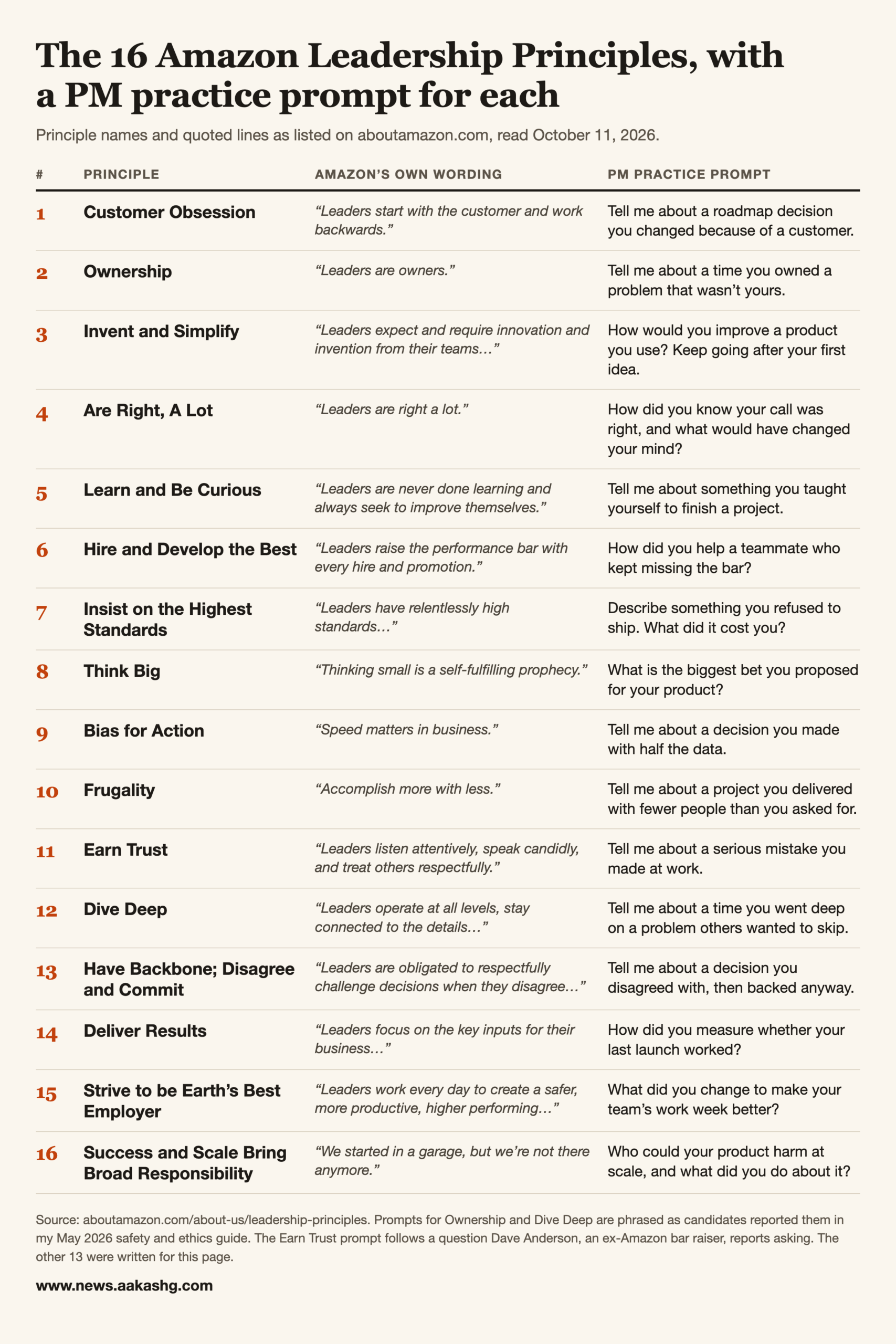
| Principle and Amazon’s wording | Question to practice | Where the question comes from |
|---|---|---|
| Customer Obsession “Leaders start with the customer and work backwards.” | Tell me about a roadmap decision you changed because of a customer. Follow-up Dave Anderson reports: “But who was the customer?” | Practice prompt written for this page. Follow-up: Dave Anderson |
| Ownership “Leaders are owners.” | Tell me about a time you owned a problem that wasn’t yours. | Reported by candidates, my May 2026 guide |
| Invent and Simplify “Leaders expect and require innovation and invention from their teams…” | How would you improve a product you use? Keep going after your first idea. | Practice prompt written for this page |
| Are Right, A Lot “Leaders are right a lot.” | How did you know your call was right, and what would have changed your mind? | Practice prompt written for this page |
| Learn and Be Curious “Leaders are never done learning and always seek to improve themselves.” | Tell me about something you taught yourself to finish a project. | Practice prompt written for this page |
| Hire and Develop the Best “Leaders raise the performance bar with every hire and promotion.” | How did you help a teammate who kept missing the bar? | Practice prompt written for this page |
| Insist on the Highest Standards “Leaders have relentlessly high standards…” | Describe something you refused to ship. What did it cost you? | Practice prompt written for this page |
| Think Big “Thinking small is a self-fulfilling prophecy.” | What is the biggest bet you proposed for your product? | Practice prompt written for this page |
| Bias for Action “Speed matters in business.” | Tell me about a decision you made with half the data. | Practice prompt written for this page |
| Frugality “Accomplish more with less.” | Tell me about a project you delivered with fewer people than you asked for. | Practice prompt written for this page |
| Earn Trust “Leaders listen attentively, speak candidly, and treat others respectfully.” | “Tell me about a time you made a serious mistake at work.” | Reported by Dave Anderson, an ex-Amazon bar raiser |
| Dive Deep “Leaders operate at all levels, stay connected to the details…” | Tell me about a time you went deep on a problem others wanted to skip. Follow-up Dave Anderson reports: “What bottlenecks?” | Reported by candidates, my May 2026 guide. Follow-up: Dave Anderson |
| Have Backbone; Disagree and Commit “Leaders are obligated to respectfully challenge decisions when they disagree…” | Tell me about a decision you disagreed with, then backed anyway. | Practice prompt written for this page |
| Deliver Results “Leaders focus on the key inputs for their business…” | How did you measure whether your last launch worked? | Practice prompt written for this page |
| Strive to be Earth’s Best Employer “Leaders work every day to create a safer, more productive, higher performing…” | What did you change to make your team’s work week better? | Practice prompt written for this page |
| Success and Scale Bring Broad Responsibility “We started in a garage, but we’re not there anymore.” | Who could your product harm at scale, and what did you do about it? | Practice prompt written for this page |
These prompts are practice shapes. The next section shows how Dave Anderson words the same principles in a live exchange.
What interviewers do after your first answer
Dave Anderson is an ex-Amazon Tech Director and GM who writes that he interviewed as a bar raiser. His free Leadership Principles guide writes out an interview exchange for every principle. He says he has heard some of the answers dozens of times and admits some are “a bit over the top,” so read them as illustrations of what he listens for. Four things in it change how I’d prepare.
- “What else?” is an invitation. He writes that when an interviewer says “that’s a good start, what else?”, it is very rare that “Um.. nope, that’s it” is the right answer. His example is a candidate asked how to improve Amazon wishlists who offers one fix and stops.
- Know the obvious details of your own story. His line: “If you increased traffic, you better know what you did.” He wants the obvious details anyone who did the work would know.
- Go a level down, then another. He says he loves candidates who can go four or five levels deep and get more excited as the details get interesting to them.
- Name your own mistake first. On mistakes he writes that you should “first recognize your own, before explaining other misses.” His example of what fails is a candidate who answers a failure question by blaming the PM, then an engineer, then marketing.
Here is the question from his guide for each principle, and where the sample answer broke.
| Principle | Question in Dave Anderson’s guide | Where the answer broke |
|---|---|---|
| Customer Obsession | “For that feature, who was the customer?” | Named the product team, then marketing and sales. Never the end customer. |
| Ownership | “When that happened and your whole application went down for a day, how’d you get it back up in the end?” | Said the ops team figured it out. Asked whether his developers helped: “that’s not our job.” |
| Invent and Simplify | “If you were in charge, how would you improve the wishlists feature on Amazon?” | Offered one fix, a sort order. Asked “what else?”, he said “that’s about it.” |
| Are Right, A Lot | “When she disagreed with your design, how did you know yours was right?” | Said she was very junior. Pressed on how he knew she was wrong: “My instincts are really good.” |
| Learn and Be Curious | “Tell me something interesting you’ve learned recently.” | His good sample is a candidate excited about Rust. His weak one only knows C++ and asks for a C++ team. |
| Hire and Develop the Best | “When they made all those mistakes, how did you help them?” | “I was available if they had questions.” Anyone who didn’t ask was, in his words, “their own fault.” |
| Insist on the Highest Standards | “How did you know what you had delivered was what the customer wanted?” | Said the product team accepted the feature, so the requirements were met. |
| Think Big | “If you owned marketing for our kids tablets, what new things would you look into?” | Offered image A/B tests, then Facebook ads. Asked “Anything else?”, he said “No, that would probably work.” |
| Bias for Action | “Since the site was down and you thought it was the cache, did you try clearing it?” | Said it was “above my pay grade” and waited for his manager. |
| Frugality | “Why did you get into an argument with him?” | Asked for 5 people, was offered 2, and told him “things cost what they cost.” |
| Earn Trust | “Tell me about a time you made a serious mistake at work.” | “Hmm.. I can’t think of anything.” Asked how the project failed, he blamed the product manager, then an engineer, then marketing. |
| Dive Deep | “Your team reduced latency on the website? How?” | “We removed bottlenecks.” Asked which ones: “I’m not really sure.” |
| Have Backbone; Disagree and Commit | He quotes only answers here. | “I showed my boss that the design wouldn’t work, she refused to listen.” Then he told the engineers it wasn’t his fault if things broke. |
| Deliver Results | “How did you know if your registration form was working?” | “If it registered people properly.” Asked how to measure success: “If it doesn’t have errors it’s successful.” |
| Strive to be Earth’s Best Employer | “How did you maintain morale on your team?” | “I didn’t need to worry about that.” His team had few other job options. |
| Success and Scale Bring Broad Responsibility | “If we had a goal to increase the usage of our Kids Tablets, what might you look into?” | His sample is a good answer. It opens with “I’d be very careful” and raises the addiction risk before anyone asks. |
Customer Obsession breaks on “But who was the end customer?” and Dive Deep on “What bottlenecks?” Both are the second question, so prepare the second level of every story.
Dave also addresses the worry that publishing the principles lets candidates prepare and fool Amazon. His answer, in the article, is that a candidate who understood the company well enough to trick the interviewers is “exactly the type of candidate we’d love to have at Amazon.” He is fine with candidates preparing hard. What he tests is whether you know the details of your own story.
The Bar Raiser: what Amazon says, and what it doesn’t
Amazon’s own Bar Raiser page gives specifics most prep guides skip.
- There are more than 3,600 Bar Raisers. Amazon describes them as objective third-party advisers in the interview process.
- They are nominated. By their manager, peers or other Bar Raisers.
- Training takes three months to a year. Amazon says some people graduate after fewer than a dozen interviews and others need 40 or more.
- The stated goal is a hire better than 50% of their would-be peers in similar roles. Amazon states it as the program’s goal.
- One person is not supposed to decide. An Amazon manager quoted on the page says the program “avoids having one person make the hiring decision.” The page also says interviewers send their input to the Bar Raiser and the hiring manager, who make the decision.
You will read that the Bar Raiser holds a veto. Some prep guides say it. Day One Careers, whose guide was written with a former Amazon Bar Raiser, describes the role as “an independent decision-maker with veto power over the hiring manager.” Amazon’s page never uses the word. Dave Anderson’s description of the role talks about authority to correct or modify parts of the process, also without the word veto (the guide is partly paywalled, so that is the free portion only).
I wrote “veto power” in my October 2025 AI PM interview guide, citing a prep site. I would now write it the way Amazon does: interviewers report to the Bar Raiser and the hiring manager, who make the decision.
Every interviewer reports what they heard at the debrief. A story you told one interviewer won’t count for what another one heard, so tell each person the full version.
How to answer “Why Amazon”
The standard “why this company” answer has three parts: mission, role fit and people. In my PM behavioral interview guide, the real skill is using each part to answer a doubt your resume raises. For Amazon I add a fourth move.
- Mission. What Amazon does that you have used or built against, in one specific sentence.
- Role fit. The team and the problem. Amazon’s interview guide says to tailor your application to the job description and its Leadership Principles, so read which principles the posting leans on.
- People. One specific thing you saw in the people you met, in your own words. “I love the culture” could describe any company.
- One principle with a story. Name a Leadership Principle you have already lived and give the short story that proves it. Dave Anderson writes that Amazon doesn’t need you to have exhibited the principles at your current job. It does expect you to show what the Amazonian move would have been.
Build a PM story bank before you read another question list
- Write each project once, with the numbers you actually know. If you can’t state the baseline and the result, the story fails at Dive Deep and Deliver Results.
- Tag each story with the principles it can carry. A launch that went badly can carry Earn Trust and Dive Deep.
- Practice one level down on every claim. What you did, how you did it, why you chose it. Amazon’s PM page says answers should include metrics where they apply.
- Write the mistake story first. Earn Trust asks for it directly, and Dave Anderson says he has heard “I can’t think of anything” dozens of times.
- Count your stories against the loop. Five interviewers at two or three behavioral questions each is 10 to 15 questions (my arithmetic from Amazon’s PM page). Two prep guides put the story count at 8 to 10 and 8 to 12. Pick the smallest set that covers all 16 principles and survives follow-ups.
My 3 Laws of PM behavioral interviews apply here too, especially flipping a weakness into a strength.
For AI PM roles, put a safety thread inside your stories
In my May 2026 safety and ethics guide, candidates I coached described Amazon’s AI roles (Alexa, AGI and Bedrock) working safety into the behavioral rounds, through Dive Deep and Ownership. Every interviewer, including the bar raiser, worked it in. Customer Obsession was the principle candidates most often saw tied to safety in their debriefs.
Across the rejections, the pattern was candidates with strong principle stories and no safety thread inside any of them. The bar was both. My April 2026 guide lists Dive Deep and Ownership as the two most tested for AI roles. Both come from candidate reports.
Where this fits in the rest of your prep
- The full behavioral system: the 3 Laws of PM behavioral interviews and the 84-question behavioral guide.
- For AI roles: the AI PM behavioral interview guide and the full AI PM interview guide.
- More free interview pages on this site: PM interview questions and PM interview cheat sheets.
- For how people climb once they are inside Amazon, Ethan Evans, who rose to VP there, walks through his Magic Loop framework on the Growth Podcast.
- If you aren’t reaching the loop at all, start with my Job Search OS guide.
Subscribe to get new interview guides by email.
Frequently asked questions
How many Leadership Principles does Amazon have?
Sixteen, as listed on aboutamazon.com on October 11, 2026. Amazon announced two new ones on July 1, 2021, per Dave Anderson’s guide: Strive to be Earth’s Best Employer, and Success and Scale Bring Broad Responsibility. Guides that still say 14 are out of date.
What is the Amazon product manager interview process?
Amazon’s PM prep page describes a 60-minute phone screen with a senior leader (half Leadership Principles, half functional PM questions), a writing assessment, and a loop of five 55-minute interviews with members of the product management community. Candidates in my April 2026 guide reported 6 to 7 rounds over 3 weeks to 2 months.
What is an Amazon Bar Raiser?
A trained interviewer who, per Amazon’s interview guide, comes from outside the hiring team and helps decide whether a candidate raises the bar. Amazon says it has more than 3,600 of them, nominated by managers, peers or other Bar Raisers. Amazon’s page says the Bar Raiser and the hiring manager make the hiring decision. It does not use the word veto.
Do I need to have worked somewhere that uses the Leadership Principles?
No. Dave Anderson, an ex-Amazon Tech Director and GM, writes that Amazon does not expect your current company to use them. It does expect you to show that you know what an owner would do in the situation.
How many stories should I prepare for an Amazon interview?
Two prep guides say 8 to 10 and 8 to 12. Amazon’s PM page says each interviewer typically asks two or three behavioral questions, so a five-interview loop is 10 to 15 questions. Pick the smallest set of stories that touches all 16 principles and still holds up when the interviewer asks what you did, how, and why.
How do I answer why Amazon?
Use three parts: the mission, the role fit, and the people you met. Make each part answer a doubt your resume raises. For Amazon, add a fourth move: name one Leadership Principle you have already lived and give the short story that proves it.
Sources and what was checked
Amazon pages read October 11, 2026:
- Amazon Leadership Principles (16 principles listed).
- Amazon Bar Raiser page (3,600+, nomination, training, decision wording).
- Amazon interview guide and interview loop page.
- Amazon PM interview prep (60-minute screen, writing assessment, five 55-minute interviews, two or three behavioral questions per interviewer, no brain teasers).
Dave Anderson’s Scarlet Ink guides: Leadership Principles (free, 2023, with later updates) and Bar Raiser (partly paywalled; only the free portion was used). His credential is quoted as he gives it, “ex-Amazon Tech Director and GM.”
Reported questions and round counts come from candidate debriefs in my own guides, linked where they appear. They are not Amazon statements. Prep sites disagree on loop details, so Amazon’s pages are the reference on this page.
