As a hiring manager who has reviewed thousands of product manager resumes, from aspiring PMs at startups to VPs at Google and Meta, I get asked one question constantly: "Is a certification worth it?" The answer isn't a simple yes or no. It's about strategic investment. A certification alone won't land you a job, but the right one, chosen for a specific career goal, acts as a powerful signal to recruiters and a genuine catalyst for skill development. It's one of many data points we use to evaluate candidates.
This guide cuts through the marketing fluff to provide a tactical breakdown of the best certifications for product managers that hiring managers actually recognize. We won't just list them; we'll categorize each option by career stage and specialization, from Agile-focused credentials to comprehensive foundational programs. You'll get a clear decision-making framework to help you choose the credential that offers the highest return on investment for your specific career path. For instance, a Senior PM at a large SaaS company like Salesforce looking to lead a new Agile Release Train would see immediate ROI from a SAFe POPM certification, while an aspiring PM from a non-tech background would benefit more from a foundational program like Product School's PMC to build core skills and a network.
For hiring managers, certifications are just one piece of the puzzle. Beyond specific qualifications, understanding the broader landscape of how companies evaluate potential hires through essential candidate assessment methods provides critical context for the role a credential plays in a holistic review. This article will help you decide which certification, if any, makes sense for you right now.
1. Product School
Product School is a global leader in product management training, offering a range of live, instructor-led certifications designed to fit specific career stages. Unlike self-paced courses, its cohort-based model provides a structured, interactive learning environment led by real-world PMs from top tech companies like Google, Meta, and Netflix. This makes it one of the best certifications for product managers seeking accountability and direct mentorship.
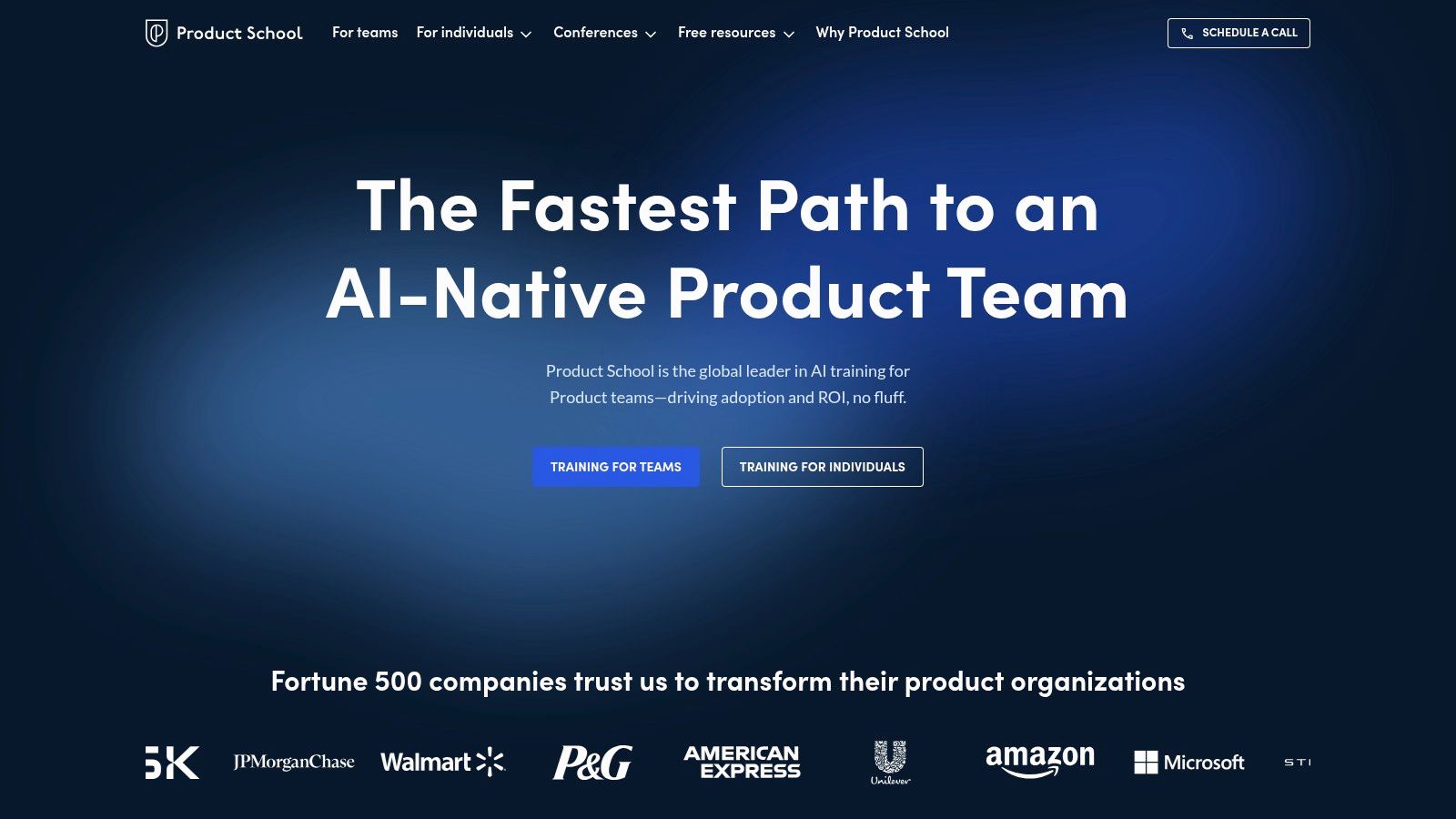
The curriculum is built around a clear career progression, from the foundational Product Manager Certificate (PMC) to advanced credentials like the Product Leader Certificate (PLC). Its standout feature is the vibrant community; graduates gain lifetime access to an active alumni network, career coaching services, and exclusive events like ProductCon. This ecosystem is invaluable for networking and continuous learning. To understand if this intensive, cohort-based approach fits your goals, you can explore detailed breakdowns of what it takes to become a successful PM through resources like this guide on how to become a product manager.
Key Details & Pricing
- Best For: Aspiring PMs and mid-career professionals seeking a structured, mentor-led program.
- Cost: Certifications typically range from $4,999 to $9,999, with membership plans offering bundled value.
- Duration: 8 weeks for core certifications.
- Pros: Strong alumni network, live instruction from industry experts, clear career paths.
- Cons: Higher cost compared to alternatives; fixed cohort schedules can sell out quickly.
2. Pragmatic Institute
Pragmatic Institute is a long-standing authority in product management training, known for its framework-driven, skills-based certifications. Its methodology centers on providing practical toolkits, templates, and repeatable processes that product professionals can immediately apply to their work. This focus on tangible, job-ready skills makes it one of the best certifications for product managers who need to build a systematic approach to market-driven product decisions. The training is respected across the industry, particularly within established B2B and enterprise tech companies in the US.
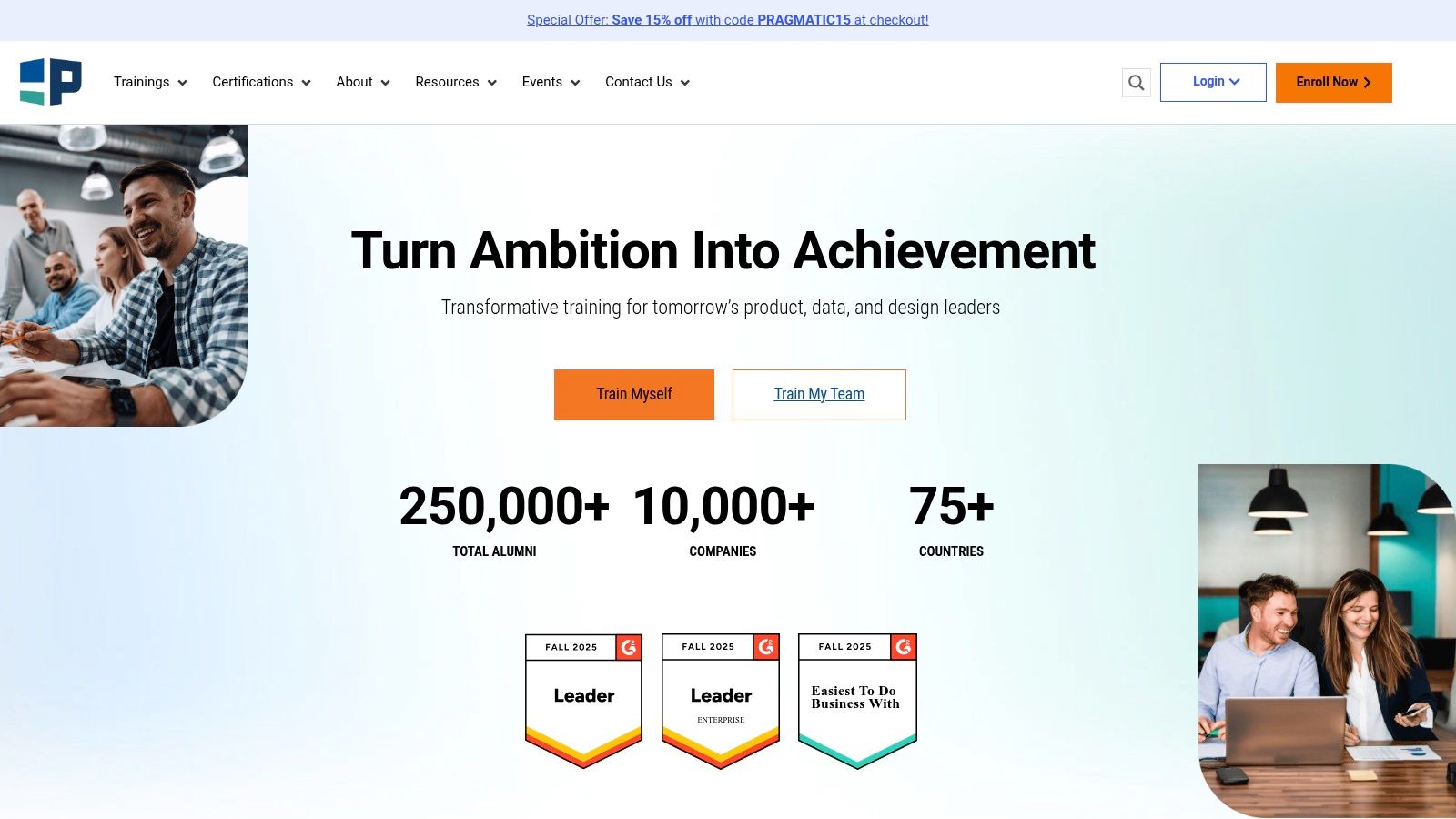
Unlike all-in-one bootcamps, Pragmatic offers a modular curriculum where you earn certification by completing a sequence of individual courses. This à la carte model allows you to build your credentials over time, starting with the required Foundations course before moving into specializations like Focus, Build, and Launch. Each course is designed to equip you with specific, actionable deliverables, such as market problem documents and positioning templates, reinforcing its reputation for practical application over pure theory. For example, a PM at an enterprise software company like Oracle could use the 'Focus' module's templates to immediately refine their market validation process.
Key Details & Pricing
- Best For: Product managers in B2B or enterprise environments and those seeking a structured, repeatable framework.
- Cost: Courses are priced individually, typically around $1,395 each. Full certification requires completing multiple courses.
- Duration: Each course is typically 1 day (live) or self-paced (on-demand).
- Pros: Strong industry recognition, practical frameworks with templates, transparent per-course pricing.
- Cons: Certification requires completing and paying for several separate courses; the curriculum has a rigid, prerequisite-based structure.
3. Productside (formerly 280 Group)
Productside offers highly focused training designed to prepare product managers for AIPMM (Association of International Product Marketing and Management) certifications. Unlike broader programs, its curriculum is tightly aligned with specific exam objectives for credentials like the Certified Product Manager. This makes it one of the best certifications for product managers who have already decided on an AIPMM credential and need an efficient, direct path to passing the exam. Its training is built around core frameworks like Optimal, Digital, and Agile product management.
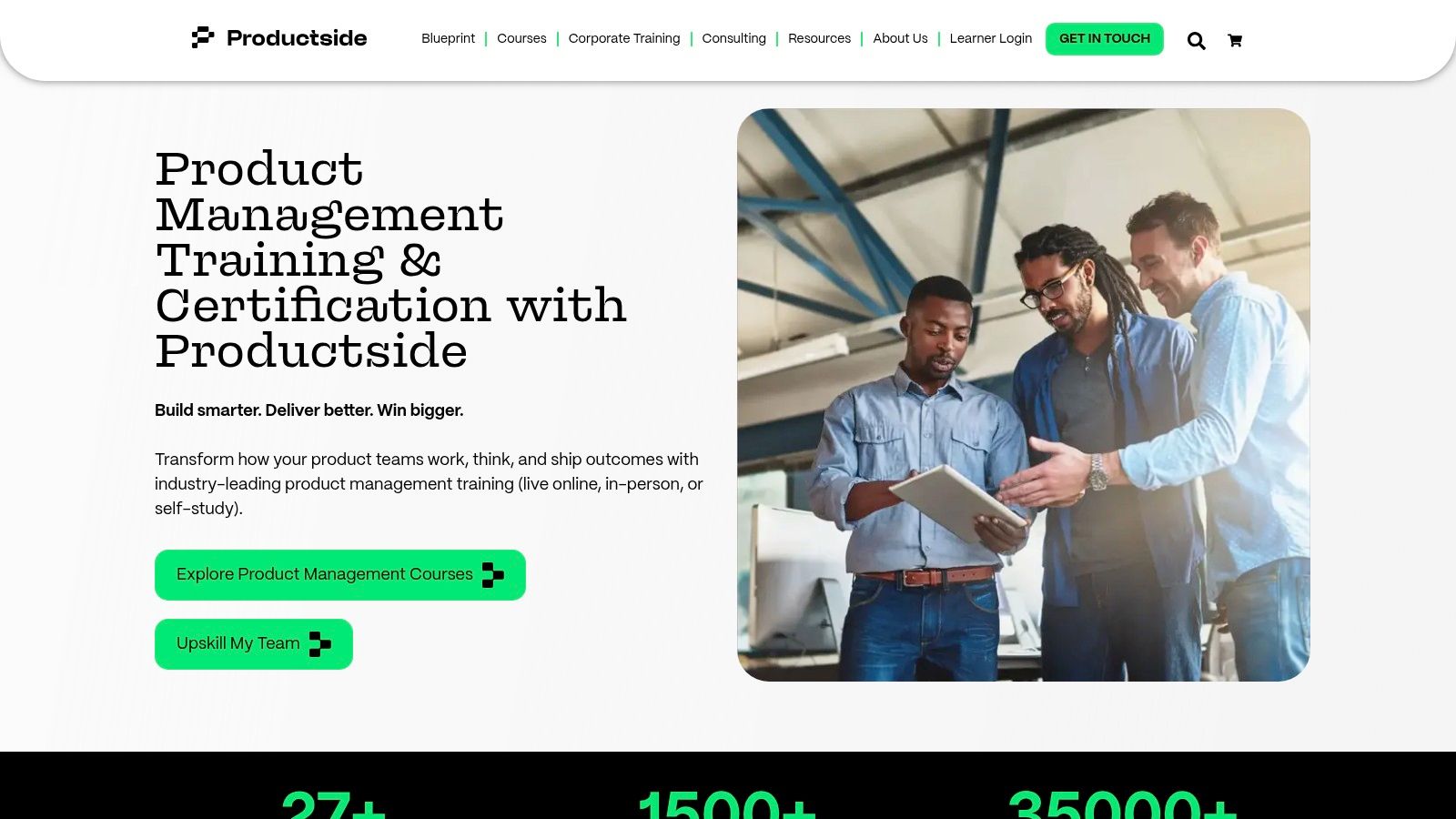
The primary advantage of Productside is its concise, no-fluff approach. The courses are structured as exam prep, stripping away extraneous topics to concentrate on the material required for certification. This is ideal for busy professionals or corporate teams seeking to upskill a group with a standardized, recognized credential. However, it's crucial to note that Productside provides the training, while the certification exam and the credential itself are administered and issued by AIPMM, a separate organization.
Key Details & Pricing
- Best For: Individuals and teams committed to achieving an AIPMM certification.
- Cost: Courses are priced individually, typically ranging from $1,995 to $2,995 for training and exam bundles.
- Duration: Varies by format; live online courses are typically 2-4 days.
- Pros: Curriculum is directly aligned with AIPMM exams, concise and focused content, offers team training options.
- Cons: The actual certification is from a separate entity (AIPMM), less emphasis on community and networking.
4. AIPMM (Association of International Product Marketing & Management)
AIPMM is one of the oldest and most established independent certification bodies in the product management space. It offers globally recognized, vendor-neutral credentials like the Certified Product Manager (CPM) and Certified Product Marketing Manager (CPMM). Unlike cohort-based programs, AIPMM's strength lies in its flexibility; candidates can self-study using the official Product Body of Knowledge (ProdBOK) or train with an authorized partner. This makes it a top choice for self-motivated professionals who prefer to prepare at their own pace.
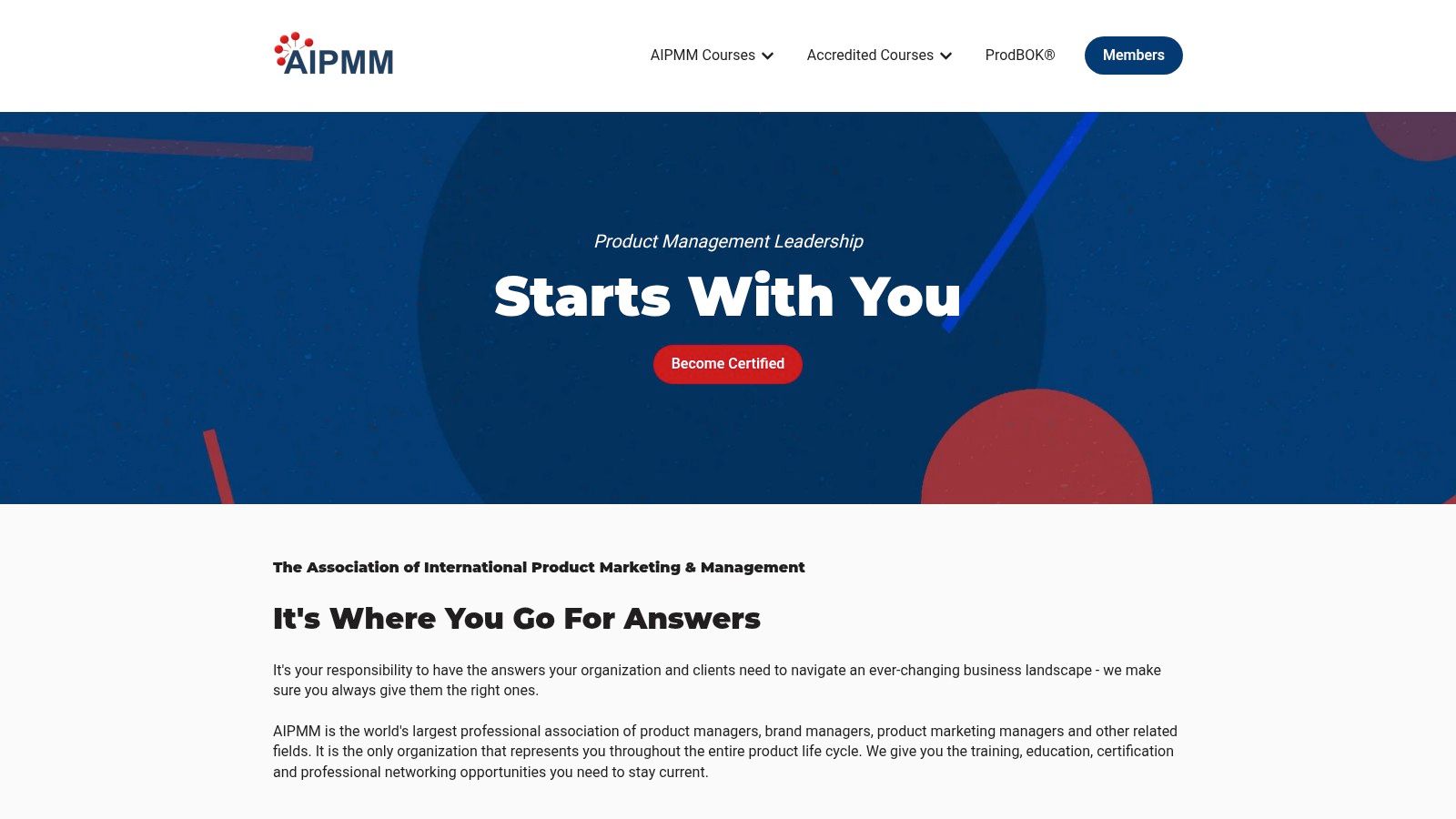
The association's focus on foundational, standardized knowledge ensures its certifications are respected across various industries, from tech to CPG. Its framework-driven approach provides a solid baseline of core competencies, which is crucial for mastering the diverse product manager skills required to succeed in the role. While it lacks the built-in community of a dedicated school, its reputation and flexible study options make it one of the best certifications for product managers seeking a respected, self-directed credential to validate their expertise.
Key Details & Pricing
- Best For: Self-starters and professionals needing a globally recognized, standardized credential.
- Cost: Exam vouchers start around $495; training partner costs vary significantly, from $1,500 to over $4,000.
- Duration: Self-paced, depends entirely on the individual's study schedule.
- Pros: Vendor-neutral and widely recognized, high flexibility with self-study or partner training options.
- Cons: Study materials are often an additional cost; pricing and quality can vary between training partners.
5. Scrum.org
For product managers operating in Agile environments, Scrum.org provides the industry-standard credentials for demonstrating expertise in the Product Owner role. Its certifications, particularly the Professional Scrum Product Owner (PSPO) series, are laser-focused on the principles and practices of Scrum. Unlike comprehensive PM programs, Scrum.org offers a direct, exam-based path to validation without mandatory training, making it an efficient and credible choice for PMs needing to solidify their Agile competency. This makes it one of the best certifications for product managers wanting a specialized, globally recognized credential.
The key differentiator is its assessment-first model. You can self-study using the official Scrum Guide and then purchase an exam attempt directly. This flexibility is ideal for experienced PMs who don’t need a full course but want to validate their skills. The certifications are highly respected in tech and do not expire or require renewal fees, offering a lifetime credential. Job postings at companies like Spotify and Microsoft frequently list PSPO as a desired qualification, reflecting its real-world value.
Key Details & Pricing
- Best For: Product managers and owners working in Scrum teams who need to formalize their framework expertise.
- Cost: Exams are highly affordable, with the PSPO I costing $200 per attempt.
- Duration: Self-paced; the exam itself is 60 minutes.
- Pros: Low cost, no expiration or renewal fees, respected global standard, flexible self-study path.
- Cons: Narrowly focused on Scrum, not a comprehensive PM business curriculum; requires self-discipline to pass without formal training.
6. Scrum Alliance
For product managers operating in Agile environments, Scrum Alliance provides the industry-standard certifications for product ownership. Its flagship credential, the Certified Scrum Product Owner (CSPO), is one of the best certifications for product managers who need to master the art of managing a product backlog and maximizing the value delivered by a development team. Unlike self-paced programs, Scrum Alliance mandates live training from certified trainers, ensuring a high-quality, interactive learning experience.
The platform’s strength lies in its structured, progressive certification track, which allows professionals to advance from the foundational CSPO to the Advanced Certified Scrum Product Owner (A-CSPO) and Certified Scrum Professional Product Owner (CSP-PO). This pathway demonstrates a deepening expertise in Agile leadership and strategy. Graduates become part of a global community with access to events and resources, but must engage in continuous learning to maintain their certification. Understanding these principles is key, as detailed in this guide on the Agile product development process.
Key Details & Pricing
- Best For: Product managers and owners working in or transitioning to Agile/Scrum teams.
- Cost: Varies by trainer and location, but CSPO courses typically range from $400 to $1,200.
- Duration: Typically a 2-day (16-hour) live training course.
- Pros: Highly recognized Agile credential, strong emphasis on practical application, access to a global community.
- Cons: Certification requires renewal every two years with ongoing fees and continuing education credits (SEUs).
7. Scaled Agile (SAFe)
For product managers operating within large, complex organizations, the Scaled Agile Framework (SAFe) has become a dominant methodology. Its SAFe Product Owner/Product Manager (POPM) certification is designed specifically for this environment, focusing on how to define and deliver value in an enterprise context. Unlike generalist PM courses, this program teaches you to manage backlogs, lead ARTs (Agile Release Trains), and collaborate across massive teams. This makes it one of the best certifications for product managers aiming to work at Fortune 500 companies or in industries like finance and healthcare where SAFe is standard.
The training is delivered through a global network of partners, offering flexibility with both virtual and in-person formats. The curriculum provides a standardized vocabulary and a clear framework for executing product strategy at scale, a critical skill for enterprise roles. While the certification itself provides a strong signal to recruiters in SAFe-driven companies, maintaining it requires an ongoing commitment via an annual SAFe Studio membership, which provides access to a community and continuous learning resources.
Key Details & Pricing
- Best For: Product managers and owners working in or targeting large enterprise organizations that have adopted the SAFe framework.
- Cost: Course fees vary by provider but generally range from $995 to $1,495. Annual renewal is required through a SAFe Studio membership ($295/year).
- Duration: Typically a 2-day intensive course.
- Pros: Highly recognized in enterprise environments, strong framework for large-scale product delivery, wide availability of training partners.
- Cons: Niche to SAFe organizations; requires annual renewal fees to maintain certification status.
8. Aha! Academy
Aha! Academy offers a unique, tool-centric certification path for product managers who use or plan to adopt the Aha! Roadmaps software. Its programs are designed to transform participants into power users, bridging the gap between product management theory and practical application within its popular platform. Unlike generalist certifications, Aha! focuses on mastering a specific ecosystem for roadmapping, strategy, and feature prioritization, making it one of the best certifications for product managers embedded in teams that rely on its software.
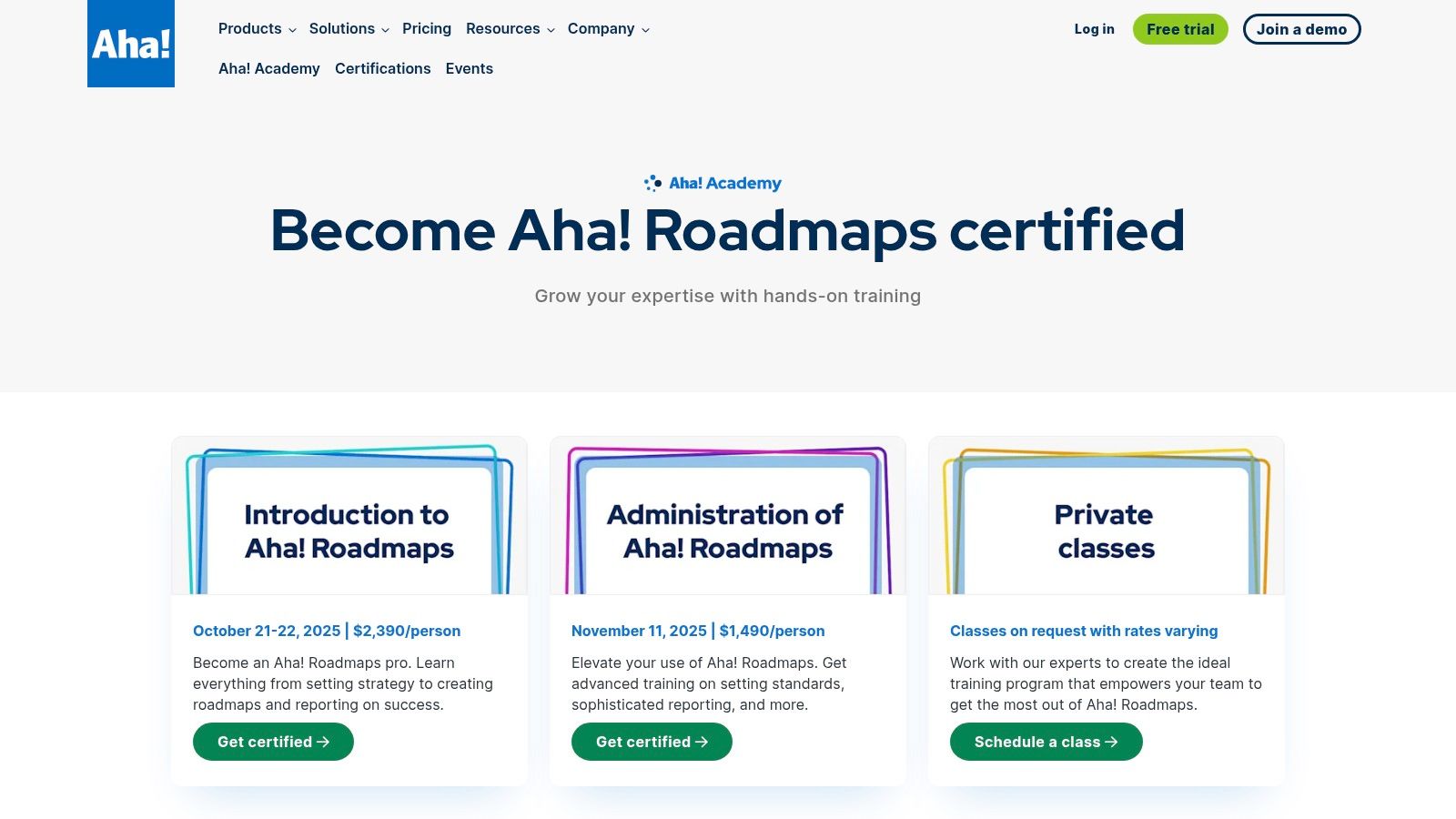
The live, instructor-led classes are delivered in small cohorts, ensuring personalized attention and hands-on learning. The curriculum covers everything from setting product value scores to building complex, data-driven roadmaps and reports directly within the tool. While the primary certification is for Aha! Roadmaps (Professional), the skills learned are directly transferable to building and communicating product strategy in any organization that values a structured, tool-based approach. The value here is becoming a master of a specific, high-demand product management toolset.
Key Details & Pricing
- Best For: Product managers and teams already using or implementing the Aha! software suite.
- Cost: The Aha! Roadmaps (Professional) certification course is priced at $1,995 per person.
- Duration: Typically delivered over several days in live, multi-hour sessions.
- Pros: Deep, practical training on a market-leading PM tool; small, interactive class sizes.
- Cons: Certification is tightly coupled with the Aha! ecosystem; less focus on generalist PM theory.
9. Coursera — University of Virginia (Darden) Digital Product Management Specialization
For those seeking a university-backed curriculum with the flexibility of self-paced learning, the University of Virginia's Digital Product Management Specialization on Coursera is an excellent entry point. Offered by the prestigious Darden School of Business, this five-course program covers the entire product lifecycle, from identifying opportunities and designing hypotheses to agile development and effective go-to-market strategies. It stands out by blending academic rigor with practical, modern PM fundamentals.
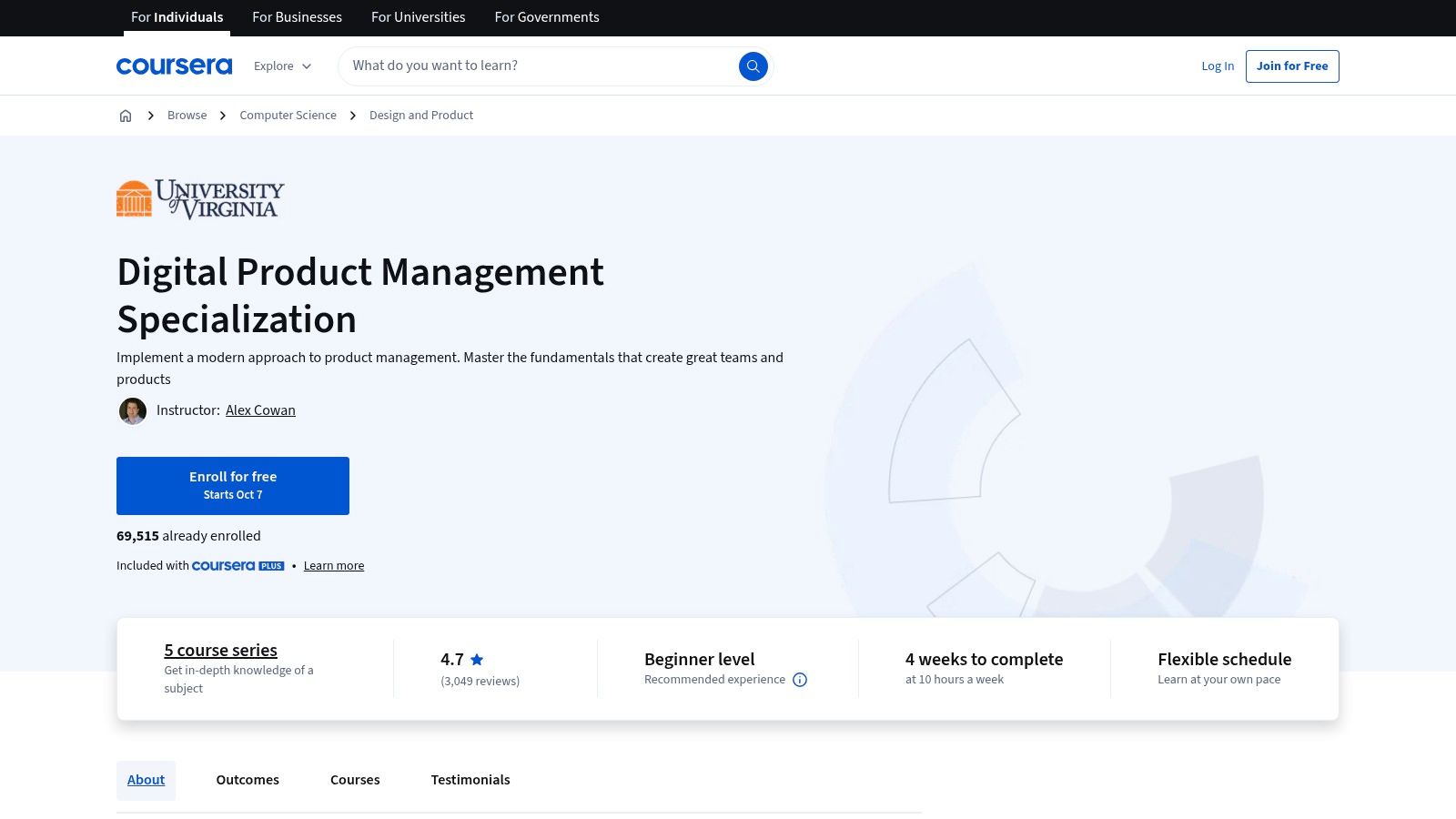
Unlike live bootcamps, this specialization allows you to learn on your own schedule, making it ideal for professionals balancing a full-time job. While it lacks direct mentorship, its structured modules and peer-reviewed assignments provide a solid framework for building core competencies. Completing the program earns you a shareable certificate from a top-tier business school, adding significant credibility to your LinkedIn profile and resume. This program is one of the best certifications for product managers who prioritize affordability and a recognized academic credential.
Key Details & Pricing
- Best For: Aspiring PMs and career switchers needing a foundational, university-affiliated program.
- Cost: Included with a Coursera Plus subscription (typically $59/month or $399/year), with financial aid available.
- Duration: Approximately 5 months at a suggested pace of 3 hours per week.
- Pros: Highly affordable and flexible, strong academic branding from UVA Darden, comprehensive curriculum for beginners.
- Cons: Lacks live instruction and a dedicated professional network; more of an academic certificate than an industry certification.
10. edX — Boston University MicroMasters in Digital Product Management
For those who prioritize academic rigor and a credential backed by a major university, Boston University's MicroMasters program on edX is a compelling option. This graduate-level series of courses provides a deep, theoretical foundation in digital product management, moving beyond tactical skills to focus on strategic thinking. Unlike bootcamp-style programs, its structure is designed for learners seeking potential academic credit toward a full master's degree, making it one of the best certifications for product managers with academic aspirations.
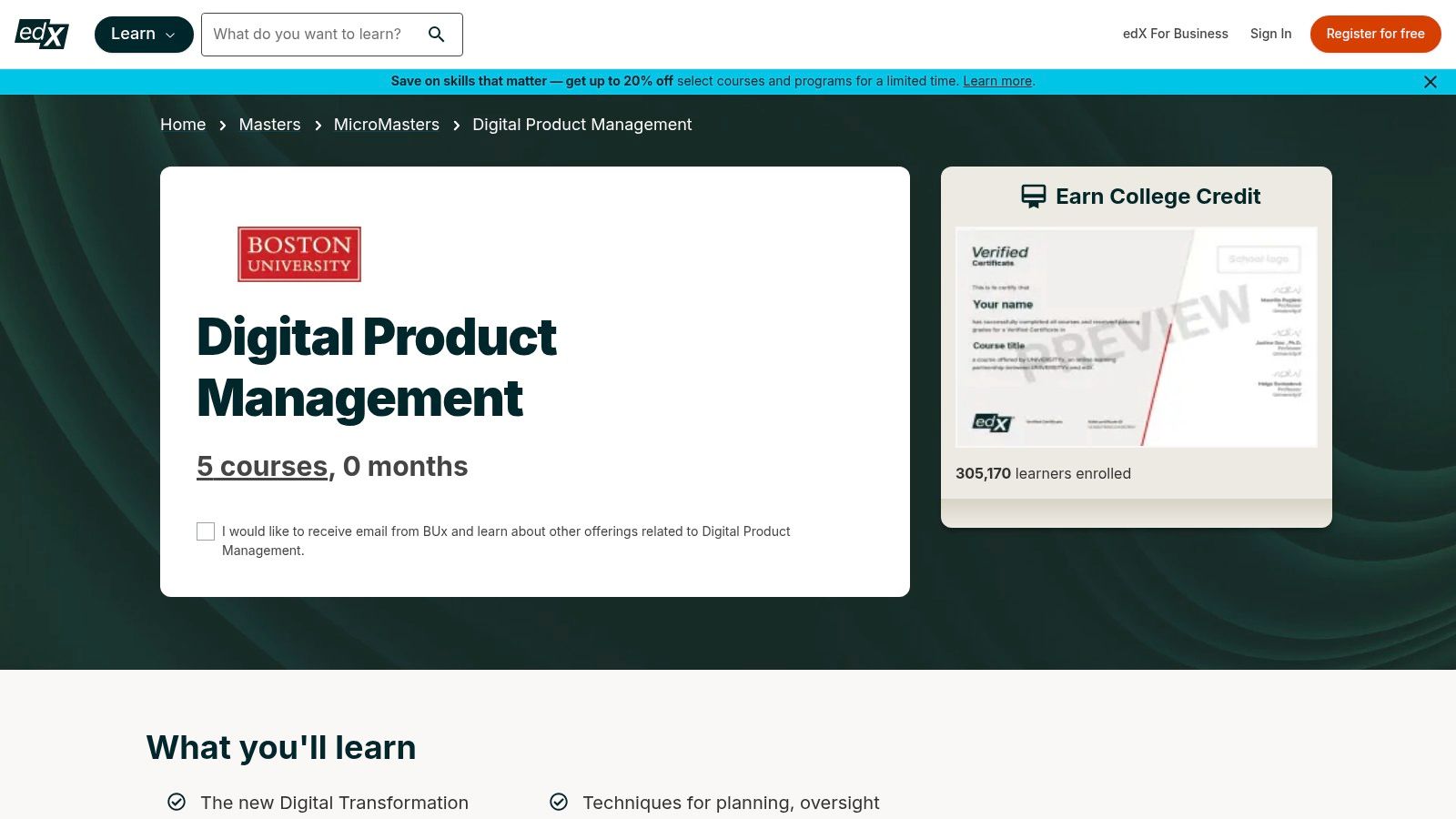
The program's key differentiator is its university-level curriculum, delivered online with the flexibility of self-paced learning combined with the accountability of proctored exams. While it may not offer the same alumni networking benefits as cohort-based models, the Boston University brand recognition provides significant credibility. The curriculum covers everything from product lifecycle management and business analytics to agile methodologies, offering a comprehensive, albeit demanding, educational experience. It’s ideal for professionals who value a structured, academic approach to mastering product principles.
Key Details & Pricing
- Best For: Professionals seeking a graduate-level, academically-focused credential with potential pathways to a master's degree.
- Cost: Approximately $2,245 for the full program certificate.
- Duration: Approximately 8 months (at 9–10 hours per week).
- Pros: Deep academic recognition, potential to earn graduate credit, strong foundational curriculum.
- Cons: Significant time commitment, less focused on immediate job-ready skills or networking compared to bootcamps.
11. Udacity — Product Manager Nanodegree programs
Udacity’s Nanodegree programs, including its specialized AI Product Manager track, are built for hands-on, practical application. Rather than focusing solely on theory, the curriculum is project-based, requiring students to build real deliverables like a product roadmap, PRD, and market analysis. This approach makes it one of the best certifications for product managers who learn by doing and want to build a strong portfolio to showcase their skills to potential employers.

The platform operates on a flexible subscription model, granting access to its entire catalog, which is ideal for self-motivated learners. A key differentiator is the structured feedback loop; each project is reviewed and graded by an experienced mentor, ensuring you are applying concepts correctly. For example, the AI Product Manager track has you develop a business proposal for an AI product, which is then reviewed by an industry expert from a company like NVIDIA or Google. You can find more details at their official site, www.udacity.com.
Key Details & Pricing
- Best For: Self-starters and tech-focused PMs who want a flexible, project-based program to build a tangible portfolio.
- Cost: Monthly subscription model, typically around $249/month, with multi-month bundles available for a lower effective rate.
- Duration: Self-paced; typically takes 3-4 months at the suggested weekly pace.
- Pros: Strong focus on practical, tech-oriented PM skills; flexible learning schedule; detailed mentor feedback on projects.
- Cons: More expensive if program duration extends; certificates are issued by Udacity, not an independent exam body.
12. Product-Led Alliance (PLA)
Product-Led Alliance (PLA) specializes in certifications for product professionals focused on modern, growth-oriented strategies. Its curriculum is built around the principles of product-led growth (PLG), making it ideal for PMs at SaaS companies or those responsible for user acquisition, monetization, and go-to-market execution. PLA offers a distinct alternative to generalist PM training by zeroing in on how the product itself can be the primary driver of business growth.
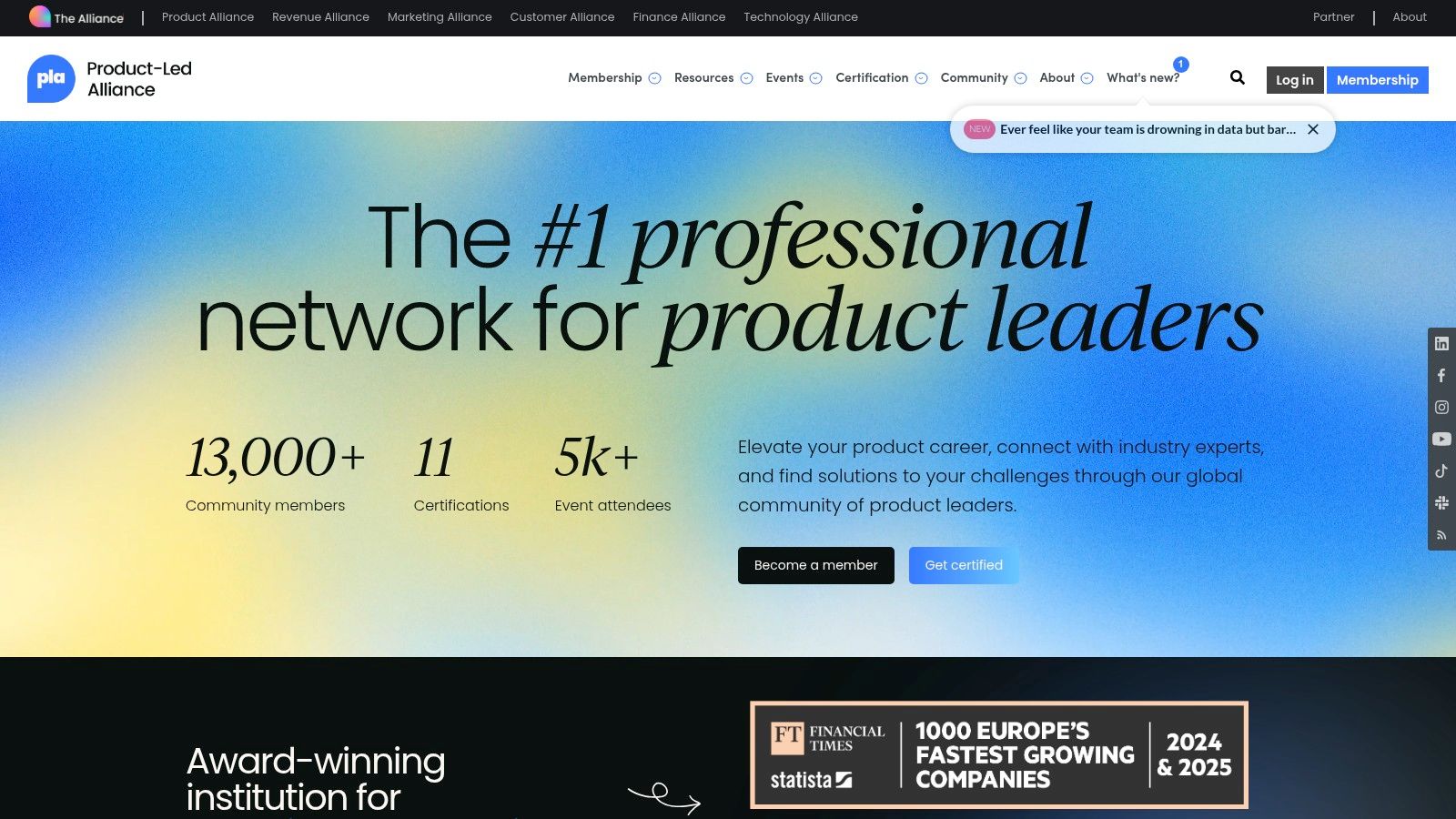
What sets PLA apart is its membership model. While you can purchase individual certifications, the Pro+ membership provides access to a comprehensive library of courses, templates, and an active community. This subscription-based approach offers continuous learning on topics from pricing to product marketing, making it one of the best certifications for product managers who want to build deep, functional expertise in PLG. A PM at a company like Slack or Calendly would find the PLG-focused templates and frameworks immediately applicable to their daily work.
Key Details & Pricing
- Best For: PMs at SaaS companies and those focused on product-led growth, monetization, and go-to-market strategy.
- Cost: Individual courses vary; Pro+ membership starts at $799/year for full access to content and events.
- Duration: Self-paced, on-demand.
- Pros: Strong focus on high-demand PLG skills, excellent value with the membership model, extensive library of templates.
- Cons: Not an independent third-party certifier; best value requires an ongoing subscription.
Top Certification Programs Comparison
| Platform | Core Features / Certifications | User Experience / Quality ★ | Value Proposition / Pricing 💰 | Target Audience 👥 | Unique Selling Points ✨ |
|---|---|---|---|---|---|
| Product School | Live, cohort-based PM certs (PMC, PLC); ProductCon access | Instructor-led; 1:1 coaching; ★★★★☆ | Higher cost; membership bundles multiple certs 💰💰💰 | Aspiring to senior PMs; US-friendly cohorts 👥 | Structured career paths; active alumni 🏆 |
| Pragmatic Institute | Modular PM cert courses; templates & toolkits | Practical deliverables; ★★★★☆ | Transparent per-course pricing 💰💰 | US product professionals needing practical skills 👥 | Pragmatic Framework-based; on-demand/live options ✨ |
| Productside (280 Group) | Focused AIPMM exam prep (Optimal, Agile, Digital) | Concise, exam-aligned; ★★★☆☆ | Per-course pricing; separate exam fees 💰💰 | Candidates targeting AIPMM certs 👥 | Aligned with AIPMM; team training options ✨ |
| AIPMM | Vendor-neutral certs (CPM, CPMM, CBM); self-study or partners | Industry-recognized; ★★★★☆ | Exam vouchers; variable partner training costs 💰💰 | PMs worldwide seeking independent certs 👥 | Flexible self-study; ProdBOK body of knowledge 🏆 |
| Scrum.org | Product Owner certs (PSPO I/II/III); online exams | Online exams; lifetime validity; ★★★★☆ | Affordable exams (~$200); no renewals 💰 | Agile PMs and Product Owners 👥 | No renewal fees; global accessibility ✨ |
| Scrum Alliance | CSPO & advanced Agile certifications; mandatory training | Trainer-led; community events; ★★★★☆ | Mandatory course; renewal every 2 yrs 💰💰 | Agile product owners & leaders 👥 | Recognized agile badge; ongoing education 🏆 |
| Scaled Agile (SAFe) | SAFe Product Owner/Product Manager cert; partner courses | Enterprise focus; flexible formats; ★★★☆☆ | Course/exam varies; annual renewal fees 💰💰 | Enterprise-scale PMs; SAFe users 👥 | Strong SAFe industry recognition; partner delivery ✨ |
| Aha! Academy | Certification on Aha! Roadmaps platform | Small live cohorts; platform-specific; ★★★☆☆ | Published pricing; tied to Aha! users 💰 | Teams using Aha! product tools 👥 | Deep Aha! product integration; live instructor-led ✨ |
| Coursera (UVA Darden) | Digital PM specialization; university-backed | Flexible, self-paced; ★★★★☆ | Subscription or financial aid; cost-effective 💰 | Beginners & academics 👥 | University credential; shareable certificate 🏆 |
| edX (Boston University) | MicroMasters in Digital PM; graduate-level | Academic rigor; proctored exams; ★★★★☆ | Time-intensive (~8 months); higher tuition 💰💰 | Advanced learners seeking academic credit 👥 | Graduate credit option; deep strategy focus ✨ |
| Udacity | Nanodegree programs; project-based learning | Mentor support; portfolio projects; ★★★★☆ | Subscription-based; can get costly over time 💰💰 | Tech-savvy PMs; hands-on learners 👥 | Project heavy; career services included ✨ |
| Product-Led Alliance (PLA) | Multiple PM & PLG certs; Pro+ membership | Online-first; community & mentor access; ★★★☆☆ | Subscription with tiers; good multi-cert value 💰 | Product-led growth PMs; monetization focus 👥 | Access to many certs + annual summit 🏆 |
The Final Verdict: Your Action Plan for Choosing a PM Certification
Navigating the landscape of product management certifications can feel overwhelming. We've analyzed a dozen of the top programs, from the broad, foundational training of Product School and Pragmatic Institute to the specialized, framework-specific credentials from Scrum.org and Scaled Agile. The key takeaway is clear: certifications are tools, not trophies. The most valuable credential is the one that directly serves your immediate career objective.
The ultimate goal isn't just to add three letters after your name; it's to achieve tangible career impact. Whether that means securing your first PM role (average starting salary $110k in the US), leading larger cross-functional teams as a Senior PM ($165k+), or shipping more successful products, the right certification acts as a catalyst for that growth. Viewing this decision through a strategic lens is crucial for maximizing your return on investment of both time and money.
Your Four-Step Action Plan
To move from analysis to action, work backward from your desired outcome. Don't start by asking "Which certification is best?" Instead, ask "What career goal will this certification help me achieve?" Use this simple, four-step checklist to find the program that aligns with your professional roadmap.
-
Define Your 'Why' and Identify Your Gap: Are you an aspiring PM trying to break into the field? Your goal is to signal foundational competence, making a comprehensive program like Product School or the Udacity Nanodegree a strong choice. Are you an established PM at a large enterprise looking to transition into a leadership role? A SAFe POPM certification demonstrates your ability to operate at scale. Pinpoint the specific skill or credibility gap you need to fill.
-
Audit Real-World Job Descriptions: Your most valuable data source is the market itself. Go to LinkedIn and search for your target roles at your dream companies (e.g., "Product Manager, AI" at Google, "Senior Product Manager, Fintech" at Stripe). Analyze 10-15 job descriptions and tally which certifications, if any, are mentioned as "preferred" or "required." This real-world data cuts through the marketing noise and shows you exactly what hiring managers are looking for.
-
Calculate the True ROI: A certification is a business decision for your career. Compare the direct cost against the potential benefits. A high-cost bootcamp like Product School (~$5,000) might have a massive ROI for a career switcher if it helps them land a role with a significant salary increase. For an experienced PM, a less expensive, targeted Agile certification like the PSPO I ($200) could provide the necessary skills to manage a new Scrum team effectively, offering a quick and efficient return. Factor in the networking value and the practical applicability of the skills you'll learn.
-
Commit, Execute, and Showcase: Once you've made your decision, treat the program like a product you're managing. Set a clear timeline, block off your calendar, and create a project plan for completion. More importantly, start applying what you learn immediately, even in your current role. The theory is only valuable once it's put into practice. After completion, update your resume and learn how to craft a winning LinkedIn profile headline to ensure your new credential gets noticed by recruiters and hiring managers.
Ultimately, the search for the best certifications for product managers leads back to a personal assessment of your unique career path. No single program is a silver bullet, but the right one can be a powerful accelerator. Choose strategically, commit fully, and leverage your new knowledge to build the next great chapter of your product career.
For continued learning from one of the industry's top product leaders, subscribe to the newsletter by Aakash Gupta. His insights on product management, career growth, and industry trends provide the kind of practical, real-world advice that complements any formal certification. Visit Aakash Gupta to learn more.
