The core job of a Product Manager is to ship value to customers, fast. The agile product development process is the system that makes this possible. Forget the textbook definitions; think of it as a repeatable blueprint for breaking down massive projects into small, high-impact chunks called sprints. This allows your team to build, measure, and learn in rapid cycles, ensuring you're always building what customers actually want.
As a PM leader who's hired and managed teams at places like Meta and Google, I can tell you that mastering this process is non-negotiable for career growth. A PM who can effectively run an agile team is seen as a reliable executor who can turn vision into reality. According to recent PM job postings from companies like Atlassian and Spotify, "deep experience with Agile/Scrum methodologies" is a top requirement, directly impacting salary brackets which can range from $130,000 for a mid-level PM to over $220,000 for a senior role leading agile pods.
From Idea to Impact: The 7-Phase Agile Blueprint
The real magic of the agile product development process is how it slashes risk and ramps up learning. Instead of pouring months of siloed work into a single "big bang" launch and just hoping for the best, you're constantly releasing small, functional pieces of the product. You gather real-world data, see what sticks, and adjust your course. This cycle is the absolute core of building products people love.
Why Agile Dominates Modern Product Development
The industry's stampede toward agile is impossible to ignore. Between 2020 and 2021 alone, agile adoption within software development teams shot up from 37% to 86%. Of those teams, a whopping 66% use Scrum as their go-to framework. That's not a small trend; it's a seismic shift showing just how essential flexibility and quick response times have become.
This whole flow is about planning, building, and learning—over and over again.
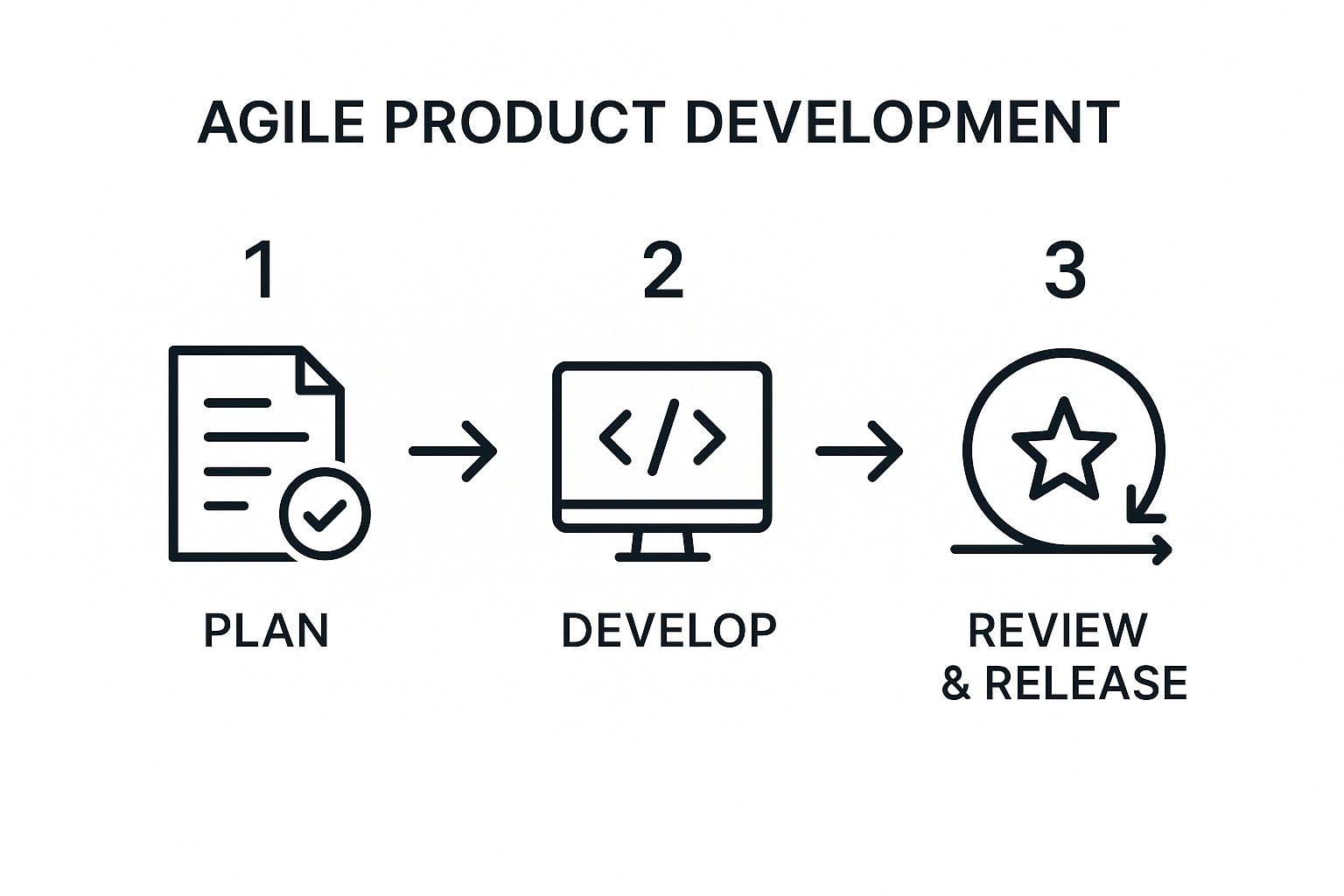
This image really drives home the cyclical nature of agile. Each stage doesn't just end; it feeds directly into the next, creating a powerful, continuous loop of improvement and delivery.
The Agile Product Development Lifecycle At A Glance
To help you visualize the entire journey, here’s a quick breakdown of each phase. This table maps out what you're trying to achieve at each step, what the team is actually doing, and the specific tools top PMs use to get the job done.
| Phase | Primary Goal | Key Activities & Deliverables | Essential PM Tools |
|---|---|---|---|
| 1. Ideation & Discovery | Validate a customer problem and define the product vision. | User research, market analysis, competitor reviews, problem statements, user personas, product vision doc. | Figma, Miro, Surveys (e.g., SurveyMonkey) |
| 2. Backlog Refinement | Translate the vision into a prioritized list of actionable work. | Creating user stories, estimating effort, defining acceptance criteria, prioritizing features. | Jira, Linear, Trello |
| 3. Sprint Planning | Commit to a specific scope of work for the upcoming sprint. | Selecting stories from the backlog, defining the sprint goal, tasking out the work. | Jira, Asana |
| 4. Development & Daily Stand-ups | Build and test the committed features. | Coding, QA testing, daily progress check-ins (stand-ups). | GitHub, Slack |
| 5. Sprint Review & Demo | Showcase the completed work and gather stakeholder feedback. | Live demo of the new functionality, discussion of what was achieved vs. the sprint goal. | Zoom, Google Meet |
| 6. Sprint Retrospective | Reflect on the sprint process to identify improvements. | Team discussion on what went well, what didn't, and actionable changes for next time. | Miro, FigJam |
| 7. Product Launch & Feedback Loop | Release the new value to customers and measure its impact. | Phased rollouts, A/B testing, monitoring analytics, collecting user feedback. | Amplitude, Mixpanel, LaunchDarkly |
This cycle repeats sprint after sprint, allowing you to build, measure, and learn in a tight, predictable rhythm.
At its core, the agile process flows from high-level strategy down to tactical execution, then bubbles back up with learnings that inform the next strategic move. Your job as a Product Manager is to steer this entire process, making sure every single sprint pushes the broader product vision forward. Getting a handle on this flow is non-negotiable for any PM. Of course, balancing this structured process with the beautiful chaos of initial discovery is a skill in itself. For more on that, check out this guide on balancing agility and effectiveness in product discovery.
As a hiring manager, I always look for PMs who see agile not as a set of rigid rules, but as a framework for making smarter, faster decisions. It’s about creating a system that embraces change rather than fighting it. That's the real difference between a good PM and a great one.
For any product leaders looking to get a deeper, more foundational grasp of modern development frameworks, the Project Management Professional (PMP) Study Guide is a fantastic resource. It can really help solidify the principles that drive today's most successful product teams.
Building Your Strategic Product Backlog
Let’s be honest: the flashy sprints and daily stand-ups get all the attention. But after more than a decade in product, I can tell you that the success of any agile project is decided long before the first line of code is ever written.
It’s won or lost in how you build the product backlog. This isn't just another to-do list; it's the single source of truth that turns your grand product vision into tangible, actionable work for your engineering team.
Your first job is to pull clarity out of the chaos. You're swimming in stakeholder requests, raw customer feedback, and mountains of data. The discovery phase is where you stop being a collector of ideas and start being a ruthless validator.

Sourcing and Validating High-Impact Ideas
The best backlogs aren't built on the whims of the loudest person in the room. They're built from a rich, diverse set of inputs. You're looking for both the "what" from quantitative signals and the "why" from qualitative ones.
Here are the primary channels I constantly have my ear to:
- Customer Interviews: Please, go beyond surveys. Get on the phone. I schedule 30-minute calls with power users, folks who recently churned, and even prospects still on the fence. Your goal isn't to ask them for feature requests—it's to understand their world, their frustrations, their "why." Use a tool like Calendly to make scheduling effortless.
- Competitor Analysis: I use tools like Similarweb or SEMrush to see where my competitors are getting traffic and what they're launching. This isn't about playing copycat. It's about spotting market trends and, more importantly, finding the gaps they've missed.
- Product Analytics Data: This is where you put on your detective hat. Dive into tools like Amplitude or Mixpanel. Don't just look at dashboards; build funnels to see exactly where users are dropping off. A 20% drop-off at a key activation step isn't just a number; it's a goldmine for your next big backlog initiative.
Once you have a steady stream of ideas, you have to act as a gatekeeper. A simple validation checklist can save your team hundreds of engineering hours down the line. Ask yourself: Does this idea solve a top-3 customer problem? Does it directly support our quarterly OKRs? Can we actually measure its impact? If the answer is no, it doesn't get a ticket. Period.
Prioritizing with a Modified RICE Framework
Prioritization often feels more like an art than a science, but a solid framework brings some much-needed objectivity to the process. The standard RICE model (Reach, Impact, Confidence, Effort) is a decent starting point, but I've always found it’s missing a critical ingredient for growth-stage companies: Strategic Alignment.
That's why I use a modified RICE score that directly ties every initiative to our big-picture company goals. We add a "Strategy" multiplier (from 0.5 to 2.0) based on how well an idea supports our primary OKR for the quarter.
| Initiative | Reach (Users/Mo) | Impact (1-3) | Confidence (50-100%) | Effort (Person-Months) | Strategy (0.5-2.0) | Final Score |
|---|---|---|---|---|---|---|
| New Onboarding Flow | 10,000 | 3 | 80% | 4 | 1.5 (Supports OKR) | 90,000 |
| Admin Panel Tweak | 500 | 1 | 100% | 1 | 0.5 (Low Alignment) | 250 |
This one simple addition changes everything. It ensures the highest-scoring items aren't just impactful in a vacuum—they're the specific things that will move our most important business needles right now. For a deeper dive, our guide on how to prioritize a product roadmap breaks down other frameworks you can try.
From Vague Goals to Sprint-Ready Stories
A prioritized idea is completely useless if your engineers look at it and say, "What am I supposed to build?" The final, and most critical, step is translating those broad business goals into perfectly defined epics and user stories. This is where you, the PM, provide the ultimate clarity.
- Epic: Think of this as the parent container for a large body of work. For example: “Revamp the user profile creation process to increase completion rate.”
- User Story: This is a small, specific slice of functionality written from the user's point of view. For instance: “As a new user, I want to sign up using my Google account so that I can create a profile in one click.”
And every single user story must have crystal-clear, testable Acceptance Criteria (AC). This isn't optional. This is the contract between product and engineering that defines what "done" actually means.
Good AC: “Given a user is not logged in, when they click the ‘Sign up with Google’ button, then they are authenticated via Google OAuth and redirected to their new profile page.”
Bad AC: “User can sign up with Google.”
See the difference? This level of detail is non-negotiable. It stamps out ambiguity, cuts down on the back-and-forth during the sprint, and gives your engineering team the confidence to build the right thing the first time.
In fact, the primary motivation for agile adoption in 83% of companies is to deliver to customers faster. That speed is born from clarity. It also creates a sense of ownership; 52% of employees in agile organizations feel highly empowered, a direct result of the trust built when everyone knows exactly what they're building and why. Your backlog isn't just a plan—it’s the foundation for alignment and empowerment.
After all the strategic work of building and prioritizing your backlog, this is where the theory ends and execution begins. The sprint is the engine room of the agile product development process—a focused, time-boxed period where your team turns well-defined user stories into a tangible, shippable product increment.
This isn’t just about coding; it’s a highly structured cycle designed for maximum focus and predictable output.
As a PM, your role shifts dramatically once the sprint starts. You go from being a strategist to a facilitator, a problem-solver, and the primary guardian of the sprint goal.
Kicking Off with Airtight Sprint Planning
A successful sprint starts with a great planning meeting. Period. I’ve seen it time and again: a sloppy, unfocused planning session is the number one cause of failed sprints. Teams walk out with vague commitments and low confidence, and the results are always predictable—missed goals and frustrated engineers.
My go-to agenda is built to create clarity and secure genuine commitment, not just compliance. Here’s how you can structure it:
- Set the Stage (15 mins): Don't just jump into tickets. Start by reminding everyone of the product vision and the primary OKR for the quarter. Then, present the proposed sprint goal as a cohesive outcome. For example, "This sprint, we will enable users to complete the checkout process using Apple Pay, reducing cart abandonment by 5%."
- Story Review & Estimation (60-90 mins): Walk through the highest-priority user stories from the backlog. This has to be a dialogue, not a monologue. You're there to answer questions, clarify acceptance criteria, and make sure everyone understands the "why" behind each piece of work.
- Capacity & Commitment (30 mins): The engineering lead should confirm the team's available capacity for the sprint, factoring in any holidays, PTO, or other commitments. Based on that, the team pulls stories into the sprint until they hit their capacity, officially committing to the scope.
The Power of Relative Sizing with Story Points
One of the biggest mistakes I see new PMs make is pushing for time-based estimates, like asking, "Will this take 3 days?" This approach is fundamentally flawed because it ignores complexity and uncertainty.
Instead, top-tier teams use story points. Story points are a relative measure of effort, complexity, and risk. A "5-point" story is roughly five times more complex than a "1-point" story. This abstraction is powerful because it decouples effort from time, which ultimately leads to more accurate long-term forecasts.
We use a technique called Planning Poker, where engineers privately vote on the size of a story using a set of numbered cards. If there's a big disagreement—say, one engineer votes 3 and another votes 8—it sparks a crucial conversation about hidden complexity or misunderstood requirements. This process alone prevents countless downstream issues.
Crafting clear and effective user stories is fundamental to this process. For a deeper look into structuring them with solid acceptance criteria, you can explore our detailed guide with examples of user stories with acceptance criteria.
Your Role in Daily Standups and Unblocking the Team
Let's clear this up: the Daily Standup is not a status update for the Product Manager. It’s a 15-minute sync for the development team, by the development team.
Your job is to listen intently for one thing: blockers.
When an engineer says they're "stuck waiting for an API key from the marketing team," that's your cue. Your value isn't in knowing that a ticket is 80% done; it's in immediately getting on Slack or walking over to the marketing team to get that API key. You are the team's chief impediment remover.
This agile approach is spreading far beyond its software roots. Recent data shows that 48% of Agile practitioners now come from Engineering and R&D teams, a significant 16% jump from 2022. This highlights agile's effectiveness in any environment focused on rapid innovation. Furthermore, to connect sprint work to larger goals, 32% of these practitioners now link their epics directly to Objectives and Key Results (OKRs), ensuring every sprint drives measurable business outcomes. Discover more insights about these Agile trends on businessmap.io.
Managing the sprint requires vigilance. Scope creep is your enemy. When a stakeholder makes an "urgent" request mid-sprint, your default answer should be, "Great idea. Let's add it to the backlog and prioritize it for the next sprint." Protecting the sprint goal is paramount; it builds trust with your engineering team and ensures you consistently deliver on your commitments.
Driving Continuous Improvement with Feedback Loops
A sprint doesn't truly end when the last bit of code is merged. In my experience, the teams that consistently crush it are the ones who master what comes after the development work. The real engine of the agile product development process isn't just about building fast; it's about learning even faster.
This is where your feedback loops come in.
These aren't just tedious meetings on a calendar. They are the critical moments where you turn raw output into intelligent outcomes. The two most important ceremonies here are the Sprint Review and the Sprint Retrospective. Getting these right separates the high-performing teams from those just going through the agile motions.
The Sprint Review: Showcasing Value, Not Just Features
The Sprint Review is your team's moment to shine, but it's so often fumbled and turned into a dry, feature-by-feature walkthrough. Let's be honest: stakeholders don't really care about the technical nitty-gritty. They care about the business value you've delivered.
As the PM, it's your job to frame the entire demonstration around the "why."
Instead of just showing what you built, structure your review around the sprint goal and how it actually impacts the user or the business.
A Winning Sprint Review Template
- Recap the Goal (2 Mins): "As a reminder, our goal for this sprint was to reduce friction in the checkout process by allowing users to save their payment information."
- Live Demo (10 Mins): Walk through the end-to-end user experience. Narrate it from the customer's point of view, calling out how the new functionality solves a specific pain point.
- Connect to Metrics (3 Mins): "By shipping this, we hypothesize a 10% increase in checkout completion for returning customers. We'll be keeping a close eye on this over the next week."
- Open Floor for Feedback (15 Mins): This is the heart of the meeting. Don't just ask, "Any questions?" Ask pointed questions like, "Does this implementation meet the business need we discussed?" or "What potential edge cases or user concerns come to mind as you see this?"
The feedback you gather here is pure gold. It directly tells you what to iterate on and helps validate (or invalidate) your hypotheses, shaping the priorities for the very next sprint. For a deeper look at gathering and acting on user insights, check out these strategies for mastering the product feedback loop.
The Sprint Retrospective: A System for Team Growth
While the review looks outward at the product, the retrospective looks inward at the process. This is the team’s dedicated, sacred time to reflect on how they work together. I can't stress this enough: this is not a complaint session. It’s a structured, blameless forum for finding concrete improvements.
To keep it from turning into an unstructured venting session, I always use a specific format to guide the conversation. This makes sure the discussion is productive and leads to real action items.
Here are a few formats I like to rotate between to keep things fresh:
- Start, Stop, Continue: A simple and effective classic. Team members jot down what the team should start doing, stop doing, and continue doing.
- Mad, Sad, Glad: This one focuses on the emotional journey of the sprint. It helps bring underlying frustrations to the surface or celebrate wins that might otherwise go unmentioned.
- 4Ls (Liked, Learned, Lacked, Longed For): This encourages deeper reflection. "Lacked" could be a specific tool or resource, while "Longed For" might be a process change or more context from leadership.
The output of any good retrospective isn't just a list of ideas; it’s a short, actionable list of commitments. For instance, an outcome might be: "We will dedicate the first 30 minutes of our next Sprint Planning to pre-reviewing the top three user stories to ensure better clarity."
It's these small, incremental process improvements that compound over time to create a truly high-functioning agile team.
Scaling Agile Beyond a Single Team
What works beautifully for a single, co-located scrum team can quickly descend into chaos when you try to apply it across an entire organization. As a company grows, the very autonomy that makes a single agile team so effective can lead to silos, misaligned priorities, and duplicated work. It’s a classic growing pain I've seen in countless product orgs.
The real challenge of the agile product development process at scale isn't about forcing every team into the exact same ceremonies. It’s about creating a lightweight system of alignment that lets multiple teams march in the same direction without killing their speed.

Frameworks for Organizational Agility
Once you have five, ten, or even fifty teams all chipping away at the same product, you need a way to orchestrate the whole thing. Two of the most common frameworks you'll hear about are SAFe and LeSS. As a PM, it's crucial to understand the very different philosophies behind each.
- Scaled Agile Framework (SAFe): This is the more prescriptive, enterprise-friendly model. It adds new layers like the "Agile Release Train" (ART) and major ceremonies like Program Increment (PI) Planning. SAFe is often the go-to for larger, more traditional companies because it provides a structured, top-down way to align a ton of teams to a shared roadmap.
- Large-Scale Scrum (LeSS): LeSS takes the opposite approach. It aims to apply the core principles of a single scrum team to a larger group with as little extra overhead as possible. It’s much less prescriptive than SAFe and really leans on systems thinking, empowering teams to figure out their own coordination problems. It's a leaner method that works best in companies with a strong, pre-existing agile culture.
The right framework is completely dependent on your company's culture. SAFe provides structure, which can be a lifesaver for massive organizations that need clear guardrails. LeSS offers more flexibility but demands a much higher level of agile maturity from the teams themselves.
The Scrum of Scrums: A Practical Coordination Tool
Regardless of which high-level framework you choose (or if you choose one at all), the most practical tool for day-to-day coordination is the Scrum of Scrums. Think of it as a meta-standup.
Instead of every single engineer showing up, one representative from each team—often the Scrum Master or a lead engineer—gets together a few times a week. The focus isn't on individual tasks but on the messy, in-between stuff: cross-team dependencies and blockers.
The agenda is simple and laser-focused:
- What has our team done that might impact others?
- What will our team do that might impact others?
- What blockers do we have on other teams?
This meeting is your early warning system. At one company I was with, we used this exact meeting to spot integration risks between our firmware and mobile app teams weeks before they would have exploded. It saved us entire sprints' worth of rework.
Aligning on a Shared Roadmap with PI Planning
For longer-term alignment, the SAFe concept of Program Increment (PI) Planning is incredibly powerful, even if you don't adopt the entire framework. A "PI" is just a fancy term for a timebox, usually a business quarter.
PI Planning is a massive, multi-day event where all the teams on an "Agile Release Train" come together to plan out the next quarter. Product Managers present the business vision and high-level features, and the teams themselves break those features into stories, thrash out dependencies, and map everything onto a shared program board.
The outcome is a committed, highly visible plan for the entire quarter. The shared context this creates is invaluable. It transforms planning from a siloed activity into a collaborative, system-wide exercise, making sure everyone is actually pulling in the same direction. Successfully scaling the agile product development process really hinges on creating these moments of intentional, high-bandwidth alignment.
Common Questions on the Agile Product Development Process
https://www.youtube.com/embed/8jWKwiIcWPI
Even with the best frameworks, the day-to-day of agile product development is messy. It just is. Over the years, I've mentored dozens of PMs, and the same tough, practical questions always come up. Here are my answers to the challenges you're almost guaranteed to face.
How Do I Handle Stakeholder Pressure for a Fixed Timeline?
Ah, the classic conflict. A senior leader walks up and asks, "When will it be done?" They expect a firm date, which feels completely at odds with how agile actually works.
Your best move here is to reframe the entire conversation away from dates and toward outcomes. Instead of trying to pin down a rigid delivery date months from now, you commit to delivering tangible, visible value every single sprint.
Your Response: "That's a great question. While it's hard to give an exact date for the whole project right now, I can tell you that in the next two weeks, we will ship the one-click Google sign-up feature. After that, we'll tackle saved payment methods. We're going to deliver the most critical pieces of value first and give you a clear demo of our progress every two weeks."
This simple pivot shifts the focus from a single, high-risk deadline far in the future to a series of predictable, low-risk deliveries. It’s a powerful way to build trust and show momentum, which is usually what your stakeholders are really asking for anyway.
Is Velocity the Best Way to Measure a Team's Success?
Absolutely not. Let me be clear: velocity—the number of story points a team completes in a sprint—is a capacity planning tool. It is not a performance metric.
Treating velocity as a measure of productivity is one of the fastest ways I've seen to destroy team morale and tank your product's quality.
When you pressure a team to "increase velocity," they don't magically get faster. They just start inflating their story point estimates or, worse, cutting corners on testing. That always leads to more bugs and technical debt down the road.
Instead, you need to focus on metrics that measure actual business impact. Things like:
- Cycle Time: How long does it actually take for a ticket to go from "In Progress" to "Done"? A decreasing cycle time means you're getting more efficient at shipping value.
- Customer Satisfaction (CSAT/NPS): Are the features you're shipping actually making users happier? This is what really matters.
- Feature Adoption Rate: Are people even using the new functionality?
- Goal Achievement: How much did this sprint's output move the needle on your quarterly OKRs?
These are the metrics that tie your team's hard work directly to business outcomes, which is infinitely more valuable than chasing an arbitrary velocity number.
How Does UX/UI Design Fit into a Two-Week Sprint?
This is a really common friction point. Deep UX research and high-fidelity design work often can't be jammed into a single two-week sprint from start to finish. Forcing it just leads to rushed, subpar designs.
The solution is to run a parallel track, sometimes called "Sprint Zero" or just a dedicated design sprint that runs ahead of development.
Basically, the UX/UI team should be working at least one to two sprints ahead of the engineering team. So, while engineers are building the features planned in the current sprint, designers are already researching, prototyping, and user-testing the features for the next sprint.
This ensures that when an engineer picks up a user story during Sprint Planning, it’s not some vague concept. It's a fully-vetted, high-fidelity design with clear specifications, ready for them to start building immediately. Decoupling the design and development timelines like this is critical for keeping up both speed and quality in the agile product development process. It keeps the engineering pipeline full of well-defined, validated work and prevents the bottlenecks that kill momentum.
At Aakash Gupta, we provide the actionable frameworks and career insights you need to excel as a product leader. For more in-depth strategies on product growth and management, explore the resources at https://www.aakashg.com.

2 replies on “A PM’s Guide to the Agile Product Development Process”
[…] For Senior PMs: Facilitate Action-Oriented Retrospectives. Go beyond simply asking "what went well?" and "what didn't?" Use the "Start, Stop, Continue" framework to generate concrete, actionable commitments. Track these action items sprint-over-sprint to foster a genuine cycle of continuous team improvement. To dig deeper into this, you can learn more about the agile product development process here. […]
[…] you want a strong companion view on how iterative execution actually works in product development, this guide to agile product development process pairs well with the Linear […]