A decision-making framework is a structured system for making a tough call. For a Product Manager, it’s the tool that pulls you from the “this feels right” zone into a repeatable, defensible process backed by logic. It’s what you use at Google or Meta to turn a messy pile of user feedback, stakeholder opinions, and engineering constraints into a clear path forward when asking for millions of dollars in company resources.
The single biggest differentiator I see between a junior PM and a Principal PM is the quality and velocity of their decision-making. Great PMs aren’t just backlog managers; they are high-stakes decision engines. Using a framework is how you build that muscle.
Let's get tactical. Imagine you're a PM at Spotify. You have to decide between two major initiatives for the next quarter:
- The Safe Bet: Launch a "Collaborative Playlist History" feature. It’s a guaranteed small win, requested by a vocal user segment, and has a clear, low-risk engineering path. Estimated Impact: 2% lift in playlist engagement.
- The Big Swing: Invest in an experimental AI-powered "Live Session DJ" that mixes tracks in real-time during a Group Session. It's a massive technical risk, but if it works, it could become a key market differentiator. Estimated Impact: Potentially huge, but highly uncertain.
How do you decide? Gut feel is a recipe for disaster. This is where a decision making framework like RICE or SPADE becomes your most critical tool. It forces you to quantify variables like potential user reach, your confidence in the outcome, and the engineering effort required, so your recommendation is built on data, not just a hunch.
Why Your PM Career Growth Hinges on Decision Frameworks
Here’s the unfiltered truth: your career progression for Product Managers is directly tied to your ability to make consistently high-quality decisions under pressure. Junior PMs coordinate features. Senior PMs, Directors, and VPs are paid to make the right strategic bets. Frameworks are the systems they use to de-risk those bets.
When you start using a framework consistently, a few career-changing things happen:
- You Justify Resource Allocation: In my time hiring PMs, the ability to articulate the why behind a decision is paramount. When you walk into a room and present a RICE score or a SPADE analysis, you’re not just sharing an opinion; you’re presenting a business case. This is how you build trust and secure the engineering headcount you need. A typical Senior PM role at a company like Salesforce (avg. salary ~$175k) explicitly asks for experience in "data-driven prioritization and resource allocation." Frameworks are how you demonstrate that skill.
- You Align Stakeholders Faster: A clear framework creates a shared language. Instead of a subjective debate with your engineering lead about which feature is "better," you're both looking at the same objective criteria for Impact and Effort. This cuts meeting times in half and reduces friction.
- You De-Risk Innovation: Frameworks provide an objective lens to evaluate bold, scary ideas like the AI DJ. This makes it much safer to take calculated risks on features that can actually create a competitive moat, moving you from an incremental feature factory to an innovation engine.
A decision framework transforms you from a feature coordinator into a strategic leader. It's the system you use to turn the chaos of competing priorities into a clear, defensible roadmap that drives real business results.
At the end of the day, your ability to make consistently good calls is the bedrock of real product leadership. Getting these frameworks down is non-negotiable for shipping better products and climbing the career ladder. The quality of your decisions directly maps to the trajectory of your career in product management. By building this systematic muscle, you create a powerful flywheel for both your own growth and the success of your product.
Matching the PM Challenge to the Right Framework
Choosing the right framework can feel overwhelming, but it's simpler than it looks. It's all about matching the tool to the specific job you need to do. Think of it like a mechanic's toolbox—you wouldn't use a sledgehammer to change a spark plug.
Here’s a quick-reference guide to help you instantly connect common product decisions to the most effective framework.
| PM Decision Scenario | Best-Fit Framework | Why It Works | Real-World Example |
|---|---|---|---|
| Prioritizing a long backlog of features for the next sprint | RICE or ICE | Gives you a quick, quantitative score to stack-rank features based on impact, confidence, and effort. Perfect for fast-paced environments. | A PM at Asana uses RICE to decide which of 50 user-requested bug fixes and small features to tackle in the next development cycle. |
| Deciding whether to build a new authentication system or use a third-party like Okta | Build vs. Buy Framework | Forces you to weigh strategic core competency, internal expertise, and long-term costs against speed-to-market and vendor reliance. | A FinTech startup PM must decide if building a proprietary identity system is a competitive advantage or a costly distraction. |
| Choosing your next strategic big bet for the annual roadmap | Kano Model | Helps you understand which features will truly delight customers ("Delighters") versus which are just expected ("Must-bes"). | A PM at Netflix uses the Kano model to determine if "interactive storytelling" is a novelty or a future must-have for subscribers. |
| Making a quick, low-risk decision on a pricing page A/B test variant | SPADE Framework | Ideal for reversible decisions where speed is key. It ensures all the right people are consulted without getting bogged down in endless meetings. | A Growth PM at HubSpot uses SPADE to quickly align marketing, legal, and engineering on a new pricing test before launch. |
| Evaluating whether to enter the European market next year | Opportunity Solution Tree | Connects high-level business outcomes (e.g., "Increase revenue by 20%") directly to potential solutions, ensuring strategic alignment. | An Expansion PM at Stripe maps out the desired outcome of "International Growth" into concrete opportunities and experiments. |
This table isn't exhaustive, but it's a fantastic starting point. The real skill is recognizing the type of decision you're facing and grabbing the framework that brings the most clarity with the least amount of overhead. With practice, this becomes second nature.
The Four Essential Decision Frameworks for PMs
To really level up from managing tasks to driving product strategy, you need a solid toolkit. Mastering a few core decision-making frameworks helps you apply the right amount of rigor to the right problem—whether you're trying to make sense of a packed backlog or betting the company on a new direction.
Think of these less as rigid rules and more as structured lenses to bring clarity to the chaos. Every product manager has to decide between running on pure gut-feel or using a structured framework to shape their thinking.
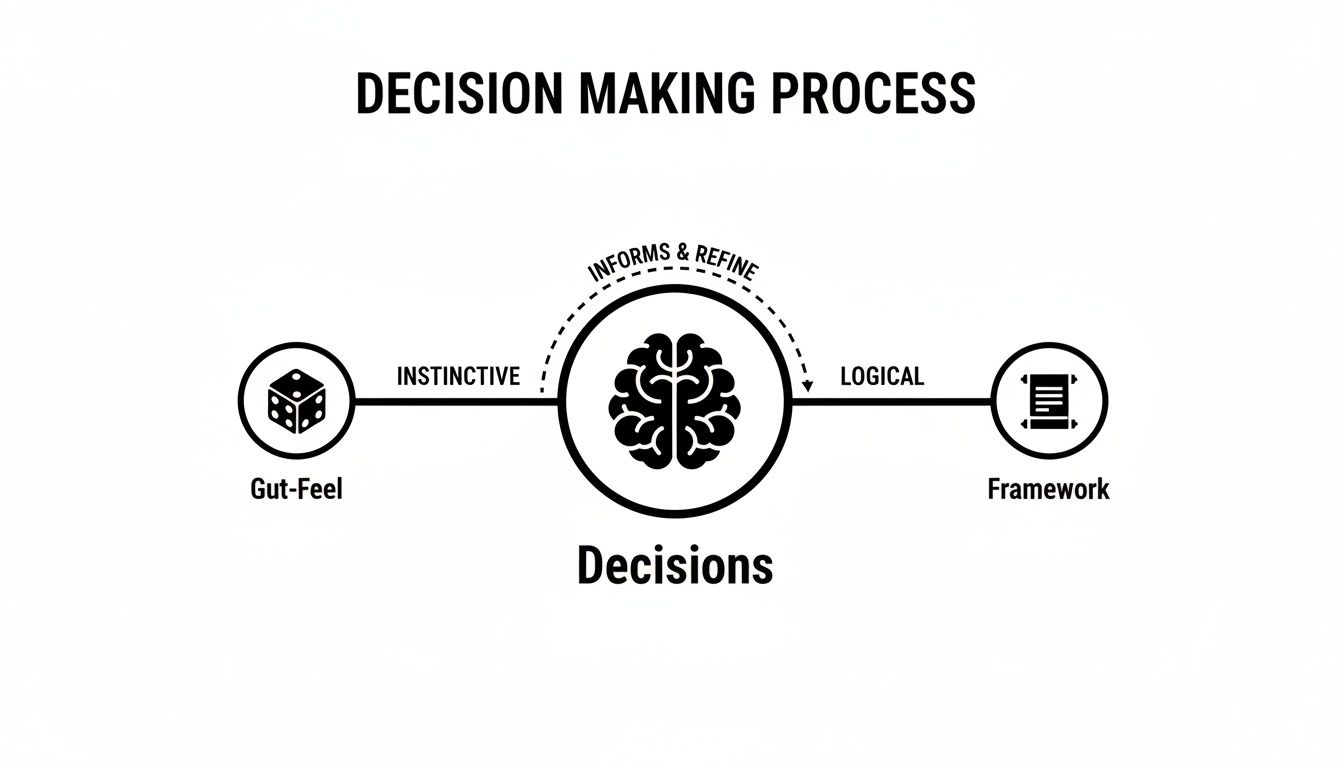
Here's the thing: frameworks don't replace your intuition. They give it structure, making your final call more robust and a hell of a lot easier to defend. Let's break down the four frameworks every PM should have in their back pocket.
RICE For Data-Driven Prioritization
The RICE framework is your go-to for injecting objectivity into the endless "what should we build next?" debate. It forces you to score potential features across four simple criteria, turning a subjective wishlist into a ranked, data-informed roadmap. It’s used widely at companies like Intercom, where it was invented.
The formula is simple: (Reach x Impact x Confidence) / Effort = RICE Score
Let's walk through a real-world example: You're a PM for a B2B SaaS tool and are considering building a new user onboarding flow.
- Reach: How many users will this feature touch in a given period? Your analytics (from a tool like Amplitude or Mixpanel) show you get 5,000 new user sign-ups per quarter. So, Reach = 5,000.
- Impact: How much will this move the needle on a key metric, like user activation rate? Score this on a scale: 3 for massive, 2 for high, 1 for medium, 0.5 for low. Based on past experiments, you believe this will have a high impact on activation. So, Impact = 2.
- Confidence: How sure are you about your Reach and Impact scores? Express this as a percentage. You have solid data on sign-ups but are less certain about the impact. You land on 80% confidence. So, Confidence = 0.80.
- Effort: How many "person-months" will this take from the team? Your engineering lead estimates it will take two engineers two months (4 person-months) and one designer for one month (1 person-month). So, Effort = 5.
Your RICE Score is: (5,000 x 2 x 0.80) / 5 = 1,600. Now you can compare this score against other potential features to make a prioritization call that you can defend with data.
The Cynefin Framework For Navigating Uncertainty
Developed by Dave Snowden at IBM, the Cynefin (pronounced ku-nev-in) framework isn't about finding the right answer. It’s about figuring out what type of problem you’re facing so you can respond in the right way. It sorts issues into five domains, stopping you from applying a simple checklist to a complex crisis.
- Clear (Obvious): The domain of best practices. Cause and effect are clear. Response: Sense, Categorize, Respond. Example: A user reports a typo on the pricing page. You create a ticket, assign it to the front-end team, and deploy a fix.
- Complicated: The domain of experts. There's a right answer, but it requires analysis. Response: Sense, Analyze, Respond. Example: A key A/B test on a new checkout flow returns inconclusive results. You bring in a data scientist to segment the data and identify confounding variables.
- Complex: The domain of emergence. There is no right answer, and you can only understand why something happened in retrospect. Response: Probe, Sense, Respond (run small experiments). Example: A new competitor like OpenAI launches a disruptive product in your market. You launch several small, fast product experiments to gauge customer reaction before committing to a large strategic response.
- Chaotic: Crisis mode. Your job is to stabilize the situation. Response: Act, Sense, Respond. Example: Your app's main database goes down during peak hours. You act first to bring the system back online using backups, then analyze the root cause later.
- Disorder: The dangerous state of not knowing which domain you're in.
Using Cynefin helps you avoid the classic PM mistake of applying rigid processes (like a simple bug-fix workflow) to complex strategic problems where they are guaranteed to fail.
The Eisenhower Matrix For Ruthless Focus
As a PM, you’re constantly drowning in requests. The Eisenhower Matrix is a dead-simple but incredibly powerful tool for getting your own productivity in order. It helps you escape the "urgency trap"—that tendency to focus on what's screaming loudest instead of what’s actually important.
It sorts all your tasks into four quadrants:
| Urgent | Not Urgent | |
|---|---|---|
| Important | Do First: Crises, pressing deadlines. (e.g., Preparing for a CEO review that's happening tomorrow) | Schedule: Strategic planning, relationship building. (e.g., Writing your Q4 product strategy doc) |
| Not Important | Delegate: Interruptions, some meetings. (e.g., Answering a routine query from sales that someone else can handle) | Delete: Trivial tasks, time-wasters. (e.g., Scrolling through internal social channels) |
The real goal is to spend as much time as possible in Quadrant 2 (Schedule), focusing on high-impact strategic work. By consciously sorting your tasks, you protect your most valuable resource: your attention. This is the quadrant where real product strategy gets done.
The SPADE Framework For High-Stakes Decisions
Created at Square and popularized by Gokul Rajaram, SPADE is built for the big, critical, often irreversible decisions. It ensures you have the right rigor and buy-in for choices with serious consequences. A perfect scenario for SPADE is the classic build vs buy software decision framework that so many product managers face.
Let's apply it to a decision to sunset a legacy product:
- Setting: What is the decision we’re making, in a single sentence? And why now? "We will decide whether to sunset the legacy desktop app by the end of Q3 to focus engineering resources on our new web platform."
- People: Who is involved? This means defining the single, accountable person making the call (the Decider), the people who must be consulted for input (like the Head of Eng and Head of Sales), and everyone who just needs to be informed of the outcome.
- Alternatives: What are our feasible paths? Brainstorm realistic, diverse options. For instance: (1) Sunset in Q3 with a forced migration, (2) Maintain it for 12 more months with no new features (maintenance mode), or (3) Invest in a migration tool to ease the user transition.
- Decide: The Decider gathers all the input from the consulted parties and makes the call. The decision and the rationale behind it must be documented.
- Explain: The decision is communicated to all stakeholders. This step is absolutely critical for alignment and making sure the team understands the why, even if they don't fully agree with the what.
SPADE turns what could be a political and emotional mess into a structured, transparent process for your most important decisions.
Framework Application Guide
To help you choose the right tool for the job, here's a quick comparison of when and where to use each of these four powerful frameworks.
| Framework | Primary Use Case | Key Metrics / Components | Ideal For (Decision Type) |
|---|---|---|---|
| RICE | Prioritizing features in a backlog or roadmap | Reach, Impact, Confidence, Effort | Data-driven prioritization: Deciding what to build next when you have multiple competing ideas and limited resources. |
| Cynefin | Classifying problem types to determine the right response | Clear, Complicated, Complex, Chaotic, Disorder | Situational analysis: Deciding how to approach a problem, from simple bug fixes to existential market threats. |
| Eisenhower Matrix | Managing personal and team tasks for maximum focus | Important vs. Unimportant, Urgent vs. Not Urgent | Time management & focus: Deciding where to spend your energy on a daily or weekly basis to avoid getting stuck in reactive mode. |
| SPADE | Making high-stakes, irreversible strategic decisions with a group | Setting, People, Alternatives, Decide, Explain | High-stakes strategic choices: Deciding on major directional shifts like sunsetting a product, entering a new market, or making a large tech investment. |
Ultimately, having these frameworks at your disposal means you're prepared for nearly any decision that comes your way, from the tactical to the transformational.
Putting Your Framework Into Action with Your Team
Knowing a framework is one thing; getting your team to actually embrace it is where the real work begins. A decision-making framework isn't just a spreadsheet for you to fill out in isolation. Think of it as a communication tool. Its success hinges entirely on your ability to get stakeholders and your engineering team on board.
The key is to frame it correctly right from the start. This isn't about adding another layer of bureaucracy. It’s a tool for clarity, objectivity, and speed. It's about ending those circular debates and replacing subjective opinions with a shared, logical process.
When you first introduce a framework, use direct, benefit-oriented language. Don't just announce a new process; explain the problem it solves for everyone.
"To bring more objectivity to our roadmap and ensure we're all aligned on the highest-impact work, we're going to trial the RICE framework for Q3. This will help us have more productive conversations and make faster, more defensible prioritization decisions."
This simple framing positions the framework as a solution, not another obstacle to get through.
Running the Implementation Playbook
Once you've set the stage, the practical mechanics of running the process become critical. A poorly managed rollout can kill a good framework before it even has a chance. Your goal is to make the process transparent, collaborative, and as low-friction as possible.
Here’s a step-by-step guide to get you started:
- Create a Shared Template: Whether you use Notion, Coda, or a simple Google Sheet, create a single source of truth. This template needs clear columns for each component of your chosen framework (e.g., Reach, Impact, Confidence, Effort for RICE).
- Schedule a Kickoff Meeting: Don't just send an email. Gather the core team—product, engineering lead, design lead—for a 30-minute session. Walk them through the template, explaining what each input means and who is responsible for providing it.
- Assign Data Gathering: Clearly delegate who owns what. The PM is responsible for sourcing Reach and Impact data from tools like Amplitude or Mixpanel. The engineering lead is accountable for providing Effort estimates, often using a planning poker or t-shirt sizing exercise with the dev team.
This division of labor makes sure the inputs are credible and builds shared ownership over the final scores. It becomes a team effort, not just another PM exercise.
Gathering Inputs and Communicating the Outcome
The data-gathering phase is where the magic of collaboration really happens.
When estimating Effort, don't just ask for a number. Work with your engineering lead to really understand the technical complexity. A great question to ask is, "What are the biggest risks or unknowns that could make this take longer than we think?"
For metrics like Reach or Impact, ground them in reality. Pull actual data from your analytics platform to show how many users perform a specific action today. This removes the guesswork and anchors the entire conversation in objective facts.
Once all the data is in and the framework has produced a ranked list, the final step is to communicate the decision. This is where many PMs fall short.
- Share the 'Why': Don't just announce the top-ranked feature. Share the completed framework template with the entire team and relevant stakeholders. Take the time to explain why certain initiatives scored higher than others.
- Acknowledge Trade-offs: Be explicit about what you are not doing. For example, "Based on the scoring, we're prioritizing the new onboarding flow. This means the proposed dashboard redesign will be pushed to the next cycle because its Reach score was significantly lower."
- Connect to Goals: Always tie the final decision back to the team's OKRs or the company's strategic goals. This reinforces that the framework isn’t just for ranking a list; it’s a tool to achieve what truly matters.
Effectively managing these cross-functional dynamics is a core PM skill. If you're looking to strengthen this area, our guide on cross-functional team management offers deeper, actionable strategies. By making the process inclusive and the rationale transparent, you build the trust and buy-in needed to execute with conviction.
The Hidden Biases That Break Even the Best Frameworks
A well-crafted decision-making framework can feel like a suit of armor—logical, protective, and seemingly objective. But we have to remember who's inside that armor: a human. Even the most disciplined PMs at Netflix or Amazon are susceptible to the cognitive biases that can quietly sabotage the most well-structured process.
Frameworks are tools for thinking, not a replacement for it.
Understanding the behavioral science behind how we decide is a massive competitive advantage. The entire field shifted in the 20th century, moving away from the old assumption that people were purely rational actors. It started with Herbert Simon's Nobel-winning concept of 'bounded rationality' in 1957, which acknowledged that we humans are limited and tend to 'satisfice'—pick the good-enough option—rather than perfectly optimize.
The real game-changer, though, came in 1979. Daniel Kahneman and Amos Tversky published their groundbreaking Prospect Theory, which used cold, hard experimental data to systematically prove just how consistently irrational our choices can be.
To protect your decisions, you have to understand the enemy within.
Confirmation Bias: The Echo Chamber of Your Own Ideas
Confirmation bias is our pesky habit of favoring information that confirms what we already believe and conveniently ignoring data that doesn't. As a PM, it's easy to fall in love with your own ideas. You latch onto the five-star reviews praising your new feature and brush off the bug reports as unfortunate edge cases.
- Product Example: You’ve been championing a new AI-powered recommendation engine for an e-commerce site. During user testing, three out of five users find it confusing, but two absolutely rave about it. Confirmation bias has you over-indexing on the positive feedback. You tell stakeholders, "We're seeing some really powerful early signals," while glossing over the fact that a majority of testers were lost.
- Debiasing Technique: Make it a rule to actively seek out disconfirming evidence. Before any big decision, ask your team point-blank, "What data or feedback would prove this idea is wrong?" This simple question reframes the entire conversation from validation to critical evaluation. It's also a great time to re-examine the underlying assumptions about the user problem.
Loss Aversion: The Fear of Sunsetting a Failure
Loss aversion is a psychological quirk where the pain of losing something feels about twice as powerful as the pleasure of gaining something of equal value. This is exactly why teams are terrified to sunset a failing feature they've poured months into. That "sunk cost" feels too painful to abandon, even when all the data screams it's a dead end.
- Product Example: A feature launched six months ago has terrible adoption and is piling up technical debt. Instead of killing it, the team proposes a "v2" to "fix" the problems. They're about to throw good money after bad, purely to avoid the bitter taste of failure.
- Debiasing Technique: Run a "pre-mortem." Before a project even kicks off, get the team in a room and have them imagine it has failed spectacularly in six months. Then, have everyone write down all the reasons why. This exercise normalizes the possibility of failure and surfaces risks early, making it psychologically easier to cut your losses later on.
Anchoring Bias: The Power of the First Number
Anchoring bias happens when we get stuck on the first piece of information we hear. That initial data point—whether it's an executive's off-the-cuff remark ("This should only take two weeks") or a flawed early estimate—becomes an anchor that drags all subsequent judgments toward it.
"Be definite in your goals but flexible in your approach." – John Wooden
- Product Example: The CEO mentions a competitor's $10 million revenue from a similar feature. That number is now anchored in everyone's mind. It shapes the entire business case, even if your market, resources, and user base are completely different. The team becomes fixated on hitting that $10 million target instead of finding the right solution for your customers.
- Debiasing Technique: Deliberately introduce new anchors and challenge the initial one. Ask, "If we had zero information, how would we size this opportunity from scratch?" You can even assign someone the official role of "devil's advocate" whose job is to poke holes in the primary anchor, forcing a more objective re-evaluation.
The Origins of Modern Product Decision Making
To really get a handle on any decision-making framework, you need to know where it came from. The systems you use to stack-rank your backlog today weren’t dreamed up in a Silicon Valley boardroom. Their DNA can be traced back to 17th-century gambling dens and tense Cold War strategy rooms.
This history isn’t just trivia. It gives you a much deeper feel for why these frameworks actually work, and it's your secret weapon when you have to defend a tough strategic call.
It all started with a simple problem of chance. Back in the mid-1600s, two mathematicians, Blaise Pascal and Pierre de Fermat, started writing letters to solve a gambler's puzzle about how to fairly split the pot in a game that gets interrupted.
Their breakthrough in 1654 laid the groundwork for probability theory. More importantly for us, it introduced the concept of expected value—a core principle PMs still use every single day to weigh the potential upside of a new feature. You can find more on how historical game theory shapes modern business on Symbio6.
This one idea—that you could mathematically weigh uncertain future outcomes—was a massive leap. It was the first real attempt to put numbers to risk and reward.
From Gambling Tables to Global Strategy
Fast forward a few hundred years to the Cold War, and this concept got a serious upgrade. In 1944, mathematician John von Neumann and economist Oskar Morgenstern published "Theory of Games and Economic Behavior." This book formalized rational choice theory, which is pretty much the bedrock of modern economics and product strategy.
Game theory gave us a mathematical language to analyze situations where a bunch of different players are making decisions that all affect each other. Sound familiar? It’s basically a Tuesday for any Product Manager. The theory works on the assumption that people, when faced with choices, will pick the option that gets them the most of what they want.
Von Neumann and Morgenstern didn't just invent a new field. They handed us a structured way to think about strategy, conflict, and cooperation when you don't know what's going to happen next.
This was a game-changer. It took decision-making out of the realm of pure gut instinct and into a structured, analytical process. It gave leaders a way to model everything from military standoffs to market competition by breaking them down into players, strategies, and payoffs.
Why This Matters for Your Next Stand-Up
So, what does 17th-century gambling have to do with your daily stand-up? Everything.
When you use a RICE score to prioritize a feature, you're using Pascal's concept of expected value. When you map out how competitors might react to a price drop, you're deep in the world of game theory.
Understanding these roots gives you two huge advantages:
- Deeper Intuition: You get a much better feel for the logic behind the frameworks. You realize they aren’t just arbitrary rules but are built on centuries of hard-nosed mathematical and strategic thinking.
- Greater Credibility: When you can explain the why behind your process, you build massive credibility with your team and with leadership. You’re not just plugging numbers into a spreadsheet; you’re applying a rigorous, battle-tested method for cutting through uncertainty.
This foundation is what turns your recommendations from opinions into strategic arguments that are almost impossible to ignore.
The Future: Using AI to Augment Your Decision-Making
The next leap for product leaders isn't about letting algorithms take the wheel. It’s about using artificial intelligence to sharpen our strategy, turning the decision-making frameworks we already use into supercharged engines for clarity and speed. For PMs, especially those working on AI products (a role where salaries at places like Anthropic can exceed $300k+), this is a non-negotiable skill.
Think of AI as a tireless junior PM on your team—one who can read, synthesize, and analyze data at a scale no human ever could. This completely changes the game for the inputs you feed into your frameworks, making your conclusions far more accurate and robust.
Supercharging Your Framework Inputs with AI
Instead of manually sifting through a small sample of user feedback or just going with your gut, you can now feed thousands of data points into a Large Language Model (LLM). This transforms the quality of information you start with.
- For the RICE Framework: Estimating "Impact" is often a biased, gut-feel exercise. Now, you can use an LLM to analyze thousands of support tickets from Zendesk, app store reviews, and sales call transcripts from Gong in minutes to generate a data-backed impact score.
- For the SPADE Framework: The "Alternatives" phase can be limited by groupthink. An LLM can rapidly brainstorm a much wider, more creative set of potential solutions, pushing your team to consider paths they might have otherwise missed.
The whole field of AI software engineering is changing how products get built, and product management is right at the center of this shift.
Tactical AI Prompts for Better Decisions
The key is to treat AI tools like ChatGPT-4o or Claude 3 Opus as a collaborator. You can get a huge leg up by giving them a specific role and a clear task. Here are a couple of prompts you can copy and paste today.
Prompt for RICE Impact Scoring:
"Act as a senior product manager at a B2B SaaS company specializing in project management tools. I will provide you with 500 user reviews from G2 and the Apple App Store. Your task is to:
- Analyze the sentiment of all reviews.
- Identify the top 5 most frequently requested features or improvements.
- For each of the 5 features, provide a quantitative Impact score on a scale of 0.5 (low) to 3 (massive) that could be used in a RICE framework.
- Justify each score with 2-3 direct quotes from the provided user reviews.
Here are the reviews: [paste reviews]"
This prompt turns a multi-day analysis project into a task you can complete in under an hour. You get a scored, justified output that plugs directly into your RICE sheet.
Prompt for SPADE Alternative Brainstorming:
"We are a mid-stage startup deciding whether to sunset our legacy desktop app. Our current alternatives are: 1) Sunset in Q3, 2) Maintain for 12 more months with no new features, 3) Invest in a migration tool.
Act as a product strategist who has experience with major product transitions at companies like Adobe and Microsoft. Generate 5 more creative and feasible alternatives we should consider. For each alternative, include potential pros, cons, and the key assumption we would need to validate for it to be successful."
This approach taps into the LLM’s ability to think divergently, making sure you’ve explored the entire decision space before you narrow in on a final choice. For more practical ways to get started, check out our guide on the top AI tools for product managers.
Frequently Asked Questions
Here are some quick, practical answers to the questions I hear most from PMs trying to put decision-making frameworks into practice. My goal here is to get you unstuck and moving.
How Do I Convince My Team to Adopt a New Framework?
The key is to frame it as a tool for clarity and speed, not just another layer of bureaucracy. Whatever you do, avoid a top-down mandate. That's a recipe for resentment.
Instead, propose a small, contained trial. You could say something like, "Hey team, let's try out the RICE framework for our next two sprints. My hunch is it could help us align on priorities faster and cut down on those endless debate meetings." This focuses on the shared benefit—making objective, data-informed decisions everyone can get behind.
Once the team sees a framework actually clearing roadblocks and making their lives easier, they'll be asking to use it.
What Is the Biggest Mistake PMs Make with Frameworks?
Easy. The single biggest mistake is treating the framework's output as an absolute truth instead of an informed guide. A framework is there to structure your thinking, not replace it.
Never, ever blindly follow the numbers spit out by a spreadsheet. You have to layer your own product sense, customer empathy, and qualitative insights on top of any score. If the top-scoring feature from your RICE analysis just feels wrong from a strategic standpoint, that's a signal to dig deeper, not to blindly follow the math.
A framework provides the science; your product intuition provides the art. The magic happens when you combine them. The framework’s output is the beginning of the conversation, not the end.
Which Framework Is Best for an Early-Stage Startup?
For an early-stage startup, it’s all about speed and focus. The best bet is usually a combination of two lightweight frameworks that won't bog you down.
- For your personal focus: The Eisenhower Matrix is perfect. It helps you ruthlessly prioritize your own daily and weekly tasks so you can protect your time for what actually matters: talking to customers and defining the product.
- For feature prioritization: A simplified ICE (Impact, Confidence, Effort) model gives you just enough structure without the overhead of calculating precise Reach numbers, which are often unknown pre-product-market fit.
These tools work so well in a startup environment because they're simple to use and don't require months of data gathering. They're built for the fast-paced, resource-constrained reality of building something new.
Ready to stop guessing and start leading with conviction? At Aakash Gupta, we provide the frameworks, insights, and expert guidance you need to accelerate your product career. Dive deeper into strategies used by top PMs by visiting https://www.aakashg.com.
