The Product Owner is the single individual accountable for maximizing the value of the product resulting from the work of the Development Team. Think of them as the CEO of the product backlog. In a world where engineering time is a company's most expensive asset, the PO's job is to ensure every single sprint delivers maximum ROI. They are the tactical commanders translating a Product Manager's strategic "why" into a development team's executable "what."
For aspiring and practicing PMs, mastering the PO function is non-negotiable. It’s where strategic vision meets the harsh reality of a two-week sprint. It’s the difference between a roadmap that gathers dust and a product that ships. This guide provides the frameworks and actionable steps to excel in this role, whether you hold the title or simply need to master its skills to advance.
What Is a Product Owner
Let’s get tactical. A great Product Owner is the on-set director for a film, while the Product Manager is the executive producer. The producer (PM) secures the budget, defines the overall story, and sells the vision. The director (PO) is on set every day, working with the cast and crew (engineers), making shot-by-shot decisions to ensure the final cut matches the vision. This hands-on leadership is the engine of high-performing agile teams at companies from Google to early-stage startups.
The role was formally defined within the Scrum framework by Jeff Sutherland and Ken Schwaber to solve the chronic disconnect between business stakeholders and development teams. As Sutherland noted, a dedicated PO, embedded with the engineering team, was the only way to ensure the right product got built. You can get the full origin story from this in-depth analysis on product roles.
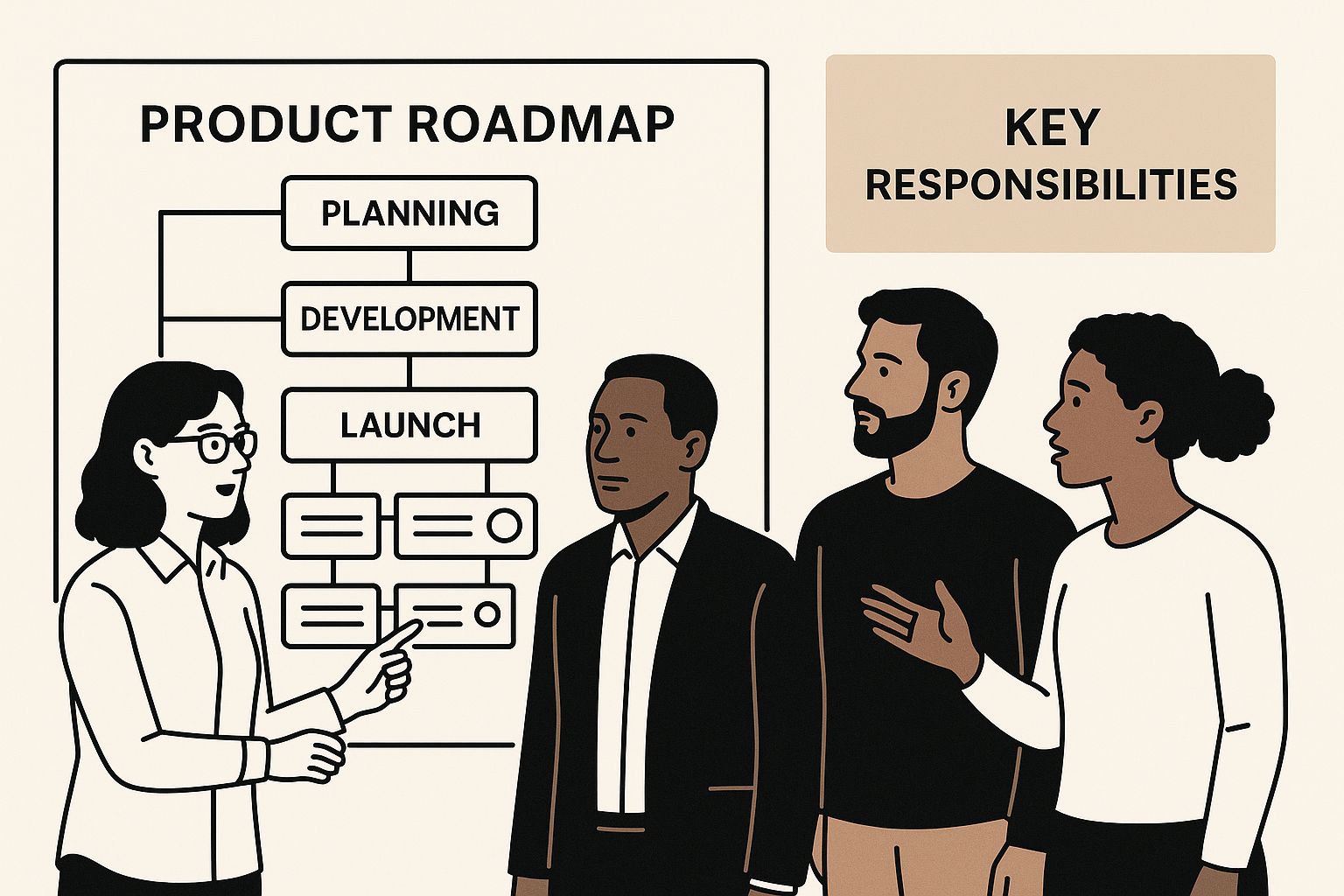
This mandate breaks down into three core pillars of responsibility, defining both their daily work and their strategic focus.
The Three Pillars of Product Ownership
To excel as a Product Owner, you must master three domains that connect product vision to shipped code. Each pillar requires a distinct skill set, from high-level strategic thinking to precise tactical execution.
- Pillar 1: Maximize Business Value: The PO is obsessed with ROI. They constantly ask, "Of all the things we could build next sprint, what will create the most measurable value for the customer and the business?" This involves deep customer empathy, sharp market analysis, and a ruthless focus on outcomes over output. A PM at Meta might set a quarterly goal to "Increase ad engagement by 5%"; the PO determines the specific features (e.g., "A/B test new CTA button design") that will hit that number.
- Pillar 2: Own the Product Backlog: The backlog is the PO’s primary strategic tool. They are solely responsible for creating, maintaining, and prioritizing this living artifact. This isn’t just ticket writing; it’s the art of crafting crystal-clear user stories with unambiguous acceptance criteria that engineers can execute on. To see this in action, review these examples of user stories with acceptance criteria.
- Pillar 3: Align Stakeholders & the Team: The PO is the central communication hub. They are the voice of the business to the engineering team and the voice of the engineering team to the business. This includes customers, executives, marketing, and sales. Their job is to create clarity and ensure everyone understands priorities, progress, and trade-offs.
The Product Owner role is often misunderstood. It's not project management or ticket-taking. To clarify its strategic importance, here’s a breakdown of the core mandate versus common misconceptions.
Product Owner Core Mandates vs Common Misconceptions
| Core Mandate | What It Means In Practice | Common Misconception |
|---|---|---|
| Value Maximizer | Ruthlessly prioritizes work based on business impact and customer needs. The focus is on outcomes (e.g., +2% conversion) not output (e.g., shipped 5 features). | Project Manager (focused on timelines and resources, not value) |
| Voice of the Customer | Deeply understands user problems through interviews, data, and feedback, advocating for their needs in every sprint planning session. | Scribe or Ticket Writer (passively transcribes requests from others) |
| Backlog Owner | Strategically manages a prioritized list of work that reflects the product vision and adapts to new information. The backlog is a dynamic tool. | Requirements Gatherer (collects a list of wants without strategic filtering) |
| Decision Maker | Is empowered to make the final call on backlog priority to maintain team velocity and focus. | Order Taker (defers to the loudest voice or highest-paid person's opinion) |
Ultimately, a Product Owner isn’t just a role; they are the strategic linchpin ensuring an expensive engineering team is always building what matters most.
The Three Product Owner Maturity Levels
Not all Product Owners are created equal. The path from a junior PO to a strategic leader is a critical career ladder for any aspiring product professional. Your level of influence directly correlates with your team's success—and your salary.
This isn't just theory. Analyses from organizations like Scrum.org have tracked this evolution for years. Data consistently shows that when POs are empowered to operate strategically (Level 3), teams report significantly higher product-market fit and deliver more impactful products.
Here is the three-level framework I use when coaching Product Owners. Identify where you are and what it takes to get to the next level.
Level 1: The Scribe
This is the entry-point, often found in large companies transitioning to agile. The Scribe is primarily a translator and ticket manager.
- Core Function: Translates requests from business units into well-formed tickets in a tool like Jira.
- Authority: Minimal. They manage the backlog but don't truly own prioritization. They lack the power to say "no" to stakeholders.
- Career Reality: This role is a foot in the door but caps out quickly. Salary for this level, often titled "Associate Product Owner" or similar, typically ranges from $70k – $95k in the US market.
Level 2: The Proxy
The Proxy is a step up, acting as a gatekeeper and representative for a more senior product leader.
- Core Function: Filters, clarifies, and bundles requests from stakeholders before they reach the engineering team. They can push back on low-value items but defer to a Product Manager for major strategic decisions.
- Authority: Moderate. They can make sprint-level priority calls but require sign-off for anything that impacts the quarterly roadmap.
- Career Reality: This is a common mid-level position. POs here earn in the $95k – $125k range. To advance, they must demonstrate the ability to think beyond the current sprint and contribute to the strategic roadmap.
Level 3: The Strategist
This is the ultimate goal. The Strategist is a business leader for their product domain, common at product-led companies like Netflix or Spotify.
- Core Function: Owns the "what" and "when" for their product area, directly translating business outcomes into a prioritized backlog. They are obsessed with metrics and customer feedback.
- Authority: High. They are empowered to define the work of the development team to achieve the strategic goals set by the Product Manager.
- Career Reality: This is a senior, high-impact role. Senior Product Owners operating at this level often command salaries of $125k – $170k+ and are on a direct path to Principal PM or Group PM roles.
As you can see, the Strategist sits at the center, ensuring every sprint and every feature directly serves a measurable business objective.
Product Owner vs Product Manager Explained
This is the most persistent point of confusion in the product world. Companies often use the titles interchangeably, but for career progression, the distinction is critical. In top-tier tech companies, these are distinct roles with different focuses.
Here's the framework: the Product Manager is accountable for the product's success in the market. The Product Owner is accountable for the development team's success in building the right product.
Let's use a real-world example. A Product Manager at Google working on a new AI feature for Google Photos spends their time on market research, competitive analysis, P&L responsibility, and building a 12-month strategic roadmap to get executive buy-in.
The Product Owner takes that 12-month vision and translates it into a prioritized backlog for the next three sprints. They are in daily standups with engineers, defining acceptance criteria for a new image-tagging algorithm, and making the trade-off decision about whether to fix a bug or finish a new story this week.
A Practical Side-By-Side Comparison
Forget abstract Venn diagrams. Here is a tactical breakdown you can use to clarify your responsibilities or interview for your next role. While there's overlap, the primary focus and time horizon are fundamentally different.
"From a true Scrum standpoint, the PO is more tactical and the PM is more strategic. If you don’t have a PM, the PO is responsible for the strategic and tactical product work."
This highlights how company structure dictates the role. In a pure Scrum environment, the line is clear. In a 50-person startup, one person does both.
The table below maps the core differences. To go deeper, check out our detailed guide on the difference between a Product Owner and a Product Manager.
Role Breakdown Product Owner vs Product Manager
| Dimension | Product Manager (The Strategist) | Product Owner (The Executor) |
|---|---|---|
| Time Horizon | Long-term (6-18 months). Focus on market vision, strategic roadmap, and business viability. | Near-term (2-4 weeks). Focus on sprint execution, feature delivery, and backlog management. |
| Primary Audience | Executives, the market, and external stakeholders. They communicate the business case and product vision. | The development team. They provide daily guidance and ensure sprint goals are met. |
| Key Artifacts | Product roadmap, business case, market requirements document (MRD), P&L statements. | Product backlog, user stories, acceptance criteria, sprint burndown charts. |
| Core Metrics | Business KPIs: Revenue, market share, customer lifetime value (CLV), adoption rates. | Delivery Metrics: Sprint velocity, cycle time, story points completed, bug rates. |
One role steers the ship toward a profitable destination (PM). The other is on the deck, ensuring the engine runs efficiently and the ship is moving forward, sprint by sprint (PO). Both are critical.
A Day in the Life of a Great Product Owner
To understand the role, let's follow a PO at a high-growth SaaS company. This isn't just about attending meetings; it's a masterclass in context-switching, communication, and ruthless prioritization.
Morning: Tactical Alignment & Stakeholder Management
- 9:00 AM – Daily Stand-up: The day kicks off with the dev team. The PO isn't a spectator; they’re an active participant. An engineer is blocked on an API dependency. The PO immediately pings the partner team on Slack to resolve it, preventing a one-hour blocker from becoming a one-day delay.
- 10:00 AM – Stakeholder Sync: Meeting with the Head of Sales. He needs a specific feature for a key enterprise deal closing this quarter. Instead of a simple "yes" or "no," the PO pulls up the current roadmap in Jira. They explain the trade-offs: "We can prioritize this, but it means delaying the self-service onboarding flow, which impacts our Q3 lead-gen goals. Can the deal close with a workaround for now?" This reframes the conversation around business impact, not just a feature list.
Afternoon: Strategic Execution & Future Planning
- 1:00 PM – Backlog Refinement (Grooming): The PO and two senior engineers are in a huddle room (or Miro board) breaking down an epic for the next sprint. They are debating the technical approach and collaboratively writing user stories. A great PO doesn't dictate solutions; they articulate the user problem so clearly that the engineers can devise the best solution. This is a core tenet of building high-performing teams.
Pro Tip: When a feature request comes in, use this prompt with ChatGPT-4 to start framing it for your team: "I am a Product Owner. A stakeholder wants to 'add a dashboard to our app.' The user is a [user persona], and their primary goal is to [user goal]. Generate 3-5 user stories for this feature, following the 'As a [user], I want to [action], so that [benefit]' format. Include potential acceptance criteria for each story."
- 3:00 PM – Deep Work on Prioritization: The sales request has created new dependencies. The PO blocks off 90 minutes to re-evaluate the backlog. Using a framework like RICE (Reach, Impact, Confidence, Effort), they re-score the top 10 items to ensure the team is still working on the highest-value initiatives. This skill is so critical we wrote a whole guide on how to prioritize a roadmap.
- 4:30 PM – Sprint Demo Prep: The PO connects with the QA lead to review features completed in the current sprint. They're not just checking for bugs; they're crafting a narrative for the Sprint Review. The goal is to demonstrate the customer value delivered, tying the shipped code back to the original business objectives.
Where Did the Product Owner Role Come From Anyway?
Understanding the origin of the Product Owner role is key to grasping its purpose. It wasn't invented to add bureaucracy; it was created to solve a multi-billion dollar problem: the gap between the people building the product and the people using it.
This concept isn't new. Its DNA traces back to a famous 1931 memo by Neil H. McElroy at Procter & Gamble. He created the "brand man" role—a single person with total responsibility for a product, from market research to sales. You can read more about this history over at Mind the Product. This revolutionary idea forced one person to be utterly obsessed with the customer and the business results.
An Agile Fix for a Classic Problem
Decades later, the founders of the Agile Manifesto faced the same issue in software. Development teams, isolated from users, were building products based on stale requirements documents. Projects failed not because of bad code, but because they delivered something nobody wanted.
The Product Owner role was born to be the team's dedicated, on-the-ground customer expert. Their whole job is to make sure the developers are always, always working on the most valuable thing, closing that feedback loop between the builders and the users.
This history matters. It proves that the PO is not a project manager or a ticket-writer. They are the modern embodiment of the "brand man," empowered to guide the development team toward value. When you step into this role, you inherit that legacy of ownership and customer obsession.
Common Questions About the Product Owner Role
Let's address the most common questions I get from both aspiring and practicing PMs. These are the real-world challenges that define your effectiveness in the role.

Can One Person Be Both Product Manager And Product Owner?
Yes, in a startup. No, in a large enterprise.
In a 30-person startup, the CEO or a single Head of Product wears both hats out of necessity. You define the 12-month vision in the morning and write user stories in the afternoon.
But at a company like Microsoft or Salesforce, attempting to combine these roles is a recipe for burnout and failure. The strategic work of a PM (market research, P&L, roadmapping) and the tactical work of a PO (daily stand-ups, backlog grooming, acceptance criteria) are two distinct, full-time jobs. When one person tries to do both at scale, the strategic, long-term work is inevitably sacrificed for the urgent fires of the current sprint.
What Are The Essential Tools For A New Product Owner?
Don't get overwhelmed. Start by mastering one tool in each of these three categories. Here are my recommendations:
- Backlog Management: Jira is the industry standard and you must know it. However, many modern engineering teams at companies like Vercel and Ramp are moving to Linear for its speed and developer-friendly UX.
- User Feedback & Analytics: You need data. Amplitude is the gold standard for product analytics to understand what users are doing. Pendo is excellent for in-app guides and collecting qualitative feedback.
- Roadmapping & Strategy: You must communicate the "why." Productboard and Aha! are purpose-built for connecting customer feedback to strategic roadmaps and sharing them with stakeholders. A simple Miro or Figma board also works well for leaner teams.
How Do I Transition From Business Analyst To Product Owner?
This is a natural and common career path. The entire transition hinges on shifting your mindset from documenting requirements to owning outcomes.
Here is your 3-step action plan:
- Get Certified (and Learn the Language): Earn a respected certification like the Professional Scrum Product Owner I (PSPO I) from Scrum.org (Cost: ~$200). This isn't just for a resume line; it teaches you the official language and framework of Scrum, which is crucial for credibility.
- Move from "How" to "Why": As a BA, you focus on defining how a feature should work. Start forcing yourself to answer why it should be built at all. For every request you get, ask: "What user problem does this solve, and how will we measure success?" This is the fundamental PO mindset.
- Own a Small Product Area: Volunteer to be the designated PO for a small feature, a bug-fix initiative, or an internal tool. This gives you direct experience in prioritizing a backlog, communicating with stakeholders, and being accountable for the team's output. Document the business impact you achieved and use that as a case study for your next internal or external role.
At Aakash Gupta, we focus on providing the specific frameworks and career guidance you need to move from tactical execution to strategic leadership. Explore our resources to accelerate your product career.
