As a Product Manager, your roadmap is your single most important communication tool. Forget abstract definitions—your roadmap is the strategic GPS that translates high-level company vision into an actionable plan your team can execute. It’s not a feature list or a project plan with rigid dates. It’s the artifact that proves you’re a strategic leader, not just a feature factory manager.
At Google and Meta, I saw firsthand that the most effective PMs—the ones who got promoted—were masters of the roadmap. They used it to align the C-suite, engineering, and sales around a single, compelling narrative of what we are building and why it matters. Getting this right is a non-negotiable career skill.
Your Roadmap Starts Here: The Actionable Framework

Without a clear roadmap, teams descend into chaos. Engineers build features that don't solve user problems, marketing promotes vaporware, and leadership loses confidence. I've seen teams waste up to 30% of their engineering cycles on misaligned work—a catastrophic loss in a competitive market. A well-crafted roadmap is your defense against this chaos.
Roadmap vs. Backlog: The Critical Distinction for PMs
One of the first traps for aspiring PMs is confusing the roadmap with the backlog. This mistake immediately signals a junior mindset and will kill your credibility with both engineers and executives. The roadmap is your strategic "why"; the backlog is your tactical "how."
A great roadmap focuses on outcomes, not outputs. It communicates the problems you intend to solve for customers and the business value you expect to create, rather than simply listing features to be built.
As an experienced PM leader who has hired dozens of PMs, getting this right is table stakes. You must be able to switch context seamlessly—talking strategy with your GM and sprint priorities with your engineering lead. This table is your cheat sheet.
Here's a straightforward breakdown of the key differences:
| Attribute | Product Roadmap | Product Backlog |
|---|---|---|
| Purpose | Communicates strategic direction, the "why," and business outcomes. | A prioritized list of tasks (user stories, bugs) for the dev team. |
| Audience | Executives, stakeholders, the entire company. | Development team, Product Owner, Engineering Manager. |
| Timeframe | Medium to long-term (quarters, year). Often uses Now-Next-Later. | Short-term (sprints, weeks). |
| Detail Level | High-level themes tied to company goals (OKRs). | Granular, detailed user stories with acceptance criteria. |
| Flexibility | Stable but adaptable to market shifts and new data. | Highly dynamic, changes daily or weekly. |
This distinction is crucial. The roadmap is your tool for strategic alignment and securing investment. The backlog is for execution. While the traditional roadmap is a powerful tool, it's also important to understand alternative viewpoints, such as why leaders actually ditch roadmaps to build scalable businesses.
A well-defined roadmap ensures every user story in the backlog traces back to a strategic objective. To see detailed examples of how this connection works, explore our deep dive into product management roadmaps.
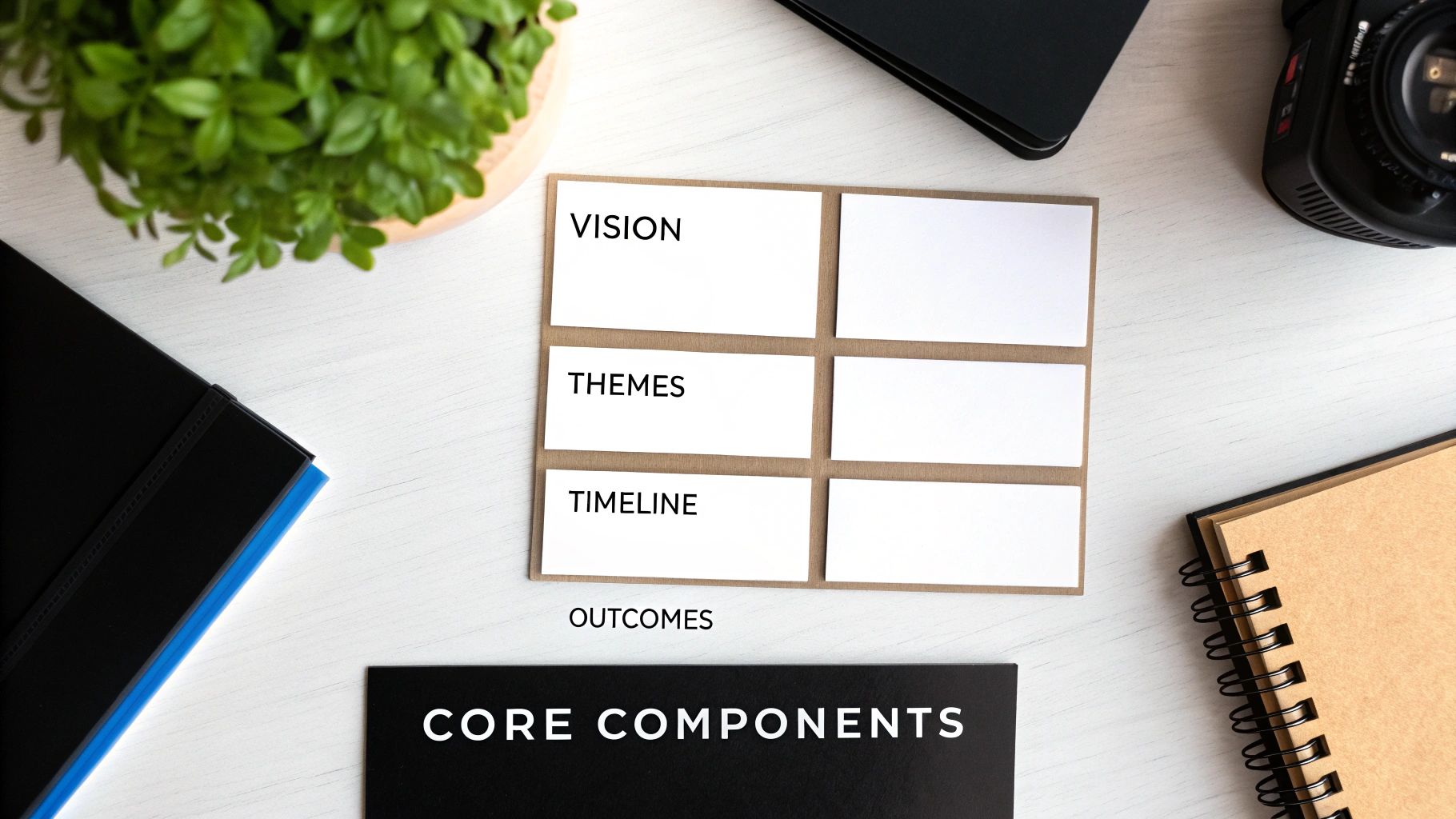
The Four Core Components of an Effective Roadmap
A roadmap is more than just a list of features on a timeline. When I'm interviewing PMs for roles at places like Google or OpenAI, I'm not looking for a project manager. I'm looking for a strategic storyteller. A powerful roadmap doesn't just list what you're building; it tells a compelling narrative about why it matters to the customer and the business.
This story is built on four foundational pillars. Get these right, and you'll command respect in any executive review.
The Why: Vision and Strategy
Every initiative on your roadmap must have a clear "so what?" It must directly support a top-level company objective (OKR). If you can't draw this line in the sand, the initiative has no business being on your roadmap. This is your primary defense against pet projects and random feature requests from sales or executives. When a stakeholder asks to add something, your first question isn't "when?" but "which company OKR does this accelerate?" This elevates the conversation from tactical feature-stuffing to strategic impact.
Themes: Grouping Work Strategically
Next, you must graduate from listing individual features. Group related work into strategic themes—high-level customer problems or business opportunities. This shifts the focus from output ("ship feature X") to outcomes ("improve user onboarding").
Here’s a practical example from an AI product:
- Weak Roadmap (Feature List):
- Integrate GPT-4 Turbo
- Add a prompt history feature
- Build a results summarizer
- Strong Roadmap (Theme-Based):
- Theme: Enhance AI-Powered Analysis for Enterprise Users
- Initiatives: Advanced model integration, contextual conversation history, automated insight summaries.
The theme-based approach communicates strategic intent. It empowers your engineering team to solve the core problem, rather than just mechanically checking off a feature list.
A theme-based roadmap frames your work around solving customer problems, not just shipping features. This simple shift is critical for fostering an outcome-driven culture and gaining strategic buy-in from leadership.
Timelines: Flexible Horizons, Not Rigid Deadlines
One of the biggest mistakes aspiring PMs make is treating a roadmap like a Gantt chart. This sets you up for failure and erodes trust. The moment a technical challenge arises, your brittle plan shatters.
Modern, agile roadmaps use flexible time horizons. The industry standard, used at companies from startups to Google, is Now, Next, Later.
- Now: What the team is actively developing this quarter. High confidence, well-defined scope.
- Next: What's planned for the following quarter. Medium confidence, scope is being finalized.
- Later: Big ideas for the second half of the year. Low confidence, represents opportunities for future exploration.
This framework builds flexibility and honest communication directly into your plan.
Outcomes: Defining Success with KPIs
Finally, every theme must have a clear, measurable definition of success. How will you know if your "Enhance AI-Powered Analysis" initiative was successful? You must tie it to Key Performance Indicators (KPIs).
For each theme, define a primary outcome metric.
- Theme: Enhance AI-Powered Analysis for Enterprise Users
- Outcome KPI: Increase the adoption of AI analysis features by paying customers by 25% QoQ.
This component makes your roadmap's value undeniable. It transforms review meetings from status updates into strategic discussions about business impact. For a deeper look into structuring your planning, explore these product roadmap best practices that can help you implement these components effectively.
Different Roadmaps for Different Audiences: A PM's Playbook
A single roadmap never gets the job done. A classic junior PM mistake is creating one master document and showing it to everyone. You wouldn't show a detailed sprint plan to your CEO, and you wouldn't show a high-level strategic vision to an engineering team deep in execution mode.
Great product managers are master communicators. This means tailoring the artifact to the audience. Your ability to present the right information at the right level of detail is what separates a good PM from a great one. This is your playbook for crafting the perfect roadmap for every conversation.
The Theme-Based Roadmap for Executive Alignment
Your C-suite and board care about market share, revenue, and competitive moats. A feature list is just noise. For this audience, your go-to is the Theme-Based Roadmap. It groups work into strategic buckets tied directly to company OKRs.
- Primary Audience: C-Suite, Board of Directors, VPs.
- Ideal Level of Detail: High-level themes focused on the "why" and business outcomes.
- Time Horizon: Quarterly or semi-annually, using a Now, Next, Later format to avoid commitment to specific dates. For a deep dive, check out our guide on the Now-Next-Later roadmap.
Example themes for an AI company might be "Achieve State-of-the-Art Model Performance" or "Drive Enterprise Adoption." Each theme would include the key outcome, e.g., "Reduce model error rate by 15%."
The Release Plan Roadmap for Cross-Functional Coordination
While executives need the "why," your peers in engineering, marketing, and sales need the "what" and "when." They execute the strategy and need a tactical view to align their work. This is where the Release Plan Roadmap is essential.
It breaks down themes into epics or major features and provides target release windows (e.g., Q3, H2). This allows marketing to plan campaigns, sales to prepare pitches, and support to train their teams.
Roadmaps are the shared source of truth that connects your product's vision to its execution. They're not just paperwork; they're the connective tissue binding strategy to the day-to-day work. In fact, 85% of product managers say roadmaps improve cross-team collaboration. If you want the full picture, see how Atlassian defines roadmaps in their comprehensive guide.
Below is a great example of a more tactical, feature-focused roadmap that brings clarity to the teams responsible for delivery.
.png)
This visual format, with its clear swimlanes and timeline, makes it easy for everyone involved in execution to see dependencies and what’s coming up next.
The Technology Roadmap for Engineering Leadership
Sometimes, the most critical work isn't customer-facing. Your tech leads and architects need to plan for infrastructure upgrades, scalability improvements, and paying down tech debt. A Technology Roadmap is the tool for this. It visualizes the plan for the underlying platform, helping you advocate for the non-feature work essential for long-term product health.
- Primary Audience: Engineering Leads, Architects, CTO.
- Ideal Level of Detail: Technical initiatives like "Migrate to Kubernetes" or "Upgrade Core Database."
- Use Case: Justify a quarter dedicated to refactoring a legacy system to improve performance and developer velocity.
The Portfolio Roadmap for Senior Product Leaders
As you advance to a Director or VP role, your scope expands from a single product to a portfolio. A Portfolio Roadmap provides a consolidated view across all product lines, ensuring their individual roadmaps align with the overarching business strategy. It helps you manage resource allocation and answer the critical question: "Are all our product bets collectively driving our most important company goals?"
Which Roadmap to Use When: A Tactical Cheatsheet
Choosing the right roadmap is about matching the artifact to the audience. Here’s a quick-reference table to help you pick the right tool for the job.
| Roadmap Type | Primary Audience | Key Goal | Example Use Case (e.g., OpenAI) |
|---|---|---|---|
| Theme-Based | Executives, Board | Strategic Alignment | Show how themes like "Frontier Model Advancement" and "API Platform Growth" will secure market leadership. |
| Release Plan | Eng, Marketing, Sales | Cross-functional Coordination | Detail the Q3 release schedule for new GPT-4o capabilities so the DevRel team can prepare documentation. |
| Technology | Eng Leadership, CTO | Infrastructure Planning | Outline the 6-month plan to scale the GPU cluster to support next-generation model training. |
| Portfolio | CPO, Senior Leadership | Business Strategy | Consolidate the roadmaps for ChatGPT, API Platform, and Enterprise products to ensure a cohesive company strategy. |
Mastering these different views is how you transition from being a feature manager to a strategic product leader who can rally the entire organization around a shared vision.
How to Build Your First Product Roadmap: A Step-by-Step System
Moving from understanding roadmaps to building one can feel daunting. The secret isn't a fancy tool; it's a repeatable, battle-tested framework. This is the exact process I've used to coach PMs at top tech companies to create roadmaps that are strategic, defensible, and actionable.
Let's walk through the system.
Step 1: Start with Your Why—Anchor to Company Goals
Before you write a single feature, anchor your roadmap to the company's North Star. Every item must answer the question, "How does this help us win?" If you can't draw a straight line from an initiative to a top-level business goal (OKR), it doesn't belong on the roadmap.
Gather these documents:
- Company OKRs: What are the top 3-5 objectives for the year? (e.g., "Increase enterprise revenue by 40%.")
- Product Vision & Strategy: How will your product uniquely contribute to these goals?
This isn't a box-ticking exercise. This is your strategic shield. When a stakeholder pushes their pet project, you can ask, "Great idea. Which of our key company objectives does this impact most?"
Step 2: Gather Inputs Systematically
Your roadmap must reflect real-world needs, not just your ideas. Systematically collect and synthesize feedback from all critical sources. Use a tool like Dovetail or Productboard to centralize these inputs.
- Customer Feedback: Synthesize user interviews, support tickets, sales calls, and NPS data to identify recurring pain points.
- Market and Competitor Data: What are competitors shipping? What market trends (e.g., AI integration) create new opportunities or threats?
- Internal Stakeholders: Collect requests from sales, marketing, and leadership, but require each to come with a "why"—a clear link to a business goal.
Step 3: Prioritize with Ruthless Frameworks
You now have a mountain of inputs. Your job is to prioritize with brutal honesty. A PM's most powerful word is often "no" (or "not now"). Use objective frameworks to justify your decisions.
- RICE (Reach, Impact, Confidence, Effort): Excellent for data-driven prioritization of user-facing features.
- MoSCoW (Must-have, Should-have, Could-have, Won't-have): Ideal for release planning with a fixed deadline to negotiate scope.
- Cost of Delay: A powerful framework for senior PMs to quantify the business impact of not doing something.
The process flow below shows how different roles interact with the roadmap at varying levels of detail.
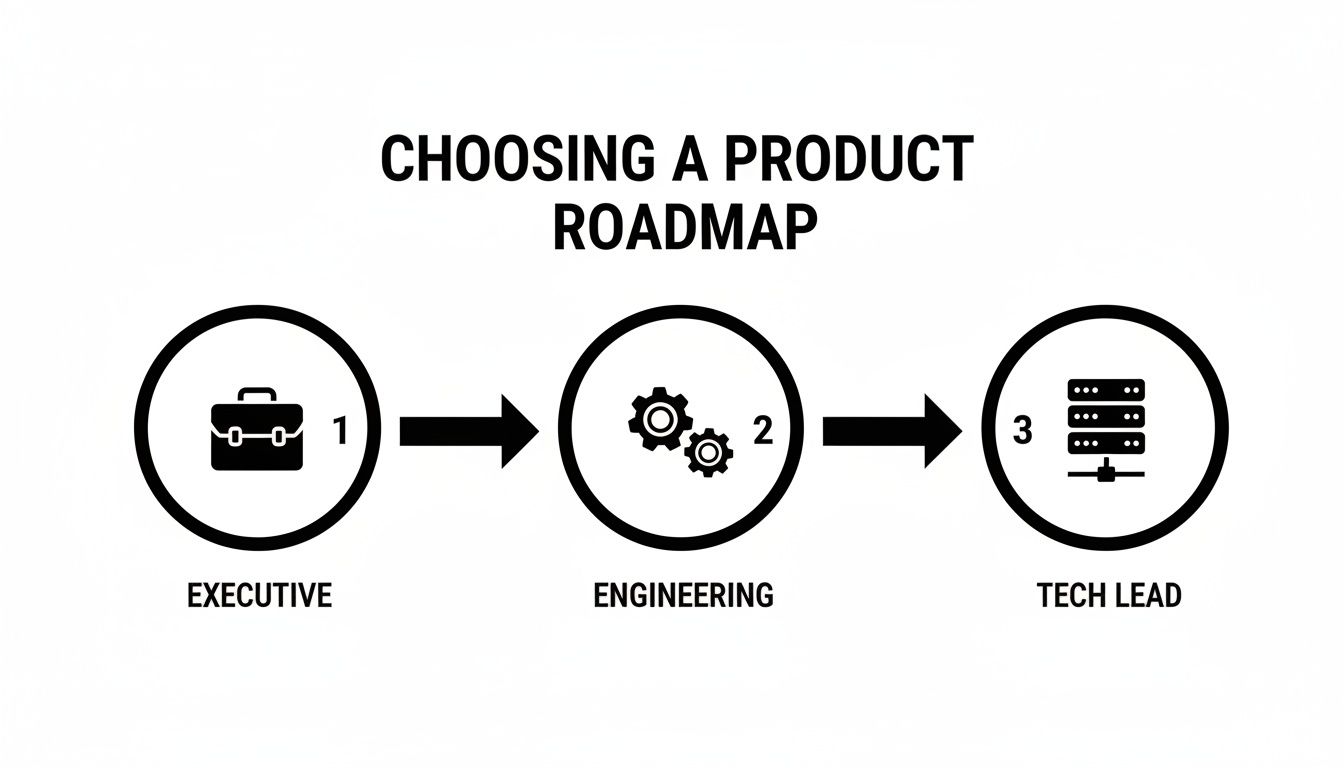
As you can see, executives need the high-level strategic view, while engineering needs the tactical details to build.
Step 4: Group and Sequence into a Narrative
Turn your prioritized list into a strategic story. Group individual items into larger themes that address a customer problem (e.g., "Improve AI-powered Search Accuracy").
Then, sequence these themes on a flexible Now, Next, Later timeline.
- Now: What the team is building this quarter. Scope is locked.
- Next: Planned for the following quarter. Scope is being defined.
- Later: Ambitious ideas for the future. No committed scope.
This structure provides clarity while maintaining the flexibility to adapt. To get started quickly, use a battle-tested product roadmap template with this structure already built-in.
Step 5: Share and Socialize for Buy-In
This final step is the most critical. A roadmap is useless if it lives on your hard drive. Your job is to turn it into a shared commitment.
A roadmap is not a declaration; it's a conversation starter. Its primary purpose is to create alignment and facilitate strategic discussions about trade-offs. Don’t present it as final—present it as a well-reasoned proposal.
Schedule dedicated meetings with key stakeholders:
- Executive Team: Focus on how themes support business goals and expected outcomes.
- Engineering Leads: Review "Now" and "Next" to get input on technical feasibility and effort. This is a partnership.
- Go-to-Market Teams (Sales/Marketing): Give them a view of what's coming to plan launches and messaging.
By proactively socializing your roadmap, you build trust and ensure the entire company is pulling in the same direction.
Common Roadmap Mistakes to Avoid
Building a roadmap is one thing; building one that works is another. Over years of leading PM teams, I’ve seen more roadmaps fail due to simple, avoidable errors than anything else. These mistakes erode trust, burn out your team, and derail your product strategy.
Here are the five most common traps and how to sidestep them.
Treating the Roadmap as a Concrete Promise
This is the #1 mistake. Presenting your roadmap with hard dates turns a strategic guide into a brittle project plan. The moment you hit an unexpected snag—which you will—your credibility shatters. A junior PM presents a 12-month roadmap with release dates; a senior PM presents a strategic direction.
The Fix: Use flexible Now, Next, Later horizons. Communicate confidence levels. You have high confidence in "Now," medium in "Next," and low in "Later." You are signaling direction, not making a promise carved in stone.
Creating an Overloaded 'Kitchen Sink'
The pressure from stakeholders is immense. Trying to please everyone by cramming every request onto the roadmap creates a bloated, unfocused document that guarantees nothing. A roadmap without focus isn't a strategy; it's a wish list.
The Fix: Prioritize ruthlessly. Every item must have a "why" that ties directly to a company OKR. Master the art of the strategic "no." To get better at this, you must learn how to prioritize a roadmap using objective frameworks that force tough trade-offs.
Forgetting to Connect to the Why
A roadmap that is just a list of features—"Build X," "Launch Y"—is meaningless. It fails to inspire your team and strips them of the context needed to make smart decisions.
The Fix: Frame your roadmap around themes and outcomes.
- Bad: "Q2: Build AI Chatbot"
- Good: "Q2 Theme: Reduce Support Ticket Volume by 25%"
- Initiative: AI-powered self-service chat
- KPI: Decrease average ticket resolution time
This connects the team's work directly to business impact.
Building It in a Silo
I’ve seen PMs emerge from a cave with a "perfect" roadmap, only to discover it’s technically infeasible, misaligned with marketing, or ignores a major customer pain point. A roadmap is an alignment tool; you cannot create alignment in a vacuum.
A roadmap is not a declaration; it's a conversation starter. Its primary purpose is to facilitate strategic discussions about trade-offs. Present it as a well-reasoned proposal, not a final decree.
The Fix: Make it a team sport. Involve engineering, design, marketing, and sales leads from the beginning. Your first draft is a conversation starter, not the final word.
Letting It Become a 'Set and Forget' Document
A roadmap created in January and never touched again is worse than no roadmap at all—it actively misleads the organization. The market shifts, you get new data, a competitor makes a move. Your roadmap must adapt.
The Fix: Schedule a recurring roadmap review cadence (e.g., quarterly). This creates a predictable rhythm for reassessing priorities based on new information. Treat your roadmap like your product—iterate on it continuously.
Frequently Asked Questions About Product Roadmaps
As a PM leader, I've seen aspiring and seasoned product managers run into the same practical questions about roadmapping. A great roadmap isn't just about the document itself; it’s about how you build, manage, and communicate it. Here are some concise, actionable answers to the questions I hear the most.
These answers come from years of seeing what works—and what really doesn't—inside high-growth tech companies.
How Often Should I Update My Product Roadmap?
For most agile teams, a quarterly review and update cadence is ideal. This aligns with most business planning cycles (OKRs) and provides a natural checkpoint to ensure your plan still drives strategic goals. The "Now" section of your roadmap might see minor tweaks sprint-to-sprint as you learn, but major strategic shifts should happen quarterly. Use every update as an opportunity to reinforce alignment, not just to announce changes.
How Do I Handle Executive Pressure to Add a Feature Request?
This is a critical test of a PM's stakeholder management skills. The key is to reframe the conversation from a simple "yes/no" to a strategic discussion about trade-offs.
When a leader asks to add a feature, don't say no. Instead, ask two questions: 'Which company objective will this impact most?' and 'To add this, which of our current strategic initiatives should we de-prioritize?'
This move turns the executive into a partner in prioritization. By pulling up the roadmap and showing the resource constraints, you shift the dynamic from a demand to a collaborative decision about strategic impact.
What Are the Best Tools for Managing Product Roadmaps?
The tool is far less important than the process. Focus on clarity and communication, not features.
- Startups & Small Teams: Keep it simple. A well-structured slide deck (Google Slides), a Trello board, or even a spreadsheet can be highly effective.
- Growing & Larger Companies: Dedicated tools can help manage complexity. The top contenders I see used effectively at places like Meta and Google are:
- Productboard: Excellent for connecting customer feedback directly to roadmap initiatives.
- Aha!: A powerful, all-in-one tool for complex enterprises.
- Jira Product Discovery: A natural choice for teams deeply embedded in the Atlassian ecosystem.
The best tool is the one your team actually uses and keeps updated.
Should I Share My Roadmap Publicly with Customers?
Sharing a public roadmap can be a powerful move for transparency and community building, but it is high-risk. If you do it, you must be disciplined.
Keep it high-level, theme-based, and focused on the problems you plan to solve, not specific features. Never, ever include specific dates. Companies like Buffer and GitHub do this well. Before you consider a public roadmap, ensure you have a rock-solid process for managing feedback and communicating changes when priorities inevitably shift.
Ready to move beyond the definition of roadmaps and master the skills that get you hired and promoted? The Aakash Gupta newsletter and podcast provide the actionable advice and industry insights you need to accelerate your product career. Join the world's largest PM community at https://www.aakashg.com.
