A bulletproof go-to-market strategy framework is the single most important system separating products that dominate a market from those that simply fizzle out. For Product Managers—especially those building AI-native products—it’s not just a plan; it’s your operational blueprint for winning. It’s how you get Engineering, Sales, and Marketing executing a unified strategy.
As a PM leader who's hired and mentored product managers now at Google, Meta, and OpenAI, I see this constantly: a weak GTM is the #1 killer of brilliant products. Forget 100-page documents. A modern GTM is a sharp, actionable plan that nails four questions: who are you selling to, what are you selling, where will you find them, and how will you win their business.
This isn’t just theory; it's a battle-tested system. In fact, companies with a clearly defined GTM framework see around 10% higher success rates on their product launches. They can even pull in up to three times greater revenue growth than teams using a more scattered, ad-hoc approach.
Your Actionable GTM Blueprint
At its core, a go-to-market strategy framework forces you to make deliberate choices across a few key pillars. It’s the strategic layer that sits right above your day-to-day execution plan. While a broader product strategy framework defines the long-term vision, your GTM is the operational guide for a specific launch or market entry.
This hierarchy diagram breaks down the relationship between the framework, your market, your product, and your channels.
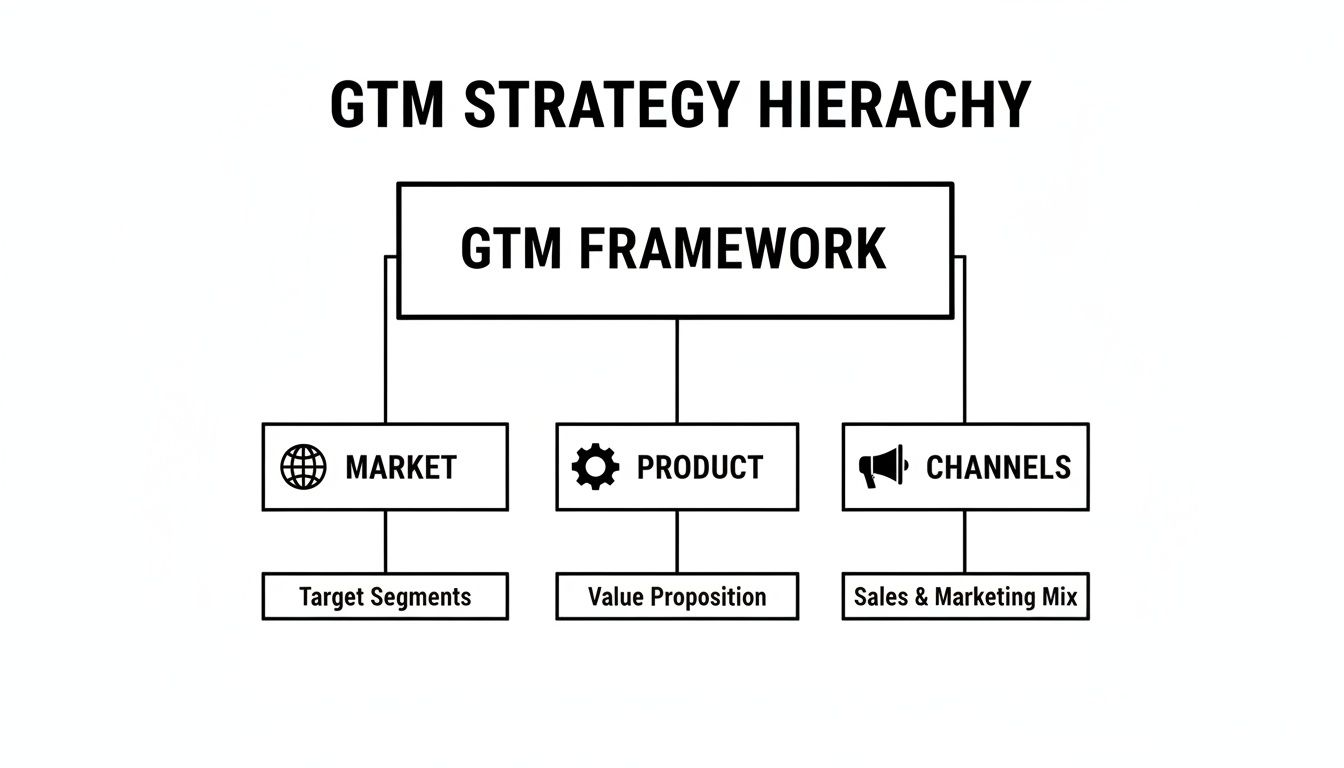
The visual makes one thing crystal clear: every decision you make about your product and channels has to flow directly from a deep understanding of your target market. If you don't have that market clarity, your GTM will be unfocused and, frankly, ineffective.
To give you a quick reference point, here’s a breakdown of the essential components that every Product Manager needs to master.
The 7 Pillars of a Winning GTM Strategy Framework
| Pillar | Core Question to Answer | Key PM Deliverable |
|---|---|---|
| 1. Target Market | Who are our ideal customers and what problem are we solving? | Ideal Customer Profile (ICP), Personas, Market Sizing (TAM/SAM/SOM) |
| 2. Value Proposition | What unique value do we offer this specific segment? | Value Prop Canvas, "Only We" Statement |
| 3. Product Strategy | How does our product deliver on the value proposition? | Launch-focused Product Roadmap, Feature Prioritization |
| 4. Positioning & Messaging | How do we talk about our product to the target market? | Messaging Framework, Positioning Statement |
| 5. Channels | Where will we find and acquire our target customers? | Channel Mix (e.g., SEO, Paid, Sales), Funnel Map |
| 6. Pricing & Packaging | How will we charge for our product and what's included? | Pricing Tiers, Packaging Model |
| 7. Metrics & Goals | How will we measure success and know if we're winning? | GTM Scorecard, North Star Metric, Key KPIs |
Mastering these pillars gives you a repeatable system you can apply to any product you manage.
From Blueprint to Execution
This guide provides the structure to build this very blueprint. We're about to break down those seven essential pillars that form the foundation of any successful launch. For those specifically focused on B2B, you can explore this guide on building your B2B Go-to-Market Strategy Framework for Growth.
Throughout this article, we’ll move from high-level concepts straight into tactical deliverables you can start building and using right away.
Defining Your Battleground and Core Message
Any go-to-market strategy built on assumptions is just a house of cards. The absolute bedrock of a winning GTM plan is a relentless, obsessive focus on two things: your customer and your competitors. This is where you go beyond flimsy demographics and define your turf with surgical precision.
The journey starts by nailing your Ideal Customer Profile (ICP). This isn't just a vague description of a company; it’s a crystal-clear portrait of the perfect business that will get massive value from what you've built. In turn, they'll deliver massive value back to you.

Once you've zeroed in on the ICP, you have to dig deeper. You're hunting for the unspoken frustrations and the core "Jobs-to-be-Done" that truly drive their decisions to buy.
Nail Your Ideal Customer Profile
Think of your ICP as the North Star for every single GTM decision you make from here on out. To build a truly useful one, you need to answer some hard, firmographic questions that create a specific, actionable target.
- Industry/Vertical: Which specific sectors feel the pain you solve most intensely? Be specific: not just "SaaS," but "B2B SaaS for sales teams."
- Company Size: Are you targeting startups with 10-50 employees or enterprises with over 10,000? This single choice dramatically changes your sales motion and pricing. A mid-career PM should expect to defend this choice with data on deal size vs. sales cycle length.
- Geography: Where are these companies based? This decision impacts everything from legal compliance to language and the channels you use.
- Technographics: What other tools are in their stack? A company running on Salesforce and Marketo is a world away from one using HubSpot and Mailchimp. Knowing this informs your integration strategy.
A sharp, well-defined ICP is your best defense against wasting time and money chasing leads that were never going to convert. To go even deeper on this critical step, check out our complete guide on how to define your target audience.
Craft a Resonant Value Proposition
Now that you have a clear picture of who you're talking to, it's time to figure out why they should care. Your value proposition is a simple, powerful statement that spells out the unique benefit you deliver. It's the direct answer to your customer's constant, silent question: "What's in it for me?"
A great value prop is never a laundry list of features. It's a promise of a better outcome.
PM Pro Tip: Try framing your value proposition using the "Only We" statement structure. It goes like this: For [target customer] who [has this need/opportunity], our [product/brand name] is a [product category] that [delivers this key benefit]. Unlike [competitors], only we [have this unique differentiator].
Remember Slack's early days? Their value proposition wasn't about "channels and integrations." It was about "making your working life simpler, more pleasant, and more productive." That message hit home for teams drowning in email, turning an interesting tool into an indispensable one. A good way to find these opportunities is to dive into a strategic guide to market mapping.
Solidify Your Market Positioning
Positioning is about controlling how your target customer perceives you in relation to your rivals. It’s the art of carving out a distinct and valuable slice of real estate in a noisy, crowded market.
A positioning map is an absolute goldmine for this exercise. By plotting your competitors on a two-by-two grid based on key attributes (like Price vs. Quality, or Simplicity vs. Power), you can literally see where the open territory lies.
Positioning Map Example for a Project Management Tool:
| High Price | Low Price | |
|---|---|---|
| Enterprise Focus | Your Competitor A | Your Competitor B |
| SMB & Team Focus | YOUR OPPORTUNITY | Your Competitor C |
Look at that. This quick analysis reveals a wide-open lane for a project management tool that caters specifically to SMBs and isn't afraid to charge a premium—presumably by offering killer features or support that this segment craves. This uncovered "battleground" becomes the laser focus for your messaging, making sure every blog post, ad, and sales call hammers home your unique spot in the market.
Choosing Your Growth Engine and Pricing Model
An amazing product with a mismatched distribution model is a fast track to failure. This part of your go-to-market strategy is all about defining the commercial engine that will actually power your growth. It’s where you make the tough, deliberate choices on how you find, win, and charge for your product.
Too many product managers fall in love with a single, trendy model—like product-led growth—without really thinking if it fits their market. Atlassian famously scaled Jira and Confluence using a PLG motion, which was perfect for its self-serve, low-friction user experience. But on the flip side, Salesforce built a global powerhouse with a highly-structured, direct enterprise sales team.
Neither approach is inherently better. They are simply different engines for entirely different journeys.

Your job is to pick the right engine for your product and its audience. The whole point is to build a system where the cost to acquire a customer (CAC) is way, way lower than the value that customer brings over their lifetime (LTV).
Selecting Your Primary Channel Mix
Your channels are just the pathways you use to reach your Ideal Customer Profile. The decision isn't about picking just one, but about selecting a primary "growth engine" and then layering in others to support it. The right mix depends completely on your product's complexity, its price, and how your customers actually buy things.
Here are the most common models for SaaS and tech products:
- Product-Led Growth (PLG): The product itself is the main tool for acquisition, conversion, and expansion. Think of Slack or Loom, where a freemium model lets people experience the magic first, driving organic, bottom-up adoption inside companies.
- Sales-Led Growth (SLG): This is for complex, big-ticket items. High-touch sales teams guide prospects through the buying process. It’s the go-to model for companies like Workday or Snowflake, where deals are massive and require a ton of education and relationship-building.
- Marketing-Led (Inbound): This engine uses valuable content—blogs, SEO, webinars—to attract and educate potential customers. HubSpot is the poster child here, building a giant lead funnel by simply becoming the best resource for marketing and sales knowledge.
A classic mistake is trying to be everything to everyone right away. Your initial go-to-market strategy should place a concentrated bet on the single growth motion most likely to win. Once you have that engine humming, you can strategically layer in secondary channels to pour fuel on the fire.
Demystifying Your Pricing and Packaging
Pricing is one of the most powerful levers you have in your GTM strategy, yet it's often the most neglected. It directly communicates your product's value and pretty much determines if your business will sink or swim. Get it right, and you create a flywheel of sustainable growth. Get it wrong, and you can kill a great product before it ever gets off the ground.
There are three main models to think about, each with its own quirks.
Common Pricing Models Comparison
| Pricing Model | How It Works | Best For | Major Pitfall |
|---|---|---|---|
| Value-Based | Price is set based on the perceived value to the customer, not your costs. | Products with a clear, quantifiable ROI for the customer. | Requires deep customer research to actually quantify "value." |
| Competitor-Based | Price is set in relation to what your direct competitors are charging. | Crowded markets where price is a key factor in the buying decision. | Risks a "race to the bottom" and ignores your unique value prop. |
| Cost-Plus | Price is determined by adding a standard markup to your internal costs. | Services or physical goods where production costs are clear-cut. | Completely ignores what the market will bear and what customers think it's worth. |
For most modern SaaS products, value-based pricing is the gold standard. It aligns your success directly with your customer's success—when they win, you win.
Once you pick a model, you have to package it into tiers. Good tiers are designed to do three things: make it easy to acquire new users, encourage them to upgrade as they grow (hello, expansion revenue), and maximize their lifetime value. For a deeper dive, our guide on pricing strategy for new products provides a detailed walkthrough.
Building Your Launch Plan and Measurement System
A strategy document is a great start, but it’s worthless without an operational plan to bring it to life. This is where the rubber meets the road—where your go-to-market strategy framework morphs from a well-researched slide deck into a real-world execution machine. It’s all about creating lock-step alignment across every single team involved in the launch.
Your goal here is to build an operational blueprint that leaves absolutely no room for ambiguity. This isn't just a "nice-to-have"; it's what separates the most effective companies from the rest. In fact, new data shows that roughly 85% of companies with solid GTM strategies report they’re highly effective at hitting their business goals. That’s a direct result of getting everyone on the same page. To dig into the details, you can learn more about GTM effectiveness on highspot.com.
This operational layer makes sure that Product, Marketing, Sales, and Support aren’t just aware of the plan, but are active, coordinated partners in making it a success.
Creating Your Launch Checklist and Timeline
First things first, you have to translate your high-level strategy into a concrete set of actions. A detailed launch checklist is non-negotiable here. Think of it as the single source of truth that maps out every dependency and deliverable, from the final engineering QA to the moment the first marketing email goes out.
A solid checklist is your best defense against critical tasks slipping through the cracks. For a great starting point, our detailed product launch checklist template gives you a structured approach that you can adapt for any launch, big or small.
To go along with the checklist, you need a crystal-clear timeline with key milestones. This isn’t just another project plan; it’s a powerful communication tool for the entire company.
- T-minus 8 Weeks: Finalize messaging and positioning with Marketing.
- T-minus 4 Weeks: Sales and Support enablement training kicks off.
- T-minus 1 Week: Final UAT and the crucial "Go/No-Go" decision meeting.
- Launch Day (T-0): Coordinated execution across all channels. It’s go-time.
- T-plus 1 Week: Post-launch retrospective and initial data review.
Defining Ownership with a RACI Matrix
With a plan in place, the next question is always, "Who does what?" A RACI (Responsible, Accountable, Consulted, Informed) matrix is a simple but incredibly powerful tool for assigning clear ownership and stamping out confusion before it starts. This framework clarifies roles for every major launch activity, ensuring nothing gets missed.
Sample RACI Matrix for a Feature Launch
| Task | Product (PM) | Marketing | Sales | Engineering |
|---|---|---|---|---|
| Write Blog Post | Consulted | Responsible | Informed | Informed |
| Train Sales Team | Accountable | Consulted | Responsible | Consulted |
| Set Final Pricing | Accountable | Consulted | Consulted | Informed |
| Deploy to Production | Informed | Informed | Informed | Accountable |
This level of clarity is what prevents the dreaded, "I thought you were doing that" conversation on launch day.
Focusing on Metrics That Matter
Finally, you have to define how you're going to measure success. It’s so easy for PMs to get distracted by vanity metrics like website traffic or total sign-ups. As a product leader, your job is to focus on the KPIs that signal true business health and actually validate your go-to-market strategy.
The ultimate goal is to prove that your GTM is a sustainable growth engine. This means demonstrating a healthy relationship between the cost to acquire a customer and the value they bring to the business over time.
Your post-launch dashboard should be laser-focused on a handful of core metrics:
- Customer Acquisition Cost (CAC): The total cost of sales and marketing needed to acquire one new customer.
- Customer Lifetime Value (LTV): The total revenue a customer is expected to generate over their entire relationship with your company.
- LTV to CAC Ratio: This is the ultimate health metric. A ratio of 3:1 or higher is the gold standard, telling you that your GTM motion is profitable.
- Churn Rate: The percentage of customers who cancel their subscriptions over a given period.
- Activation Rate: The percentage of new users who hit that key "aha!" moment in your product within their first week.
Tracking these numbers allows you to prove the business impact of your work and, more importantly, make data-driven adjustments to optimize your strategy for the next launch.
Real World GTM Frameworks in Action
Theory is a great starting point, but as a product manager, your career is defined by execution. To really get a feel for a go-to-market strategy framework, you have to see it in motion. Let's dissect the playbooks of three iconic companies, mapping their decisions back to the 7 pillars we've discussed.
This isn’t just a history lesson; it's a masterclass in application. We'll look at a community-led giant, a product-led powerhouse, and a sales-led enterprise dominator. Each one reveals how the right GTM model, flawlessly executed, can define an entire market.
Airbnb: The Community-Led Disruptor
Airbnb didn't just sell rooms; it sold trust and belonging. Their early GTM strategy was a brilliant example of community-led growth, focusing on building a two-sided marketplace from the ground up by fostering deep connections between hosts and guests.
- Target Market: They didn't target "travelers." They zeroed in on two specific ICPs: budget-conscious travelers looking for authentic experiences and homeowners with spare rooms who wanted extra income. This dual focus was critical.
- Value Proposition: For guests, it was "Live like a local." For hosts, it was "Make money from your extra space." Simple, powerful, and it hit on an emotional level.
- Channels: Their initial channel was pure hustle. They famously piggybacked on Craigslist—a massive existing community—to find their first users. They also invested heavily in professional photography to make listings more trustworthy and appealing, a move that directly built the quality of their community.
Airbnb’s genius was realizing their product wasn't just a website; it was the community itself. Every GTM decision they made was designed to build trust and encourage user-to-user interactions, creating a powerful network effect that competitors found nearly impossible to replicate.
Slack: The Product-Led Growth Engine
Slack’s GTM is the gold standard for product-led growth (PLG). They built their product to be its own marketing and sales engine, using a freemium model to sneak into organizations from the bottom up.
Their whole strategy was built around delivering a magical user experience first. When thousands of people signed up within 24 hours of their public launch, it was obvious the product's value spoke for itself. This mirrors the explosive growth seen in other modern product-led companies, a concept explored in this deep dive on Stripe as a modern product rocket.
- Product Strategy: The freemium tier wasn't some stripped-down demo; it was a fully functional, powerful tool. The key limitation—a 10,000 message search history—created a natural and compelling reason for teams to upgrade once they were hooked.
- Positioning & Messaging: Their message was simple: "Be less busy." It spoke directly to the pain of overflowing email inboxes, positioning Slack not as another chat tool, but as a productivity revolution.
- Viral Loops: The product was inherently viral. To get any real value from Slack, you had to invite your colleagues. This user-driven acquisition model was the core of their GTM engine, letting them scale with incredible capital efficiency.
Snowflake: The Enterprise Sales-Led Machine
Snowflake targets a totally different market: large enterprises with complex, mission-critical data needs. A PLG model would have been a spectacular failure. Instead, they built a sophisticated, high-touch, sales-led GTM framework designed to land massive, multi-million dollar contracts.
Their approach was to go "big game hunting," focusing all their resources on a select list of high-value enterprise accounts.
- Channels: Their primary channel is a direct, highly-skilled enterprise sales force. These aren't just salespeople; they are consultative partners who can speak the language of CIOs and data architects.
- Pricing & Packaging: Snowflake pioneered a consumption-based pricing model for data warehousing. Customers only pay for the compute and storage they actually use, which perfectly aligned value with cost. This made it much easier for huge companies to start small and scale their investment over time.
- Metrics & Goals: Their key metric isn’t daily active users; it's Net Revenue Retention (NRR). They focus intensely on growing the spend within their existing enterprise accounts—a hallmark of a successful sales-led strategy.
Adapting Your GTM for New and Global Markets
Let’s be honest. A go-to-market strategy that absolutely crushed it in North America will almost certainly fall flat in Mumbai or Berlin. If you're a product manager with global ambitions, you have to get one thing straight: expansion isn't about copy-pasting your playbook. It's a complete teardown and rebuild of your entire GTM framework.
Scaling a product internationally is so much more than simple translation. The real work is in localization—the deep, often difficult, process of adapting your messaging, your pricing, and maybe even your core product to fit entirely new cultural norms, competitive threats, and buying habits.
Moving from Translation to Localization
Translation is just swapping words. Localization is about redesigning the entire experience to feel like it was born and raised in that specific region. This has a ripple effect on every single part of your go-to-market strategy.
- Pricing and Packaging: A SaaS pricing model that feels like a no-brainer in San Francisco could be completely out of reach in Southeast Asia. You've got to dig into local purchasing power and see what competitors are charging to build out region-specific tiers that actually make sense.
- Messaging and Positioning: The whole "hustle culture" vibe that resonates with a US startup crowd might come off as aggressive or just plain weird in Japan. Your value proposition has to be re-angled to connect with local values and what people actually care about.
- Channels: The marketing channels you lean on in one country might be ghost towns in another. While LinkedIn is king for B2B in the US, a platform like WeChat is non-negotiable for doing business in China.
The single biggest mistake PMs make going global is assuming their home market's success is a universal template. It's not. True global product-market fit is earned by treating each new country as a brand-new launch, demanding its own tailored GTM from the ground up.
Conducting Targeted Market Research
This whole adaptation process kicks off with serious, boots-on-the-ground research. Before you even think about entering a new country, your team needs crystal-clear answers to a few questions that will shape every decision you make.
Your International GTM Checklist:
- Competitive Dynamics: Who are the local players already there? How are they positioned, what GTM motions are working for them, and where are they weak?
- Regulatory Landscape: Are there data privacy laws (like GDPR), specific payment processing rules, or other legal landmines you need to navigate?
- Cultural Nuances: How do people build business relationships? What are the local expectations for customer support or how a sales conversation should feel?
- Economic Realities: What's the average willingness to pay for a product like yours? Are people used to signing annual contracts, or is everything month-to-month?
In emerging economies, which are massive growth opportunities, this level of strategic focus really separates the winners from the losers. The data shows that companies with a mature GTM framework outperform their rivals by about 4% in compound annual revenue growth (CAGR) and an impressive 6% in profit growth. You can discover more insights on how winning GTM strategies drive growth in these crucial markets.
GTM Strategy FAQs
As a product manager, you're constantly juggling the moving parts of a go-to-market strategy framework. It’s natural for questions to pop up. Here are the most common ones I hear from PMs, with direct, no-fluff answers.
How Often Should I Revisit My GTM Framework?
Your GTM strategy is a living document, not a "set it and forget it" relic you build once and file away. Think of it like a map for a landscape that's constantly changing.
At a minimum, you need to do a major review annually. But the real answer is: you have to refresh it the moment something big happens in your market. A major competitor launching, a fundamental technology shift like generative AI—these are triggers that demand an immediate revisit of your entire plan.
For new products or those in fast-moving markets, I'd go further. A quarterly check-in on your core assumptions, channel performance, and messaging is just smart practice. It keeps you honest and ensures you're reacting to what the market is telling you now, not what you assumed three months ago.
What Is The Biggest Mistake PMs Make?
Hands down, the single most common failure I see is a lack of deep, authentic customer understanding. Far too many PMs build their strategy from the inside out, starting with their product's shiny features instead of the customer's burning pain points.
This is a foundational error, and it creates a domino effect of problems. Your value proposition feels weak, you pick the wrong channels to reach people, and your messaging falls completely flat. A winning GTM is always built from the outside in. It starts with an obsessive focus on your market and your customer. Everything else flows from that.
How Does GTM Differ For A New Product Versus A New Feature?
The scope and focus are worlds apart. For a brand new product, you're building the entire GTM from the ground up. You have to nail all seven pillars, from defining your market to setting up operations. You’re building awareness, creating distribution channels, and figuring out pricing from scratch. It's an all-hands-on-deck, full-scale strategic mission.
For a new feature, things are much tighter. Your "market" is usually your existing user base, so the game changes. The GTM becomes an exercise in in-product execution, prioritizing a few key things:
- User Onboarding: How will users discover this new thing and, more importantly, learn how to use it effectively?
- Feature Discovery: What breadcrumbs, tooltips, or announcements will you use inside the app to drive that first click?
- Adoption & Upsell: How are you measuring who's using it? And how can you leverage this new feature to drive account upgrades or expansion?
What Role Does AI Play In Modern GTM Strategy?
AI is no longer a "nice to have"—it's a massive force multiplier for your GTM. For us PMs, it gives us an edge in both the planning and the execution phases.
During strategy development, you can use AI tools to do things that used to take weeks. Think analyzing competitor messaging at scale, sifting through mountains of data to find signals for your ideal customer profile, or even generating first drafts of your positioning. For example, you can use a prompt like: "Act as a GTM strategist for a B2B SaaS company. Analyze the messaging on the homepages of [competitor 1 URL], [competitor 2 URL], and [competitor 3 URL]. Identify the top 3 value propositions they each emphasize and identify a potential positioning gap for a new entrant focused on [your unique value prop]."
When it's time to execute, AI really shines. It can optimize ad spend in real-time, personalize marketing campaigns for different segments, and even power sales bots that feed reps the exact right piece of information when they need it. It makes your entire go-to-market motion smarter, faster, and way more data-driven.
At Aakash Gupta, we provide the frameworks and insights you need to excel in your product career. Explore resources for product managers to sharpen your strategic skills.
