Getting promoted as a Product Manager isn’t something you wait for; it's something you engineer. It requires a deliberate system for delivering measurable business impact, building strategic visibility, and proving you're ready to solve the company's next set of problems.
The most successful PMs I've hired and mentored don't just hope to be noticed. They operate with a clear system that makes their value impossible to ignore. This guide provides that system.
The Promotion Equation: Impact + Visibility + Strategy
Here's a hard truth many Product Managers learn too late: just doing great work isn't enough to get you promoted.
While high-quality output is the foundation, it’s only part of the story. At places like Google and Meta, the promotion process is a tough evaluation of your ability to move the needle on business outcomes—not just your ability to ship features. To get that next role, you have to shift your mindset from a task-doer to a business owner.
This requires a system. I coach my PMs to use what I call the Impact + Visibility + Strategy equation. It's a simple but incredibly powerful framework for making sure your efforts are not only effective but also seen and valued by the people who make promotion decisions.
Here's the breakdown:
- Impact: Can you quantify your work in terms of revenue, user retention, or cost savings? A 10% increase in activation rate is impact; shipping an onboarding flow is output.
- Visibility: Do the right people—your manager, their boss, and cross-functional leaders—know about your impact? If your Director of Sales doesn't know how your feature drove enterprise deals, it didn't happen.
- Strategy: Are you tackling the company's most critical problems? Promotions go to the people who prove they can handle the challenges of the next level, not just the ones of their current role.
This flow is the simplest way to visualize how you can start building your promotion case, starting today.
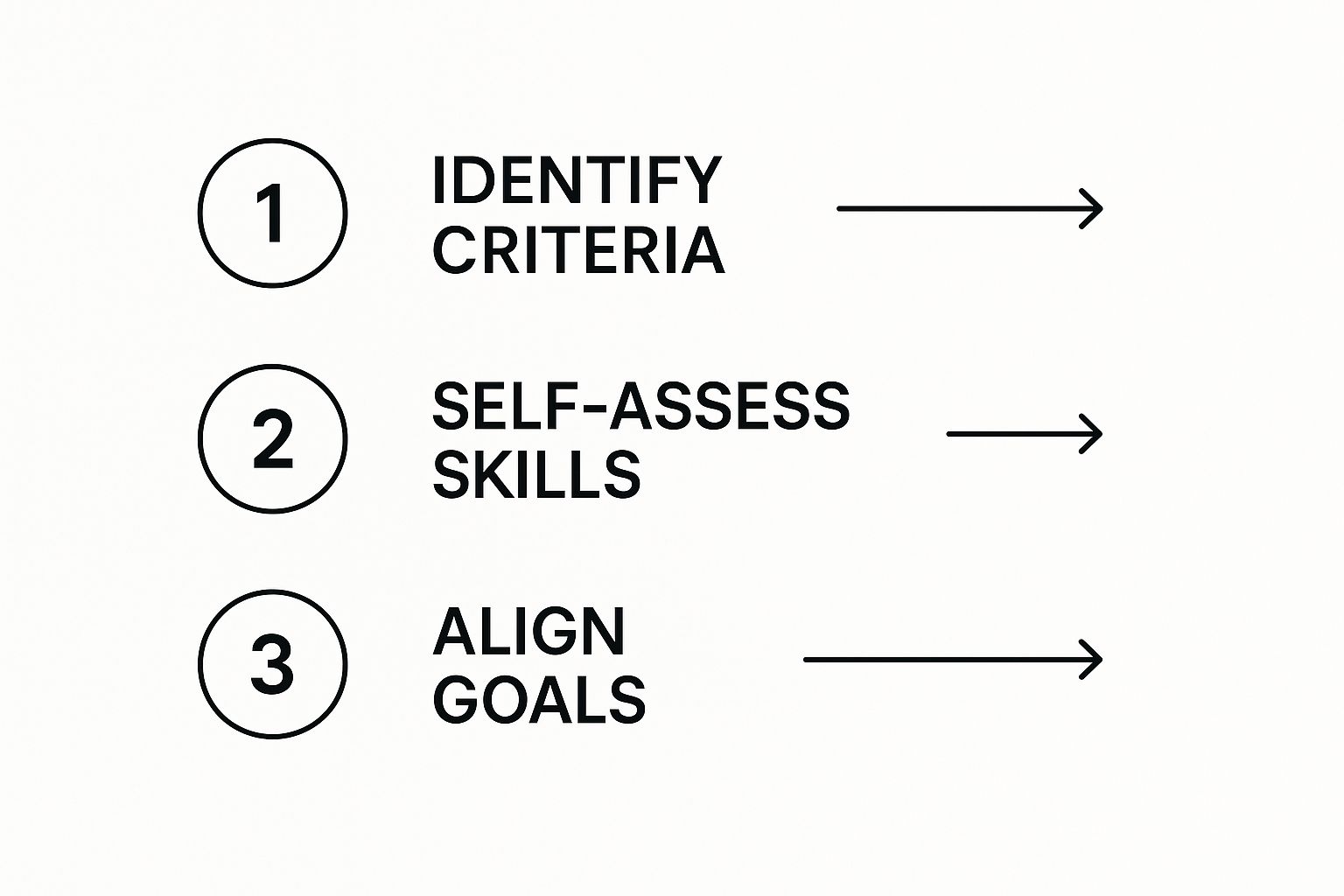
Following this process transforms that vague desire for a promotion into a concrete plan. It forces you to define what success looks like, honestly assess where you stand, and align your future work with what leadership actually cares about.
Key Takeaway: Promotions aren't a reward for past work; they are an investment in your future potential. Your job is to make that investment decision an obvious "yes" for the company by building a compelling case that proves you're already operating at the next level.
Before you dive in, it helps to know where you stand. A quick self-assessment can pinpoint exactly where you need to focus your energy to build the strongest possible case for your promotion.
The Promotion Readiness Checklist
Use this checklist to quickly identify your strengths and weaknesses across the key pillars of a promotion case. Be honest with your ratings—this is for you, and it will guide your action plan.
| Pillar | Key Question | Self-Rating (1-5) | Action Item |
|---|---|---|---|
| Impact | Can I clearly link my work to a 5-10% improvement in a core business metric? | ||
| Impact | Do I have a "brag doc" that quantifies my achievements with hard data? | ||
| Visibility | Does my manager's boss know who I am and what I've accomplished? | ||
| Visibility | Have I presented my work or strategy to a leadership audience in the last quarter? | ||
| Strategy | Am I owning a project that is considered a top-three priority for my organization? | ||
| Strategy | Can I articulate how my current work directly contributes to the company's annual goals? |
Once you've filled this out, you'll have a much clearer picture of your gaps. Is your impact solid but your visibility low? Or are you well-known but not tied to strategic projects? Your "Action Item" column becomes your personal roadmap.
Now, let's break down how to master each component of this equation, starting with the most important one: proving your impact with undeniable, data-driven results.
Prove Your Impact with Measurable Results

Here's a hard truth: promotions aren't given out for effort. They're earned through tangible business impact.
In every single performance review and promotion committee I've ever been a part of, the conversation eventually boils down to one simple question: “What did this person actually do to move the business forward?”
Vague statements like, “I led the launch of a new feature,” are basically meaningless. They don’t land. Your leadership team runs on data, and to get what you want, you have to learn to speak their language. That means translating every product decision and shipped feature into a measurable outcome that hits the company’s bottom line.
Adopt the Metric Mover Technique
The most powerful way I’ve seen this done is with what I call the “Metric Mover” technique. It’s a dead-simple, continuous documentation method that forces you to connect your work directly to key performance indicators (KPIs).
Instead of just keeping a running list of tasks you’ve completed, you maintain a document that tracks every single project against a specific metric. This small shift in habit completely transforms your thinking. You stop just shipping stuff and start deliberately driving business outcomes. For any PM looking to level up, this shift from focusing on outcomes over output is non-negotiable.
For every initiative, your Metric Mover doc needs to answer three questions:
- What was the user problem or business opportunity? (The Why)
- What did we build/launch? (The What)
- What metric did it move, and by how much? (The Impact)
Pro Tip: Don't wait until performance review season to scramble for this information. Update your Metric Mover document weekly or bi-weekly. This discipline ensures you never forget a win and always have a data-backed narrative ready to go for any promotion conversation.
Framing Your Wins Like a Senior PM
Let’s walk through a real-world scenario. A mid-level PM at a company like Salesforce might describe their work by saying: “Launched the new in-app onboarding flow.”
This is an output. It’s fine, I guess. But it won’t get you promoted.
Now, let’s see how a senior PM using the Metric Mover technique frames it: “I identified a 25% drop-off rate during user setup, which was costing us an estimated $1.2M in annual recurring revenue. I led a cross-functional team to design and launch a new guided onboarding experience, which resulted in a 15% improvement in successful user activation and a 10% increase in Week 1 retention.”
See the difference? The second example is just undeniable. It screams strategic thinking, business acumen, and, most importantly, measurable impact.
This is how you build an airtight case for your promotion. Start tracking your wins this way today, and you’ll have irrefutable proof of your value when it matters most.
Develop Skills for the Role You Want
I've seen it happen more times than I can count. A promising Product Manager, absolutely crushing it in their current role, gets passed over for a promotion. Why? It almost always boils down to one thing: a mismatch between their skills today and what the company needs tomorrow.
Promotions aren't just a reward for past performance. They're a bet on your ability to solve the next set of bigger, more complex problems. You have to be skating to where the puck is going.
This means you need to look beyond the immediate needs of your current project. Start identifying the capabilities your company will need from its next generation of leaders. If you're at a B2B SaaS company, for instance, skills in platform thinking, API product management, or enterprise sales enablement might be exactly what leadership is looking for.
Create a Targeted Personal Development Plan
Forget about randomly collecting certifications. What you need is a Personal Development Plan (PDP) that's laser-focused on getting you to that next level. Think of it less like a to-do list and more like a strategic project to build and, most importantly, demonstrate new skills.
Your PDP should be built around three core questions:
- What skills actually define the next level? Go find the job descriptions for Senior PM or Group PM roles—not just at your company, but at competitors you admire, like OpenAI or Atlassian. Look for the recurring keywords. Are they "AI/ML," "platform strategy," "go-to-market," or "P&L ownership"? That's your roadmap.
- Where are my biggest gaps? Now, do an honest self-assessment against those requirements. If the goal is to land an AI PM role but you have zero hands-on experience, that's your #1 gap. To get a full picture of the abilities you'll need, check out our guide on the most critical product manager skills required for success.
- How can I prove I've closed these gaps? This is the key. Identify specific projects, courses, or even internal initiatives that will give you concrete, visible proof of your new skills.
We're in the middle of a massive shift in the global labor market. The World Economic Forum’s Future of Jobs Report predicts that 22% of current jobs will be disrupted by tech and industry changes between 2025 and 2030. Roles in AI, machine learning, and fintech are booming. Upskilling in these areas isn't just a "nice-to-have" for a promotion anymore; it’s essential for staying relevant.
Your development plan should be a direct response to these market trends, tailored to your company's strategic direction. If your CEO is constantly talking about AI, your PDP needs an "AI Strategy" section.
Go Beyond Theory with Actionable Projects
Reading about a skill isn’t the same as having it. You have to create opportunities to apply what you've learned in a way that generates real, visible results. It's also vital to work on foundational skills like communication, which is crucial for leading teams and articulating strategy. You can find some great advice in this article on 8 Effective Ways to Improve Workplace Communication.
Here are a few project ideas to get you started on building high-demand skills:
- For AI Product Strategy: Don't just watch a video course. Find a clunky, manual process your team struggles with—like tagging customer feedback. Then, build a simple prototype using no-code AI tools to automate it. Document the hours saved and present it as a proof-of-concept. For example, use a tool like Zapier's AI features to connect customer support tickets in Zendesk to a "Sentiment Analysis" model, then auto-tag and route them in Jira.
- For Platform Thinking: Volunteer to lead the creation of a cross-team "design system" or a shared component library. This is a perfect way to show you can think in terms of scalable, reusable systems instead of just siloed features.
Build Your Visibility and Internal Network

Here’s a hard truth about product management: the best work, done in total isolation, is a tree falling in an empty forest. Sure, it makes an impact, but if the promotion committee never hears the crash, did it really happen?
Your brilliant strategy and flawless execution are only half the battle. Getting promoted hinges on key decision-makers knowing who you are, what you’ve accomplished, and why you’re essential to the business. This isn’t about obnoxious self-promotion; it’s about strategic communication and building genuine relationships.
Moving From Doer to Leader
Junior PMs are often stuck in the weeds, focused on executing tasks. Senior PMs, on the other hand, shape the conversation. The single best way to show you're ready for that leap is to create and own communication channels that go beyond your immediate team.
Think bigger than just your daily standups. Try these high-impact tactics to build your reputation:
- Write an Internal Deep-Dive: Author a detailed post on your company’s wiki (like Confluence or Notion) about a thorny problem your team just solved. You could also break down a surprising customer insight or analyze a market trend that affects your product. This creates a lasting asset that leaders can find, read, and share long after you’ve moved on to the next thing.
- Lead a Cross-Functional Guild: Step up and volunteer to organize something like a "Product Guild" or a "Growth Guild." This move instantly positions you as a connector and a thought leader. It gives you a natural stage to share your team's wins and strategic thinking with peers and managers from all over the company.
Finding and Cultivating Your Sponsor
Your manager is your advocate, but a sponsor is different. A sponsor is the senior leader who pounds the table for you in the promotion meetings you aren't invited to. This is usually a Director or VP who has seen your work firsthand and believes you’re ready for more responsibility.
Building that relationship has to be intentional.
Start by paying attention. Notice which leaders seem genuinely interested in your work during larger meetings or company-wide demos. Once you’ve spotted someone, your mission is to create organic opportunities for them to see your strategic mind in action. And to really sharpen your approach here, it’s worth brushing up on some effective networking tips.
My Advice: Whatever you do, don't walk up to a senior leader and awkwardly ask, "Will you be my sponsor?" Instead, find a legitimate reason to connect. Ask for their take on a strategic challenge you're tackling that falls into their area of expertise. It’s a natural, value-driven way to start a conversation and immediately shows you’re a proactive, strategic thinker.
Master the Project Readout
Your project readouts are your primetime TV slot. Don't waste them by just rattling off a list of features you shipped. This is your chance to frame your work in a way that highlights your business acumen and leadership potential.
When I coach PMs, I give them a simple framework for readouts that signals they’re operating at the next level. Instead of just talking about what you did, you need to anchor your presentation in the "why" and the "so what."
For instance, create a slide that draws a direct, unmistakable line from your project’s outcome to one of the company's top-level OKRs. This one move elevates the entire conversation from tactical execution to strategic impact. It makes the case for your promotion for you.
How to Talk to Your Manager About a Promotion
Walking into your manager's office to talk about a promotion can feel like a high-stakes negotiation. It really shouldn't.
The best promotion conversations aren't confrontations. They're collaborative sessions where you lay out an undeniable, data-backed case for why you’re ready for the next step. Your goal isn't just to ask for it. It's to get on the same page with your manager, creating a clear, time-bound plan that makes your promotion feel like the most logical outcome for the business.
This means shifting your mindset. You're not an employee asking for a raise. You're a strategic partner presenting a business case.
Build Your Promotion Packet
Before you even think about scheduling that meeting, you need to build your "promotion packet." Think of this as a concise, data-rich document that makes your case for you. It’s the physical proof of all the impact, visibility, and strategic work you’ve been doing.
Here’s what goes inside:
- Your Biggest Wins, Quantified: Pull the highlights from your "Metric Mover" document. You need to explicitly link your work to business outcomes. For example: "Increased user retention by 12% in Q3 by leading the 'Project Phoenix' initiative, which contributed an estimated $500K in ARR."
- Praise from Stakeholders: Collect a few powerful, one-sentence quotes from your peers or senior leaders. The easiest way to do this is to ask right after a successful project. A simple, "Hey, could you send me a quick sentence on what you thought of our collaboration on Project X for my performance doc?" works wonders.
- Proof of Next-Level Work: You need to map your accomplishments directly to the specific skills and responsibilities required for the next level. You have to show, not just tell, that you are already operating at that higher level.
This packet becomes your script for the conversation. It keeps everything focused on data and results, not feelings or opinions. Nailing this skill is crucial, especially when you need to present your work to executives who often hold the final approval.
To keep the conversation on track and ensure you hit all the key points, it's helpful to structure your talking points beforehand. This isn't about reading from a script, but about having a clear mental checklist.
Here’s a simple framework to guide your discussion:
Promotion Conversation Talking Points
| Topic | Key Objective | Example Phrase to Use |
|---|---|---|
| Opening | Set a collaborative, forward-looking tone. | "Thanks for meeting. I'd love to discuss my career growth here and align on a path to the next level." |
| Presenting Your Case | Showcase your impact with data. | "I've put together a summary of my recent work, showing how I've been operating at the next level. For instance, I led Project X, which increased Y by 15%." |
| Defining the Gap | Proactively ask for feedback on what's missing. | "What specific skills or impact areas do you see as the final bridge for me to get to the Senior PM role?" |
| Creating a Plan | Turn vague feedback into concrete, time-bound goals. | "That's helpful. Could we define 2-3 specific goals and a target review date in Q4 to check my progress?" |
| Closing | Summarize and confirm next steps. | "Great, so to recap, my focus will be on [Goal 1] and [Goal 2], and we'll check in formally in three months. Is that right?" |
Having this structure in mind prevents the conversation from stalling and ensures you walk out with a clear, actionable plan.
Dealing with Pushback
Even with a perfect packet and a clear plan, you might hit roadblocks. A non-committal manager or vague "corporate timelines" are pretty common hurdles. The trick is to turn that ambiguity into concrete action items.
Here’s a classic scenario:
Manager: "You're doing great work, but now just isn't the right time."
Your Response: "I appreciate that. Could we work together to define what the 'right time' looks like? Let's outline the specific milestones I need to hit and set a target review date in three months to check my progress against those goals."
See the difference? This response shifts the dynamic. You're no longer just passively waiting for something to happen. You're actively co-creating your promotion path with your manager, making them a partner in your success.
This kind of collaborative approach is becoming more common. For example, research in the UK found that companies involving managers directly in employee development saw a 120% increase in voluntary training participation. When you take control of the narrative with data and drive the conversation toward a clear plan, the promotion process transforms from a source of anxiety into a manageable project with a defined outcome.
Common Questions About Getting Promoted

Trying to climb the career ladder is messy. It's full of tricky conversations and situations you just can't predict. Even if you've done everything right, you’re going to hit roadblocks that need a smart, professional game plan.
Let’s get into a few of the most common hurdles product managers run into.
What If I Get Passed Over for a Promotion
Okay, this one stings. It's a gut punch, no question. But how you react in the immediate aftermath is everything.
Your first instinct might be to get defensive or list all the reasons it was a mistake. Don't. Your new mission is to gather data, not air grievances.
Get a meeting on the calendar with your manager specifically to talk about it. The key is to frame the entire conversation around your future growth, not your past disappointment. Think "What do I need to do to get there next time?" instead of "Why didn't I get it this time?"
Key Takeaway: Your only goal for that meeting is to walk out with a concrete, written-down list of 3-5 specific, measurable goals. This list is your new roadmap. It turns a major setback into an actionable plan to crush it in the next promotion cycle.
How Do I Know If I Am Genuinely Ready
This is where ruthless self-awareness comes in. You might feel ready for that next step, but feelings aren't enough. You need to stack your accomplishments up against the company's official expectations for the role you want.
First, track down the internal job description or career ladder document for the next level. This is your rubric. For example, a Senior PM at a company like HubSpot is expected to not only execute but also influence strategy for a product line. The average salary for this role in the US is around $165,000, reflecting these increased strategic responsibilities.
Now, do a serious self-audit. Go through your "promotion packet" and map every single one of your wins directly to a requirement on that list. Be honest. Where are the gaps? That's what you need to work on, starting yesterday.
It sounds obvious, but you’d be surprised how many people skip this. In fact, a 2023 analysis of over 51 million U.S. workers found that a tiny 3.8 percent actually focus on upskilling within their first two years on the job. That lack of proactive development is a career killer. The same data showed a direct link between stalling out and not building new skills, with nearly three-quarters of workers leaving a company before ever getting promoted. You can dig into the research on skill development and career progression yourself.
How Do I Handle Promotion Freezes
When the company slams the brakes on all promotions, it’s easy to feel like you're stuck in neutral. But this is actually a golden opportunity to pull away from the pack.
While everyone else is coasting or complaining, you need to double down on making an impact. This is your time to get visible.
- Lead a high-profile project. Find a major pain point for the business and spearhead a cross-functional initiative to solve it.
- Mentor junior PMs. This is how you demonstrate leadership potential without needing a title change.
- Master a new, strategic skill. Pick something that aligns with where the company is headed, like AI product development or data science for PMs.
Think about it: when the freeze finally thaws, who will be top of mind? The person who kept their head down, or the person who used the time to become indispensable? By playing the long game, you ensure that when promotions are back on the table, your manager already has an undeniable case ready to go.
Ready to stop waiting and start engineering your next promotion? At Aakash Gupta, I provide the frameworks and insider knowledge you need to build an undeniable case for your career advancement. Learn more and get the strategies top PMs use to get ahead.
