Let's get straight to the framework. Not negotiating your Product Manager salary is one of the most expensive career mistakes you can make. This isn't about being greedy; it’s about being compensated for the massive value you deliver. A single, professional 15-minute conversation can add tens of thousands to your annual compensation, compounding into millions over your career.
As a PM leader who has hired at both startups and FAANG, I’ve seen countless talented PMs leave a staggering amount of money on the table. The number one reason? Fear of getting the offer rescinded.
Let's dismantle that myth right now. For a reasonable, data-backed ask, this almost never happens. A confident, well-reasoned negotiation is a positive signal. It shows me you have business sense and understand market value—the exact traits we hunt for in product leaders, whether it's an APM at Google or a Director at a Series C startup.
It's a Business Discussion, Not a Confrontation
The key is to reframe the entire situation. You aren’t walking into a fight; you're initiating a collaborative discussion about your market value and how it aligns with the company’s compensation bands for the role. You are a business partner, not just a candidate.
The data backs this up. A study by Fidelity showed that 85% of Americans who negotiated their last job offer were successful, with the average increase being 11.3%. Another analysis found that a collaborative approach boosted starting pay by an average of $5,000. The numbers don't lie.
The Real Cost of Staying Silent
Failing to negotiate isn't a one-time loss. It handicaps you financially for years by setting a lower baseline for every future raise, bonus, and equity refresher. Your next job offer will likely be anchored to that lower number. It’s a financial drag that follows you.
A 15-minute phone call can literally change your financial path for the next decade. Your future self is counting on you to have this conversation. It's the highest ROI activity in your entire job search.
If this is a skill you want to master, professional guidance can be a game-changer. For a deeper dive into how an expert can help you nail these conversations, you might consider hiring a career coach. They can arm you with personalized strategies and the confidence to walk into that discussion fully prepared.
This negotiation isn't just about money. It’s your first act as a value-driven leader in your new role. Start strong.
Building Your Negotiation Business Case
Before you pick up the phone, your negotiation has already started. It begins with building an irrefutable, data-driven business case for yourself. This isn't about what you feel you deserve; it's about proving your value with hard data and tangible impact, just like you would for a product decision.
A well-prepared case shifts the dynamic from a subjective ask to an objective discussion about fair market value and the return on investment you represent.
Triangulating Your Market Value
Top PMs don’t just glance at a single salary site. They triangulate data from multiple sources to create a precise, defensible range. Your mission is to become an expert on what the market pays for your specific level (e.g., L5 PM), location (e.g., NYC vs. Austin), and company tier (e.g., Meta vs. Series B).
Treat this exactly like you would product research.
- Levels.fyi: This is the gold standard for tech compensation, especially for FAANG and public tech companies. Use it to find detailed breakdowns of Base Salary, Stock (RSUs), and Bonus for an L5 PM at Google in Mountain View.
- Blind: The anonymous salary-sharing threads on Blind offer raw, real-time data points. Search for "[Company Name] PM offer" to find recent details from people who were just in your shoes.
- Harnessed: This AI-powered tool analyzes real, verified offer letters to provide highly accurate compensation benchmarks. It's an excellent source for validating the ranges you find elsewhere.
To put this all together, use this actionable checklist to organize your research.
Product Manager Compensation Research Checklist
This checklist will help you systematically gather the data needed to establish your target salary and build a compelling case.
| Research Area | Data Sources | Actionable Goal |
|---|---|---|
| Role-Specific Benchmarking | Levels.fyi, Blind, Harnessed | Identify the Base, Bonus, and RSU range for your exact role and level at target companies (e.g., "Meta RPM," "Senior PM Stripe"). |
| Location Adjustment | Levels.fyi, Glassdoor | Determine the cost-of-labor and market rate adjustments for your specific city (e.g., Bay Area vs. remote). |
| Company Tier Analysis | Levels.fyi, AngelList, Crunchbase | Compare compensation between company stages (e.g., Series B startup vs. a public company like Microsoft). |
| Peer Data Points | Blind, Personal Network | Gather recent, anonymous offer details to validate public data sources. Ask peers: "What's the current market band for a role like this?" |
| Total Compensation Structure | Offer letters, Levels.fyi breakdowns | Understand the typical split between Base, Bonus, Sign-on, and Equity for your level. Is it 50% base, 50% equity? |
By the time you're done, you should have a tight, evidence-backed salary band—not just a single number you pulled out of thin air.
Quantifying Your Impact
Market data tells you what the role is worth. Now, you must connect that to your personal performance. This is where you conduct a self-audit, turning your accomplishments into powerful negotiation leverage.
A list of job duties is useless. Translate your work into quantifiable business outcomes.
Instead of saying, "Managed the checkout flow redesign," reframe it as, "Led the checkout optimization project that reduced cart abandonment by 15% in Q3, directly adding an estimated $2M in annualized revenue." See the difference?
The goal is to present yourself not as a candidate seeking a job, but as an investment with a proven track record of delivering a return. Every bullet point on your "brag sheet" should answer the question "So what?"
Going through this process does more than just build your case—it builds your confidence. You stop feeling like you're asking for a favor and start realizing you're discussing a fair exchange of value. This mental shift is everything.
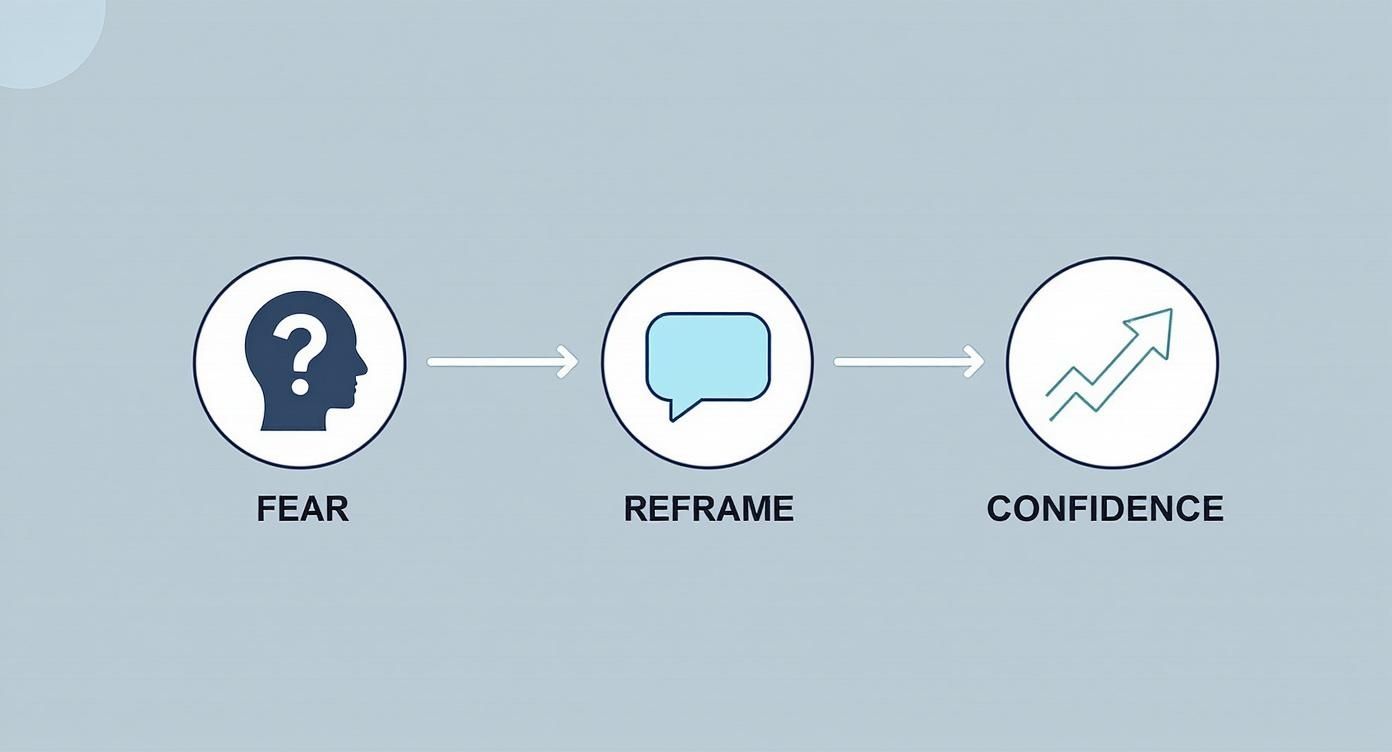
This visual really nails it: confidence isn't something you're born with; it's a direct result of solid preparation and proof of your value. And by the way, consistently demonstrating this level of impact is also the core of learning how to get promoted.
Deconstructing the Full Offer
Finally, remember that base salary is just one piece of the puzzle. At companies like Meta or Stripe, a huge chunk of your total compensation is variable. Before you negotiate, understand every component.
- RSUs (Restricted Stock Units): This is a big one. Don’t negotiate the number of shares. Always negotiate the total grant value (e.g., "$400k vested over 4 years"). This protects you from stock price fluctuations between the offer date and your start date.
- Sign-On Bonus: This is often the most flexible component for a hiring manager. It’s a one-time cash payment typically used to offset an annual bonus you’re leaving on the table or unvested equity from your old job.
- Performance Bonus: Get the details on the target percentage (e.g., 15% of base) and how it's calculated. Is it based on company performance, your team's results, or your individual contribution? The answer matters.
When you have a clear view of each part of the offer, you can be strategic about where you push. This dramatically increases your odds of a successful negotiation.
Executing the Conversation with Proven Scripts
Alright, this is where all your prep work pays off. Knowing what to say—and just as importantly, how to say it—can be the difference between locking in a top-of-band offer and hitting an awkward wall. The goal is to keep the conversation collaborative and positive, while still being firm about the value you bring.
One single piece of tactical advice: always negotiate over the phone or video call, never over email. Communication is so much more than words on a screen. Research has shown that up to 93% of communication's impact comes from your tone of voice and body language, both of which are completely lost in an email. A live conversation lets you build rapport, read the room, and adjust your approach on the fly. Don't hide behind an email.
Handling the Initial Offer
When the recruiter calls with the first offer, your immediate reaction should always be the same. Be genuinely excited and grateful, but never, ever accept on the spot. This is standard practice, and it carves out the space you need to review and plan your counter.
Here's the script:
"Thank you so much for the offer! I’m incredibly excited about the opportunity to join the team and tackle the challenges we discussed. This is a big decision, so I'd like to take a day or two to review the details with my family. Can we schedule a brief call for Thursday afternoon to discuss?"
This script works wonders. It’s positive, professional, and buys you crucial time without putting anyone on the defensive. It shows you're thoughtful and serious—qualities every hiring manager respects.
The Counter-Offer Script
When you get back on that scheduled call, lead with that same enthusiasm before you make your case. Remember, you’re not delivering an ultimatum. You're kicking off a collaborative discussion based on the data you've gathered.
Try this:
"After reviewing the offer, I'm even more excited about the possibility of joining. Based on my research on Levels.fyi and other sources for a Senior PM role at this level in this market, and considering my specific experience driving user engagement up by 20% in my previous role, I was targeting a base salary closer to the $185k-$195k range. I'm confident I can deliver immense value, and I'm wondering if there's any flexibility to get closer to that number."
This script is effective for a few key reasons:
- It’s Data-Driven: You’re referencing the market research you did.
- It’s Value-Focused: You immediately connect your request to a specific, impressive past accomplishment.
- It's Collaborative: Phrases like "wondering if there's any flexibility" open a dialogue instead of shutting one down.
This approach is especially critical for us as product managers. We're expected to make decisions based on evidence, and your salary negotiation should reflect that same data-informed thinking. While these scripts are battle-tested, it never hurts to explore additional resources for conversation scripts tailored for various interactions to sharpen your communication skills even further.
Responding to Common Pushback
Hiring managers often have a few standard responses. Your job is to be ready for them and gently guide the conversation back to the value you provide.
Scenario 1: "This offer is at the top of the band for this level."
- Your Response: "I appreciate you sharing that context. Given my experience with [mention a specific, high-impact skill like scaling a product from 1M to 10M users], I'm confident my performance will align with the top of that band and beyond. Are there other levers we can pull, such as a sign-on bonus or an RSU grant, to bridge the gap?"
Scenario 2: "We don't have the budget for that."
- Your Response: "I completely understand that there are budget constraints. My primary goal is to join the team, and I'm flexible on how we structure the total compensation to reach a number that feels right for both of us. Could we explore a larger equity package or a sign-on bonus to make the total compensation more aligned with the market?"
The key is to show flexibility while holding firm on your overall value. Think of this conversation as your first real test as a PM at this company—you're operating thoughtfully, collaboratively, and with a clear eye on delivering exceptional results. It's a skill that will serve you well in the role, particularly when navigating the unique dynamics of remote product manager jobs.
Leveraging Pay Transparency and Market Trends
The rules of the negotiation game are changing, fast. For what felt like forever, compensation was a total black box. But a wave of pay transparency laws in states like California and New York is finally giving Product Managers the factual leverage we've always wanted. Knowing how to wield this new information is the key to landing a top-tier offer.
When a company posts a salary band—say, $150k – $210k for a Senior PM role—they’re basically showing you their hand. They've given you your anchor. Your job is to read between the lines. An offer at the bottom ($150k) likely means they see you as meeting the baseline requirements. An offer near the top ($210k)? That signals they think you’re an exceptional candidate who blows past their expectations.
Reading Between the Lines of Salary Bands
If an offer comes in at the low end of their own posted range, don't take it as an insult. See it for what it is: an invitation to make your case.
This is your moment to connect your specific experience directly to the higher end of their scale. Your counter isn't just a number you pulled out of thin air; it’s a direct response to the value they’ve already defined.
For instance, you could frame it like this:
"Thank you so much for the offer. I noticed the role was posted with a range of up to $210k. Given my experience scaling a product to 10M+ users and my specific background in enterprise SaaS, I believe my qualifications are a strong match for the upper end of that band. I'd love to explore getting closer to that number."
See how that works? It’s not confrontational. You’re grounding your request in their data, turning a potentially awkward ask into a reasonable, evidence-based discussion. The same logic applies even if you're just breaking into the field; our guide on the typical entry-level product manager salary can help you build that baseline.
Navigating the Current Economic Climate
Of course, a company's salary band isn't the only number that matters. You have to understand broader market trends. While transparency laws are reshaping negotiations, global economic factors still play a massive role.
The good news? Research shows that despite economic caution, real wage growth is actually positive. The forecast is for a global salary increase of 1.7% above inflation. Digging into the details, you'll see salary increase budgets in the United States are hovering around 3.7%, while the Asia-Pacific region is seeing real salary increases of 3.1%. You can discover more insights about these global salary trends to really sharpen your strategy.
Acknowledging these realities can be a power move. It shows you're not just thinking about your own number, but that you're also aware of potential budget constraints. You're demonstrating business acumen—a killer PM trait.
By aligning your personal value with both the company's public salary data and the current market conditions, your request becomes more than just justified. It becomes strategic.
Negotiating the Full PM Compensation Package
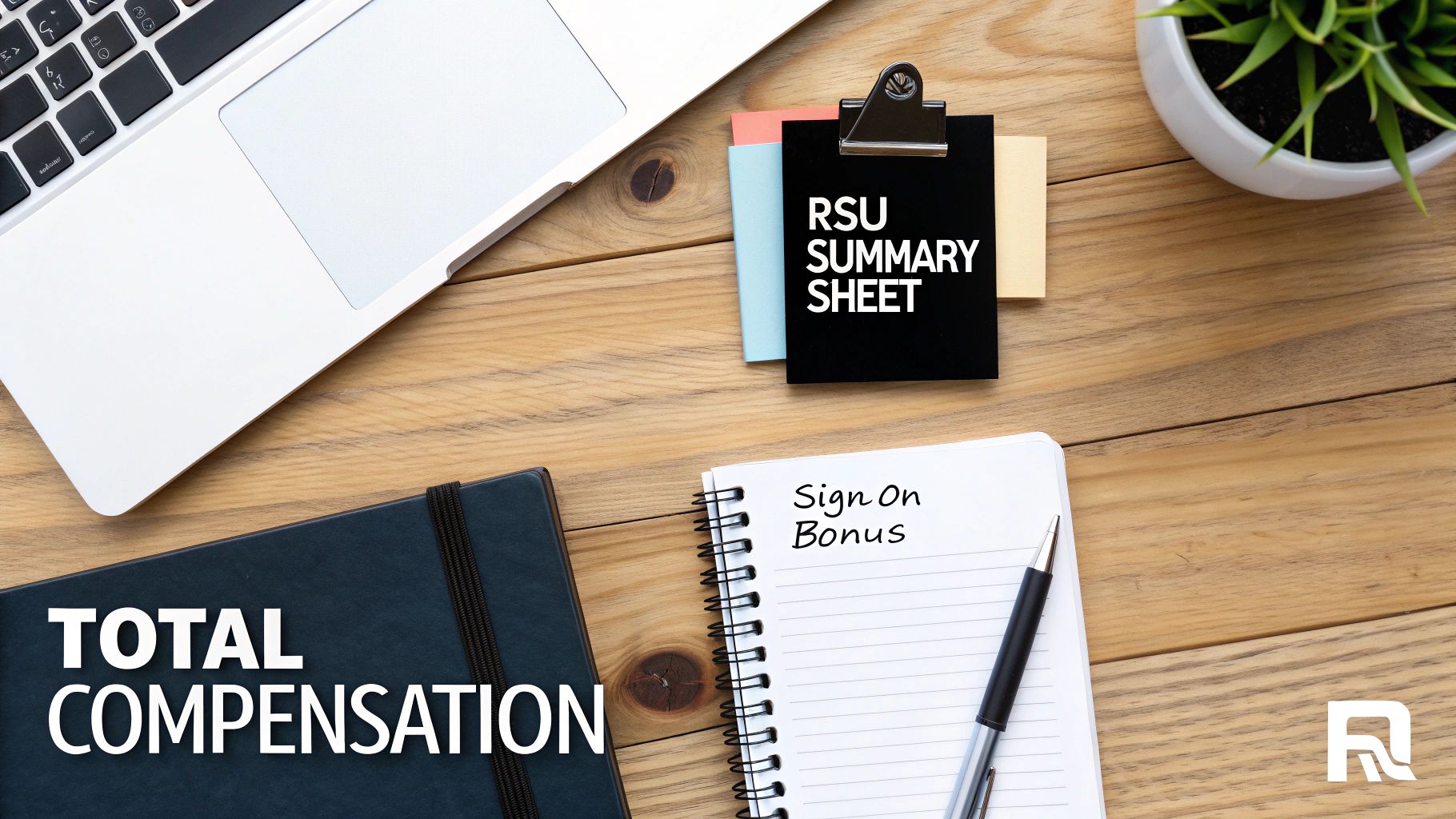
If you're a PM talking to a company like Google or Meta, obsessing over the base salary is a rookie mistake. From my experience hiring dozens of PMs, the sharpest ones know that the base is often one of the least flexible parts of an offer.
The real negotiation happens around the other pieces of your total compensation. Hiring managers usually have a lot more wiggle room on one-time payments or long-term incentives than they do on a fixed salary, which is often locked into rigid internal pay bands. Your job is to find and push on those flexible levers.
Securing Your Sign-On and Equity
One of the most powerful tools in your negotiation toolkit is the sign-on bonus. Its main purpose is to make you whole for any money you're leaving on the table at your current job—think annual bonuses or unvested stock.
When you frame your request this way, it stops being about "I want more money" and becomes a logical ask to cover a real financial loss.
You could say something like:
"By making this move, I'm forfeiting about $40,000 in unvested equity and a pro-rated bonus. A sign-on bonus would really help bridge that gap while I transition over."
See how that works? It’s a data-driven, business-minded request, not just an arbitrary ask.
Now, when it comes to equity, particularly Restricted Stock Units (RSUs), the language you use is everything. A critical mistake I see people make is negotiating the number of shares. The stock price could dip between your offer and your start date, and just like that, your grant is worth less.
Instead, you should always negotiate the total grant value over its vesting period. For example, frame your ask like this: "I'm targeting a total RSU grant of $400,000 vesting over four years." This approach shields you from market swings and keeps the conversation anchored to a clear dollar amount. This is a vital part of learning how to negotiate salary the right way.
Unlocking High-Value Perks
Once you've handled the big cash and equity components, it's time to look at the perks. These non-monetary benefits can add a ton of value to your career and work-life balance, and they're often much easier for a company to say yes to than a direct pay increase.
Think strategically. What would help you grow faster or make your work life better?
- Professional Development Budget: Don't just accept the standard. Ask for a specific, dedicated annual budget for conferences (e.g., Mind the Product), courses (e.g., Reforge membership – $1,995/yr), and certifications. It’s a direct investment in your skills, which is a win for both you and the company.
- Accelerated Performance Review: This is a fantastic, underused tactic. Requesting your first performance review cycle at six months instead of the usual twelve can put you on the fast track for a promotion and the pay bump that comes with it, assuming you kill it in your first half-year.
- Specific Work Arrangements: If the company has a hybrid policy, see if you can negotiate a fully remote setup or lock in specific in-office days. The impact this can have on your quality of life is massive.
Pushing for these kinds of things shows you’re thinking about long-term value, not just a quick payday. And believe me, that’s a quality every hiring manager is looking for in their next product leader.
Common PM Salary Negotiation Questions
Even with the best prep, you're going to have some last-minute doubts creep in. It's totally normal. Over the years, I've heard the same few questions from countless Product Managers I've coached. Here are the straight answers you need.
What If They Ask for My Current Salary?
This question is a classic trap. You should politely, but firmly, sidestep it every time.
Your previous salary has zero bearing on what you're worth to this company for this role. Plus, in many places, including California and New York City, it's actually illegal for them to even ask.
Here’s a professional way to pivot the conversation:
"I'd prefer to focus on the value I can bring to this role and the market rate for this specific position at your company. Based on my research, a competitive range for a Senior PM at a company like yours in this location would be…"
Just like that, you've shifted the focus from your past to your future value. It puts the ball back in their court and anchors the discussion around market data, not your old pay stub.
Can the Company Really Rescind My Offer?
This is the number one fear I hear, and I get it. But let me put your mind at ease: a company pulling an offer just because you tried to negotiate is extremely rare.
Think about it from their side. The hiring manager has already sunk dozens of hours into finding you. They've interviewed tons of candidates and decided you are the best person for the job. They want this to be over just as much as you do.
A polite, well-researched negotiation is an expected part of the hiring dance, especially for senior roles. Frankly, if a company reacts badly to a reasonable request, that's a massive red flag about their culture. You might have just dodged a bullet.
How Do I Negotiate Without a Competing Offer?
A competing offer is great leverage, no doubt. But it's not the only leverage. You can absolutely negotiate effectively without one.
Your power comes from the value you've already demonstrated and the research you've done.
Focus your discussion on a few key pillars:
- Market Data: Anchor everything in objective data. This is where your homework on sites like Levels.fyi pays off. You’re not just saying what you want; you're showing them what the market demands.
- Your Impact: Circle back to specific wins you talked about in your interviews. Connect your past performance directly to their future needs. (e.g., "Given my experience scaling products by 30% year-over-year, I'm confident I can drive similar results for your new platform…").
- Your Enthusiasm: Don't forget to reinforce how excited you are about this specific role, team, and company. Make it clear this isn't just about the money; you genuinely want to be there.
This approach frames your negotiation around your objective worth and excitement for the role, which is a powerful combination on its own.
Ready to master every part of the PM job search and build a standout career? On my site, Aakash Gupta, you'll find the strategies and insights I've used to coach hundreds of product leaders. Explore the resources and join my newsletter for exclusive content.
