To get executives on board, you have to stop talking about product features and start talking about business outcomes. It’s that simple. In the boardroom, the only languages that matter are revenue growth, cost reduction, and strategic advantage. As a Product Manager, your job is to shift the narrative from "here’s what my team built" to "here’s what this unlocks for our business." This guide provides the tactical frameworks I’ve used and seen succeed at top tech companies to get that "yes."
Mastering the Executive Mindset

Here's the single biggest mistake I see Product Managers make: they assume executives care about the product as much as they do.
They don’t. Not even close.
Executives are the custodians of the company's most precious resources—time, money, and people. Their job is to funnel those resources into the initiatives with the highest possible return on investment. Their entire focus is on the P&L, market share, and competitive threats from the likes of Google, Meta, or a disruptive startup.
Your presentation isn’t a product demo. It’s an investment pitch. To get that "yes," you need to start thinking like a venture capitalist and frame your project as the clear solution to a critical business problem.
Speak in Outcomes, Not Features
Stop detailing the technical elegance of your new AI-powered recommendation engine. Instead, connect it directly to a core business metric. You need to reframe the entire narrative to answer the only questions bouncing around their heads:
- How does this drive revenue? ("This feature will increase average order value by 8%, driving an estimated $1.2M in incremental revenue in Q4.")
- How does this reduce costs? ("Automating this process cuts support tickets by 20%, saving $150k annually in operational overhead.")
- How does this increase our market share? ("This positions us to finally capture the underserved enterprise segment, a $50M market we currently can't access.")
This approach immediately signals that you get it—you understand the bigger picture. In a recent McKinsey survey of C-level executives, cost reduction and productivity gains were top priorities. When you frame your project through that lens, you show you're plugged into their immediate challenges.
I’ve watched countless pitches fall flat because they were just a list of features. The ones that actually get funded? They’re presented as rock-solid business cases. A junior PM talks about a new API; a future product leader explains how that same API unlocks a new partnership channel with Salesforce worth $5M in ARR.
To really nail this, you need a fundamental shift in how you think about your presentation's purpose. It's not about showcasing work; it's about securing investment by proving value.
Executive Mindset Shift Your Focus
| Standard Approach | Executive-Focused Approach | Why It Works |
|---|---|---|
| Detailing feature specs and functionality | Quantifying the business impact (e.g., revenue, cost savings) | Executives speak the language of numbers and P&L. |
| Showcasing technical complexity | Highlighting competitive advantage or market differentiation | Their focus is on winning the market, not on engineering marvels. |
| Explaining the "what" and "how" | Emphasizing the "why" and "so what" for the business | This connects your project directly to strategic goals. |
| Requesting resources for a project | Presenting an investment opportunity with a clear ROI | It frames you as a business partner, not just a department head. |
Internalizing this shift is the difference between a presentation that gets polite nods and one that gets a budget approved.
Anticipate Their Core Concerns
Executives are paid to be skeptical. They're constantly weighing risk versus reward. Before you even think about building a slide, you have to get inside their heads, anticipate their toughest questions, and weave the answers directly into your story.
Think about the primary drivers for any senior leader:
- Financial Impact: What’s the ROI? How does this hit our P&L? What’s the payback period?
- Strategic Alignment: Does this actually support our quarterly and annual company goals (OKRs)?
- Competitive Advantage: How does this give us an edge over Google or Meta?
- Resource Allocation: What’s the opportunity cost? If we fund this, what aren't we doing?
When you address these points proactively, you change the dynamic. You’re no longer just a PM asking for resources; you're a strategic partner driving real business value. This mindset is what it takes to truly multiply your impact as a product leader.
The BLUF Framework: How to Win Over Executives in 30 Seconds
Executives are drowning. They jump from one meeting to the next, staring down a tidal wave of emails and Slack messages. They don’t have time for a slow, meandering story that builds to a dramatic reveal. If your most important point is hiding on slide 12, you've already lost them. Worse, you've lost their confidence.
To get through to them, you need to borrow a page from military communication strategy: BLUF, or Bottom Line Up Front.
This means you lead with your conclusion. Your big ask. The ultimate business impact. All within the first 30 seconds. It completely flips the traditional presentation model on its head, but it's the single best way to show respect for their time and immediately frame the entire conversation around a decision.
This infographic breaks down the basic flow of a BLUF-style presentation. Notice how it starts with a powerful hook and drives straight to the point.
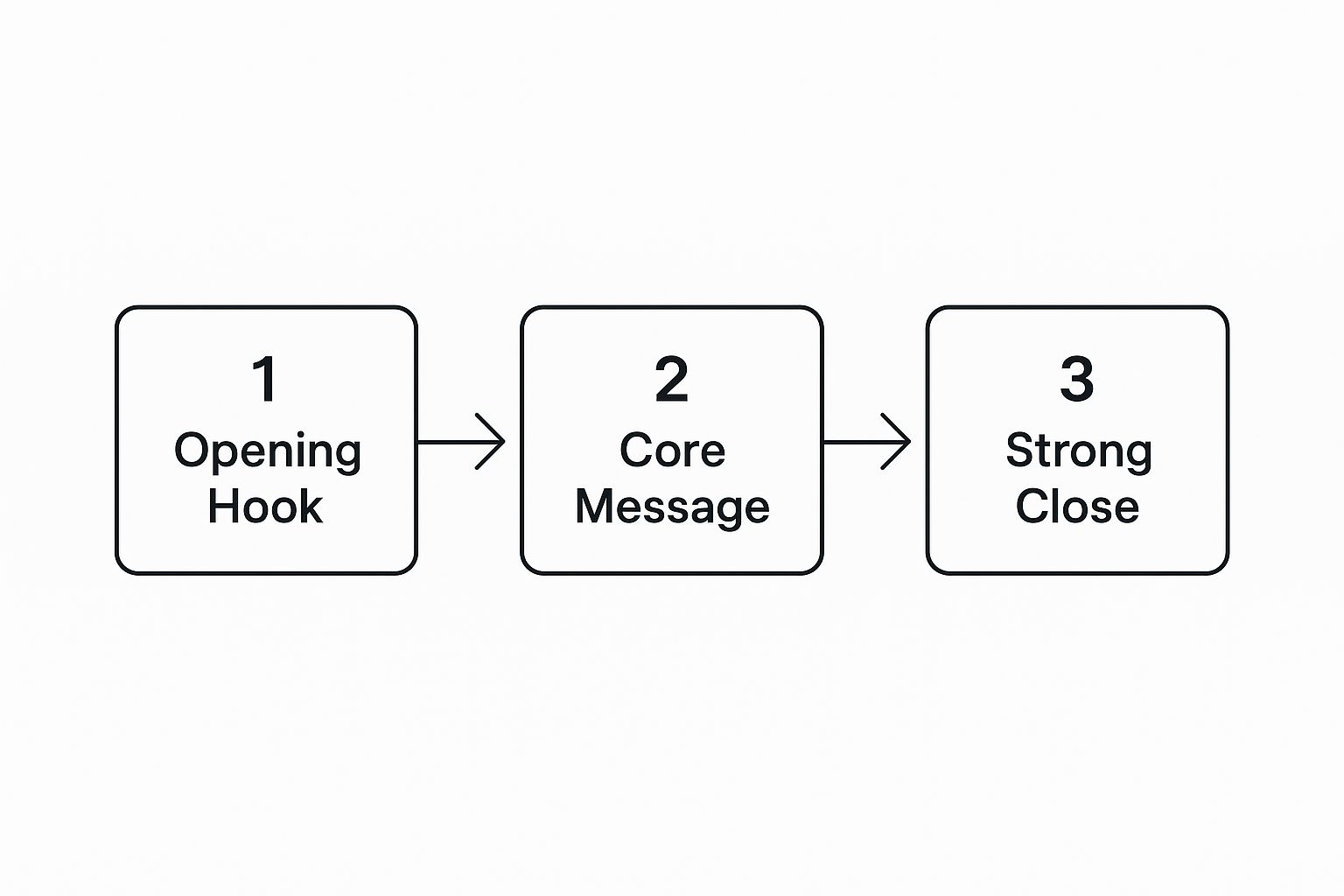
It’s a simple but incredibly effective structure. You lead with your most critical information right away and close with a crystal-clear call to action. No fluff, no suspense.
The Five Pillars of a Killer BLUF Deck
A great BLUF presentation isn't just about blurting out your recommendation. It's a tightly crafted narrative built on five essential pillars. I think of this as the core five-slide sequence that should anchor your entire pitch.
- The Ask: State exactly what you need. No ambiguity. "We are requesting a $750k budget and two senior engineers for Q3 and Q4."
- The Impact: Immediately connect that ask to a high-level business outcome they care about. "This investment will let us launch our new enterprise payment gateway, which is projected to capture 5% of the mid-market segment and generate $4M in new ARR by the end of 2025."
- The Evidence: Hit them with your single most compelling data point. "Our pilot with three beta customers showed a 30% reduction in their transaction processing times. All three have already signed letters of intent."
- The Risks: Show you've thought ahead by addressing the biggest potential roadblock. "The main risk is the integration timeline with legacy banking systems. We've built a mitigation plan that involves a phased rollout, starting with modern APIs first."
- The Next Steps: Clearly outline what happens the moment they give you the green light. "Upon approval, we will finalize the engineering spec by this Friday and kick off the first sprint next Monday."
This five-part structure forces you to be disciplined and clear. It preempts the most common questions you'll get from the C-suite and proves you've considered the entire business case, not just the shiny new features.
A Real-World Scenario: Pitching at Stripe
Let's make this tangible. Imagine you're a Product Manager at Stripe pitching a new feature to handle multi-currency transactions for platform businesses.
A typical presentation would probably start with market trends, customer interview snippets, and a deep dive into the technical architecture. That's the scenic route.
The BLUF approach is the express lane.
You walk into the room, and your very first slide lays it all out:
Ask: $1.2M in funding for "Project Atlas."
Impact: Unlock the $10B global marketplace vertical, projecting $8M in net new processing volume in the first 18 months.
Timeline: Beta launch in 6 months.
Just like that, the entire conversation is framed. The execs know exactly why they're in the room and what decision they're being asked to make. The rest of your (very short) presentation is just providing the essential evidence to back up that first slide.
This is how you demonstrate executive presence and command a room. You’re not there to ask for permission to speak; you're presenting a clear, data-backed business opportunity and leading them toward a logical conclusion.
Crafting a Clear Narrative and Visuals

Executives don't invest in raw data. They invest in compelling stories. Your job as a Product Manager is to be the translator—transforming dense spreadsheets and complex user research into a clear, decisive narrative they can actually act on.
The most common mistake I see is the "data dump." A PM, understandably proud of their team's work, will show slide after slide of charts, metrics, and technical diagrams. But this doesn't project confidence. It creates confusion and signals you don't know what's truly important.
Your real goal is to find the hero metric—that one, maybe two, data points that tell the most powerful story. Then, you build your entire narrative around that single idea.
Transforming Data into a Story
Let's imagine your team just shipped a new onboarding flow. Your first instinct might be to show off a dashboard with twenty different metrics. Resist that urge. Instead, find the one metric that matters most to the business.
Here's the difference:
- Before (The Data Dump): "Here’s our user activity dashboard. We saw a 12% increase in clicks on the tutorial, session duration is up by 4%, and our server response time improved by 50ms."
- After (The Narrative): "Our new onboarding flow drove a 7% increase in Day 30 retention for new users. This directly translates to an estimated $500k in additional LTV this quarter."
See the shift? The second version is a story with a clear business outcome. It connects your team's work directly to revenue, which is the language every executive understands.
The Five-Second Slide Test
Every single slide in your deck must pass the five-second test. Can a CEO glance at it, grasp the main point, and look away? If not, it's too complicated. Burn it.
A slide packed with dense charts and bullet points is a sign of respect for your data but disrespect for your audience's time. A great executive slide has a clear title that states the conclusion and a single, simple visual to support it.
This level of clarity isn't just a "nice to have," it's vital. Neuro-marketing studies show that the human brain is wired for simple, visual storytelling, processing images 60,000 times faster than text. That’s why the most effective presentations I've seen rarely go beyond 10 to 15 minutes. It’s all about laser focus.
The Power of the Appendix
So, where does all that valuable supporting data go? It lives in the appendix or a separate "pre-read" document. This is a brilliant tactic used by PMs at companies like Amazon. The live presentation stays incredibly lean and high-level, focused purely on the story and the decision you need.
But you have all the supporting evidence ready for the inevitable deep-dive questions. When the CFO asks about the financial model or the VP of Engineering wants to see the architecture diagram, you can instantly pull it up. This shows you're not hiding anything; you’ve simply curated the presentation to be as efficient as possible. Building this kind of data-driven narrative often starts with foundational work, and knowing how to approach things like structuring a robust feasibility study is key to having that backup credibility.
This approach demonstrates supreme confidence and preparation. You control the narrative by keeping it simple, but you have all the depth needed to back it up when challenged.
The Art of Pre-Socializing Your Idea
The most important part of your big executive presentation happens weeks before you ever step into that boardroom. A successful pitch is never a surprise. It’s the final, formal step in a quiet campaign you’ve been running behind the scenes.
This is the art of pre-socialization.
Your goal is to walk into that room knowing that every single key stakeholder has already seen a version of your idea. You want to eliminate shocks, build a coalition of supporters, and uncover any hidden landmines before they have a chance to blow up your meeting. Ideally, most of the room is already on your side before you even say "hello."
Your Pre-Meeting Roadmap
First, map the political landscape. Don't just pull up the org chart. Think about influence, not just titles. Who are the real decision-makers, and more importantly, who do they listen to?
Your list needs to include a few key archetypes:
- The Ultimate Decision-Maker: This might be the CEO or a GM. You don't always need to get on their calendar directly, but you absolutely have to make sure their most trusted lieutenants are briefed and on board.
- The Skeptic: Every organization has one. This is the leader most likely to poke holes in your plan. At Google, this person was often referred to as the "designated challenger." Getting their early feedback is a non-negotiable. It’s your chance to address their concerns head-on and potentially turn your biggest critic into an advocate.
- The Cross-Functional Leaders: Think VPs of Engineering, Sales, and Marketing. If they feel blindsided in the meeting, they can easily sink your proposal by raising legitimate operational concerns you never saw coming.
By the time you present, your idea shouldn't feel like your idea. It should feel like our idea—a shared conclusion reached through a series of thoughtful, collaborative conversations with leaders across the business.
Running the One-on-One Previews
Once you have your list, start booking short, 15-20 minute one-on-ones. Keep your calendar invite direct and respectful of their time.
Something simple works best: "Hi [VP Name], I'm putting together a proposal on [Project X] for the exec meeting on the 15th. I'd love to get your early perspective for 15 minutes next week to make sure it aligns with your team's priorities."
In these previews, your job is to listen way more than you talk. You’re on a fact-finding mission.
Ask questions designed to uncover problems:
- "From where you sit, what are the biggest risks I'm not seeing?"
- "How would this actually impact your team's current roadmap?"
- "Is there anyone else you think I should chat with before this meeting?"
This entire process is fundamental to driving cross-functional consensus as a product team and it’s a massive signal of mature leadership. You aren't just pushing your own agenda; you're building a durable, company-wide solution.
This groundwork transforms your final presentation from a high-stakes gamble into a well-orchestrated confirmation of a decision that has, in many ways, already been made.
Delivering with Confidence and Managing the Room

After all the pre-socializing and deck-building, the final piece of the puzzle is you. Your delivery, your composure, and your ability to command the room are just as critical as the data on your slides. This is where you truly earn your stripes as a leader.
Executive presence isn't some mystical quality you're born with; it's a skill you build. It starts with managing your own energy. Before walking in, take a few deep breaths. Stand tall, roll your shoulders back, and remind yourself that you’ve done the work. You’re not there to perform—you’re there to lead a strategic discussion.
Navigating Tough Questions with Poise
Questions aren’t a sign of weakness in your argument—they’re a sign of engagement. The moment a CFO challenges your financial model or a VP questions your timeline, don’t get defensive. Welcome it.
Your response framework should be simple: validate, pivot, and control.
Instead of fumbling for an immediate answer, use phrases that buy you a second to think while projecting confidence:
- “That’s a valid concern, let me walk you through the data on that.”
- “Great question. We looked at that angle closely during our risk assessment.”
- “I’m glad you brought that up. It actually touches on a key dependency.”
This shows you respect their input without letting them derail your narrative. The ability to gracefully handle objections is a core leadership competency. While you might not be selling a product, you are selling an idea, and mastering the art of handling sales objections provides powerful techniques that apply directly to securing that 'yes' in the boardroom.
I once saw a junior PM completely win over a skeptical CEO by responding to a sharp critique with, "That's exactly the blind spot we had in our initial plan. Here's how we've since de-risked it." The CEO's entire demeanor changed because the PM demonstrated adaptability and intellectual honesty, not defensiveness.
Executives will throw curveballs—some intentional, some not. Being prepared for common objections and knowing how to steer the conversation back to your core message is a superpower. How you respond can make or break your credibility.
Handling Executive Objections
| Common Objection/Challenge | Ineffective Response | Strategic Response |
|---|---|---|
| The "Derailer": "This reminds me of a totally unrelated project from 2012…" | "Um, okay. So, back to my slide…" (Dismissive) | "That's an interesting parallel. I'd love to learn more about that offline. For today's decision, let's focus on…" (Acknowledge & Park) |
| The "Scope Creep": "Can we also add X, Y, and Z to this plan?" | "That's not in scope." (Abrupt) | "Those are all valuable ideas for a V2. Let's get this foundational piece approved first to unlock that future potential." (Reframe & Prioritize) |
| The "Data Doubter": "I don't believe these numbers. Where did you get this?" | "Well, the data team gave them to me." (Defensive) | "Great question on the methodology. This data comes from our user analytics platform, filtered for the last 90 days. We can dive deeper into the raw query after the meeting if you'd like." (Provide Context & Offer Detail) |
Mastering these pivots shows you can think on your feet and maintain control without being controlling.
The Art of the Parking Lot
Sometimes, an executive will raise a valid but tangential point that threatens to send the entire meeting off the rails. This is the perfect time to use the "parking lot" method to maintain control.
Acknowledge the point's importance and then professionally table it.
For instance: "That’s a critical discussion we need to have about our long-term platform strategy. To make sure we give it the time it deserves, can I schedule a dedicated follow-up with you and the engineering leads? For today, let's stay focused on the Q3 funding decision."
This simple act validates their contribution while protecting your agenda. It's a key tactic for keeping high-stakes meetings on track.
Reading the Room and Adjusting in Real Time
The best presenters are constantly scanning the room, gauging engagement levels like a pilot reading their instruments. Are people checking their phones? Are they leaning forward, nodding?
If you feel the energy dipping, it's time to adjust.
You might skip a few of your more detailed slides, jump ahead to the core recommendation, or directly engage a quiet stakeholder with a question like, "Maria, from a marketing perspective, how do you see this impacting our brand positioning?"
This real-time adaptation shows you're present and attuned to your audience, not just reciting a script. It’s this dynamic control that separates a good presentation from a great one.
Your Questions, Answered
As an experienced PM leader who has hired and mentored product managers from APM to Director level, I've seen the same challenges crop up repeatedly. Here are my answers to the most common questions about presenting to executives.
How Much Detail Is Too Much for an Executive Presentation?
The rule of thumb I coach my PMs on is the 'one-breath' test. If you can't explain a slide's main point in a single, easy breath, it's too dense. Executives are focused on the "so what," not the "how we got here."
Your main deck should be laser-focused on outcomes, revenue impact, and how your proposal fits into the bigger company strategy. All the granular data, the technical specs, and the nitty-gritty project plans? Move them to an appendix. If a VP wants to go deep, they’ll ask. And you’ll look brilliant when you pull up the exact slide they need.
Your job is to sell the business case, not to narrate the project plan.
What Is the Single Best Way to Start My Presentation?
Lead with your recommendation. Don't bury the lede.
I’m a huge believer in the BLUF (Bottom Line Up Front) framework. Your first 30 seconds should make it crystal clear what you want and what will happen if you get it.
For example: "We're asking for a $500k investment in Project Titan. We project this will let us capture a 10% market share in the enterprise AI space within 18 months."
This approach immediately frames the entire conversation. It shows you respect their time and tells them exactly why they're in the room. All that background information can wait.
In my experience, presentations that start with a clear "ask" get to a decision 50% faster than those that build up to it. Executives appreciate the directness and it frames you as a decisive leader.
How Do I Recover If an Executive Derails My Presentation?
First, don't panic. It happens. The key is to stay composed and validate their point. Something as simple as, "That’s a critical question," shows you're listening.
Then, you have a split-second decision to make: can I answer this quickly, or is this a rabbit hole that will eat my entire time slot?
If it's a major tangent, you need to professionally 'park' it. Try saying something like, "That's a deeper topic that really deserves a focused discussion. To respect everyone's time, can we connect one-on-one after this meeting to do it justice?"
This acknowledges their input as important without letting your entire agenda get hijacked.
Should I Send My Slides Out Before the Meeting?
Yes, absolutely. Sending a 'pre-read' deck 24-48 hours ahead of time is a power move. It’s a standard best practice at companies like Amazon for a reason.
It lets executives show up with context, which means you can spend that precious meeting time on discussion and decision-making, not just walking them through data they could have read on their own.
Keep the email short and sweet. State the meeting's goal and reiterate your core recommendation. This simple step shows you’re prepared and that you value their schedule, setting a positive tone before you even walk into the room.
Ready to accelerate your career and master skills like this? The Aakash Gupta newsletter and podcast provide the actionable insights you need to become a top-tier product leader. Learn more and subscribe.
