As a hiring manager at both Google and Meta, I’ve seen countless brilliant product ideas die. They didn't fail in the market; they failed quietly in some forgotten Confluence or Google Doc long before a single line of code was ever written. That gap between a visionary idea and a mediocre product almost always comes down to one critical skill: the inability to write clear, comprehensive requirements.
This isn't just about bureaucratic paperwork. It's the ultimate de-risking tool for any product. A well-crafted Product Requirements Document (PRD) is the single source of truth that prevents wasted engineering cycles, endless design revisions, and shipping something that technically works but completely misses the user's actual needs. Honestly, this skill is what separates a junior PM from a true product leader. Aspiring PMs often get caught up in strategy and vision—which are essential, don't get me wrong—but the ability to translate that vision into execution-ready instructions is what gets you promoted. It shows you have command of the details and that you respect your team's time.
A job posting for a Senior PM role at Stripe recently listed "authoring detailed product specifications" as a key responsibility, with a salary range of $210,000 – $294,000. That's not a coincidence. Top-tier companies pay a premium for PMs who can eliminate ambiguity and drive execution.
The Actionable Framework for a World-Class PRD
Let's get straight to the point. A great PRD is a blueprint for execution. It's a scannable, data-driven document that tells a story from the high-level "why" down to the granular "what." Here is the non-negotiable structure I expect from my PMs at every level.

This table isn't just a template; it's a checklist to ensure you've de-risked your project. Each component forces you to answer a critical question that prevents failure down the line.
| Component | Purpose & Key Question Answered | Example Snippet (For a Subscription Tracker) |
|---|---|---|
| Problem Statement | Defines the "why." What specific user pain point are we solving? | "Users struggle to track subscription renewals, leading to unexpected charges. 78% of surveyed users have been charged for a service they forgot to cancel." |
| Goals & Objectives | Defines success. What business and user outcomes are we aiming for? | "Reduce subscription churn by 15% in Q3. Increase user engagement with the 'My Subscriptions' page by 25%." |
| User Stories | Frames requirements from the user's perspective. Who is this for and what do they want to achieve? | "As a budget-conscious user, I want to receive a renewal reminder 7 days before my subscription renews, so I can decide whether to cancel." |
| Functional Requirements | Details the "what." What must the product do? | "The system must send an email and a push notification to the user 7 days prior to the subscription's auto-renewal date." |
| Acceptance Criteria | Defines "done." How do we know a user story is complete and working correctly? | "GIVEN a user's subscription is 7 days from renewal, WHEN the daily cron job runs, THEN an email is sent to the user's registered address." |
| Non-Functional Requirements | Covers the "how." How well must the system perform? (e.g., speed, security) | "The subscription status page must load in under 500ms. All user payment data must adhere to PCI DSS compliance." |
Having these components clearly laid out is your best defense against ambiguity. It forces you to think through every detail, ensuring the entire team is building the same product from the same blueprint.
Why Poor Requirements Silently Kill Great Products
When your requirements are vague, engineers are forced to make assumptions. Designers have to guess at user flows. This kind of ambiguity is incredibly expensive, leading to rework, missed deadlines, and a demoralized team. It's the root cause of that dreaded "this isn't what we talked about" conversation that no one wants to have.
The data backs this up. According to a 2025 Project Management Institute (PMI) report, nearly 47% of unsuccessful projects fail due to poor requirements gathering. That's a staggering statistic. It shows that without clear documentation, even the best ideas face what’s basically a coin-flip chance of failure. If you want to dig deeper, you can discover more insights about requirements documentation to understand the broader impact.
A PRD is your contract with the team. It’s a shared understanding that turns an abstract vision into a concrete plan of action. Without it, you’re not building a product; you’re just hoping for the best.
An effective PRD doesn't just guide your immediate product squad. It serves a much wider purpose, creating alignment across the entire company:
- Engineering: Gets the clarity they need to estimate timelines accurately and build the right thing, the first time.
- Design: Understands the user context and constraints, allowing them to create intuitive and effective user experiences.
- Marketing: Can start crafting messaging and go-to-market strategies based on clearly defined user benefits.
- Leadership: Sees a clear, evidence-based plan that connects the team's work directly to business objectives.
Step 1: Gathering Inputs Before You Write a Single Word
A great Product Requirements Document is built on rigorous discovery, not just solid writing. I’ve seen so many junior PMs jump straight into a document, trying to fill out a template. It's a classic mistake.
Experienced PMs know the truth: 80% of the work happens before they ever type the first sentence of a requirement. This section is your playbook for nailing that critical, upfront investigation. This isn't just about "talking to users." It's a systematic process for gathering both qualitative and quantitative evidence. You're building an undeniable case for your product's direction.
The Internal Stakeholder Checklist
Your first port of call should always be your internal teams. They hold the keys to operational realities, hidden constraints, and invaluable customer insights that you simply won’t find anywhere else. Don't just send out a survey; schedule brief, focused conversations with specific goals.
Here’s who I always talk to and what I try to uncover:
- Sales & Account Management: These folks are on the front lines, hearing exactly why deals are won and lost.
- Ask: "What are the top three feature gaps that keep coming up in competitive deals? Are we consistently losing to one competitor like [Competitor Name] because of a specific missing capability?"
- Customer Support: This team lives and breathes user pain points every single day. Their ticket data is an absolute goldmine.
- Ask: "What's the most common 'how do I do X?' ticket you see? If we could wave a magic wand and solve one recurring problem for our users, what would it be?"
- Legal & Compliance: Getting them involved early prevents massive roadblocks later, especially if you're in a regulated industry like finance or healthcare.
- Ask: "Are there any data privacy (like GDPR or CCPA), accessibility (WCAG), or other regulatory hurdles we need to consider for this idea?"
Remember, the point of these conversations is to collect constraints and context. A requirement isn't just what the user wants; it's what the user wants, filtered through the realities of your business.
From User Feedback to Deep Insights
Now it's time to turn outward. Listening to users is, of course, absolutely essential. But you have to go beyond surface-level feature requests. Your real job is to uncover the deep-seated problem, not just write down their proposed solution.
Structuring your user conversations is key. Conducting effective interviews is a craft in itself. A well-run session can reveal motivations a user might not even be consciously aware of. To really master this, you can learn more about how to structure questions and probe for deeper needs by exploring our comprehensive guide on how to conduct user interviews.
Once you have this qualitative feedback, start synthesizing. Look for the patterns that emerge across multiple interviews. Are five different users describing the same underlying frustration, even if they’re asking for five different features? That pattern—that's where the real product opportunity lies.
Synthesizing with Quantitative Data
Qualitative insights tell you why users are struggling. Quantitative data tells you how many are struggling and the sheer scale of the impact. A truly powerful PRD blends both to create a compelling, undeniable narrative.
So, it's time to fire up your analytics tools and see if the data backs up what you heard in your interviews.
- Product Analytics (Amplitude, Mixpanel): If users complained about a confusing workflow, go look at the numbers. Can you see a significant drop-off at a specific step in that funnel? A high degree of user friction there provides the hard evidence you need.
- Business Intelligence (Tableau, Looker): Connect the user problems you've identified directly to business metrics. If the problem is related to account upgrades, for instance, what's the potential revenue impact of customers who abandon that upgrade flow?
To make sure you're gathering comprehensive and accurate information, it helps to lean on established business analysis best practices. This approach helps formalize your data collection, making your final argument that much stronger. By combining direct quotes from user interviews with hard data showing engagement drops or revenue loss, you transform your PRD. It stops being a simple request and becomes a powerful, evidence-based business case.
Step 2: The Tactical Writing Process
Alright, let's get tactical. Once you've done the discovery work, the real magic happens when you translate all those insights into a structured document. A great Product Requirements Document (PRD) isn't a novel; it's a blueprint. It needs to be scannable for an executive but detailed enough for an engineer.
Here's a snapshot of a developer deep in thought, likely wrestling with the functional specs—the very heart of the PRD.
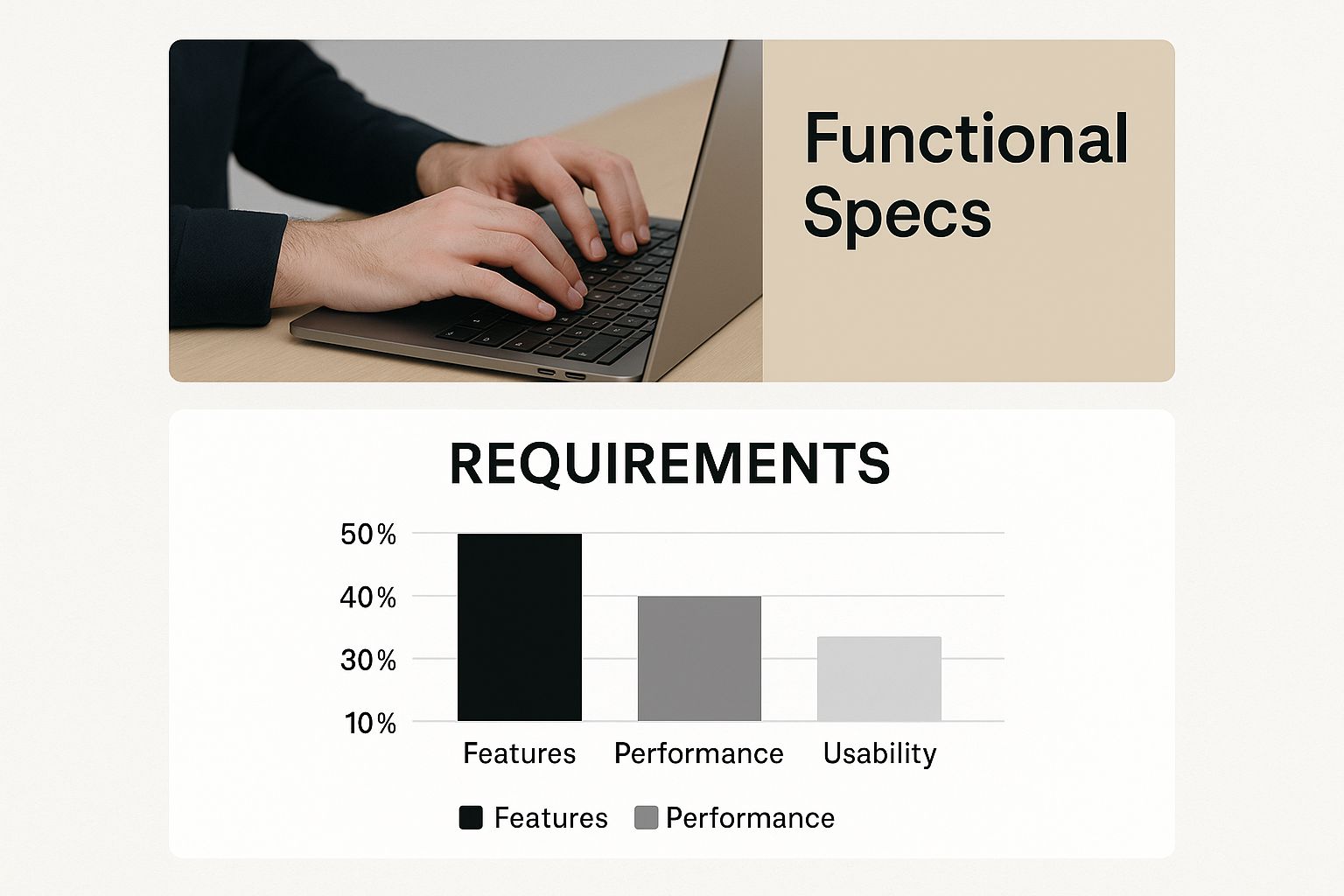
This really gets to the core of it: a PRD's primary job is to turn big-picture goals into specific, actionable tasks for the engineering team.
Functional vs. Non-Functional Requirements
One of the first hurdles for new PMs is getting the hang of functional versus non-functional requirements. It's a critical distinction. If you mess this up, you'll get that dreaded feedback after launch: "It works, but it's so slow."
-
Functional Requirements: These are all about what the system does. They’re the features a user can see and interact with. Think action verbs: "upload a file," "add to cart," "export a report."
-
Non-Functional Requirements (NFRs): These define how well the system does its job. They cover the essential qualities like performance, security, and reliability.
A feature that meets all functional requirements but fails on non-functional ones is a failed feature. A slow, insecure, or unreliable product is a broken product, no matter how many features it has.
This distinction is especially crucial for any SaaS product. You could write a functional requirement for a slick new dashboard, but the NFRs are what make it usable in the real world:
- Performance: The dashboard must load all data widgets in under 2 seconds.
- Security: Access to the dashboard must be restricted based on user roles defined in the admin panel.
- Compliance: All user data displayed must adhere to GDPR and CCPA regulations.
If you don't define these NFRs, you're leaving your engineering team to guess. That's a recipe for performance bottlenecks or security holes that will cost you a fortune to fix later. This table shows the key differences between functional and non-functional requirements, using an e-commerce application as a practical example. Notice how one defines an action, while the other defines the quality of that action.
| Requirement Type | Definition | Example for an E-commerce App |
|---|---|---|
| Functional | Specifies what the system should do. These are the user-facing features and actions. | Users must be able to add a product to their shopping cart from a product detail page. |
| Non-Functional | Specifies how the system should be. These are the qualities and constraints of the system. | The shopping cart page must load in under 1.5 seconds, even with 10 items in the cart. |
As you can see, both are essential. A cart that works but is painfully slow will lead to abandoned checkouts, directly impacting the bottom line. Getting both right is non-negotiable.
Writing User Stories That Inspire Action
Okay, you've got your high-level requirements. Now it's time to break that work down into user-centric chunks. This is where user stories shine. They are the fundamental building blocks of agile development for a reason—they're the best way I've found to communicate what a user actually needs to an engineering team.
The classic format is simple but incredibly powerful:
As a [type of user], I want to [perform some action], so that [I can achieve some goal].
This structure forces you to clarify three vital pieces of information: the audience (who), the action (what), and the motivation (why). That "so that" clause is the most important part. It connects the feature directly to user value and stops the team from just building stuff for the sake of it.
For instance, a vague requirement like "Add CSV export" can be transformed into a much clearer user story:
- Good: "As a Marketing Analyst, I want to export my campaign performance data as a CSV file, so that I can perform advanced analysis in Excel and share it with my leadership team."
Defining Crystal-Clear Acceptance Criteria
A user story tells the team what to build. Acceptance Criteria (AC) tell them how to know when it's done. ACs are basically a checklist of testable conditions that must be met for a feature to be considered complete. They remove all the guesswork and become the foundation for QA testing.
I'm a big fan of the Gherkin format (Given/When/Then) for writing unambiguous ACs:
- Given: A certain context or precondition.
- When: A specific action is performed by the user.
- Then: A particular outcome or result is expected.
Let's apply this to our CSV export story. The ACs might look something like this:
- Given I am logged in as a Marketing Analyst on the campaign dashboard, when I click the "Export" button, then a CSV file named "campaign_performance_[date].csv" begins to download.
- Given the CSV file has been downloaded, when I open it in Excel, then the column headers match the fields displayed on the dashboard.
Ultimately, the clarity of your writing dictates the quality of your product. To craft a PRD that truly stands out, you have to continuously sharpen your communication skills. Check out these expert tips on how to improve writing skills to make sure your requirements aren't just clear, but genuinely compelling.
Step 3: From Draft to Done: Getting Your Team Behind the PRD
A PRD sitting unread in a folder has exactly zero value. Let's be real: getting it written is only half the battle. The real work is turning that document into a shared mission. A piece of paper doesn't build a product—a motivated, aligned team does.
This is where I see a lot of junior PMs stumble. They treat the PRD like a final handoff, a sacred text passed down from on high. But experienced product leaders know the truth: it's a negotiation.
The Socialization Tour: Who to Involve and When
Before you even think about scheduling a big, all-hands review meeting, you need to go on a "socialization tour." These are small, focused 1:1s or small-group sessions. The goal? Build allies, uncover blind spots, and get ahead of any major objections before they blow up in a big meeting.
Here’s the sequence I’ve found works best:
- Engineering Lead First: This is non-negotiable. Before anyone else sees the draft, I'm sitting down with my tech lead to talk feasibility, flag technical risks, and get a gut check on complexity. This builds trust and ensures the PRD is grounded in reality.
- Design Lead Next: With a good sense of the technical landscape, I'll huddle with my design partner. We walk through the user stories. The key question is, "Is this solution not just buildable, but also intuitive? Does it actually solve the user's problem?"
- Key Stakeholders Last: Now, armed with alignment from engineering and design, I’ll approach other players like marketing, sales, and legal.
Walking into those broader stakeholder meetings with your engineering and design leads already on board is a total power move. It shifts the conversation from "can we even do this?" to "how can we all best support this?" It shows you've done your homework and that the core team is united.
Running an Effective PRD Review Meeting
The goal here isn't to read the document out loud. It's to facilitate a discussion that gets you to final alignment.
- Set the Stage: Kick things off by restating the core problem and the number one goal. Anchor everyone back to the "why."
- Focus on the Hot Spots: Guide the discussion to the most complex user stories, the biggest assumptions, or areas of potential disagreement.
- Use a "Parking Lot": When someone brings up an idea that's out of scope, acknowledge it and add it to a "Parking Lot" section in your PRD. This shows you're listening without letting the meeting get derailed.
How to Handle Feedback and Negotiate Trade-Offs
When a stakeholder pushes hard for something new, don't just say "no." Frame it as a trade-off.
Here’s a line I use all the time: "That's a really interesting idea. To prioritize that for this release, which of our current user stories should we push out to make room for it?"
This one simple question reframes the conversation from a limitless wish list into a pragmatic discussion about priorities and impact. It forces everyone to think about the consequences. If you want to go deeper on this, there are a few counter-intuitive PM moves for PRDs that can give you a real edge in these conversations.
Version Control: The Single Source of Truth
Finally, your PRD needs to be a living document, but not a chaotic one. Make sure you're using a tool with built-in version history, like Confluence or Notion. After the review, establish clear rules for changes: any change that impacts scope or timeline requires a conversation with the engineering and design leads. This discipline ensures your PRD remains the team's reliable source of truth.
Writing Advanced Requirements for Complex Products
As you climb the ladder into senior and lead PM roles, you're no longer just creating simple feature lists. Your documents need to become strategic assets that wrestle with complex dependencies, nail down business risks, and tackle sophisticated tech. This is especially true when you're building in high-stakes, regulated environments.

Writing requirements for these kinds of products is a completely different game. Here, ambiguity isn't just a risk; it's a liability. Your ability to think through and document gnarly edge cases, security protocols, and compliance needs is what separates a good PM from a truly great one.
Navigating Regulated Industries Like FinTech and HealthTech
When you're working in sectors like finance or healthcare, the PRD becomes a critical tool for ensuring compliance and security. You can learn more about PRD requirements in regulated fields) to see just how serious this documentation is.
This means your requirements have to be exceptionally precise.
- Data Handling and Privacy: Go deeper than just saying, "we need to be GDPR compliant." Get specific: "User PII (Personally Identifiable Information) must be encrypted at rest using AES-256 and in transit using TLS 1.3. Access to this data is restricted to users with 'Admin' roles and must be logged for audit purposes."
- Security Protocols: Detail the full authentication flow. Instead of "the app should be secure," write: "The user session must time out after 15 minutes of inactivity. All password reset attempts must trigger an email notification to the registered user."
- Audit Trails: For many financial products, having an immutable log of transactions isn't a nice-to-have; it's a legal requirement. Spell out what events create an audit log entry.
In regulated spaces, your PRD is not just a product document; it's an auditable record of your company's intent to comply with the law. Treat it with that level of seriousness.
Defining Requirements for AI and Machine Learning Products
Writing requirements for AI/ML products adds another layer of complexity. You're dealing with probabilistic outcomes, not deterministic logic. An engineer can't just build a model that is "100% accurate," so your PRD has to define what "good enough" actually looks like.
This forces a shift in how you think about and write requirements. Your PRD must clearly state the target performance for the model, which almost always involves a trade-off.
- Precision and Recall: For a fraud detection model:
- Precision: Of all the transactions we flagged as fraud, what percentage were actually fraudulent? (Goal: Don't annoy legitimate customers).
- Recall: Of all the actual fraudulent transactions, what percentage did our model catch? (Goal: Don't lose money to fraud).
- PRD Example: "The fraud detection model must achieve a minimum recall of 95% while maintaining a precision of at least 80% on the validation dataset."
- Latency: For real-time AI features, speed is everything.
- PRD Example: "The OpenAI-powered product description generator must return a response in under 500ms for 99% of requests."
- Confidence Thresholds: You need to define how confident the model needs to be before an action is taken automatically. *"If the model's confidence score for a transaction being fraudulent is below 75%, flag it for manual review instead of automatically blocking it."*
- Fallback Logic: What happens when the model fails? You always need a backup plan. "If the personalization service fails to respond within 200ms, the system must fall back to showing the default, non-personalized homepage."
Common PRD Questions Answered
Even with the best templates in the world, you're going to have questions when the rubber meets the road. Moving from theory to actually writing product requirements always surfaces a few common sticking points.
These are the questions I hear over and over from the PMs I mentor. Here are my straight-up, no-fluff answers.
How Detailed Should My Product Requirements Be?
The honest answer is: it depends on your team. There's no magic formula here, and a seasoned PM knows how to dial the level of detail up or down.
If you're working with a mature, co-located team, you can probably get by with high-level user stories. They have shared context and trust. In that environment, being overly prescriptive can kill creativity.
On the other hand, if you're wrangling a distributed team across different time zones, or working on a project with heavy compliance needs (hello, FinTech!), you need to be way more explicit. You'll have to spell out logic, error states, and data flows with precision.
Here's a great gut check: ask yourself, 'Could a brand new engineer, with zero context on this project, build this feature with only a few clarifying questions?' If the answer is no, you probably need to add more detail. Your job is to provide enough clarity to prevent bad assumptions, not to write a technical spec for them.
What Is the Difference Between a PRD and User Stories?
This trips up a lot of people, but the difference is really about altitude. Think of them as serving different levels of planning—they aren't interchangeable.
A Product Requirements Document (PRD) is the strategic document. It defines the "what" and "why" for an entire product or a massive new feature. Its main audience is leadership, stakeholders, and other teams who need to grasp the big picture and the business case.
User Stories, in contrast, are the tactical units of work for an agile team. They're the ground game. They break down the grand vision from the PRD into the smallest possible slices of value you can ship to a user.
It’s a hierarchy, really:
- PRD: Sets the strategic destination for a major initiative (e.g., "Build a new subscription management portal").
- Epic: A big chunk of work within that PRD (e.g., "Allow users to cancel their subscription").
- User Story: A specific, buildable task for a single sprint (e.g., "As a user, I want to see a confirmation modal before my cancellation is final, so that I don't cancel by accident").
The PRD is the map to the destination; user stories are the turn-by-turn directions for the next two weeks.
What Are the Best Tools for Managing PRDs?
Look, you can write a PRD in a Google Doc. But as you scale, dedicated tools offer way better integration, version control, and collaboration features. The best tool is always the one your team will actually use consistently.
-
Confluence: Still the undisputed king, especially for any team in the Atlassian ecosystem. Its killer feature is the seamless integration with Jira, letting you link requirements directly to engineering tickets. It’s the default choice for a reason at most established tech companies.
-
Notion: The flexible, powerful upstart that has won over countless startups. Notion's clean UI and powerful databases make it an amazing tool for creating dynamic PRDs that connect to everything else your team is working on.
-
Aha! or Productboard: These are full-blown product management platforms. Tools like Aha! or Productboard are a great fit for larger enterprise teams who need to tie requirements directly to a strategic roadmap, idea management, and customer feedback loops.
Ultimately, your choice should match your company's existing workflow and tech stack. The goal is clarity and alignment, and the right tool should make that easier, not harder.
At Aakash Gupta, we provide the frameworks, insights, and career guidance you need to excel as a product leader. Explore our resources to deepen your expertise and accelerate your career growth at https://www.aakashg.com.
