If you believe marketing is just the department that makes ads, you’re on the fast track to building a product nobody uses. The most common mistake I see in aspiring and even mid-career PMs is this dangerous separation: "I build it, they sell it." That's a career-limiting mindset.
The modern PM, especially at top-tier companies like Google or Meta, owns the entire customer journey. Your product isn't just the code; it's the first ad, the landing page, the onboarding flow, and the first "aha!" moment. Distribution and user acquisition are features you must design and build.
This guide provides the frameworks and tactical plays I've used to hire, mentor, and lead high-performing PMs. We'll skip the theory and get straight to the how-to, with specific examples and tools you can apply within 48 hours to connect your product work directly to market success.
Your PM vs. PMM Responsibility Matrix (And Why It Matters)
Let's start with the most common point of friction: the PM vs. Product Marketing Manager (PMM) relationship. A bad handoff here can kill a great product. The key is to see it as a strategic partnership, not a territorial battle.
As a hiring manager, I view the PM as the voice of the user inside the product ("What problem are we solving?") and the PMM as the voice of the product to the market ("How do we message the solution?").
Here is the exact matrix we use to define roles and ensure a seamless collaboration across the product lifecycle. Use this to clarify responsibilities with your PMM counterpart this week.
PM vs PMM Responsibility Matrix Across the Product Lifecycle
| Lifecycle Stage | Product Manager (PM) Core Focus | Product Marketing Manager (PMM) Core Focus | Key Collaborative Output |
|---|---|---|---|
| Discovery | Identifying user problems and needs through research; defining "what" to build. | Analyzing market landscape, competitive positioning, and defining the target audience (TAM/SAM/SOM). | Validated Problem & Market Opportunity: Agreement on the core user problem and its $ business potential. |
| Development | Prioritizing features, writing user stories, managing the backlog, and guiding the engineering team. | Developing core messaging, value propositions, and initial Go-to-Market (GTM) channel strategy. | Product-Market Fit Narrative: A clear story connecting product features to market needs, ready for launch. |
| Launch | Ensuring the product is stable, scalable, and delivers on the core value proposition at launch. | Executing the GTM plan, creating sales collateral (battle cards, one-pagers), and managing launch comms. | Successful Go-to-Market (GTM): A coordinated launch that hits the target audience with the right message. |
| Growth/Maturity | Analyzing product usage data (Amplitude, Mixpanel), iterating on features to improve activation and retention. | Running marketing campaigns, gathering customer feedback, and enabling the sales team to drive adoption. | Growth & Optimization Plan: Data-driven strategies for user acquisition, retention, and revenue expansion. |
This isn't just theory. The best PMs at companies like Google and OpenAI live by this kind of structured collaboration. They understand that a brilliant product nobody can find or understand is a failed product.
The End of Silos: Why Distribution is a Product Feature
That old, imaginary line between building the product and taking it to market has completely dissolved. This isn’t about you becoming a full-time marketer. It’s about weaving marketing thinking into the very DNA of your product from day one.
From the earliest stages of development, you should be asking questions like, "How will this new feature support our go-to-market plan?" or "What in-product viral loops can we build to drive user acquisition on its own?"
The most dangerous mindset for a PM is 'I build, they sell.' The modern PM understands that building and selling are two sides of the same coin. Your job is to design a product that is not only useful but also discoverable and desirable.
This isn't just a philosophical shift; it’s a hard business reality. The data shows that the most successful companies are the ones that break down these walls. For instance, projections for 2026 show that 78% of salespeople find their CRM systems effective for improving sales and marketing alignment. This isn't just a stat; it signals a fundamental change where distribution strategy and go-to-market execution are no longer afterthoughts but core product responsibilities. You can dig into more data on this trend in HubSpot's latest marketing statistics.
Think of the entire customer journey as your product canvas. You're not just creating features in a vacuum; you're architecting an end-to-end experience. It starts with that first marketing touchpoint and culminates in a valuable, long-term relationship. Mastering this holistic view is the new superpower for any PM who wants to lead and have real impact.
Your Go-To-Market Playbook for Product Success
I’ve seen too many brilliant products fail because they were treated like a rocket ship with no launchpad. As a product leader, your job isn't just to oversee the build; you must architect its successful entry into the market.
The single most effective tactic I’ve implemented is this: bake your Go-To-Market (GTM) plan directly into your product requirements document (PRD) from day one.
When you do this, you force yourself and the team to treat distribution and positioning as core features, not last-minute additions. Marketing stops being a separate team you hand things off to and becomes part of the product’s DNA.
Defining Your Target and Message
First things first: Who are we building this for, and what do we need to tell them? This is where you, the PM, bring deep user knowledge—the real story behind the problem you're solving. Your marketing partners bring channel expertise.
Together, you nail down:
- Ideal Customer Profile (ICP): Go beyond demographics. What are their specific goals, pain points, and "jobs to be done"? Where do they hang out online (e.g., specific subreddits, LinkedIn groups, newsletters)? Example: "Mid-market FinTech compliance officers struggling with manual audit trails."
- Value Proposition: What is the single, compelling promise you're making? It must be simple and clearly state why you're better than the status quo (which is often Excel or doing nothing).
A powerful value proposition isn't a laundry list of features. It's the specific, desirable outcome a person gets from using your product. It’s the "so what?" that makes them stop scrolling.
A simple one-page positioning statement is a lifesaver here. It forces clarity on your target customer, their need, your product, its category, the key benefit, and the primary competitor.
This process sets up the first critical steps of the user's journey: getting their attention (awareness), getting them to try the product (acquisition), and getting them to see the value (activation).
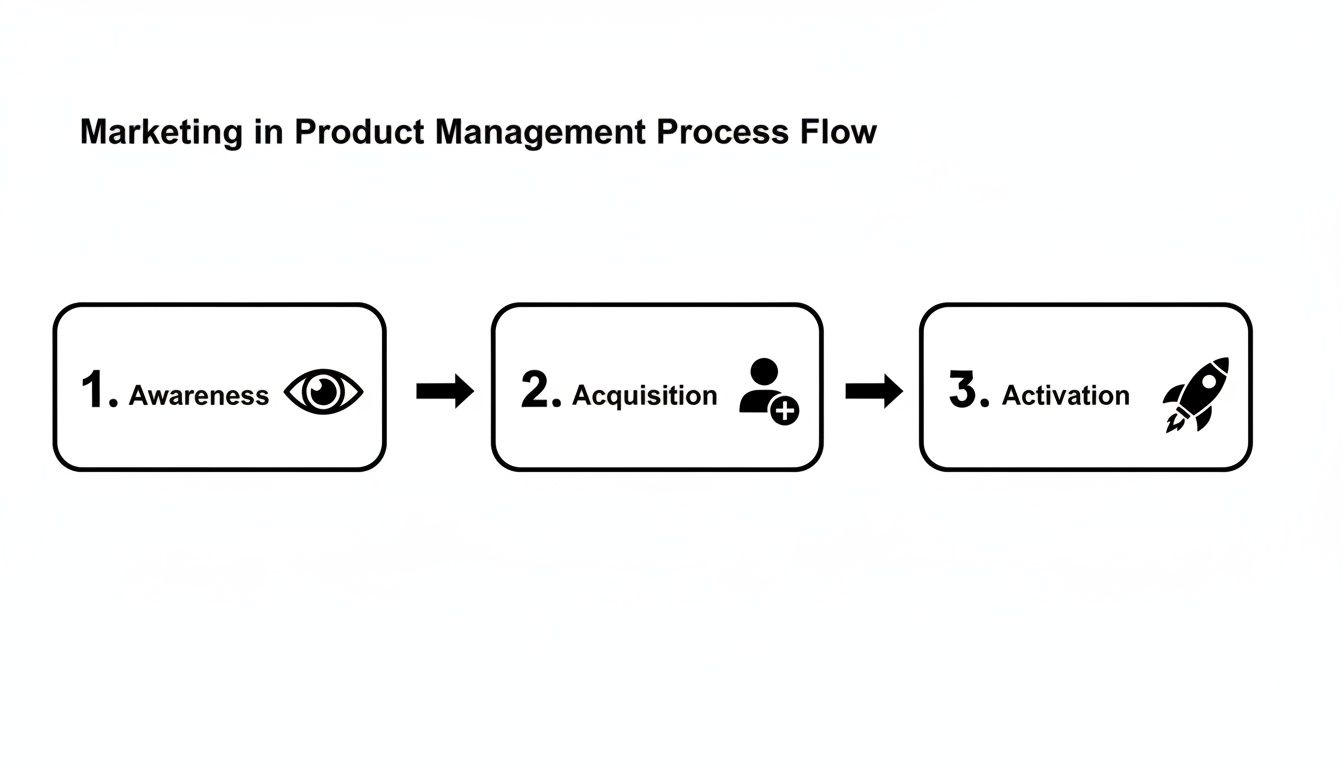
As you can see, a great GTM strategy is a connected flow where the awareness you build with marketing leads directly into a product experience that delivers on the promise.
Mapping the User Journey from Click to Conversion
Once you know who you're talking to and what you're saying, you must own the handoff from marketing campaign to product experience. This is the core of marketing in product management.
Let's say Figma is launching a new AI feature. The PM's job goes way beyond just shipping the code. They work with marketing to architect the user's path:
- The Ad (Awareness): A LinkedIn ad targets designers, highlighting how the AI feature saves them 10 hours a week on repetitive tasks.
- The Landing Page (Acquisition): Clicking the ad takes them to a page that repeats the "10 hours saved" value prop, shows a 30-second demo GIF, and has a clear CTA.
- The Onboarding (Activation): The moment they log in, an in-product tooltip guides them straight to that new AI feature and prompts them to try the exact action shown in the ad.
When you align these three steps, you avoid that awful, jarring experience where a marketing promise leads to a confusing product reality. You can get into the nitty-gritty of building a complete plan with a solid go-to-market strategy framework.
To ensure a flawless launch, use a detailed product launch checklist. This keeps every team on the same page and ensures nothing falls through the cracks. By owning the GTM playbook, you're not just launching features; you’re engineering success in the market.
Mastering the Marketing Metrics That Matter to PMs
If you're a product manager, you can't just toss marketing metrics over the fence anymore. Numbers like Customer Acquisition Cost (CAC) and Lifetime Value (LTV) aren't just for the marketing team's dashboard; they're vital signs for your product's health. A rising CAC could be the first sign that your product-market fit is slipping. Your product decisions directly impact these numbers.

The best PMs I hire are expected to connect their work to business outcomes. It's no longer enough to just ship features. The pressure is on to prove your impact, even though recent data shows that a staggering 84% of product teams aren't confident in their ability to measure it. To see this trend in action, check out these insights on outcome-based accountability.
PMs who can fluently speak the language of growth and tie their roadmap to marketing metrics build massive influence and see their careers take off.
Your PM-Focused Metrics Dashboard
A classic mistake I see is tracking too many metrics, which just creates noise. You need a focused dashboard that tells a clear story about the user's journey. Before we dive in, it's crucial to understand the difference between a KPI and a metric. A metric measures activity; a KPI tells you if you're making progress toward a strategic goal.
Here’s a breakdown of the essential metrics that every product manager should be reviewing weekly.
Essential Marketing Metrics for Product Managers
This table cuts through the noise to show you which marketing KPIs matter most from a product perspective, what they signal, and how you can directly influence them.
| Metric (KPI) | What It Measures | Why It Matters to a PM | Example PM Action |
|---|---|---|---|
| Customer Acquisition Cost (CAC) | The total cost to acquire a new customer (Marketing Spend / New Customers). | This shows how efficient your GTM strategy is. A rising CAC can be a red flag for declining product-market fit or a clunky onboarding experience. | If CAC is spiking for a key channel, dig into the user journey from the ad all the way to activation. You might find a major disconnect between the ad's promise and the product's first-run experience. |
| Lifetime Value (LTV) | The total revenue you expect to earn from a single customer over their entire relationship with your product. | LTV is a direct reflection of your product's long-term value and stickiness. An LTV to CAC ratio of at least 3:1 is the gold standard for sustainable growth. | To boost LTV, you could prioritize features that drive repeat engagement or build natural upgrade paths that nudge users toward higher-value subscription tiers. |
| Monthly Recurring Revenue (MRR) Churn Rate | The percentage of revenue you lose from existing customers each month. | This is your product's "leakiness." A high churn rate means your product is a leaky bucket—no amount of marketing spend can fix a product people won't stick with. | Run a cohort analysis on users who've churned. See if a recent feature launch or UI change lines up with a spike in churn, and if so, make fixing it your top priority. |
| Activation Rate | The percentage of new users who complete the key action that unlocks your product's core value—the "aha!" moment. | This is the ultimate measure of your onboarding's success. If activation is low, it means users aren't "getting it," no matter how great your marketing is. | A/B test your onboarding flow. Try an interactive tutorial versus a simple video walkthrough to see which one gets more users to that "aha!" moment faster. |
These four KPIs give you a powerful, high-level view of how well your product and marketing efforts are working together to drive real business growth.
Using AI to Forecast Metric Impact
You don't have to ship a feature and wait three months to see if it moved the needle. With modern AI-powered analytics tools, you can run predictive analyses to forecast the impact of your roadmap decisions before you even write the first line of code.
The most powerful question a PM can answer is not "What will this feature do?" but "How will this feature impact our LTV and Churn Rate?" Forecasting with AI gives you the data to answer that confidently.
This changes the game. Here’s a prompt you can adapt for AI analytics tools like Amplitude or Mixpanel to model a new feature's potential impact:
AI Analytics Prompt Example
"Run a predictive cohort analysis. Compare users who completed 'Action A' (our current core action) with users who also completed 'Action B' (our proposed new feature). Forecast the 90-day retention and LTV for both cohorts, assuming the adoption rate for 'Action B' is 15% among new signups. Highlight the projected lift in overall LTV if we ship this feature."
By truly mastering these metrics and using today's tools to analyze them, you stop being just a feature manager. You become a genuine growth driver—and that’s one of the most important leaps you can make in your product career.
Turn Your Product into a Growth Engine (PLG Tactics)
The old marketing playbook was to drag users to the product's front door and hope the product team built something sticky. But companies like Slack and Dropbox flipped that model on its head. They realized their product wasn't just a destination—it was their single most powerful marketing engine. This is the heart of Product-Led Growth (PLG), a strategy where the product itself is responsible for acquiring, activating, and upselling users.
As a PM, this means you're no longer just building features. You’re architecting an experience that sells itself.

This shift demands you think like a growth marketer. It boils down to three core strategies that can transform your product into a self-powering growth loop.
1. Get to the "Aha!" Moment, Fast
In a PLG world, your number one job is to guide users to their "aha!" moment as quickly and painlessly as possible—that magical instant where they experience your product's core value.
Calendly is an absolute masterclass in this. Seconds after signing up, you’re connecting your calendar and setting your availability. You share your link, and like magic, your first meeting gets booked. That's the "aha!" moment—the product delivered on its promise, no human intervention needed.
As a PM, your obsession should be ruthlessly cutting out every single bit of friction between signup and that first taste of value. Every extra form field, every confusing step, every unnecessary click is a hole in your acquisition bucket.
If you want to go deeper on this, you can learn more about crafting an effective product-led growth strategy and see how to put it into practice.
2. Build Virality into the Core Loop
The holy grail of PLG is a product that users can’t stop themselves from sharing. This isn’t about just adding a "Share on Twitter" button. It’s about designing features that are inherently social and become exponentially more valuable as more people join.
Think about Miro's collaborative whiteboards. Using it alone is almost pointless. The real power is unlocked the second you invite your team to brainstorm with you. Every single time a user shares a board, they're acting as a salesperson for Miro, creating a powerful viral flywheel.
As a PM, you need to be constantly asking:
- How can we make using this feature with others the default, most natural way to work?
- What’s the incentive for a user to invite a colleague? Does it unlock a feature or solve their problem faster?
- Does the product get 10x better with each new person added to a team or project?
3. Use the Product to Drive Expansion
Once a user is activated, the product itself should guide them toward deeper features and a paid plan. This is about using product data to trigger the right upgrade message at the perfect time.
Dropbox has been doing this brilliantly for years. The moment you start bumping up against your free storage limit, a perfectly timed prompt appears offering an upgrade. It’s not a pushy sales pitch; it’s a helpful solution to an immediate pain point.
Here's a quick audit you can run on your product this week.
The Product-Led Audit Checklist
- Onboarding: Can a new user get to the "aha!" moment in under 5 minutes, without talking to a person?
- Virality: Are there core features that naturally require users to invite others to get the full value (e.g., sharing a doc, assigning a task)?
- Expansion: Does the product automatically prompt users to upgrade when they hit a usage limit or try to access a clearly marked premium feature?
- Value Delivery: Is your free/trial version generous enough for users to experience the core value, making an upgrade a no-brainer?
When you build these principles into your roadmap, you stop just making something people want. You start making something people want to discover, share, and pay for—all on their own.
How PMs Can Leverage AI for Marketing
AI isn't coming for your job as a product manager. But PMs who refuse to adapt will be replaced by those who do.
For PMs who embrace it, AI is the single biggest force multiplier for marketing impact we've seen in a decade. It’s about moving faster, making smarter bets, and drawing a straight line from your product work to real growth. We’re not using AI as a magic wand, but as a scalpel to dissect problems and build solutions with ridiculous speed.
Instantly Generate Go-To-Market Artifacts
One of the most immediate wins is using Large Language Models (LLMs) like GPT-4 or Claude 3 to kickstart your GTM planning. Drafting foundational documents like positioning statements or user personas used to be a multi-day slog. Now, you can spin up a solid first draft in minutes.
This isn't about outsourcing your thinking. It's about getting from a blank page to a 70% solution almost instantly. Your job is to then apply the final 30% of refinement, validation, and critical market context that only you, the PM, can bring.
Your expertise is the final 30%. AI handles the grunt work of structuring and initial drafting, freeing you up to focus on the high-level strategy and nuance that truly drives market success.
Here's a specific prompt you can use today to generate a data-informed user persona.
AI Prompt for Persona Generation
"Act as a Senior Product Manager at a B2B SaaS company. Our product is an AI-powered code completion tool for enterprise developers. Using our customer interview transcripts [insert or link to data], create a detailed user persona for our primary user, 'Alex the Senior Engineer.' Focus on their daily workflows, core pain points with code quality and speed, their career goals, and the specific technical challenges they face that our product solves. Format the output as a one-page document."
Uncover High-Value Segments Automatically
Beyond generating text, AI-powered analytics platforms are changing how we approach marketing segmentation. Tools like Amplitude now use machine learning to automatically surface behavioral cohorts you’d likely never find on your own.
Instead of guessing which users are most likely to convert, these tools can analyze millions of data points and deliver actionable insights like: "Users who invite at least two teammates and use 'Feature X' within their first 24 hours have a 300% higher LTV."
This fundamentally changes your role. You're no longer just staring at dashboards; you're getting proactive, data-backed recommendations for where to focus. You can then arm your marketing team with this intel to build campaigns aimed squarely at these high-value segments. For a deeper look at the tools out there, our comprehensive guide on AI tools for Product Managers is a great starting point.
A PM's AI Marketing Toolkit
Weaving AI into your daily grind means having the right tools and prompts ready to go.
- For Market Research & Synthesis: Use tools like GPT-4 or Claude 3 to summarize user interview transcripts, spot recurring themes in support tickets, and draft initial competitive analysis reports.
- For Content & Messaging: Use a copywriting AI like Jasper to brainstorm dozens of ad copy variations, landing page headlines, and email subject lines for your next A/B test. For a quick win, you can even generate highly effective AI-powered cold email prompts.
- For Analytics & Segmentation: Lean on the AI features in platforms like Amplitude or Mixpanel to run predictive analyses and flag user segments with the highest potential for upsell or churn risk.
By folding these specific AI workflows into your process, you're not just doing the same job faster. You're making sharper, data-informed decisions and forging a stronger bond between your product and its market.
Advance Your PM Career with Marketing Expertise
If you want to climb the ladder in product management and see your salary climb with it, you need to stop thinking only about shipping features. The PMs who land the most senior—and highest-paying—roles are the ones who can draw a straight line from their product strategy to real business growth. It’s about proving you can move the needle on market share, user acquisition, and revenue.
What Top Companies Are Looking For
Go pull up job descriptions for Senior or Principal PM roles at Google, Meta, or any fast-growing startup. The language shifts from "shipping features" to owning business outcomes.
You'll find phrases like:
- "Owns the go-to-market (GTM) strategy from ideation to launch." (Meta, Senior PM, Monetization)
- "Responsible for driving key growth metrics, including user acquisition and activation." (Stripe, Product Lead, Growth)
- "Defines and executes the product roadmap to capture market share." (Google, Principal PM)
These aren't buzzwords. They're a clear signal that the company is looking for a business owner. A PM with a track record of launching products that acquire and keep users is rare, and they command a serious premium.
The compensation gap is real. PMs who can point to specific growth metrics they've moved on their resume—like a 20% reduction in Customer Acquisition Cost (CAC) or a 15% lift in activation rate—are consistently paid more. We're seeing roles with "growth" or "GTM" in the title carry a 10-25% salary premium over more technically-focused PM roles at the same level. A Senior PM in San Francisco might make $180k, while a Senior PM, Growth could command $220k+.
A Roadmap for Building Your Marketing Acumen
You can start building this muscle right now, no matter your level. It comes down to reframing your work around market impact.
- For Aspiring PMs: Don’t just stop at the prototype for your side project. Build a one-page GTM plan. Define your user, value prop, and distribution channels (e.g., post on Product Hunt, share in 3 specific subreddits). This shows you're already thinking like a business owner.
- For Entry to Mid-Career PMs: The next time a launch comes up, volunteer to partner with the PMM. Ask to own the success metrics for the launch campaign. Get your hands dirty analyzing how your features are affecting activation and churn using a tool like Amplitude.
- For Senior PMs & Leaders: Your focus must be on the business P&L. Stop presenting just a feature roadmap. Instead, present a plan to grow revenue in a new market segment by $5M over the next 18 months, outlining the product and GTM initiatives required. If you're looking to switch careers, understanding the journey from product marketing to product management offers a fantastic lens on how these two critical functions intersect.
When it comes time to update your resume, don't just list what you built. Quantify the business impact your work had. That’s how you prove you're ready for the next level.
Frequently Asked Questions
What Is the Difference Between a Product Manager and a Product Marketing Manager?
The Product Manager (PM) is the voice of the customer inside the company. They are obsessed with defining the "what" – what problem are we solving, and what is the right product to solve it? Their primary job is shipping a valuable, usable product.
A Product Marketing Manager (PMM) is the voice of the product to the market. They own the "how" – how do we tell the world about this solution? They define positioning, messaging, and the go-to-market plan. Put simply: a PM builds the right product; a PMM makes sure the right people find out about it.
My Company Has No PMM. What Should I Do?
This is normal in smaller companies. When there’s no PMM, you, the PM, must own the "minimum viable marketing" plan. The key is not to try and be a full-time marketer.
Your goal isn't to run a perfect marketing campaign. It's to ensure your product doesn't launch into a vacuum. A simple, PM-led go-to-market effort is infinitely better than no effort at all.
Start with a one-page positioning doc. Define your target customer, their pain point, and your unique value. Then, execute the simplest possible launch: a blog post, an email to your user base, and a few social media updates are often enough to get started.
As a Technical PM, How Can I Start Building Marketing Skills?
Your deep product knowledge is a huge advantage. The trick is translating features into a compelling customer story. Here's a tactical first step: write the announcement blog post before you finalize the product requirements.
This exercise forces you to think like a customer. What headline grabs their attention? What benefits—not features—will you lead with? Which specific pain point are you solving? This document becomes your North Star, aligning technical decisions with what the market actually cares about. It's the fastest way to start your journey into marketing in product management.
Learn how to master this and other essential PM skills with Aakash Gupta's newsletter and podcast, designed to help you advance your product career. Join thousands of PMs at https://www.aakashg.com.
