As a Product Manager in the marketplace space, your career hinges on one thing: mastering growth. The path from an empty platform to a thriving, liquid ecosystem is paved with specific, strategic choices that separate category leaders like Airbnb and Uber from the graveyard of failed startups. This isn't about vague theories; it's about a concrete playbook for implementing effective marketplace growth strategies.
Having hired, mentored, and worked with Product Managers at companies that successfully solved the infamous chicken-or-egg problem, I've seen firsthand that the difference is always in the tactical execution of proven frameworks. True success in this domain requires a deep understanding of the platform dynamics and the ability to act as a skilled marketplace maker, orchestrating both supply and demand to build momentum. This role is foundational for any PM aiming to build a dominant platform.
This article breaks down the 10 most potent marketplace growth strategies into actionable frameworks you can implement immediately. We will move beyond the buzzwords to provide you with:
- Step-by-step implementation guides for each strategy, including specific prompts for AI tools.
- Real company examples from platforms like DoorDash, Meta Marketplace, and ClassPass.
- Key metrics to add to your product dashboards for tracking success (e.g., Time-to-Fill, Utilization Rate).
- Tactical salary data for PMs specializing in marketplace growth.
Our goal is to give you a definitive resource to build defensible moats and accelerate your platform’s journey to critical mass. These are the strategies that not only drive platform liquidity but also accelerate your career to the next level. Let's dive in.
1. Engineer Virality with Network Effects Optimization
Network effects are the bedrock of any defensible marketplace. This growth strategy moves beyond hoping for organic word-of-mouth and focuses on deliberately engineering the product to become more valuable as each new user joins. For a Product Manager, this means architecting a system where growth becomes a self-sustaining output of user activity. The core principle is that users themselves become the primary acquisition channel.
This isn't just about getting users; it's about activating the flywheel between the two sides of your market. For example, Airbnb’s success hinges on cross-side network effects: a higher density of hosts in a city makes the platform more attractive to guests, whose increased demand then incentivizes more hosts to list their properties. This creates a powerful, localized loop that is incredibly difficult for competitors to break into. The goal is to reach a "critical mass" where the marketplace's value is so high that it becomes the default choice for its niche.
Actionable Framework:
- Step 1: Identify and Subsidize the "Hard Side": Determine which side of your marketplace is harder to acquire (e.g., drivers for Uber, sellers for Etsy). Offer powerful incentives like cash bonuses for the first 100 drivers, waived commission fees for the first 50 sellers, or free premium tools to attract this cohort first. This cohort will then draw in the other side.
- Step 2: Design for Interaction & Trust: Build features that naturally encourage engagement and build trust. This includes two-way review systems, direct messaging, and social sharing tools. eBay’s feedback score, for instance, builds trust and encourages repeat transactions.
- Step 3: Focus on a Niche to Reach Density: Don't try to be everything to everyone at launch. Start with a hyper-specific geography (one city) or category (e.g., vintage vinyl records) to achieve network density and prove the model before expanding. Meta Marketplace launched within the existing Facebook ecosystem, leveraging pre-built local groups to achieve initial density.
The following concept map visualizes the core components that drive this engineered growth, showing how user density, viral loops, and conversion are interconnected.
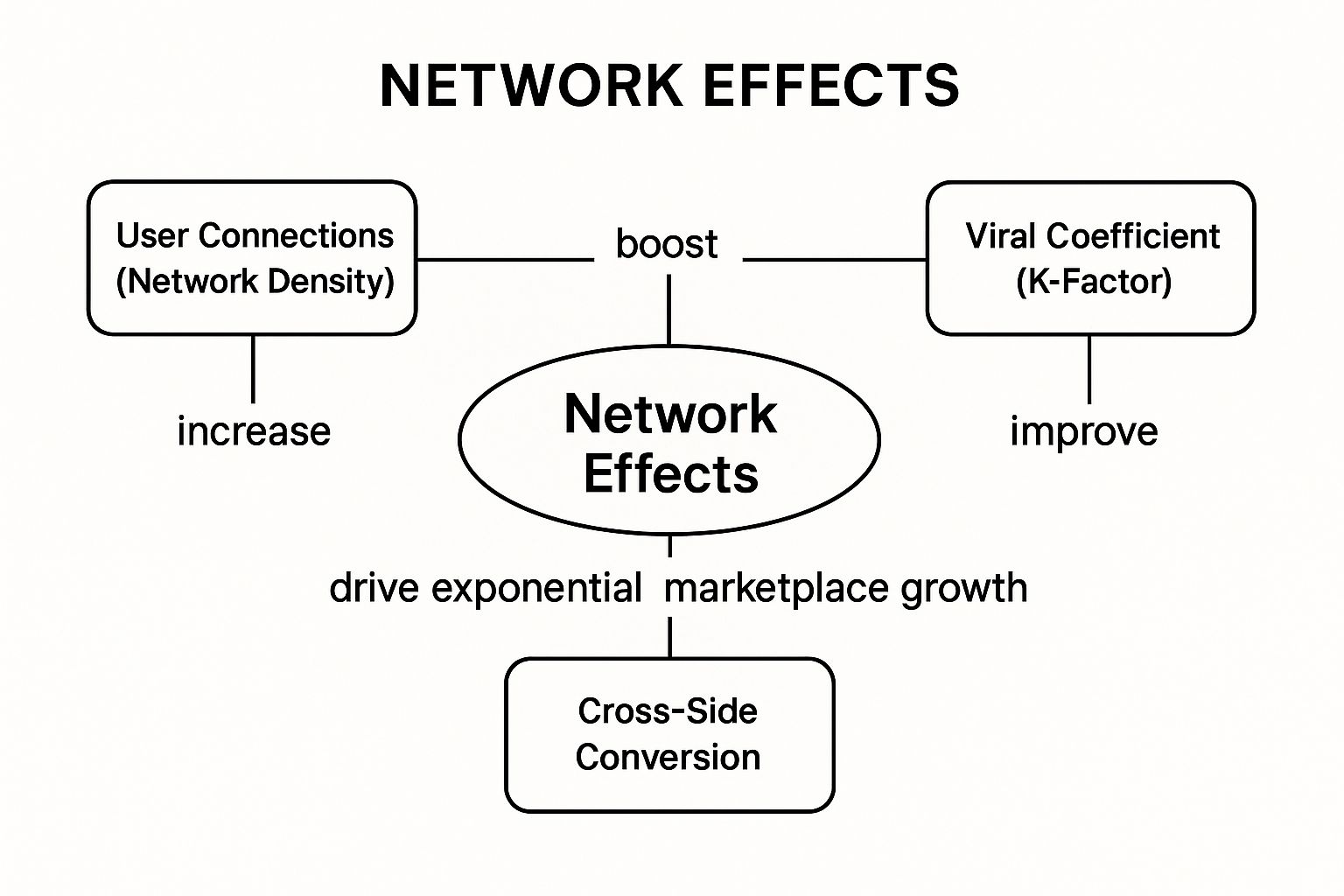
The visualization highlights that a high viral coefficient (K-Factor) directly amplifies network density, which in turn fuels higher conversion rates between buyers and sellers, creating a virtuous cycle.
2. Supply-Side Seeding Strategy
The supply-side seeding strategy directly tackles the classic marketplace "chicken-and-egg" problem. This approach prioritizes building and curating a high-quality, dense supply side before investing heavily in attracting demand. For a Product Manager, this means focusing all initial resources on recruiting sellers, service providers, or hosts to create an irresistible catalog that ensures the first wave of buyers finds immediate and compelling value. The core principle is that a strong supply is the most powerful magnet for demand.
This strategy is about manufacturing an initial "wow" moment for demand-side users. For instance, OpenTable painstakingly signed up restaurants in specific cities long before it ever marketed its app to diners. When diners finally arrived, they found a valuable tool with real utility, not an empty platform. Similarly, Rover invested heavily in recruiting and vetting a trustworthy network of pet sitters, ensuring that when pet owners started looking, they found a safe, reliable, and abundant set of options. The goal is to solve the supply constraint first, making future demand generation efforts significantly more efficient.
Actionable Framework:
- Step 1: Offer "Can't-Refuse" Supplier Benefits: Attract your critical first suppliers with unique incentives. Examples: guaranteed initial earnings of $1,000 for the first 20 service providers, zero commission for the first six months, or free professional photography for the first 100 listings (as Airbnb did).
- Step 2: Manually Curate for Quality: In the beginning, quality trumps quantity. Manually vet and onboard every supplier to ensure they meet a high standard. Thumbtack initially built its professional database with a focus on verification and quality, building trust from day one.
- Step 3: Provide Tools to Increase Stickiness: Build free, valuable software for your suppliers that helps them manage their business, even outside your marketplace. This creates lock-in and provides value before they even get their first customer from your platform. For instance, build a simple scheduling tool for service providers.
- Step 4: Set Clear Demand-Side Triggers: Define specific supply-side density metrics that must be met before shifting marketing spend to attract buyers. This could be "50 restaurants live in downtown Austin" or "100 verified pet sitters in Seattle with 5+ reviews each."
The supply-side seeding model is one of the most proven marketplace growth strategies, turning a potential weakness (the empty store problem) into a strategic advantage by guaranteeing a high-quality initial user experience. You can explore how early tech companies leveraged similar tactics in this breakdown of PayPal's early growth strategies on aakashg.com.
3. Single-Player Mode Strategy
The Single-Player Mode strategy is a powerful approach for solving the "chicken-and-egg" problem that plagues many new marketplaces. Instead of trying to acquire both buyers and sellers simultaneously, this strategy involves building a product that provides standalone value to one side of the market first. Users adopt the platform as a useful tool in its own right, even without any other users present. Once a critical mass of this initial user base is established, the marketplace functionality is introduced as a natural, value-added layer.
This model fundamentally de-risks the launch phase. For a Product Manager, the goal is to create a compelling utility that attracts an initial user cohort, whose activity and data then become the foundation for the future two-sided network. For example, Zillow initially offered the "Zestimate," a home valuation tool that homeowners could use independently. This attracted millions of users, creating a high-intent audience to which Zillow could later introduce real estate agents, effectively building the supply side of its marketplace on a pre-existing demand-side foundation.
Actionable Framework:
- Step 1: Identify a Standalone Pain Point: Interview your target users and find a significant, recurring problem that can be solved with a software tool. For Square, this was simplifying credit card payments for small merchants before it ever launched its lending marketplace, Square Capital. For aspiring PMs, find a niche—like photographers—and build a simple portfolio tool for them.
- Step 2: Design for a Natural Transition: The single-player tool shouldn't be a dead end. Architect it so that the marketplace features feel like a logical and beneficial evolution. The data generated by the single-player tool should directly inform and improve the eventual marketplace matching. A portfolio tool can naturally evolve to a "hire this photographer" marketplace.
- Step 3: Layer in the Network Incrementally: Don't switch from a tool to a marketplace overnight. Use the single-player phase to deeply understand user behavior and identify the perfect moment to introduce the second side of the market. This creates a seamless user experience where the marketplace adds value rather than feeling like an abrupt change in the product’s core purpose.
4. Vertical Market Penetration
Instead of attempting to serve a broad horizontal market, this strategy involves dominating a single, specific vertical first. For Product Managers, this is one of the most effective marketplace growth strategies because it allows for deep focus on a niche customer segment. By concentrating resources on one industry, profession, or category, a marketplace can build highly specialized features, understand unique user pain points, and establish market leadership before considering expansion.
The core principle, popularized by Peter Thiel's "Zero to One" philosophy, is to monopolize a small market first. For example, Faire began by exclusively serving the independent boutique retail space, building tools specifically for those users. This deep focus created immense value and trust within that community, allowing them to build an impenetrable moat. Only after achieving dominance did they expand to adjacent verticals. This approach builds a defensible foundation and establishes credibility that a horizontal player simply cannot match.
Actionable Framework:
- Step 1: Become Deeply Embedded in the Niche: Go beyond surface-level research. Attend industry events, join community forums (like subreddits or Discord servers for your vertical), and partner with vertical-specific influencers to build authentic relationships and gain insights.
- Step 2: Build Vertical-Specific Features: Develop tools and functionalities that solve problems unique to your chosen niche. Reverb, a marketplace for musical instruments, built features like integrated shipping for guitars and gear-specific condition guides that generic platforms like eBay couldn't replicate. This is your moat.
- Step 3: Establish Thought Leadership with AI: Use AI tools to accelerate content creation. Prompt:
Using ChatGPT-4, act as a content strategist for a B2B marketplace serving the [your vertical] industry. Generate a 3-month content plan with blog post titles, webinar topics, and a white paper outline that establishes our platform as the definitive expert. - Step 4: Plan Adjacent Expansion: Once you've achieved critical mass, identify adjacent verticals that share similar user dynamics or supply chains. For example, a marketplace for wedding photographers could logically expand to serve wedding planners or florists.
5. Geographic Market-by-Market Expansion
This strategy rejects the "spray and pray" approach of a wide, thin launch in favor of surgical, concentrated efforts. The core idea is to launch, perfect, and dominate a single geographic market before systematically expanding to the next. For a Product Manager, this means treating each new city or region as a distinct product launch, ensuring liquidity and strong local network effects are achieved before allocating resources elsewhere. This creates defensible regional strongholds that compound into broader market leadership.
The power of this marketplace growth strategy lies in its focus on liquidity. Instead of having a few buyers and sellers spread thinly across a country, you create a vibrant, self-sustaining ecosystem in one specific area. Uber famously perfected its model in San Francisco, documenting a replicable playbook before expanding city-by-city. Similarly, DoorDash built overwhelming density in suburban markets, an underserved vertical, before tackling more competitive major cities. The goal is to make your marketplace the undisputed leader in one territory, generating the momentum and operational learnings needed for the next conquest.
Actionable Framework:
- Step 1: Select a Beachhead Market: Choose an initial market with favorable characteristics. Look for high population density, a tech-savvy user base, and a clear, unmet need. Starting in a tier-2 city like Austin or Denver can often be smarter, as it presents less competition than a major hub like NYC or SF.
- Step 2: Create a Templated Expansion Playbook: Document every step of the launch process in a tool like Notion or Coda. Include checklists for initial supply acquisition, local marketing tactics, PR outreach templates, and key launch metrics (e.g., "Time to First Transaction"). This playbook becomes a standardized, repeatable guide.
- Step 3: Hire and Empower Local Leaders: Empower local market managers ("Launchers") who possess deep regional knowledge. They understand the unique cultural nuances, competitive landscape, and key relationships needed to win the market, adapting the playbook for maximum local impact.
6. Demand Aggregation Through Content & SEO
This strategy inverts the traditional marketplace model by building a massive demand-side audience before fully monetizing it. Instead of first building the transaction engine, the focus is on becoming the definitive, trusted source of information in a specific category. By creating high-value content like guides, reviews, and comparison tools, the platform attracts a large volume of high-intent users through search engines, creating one of the most effective and scalable marketplace growth strategies.
The core principle is to solve the user's research problem first and their transaction problem second. For a Product Manager, this means prioritizing content development and SEO to capture users at the top of the funnel. Zillow mastered this by providing free home value estimates (Zestimates), attracting homeowners and buyers who would later need to connect with real estate agents. This content-led approach builds an organic, defensible moat, reducing reliance on expensive paid acquisition channels and creating a predictable stream of qualified leads for the supply side.
Actionable Framework:
- Step 1: Target Commercial Intent Keywords: Use a tool like Ahrefs or SEMrush to identify long-tail keywords that signal a user is close to a purchase decision. Focus on phrases like "best [service] in [city]," "[product] alternatives," or "how much does [service] cost."
- Step 2: Incentivize User-Generated Content (UGC): Build systems that encourage users to contribute reviews, photos, and Q&As. TripAdvisor’s dominance is built on its vast library of user-submitted hotel and attraction reviews, which fuels its SEO and builds trust. Offer small rewards like badges or platform credits for high-quality contributions.
- Step 3: Develop Comprehensive "Pillar" Content: Create authoritative, in-depth guides (2,000+ words) that walk a user through the entire decision-making process. The Knot’s detailed wedding planning checklists and vendor guides capture couples early in their journey and guide them toward its vendor marketplace.
- Step 4: Build Hyper-Local Landing Pages Programmatically: For marketplaces with a local component, create unique, optimized pages for each city or neighborhood. This tactic is crucial for platforms like Thumbtack or Yelp to capture local search traffic effectively. This can be automated to scale across thousands of locations.
7. Referral & Incentive Programs
One of the most effective marketplace growth strategies involves leveraging your existing user base to acquire new customers. This is accomplished through structured referral programs that reward both the referrer and the new user, creating a powerful viral loop. This strategy turns your satisfied customers into an active, motivated acquisition channel by aligning incentives so that everyone, including the marketplace, benefits from a successful referral. The goal is to make sharing so easy and rewarding that it becomes a natural extension of the user experience.

This isn't just about offering cash; it's about embedding growth into the core product loop. Airbnb's program, which offered substantial travel credits to both parties, was a key driver of its global expansion. Similarly, Uber's "free ride" referrals fueled its rapid city-by-city takeover. The magic of these programs is that the reward is delivered directly within the product, encouraging immediate re-engagement and habit formation. By understanding the core value your users seek, you can design an incentive that reinforces that value, making the referral feel like a gift rather than a transaction.
Actionable Framework:
- Step 1: Align Incentive with Core Value: The most powerful rewards are tied to your product. Dropbox famously offered more storage space, not cash, which directly enhanced its value for power users. TaskRabbit and Rover offer service credits, encouraging deeper platform usage.
- Step 2: Make Sharing Effortless with One-Click Options: Reduce friction to an absolute minimum. Integrate one-click sharing options via WhatsApp, iMessage, and social media. Pre-populate referral messages to make the process as simple as possible for the sender.
- Step 3: Time the Prompt at the "Moment of Delight": Ask for a referral at a moment of peak user satisfaction, such as immediately after a 5-star review is left, a successful transaction is completed, or a milestone is achieved. This captures positive sentiment when users are most likely to advocate.
- Step 4: A/B Test and Optimize: Don't set and forget your program. Continuously test different incentive amounts ($10 vs $20 credit), reward structures (e.g., single-sided vs. double-sided), and messaging to find the optimal balance between customer acquisition cost (CAC) and lifetime value (LTV). While referrals are potent, they work best when integrated with other proven customer acquisition strategies to create a diversified growth engine.
8. Platform Subsidization & Loss Leader Strategy
Platform subsidization is an aggressive growth strategy that involves deliberately operating at a loss to rapidly acquire a critical mass of users. This approach focuses on temporarily subsidizing one or both sides of the marketplace to overcome the "chicken-and-egg" problem and accelerate network effects. For a Product Manager, this means using capital as a tool to engineer market liquidity, establishing a dominant position before competitors can gain a foothold. The core principle is to make participation so attractive that it becomes irrational for early users not to join.
This isn't just about offering discounts; it's a calculated investment in market creation. For example, Uber's early strategy involved massive subsidization on both sides: riders received heavily discounted fares while drivers were offered guaranteed hourly earnings and sign-on bonuses. This dual-sided incentive created an initial wave of liquidity in new cities, making the service reliable and affordable from day one. By shouldering the initial costs, Uber built user habits and network density, creating a powerful moat that made it difficult for later entrants to challenge.
Actionable Framework:
- Step 1: Target the Constrained Side: Identify which side of your marketplace is the bottleneck to growth (e.g., restaurants for DoorDash, drivers for Lyft). Focus the majority of your subsidy budget on attracting and retaining this "hard side," as their presence will naturally pull in the other side of the market.
- Step 2: Set Clear Subsidy Exit Metrics: Define specific goals for when subsidies will be reduced or eliminated. These should be tied to liquidity metrics like "Time-to-Fill" or "Search-to-Fill" rate. For example: "Reduce rider subsidies by 10% for every 5% decrease in average rider wait time." This prevents indefinite cash burn.
- Step 3: Build Habits Beyond Price: While subsidies attract users, the product experience must retain them. Use the subsidy period to onboard users effectively and demonstrate the platform's core value proposition outside of the financial incentive. For example, communicate the convenience and selection, not just the low cost, through in-app messaging and email campaigns.
9. Trust & Safety Infrastructure as Competitive Advantage
Building trust is not merely an operational cost; it is one of the most powerful marketplace growth strategies available. This approach frames comprehensive trust and safety systems as a core product feature and competitive moat. For a Product Manager, this means architecting verification, insurance, and dispute resolution mechanisms that actively drive user acquisition and retention by reducing transaction friction and enabling higher-value exchanges. The central principle is that superior trust infrastructure unlocks market segments that competitors cannot access.
This strategy moves beyond basic safety checks to create an environment where users feel secure enough to engage in high-stakes transactions. Airbnb, for example, didn't just facilitate bookings; it built trust in the concept of staying in a stranger’s home. It achieved this through its $1M Host Guarantee, two-way reviews, and Verified ID system. By systematically dismantling the barriers of stranger-danger, Airbnb created a new market category. The goal is to make trust so foundational to the user experience that your platform becomes the only logical choice for its category.
Actionable Framework:
- Step 1: Make Trust Visible and Proactive: Embed trust signals throughout the user journey. Showcase features like Uber's driver background checks or Poshmark's authentication service prominently in onboarding, on listing pages ("Verified Seller" badges), and during the checkout process.
- Step 2: Offer Guarantees That Exceed Industry Norms: Implement programs that go beyond legal requirements, such as eBay's Money-Back Guarantee or Rover's reservation protection. This demonstrates a strong commitment to user security and builds immense brand equity.
- Step 3: Engineer Two-Way Accountability: Create systems where both sides of the marketplace are incentivized to act responsibly. Two-way rating systems, like those used by Uber and Upwork, ensure that buyers and sellers (or riders and drivers) are equally accountable for maintaining a high-quality ecosystem. A seller with consistently low ratings should face penalties, just as a buyer should.
10. Data & Personalization Flywheel
This growth strategy centers on creating a self-improving loop where user activity generates data, which in turn fuels better personalization and matching. This enhanced experience drives more activity, completing the virtuous cycle. For a Product Manager, this means architecting a system that learns from every interaction to make the marketplace smarter, more efficient, and stickier over time. The core principle is transforming user data into a compounding competitive advantage.
This isn't just about showing relevant items; it's about deeply understanding user intent and context to create a hyper-personalized journey that feels almost magical. For example, Spotify’s "Discover Weekly" playlist isn't just a random assortment of songs; it’s a finely tuned recommendation engine that analyzes listening history, skips, and playlist additions to predict what a user will love next. This data-driven personalization keeps users engaged and reduces churn, creating an experience that's incredibly difficult for competitors to replicate without equivalent data scale.
Actionable Framework:
- Step 1: Implement Granular Event Tracking: From day one, use a tool like Segment or Amplitude to collect behavioral data across the entire user journey. Track events like
search_performed,listing_viewed,message_sent, andtransaction_completed. This raw material is the fuel for your personalization engine. - Step 2: Invest in Data Infrastructure Early: Don't wait until you're drowning in data to build the systems to manage it. Prioritize building a scalable data warehouse (like Snowflake or BigQuery) and processing pipeline before you think you need it, as this will be foundational to your success.
- Step 3: Balance Algorithms with Serendipity: While personalization is key, also build in mechanisms for discovery. Over-optimization can create a filter bubble; allow users to stumble upon unexpected but delightful items or services to keep the experience fresh and engaging. For example, include a "You Might Also Like" module that shows items from adjacent categories.
- Step 4: Build a Specialized Data PM Team: As you scale, investing in a dedicated team is crucial. PMs in this role at a company like Netflix or Spotify can command salaries of $200k-$300k+ due to their specialized skills. To explore this further, you can learn more about the role of a data product manager and when to hire one on Aakash G's blog.
Marketplace Growth Strategies Comparison Matrix
| Strategy | Implementation Complexity 🔄 | Resource Requirements ⚡ | Expected Outcomes 📊 | Ideal Use Cases 💡 | Key Advantages ⭐ |
|---|---|---|---|---|---|
| Network Effects Optimization | High – complex bootstrapping & critical mass | High – significant upfront investment | Exponential value growth, defensible moats | Platforms needing viral growth and strong network moats | Strong defensibility, lower marginal costs, viral loops |
| Supply-Side Seeding Strategy | Medium – focused supplier recruitment | Medium to High – supplier curation effort | Predictable cold-start solution, early supply quality | Marketplaces needing strong supply before demand | Better first impressions, quality control, premium positioning |
| Single-Player Mode Strategy | Medium – build standalone utility first | Medium – development of non-marketplace product | Immediate utility, data assets, reduced adoption friction | Platforms seeking initial user engagement without network | Eliminates chicken-egg problem, lower marketing cost |
| Vertical Market Penetration | Medium – specialization in one niche | Medium – tailored features and marketing | Easier critical mass, strong brand authority | Marketplaces targeting industry-specific users | Faster word-of-mouth, premium pricing, focused product fit |
| Geographic Market-by-Market Expansion | Medium to High – sequential launches per region | Medium – local market customization | Faster liquidity per market, regional monopolies | Platforms expanding through careful geographic rollout | Focused marketing, strong local network effects |
| Demand Aggregation Through Content & SEO | Medium – significant content creation | Medium to High – content production & SEO | Predictable organic traffic, scalable demand funnel | Marketplaces benefiting from high-intent search traffic | Low CAC at scale, brand authority, long-term compounding |
| Referral & Incentive Programs | Low to Medium – set up tracking & rewards | Low to Medium – incentive funding | Viral user acquisition, lower CAC | Platforms with existing user base seeking growth leverage | High-quality users, scalable viral loops |
| Platform Subsidization & Loss Leader Strategy | High – requires capital & complex subsidy planning | High – significant subsidization funding | Rapid critical mass, aggressive market share | Early-stage marketplaces needing fast liquidity growth | Overcomes switching costs, establishes category leadership |
| Trust & Safety Infrastructure as Competitive Advantage | Medium to High – complex trust systems build | Medium to High – operational & development costs | Higher conversion, defensible competitive advantage | Marketplaces in trust-sensitive or high-value categories | Increased LTV, fraud reduction, higher transaction value |
| Data & Personalization Flywheel | High – advanced data/ML infrastructure | High – technical and data science resources | Improved matching, compounding competitive edge | Data-driven marketplaces prioritizing personalization | Continuous improvement, premium pricing, user retention |
Your Next Move: Implementing Your Growth Strategy
You’ve just navigated a comprehensive toolkit of ten powerful marketplace growth strategies, moving from the foundational physics of network effects to the sophisticated engines of data personalization. We have deconstructed the exact methods used by category-defining companies like Airbnb, Uber, and Etsy to solve the chicken-and-egg problem and build defensible, scalable platforms. The journey from a theoretical understanding to a tangible growth trajectory, however, begins now, with deliberate action.
The core challenge for any Product Manager in the marketplace domain isn't knowing these strategies exist; it's the disciplined process of selection and execution. Attempting to implement all ten at once is a recipe for diluted effort and minimal impact. True marketplace momentum is built by identifying the single most critical constraint holding your platform back and applying the right strategic lever with focus and precision.
From Theory to Roadmap: Your Action Plan
Your primary task is to move from this listicle to your product backlog. This requires a ruthless diagnosis of your marketplace's current state. Is your platform a ghost town, desperately needing an initial spark? A Supply-Side Seeding Strategy or the Single-Player Mode Strategy might be your most critical first move. Are you struggling to build user confidence in a high-stakes vertical? Then, prioritizing Trust & Safety Infrastructure isn't just a feature; it’s your entire growth strategy.
To make this tangible, follow these steps over the next 48 hours:
- Diagnose Your Core Problem: Frame your primary growth obstacle as a single, clear question. For example, "Why aren't new sellers completing their first transaction?" or "What is the biggest friction point preventing buyers from making a repeat purchase?"
- Select Your Primary Strategy: Map your core problem to one of the ten strategies discussed. If your issue is low buyer retention, the Data & Personalization Flywheel might be the key. If it's undifferentiated competition, Vertical Market Penetration could be your path to dominance.
- Define a 90-Day Objective: Do not boil the ocean. Set one ambitious but achievable Key Result for the upcoming quarter based on your chosen strategy. This could be "Increase seller liquidity by 30%" or "Achieve a 25% user activation rate through our new single-player tool."
- Build a Lean Roadmap: Outline the specific epics and features required to execute this one strategy in a tool like Jira or Linear. This focused roadmap becomes your team's north star, aligning engineering, design, and marketing on a single, measurable goal.
Key Insight: The most successful marketplace leaders don't just collect strategies; they are expert diagnosticians. They excel at identifying the unique physics of their market and applying the highest-leverage strategy at the right time. Your value as a Product Manager is measured by this strategic clarity.
Mastering these marketplace growth strategies is more than an intellectual exercise; it is the fundamental skill set that separates stagnant platforms from market leaders. It empowers you to build products that create powerful, self-reinforcing loops of value, turning initial traction into an unstoppable competitive moat. The frameworks in this article are your blueprints. Now, it's time to pick up your tools and start building.
For deeper dives into product strategy, growth frameworks, and the career mechanics of product leadership, I highly recommend the newsletter and resources from Aakash Gupta. Aakash is a renowned product leader who breaks down complex topics like marketplace dynamics and growth loops with exceptional clarity. You can find his work at Aakash Gupta.
