Your North Star Vision isn't a metric or a feature list. It's a vivid, story-driven picture of the future your product makes possible for its users. As a PM, this is your most powerful tool for alignment. Think of it as the ultimate "why" behind every line of code, the destination on your product's map that describes the world you're trying to build. For aspiring PMs, mastering this concept is non-negotiable for interviews at places like Google or Meta. For senior PMs, this is the primary mechanism for driving multi-team alignment.
Why Your Product Needs a North Star Vision
Before you write a single user story, you need to know where you're going. A product without a clear vision is like a ship without a rudder—it's certainly busy, but it isn't moving toward any meaningful destination. Your North Star Vision is the navigational tool that prevents this chaos.

It acts as a strategic compass, keeping your team pointed in the right direction and ensuring every sprint actually contributes to a single, inspiring goal. As someone who has hired PMs at all levels, I can tell you that a candidate’s ability to articulate a product vision is a massive differentiator. An entry-level PM with a clear vision for a feature is more valuable than a senior PM who can only manage a backlog.
Vision vs. Metric: A Critical Distinction for PMs
Here’s where a lot of teams get tripped up: they confuse the North Star Vision with its tactical cousin, the North Star Metric (NSM). This is a huge mistake. It leads teams down a path of short-term optimization while completely losing sight of the bigger strategic picture.
The two are designed to work together, but they play very different roles. If you really want to get into the weeds on this, we've got a comprehensive guide on the North Star Metric that breaks it all down.
To make this distinction crystal clear, here’s a quick comparison.
North Star Vision vs North Star Metric at a Glance
| Attribute | North Star Vision | North Star Metric (NSM) |
|---|---|---|
| Type | Qualitative, narrative-driven | Quantitative, number-driven |
| Purpose | To inspire and align | To measure and track progress |
| Timeframe | Long-term (3-5+ years) | Short-to-mid term (quarterly, yearly) |
| Core Question | "What future are we creating for our users?" | "Is our work creating value on the path to that future?" |
| Example | Airbnb: "Belong Anywhere" | Airbnb: "Nights Booked" |
The vision is the why, and the metric is the how. One tells you where you’re going, and the other tells you how fast you’re getting there. You absolutely need both.
A North Star Metric tells you how fast you're moving, but the North Star Vision tells you if you're headed in the right direction. Both are essential for sustainable growth.
Building a powerful vision starts with being bold. You need to create an audacious vision for their projects that truly pushes the boundaries of what's possible.
This vision becomes the ultimate tie-breaker in tough roadmap debates and the number one filter for any new idea. It fundamentally shifts the conversation from "What are we building next?" to "Where are we trying to go?"—and that simple change is what separates the good product teams from the great ones.
The High Cost of Navigating Without a North Star
A product team without a North Star Vision is like a ship without a rudder. Everyone's busy—sprints are churning, tickets are closing, features are shipping—but the ship isn't actually heading toward a meaningful destination. It’s just drifting.
This isn't some hypothetical problem. It's a direct path to burning through cash, frustrating your best people, and eventually becoming irrelevant. This state of aimless activity has a name: strategic drift.
Without a unifying vision, every team starts optimizing for its own little island. Engineering pursues technical perfection for its own sake. Marketing chases vanity metrics that look good on a slide deck. Sales pushes for one-off features to close a single deal. What you end up with is a Frankenstein's monster of a product—a collection of disjointed features that don't add up to a coherent experience or a real competitive edge.
This misalignment has tangible costs that leaders at companies like Meta and Google actively fight to prevent. Every engineering cycle spent on a feature that goes nowhere is a cycle you can't spend creating actual value for your customers. This is how even well-funded companies with brilliant teams can fail; their "why" gets fuzzy, and their roadmap becomes a reactive to-do list instead of a strategic plan.
When Teams Lack a Guiding Vision
When a North Star Vision is missing, a few predictable problems start to pop up. These dysfunctions create friction, kill momentum, and ultimately burn out your most talented people.
- Endless Roadmap Debates: Without a vision to act as the ultimate tie-breaker, roadmap meetings devolve into battles of opinion. The loudest person in the room or the most powerful stakeholder usually wins, whether their idea serves the long-term goal or not.
- Reactive Feature Development: Your team gets stuck playing defense, constantly reacting to what competitors are doing or scrambling to build one-off customer requests. You're always one step behind instead of shaping the market yourself.
- Difficulty Prioritizing: When everything seems important, nothing truly is. A strong vision acts as a filter, making it painfully obvious which ideas are worth pursuing and which are just noise.
A North Star Vision completely changes the question your team asks every day. They stop asking, "What should we build next?" and start asking, "Does this get us closer to our North Star?"
The Economic Impact of Misalignment
The financial fallout from strategic drift is serious. While the vision provides the story and direction, its absence hits your bottom line. This is where the North Star Vision needs a partner: the North Star Metric (NSM). The vision is the destination; the metric is the speedometer telling you if you're actually making progress.
This combo is the statistical backbone that has propelled products to unicorn status. Take Facebook (now Meta). They obsessed over 'daily active users sharing content.' That single metric exploded from 1 million in 2004 to a projected 3.03 billion by 2025, driving 98% of the company's revenue. Research from Amplitude shows that teams with a solid NSM achieve 2.5x higher growth because it’s a leading indicator that predicts future revenue with stunning accuracy. You can dive deeper by reading the full research on North Star Metrics from Amplitude.
This link between a qualitative story and hard numbers is what separates busywork from real business impact. It's the critical difference between objectives versus outcomes—focusing on delivering value, not just shipping features. Without that clarity, you're just burning cash to build something nobody really wants, a costly mistake a clear vision is designed to prevent.
A 4 Step Framework for Defining Your Vision
A powerful North Star Vision isn’t something you just cook up in a single brainstorming session. It's forged. As a PM leader, I've run this exact playbook multiple times to align teams around a shared goal. This repeatable four-step framework will take you from abstract ideas to a documented, potent vision that can pull your entire organization in the same direction. Any PM, regardless of their experience level, can use these steps to bring clarity and focus to their work.
Step 1 Deep Customer Immersion
First things first: your vision has to be rooted in the real-world aspirations of your users. It can't be based on what you think they want or some internal assumption. This step is all about getting past surface-level feedback to uncover the core, often unspoken, motivations that drive your customers.
The goal here isn't just to list out pain points. It’s about understanding the future they're trying to build for themselves. What does their ideal world look like, and how can your product be the bridge that gets them there?
To really nail this, you need to lean into qualitative research:
- Conduct "Jobs to Be Done" interviews: Forget asking about features. Instead, ask users to walk you through their process. What are they really trying to accomplish? What "job" are they hiring your product to do for them?
- Analyze support tickets and sales calls: Dig through these for recurring themes and emotional language. What frustrations and desires keep bubbling to the surface again and again?
- Build empathy maps: Go way beyond demographics. Map out what your users see, hear, think, and feel to create a truly holistic picture of their world.
A great North Star Vision is born from customer obsession. It solves a real human need, not just a business problem. By starting with deep empathy, you ensure your vision is both aspirational and grounded in reality.
Step 2 Define the Future State Narrative
Once you’re steeped in your users' aspirations, it's time to write the story of the future your product makes possible. This isn't a feature list; it's a narrative. A future state narrative is a short, compelling story describing your ideal user's experience 3-5 years from now—an experience made real by your product.
Imagine you're writing a press release from the future, announcing how your product has fundamentally changed someone's life or workflow. Describe the "before" state of frustration and the "after" state of success and empowerment. This story makes the vision tangible and gives it an emotional punch that resonates with your team and stakeholders.
You can even use modern AI tools to get the ball rolling. Try this prompt with ChatGPT or Claude:
Act as a senior product strategist at OpenAI. I've conducted 10 user interviews with enterprise PMs about the challenges of creating product roadmaps. Based on these key themes [paste summarized interview notes], draft three distinct future state narratives for an AI-powered roadmapping tool that helps users achieve strategic alignment and faster execution. Each narrative should be 150 words and told from the user's perspective.
Step 3 Identify Your Product's Superpower
Every truly great product has a "superpower"—a core differentiator that makes it uniquely capable of delivering that future state. This isn’t just a feature; it's the fundamental advantage that your competitors can't easily copy. For OpenAI, it's access to foundational models. For Google Search, it's the PageRank algorithm and the data it's indexed.
What is it for you? Is it a proprietary dataset that fuels smarter recommendations? A unique workflow that saves users an insane amount of time? An ecosystem effect that gets stronger with every new user who joins?
Without a clear vision and superpower, teams start to drift. The infographic below shows what happens when a vision is missing—it leads directly to wasted effort and misaligned teams.
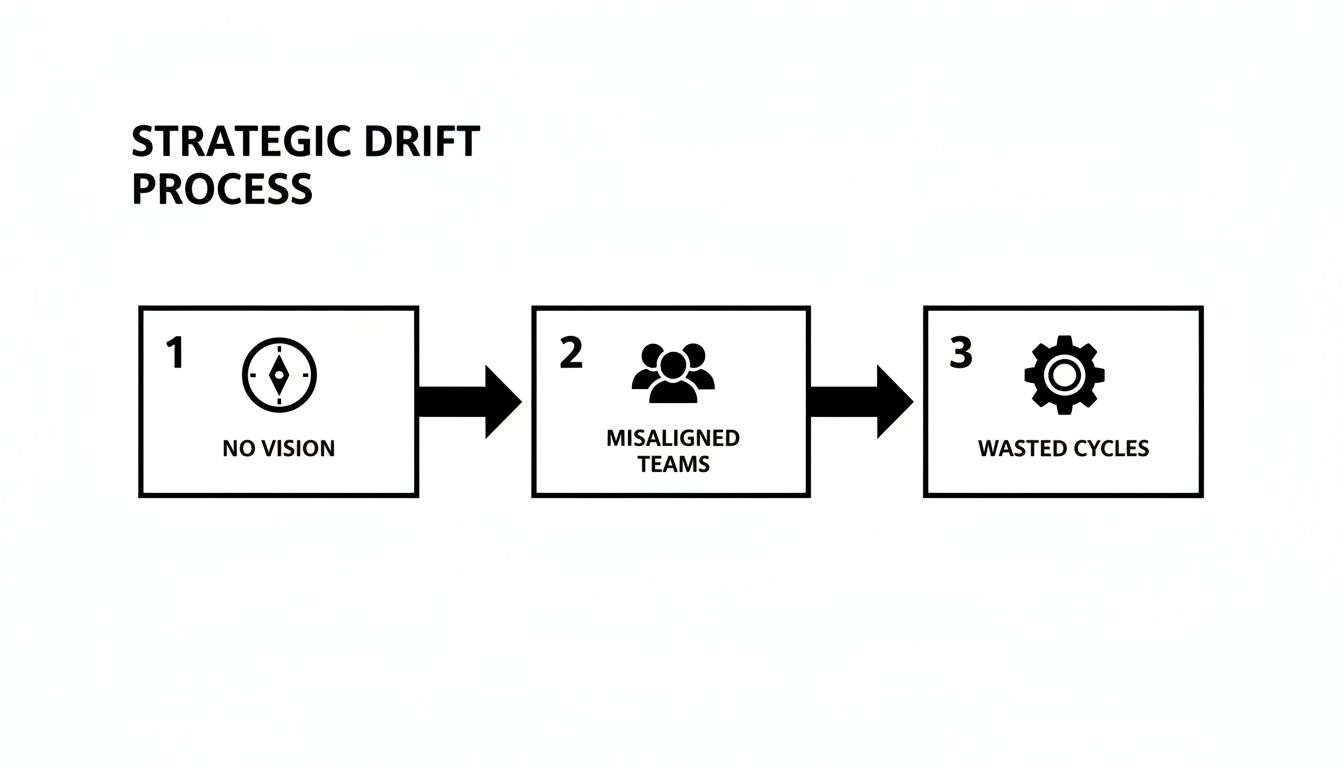
This kind of strategic drift is exactly what your product's superpower—guided by your vision—is meant to prevent. To sharpen your thinking on this, I highly recommend exploring this detailed guide on building a product strategy framework.
Step 4 Articulate the Vision Statement
Okay, this is the final step. It's time to distill your future narrative and unique superpower into a single, memorable, and inspiring vision statement. This is the phrase everyone in the company can remember and rally behind. It’s the culmination of all the hard work from the previous steps.
A strong vision statement has a few key qualities:
- It is customer-centric: It’s all about the value delivered to the user.
- It is ambitious: It inspires the team to aim high and push what’s possible.
- It is clear: It’s simple to understand and even easier to repeat.
- It is durable: It should be a guiding light for at least 3-5 years.
If you're looking for a practical framework for setting business goals to help inform your vision, a good guide can provide some valuable structure. Following this process moves you from deep customer insight to a concise, actionable North Star Vision—the true north for your entire product organization.
How Tech Giants Use Their North Star Vision
Theory is one thing, but seeing how the best in the business actually put it into practice is where the real lessons are. A North Star Vision isn't just a fluffy, inspirational quote for an all-hands meeting; it's a compass that guides concrete product decisions and shapes experiences that define entire markets.
Let’s dissect the visions of a few iconic companies. You'll see a straight line from a single, compelling idea to tangible, massive business impact. This is how one sentence can direct years of development, millions in investment, and countless strategic pivots.
Airbnb: Belong Anywhere
Airbnb’s North Star Vision, "Belong Anywhere," is a masterclass. It’s simple, emotional, and immediately tells you what they're really about. They aren't just selling rooms; they're selling the feeling of being at home, no matter where you are in the world. That vision instantly separates them from the transactional, cookie-cutter world of hotel chains.
This qualitative story directly informs their quantitative North Star Metric (NSM): "Nights Booked." It’s a perfect match. Every single night booked is a direct signal that someone found a place to belong, even if just for a little while.
So how does that vision show up in the actual product?
- Host Profiles & Reviews: These features aren't just functional; they build trust and add personality. You're not booking a sterile room, you're getting a glimpse into the person you'll be staying with, making the whole experience feel more human.
- Experiences: This was a brilliant extension of the vision. "Belonging" isn't just about where you sleep; it's about connecting with local culture and people. Experiences took Airbnb beyond accommodation and into the fabric of the destination itself.
- Wish Lists & Guides: These features tap into the aspirational side of travel. They let users dream, plan, and share ideas about where they could belong next, fostering a sense of community around shared travel goals.
Slack: Make Work Life Simpler, More Pleasant, and More Productive
Slack’s vision is deceptively simple, but it targets a universal pain point: the soul-crushing friction of workplace communication. We’ve all lived through the endless email chains, the missed messages, and the general chaos of collaboration. Slack’s vision promises a better way.
This promise cascades neatly down to their NSM of "Daily Active Users." A team that uses Slack every single day is clearly finding their work life simpler, more pleasant, and more productive. If they weren't, they'd leave.
Look at how the vision shapes their product decisions:
- Channels: This is the core of Slack. By organizing conversations around topics instead of people, Channels demolish the chaotic, all-reply email threads that kill productivity.
- Integrations & Apps: The vision is to make work life simpler, not just messaging. By connecting with essential tools like Google Drive, Asana, and Jira, Slack becomes the central hub where work actually happens.
- Huddles & Clips: These features address the "pleasant" part of the vision. They make remote collaboration feel more human and spontaneous, offering lightweight ways to connect without the formality (and dread) of a scheduled video call.
This kind of focused execution is often what separates the winners from the also-rans. To see another example of this in action, you can check out how modern product rockets like Stripe operate.
Spotify: A Million Artists Living Off Their Art
Spotify's vision is powerful because it looks beyond just the listener. "A million artists living off their art" forces the company to build a healthy, two-sided marketplace. This isn't just about consumption; it's about creation and empowerment.
This ambitious goal gives them a clear focus: build value for both artists and fans. It’s a much more defensible moat than simply being a music player.
A powerful North Star Vision is not just about the customer's future; it can also be about the future you create for your entire ecosystem, including partners and creators. This broader perspective often leads to a more defensible market position.
The North Star Metric flowing from this vision is "time spent listening." For Spotify, this metric propelled them from 20 million users in 2012 to over 600 million by 2024. More listening time means more ad revenue and more subscription value, which ultimately flows back to the artists. It’s a virtuous cycle.
Case Study Connecting Vision to Metric and Features
Let's tie this all together. The table below shows the clear through-line from a qualitative vision to a quantitative metric, and finally to the tangible product features that bring it to life. This is the North Star Framework in action.
| Company | North Star Vision (Qualitative) | North Star Metric (Quantitative) | Example Feature Driven by Vision |
|---|---|---|---|
| Airbnb | Belong Anywhere. | Nights Booked | Experiences: Connecting travelers with local culture and people. |
| Slack | Make work life simpler, more pleasant, and more productive. | Daily Active Users | Channels: Organizing conversations by topic to reduce email chaos. |
| Spotify | A million artists living off their art. | Time Spent Listening | Discover Weekly: Personalized playlists that help fans find new artists. |
| Connect the world. | Daily Active Users | News Feed: Surfacing relevant content from friends and family. | |
| Uber | Transportation as reliable as running water, everywhere for everyone. | Rides per Week | Upfront Pricing: Removing uncertainty and friction from the booking process. |
As you can see, the vision isn't an afterthought. It's the starting point that dictates what gets measured and, ultimately, what gets built. This alignment is what separates good product teams from great ones.
Embedding the Vision into Your Team's DNA
A brilliant North Star Vision collecting dust in a Google Slides presentation is completely worthless. Its true power is only unlocked when it becomes the daily compass for every single person in your organization—from the newest engineer to the most senior executive.
Getting there isn't magic; it requires a deliberate, multi-faceted communication strategy. The goal is to reach a point where every team member instinctively asks, "Does this feature, this marketing campaign, this sales deal move us closer to our North Star?" When that question becomes part of your company's DNA, you’ve won.

Tailoring Your Communication Strategy
You can't just read the same script to everyone and expect it to land. The message has to be tailored to resonate with what each group cares about most. A truly powerful vision connects their daily grind to a larger, inspiring purpose.
Here’s a tactical breakdown of how to frame the vision for different stakeholders:
- For Engineers: Pitch the vision as the ultimate technical challenge. Talk about the future state you're all building together and the complex, fascinating problems they'll get to solve to bring it to life. Inspire them not just with the what but with the architectural and engineering elegance required to pull it off.
- For Executives: Tie the vision directly to business outcomes like revenue growth, market share, and competitive moats. Explain how this qualitative story will drive your quantitative metrics, creating a defensible, long-term advantage that hits the bottom line. It's crucial to understand how stakeholders perceive the product vision to get their full buy-in.
- For Marketing & Sales: Hand them the brand story on a silver platter. Equip them with a powerful narrative to attract ideal customers who believe in the future you're creating. This story becomes a potent tool for standing out in a crowded market beyond a simple feature-for-feature comparison.
A Checklist for Your Vision Rollout Plan
Rolling out a vision is an ongoing campaign, not a one-and-done all-hands meeting. You're trying to win hearts and minds for the long haul.
- Craft the Core Narrative: Finalize the vision statement and the compelling story that goes with it. Get your key talking points ready for different scenarios and audiences.
- Secure Executive Buy-in: Meet with the leadership team one-on-one. Your goal isn't just alignment; you need them to be active, vocal champions of the vision.
- Launch at a Company All-Hands: This is your big moment—make a splash. Use powerful visuals and customer stories to make the vision feel real and exciting.
- Cascade Through Team Meetings: In the week after the launch, every manager should reiterate the vision in their team meetings, explicitly connecting it to their team's specific charter and goals.
- Integrate into Rituals: This is the most critical step for making it stick. Weave the vision into your company’s operating rhythm.
A North Star Vision is not a "set it and forget it" exercise. It must be woven into the fabric of your company's daily operations—from sprint planning to quarterly business reviews—to have any real, lasting impact.
This constant integration is where the vision truly gains its power. Think of how a North Star Metric (NSM) helps ensure every team pulls in the same direction—a framework that can slash the misaligned efforts plaguing 70% of scaling tech firms. PMs who effectively use an NSM report 25% faster decision-making because it acts as a filter, cutting through distracting vanity metrics.
Weaving the Vision into Daily Workflows
To make the vision a living, breathing part of your culture, you have to bake it directly into your team's existing processes.
- Sprint Planning: Kick off every sprint planning session by restating the vision. Then ask the team, "How does the work we're committing to this sprint move us closer to our North Star?"
- Quarterly Reviews: Frame your quarterly goals and results in the context of the vision. Don't just show KPI progress; show how you're moving down the path toward that future state.
- Onboarding: Make the North Star Vision a cornerstone of your new hire orientation. This ensures that from day one, every employee understands the "why" behind their role.
By consistently reinforcing the vision through these channels, you transform it from an abstract idea into a practical, everyday tool for making better decisions.
Common Questions About North Star Visions
Even with a solid framework in hand, actually crafting and selling a North Star Vision can bring up some tricky questions. As a product leader, knowing how to field these is half the battle in keeping everyone aligned and moving forward. Here are the most common roadblocks I see PMs hit, with direct answers to get you past them.
How Often Should a North Star Vision Change?
Think in terms of years, not quarters. A North Star Vision is built to last—we're talking a 3-5 year horizon. It's the stable destination on your map, intentionally disconnected from the short-term churn of sprints and quarterly goals.
The only time you should even think about revisiting your vision is under a few high-stakes conditions: a fundamental business pivot (like shifting from B2C to B2B), a massive market disruption (like the arrival of generative AI), or the rare occasion you've actually, fully achieved it. If you find yourself wanting to change it often, that’s a huge red flag. It usually points to a lack of strategic clarity, not a healthy sign of agility.
What Is the Difference Between a Mission and a Vision?
This one trips up a lot of teams, but the distinction is critical. A company's mission is broad, timeless, and usually inward-looking. It defines the organization's core purpose for existing. Think of Google's mission to "Organize the world's information"—it's a perpetual goal that's never truly "done."
A product's North Star Vision, on the other hand, is customer-centric, specific, and has a finish line. It paints a clear, aspirational picture of a future your product creates for its users. The vision is the tangible, product-level expression of how you'll contribute to the company's broader mission. It answers the question, "What will the world look like for our customers once we've succeeded?"
How Do I Get Buy-In for a Qualitative Vision?
This is a classic challenge. You're trying to sell a story to people who live in spreadsheets. Stakeholders in finance or sales are wired to think in numbers, and pitching a qualitative vision in isolation is a surefire way to get blank stares. Don't do it.
Instead, frame the North Star Vision as the strategic "why" that gives all your quantitative metrics meaning. You need to show them exactly how the vision provides the essential context for your North Star Metric. Build a compelling narrative that illustrates how achieving this inspiring future for your customers will inevitably drive the KPIs they care about—revenue, retention, and market share. Use real-world examples like Airbnb and Spotify to draw a direct line from their qualitative inspiration to their undeniable quantitative success.
Can a Product Have More Than One North Star Vision?
Let me be direct: an unequivocal no. The entire point of a North Star Vision is to provide a single, unifying focal point for everyone. It's the ultimate tie-breaker when you're facing tough roadmap decisions.
Now, a massive company like Microsoft will have multiple products (Azure, Office, Xbox), and each of those should have its own distinct vision. But a single product must have only one. Introducing a second "North Star" just creates confusion, splits focus, and invites politics into the process. Having one vision forces the hard—but essential—strategic choices that stop your product from becoming a bloated collection of disconnected features. It's your tool for ensuring absolute alignment across every single team.
Ready to elevate your product management career? In the Aakash Gupta newsletter, I share actionable frameworks, career advice, and deep dives into the strategies used by top tech companies. Join thousands of PMs and leaders here.
