As a Product Manager, your ability to distinguish between goals, objectives, and strategies is a non-negotiable skill that separates the top 1% from the rest. Get them wrong, and you'll burn through engineering cycles, confuse stakeholders, and ship products that miss the mark. Get them right, and you create a clear path to victory.
Let’s get straight to the tactical breakdown. Bookmark this table; it’s the cheat sheet you’ll use before your next roadmap meeting.
Quick Reference: The Strategic Hierarchy for Product Managers
| Concept | Definition | Timeframe | Real-World Example (Meta / Facebook) |
|---|---|---|---|
| Goal | A broad, aspirational outcome that sets your long-term direction. | 3-5+ Years | "Connect the world." |
| Objective | A specific, measurable, time-bound result that tracks your progress toward the goal. | Quarters to 1-2 Years | Increase Daily Active Users (DAUs) in emerging markets by 15% in the next fiscal year. |
| Strategy | The high-level plan or approach you'll use to achieve an objective. It's a set of choices. | Ongoing/Iterative | Launch a lightweight, data-efficient version of the app (e.g., Facebook Lite) to overcome bandwidth and device constraints. |
This isn't just theory; it’s the operating system used by top-tier PMs at companies like Google and Meta to align massive teams and build decade-defining products. Mastering this hierarchy is how you stop being a feature factory manager and start acting like a business owner.
The Strategic Hierarchy for Product Leaders
Your job as a PM is to be the primary translator, cascading the company’s high-level vision down into actionable work for your engineering and design teams.
It all starts at the top. Before you can even think about goals, your company needs foundational principles. You can delve into the core distinctions between mission statements vs. purpose to get that top-level clarity right. This is the "why" that anchors everything else you do.

Core Components of Product Strategy
This framework isn't some new-age management fad; it has deep roots in classic organizational theory. The split between objectives, goals, and strategies really took hold in the mid-20th century as big corporations began to formalize their strategic planning.
Even today, giants like Procter & Gamble rely on models like OGSM (Objectives, Goals, Strategies, Measures) to keep their massive global teams pulling in the same direction. It’s a testament to how powerful and timeless this structured approach really is.
Getting these distinctions locked in is what separates a backlog manager from a true product leader.
Suddenly, you're not just answering "what are we building?" You're confidently explaining "why it matters, how we'll win, and how we'll know we've won." That's the real mark of a senior product leader.
Defining Your Product Goal and North Star
A powerful goal is your product's North Star. This is the qualitative, inspirational vision that guides every single product decision, every feature prioritization debate, and every team meeting. It answers the most important question: "Why does our product exist?"
Objectives are about hitting numbers and strategies are about the 'how,' but the goal? That’s the soul of your product. A common mistake is setting goals that are really just big objectives, like "Increase revenue by 50%." That's a target, not a unifying vision. A true goal connects the daily grind to a meaningful, long-term ambition that can galvanize an entire company.

From Vague Mission to Actionable Vision
The best tech leaders understand this distinction instinctively. Stripe’s goal isn’t just to be a payment processor; it’s to "Increase the GDP of the internet." That’s a goal you can build a multi-decade roadmap around. It's wildly ambitious, deeply inspiring, and broad enough to allow for pivots without ever losing the plot.
As a Product Manager, your main job in goal-setting is to translate the high-level corporate mission into a specific product vision your team can actually rally behind. You have to be its chief evangelist.
This vision becomes the ultimate tie-breaker. When your engineering and design leads are stuck debating two different user flows, you can bring them back to what matters: "Which one gets us closer to making complex financial tools simple for everyone?"
Leading a Goal-Setting Workshop: A Step-by-Step Tactical Plan
You'll be expected to lead the charge in defining and sharpening this goal. But don't you dare do it in a vacuum. A goal dictated from an ivory tower gets zero buy-in. Your job is to facilitate a structured conversation.
Here’s a step-by-step process for a goal-setting workshop you can run tomorrow with your core team (eng lead, design lead, PMM):
-
Start with the 'Why': Kick things off by reviewing the company's mission. Then ask the team: "Within that mission, what unique problem does our product solve for our users?" This grounds everyone in a shared purpose from the get-go.
-
Brainstorm Future Headlines: Ask everyone to imagine it's three to five years from now. Have them write down the press release headline announcing your product's greatest achievement. This trick pushes people past the current quarter and encourages big, ambitious thinking.
-
Find the Core User Value: Zero in on the customer's success with some pointed prompts.
- What superpower do we give our users?
- If we disappeared tomorrow, what would our users suddenly be unable to do?
- What's the single most important value we deliver that no one else can touch?
-
Synthesize and Draft: After the workshop, it's on you to pull together the key themes into a few draft goal statements. Keep them qualitative, memorable, and laser-focused on the user. Ditch the corporate jargon and metrics.
-
Pressure-Test and Refine: Now, share the drafts with stakeholders and leadership. The point isn't to bikeshed wording but to confirm you're aligned with the bigger business strategy. The final goal should be simple and powerful enough that you can repeat it in every all-hands and planning meeting for the next year.
A well-defined product goal is the direct precursor to a powerful North Star Metric—the crucial link that translates your qualitative vision into a single, quantifiable measure of success. To get that part right, you should check out our guide on how to define your North Star Metric to connect your big vision to tangible results. Mastering this flow from goal to metric is what separates okay product teams from great ones.
Crafting Objectives That Drive Real Outcomes
If your product goal is the destination city, your objectives are the specific, measurable signposts on the highway. This is where high-level ambition meets on-the-ground reality. For any PM, the ability to turn a vague goal into a crisp, quantifiable objective is what separates a real strategy from wishful thinking.
An objective takes the "what we want to achieve" and sharpens it into "how much, by when." It strips away ambiguity and creates a definition of success so clear that your engineering, design, and marketing partners can all build toward the same thing. Without that clarity, teams spin their wheels, shipping features that feel productive but don't actually move the needle.
Translating Vision Into Measurable Milestones
The best framework for this is SMART: Specific, Measurable, Achievable, Relevant, and Time-bound. As a PM, you need to burn this framework into your brain and apply it with ruthless consistency. It's the tool that transforms a soft goal like "improve user retention" into a hard, actionable objective.
Let's watch this play out with a real-world example from a company like Airbnb.
- Vague Goal: We want new hosts to be more successful.
- SMART Objective: Increase the 30-day retention rate for new hosts from 40% to 55% by the end of Q4.
This objective is powerful because it's undeniable. There's no gray area; you either hit that 55% mark by the deadline, or you don't. This clarity becomes your best friend when you're justifying resources or making tough prioritization calls.
A great objective focuses on the outcome, not the output. The goal isn't to ship a feature; it's to change a user behavior or a business metric. This shift in mindset is fundamental to building products that create real impact.
A Checklist for Bulletproof Product Objectives
Before you walk your next objective into a roadmap planning session, run it through this battle-tested checklist.
- Is it Specific? Does it state exactly what you want to accomplish? Kill vague words like "improve," "increase," or "optimize" if they don't have a specific metric attached.
- Is it Measurable? Can you track it with a number? There must be a clear metric (e.g., conversion rate, DAU/MAU ratio, NPS) that defines what success looks like.
- Is it Achievable? Is this target actually realistic given your team, resources, and timeline? Setting an impossible objective just demotivates everyone.
- Is it Relevant? Does hitting this objective directly contribute to the larger product goal and company vision? If it doesn't, it’s a distraction.
- Is it Time-bound? Does it have a clear deadline (e.g., "by end of Q3," "within six months")? A deadline creates urgency and a clear finish line.
The discipline of crafting SMART objectives is also about maintaining focus. Data from strategic management analyses show mature organizations stick to between five and nine strategic objectives. Those with fewer than ten objectives achieve completion rates two to three times higher than organizations drowning in 10 or more. This lets leadership actually monitor progress and step in early when needed. You can find more details on the ideal number of strategic objectives at ClearPoint Strategy.
Avoiding Common PM Pitfalls
So many Product Managers stumble when setting objectives, usually by falling into a few predictable traps. Recognizing these pitfalls is the first step to sidestepping them.
- Confusing Objectives with Initiatives: An objective is the what (increase sign-ups by 20%), while an initiative is the how (build a new onboarding flow). You can't mix these up. Your objective is the target; initiatives are the arrows you shoot at it.
- Focusing on Vanity Metrics: Sure, metrics like total downloads or page views can feel good, but they often have zero correlation with business success. You need to focus on outcome metrics that reflect real user value, like activation rates, retention cohorts, or feature adoption.
- Setting Too Many Objectives: A laundry list of objectives is a huge red flag that your team doesn't have a clear strategy. A few well-chosen objectives provide the focus and alignment that teams crave. This is where frameworks like OKRs (Objectives and Key Results) are incredibly powerful. You can learn more about why OKRs work to drive product growth in our detailed guide.
By mastering the art of crafting sharp, measurable objectives, you give your team the clarity and motivation they need to turn those ambitious goals into tangible business results.
Developing Strategies to Win in Your Market
So, you have your goal (the destination) and your objectives (the signposts). The final piece is your strategy. This is the 'how'—the set of big-picture, connected choices you’ll make to hit those objectives. One of the most common mistakes I see junior PMs make is confusing strategy with a to-do list of features. It's not.
A real strategy is a deliberate, thought-out plan built on deep customer insight and a sharp analysis of the market. It's about deciding where you're going to play and how you're going to win. This means making tough trade-offs and focusing your team's limited time and energy on what truly matters.
Strategic Levers for Product Managers
As a PM, you’ve got a few core strategic levers you can pull. The one you choose depends entirely on your product, market maturity, and what your competitors are doing. Knowing why it’s the right call for your specific situation is critical.
-
Product-Led Growth (PLG): The product itself is the main engine for acquisition, conversion, and expansion. It hinges on an amazing user experience that encourages organic word-of-mouth. Think of tools like Calendly or Miro, where the value is so immediate that users can't help but invite their colleagues.
-
Niche Market Penetration: Instead of trying to be everything to everyone, this strategy is about dominating a specific, underserved vertical. By getting laser-focused on the unique needs of one customer segment, you can build a defensible moat that bigger, more generic competitors will find almost impossible to cross.
-
Feature-Based Differentiation: This is about winning by building a better product—one with capabilities that your rivals just can't match. This works best in markets where customers make buying decisions based on specific functions. For example, OpenAI's early lead with GPT-4's advanced reasoning capabilities was a clear feature differentiator in the AI model market.
Case Study: Slack's Bottom-Up Enterprise Assault
Slack is a masterclass in brilliant strategic execution. Their big goal was to unseat the clunky, old-school communication tools entrenched in the enterprise world. Their objective? To hit a critical mass of daily active users inside large companies.
Their strategy was a brilliant mix of PLG and bottom-up adoption. Instead of trying to sell to CIOs, they built a freemium product so good that individual teams started using it on their own. Once a few teams were hooked, the value of having a single, unified communication platform became a no-brainer for leadership, making the paid, enterprise-wide upgrade an easy sell. This let them sidestep the traditional gatekeepers and win the enterprise market from the inside out.
A Framework for Developing Your Product Strategy
A winning strategy doesn’t just pop out of a brainstorming session; it’s forged through tough analysis and deliberate choices. It should be a living document that guides everything your team does. For a comprehensive guide, check out our piece on what is a product strategy.
Use this practical framework to get started:
-
Conduct Competitor Teardowns: Don't just list their features. Dig into their business models, go-to-market motions, and target customers. Pinpoint their strengths, and more importantly, their weaknesses. Where are they vulnerable? What customer needs are they ignoring?
-
Map Resource Allocation Trade-Offs: You can't do it all. Strategy is just as much about what you decide not to do. Be explicit about these trade-offs. For example, "We will focus our engineering resources on building out our core workflow integration, even if it means delaying our mobile app refresh."
-
Perform a Risk Assessment: Every strategy has risks. What are the biggest assumptions you're making? What happens if a competitor reacts faster than you expect? What if your target users don't adopt the new feature? Identify these risks and have a plan B for the ones that could really hurt you.
Your strategy document should be simple enough for any engineer or marketer to understand how their daily work connects directly to the company's objectives and goals. If it's a 50-page slide deck no one reads, it's not a strategy; it's a book report.
By laying out a clear set of choices, your strategy becomes the connective tissue between your team's day-to-day work and the company's long-term vision. It makes sure every feature built and every campaign launched is a deliberate step toward winning your market.
Putting It All Together: A PM's Strategic Workflow
Knowing the difference between objectives, goals, and strategies is one thing. Actually weaving them into a repeatable, high-impact workflow is what separates senior PMs from the rest of the pack. This is where theory hits the road, turning lofty corporate ambitions into tactical product work that ships and gets results.
This process of cascading strategy isn't a one-time meeting; it's a constant cycle of translation and alignment. As a Product Manager, you're the central hub, responsible for making sure the C-suite's vision connects directly to the code your engineers are pushing.
The Strategic Cascade: A B2B SaaS Case Study
Let's walk through a real-world scenario. Imagine you're a Senior Product Manager at a B2B SaaS company called "ConnectSphere," which makes a CRM platform.
The executive team drops a big, multi-year company goal:
- Goal: Become the #1 CRM for small businesses (SMBs) in North America.
This is the North Star. It's aspirational, but you can't build a Q3 roadmap from it. Your job is to break this down into something your product team can tackle.
Working with product leadership, you define a specific, measurable product objective for the next two quarters that directly supports that goal:
- Objective: Increase new SMB sign-ups by 40% in the next six months.
Now we're getting somewhere. You have a clear, quantifiable target. The immediate next question is, how? This is where your product strategy comes into play. After digging through user feedback, competitive analysis, and market data, you form a hypothesis: the biggest hurdles for SMBs are a complex onboarding process and a steep price tag.
Based on that insight, you craft a two-pronged strategy:
- Strategy: Drive acquisition by launching a self-service onboarding flow and introducing a lower-priced, entry-level tier.
A great strategy is as much about what you decide not to do as what you do. By focusing on self-service and a new tier, you're consciously choosing to ignore other paths like building more enterprise features or complex integrations. That focus is everything.
From Strategy to Execution
With a clear strategy locked in, you can finally define the specific initiatives (or epics) that your team will actually build. These are the concrete projects that bring your strategy to life.
- Initiative 1: Build and launch the "QuickStart" self-service onboarding experience.
- Initiative 2: Develop and release the "Starter" pricing tier with a simplified feature set.
Finally, for each initiative, you need to define the Key Performance Indicators (KPIs) or metrics that tell you if the strategy is actually working. These tie directly back to the success of your objective.
- Key Metrics:
- New trial sign-ups per week
- Trial-to-paid conversion rate for the "Starter" tier
- Time-to-value (TTV) for new users in the "QuickStart" flow
- User activation rate (percentage of new users completing key setup actions)
This whole workflow gives you a clear "why" for every single thing on your roadmap. When an engineer asks why they're spending a sprint on a simplified settings page, you can draw a straight line from that task all the way up to the company's #1 goal. This is how you build an aligned, motivated, and outcome-driven team.
The whole process starts with a deep understanding of your customers and the market—strategy doesn't happen in a vacuum.
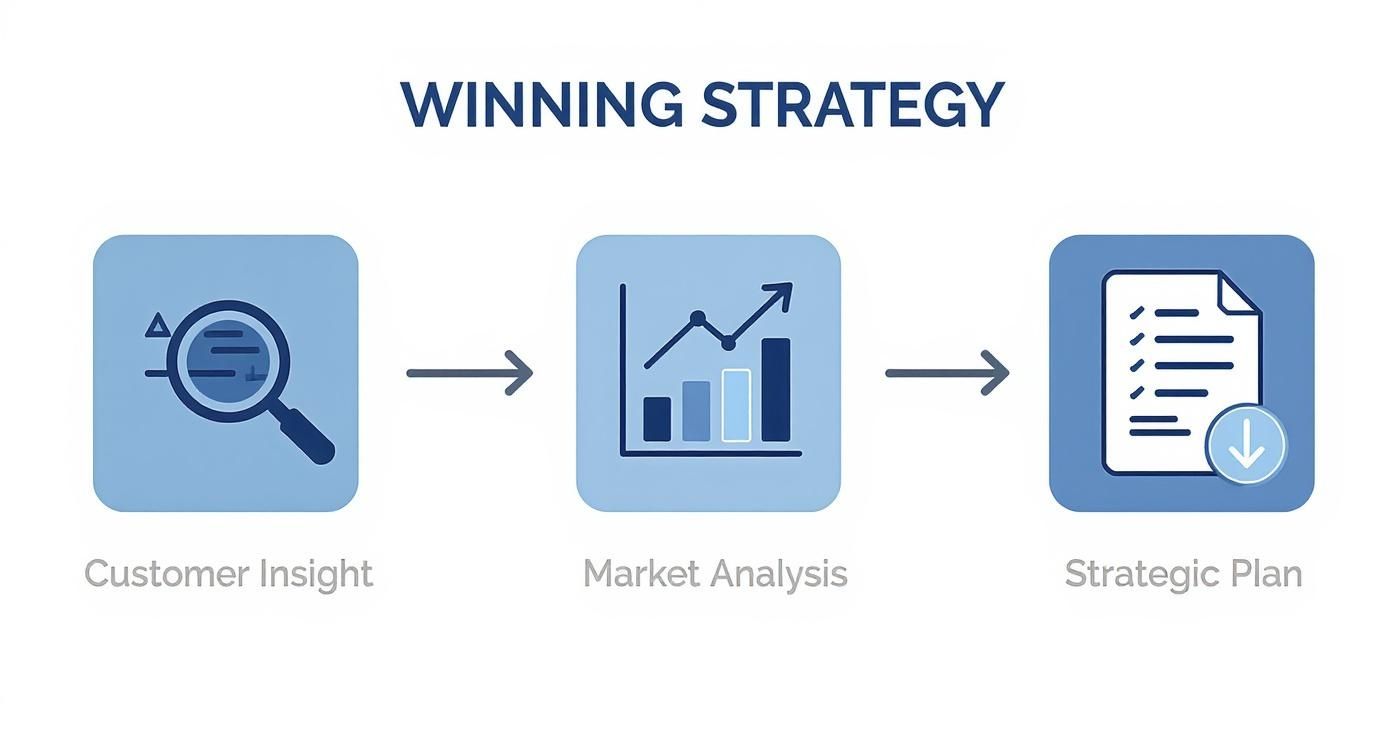
As the graphic shows, a solid strategic plan is the result of rigorous analysis, not the starting point.
To make this crystal clear, here’s how that entire cascade looks in a structured format.
Case Study: B2B SaaS Strategic Cascade
| Level | Type | Description | Metric/KPI |
|---|---|---|---|
| Top | Company Goal | Become the #1 CRM for SMBs in North America. | Market Share |
| Product | Product Objective | Increase new SMB sign-ups by 40% in the next 6 months. | New SMB Sign-ups |
| How | Product Strategy | Drive acquisition with self-service onboarding & a low-cost tier. | N/A (Directional) |
| What | Initiatives | 1. "QuickStart" onboarding 2. "Starter" pricing tier |
Project Completion |
| Measure | Key Metrics | Trial sign-ups, Conversion rate, TTV, Activation rate. | Specific KPIs |
This table shows the direct line of sight from the highest-level ambition down to the daily metrics the team is tracking. Everything is connected.
The Power of Structured Frameworks
Adopting a structured approach like this isn't just about keeping things neat. It has a real, measurable impact on performance. Companies that use frameworks like Objectives and Key Results (OKRs) see huge benefits. In fact, 83% of users recommend OKRs for improving goal alignment, and companies using them report a 40% higher impact on achieving their goals.
It doesn't stop there. Over 64% of employees in organizations that use OKRs believe their company is more successful. You can find more data on the impact of goal-setting frameworks at Mooncamp.
The data is clear: a systematic workflow for connecting goals to objectives to strategies is a powerful driver of success. It creates clarity and accountability, giving your team the focus they need to win.
Common Questions on Product Strategy
Even with a solid framework, putting the hierarchy of goals, objectives, and strategies into daily practice can get messy. I've been a PM leader for a while now, and I've seen all the friction points—from the beautiful chaos of an early-stage startup to the tangled complexity of a massive enterprise.
This section tackles the most common questions I get from Product Managers who are trying to turn their ambition into actual, shippable products.
How Does This Framework Fit with OKRs?
This is the big one. Many PMs look at the Goal > Objective > Strategy hierarchy and immediately ask how it syncs up with Objectives and Key Results (OKRs). It's a fantastic question, because getting this wrong creates a world of confusion for your team.
Here's the simplest way to think about it: The strategic hierarchy is your planning architecture. OKRs are your execution and measurement framework, usually set quarterly. They aren't in conflict; they're partners.
- Your Goal is the big, long-term vision that lives above your OKRs. It’s the north star that guides them year after year.
- A product Objective (from our hierarchy) very often becomes the "O" in your OKR. It's the specific, qualitative outcome you're aiming for this quarter (e.g., "Launch a world-class onboarding experience").
- Your Key Results are the metrics that prove you actually achieved that objective (e.g., "Increase new user activation rate from 40% to 60%"). They make the objective measurable.
- Your Strategies and Initiatives are the high-level plans and concrete projects you ship to push those KRs forward. This is the work you and your team do to get the results.
In short, the Goal-Objective-Strategy model helps you decide what to focus on, while the OKR framework helps you measure your progress on that focus within a specific timeframe. They work together beautifully.
What Are the Biggest Mistakes PMs Make?
Over the years, I've seen incredibly smart PMs make the same handful of mistakes when setting their strategic direction. Sidestepping these common traps is one of the most important things you can do for your team's success and, frankly, for your own career.
- Setting "Output" Objectives: By far the most common error is creating objectives that are just about shipping features, not changing user behavior. "Launch the new dashboard" is an output. "Reduce time-to-value for new users by 30%" is an outcome. Always, always focus on the outcome.
- Gold-Plating the Strategy Document: I've seen PMs proudly present a 50-slide deck that absolutely no one will ever read. Your strategy should be a simple, clear articulation of your choices—think of it as a living document, not a book report. If an engineer can't grasp the core of it in five minutes, it’s too complicated.
- Confusing Goals with Objectives: A goal to "Become the market leader" is great for inspiration. An objective to "Increase market share by 10%" is something your team can actually execute against. When you blur this line, you end up with vague, unactionable targets that just leave your team frustrated.
How Should My Strategy Adapt by Company Stage?
Your approach to this stuff has to evolve as your company grows. The scrappy, experimental tactics that work for a 10-person startup will cause a five-alarm fire at a 10,000-person enterprise.
-
Early-Stage Startup (Seed/Series A): Your entire world revolves around one thing: finding product-market fit. Goals are more like guiding stars than fixed points, and they can shift fast. Your strategy is basically a series of hypotheses you need to validate or kill as quickly as possible. You might only have one or two core objectives, likely focused on raw user engagement and retention. Here, speed and learning are the strategy.
-
Growth-Stage Company (Series B/C): Okay, you've found product-market fit. Now the game changes to scale and optimization. Your goals become more stable. Strategies are all about capturing market share, improving your unit economics, or expanding into adjacent user segments. Your objectives get more granular, often tied to specific growth loops or funnel metrics.
-
Mature Enterprise (Public Company/Late Stage): At this scale, your focus is on defending your market position, squeezing out more efficiency, and finding new pockets of incremental growth. Strategies often span multiple years and require intense cross-functional choreography. Objectives are tracked with hawk-like precision and are tied directly to revenue, profitability, and shareholder value. The process is slower, but the blast radius of every strategic decision is massive.
Knowing the difference is critical. If you apply an enterprise-level planning process to a startup, you'll suffocate it. If you bring a startup's "move fast and break things" chaos into a large organization, you'll create anarchy. The best PMs know how to adapt their strategic toolkit to the business they're in.
Ready to dive deeper and master the frameworks that drive product growth? Join thousands of other product leaders and subscribe to the Aakash Gupta newsletter and podcast for actionable insights on strategy, career growth, and more. Find all the resources you need at https://www.aakashg.com.
