A product manager's core duty is to define the product vision, decide what to build next, and lead a cross-functional team to make it a reality. Forget the abstract definitions. In practice, you are the CEO of the product—the central hub connecting engineering, design, marketing, and, most critically, the customer. Your job is to ensure the team ships a product that solves a real-world problem and drives tangible business results.
The Four Pillars of Modern Product Management
To truly understand what PMs do day-to-day, we must move beyond the simple definition. The role breaks down into four interconnected pillars: Strategy, Execution, User Empathy, and Influence. These aren't just buzzwords; they are the foundational duties that separate elite PMs from the rest. Mastering the balance between them is the key to driving impact and accelerating your career from an entry-level PM to a C-suite leader.

These four pillars form the bedrock of the modern PM role. Excelling at one or two isn't enough—greatness comes from integrating all four into your daily workflow. The table below provides an actionable breakdown of how each pillar translates into specific duties, tools, and metrics you'll be measured against.
The Four Pillars of Product Management Duties
A summary of the essential responsibilities and tools that define the modern Product Manager role.
| Pillar | Core Duty | Key Activities | Example Metric |
|---|---|---|---|
| Strategy | Define the 'Why' | Market research, competitive analysis, roadmap creation, OKR setting. | North Star Metric |
| Execution | Ship the 'What' | Backlog grooming, sprint planning, writing user stories, bug triage. | Velocity / Cycle Time |
| User Empathy | Understand the 'Who' | User interviews, data analysis, feedback synthesis, persona development. | Customer Satisfaction (CSAT) |
| Influence | Align the 'How' | Stakeholder communication, team motivation, cross-functional syncs. | Stakeholder Alignment Score |
Each pillar demands a unique set of skills, but they are deeply codependent. Strong execution is useless without a clear strategy, and a brilliant strategy will fail if you can't align and inspire the team to build it.
Pillar 1: Strategy
Strategy is the art of translating high-level company objectives into a clear, actionable product vision. Your duty is to answer the big questions: "What market are we competing in, and what is our unique path to victory?" This requires deep market analysis, obsessive competitor tracking, and crafting a compelling roadmap that charts the course.
Consider Spotify. Their initial strategy was simple and powerful: "all the world's music, instantly." As the market matured, their PMs evolved this strategy to focus on personalization and discovery. This led to game-changing features like Discover Weekly. This wasn't a lucky guess; it was a strategic pivot, driven by user data indicating a craving for curated experiences, which in turn boosted engagement and long-term retention.
Pillar 2: Execution
This is where strategy meets reality. Execution involves turning that vision into a tangible, shipped product. It encompasses all the tactical duties of working hand-in-hand with engineering and design, such as meticulously grooming the backlog, running efficient sprint planning meetings, and writing crystal-clear user stories. Your goal is to give the team everything they need to deliver high-quality work on schedule.
But this is far more than project management. Effective execution means making thousands of micro-decisions and trade-offs each week to maintain momentum without sacrificing quality or losing sight of the strategic "why."
Pillar 3: User Empathy
Exceptional products are built on a deep, almost obsessive, understanding of the customer. A primary duty for any PM is to be the unwavering voice of the user within the organization. This isn't about intuition; it's a data-driven discipline combining qualitative and quantitative methods.
You'll conduct one-on-one user interviews, run usability tests, dive into product analytics, and analyze customer support tickets. The objective isn't merely to collect feedback—it's to synthesize it into powerful insights that inform every decision, from major strategic bets to minor UI tweaks. You must understand your user's pain points even better than they do.
Pillar 4: Influence
This may be the most underestimated pillar. Product managers lead teams without direct authority. You don't manage engineers or designers, yet you are accountable for what the team ships. This is achieved through influence.
This requires exceptional communication and persuasion skills to align everyone—from senior executives to junior engineers—around a shared vision. To see how top-tier PMs master this, it’s worth learning more about what makes a great product manager and their unique ability to lead.
Mastering stakeholder alignment is directly tied to your career growth. PMs are the bridge between the technical and business worlds, and a key duty is defining and prioritizing the roadmap. This responsibility pays well; recent salary data shows UK mid-level PMs average £67,000, while senior PMs can command £109,100. The trend is consistent across major tech hubs, proving that mastering influence doesn't just drive product success—it accelerates your career and earning potential.
A Day in the Life of a Product Manager
If you ask a Product Manager what they do, you'll rarely get a straight answer. The job isn't static; it's a dynamic mix of strategy and execution that shifts day by day, sometimes hour by hour.
To make this tangible, let’s walk through two distinct but equally common PM scenarios: a day spent deep in discovery versus one focused entirely on delivery.
Think of it like this: on a discovery day, the PM is an explorer, drawing maps and searching for treasure. On a delivery day, they are the ship captain, navigating the crew through a storm to get that treasure home safely. Both roles are critical to the product's success.
This contrast is vital. It demonstrates how a PM’s duties adapt to the product lifecycle and offers a realistic view of the job—and a framework for auditing how you're spending your own time.
A Discovery-Heavy Day
A discovery day is all about answering the big 'why' and 'what' questions. Your primary duty is to reduce uncertainty and validate that the team is building the right thing. Mornings on these days are typically reserved for deep, focused work, transforming raw insights into actionable strategy.
-
9:00 AM – Synthesize User Research: You’re in Dovetail, digging through transcripts from recent user interviews. You're tagging key pain points and pulling out powerful quotes, searching for patterns that validate or invalidate a core hypothesis. For instance, "Do users actually need an AI summary feature, or is the real problem information overload during checkout?"
-
11:00 AM – Brainstorm with Design: Armed with fresh insights, you jump into a collaborative session with your product designer. A digital whiteboard is essential for this creative work.
This screenshot from Miro shows a classic setup—virtual sticky notes mapping out user flows and feature ideas. This is how you and your designer rapidly iterate on different solutions before committing engineering resources.
-
1:00 PM – Draft a Strategy Brief: Time to translate the morning's exploration into a coherent plan. You start writing a concise one-page strategy brief. This document clearly defines the problem, the target user, the proposed solution, and the metrics for success. It’s your primary tool for aligning stakeholders.
-
3:00 PM – Present Initial Findings: The day concludes with a meeting with key stakeholders—like the engineering lead and a marketing manager. You present the strategy brief, share compelling user quotes, and invite discussion. The goal is to get early buy-in and, more importantly, to have your plan stress-tested now, not after launch.
A Delivery-Heavy Day
In stark contrast, a delivery day is focused on execution and shipping. Your primary duty is to clear roadblocks so the engineering team can focus on building the thing right. The day is more reactive, filled with quick decisions and constant communication.
-
9:00 AM – Lead Engineering Stand-up: You're in the daily stand-up, but you're not there to talk—you're there to listen for blockers. An engineer mentions they're uncertain about an edge case. Your job is to provide an immediate answer or commit to finding one within the hour.
-
10:00 AM – Triage Bugs in Jira: A critical bug has been flagged from the latest build. You immediately jump into Jira, reproduce the issue, assess its impact on the user experience, and huddle with the engineering lead to prioritize a fix. This requires sharp, decisive judgment.
-
1:00 PM – Clarify Requirements: A developer Slacks you asking for more detail on a user story. You hop on a quick call, pull up the Figma designs, and walk them through the intended user flow screen by screen, ensuring zero ambiguity.
-
4:00 PM – Check Pre-launch Metrics: Using a tool like Amplitude, you analyze data from a feature currently in beta. You're looking for early signals that it's hitting its KPIs—are users engaging with it? Is it driving the intended conversions?
These two days illustrate the core tension of product management. You're constantly balancing the long-term vision with the messy, short-term realities of getting stuff done. A great PM is a master of the context switch, toggling between these two modes, sometimes multiple times in a single day.
How Product Manager Duties Evolve with Seniority
A Product Manager's career path isn’t linear—it’s a series of level-ups, each with a distinct shift in scope, influence, and daily duties. While the core responsibilities of strategy and execution remain, how you perform them changes dramatically as you advance from an Associate PM to a Chief Product Officer.
Understanding this evolution is crucial for accelerating your own career. At each stage, the expectations for your impact expand. You'll progress from owning a single feature to an entire product line, and eventually, to steering the entire product organization and its multi-year vision. Your success is no longer measured by shipping features, but by shaping market outcomes and, most importantly, leading people.
Associate Product Manager (APM) to Product Manager (PM)
Your career begins with a laser focus on tactical execution and learning the craft. As an APM, your entire world is your scrum team. Your primary duty is to translate a senior PM’s strategy into crystal-clear user stories, meticulously manage the backlog, and ensure the engineering team has zero blockers.
You are measured almost entirely on your ability to deliver. An APM job description from a company like Meta or Google will emphasize "working closely with engineering to define requirements" and "managing sprint priorities." You are there to learn the fundamental rhythms of product development—the art of the trade-off, the science of prioritization, and the discipline of relentless, clear communication.
The leap to Product Manager signifies a graduation from executing someone else's vision to owning your own. You are now accountable for a specific feature or a small product area. Your duties expand from just the 'how' to include the 'what' and 'why.' This is when you begin running your own user research, analyzing data to form hypotheses, and crafting a roadmap for your domain.
This diagram illustrates the two primary modes a PM operates in—discovery and delivery—which you must master to advance.
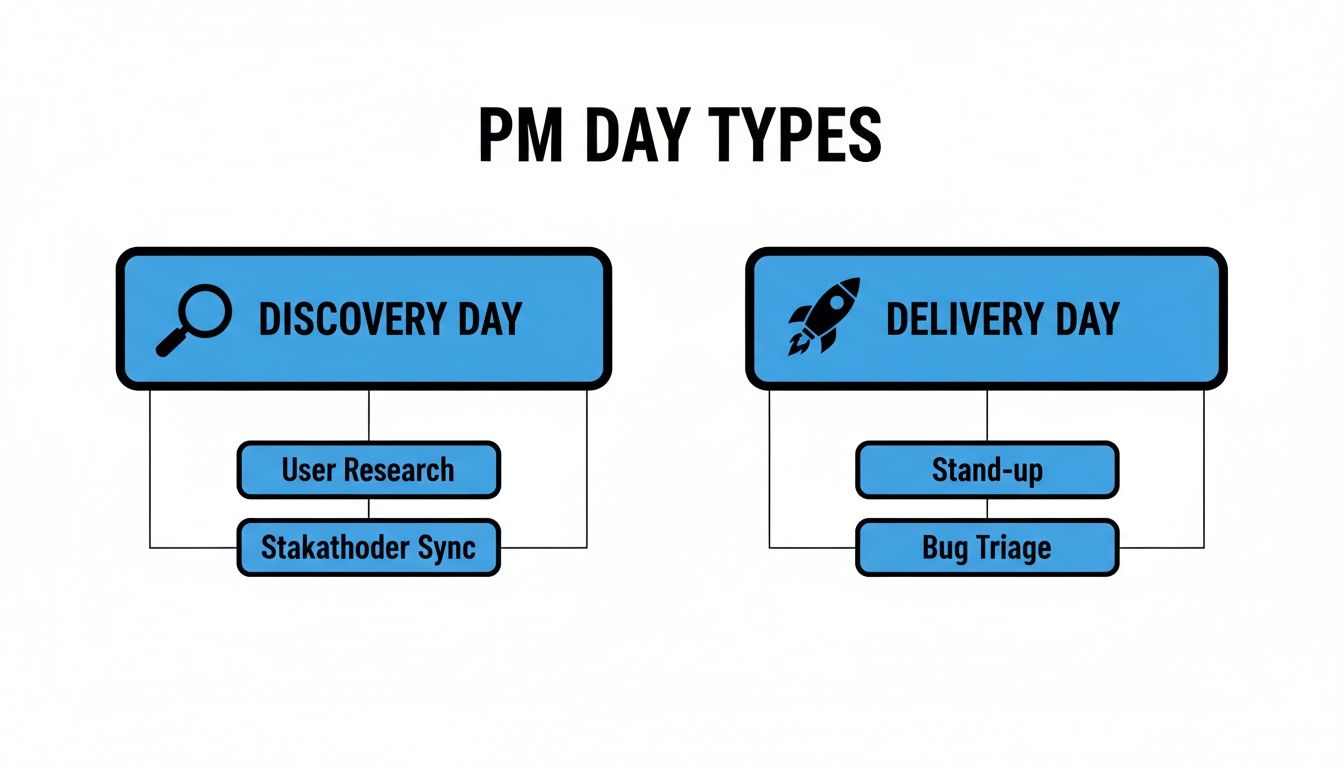
As you become more senior, the goal is to progressively shift your time from being bogged down in delivery tasks to driving more high-impact, strategic discovery work.
Senior PM to Group PM
Becoming a Senior PM marks a shift from owning a feature to driving strategy. At this level, you are expected to operate with significant autonomy, tackling larger, more ambiguous problems that may span multiple teams. Your job isn't just to ship a product, but to prove it had a measurable impact on the business.
A critical new duty is mentorship. You will start guiding junior PMs and helping them navigate their own projects. You also become a key voice in broader product strategy discussions, influencing the roadmap far beyond your own team's scope. Your ability to zoom out, connect your work to the company's broader goals, and influence your peers becomes as important as your execution skills. To learn more about this transition, explore our guide on the essential skills required for a product manager.
VP of Product to Chief Product Officer (CPO)
At the executive level, your duties transform completely. You are no longer building products; you are building the organization that builds products. As a VP or CPO, your primary responsibilities are setting the multi-year product vision, managing the entire product portfolio, and—most critically—hiring, developing, and retaining world-class product talent.
Your calendar is filled with budget planning, C-suite alignment meetings, and organizational design, not backlog grooming. A core duty is mastering cross-functional collaboration at the highest level, ensuring the entire company is aligned and marching in the same strategic direction.
This mastery is directly reflected in compensation. One newsletter reports the median VP of Product total compensation is around $707,000, which can jump to $1.425 million for CPOs. These figures demonstrate the immense value companies place on strategic leadership and organizational influence. You can find more insights on how PM salaries scale with leadership at Lenny's Newsletter.
The table below breaks down how these responsibilities shift at each level of the product management career ladder.
PM Duty Focus by Career Level
| Career Level | Primary Focus | Key Duties | Example KPI |
|---|---|---|---|
| APM/PM | Tactical Execution | Backlog grooming, writing user stories, sprint planning, feature delivery, basic data analysis. | Team velocity, feature adoption rate, on-time delivery. |
| Senior PM | Strategic Ownership | Roadmap planning, user research, cross-team alignment, mentoring junior PMs, business case creation. | Product-line revenue, user engagement, customer satisfaction (CSAT). |
| Group PM / Director | Leading People & Product Lines | Managing a team of PMs, resource allocation, product line strategy, influencing other departments. | Team performance, portfolio growth, market share. |
| VP / CPO | Organizational Leadership | Setting multi-year product vision, hiring and developing talent, budget management, C-suite alignment. | Overall company revenue, stock price, organizational health. |
As you can see, the journey is a clear progression from mastering details to mastering the big picture.
The arc of a PM career is a journey from tactical depth to strategic breadth. Early on, you win by being the master of your feature. Later, you win by empowering a hundred other PMs to be masters of theirs.
Ultimately, successfully navigating this path requires acute self-awareness. You must constantly ask yourself if you're building the skills for the next level—not just perfecting the job you already have.
The New Duties of an AI Product Manager
The most significant shift in product management isn’t a new framework; it's an entirely new class of products. The AI explosion has created a specialized and critical role: the AI Product Manager. While core PM skills remain foundational, an AI PM operates in a world of probabilities, not predictable code. This requires a fundamentally different playbook.
A traditional PM is like an architect designing a skyscraper with a fixed blueprint. An AI PM is more like a biologist designing an ecosystem. You set initial conditions and introduce the right elements (data), knowing the system will learn, adapt, and behave in ways that are not perfectly predictable.
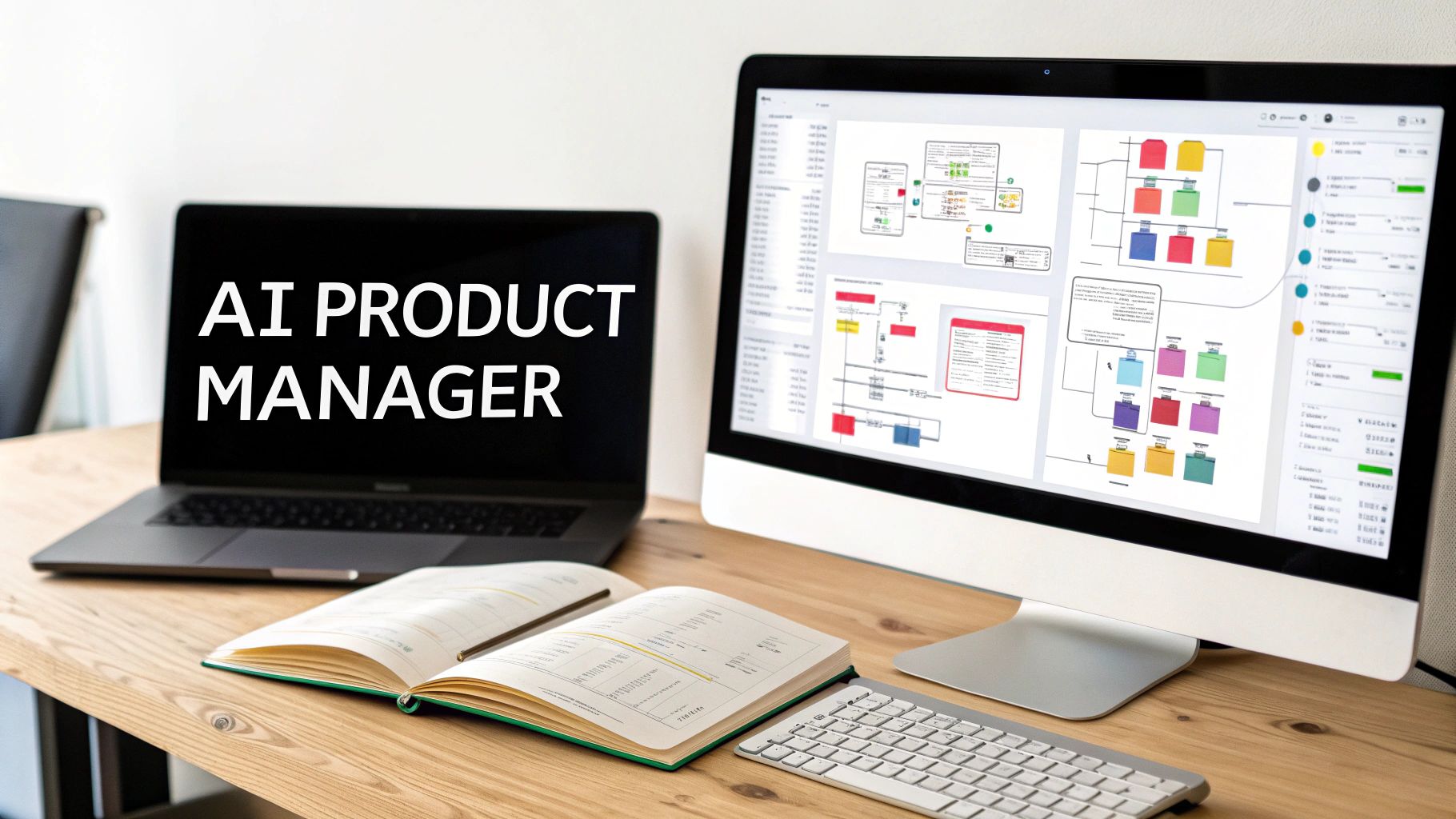
This new environment is complex, dominated by data flows and model diagrams rather than clean user flow mockups. It fundamentally changes the job, adding new layers of complexity to the classic PM role.
The Shift from Code to Data and Models
A traditional software PM focuses on code and logical flows. An AI PM's duties expand to include three new, critical domains: data strategy, model performance, and navigating ambiguity.
-
Owning the Data Strategy: AI models are only as good as their data. A crucial new responsibility for an AI PM is to own the data pipeline. This means sourcing data, ensuring it’s clean and labeled correctly, and relentlessly hunting for biases that could corrupt your model. At a company like OpenAI, a PM's success hinges as much on securing high-quality, ethically-sourced datasets as it does on shipping user-facing features.
-
Mastering Model Performance Metrics: A traditional PM tracks user engagement and conversion rates. An AI PM must be fluent in a new language of model metrics. You will find yourself in deep discussions about precision (how many of our positive predictions were actually correct?) and recall (how many of the actual positives did our model identify?). The trade-off is critical. For an AI that detects bank fraud, you would optimize for high recall to catch every possible fraudulent transaction, even if it means flagging a few legitimate ones.
-
Navigating Non-Deterministic Systems: AI products don't always behave as expected. An LLM-powered feature might provide a brilliant answer one minute and a nonsensical one the next. The AI PM’s duty is to design products that handle this uncertainty gracefully. This involves creating "human-in-the-loop" workflows for error correction and designing user interfaces that manage expectations when the AI inevitably fails.
An Actionable Framework for AI Product Development
To manage these new duties, AI PMs need a specialized framework that goes beyond standard agile sprints. It’s a continuous loop of problem framing, data strategy, model evaluation, and human-centric design.
Here’s a practical look at how this plays out, with specific prompts you can use to get started.
1. AI Problem Framing
Before writing any code, you must determine if AI is the right tool. Sometimes it's a complex, expensive solution for a problem that a simple script could solve.
- Action: Ask yourself, "Can I solve this with a few simple if-then rules? Or does it truly require learning from messy, unstructured data?"
- ChatGPT Prompt: "Act as a senior AI Product Manager. My problem is [describe user problem, e.g., 'users struggle to find relevant articles in our knowledge base']. Brainstorm 3 potential solutions: one using rules-based logic, one using a basic machine learning model, and one using a large language model. Compare the pros, cons, and data requirements for each."
2. Model Evaluation and Human-in-the-Loop Design
Once a model is in development, your focus shifts to its real-world performance—and how to prevent it from failing.
- Action: Define what "good enough" means. Is 95% accuracy acceptable? More importantly, what are the consequences for the 5% of cases where it fails?
- ChatGPT Prompt: "I'm building an AI feature that [describe feature, e.g., 'summarizes legal documents']. Generate a list of potential ethical risks and biases I should test for. Suggest 3 specific 'human-in-the-loop' design patterns to allow users to correct errors and provide feedback."
For an AI PM, the product launch is not the end of development—it's the beginning. Your product will evolve as it consumes more data, and your duty is to guide that evolution responsibly.
Knowing the right tools is critical for any modern PM. This means finding the best AI notetaker for their needs to capture insights from the countless meetings needed to get data science, engineering, and stakeholders on the same page. For a much deeper dive into this world, check out this comprehensive guide to AI Product Management.
Essential Frameworks to Execute Your PM Duties
Top-tier product managers don't rely on intuition alone. They use proven systems to manage the chaos of product development. Frameworks are the tactical tools that translate a grand vision into daily execution, ensuring teams stay focused, aligned, and make data-driven decisions.
Mastering a few core frameworks is one of the fastest ways to level up as a PM. They create a shared language for your team and stakeholders, making planning, prioritization, and communication more efficient. Think of them as the operating system for your product work.
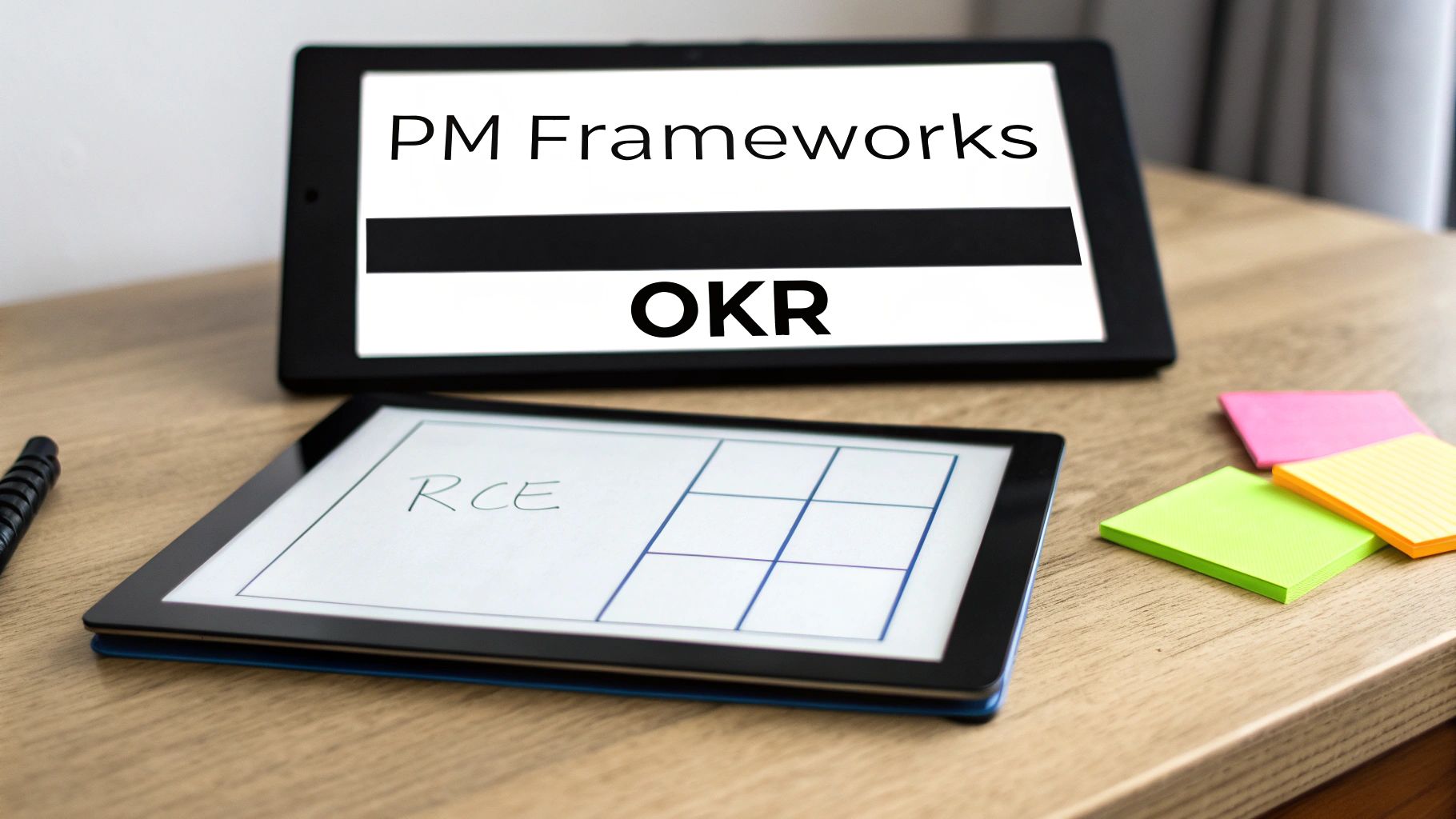
OKRs for Strategic Alignment
OKRs (Objectives and Key Results) are your secret weapon for connecting your team’s daily work to the company's highest-level goals. An Objective is the ambitious, qualitative goal (e.g., "Become the go-to app for new parents"). Key Results are the specific, measurable outcomes that prove you achieved it (e.g., "Increase MAU from 50k to 150k").
How to implement it:
- Start with the 'Why': Your Objective must be clear and inspiring.
- Define Success: Choose 3-5 quantitative Key Results with a clear deadline. If you can't measure it, it's not a KR.
- Cascade and Align: Work with your team to set their own OKRs that directly support yours.
A well-crafted OKR set ensures everyone is rowing in the same direction. It changes the conversation from "Are we shipping features?" to "Are we achieving our desired outcomes?"
RICE for Ruthless Prioritization
The RICE scoring model is a simple, effective tool for removing emotion and bias from prioritization debates. It forces you to evaluate every potential feature against four criteria, providing a single score to guide your roadmap.
- Reach: How many users will this impact in a given timeframe? (e.g., 5,000 users/month)
- Impact: How much will this move our primary metric? (Score: 3 for massive, 2 for high, 1 for medium, 0.5 for low)
- Confidence: How certain are we about our Reach and Impact estimates? (Score as a percentage: 100% for high confidence, 80% for medium, 50% for low)
- Effort: How much engineering and design time is required? (Estimate in "person-months")
The final score is calculated as: (Reach x Impact x Confidence) / Effort. The higher the score, the higher the priority. For a deeper dive on this and other methods, check out these essential product strategy frameworks.
RACI for Clear Communication
A RACI matrix is a lifesaver for preventing stakeholder confusion and clarifying ownership. For any project, it defines who is Responsible, Accountable, Consulted, and Informed.
- Responsible: The person (or people) doing the actual work.
- Accountable: The single individual who ultimately owns the outcome. There can only be one "A."
- Consulted: Subject matter experts whose input is needed.
- Informed: Stakeholders who need to be kept updated on progress.
Establishing a RACI chart at the start of a project eliminates ambiguity about who needs to attend which meeting and who has the final say. It’s a simple tool that prevents countless hours of frustration.
These frameworks aren't abstract exercises; they're grounded in the PM's core duty of relentless market research and user feedback. This is what informs every product decision, ensuring what you build actually resonates with people. It’s also how you grow in your career—the ability to turn those insights into real value is what separates a junior PM making $79,601 from a senior PM earning $125,554 in the US.
Frequently Asked Questions About PM Duties
Even after detailing the core duties, several questions consistently arise. Let's address the most common ones I hear from aspiring and experienced PMs alike.
What Is the Single Most Important Duty of a Product Manager?
It all comes down to owning the “why.” Why are we building this product? Why this specific feature? And why is now the right time to do it? The single most critical job of a PM is to define and champion a compelling product vision that’s deeply rooted in customer needs and perfectly aligned with the business’s goals.
This isn’t just about having a good idea. It’s about blending hard data from market analysis with invaluable human insights from user conversations. Without a rock-solid "why," your team builds without direction, marketing lacks a compelling narrative, and the product will inevitably miss the mark. All other PM duties—from writing specs to managing stakeholders—flow from this essential responsibility.
How Do Product Manager Duties Differ Between Startups and Large Corporations?
The core job is the same, but the day-to-day reality is worlds apart. At a startup, a PM is a Swiss Army knife. You'll find yourself doing everything—project management, marketing, QA, maybe even a little customer support. It's scrappy, tactical, and all about moving fast to find product-market fit.
In a big company like Google or Microsoft, the role gets much more specialized and strategic. Your job becomes less about "doing it all" and more about navigating complex org charts, aligning dozens of stakeholders, and finding ways to drive growth in a huge, established product ecosystem. It's a shift from "doing it all" to "influencing at scale."
What Duties Should an Aspiring PM Focus on to Get Their First Job?
You need to demonstrate you can do the job before you have the title. Hiring managers want to see proof of work in PM-adjacent skills. It's the most powerful way to stand out.
I'd focus on building experience in these three areas:
- Develop Customer Empathy: Don't just say you care about users. Run some mock user interviews with friends or dive into app reviews to spec out a new feature. Show you can find and clearly explain a user's pain point.
- Practice Execution and Prioritization: Take a personal project—anything from planning a group trip to building a simple website—and manage it like a product. Create a simple roadmap for it (a RICE score sheet works great) and write a few clear user stories.
- Showcase Analytical Skills: Take a free course on SQL or data analysis. Then, grab a public dataset and use your new skills to pull out a few interesting product insights.
If you really want to see how these duties come to life, digging into real-world product management case studies is one of the best ways to connect the dots.
What Is the Difference Between a Product Manager and a Project Manager?
This one trips up a lot of people. Here’s the simplest way to think about it: the Product Manager owns the “what” and the “why,” while the Project Manager owns the “how” and the “when.”
A Product Manager has a strategic role. They are accountable for the product's vision, its roadmap, and its ultimate success or failure in the market. They identify which problems are most valuable to solve to achieve business goals.
A Project Manager, in contrast, has a tactical role. They are given a specific project with a defined scope, timeline, and budget, and their job is to execute it. They manage resources, track schedules, and ensure the team meets its deadlines. While their duties can overlap, they are two distinct roles. For a deeper analysis, see our guide on the differences between a product manager vs project manager.
Do Product Managers Need a Technical Background?
No, you don't need a computer science degree to be a great PM. But technical literacy is absolutely non-negotiable. You don’t have to write code, but you must understand the fundamentals of how software is built to have credible conversations with your engineers.
This means you should understand what an API is, the basics of how databases work, and the general tech stack your product is built on. This knowledge allows you to grasp technical trade-offs, sanity-check effort estimates, and—most importantly—build trust with your engineering team. Without it, you will quickly lose credibility and make uninformed decisions that could jeopardize your product.
At Aakash Gupta, we are dedicated to helping you master every aspect of the product management field, from foundational duties to advanced AI strategies. Explore our resources to accelerate your career and become a top-tier product leader. Learn more at https://www.aakashg.com.
