To influence without authority, a product manager has to build what I call "influence capital." It’s earned through three core currencies: deep expertise, strong relationships, and compelling data. This isn't abstract theory; it's the tactical playbook I've seen separate top 1% PMs from the rest at companies like Google and Meta.
This approach is about shifting from giving orders to creating genuine alignment. Frankly, it's the only way to succeed when you own the product outcome but not the engineering, design, or marketing teams building it. Your ability to lead through persuasion, not command, will define your career trajectory and your salary band.
The Product Manager's Paradox: Total Ownership, Zero Authority
Welcome to the central challenge of modern product management. You are 100% accountable for your product's success, yet you have zero direct authority over the core team. This isn't a bug; it's a feature of high-performing, cross-functional organizations. This structure makes your ability to influence without formal authority the single most critical skill for getting promoted.
This isn't just a Silicon Valley quirk. A 2023 McKinsey report found that employees in agile, cross-functional teams report higher engagement and are 1.5 times more likely to be part of a successful product launch. Your job is to lead, not manage.

Building Your Influence Capital
Think of influence like a bank account. You can't show up and make a big withdrawal (like asking an engineering team to work over a weekend) without first making consistent deposits. The best PMs I've hired and mentored are constantly depositing into their "influence capital" account.
This capital is built on three distinct currencies:
- Expertise: Become the undeniable go-to person for the customer, the market, the technology, and the business metrics. When you know more than anyone else in the room about the "why," people naturally turn to you and listen.
- Relationships: Proactively build a "trust battery" with your key partners, especially in engineering and design. Strong relationships create a foundation of goodwill that makes the inevitable tough conversations about scope and deadlines much easier.
- Data: This is your secret weapon. Data moves conversations from the frustrating realm of subjective opinions ("I think users will like this") to the clear world of objective facts ("Users with this persona have a 3x higher churn rate"). A well-reasoned, data-backed case is the most powerful tool for convincing a skeptical stakeholder.
As a PM leader who has managed teams at major tech firms, I've seen countless careers stall not from a lack of good ideas, but from an inability to rally a team around them. Mastering these three currencies is non-negotiable for anyone aspiring to senior leadership roles. If you want to see how this applies in similar roles, check out the 7 Core IT Project Managers' Responsibilities.
Your first 90 days on any project are absolutely crucial for building this foundation.
Your First 90 Days Influence Capital Checklist
So, you're starting a new role or project. How do you start making those deposits into your influence capital account from day one? Here’s a tactical checklist to get you started.
| Influence Currency | Day 1-30 Action Items | Day 31-60 Action Items | Day 61-90 Action Items |
|---|---|---|---|
| Expertise | Read all existing documentation (PRDs, research, metrics dashboards). Schedule 1:1s with 10+ customers. Shadow support calls. | Analyze competitors' products and recent launches. Identify 3-5 core metrics for your area and track them daily. | Present a "State of the Product" summary to your team, incorporating customer insights and data trends. Become the person who answers questions about the "why." |
| Relationships | Schedule 30-min intro 1:1s with every engineer, designer, and key stakeholder. Ask: "What's working well? What's not? How can I help you succeed?" | Identify your "go-to" person on each team (Eng Lead, Design Lead, etc.). Grab coffee or lunch. Make a point to give public credit to teammates for their work. | Facilitate a brainstorming or retrospective session. Establish a reputation for being a great collaborator who listens more than they talk. Mediate a minor disagreement successfully. |
| Data | Learn your company's analytics tools (e.g., Amplitude, Mixpanel). Pull your first basic product usage report. | Find one surprising data point and share it with the team. Ask, "What do we think is happening here?" | Build a simple data dashboard for your product's key health metrics. Use a data point to successfully argue for or against a feature in a team meeting. |
This isn't about checking boxes; it's about forming habits. Consistently investing in your expertise, relationships, and data-driven arguments will pay dividends for years to come, turning you from a product manager who needs authority into a leader who commands influence.
Building Your Three Currencies of Influence
To consistently drive outcomes without a single direct report, you have to build what I call "influence capital." This isn't about shady office politics; it’s about strategically earning the right to lead.
In my time hiring and mentoring PMs at major tech companies, I've seen a clear pattern: the ones who get promoted fastest are those who master the three core currencies of influence. Your goal is to become so valuable that engineers, designers, and stakeholders naturally look to you for direction. Let's break down how to build each one.
Currency #1: Become the Go-To Expert
Your first currency is expertise. You need to become the undisputed, go-to source of truth on four key domains: the customer, the market, the tech stack, and the business metrics.
When you're the walking encyclopedia for your product area, people stop questioning your judgment. Instead, they start seeking it out. This means going deeper than anyone else on the team. It’s not enough to read a summary of user feedback; you need to know the customer's exact words, their raw frustrations, and what they truly desire. It's not enough to know who your competitors are; you must understand their strategy, their recent launches, and even their technical limitations.
Tactical Plan for Building Expertise:
- Customer Immersion: Block 2 hours on your calendar every single week for "Customer Time." Make it non-negotiable. Shadow customer support calls, read raw feedback tickets, and watch user session recordings in tools like FullStory until you can anticipate user behavior before it happens.
- Technical Literacy: You don't need to write code, but you absolutely must understand the architecture, dependencies, and technical debt of your product. Ask your tech lead to whiteboard the system for you. Ask "Why was it built this way?" This builds massive respect with engineering.
- Metric Ownership: Master your analytics tools, whether it's Amplitude or Mixpanel. You should be the person who can answer any question about user engagement, conversion funnels, or retention rates without having to say, "I'll get back to you."
Currency #2: Forge Unbreakable Relationships
Your second currency is relationships. A PM with deep expertise but poor relationships is just a smart jerk nobody wants to work with. Your product team is a group of highly intelligent, often skeptical people who will only follow you if they trust and respect you.
Building this trust requires a proactive, consistent investment in what I call the "trust battery." Every positive, helpful, and transparent interaction charges it up. Every missed deadline, vague requirement, or self-serving decision drains it.
As a leader, I can tell within one meeting if a PM has invested in their relationships. When an engineer defends the PM’s proposal before the PM even has to, that’s a sign of a fully charged trust battery. That’s real influence.
A huge part of this is building strong cross-functional collaboration skills, which create the foundation for mutual respect and much faster decision-making.
Tactical Plan: Run Effective 1-on-1s to Build Trust
Your weekly 1-on-1s with your engineering and design leads are your primary tool for charging that trust battery. Don't waste them on status updates.
Instead, use this agenda:
- Start with Them (5 mins): "How are you doing? Anything outside of work you’re excited about? How is your workload feeling?" This shows you care about them as a person, not just a resource.
- Their Agenda (10 mins): "What's on your mind? What roadblocks are you hitting? What can I do to help you be more effective this week?" Listen intently and take notes. Your follow-through here is everything.
- Your Agenda (10 mins): "I wanted to get your thoughts on X. Here’s some customer feedback related to Y. What are the technical implications of Z?" This is where you collaborate, not dictate.
- Align on Next Steps (5 mins): "So, to confirm, I'll clarify the requirements for X, and you'll investigate the API for Z. Does that sound right?" Always end with clarity and shared ownership.
Currency #3: Let Data Drive the Narrative
The final and most powerful currency is data. Data transforms your arguments from subjective opinion ("I think users want this") into objective reality ("Session recordings show 80% of users drop off at this step"). For a PM trying to influence without authority, it's the ultimate trump card.
A compelling, data-backed case is nearly impossible for a reasonable stakeholder to ignore. It reframes the whole conversation around solving a shared, visible problem rather than just debating personal preferences. As detailed in a study from Wharton, proposals backed by quantitative data are up to 40% more persuasive in business settings. You can learn more about how data helps leaders inspire change from Harvard Business School Online.
Here’s a real-world scenario. A PM I knew at Airbnb was struggling to convince her engineering lead to prioritize a frustrating bug in the booking flow. The lead was far more interested in a new, shiny feature. Instead of arguing, the PM spent a day digging into customer support tickets and watching session recordings in FullStory.
She came to the next meeting armed with this:
- "Over the last 30 days, we've had 112 support tickets directly mentioning this bug."
- "I watched 20 session recordings of users who encountered it. 18 of them (90%) abandoned their booking."
- "Based on our average booking value, I estimate this bug is costing us over $50,000 per month in lost revenue."
The conversation changed instantly. The bug was prioritized and fixed in the very next sprint. That’s the power of data.
Implementing a Stakeholder Management System
Influence isn't something you can just brute-force; it’s a game of nuance and targeted effort. If you’re sending the same generic updates to everyone you work with, you're missing opportunities. To get good at influencing without formal authority, you need a system for mapping, understanding, and managing the key players in your product's orbit.
The goal here is to shift from being reactive—responding to emails and putting out fires—to running a proactive influence campaign. The most effective PMs I've ever worked with have this down to a science. It looks like magic from the outside, but it’s really just a well-executed system.
At the heart of this system are the three currencies we've been talking about: expertise, relationships, and data. They all feed into each other, creating a powerful foundation for your influence strategy.
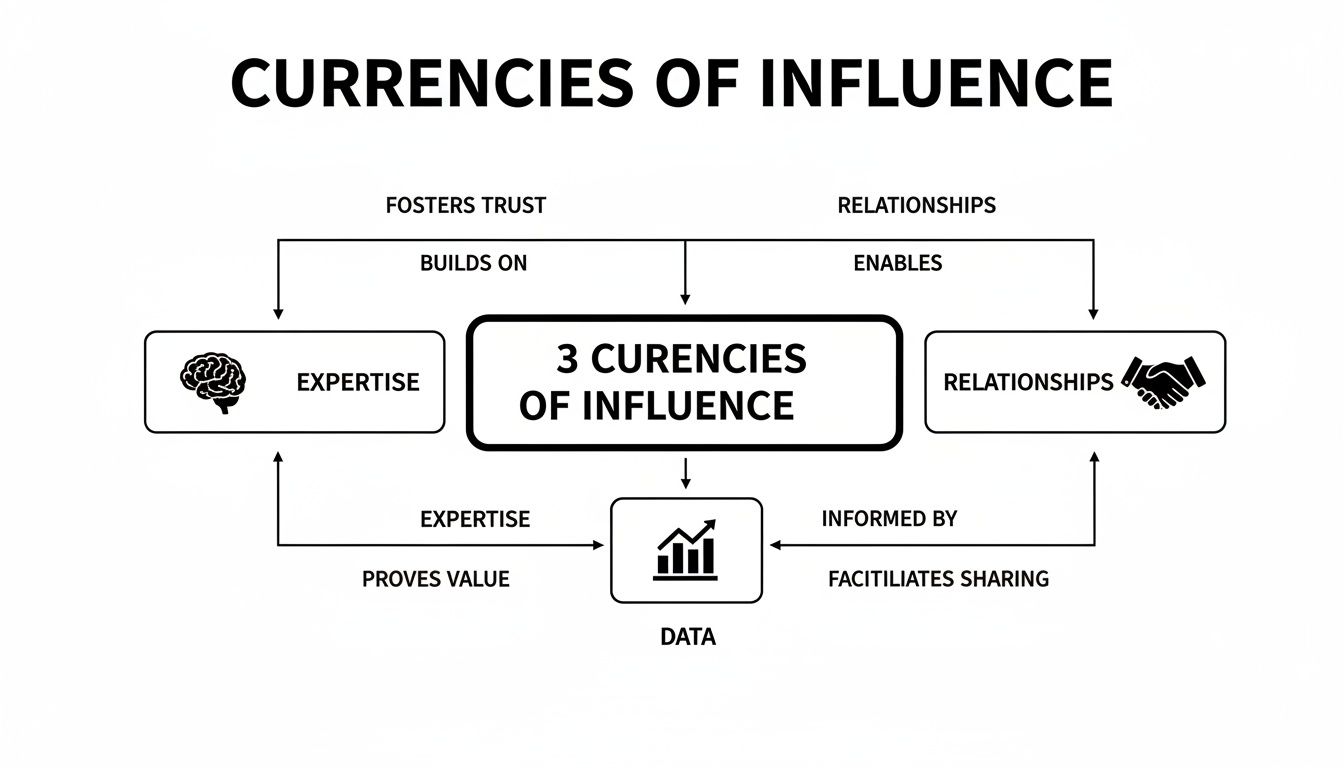
This isn’t just a theoretical model. Strong relationships make people more willing to listen to your expertise. And when you back up that expertise with solid data, the trust you've built becomes rock-solid.
The Power and Interest Stakeholder Matrix
A simple but ridiculously effective tool for getting started is the Power/Interest Matrix. This framework is all about categorizing your stakeholders into four groups so you can stop communicating on autopilot and start being strategic.
First, list every person or group that can affect your product's success: your core engineers, designers, your manager, execs, marketing, sales, legal, customer support—everyone. Then, map each one onto a 2×2 grid based on two simple questions:
- How much power do they have to block or approve decisions? (High/Low)
- How much interest do they have in your product's outcome? (High/Low)
This gives you four distinct quadrants, each demanding a different approach:
- Manage Closely (High Power, High Interest): Your core partners: Engineering Lead, Design Lead, your direct manager. They need constant, high-fidelity communication.
- Keep Satisfied (High Power, Low Interest): Senior leaders or heads of other departments. They can kill your project but aren't in the daily details. They need concise, data-driven proof of progress.
- Keep Informed (Low Power, High Interest): Your end-users, customer support team. They are deeply impacted but have little direct say. Keeping them informed builds an army of advocates.
- Monitor (Low Power, Low Interest): Peripheral teams who only need occasional, low-touch updates. Your goal here is efficiency.
A well-maintained stakeholder matrix is like a cheat sheet for organizational politics. I've watched mid-level PMs run circles around senior colleagues simply because they understood the map of influence better. They knew exactly whose support they needed to win and precisely how to earn it.
To bring this to life, here’s a framework you can use to structure your approach.
Stakeholder Influence and Communication Matrix
This matrix translates your Power/Interest grid into a concrete action plan, defining exactly how you'll communicate with and influence each group.
| Stakeholder Group | Description | Communication Tactic | Influence Strategy |
|---|---|---|---|
| Manage Closely | Key partners like your engineering lead, direct manager, and executive sponsor. | Daily syncs, 1:1s, detailed updates, collaborative workshops. | Build deep trust through shared goals. Involve them in key decisions early and often. |
| Keep Satisfied | Senior leaders, department heads who can veto but aren't in the weeds. | Bi-weekly email summaries, high-level roadmap reviews, quarterly business updates. | Proactively provide concise, data-driven proof of progress. Demonstrate competence and alignment with their strategic goals. |
| Keep Informed | End-users, customer support, sales teams who feel the impact but have little formal say. | Monthly newsletters, product demos, feedback sessions, read-only access to docs. | Empower them with information to build advocacy. Show them you're listening to their input. |
| Monitor | Peripheral teams with low impact and interest. | Company-wide announcements, occasional FYI emails. | Provide information efficiently through public channels. Minimize direct engagement to save time. |
By filling this out, you create a living document that guides your day-to-day interactions and ensures no one important falls through the cracks.
Creating Your Social Capital Map
Beyond a formal matrix, you need a picture of your actual relationships. This is your Social Capital Map. It's a less formal tool that shows you where your "trust battery" with people is strong and where you have gaps. A strong internal network is one of the biggest career accelerators you can have.
Research from the Harvard Business Review shows that individuals with broad internal networks achieve their goals 30–60% more often than peers who rely solely on their technical chops.
Here's how to build your map in five minutes:
- Draw your name in the center of a piece of paper.
- Add your key stakeholders in circles around you.
- Connect yourself to them with different lines: a solid line for a strong, trusting relationship; a dotted line for a functional but weak one; and no line if there's no real relationship.
This simple exercise is incredibly revealing. You'll immediately see who you need to invest more time with. Is your connection to the lead data scientist just a dotted line? Schedule a 15-minute virtual coffee to understand their team's priorities. This proactive relationship-building is the essence of influence. For more on navigating high-stakes conversations, check out our guide on how to present to executives.
Using Persuasion Frameworks That Actually Work
Having a brilliant strategy is one thing. Articulating it in a way that gets people to build it is another. Battle-tested communication frameworks are the operating system for your influence strategy. Knowing which one to use and when is what separates truly effective PMs from the ones who are just busy.
Let’s break down three essentials.
The Vision Pitch: Amazon's PR/FAQ
When you have a big, audacious idea, the worst thing you can do is open a slide deck filled with feature lists. You have to start with the story.
Amazon famously makes its PMs write a Press Release and FAQ document (PR/FAQ) before writing a single line of code. It's a killer tool for influencing because it forces you to frame everything from the customer's point of view. The conversation immediately shifts from "what are we building" to "why does this matter to our users?"
A solid PR/FAQ does two critical things:
- The Press Release: You write a compelling story as if the product just launched, hitting on the customer's problem, your solution, and the incredible benefit they'll get. It makes the vision tangible and exciting.
- The FAQ: You anticipate and answer all the hard questions from leadership ("How does this support our Q3 goals?") and your engineers ("What are the biggest technical risks here?"). Answering these questions upfront builds massive credibility.
When you walk into a room with a well-crafted PR/FAQ, you're not asking for permission. You’re presenting a compelling vision of the future and showing you've already wrestled with the tough stuff.
The "Disagree and Commit" Conversation
Disagreements will happen. In a healthy team, they should happen. The secret is knowing how to navigate them to maintain momentum. The "Disagree and Commit" principle, made famous at Intel and now a bedrock of Amazon's culture, is the perfect framework for this.
It's a two-step process. The "disagree" part is about fostering vigorous, healthy debate. As a PM, your job is to create an environment where your engineering lead feels totally comfortable poking holes in your ideas.
But once a decision is made, the "commit" part is non-negotiable. Everyone—especially those who argued against the final call—has to get 100% behind it. This prevents passive-aggressive sabotage. Your role is to facilitate the debate, listen carefully, make the call, and then state clearly, "Okay, I've heard everyone… here's the decision and here's why. Now I need all of us to commit to making this work."
This is one of the most powerful tactics of influence because it shows you value every voice, but you also value action.
The Data-Driven Request for Resources
When it's time to ask leadership for more people, budget, or a spot on the roadmap, your opinion is worthless. Your data is everything. The Data-Driven Request is a non-negotiable framework for getting what you need.
Follow this simple, logical flow:
- Observation: "I've noticed our user churn rate has jumped 15% in the last quarter."
- Root Cause Analysis: "Digging into the data, we've found that 70% of those users hit a specific performance bug during onboarding."
- Proposed Solution: "We believe that dedicating two engineers for one sprint to fix this bottleneck will improve performance by 50%."
- Expected Impact (The Ask): "This should cut our churn by an estimated 10%, which translates to retaining about $200K in ARR. Can we get those two engineers for the next sprint?"
This structure flips your request from a hopeful wish into a rock-solid business case. When putting these pitches together, using effective decision-making frameworks can help you structure the discussion for an even better outcome.
Using AI to Sharpen Your Message
Modern AI tools like ChatGPT and Claude are amazing sparring partners for pressure-testing your arguments before they ever see the light of day. Use them to find the holes in your logic.
Actionable AI Prompt for PMs:
Act as a skeptical, time-poor engineering manager with 15 years of experience at Google. I am a Product Manager proposing a new feature to use AI to summarize customer feedback. My proposal is [paste your brief proposal here].

Critique this proposal from your perspective. List your top 3-5 objections or concerns, focusing on technical feasibility, opportunity cost, and unclear requirements. Be direct and blunt in your feedback.
This kind of prep work is like a cheat code. You anticipate pushback and strengthen your arguments ahead of time, making your real-world conversations dramatically more effective.
Troubleshooting Common Influence Roadblocks
Even with the best playbook, you're going to hit a wall. People are complicated and departmental goals clash. Your real test as a PM isn't just building a great vision; it's how you diagnose and navigate these roadblocks. What separates the good PMs from the great ones is how they deal with the messy, human reality of getting things done.

Scenario One: The Naysaying Engineer
We've all been there. You're trying to influence a brilliant but skeptical engineer who finds a hole in every idea. Doubling down on logic rarely moves the needle. The real issue is almost never just about the technical details.
Before you debate, diagnose the root cause:
- Is there a trust deficit? Have you shown them you understand the mountain of technical debt they're already dealing with?
- Are they missing the 'why'? Do they actually understand the customer pain you're trying to solve? It's one thing to see a Jira ticket; it's another to hear a frustrating customer call.
- Could they be burned out? Sometimes, "no" isn't about your idea at all. It can be a defense mechanism from someone who's completely overwhelmed.
Tactical Response:
- Co-create, don't just pitch. Instead of presenting a fully-baked solution, bring them the problem. Try saying, "I'm not exactly sure how to solve this, but the data shows it's a huge issue for our users. How might we even begin to approach this?" This changes the dynamic from a confrontation to a collaboration.
- Build social capital. Take them out for coffee. Ask them about their career goals and what parts of the codebase they actually enjoy working on. This isn't manipulation; it's building a genuine human connection.
Scenario Two: The Disengaged Senior Leader
You need a key decision from a Director or VP, but they keep canceling meetings or giving vague answers. Pushing harder is the fastest way to get shut down. The challenge here is to make it frictionless for them to say "yes."
Diagnose the real problem:
- Are you aligned with their goals? If your project doesn't clearly connect to one of their top-line OKRs, it's just noise they have to filter out.
- Is your ask crystal clear? Can you distill your entire request, including the business impact, into three bullet points in an email?
I once saw a PM secure a multi-million dollar budget increase with a one-page memo. It wasn't about the sheer volume of information; it was the sharp clarity of the argument and how it drew a straight line to the company's annual revenue goal. That’s how you get the attention of busy executives.
Scenario Three: Conflicting Sales and Engineering Priorities
The classic showdown. Sales needs a specific, custom feature to close a massive $500K deal that has to sign this quarter. Engineering is adamant that building it will introduce huge technical debt and derail the roadmap. Your job is to step in as the objective broker.
Diagnose the incentives:
- What are the underlying incentives? Sales is driven by quarterly revenue targets. Engineering is driven by building a stable, scalable system. Acknowledge that both of these perspectives are valid.
- Do we have the full picture? Does Sales have data suggesting this is a broad market need, or is it a one-off? Does Engineering have a rough estimate of the long-term maintenance cost of this technical debt?
A Menu of Tactical Responses:
- Frame it as a business decision, not a technical one. Get the sales and engineering leads in a room and present the trade-offs in financial terms: "Option A gets us $500K in revenue this quarter but will likely cost us $150K in engineering time over the next year to clean up the debt. Option B protects the platform's integrity but means we defer that revenue. As a business, which outcome are we optimizing for right now?"
- Look for the short-term compromise. Can Engineering build a simpler, tactical solution to get the deal across the line while you work on validating the broader demand for a more robust feature later?
Navigating these roadblocks is the real art of product management. It takes empathy, strategic communication, and recognizing that how to influence without authority is often less about the data and more about solving the human problem first.
Turning Influence Into Career Advancement
Mastering influence isn't just a nice-to-have skill; it's the engine of your career growth and salary progression. The ability to drive outcomes through persuasion is what separates a mid-level PM (average salary ~$150k) from a senior or principal leader (average salary ~$220k+).
This isn't a secret—it's written into the job descriptions for top-tier roles. Go look at any senior PM posting from a company like Stripe or Atlassian. You won’t see "manages a team of 5." What you will find are phrases like these:
- "Drives alignment across engineering, design, and GTM teams."
- "Influences senior leadership and executives on product strategy."
- "Proven ability to lead complex, cross-functional initiatives."
These aren't just HR buzzwords. They're direct proxies for your ability to influence without formal power.
Framing Your Influence on Your Resume and in Interviews
You have to translate those influence-driven wins into tangible, metric-backed results on your resume. The STAR method (Situation, Task, Action, Result) is your best friend here.
Never just say you "led a project." That's passive and tells a hiring manager nothing about how you led. Instead, reframe it to put your influence front and center.
Let's look at an example.
Before: Led a project to update our API standard.
After (STAR Method): Influenced three reluctant engineering teams to adopt a new, unified API standard by demonstrating its potential to reduce future integration work (Action). This initiative cut cross-team integration time by 40% and resolved 25% of our recurring dependency bugs within six months (Result).
See the difference? The "after" version moves the focus from simple execution to strategic impact. It directly showcases the exact skills that justify a promotion and a move into a higher salary band. If you really want to go deep on this, our guide on how to get promoted offers a complete playbook for leveling up.
At the end of the day, your ability to build consensus, navigate complex stakeholder maps, and drive decisions with data is the most valuable currency you have as a PM. It’s what ultimately earns you the roles that come with formal authority—because you’ve already proven you know how to lead without it.
Got Questions? I've Got Answers
A few common questions I get from PMs trying to level up their influence game.
"I'm Just Starting Out. How Can a Junior PM Build Influence Without Years of Experience?"
This is a classic chicken-and-egg problem. Don't try to be the smartest person in the room; instead, become the most helpful and the most prepared.
Focus on "servant leadership." Volunteer for the thankless tasks: taking notes, organizing the messy shared drive, chasing down action items. This builds goodwill and makes your team's life easier, which they will notice.
At the same time, become the undisputed master of your product's data. Dig into the numbers. When you can walk into a meeting and say, "I've gone through the last 50 support tickets, and a full 70% of them mention this exact usability issue," you've just built a mountain of credibility. That kind of influence isn't based on your title; it's based on facts.
"What's the Real Difference Between Influence and Manipulation?"
It all comes down to intent and transparency. It's the line between leading and misleading.
Influence is about rallying people around a shared goal that benefits the customer and the business. You're using logic, data, and a compelling vision to get everyone rowing in the same direction. It's collaborative and open.
Manipulation, on the other hand, is about achieving your own goals, often by hiding information, playing politics, or using relationships in a way that serves you at the expense of others.
Authentic influence is the bedrock of a long and successful PM career. It builds trust. Manipulation is a short-term tactic that torches relationships and will, eventually, get you pushed to the sidelines.
"How Do I Build Influence When My Whole Team Is Remote?"
Building influence remotely requires you to be way more intentional. You can't rely on random hallway chats or grabbing coffee to build rapport. You have to manufacture those moments.
Your communication, especially in writing, needs to be crystal clear. Over-explain your "why" in Slack threads and shared documents. Create a paper trail of your thinking so people can follow along asynchronously.
Here are a few tactics that work wonders:
- Schedule casual 15-minute virtual coffees. No agenda. Just chat. This is how you build the personal connections that grease the wheels of collaboration.
- Lean on collaborative tools. Use a digital whiteboard like Miro for brainstorming sessions. When people build something together, even virtually, they feel a sense of shared ownership.
- Be ridiculously reliable. This is maybe the most important one. When you're remote, your word is everything. Consistently doing what you say you're going to do builds a reputation for trustworthiness that is pure gold.
For more deep dives into building a killer product career, check out my newsletter and podcast at Aakash Gupta's official site.
