Acing the modern product manager interview is a game of strategy, not just ideas. To land an offer at Google, a high-growth startup like Perplexity, or a legacy player pivoting to AI, you must navigate a multi-stage gauntlet designed to test your product sense, execution rigor, and leadership instincts. This guide provides the exact frameworks, prep plans, and insider tactics I've seen work time and again when hiring and mentoring PMs.
Decoding the Modern Product Manager Interview: A Hiring Manager's View
To win the game, you must understand the rules. A product manager interview isn't a single meeting; it’s a meticulously designed funnel. Its sole purpose is to filter candidates at every stage.
Hiring managers at places like Google, Meta, and AI-first companies like OpenAI aren't just filling a seat. They are hunting for a future product leader who can own a product from a vague concept through launch and iterative growth. The entire process, from the first recruiter call to the final executive sign-off, is a test of your structured thinking, communication clarity, and resilience under pressure. This is truer now than ever, as companies prioritize senior talent and PMs with specialized skills in AI and data. The bar for entry is exceptionally high.
The Four Stages of the PM Hiring Funnel
Most top tech companies use a consistent, four-stage interview process. Each stage has a distinct objective. Think of it as a series of gates, each requiring a different key to unlock.
This flow illustrates the typical journey from initial screen to the final leadership round.
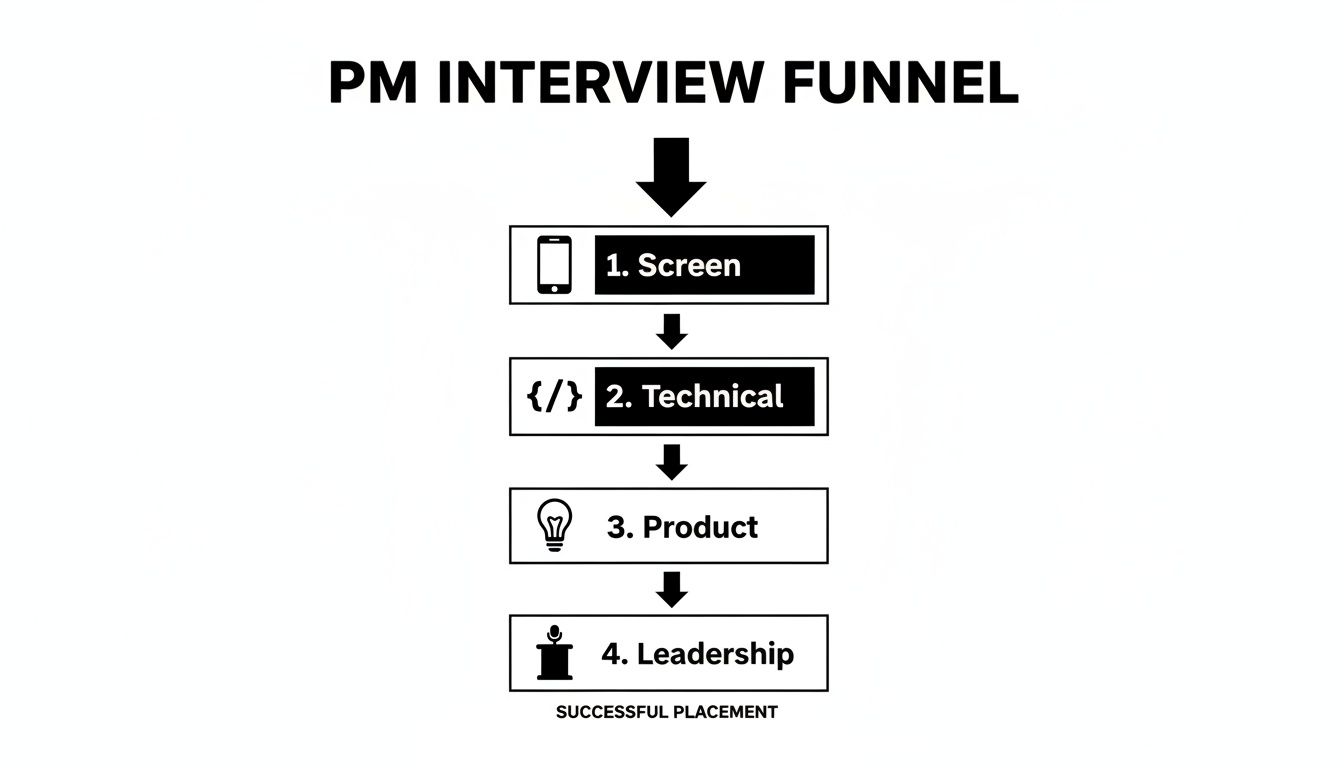
The funnel isn't a set of random hurdles; it’s designed to methodically peel back the layers of your skill set, starting with foundational qualifications and progressing to your potential as a strategic leader.
Here’s a practical breakdown of what each stage is really about.
PM Interview Stages and Objectives
| Interview Stage | Interviewer's Goal | Candidate's Goal |
|---|---|---|
| Recruiter Screen | Check for basic qualifications (e.g., years of experience, domain knowledge), communication skills, and genuine interest. | Prove you’ve researched the company and role, align your experience with the job description, and make a strong, professional first impression. |
| Technical/Execution Round | Assess your ability to work with engineers, understand technical constraints and trade-offs, and make data-driven decisions. | Demonstrate analytical rigor, explain how you use metrics to diagnose problems, and show you can think through the details of execution and delivery. |
| Product Sense Round | Evaluate creativity, user empathy, and the ability to break down ambiguous problems ("Design a product for X") into a structured plan. | Showcase how you think about products from first principles, starting with a specific user problem and methodically moving toward a prioritized solution. |
| Leadership/Behavioral Loop | Assess past performance, ability to influence without authority, conflict resolution skills, and overall fit with the company’s operating principles. | Tell compelling, concise stories from your experience (using STAR-L) that prove you can lead teams, collaborate effectively, and drive business impact. |
Each round builds on the last. Exceptional product sense won't save you if you can't discuss metrics or demonstrate leadership through concrete examples.
Why The Process Is More Demanding Now
Navigating this funnel is tougher than ever. Interview loops for PM roles have become longer and more rigorous, creating a significant challenge for candidates. We're seeing hiring timelines extend from weeks to months.
Companies are deploying a wider range of assessments, such as take-home assignments and deep dives into past projects, to rigorously evaluate 'product sense.' You can read more about the challenges in the current PM job market to understand these shifts.
As Ken Norton, a veteran PM leader from Google Ventures, has noted, while the PM role is always evolving, the "human stuff that actually matters most in PM’ing is the least likely to be automated by AI."
This gets to the core of the modern interview: you need sharp analytical and technical skills, but they must be paired with exceptional human-centered skills.
Targeted preparation for each distinct phase of the interview is no longer optional—it's essential to land a competitive role. A great place to start is by deconstructing the modern product manager job description to understand exactly what companies are screening for.
Actionable Frameworks for Acing Core PM Interview Questions

Top-tier product managers don't just have good ideas; they think with structure. In a high-pressure product manager interview, demonstrating this clarity is paramount. Frameworks are your tool for achieving it.
Think of a framework not as a script, but as a mental checklist that prevents you from rambling when asked to deconstruct a complex problem on the spot. Interviewers at Amazon or Microsoft aren't looking for a single "right" answer. They are evaluating how you arrive at a recommendation.
The CIRCLES Method for Product Sense Questions
Product sense questions test your creativity and user empathy. Examples include "Design a better alarm clock" or "What product would you build for remote workers?" The CIRCLES method is the industry-standard framework for tackling these open-ended design questions.
It’s a step-by-step process that forces you to build a user-centric answer from the ground up:
- Comprehend the Situation: Start by asking clarifying questions. Who is this for? What is the goal (e.g., engagement, revenue)? What are the constraints? Never assume you have the full context.
- Identify the Customer: Get specific with user personas. Who are they? What are their core pain points and motivations? "College students living in dorms" is a useful persona; "young people" is not.
- Report the Customer's Needs: Articulate the core problems or use cases. Frame these as user stories (e.g., "As a busy student, I want to wake up on time for my 8 AM class without disturbing my roommate.").
- Cut, Through Prioritization: You can't solve everything. Identify the most critical user need to tackle first and explain your reasoning (e.g., based on impact vs. effort).
- List Solutions: Brainstorm several distinct solutions for the prioritized problem.
- Evaluate Tradeoffs: Discuss the pros and cons of your proposed solutions. Consider engineering complexity, business viability, and user experience tradeoffs.
- Summarize: Conclude with a clear recommendation. State which solution you'd build first and briefly recap how it addresses the core user need and achieves the initial goal.
This method prevents the most common mistake: jumping directly to a solution. It forces you to start with the user, which is the foundation of all great products.
The AARM Framework for Execution Questions
Execution questions test your analytical abilities. An interviewer might ask, "How would you measure the success of Instagram Reels?" or pose a diagnostic scenario like, "Engagement for YouTube Shorts is down 10% week-over-week. What do you do?"
The AARM framework is ideal for structuring your response. It helps you investigate problems and define success metrics in a logical way.
AARM stands for Acquisition, Activation, Retention, and Monetization—a clean way to organize metrics around the user lifecycle.
- Acquisition: How do users discover the product? (e.g., app downloads, new user sign-ups)
- Activation: Are new users having a successful first experience (the "aha!" moment)? (e.g., completing onboarding, creating their first Reel)
- Retention: Do users come back? (e.g., daily active users (DAU), 30-day cohort retention, churn rate)
- Monetization: Are we generating revenue? (e.g., average revenue per user (ARPU), subscription conversion rate)
When faced with an execution question, first clarify the product's primary goal. Then, walk through the AARM funnel, identifying a "North Star" metric and a few key supporting KPIs that align with that goal.
A great answer doesn't just list metrics. It tells a story, explaining why certain metrics are more important than others for a specific product at its current stage of growth.
The STAR-L Method for Behavioral Questions
Behavioral questions like, "Tell me about a time you disagreed with an engineer," are designed to evaluate your past performance and soft skills. The classic STAR method is good, but adding an "L" for Learnings elevates your answer for PM roles.
- Situation: Briefly set the context. What was the project and your specific role?
- Task: What was the challenge or goal you were responsible for?
- Action: Detail the specific steps you took to address the challenge. Use "I" statements, not "we."
- Result: Quantify the outcome. What happened as a direct result of your actions? Use specific data (e.g., "This initiative increased user retention by 15% in the first quarter.").
- Learning: This is the critical differentiator. What did you learn from this experience? How has it changed your approach to similar situations today?
The "Learning" step demonstrates self-awareness and a commitment to continuous improvement—two essential traits for any product leader. For more tools, you can explore other valuable product management frameworks. Ultimately, consistently improving problem-solving skills beyond any single framework is what will truly set you apart.
Mastering the AI Product Manager Interview
The AI revolution is creating a new class of product leader. The AI Product Manager is one of the most in-demand and scrutinized roles, and interviews at places like OpenAI or Google DeepMind are designed to test a rare combination of deep technical literacy and user-first product sense. It's no longer enough to be fluent in user stories; you must also speak the language of machine learning.
Core AI Concepts You Absolutely Must Know
Interviewers will quickly probe your technical depth to see if you can have a credible conversation with a machine learning engineering team. You don't need to code a neural network, but you must understand the foundational concepts.
Here's your knowledge checklist:
- Model Evaluation Metrics: Go beyond "accuracy." You must be able to discuss the trade-offs between precision (of the items we predicted as positive, how many were correct?) and recall (of all the actual positive items, how many did we correctly identify?). Know when the F1-score is used to balance them. For instance, in medical diagnostics, recall is often prioritized over precision.
- Data Pipeline & Lifecycle: Be prepared to describe the entire data journey for an AI system: sourcing, cleaning, labeling (and its associated costs), feature engineering, and the critical difference between training data and inference data.
- Types of ML Models: At a minimum, understand the differences between supervised, unsupervised, and reinforcement learning. More importantly, map these approaches to real product problems: supervised learning for spam detection, unsupervised for customer segmentation, and reinforcement learning for training a game-playing agent.
- Ethical AI & Bias: This is non-negotiable. Be able to discuss sources of bias (e.g., unrepresentative training data) and have concrete strategies for mitigation, such as fairness-aware algorithms and post-launch monitoring.
Framework for Answering "Productize an LLM"
A common high-stakes question is, "How would you build a product around a new Large Language Model (LLM)?" This tests your ability to connect raw technology to a real user problem. Use this structured approach:
- Define the Core Capability: Isolate the LLM's superpower. Is it summarization, code generation, creative writing, or something else? Start there.
- Identify a High-Value Problem & User: Match that superpower to a specific persona with a painful, unsolved problem. Don't say "help writers." Say, "Help junior marketing associates overcome writer's block when creating social media ad copy for a specific campaign."
- Propose a "Thin Wrapper" MVP: Your first product should be the simplest possible interface that delivers immediate value. For the marketing associate, this might be a simple web app with a text box for a prompt and a "Generate Copy" button.
- Outline the Feedback Loop: How will you collect data to improve the model? This is critical for AI products. It could be as simple as a thumbs-up/down button on the generated copy, which feeds back into the model for fine-tuning. This shows you understand that AI products are never "done."
- Address the "Last Mile" Problem: Acknowledge that LLMs are often 80% correct but require human oversight for the final 20%. Your product must facilitate this human-in-the-loop workflow, making it easy for the user to edit, refine, and polish the AI's output.
A top-tier answer focuses on the human-computer interaction, showing how the product augments the user's existing workflow rather than attempting to fully automate it.
Handling Questions on Model Bias Post-Launch
Scenario: "Your AI-powered recruiting tool is found to be systematically down-ranking candidates from a specific demographic. What do you do?" This tests your crisis management, leadership, and ethical compass.
Your answer must follow a clear, responsible path:
- Acknowledge & Investigate: State that your first priority is understanding the issue. You would immediately assemble a cross-functional team (engineering, data science, legal, PR) to diagnose the root cause.
- Contain the Damage: Describe immediate actions. This could include disabling the feature, rolling back to a previous model version, or implementing a mandatory human review layer for all recommendations until a fix is deployed.
- Diagnose the Root Cause: Articulate potential causes. Was it biased training data? Flawed feature engineering? Did the model learn a spurious correlation?
- Communicate Transparently: Outline a communication plan for informing affected users, customers, and the public. This demonstrates an understanding of the business and reputational risks.
- Implement Long-Term Fixes: Detail how you will prevent this from recurring. This could involve diversifying training data, implementing specific fairness metrics (like demographic parity) into the model's objective function, and establishing an internal AI ethics review board.
Demonstrating this structured, responsible thinking proves you have the maturity to handle the unique risks of building AI products.
Your 30-Day Product Manager Interview Prep Plan
Consistent, deliberate practice separates good PM candidates from those who get offers. You cannot cram for a product manager interview and expect to succeed. You need a battle-tested system that builds skills and confidence incrementally.
This 30-day plan breaks the overwhelming task of preparation into manageable weekly sprints.
Week 1: Foundations and Storytelling
The first week is about building your core toolkit. Don't jump into mock interviews yet. First, master the fundamental frameworks and perfect the personal stories that will form the backbone of your behavioral answers. A strong foundation makes everything that follows easier.
Key activities for Week 1:
- Master Key Frameworks: Internalize the CIRCLES method for product sense, AARM for execution, and STAR-L for behavioral questions. Practice applying them until they become second nature.
- Craft Your Stories: Identify 5-7 of your most impactful projects. Write each one out using the STAR-L method, focusing on your specific actions and quantifying the results with hard data.
- Build a Target List: Research 5-10 companies you are genuinely excited about. Do a deep dive into their product lines, business models, recent launches (via their blog and press releases), and key competitors.
Week 2: Deep Practice on Core Skills
With your frameworks and stories established, Week 2 is about pressure-testing them. The goal is to move from theory to fluent application, focusing on the two question types you are guaranteed to face: product design and execution.
This is where the real work begins:
- Product Design Drills: Every day, tackle a new product sense question. Use a whiteboard or notebook to practice thinking visually and structuring your response with the CIRCLES method.
- Execution and Analytics: Work through execution prompts. Pick a product you use and define its North Star Metric and supporting KPIs. For a prompt like "user engagement just dropped," walk through your diagnostic process using the AARM framework.
A critical mistake is practicing silently. You must practice speaking your answers out loud. This builds the muscle memory needed to articulate complex ideas clearly under pressure.
Week 3: Strategy and AI Specialization
Week 3 elevates your game from product-level to business-level thinking. You'll tackle broader strategic challenges and the increasingly critical domain of AI. This is how you differentiate yourself as a strategic thinker.
Here's your focus:
- Tackle Strategy Questions: Practice questions like, "Should Google enter the enterprise project management space?" Analyze the market size, competitive landscape (e.g., Asana, Monday.com), and Google's core competencies to form a reasoned recommendation.
- Get Smart on AI/ML: Solidify your grasp of core AI concepts like precision vs. recall, data pipelines, and different ML models. Our complete product manager interview preparation guide can help you go deeper.
- Work Through AI Product Scenarios: Apply your knowledge to AI-specific prompts. Think through how you'd handle model bias post-launch or how you'd productize a new LLM.
Week 4: Intensive Mocks and Final Polish
The final week is about simulating the real interview experience. The focus shifts from learning new content to refining delivery, managing nerves, and building confidence through intensive mock interviews.
- Schedule Your Mocks: Aim for 3-5 mock interviews with peers, mentors, or via platforms like Exponent. Do not skip this step.
- Record and Review: If possible, record your mock sessions. Watching yourself back is the fastest way to identify and fix verbal tics, rambling answers, or logical gaps.
- Refine and Rest: Use feedback from mocks to polish your weakest areas. In the final 48 hours, your job is to rest, review your key stories, and walk into the interview calm and prepared.
30-Day PM Interview Prep Schedule
| Week | Focus Area | Key Activities |
|---|---|---|
| Week 1 | Foundations & Storytelling | 1. Master CIRCLES, AARM, STAR-L frameworks. 2. Write out 5-7 core project stories with quantified results. 3. Research 5-10 target companies, their products, and competitors. |
| Week 2 | Core Skill Practice | 1. Daily product sense/design drills (spoken out loud). 2. Practice execution & analytics questions (diagnostics, metrics). 3. Refine framework application based on daily practice. |
| Week 3 | Strategy & Specialization | 1. Tackle business strategy & market entry questions. 2. Solidify understanding of core AI/ML concepts. 3. Practice AI-specific product scenarios and ethics questions. |
| Week 4 | Mock Interviews & Polish | 1. Complete 3-5 mock interviews with peers or mentors. 2. Record, review, and incorporate constructive feedback. 3. Rest and review key stories in the last 48 hours. |
Adhering to this plan will systematically build the skills and confidence needed to perform at your peak.
Negotiating Your Product Manager Offer
Receiving an offer is a major milestone, but the process isn't over. The moment that offer arrives, the negotiation phase begins. Many strong product managers leave significant money and equity on the table by accepting the first offer.
Your leverage in this conversation comes from data. The PM job market is dynamic; understanding current compensation trends is your secret weapon. For example, a Senior PM at Google in the Bay Area can expect a total compensation package well over $300k, while an equivalent role at a Series B startup might have a lower base but higher equity potential.
Decoding and Benchmarking Your Offer
Before countering, you must understand every component of the offer and benchmark it against the market. An offer is a total package, and each part is a potential negotiation lever.
- Base Salary: Your guaranteed annual income. This is the most straightforward component to benchmark.
- Equity (RSUs/Stock Options): Your ownership stake. For public companies like Meta, Restricted Stock Units (RSUs) are granted and vest over time. For startups, stock options offer higher upside potential but also higher risk.
- Signing Bonus: A one-time cash payment to incentivize you to join, often used to compensate for a bonus or unvested equity you're leaving behind.
- Performance Bonus: An annual, variable bonus tied to individual and company performance, typically expressed as a percentage of your base salary.
The most powerful tool in any negotiation is objective, third-party data. Never enter a salary discussion without it.
Building Your Counter-Offer
Once you've researched market rates on sites like levels.fyi and have a clear target compensation range, you can formulate your counter. The key is to be professional, data-driven, and collaborative.
Always begin by expressing genuine excitement for the role and the team. Then, present your case calmly, referencing the market data you've gathered. For example: "Based on my research for a Senior PM role with this scope in New York, and considering my experience in X, I was expecting a total compensation package closer to the $280k-$300k range."
Remember to negotiate the entire package. A company might have rigid salary bands but more flexibility on a signing bonus or equity grant. For detailed tactics and scripts, our guide on how to negotiate your salary provides a step-by-step process to ensure you are paid what you're worth.
Product Manager Interview FAQ
The interview process can be daunting. Here are direct, actionable answers to the most common questions I hear from aspiring and practicing PMs.
How Technical Do I Need to Be?
The answer is: you must be technically literate enough to earn the respect of your engineering team. No one expects you to write production code, but you must be able to engage in detailed technical discussions.
At a minimum, you should be able to:
- Explain System Design: Comfortably discuss APIs, databases, client-server architecture, and how different parts of a system interact.
- Discuss Technical Trade-offs: Articulate the pros and cons of different implementation approaches. For example, why choose a microservices architecture over a monolith for a new product? What is the trade-off between shipping quickly and building for long-term scale?
- Understand Data: Discuss how data is stored, queried, and used in decision-making. For AI PM roles, this expectation is significantly higher, requiring an understanding of model training and deployment pipelines.
Should I Use a Framework for Every Question?
Frameworks like CIRCLES are tools, not scripts. Use them as a mental checklist to ensure your thinking is structured and comprehensive, but do not recite them robotically.
The best answers seamlessly integrate the logic of a framework into a natural conversation. An interviewer wants to see how you think, not whether you've memorized an acronym.
Think of frameworks as the scaffolding for your answer. They provide structure, but the substance comes from your unique insights, creativity, and user empathy. Over-reliance on a framework can make your answers sound generic.
How Do I Prepare for Company-Specific Questions?
Demonstrating genuine interest requires deep research. A quick scan of a company's homepage is insufficient. Before any interview, you must have solid answers to these questions:
- What is their mission and business model? How do they generate revenue? What is their overarching strategic goal?
- Who are their main competitors? More importantly, what is their core product differentiation and competitive advantage?
- What have they launched recently? Review their company blog, press releases, and earnings calls. This shows you are up-to-date on their current strategy.
- What is one thing you would improve about their product? This is a classic question. Prepare a thoughtful, user-focused suggestion. It tests your product sense and your passion for their mission.
Devoting a few hours to this research will enable a much richer, more impressive conversation.
What Kind of Questions Should I Ask the Interviewer?
The end of the interview is your opportunity to interview them. Asking sharp, insightful questions is a powerful signal of your intelligence and interest. Avoid generic questions about "company culture."
Here are some strong examples:
- "What are the biggest challenges this team is currently facing that the new PM will be expected to solve in their first six months?"
- "Could you walk me through how an idea typically moves from concept to launch here? What does the product development process look like in practice?"
- "What defines a successful partnership between Product, Engineering, and Design at this company?"
- "How will the success of this role be measured over the next year? What are the key metrics that matter most to leadership?"
These questions show you are already thinking like a PM on their team—focused on impact, process, and collaboration.
At Aakash Gupta, we provide the resources and expert insights to help you not just land a product manager job, but build a thriving, impactful career. Continue exploring our in-depth guides at https://www.aakashg.com to sharpen your skills and stay ahead in the competitive world of product management.
