A solid prep plan for a product manager interview isn't a last-minute scramble; it's a structured, eight-week system designed to build mental muscle memory. The goal is to turn abstract frameworks into confident, real-time performance when you're in front of a hiring manager from Google, Meta, or a high-growth startup. This guide provides a week-by-week operating system that has helped countless candidates land offers.
Your 8-Week PM Interview Prep Operating System
Forget randomly reading books or watching YouTube videos. The best approach to product manager interview prep is a repeatable process that systematically builds your skills over two months. The candidates who land offers at top-tier companies don't just "study"; they train with a deliberate, progressive plan. This timeline de-risks the process by layering skills week-by-week, preventing burnout and ensuring you're at peak performance when it counts.
I've seen this timeline work for aspiring PMs breaking into the field and for mid-career PMs targeting senior roles. It breaks down a massive, intimidating goal into manageable, weekly sprints.
The 8-Week PM Interview Prep Timeline
| Week | Primary Focus | Key Activities | Goal |
|---|---|---|---|
| Weeks 1-2 | Mastering Frameworks | Drill CIRCLES, AARRR, 5 C's. Deconstruct 3-5 products (e.g., Spotify, TikTok). Record yourself answering common questions. | Internalize core mental models until they feel like second nature. You should be able to apply them without thinking. |
| Weeks 3-4 | Mock Interview Gauntlet | Schedule and complete 15-20 mock interviews on platforms like StellarPeers. Focus on gathering raw, unfiltered feedback. | Get battle-tested. Identify your blind spots under pressure and build conversational fluency with PM concepts. |
| Weeks 5-6 | Company & Role Deep Dive | Research target companies' products, strategies, and recent earnings calls. Tailor your "why" for each role. Update resume and portfolio. | Develop specific, compelling narratives for why you are the right fit for that company and that role. Align your stories to their business needs. |
| Weeks 7-8 | Polish & Specialization | Focus on weak areas (e.g., technical, behavioral). Conduct final mocks with senior PMs or hiring managers. Rest. | Sharpen specialized skills, eliminate any remaining weaknesses, and walk into the interview calm, confident, and collected. |
Let's break down what each of these phases actually looks like in practice.
Weeks 1-2: Mastering The Fundamentals
The first two weeks are about laying a strong foundation. This isn't about memorizing answers; it's about deeply internalizing the mental models that structure elite product thinking. Your only job here is to understand and practice core frameworks until they become an extension of your own thought process.
Here’s your tactical plan:
- Framework Drills: Spend time every single day with the CIRCLES method for product design, AARRR for metrics questions, and the 5 C's for market analysis. Don't just read about them—practice them out loud. Grab a prompt like "Design a better alarm clock for Google" and talk through the CIRCLES framework from start to finish.
- Product Deconstruction: Pick two products you love (e.g., Spotify, Airbnb) and one with flaws (e.g., a clunky enterprise tool you use). For each, write a one-pager on how you'd apply the AARRR framework to measure its success. What is its North Star Metric? What are the key activation and retention loops?
- Solo Practice & Recording: Start answering common questions by yourself. Record yourself on your phone answering prompts like, "Tell me about yourself" or "Why Product Management?" It will feel awkward, but it's the fastest way to improve clarity and conciseness. The goal is to get comfortable articulating your thoughts under pressure.
Weeks 3-4: The Mock Interview Gauntlet
This is where theory meets reality. Frameworks are useless if you can't apply them under pressure, and mock interviews are your sparring sessions. The goal for these two weeks is to collect as much direct feedback as you can and identify your blind spots. You must simulate the real interview environment relentlessly.
The single biggest mistake I see candidates make is not doing enough mock interviews. Aim for a bare minimum of 15-20 mocks. The feedback from your first five is often more valuable than re-reading any book.
Use platforms like StellarPeers to schedule mocks. Prioritize practicing with experienced PMs who provide direct, actionable feedback. After every session, spend 30 minutes writing down your key takeaways and one specific action item for your next mock. This cycle of practice, feedback, and iteration is what separates candidates who get offers from those who don't. To understand what interviewers are screening for, review a typical product manager job description and tailor your practice to hit those key competencies.
Weeks 5-8: Deep Dives And Specialization
The final month is about tailoring your preparation. You’ll shift from general practice to drilling down on specific companies and sharpening your skills in areas like technical and behavioral interviews. This is where you go from a generic candidate to the candidate for a specific role.
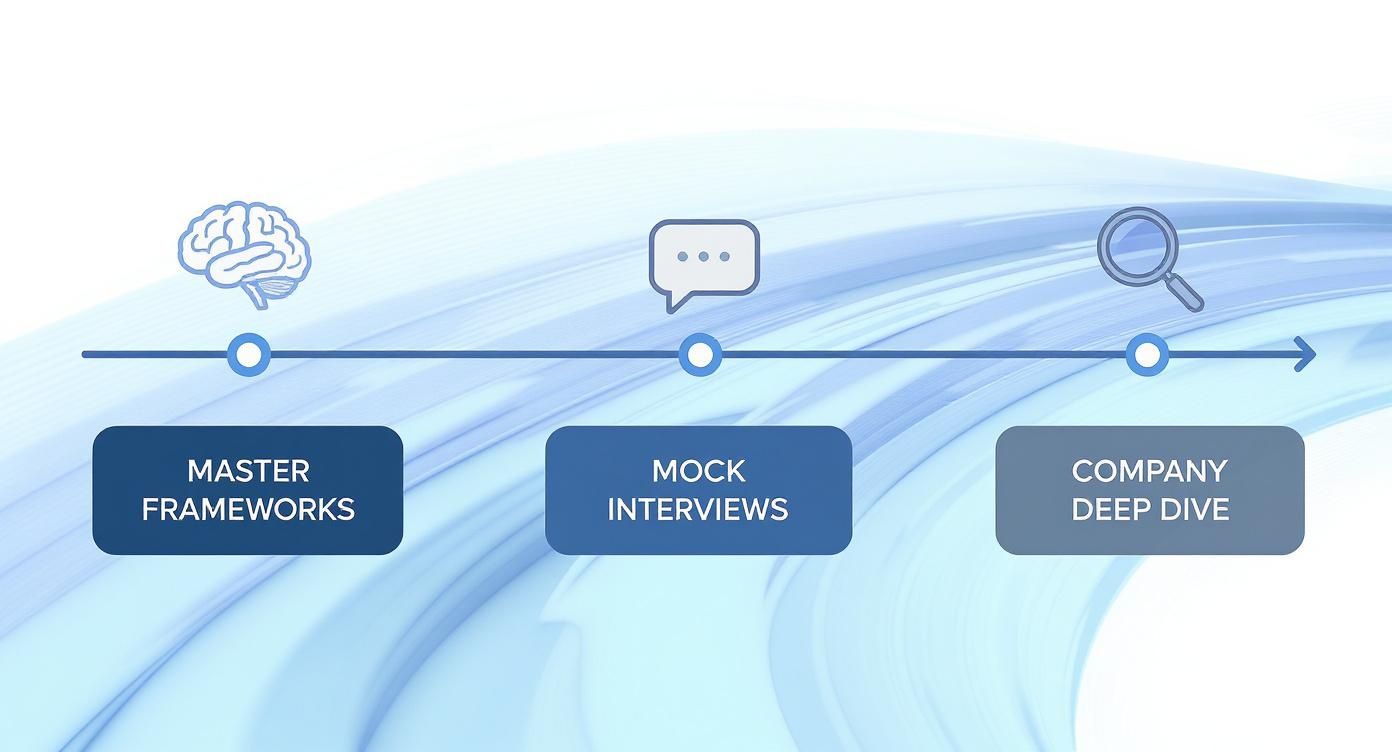
This structured path—from broad knowledge to live practice to fine-tuned expertise—ensures you build a comprehensive skillset without feeling overwhelmed. It makes the entire process more effective and manageable.
Decoding the Key PM Interview Types

A modern PM interview is a gauntlet of distinct challenges, each designed to test a specific skill. When I’m on a hiring panel at a company like Google or OpenAI, I'm not just looking for someone who can talk about product; I need to see evidence of competence across several dimensions.
Think of it like a decathlon. You must be solid across multiple events to win. Nailing one interview but bombing another won't cut it at a top-tier company. A huge part of your product manager interview prep is knowing exactly what each interview type is designed to assess. Hiring loops at companies like Meta and Microsoft are intense, typically zeroing in on four core pillars: product sense, analytical skills, leadership, and behavioral fit.
Product Sense: The Creativity and Empathy Test
This is your classic "design" interview. You'll get an open-ended prompt like, "Design a better alarm clock for kids" or "You're the PM for Spotify. What do you build next?"
The interviewer isn't waiting for a magical idea. They're stress-testing your process. Can you structure ambiguity? Can you identify a specific user and their real problem, brainstorm solutions, and defend your path forward? Articulating the "why" behind every decision is critical.
The rookie mistake? Jumping straight into features. A great answer always starts with questions—clarifying the goal, defining the user persona, and digging into the actual pain points.
Analytical Acumen: The Data Fluency Test
This is where you prove you can think in numbers and make data-informed decisions. It’s about showing you know how to measure what matters for the business.
You can expect questions like:
- "Netflix daily active users just dropped by 10%. As the PM, what do you do?"
- "Define the North Star Metric for Airbnb Experiences."
- "How would you measure the success of a new Instagram Stories feature?"
Structure is your best friend here. You need to demonstrate a logical process: form a hypothesis, identify relevant metrics, consider internal and external factors, and outline a clear investigation plan. It's less about having the "right" answer and more about showing a systematic way of diagnosing a problem.
A huge tell for me is whether a candidate can segment data. Instead of just saying 'users dropped,' a top PM immediately asks, 'Did we see the drop in new or returning users? On iOS or Android? Was it concentrated in a specific country?' That shows a much deeper level of analytical thinking.
Strategy: The Business Acumen Test
Strategy interviews pull the camera back from a single feature to the entire business and competitive landscape. The interviewer wants to see if you can think like a General Manager and connect product decisions to market dynamics.
You might get a prompt like, "Should Spotify enter the live audio space?" or "Who is Google's biggest competitive threat, and how should they respond?"
To excel here, you must dissect the market, perform a quick SWOT analysis, evaluate risks, and pitch a defensible strategic direction. Frameworks like the 5 C's (Company, Customers, Competitors, Collaborators, Climate) are invaluable for organizing your thoughts under pressure.
Technical Fluency: The Collaboration Test
Don't panic—this isn't a coding test (unless you're applying for a highly technical PM role, e.g., in AI/ML). This interview assesses your ability to have productive conversations with engineers. Can you grasp technical constraints, discuss trade-offs intelligently, and earn the respect of your engineering counterparts?
Get ready to discuss topics like:
- How an API works in simple terms.
- The difference between a native app and a web app.
- How you would prioritize paying down tech debt versus shipping a new feature.
The goal is to prove you understand the "how" well enough to be a true partner to your tech team and make smart, informed decisions together.
Behavioral Leadership: The Influence Test
This is where you demonstrate the people skills required to lead without direct authority. The interviewer is digging for real stories from your past, and the questions almost always start with "Tell me about a time when…"
- "…you disagreed with an engineer."
- "…you had to convince a key stakeholder to change their mind."
- "…a launch you managed completely failed."
The STAR method (Situation, Task, Action, Result) is a useful framework, but don't be robotic. Tell a compelling story that showcases your leadership, communication skills, and resilience. While these questions test PM-specific situations, it also helps to have your answers down for top remote job interview questions, as the core principles of clear storytelling apply everywhere.
How to Master Essential Interview Frameworks
Frameworks aren't rigid scripts to be memorized. Think of them as mental scaffolding. Under the pressure of a PM interview, they prevent rambling and ensure you cover all your bases logically.
As an interviewer, I can immediately spot someone who has internalized frameworks versus someone just reciting steps from a book. The first person sounds structured yet natural. The second sounds robotic.
Your goal is to become so comfortable with these tools that you can adapt them on the fly. This demonstrates a fluid, confident thought process, a non-negotiable part of your product manager interview prep.
CIRCLES for Product Design Questions
The CIRCLES method is your best friend for any product design or "build a…" question. It's a seven-step process that forces you to start where all great product work begins: with the user and their problem, not the solution.
Let's use a classic prompt: "Design a smart fridge for families."
- Comprehend the Situation: First, ask clarifying questions. "Who are these families? Busy professionals with young kids? What's the business goal? Are we trying to reduce food waste, simplify grocery shopping, or drive subscriptions?" This shows you don't jump to conclusions.
- Identify the Customer: Get specific and build a quick persona. "We're targeting dual-income parents with two kids under 10. They're tech-savvy but time-poor and constantly struggle with meal planning."
- Report the Customer's Needs: What are their actual pain points? "They forget what's in the fridge when they're at the store. Finding recipes for the ingredients they have is a nightmare. Plus, picky kids make planning a daily battle."
- Cut, Through Prioritization: You can't solve every problem. Zero in on one core user story. "As a busy parent, I want to easily see what's in my fridge and get meal suggestions, so I can save time and reduce food waste."
- List Solutions: Now, and only now, do you brainstorm. An internal camera with object recognition? A connected app for real-time inventory? Integration with grocery delivery services like Instacart? AI-powered recipe suggestions?
- Evaluate Tradeoffs: This shows you think like a real PM. Discuss pros and cons. "A camera system is powerful, but it's expensive and raises privacy concerns. A manual-entry app is cheaper but relies on user discipline." This signals awareness of engineering and business constraints.
- Summarize Your Recommendation: End with a confident conclusion. "My recommendation is to launch an MVP focused on a smart inventory app that uses AI for recipe suggestions. It addresses the core meal-planning pain point with lower technical complexity and opens a clear path to monetization through grocery partnerships."
AARRR for Metrics and Analytical Questions
When an interviewer throws a curveball like, "User activation for our mobile app has dropped," the AARRR funnel (Acquisition, Activation, Retention, Referral, Revenue) should be your immediate go-to. It provides a systematic way to investigate the problem instead of guessing.
Let's imagine you're the PM for a language-learning app. User activation—defined as completing the first lesson within 24 hours—has dropped by 15%.
Here’s how you'd use AARRR to break it down:
- Acquisition: "First, I'd investigate if the type of user we're acquiring has changed. Are we running a new marketing campaign bringing in lower-intent users? Has a specific channel, like a TikTok campaign, spiked? A lower-quality user cohort might naturally have a lower activation rate."
- Activation: "Next, I'd dig into the activation flow itself. Have there been any recent changes to onboarding? A new UI element, a server bug, or a performance issue? I’d segment the data by device type, OS, and country to isolate the drop."
- Retention: A sharp PM thinks ahead. "Are users who do activate still retaining at the same rate? If not, it could point to a broader issue with our core value proposition."
- Referral & Revenue: These are less likely culprits, but mentioning them shows you're thorough and thinking about the entire business.
Using a framework like AARRR shows the interviewer you won't panic. You'll methodically segment the problem, form hypotheses, and identify where to dig deeper. It proves you are data-fluent and structured in your problem-solving.
Frameworks for Strategic Thinking
For bigger-picture questions about market entry or competitive threats, you need a strategic framework.
- The 5 C's (Company, Customers, Competitors, Collaborators, Climate): Perfect for market analysis questions like, "Should Airbnb enter the corporate travel market?" It forces you to consider internal capabilities (Company), the specific customer segment, the competitive landscape (like TripActions), potential partners, and the overall economic climate.
- Porter's Five Forces: A classic for analyzing market attractiveness. You’ll examine the threat of new entrants, the bargaining power of buyers and suppliers, the threat of substitute products, and the intensity of existing rivalry.
Mastering these isn't about rote memorization; it's about building a versatile mental toolkit. To get more reps, check out these excellent PM interview cheat sheets. They're a great way to solidify your understanding. The real key is to practice until you can adapt and combine these frameworks seamlessly.
Cracking Estimation and Data Questions
When an interviewer asks, "How many Ubers are active in NYC right now?" they're not looking for the exact number. They're testing your ability to handle ambiguity and structure a logical argument on the fly.
Success is about showing them how you think. This simulates the real PM job, where you constantly size up opportunities with incomplete data. These questions reveal if you can break down a complex problem, state your assumptions clearly, and use back-of-the-napkin math to reach a defensible number.
Your Mental Toolkit for Estimation
To nail these questions, you need a repeatable approach for any estimation problem.
Your game plan should be:
- Clarify and Scope: Start by asking smart questions. For the Uber example, ask, "Are we talking just UberX drivers, or all services? And is this for rush hour or a 24-hour average?" This shows you're methodical.
- State Assumptions Loud and Clear: Every estimate is built on assumptions. Make them explicit and reasonable. "Okay, I'm going to assume NYC has a population of 8 million people, and we're calculating for a typical weekday afternoon."
- Break Down the Problem: Deconstruct the question into smaller pieces using a "top-down" (start with population) or "bottom-up" (start with one driver) approach.
- Do the Math Out Loud: Walk the interviewer through your calculation. It lets them follow your logic and correct minor errors without derailing the conversation.
- Sanity Check Your Answer: Once you land on a final number, pause. Ask yourself: "Does this number feel reasonable?" Acknowledging potential flaws or mentioning where you'd want more data shows maturity.
The candidates who really stand out don't just act like human calculators. They layer qualitative insights onto their quantitative breakdown. After estimating the Ubers, a great candidate might add, "Of course, this number would likely spike during major city events like a concert or a holiday, and it's also heavily influenced by surge pricing dynamics."
Memorize Key Data Points
Having a few key numbers in your back pocket makes your estimations more credible. Part of any solid product manager interview prep process is committing baseline stats to memory.
Essential Data for PM Estimation Questions
| Data Point | Approximate Value | Common Application |
|---|---|---|
| US Population | 330 million | Sizing national markets |
| World Population | 8 billion | Sizing global markets |
| US Households | 130 million | Products sold on a household basis |
| Life Expectancy | ~80 years | Calculating lifetime usage |
| Internet Penetration (US) | ~90% | Sizing addressable online markets |
| Smartphone Users (US) | ~310 million | Mobile app market sizing |
| Avg. People per Household | 2.5 | Refining household-based estimates |
Knowing just the US population gives you a powerful anchor for building realistic assumptions. For a more exhaustive list, check out this essential data cheat sheet for PM interviews.
Example Walkthrough: How Many Scooters?
Let's practice with a common question: "Estimate the number of electric scooters in San Francisco."
1. Clarify: "Good question. Are we talking about all e-scooters, including privately owned ones, or just the rentable fleet from companies like Lime and Bird?" Let's say it's just rentable ones. "Got it. And are we estimating the total fleet size, or how many are actively in use right now?" Let's go with total fleet size.
2. Assumptions: "Okay, great. I'll start by assuming the population of San Francisco is roughly 900,000. My next assumption is that the primary user base is younger professionals and students, which I'll estimate is about 30% of the population."
3. Breakdown (Top-Down):
- Population of SF: 900,000
- Target demographic (18-40, tech-savvy, commuters): Let's say that's 30% of the population, giving us 270,000 people.
- Adoption rate: Not everyone will use scooters. I'll assume 20% are active users. That gives us 54,000 users.
- Usage frequency: Let's estimate an average active user takes 2 trips per week. That’s 108,000 total trips per week.
- Trips per scooter per day: A single scooter is probably used multiple times. Let's say 5 times a day on average, so 35 trips per week.
- Calculation: Total trips (108,000) / Trips per scooter (35) = roughly 3,085 scooters.
4. Sanity Check: "So, my final estimate is around 3,100 rentable scooters in SF. This feels reasonable, as city regulations often cap fleet sizes. If I had more time, I'd research SFMTA data on trip frequency or the specific permit caps for each scooter company to refine this."
This structured, vocalized process is exactly what interviewers are looking for. It proves you can think on your feet, handle numbers confidently, and communicate your reasoning like a seasoned product leader.
Demonstrating Strategic and Leadership Skills

For senior PM roles, the game changes. Interviewers aren't just checking if you can ship features; they need to know if you can set a direction and rally a team to follow you. This is your moment to prove you're a product leader, not just a feature manager. It’s all about articulating the "why" behind every product decision and connecting it to business outcomes like ROI, market share, or competitive advantage.
The Art of the Behavioral Narrative
Behavioral questions are the primary way interviewers assess your leadership potential. They almost always begin with "Tell me about a time when…" and are designed to see how you operate in the messy reality of product development.
Be prepared for prompts like these:
- "Tell me about a time you fundamentally disagreed with an engineer."
- "How do you align stakeholders with conflicting priorities?"
- "Walk me through a time a product launch failed. What did you learn?"
The key isn't just what you did, but how you did it and why it mattered. A solid storytelling framework is your best friend.
The STAR method (Situation, Task, Action, Result) is the gold standard for a reason—it provides a clear, logical flow.
- Situation: Briefly set the business context.
- Task: What was your specific responsibility or goal?
- Action: Describe the specific steps you took. This is about your direct contributions.
- Result: Quantify the outcome. Use hard numbers. How did your actions move the needle for the product or business?
The most compelling STAR stories are heavy on the 'A' (Action) and 'R' (Result). I want to hear about the specific conversations you had, the data you brought to the table, and the direct line between what you did and a measurable business outcome. A 20% increase in user retention is a world away from just saying "the launch went well."
Connecting User Needs to Business Impact
A core test for any senior PM is your ability to translate a user problem into a business opportunity. Don't just talk about features. Frame the 'why' behind them.
For instance, never just say, "Users wanted a dark mode."
Instead, frame it with strategic intent: "Our user research showed that 35% of our power users experienced eye strain during late-night sessions, causing shorter session times. By introducing a dark mode, we hypothesized we could increase nighttime engagement by 15%. This was critical for hitting our quarterly active user targets."
That reframing shows you think about the business, not just the backlog. It demonstrates the crucial distinction between leadership and management. For those looking to set themselves apart, exploring strategies to become a recognized thought leader can provide a significant edge.
Handling Conflict and Influence
Conflict is inevitable in product development. Your ability to navigate disagreements and influence without formal authority is a core leadership skill. When an interviewer asks about a time you disagreed with an engineer, they're testing your emotional intelligence and collaborative spirit.
A weak answer: "The engineer wanted to build it one way, I wanted another, and I eventually convinced them I was right."
A much stronger answer showcases empathy and a focus on shared goals: "An engineer on my team proposed a solution that, while technically elegant, would have delayed our launch by three weeks. I started by acknowledging the quality of their approach. Then, I re-centered our conversation on our shared goal—getting a feature to market quickly to test a key hypothesis. We collaborated on a phased approach that hit our deadline without taking on significant tech debt."
This response shows respect, a focus on outcomes, and collaborative problem-solving—the essence of product leadership. If you're looking to dive deeper, our guide on leadership vs management offers valuable insights. It’s this level of nuance that top companies like Google and Meta are looking for.
Frequently Asked Questions in PM Interview Prep
As you get deeper into product manager interview prep, common questions will arise. Here’s my take on the questions I hear most often from candidates I mentor.
How Many Mock Interviews Should I Do?
My answer is always the same: more than you think. Mock interviews are the single most valuable activity you can do to prepare.
Aim for a minimum of 15-20 mock interviews before your first real one. Early on, 2-3 mocks a week is sufficient. In the final two weeks, ramp up to 4-5 per week to build the stamina needed for an intense, real-life interview loop.
A word of caution: quality over quantity. The quality of the feedback is more important than the raw number. Prioritize practicing with experienced PMs, not just other candidates. Check out platforms like StellarPeers or the Lewis Lin community on Slack to find solid partners.
Always record your sessions if possible. It’s humbling, but it’s an incredible way to catch nervous habits, filler words, and flawed thought patterns that you would otherwise miss.
What Are The Biggest Mistakes Candidates Make?
I've sat on countless hiring panels at FAANG and startups, and I see the same few mistakes sink otherwise strong candidates.
It almost always comes down to one of these three pitfalls:
- Jumping straight to a solution. This is a massive red flag. The best candidates always take the first few minutes of a design or strategy question to ask clarifying questions to fully grasp the goal, user, and constraints.
- Being too rigid with frameworks. Frameworks like CIRCLES are a guide, not a script. When a candidate sounds like they're just checking boxes, it shows they haven't internalized the principles. You must adapt the framework to the question.
- Forgetting the "why." It's not enough to list features. You must connect every decision back to a core user problem and a business objective. Articulate why your solution solves a specific pain point and how it moves the company's strategic goals forward.
How Do I Best Prepare For A Specific Company?
Company-specific prep is non-negotiable. It’s how you show genuine interest and that you've done the work.
First, go deep on the company’s mission, products, and target users. You must read their latest quarterly earnings report and the CEO's letter to shareholders. This is a goldmine for understanding their current strategic focus.
Next, become a power user of their product. Don't just sign up; use it until you have informed opinions on its strengths and weaknesses. Research recent product launches and press releases. For behavioral questions, prepare stories that map directly to the company's stated values, like Amazon's famous Leadership Principles.
Finally, use LinkedIn to connect with current or former PMs from that company. A 15-minute informational interview can provide insider tips on their interview culture and what hiring managers really care about that you'll never find online.
Ready to dive deeper and build a career-defining product strategy? At Aakash Gupta, we provide the frameworks and insights you need to excel. Explore more at https://www.aakashg.com.
