A product manager job description isn't just a list of HR requirements. For an aspiring PM, it's a treasure map. For a practicing PM, it's a competency checklist for your next career move. It’s the blueprint a company like Google or OpenAI uses to find the person who will own a product's success, guiding it from a spark of an idea to a tool that users can't live without. Let's break down exactly how to read between the lines, prove your value, and land the role.
What a Product Manager Actually Does: The Conductor Framework

Let's cut through the corporate-speak. The best analogy I’ve ever heard is that a Product Manager is the conductor of an orchestra. They don't play the violin (that's engineering) or the trumpet (that's design), but they make sure everyone is playing the same music, in harmony, to create something beautiful—the product.
This "product conductor" has one primary job: get every team rowing in the same direction, inspired by a unified vision. They’re the translator, turning high-level business goals into a real product strategy, and then breaking that down into features that engineers can actually build.
A PM at a company like Meta isn't just saying, "Hey, let's add a new filter to Instagram Reels." They're defining why this filter matters for user engagement, what success will look like when it's launched (e.g., a 5% increase in daily active users sharing Reels), and how it gives them an edge over competitors like TikTok. They own the product’s entire story.
The True Scope of the Role
Over the past decade, this role has exploded well beyond its original confines. It's now about steering a product's entire lifecycle, from the first sketch on a whiteboard to the day it's retired, always making sure it meets a genuine user need.
And the demand is only growing. As of 2024, there are over 6,000 open PM roles globally—that’s a 53.6% jump from the lows of 2023. It’s a clear sign that companies see skilled product leadership as critical for growth. For more on this trend, check out the analysis from CPO Club.
A PM’s day is a constant juggle between big-picture strategy and in-the-weeds execution. They are held accountable for the product's success, but here's the tricky part: they have zero direct authority over the people who design, build, and market it. This is where influence becomes their superpower.
The human stuff that actually matters most in PM’ing is the least likely to be automated by AI. The role is shifting and evolving, as it always has.
This distinction is key. You might hear the term "Product Owner" used, but that role is typically more focused on the development backlog. The Product Manager has a much wider lens, looking at market trends, business results, and long-term strategy. It's worth understanding the differences between a Product Owner and a Product Manager to really grasp the nuances.
At the end of the day, a PM's job is to relentlessly seek answers to three fundamental questions:
- What problem are we solving? This means getting out of the building, talking to users, and digging into the data.
- Why is this the right problem to solve now? This is all about ruthless prioritization and making sure the work aligns with the company's biggest goals.
- How will we know if we've succeeded? This is about defining clear metrics and KPIs to measure the actual impact of the work.
Decoding a Real Product Manager Job Description
Let's get tactical. Job descriptions from top tech companies like Shopify, Stripe, or OpenAI are packed with phrases that feel like corporate-speak, but they're actually coded language for very specific skills and behaviors. Your ability to translate this language is the first real test you'll face.
When a job post asks for a PM who can "influence without authority," they're not looking for a motivational speaker. They want to know if you can walk into a room full of senior engineers who don’t report to you, make a compelling case for your product vision using hard data and real user stories, and get them genuinely excited to build it. It’s all about earning respect through competence, not commanding it through a title on an org chart.
Similarly, a phrase like "drive product strategy from conception to launch" is much bigger than just managing a project. This is a signal that they need a leader who thrives in ambiguity. Someone who can define what success even looks like from a business perspective (like, "increase user retention by 15%") and then make the tough prioritization calls that actually get the team there.
From Vague Phrases to Concrete Actions
The real key here is to map these common phrases to tangible, real-world PM actions. Once you can do this, you can look at any product manager job description and understand precisely what the hiring manager is screening for. Then, you can tailor your resume and interview stories to hit those exact points.
A great job description is a window into a company's culture and priorities. Learning to read between the lines tells you not just what they want you to do, but how they expect you to operate.
If you want to get inside the head of the person writing the posting, it helps to understand what makes one effective in the first place. Exploring some strategies for creating impactful job descriptions gives you that reverse-engineered perspective, helping you decode what companies are really signaling.
Let’s break this down even further. Think of the job description as a Rosetta Stone. You just need the key to translate it.
Translating Job Description Phrases to Real-World PM Skills
Too often, we see a phrase in a job description and just nod along. But each one is a prompt, asking you to provide a specific kind of proof. The table below is a quick guide to decoding some of the most common requests and turning them into powerful stories you can tell.
| Job Description Phrase | What It Really Means (The Skill) | Example Action or Experience |
|---|---|---|
| "Data-driven decision making" | Using quantitative and qualitative data to prioritize features and validate hypotheses. | "I analyzed user drop-off data in Amplitude and found a 30% exit rate at the payment step. This led us to prioritize a one-click checkout feature, which boosted conversions by 12%." |
| "Deeply understand our users" | Conducting user research, analyzing feedback, and building genuine empathy to solve real problems. | "I ran five user interviews and synthesized feedback from 100+ support tickets to define the core pain point before we wrote a single line of code." |
| "Collaborate with cross-functional teams" | Effectively communicating and aligning with engineering, design, marketing, and sales. | "I facilitated daily stand-ups and weekly syncs with design and engineering leads to ensure our mobile app redesign stayed on track and met both user needs and technical constraints." |
| "Own the product roadmap" | Strategic planning, prioritization, and communicating the "why" behind product initiatives to all stakeholders. | "I built and maintained the product roadmap in Jira, presenting it quarterly to leadership to secure buy-in and align the entire organization on our strategic priorities for the next six months." |
By seeing the job description through this lens, you're no longer just a passive reader. You're actively deconstructing it. This process gives you the exact blueprint you need to showcase your most relevant skills and prove you're not just qualified—you're the perfect fit for the role.
The Four Pillars of the Product Manager Role
If you really want to make sense of a product manager job description, you have to see the role as a balancing act across four distinct domains. Every single thing a PM does, from running a sprint planning meeting to mapping out a three-year vision, fits squarely into one of these pillars.
Getting a handle on them is the key—not just to landing the job, but to actually crushing it once you're in.
This infographic is a great starting point. It translates the vague corporate phrases you see in job descriptions into the real, tangible actions PMs take every day.
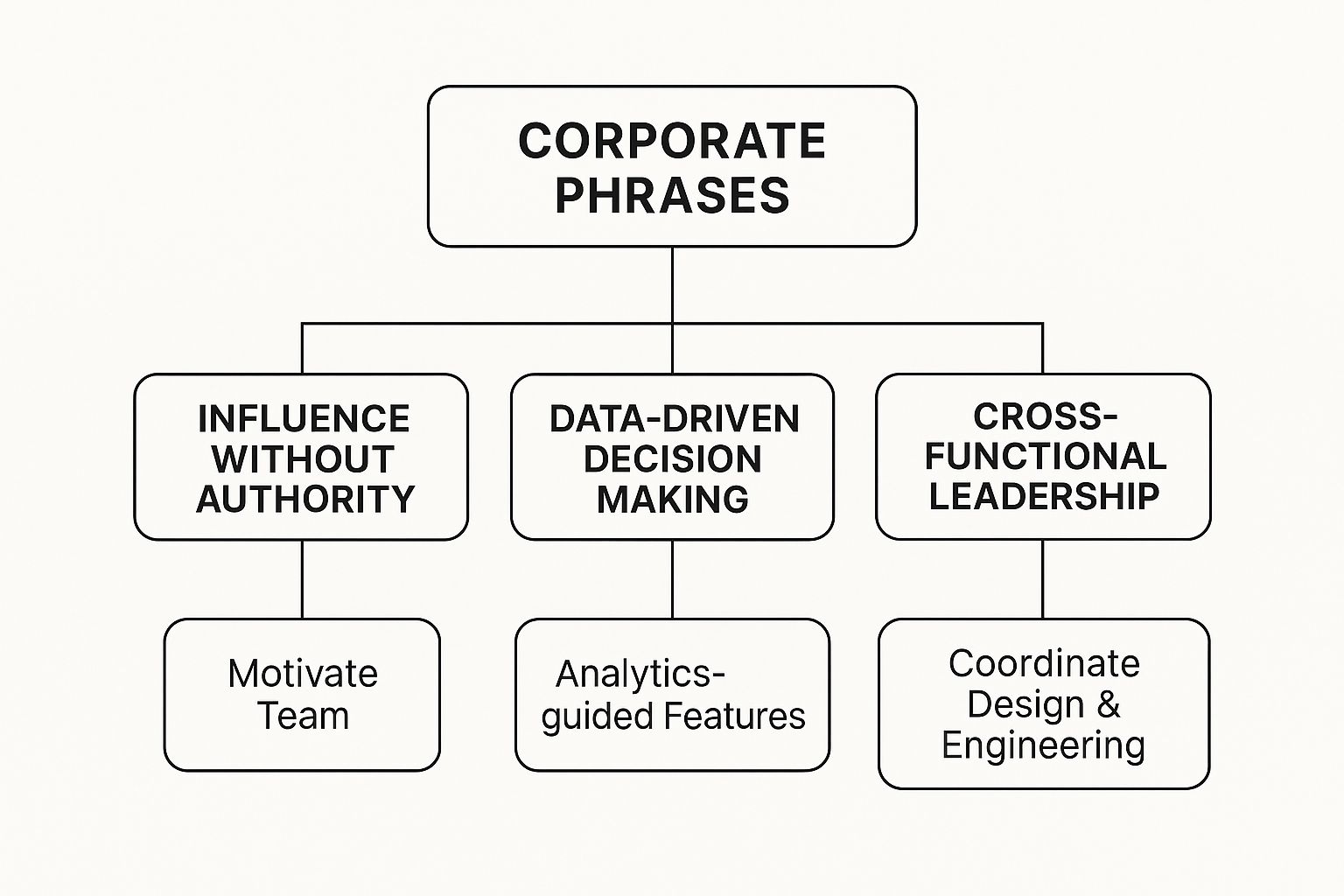
It helps clarify that something abstract like "influence" is really about your ability to rally the team around a clear vision, backed by compelling data. Let's break down what that looks like in practice.
Vision and Strategy
Think of this as the "North Star" pillar. Your job here is to define what winning looks like and then chart the course to get there. It’s all about answering the big questions: What problem are we solving, who are we solving it for, and why the heck does it matter?
This isn't about daydreaming. It involves digging deep into market analysis, sizing up the competition, and translating lofty business goals into a product vision your team can get behind. You’re not just shipping features; you're shaping the future.
Mini Case Study: Netflix
A PM at Netflix might spot a trend in the data: viewers spend a ton of time browsing, but a lot of them bail if they don't find something within 90 seconds. The strategic goal isn't "build a new button." It's "reduce content discovery friction." That insight leads to a pitch for a new AI-powered "Quick Match" feature. That’s strategy in action.
Execution and Delivery
If strategy is the "why," execution is the "how." This pillar is where the rubber meets the road and your beautiful roadmap turns into a real, working product. It’s the gritty, day-to-day grind of getting stuff shipped.
This means you have to become a master of prioritization, an expert at backlog grooming, and a pro at writing user stories so clear that anyone can understand them. You’re the operational hub, making sure engineering, design, and QA are all on the same page and nothing is blocking their path.
- Sprint Planning: You’re huddled with the engineering lead, hashing out which user stories and bug fixes to pull into the next two-week sprint. You’re the one clarifying requirements and making sure the work ladders up to the bigger quarterly goals.
- Backlog Grooming: You’re constantly refining the backlog, making the tough calls on what to build next versus what has to wait, all based on user impact and business value.
- Managing Dependencies: You’re the one identifying potential roadblocks, coordinating with other teams whose work might affect your launch, and ensuring everything comes together for a smooth release.
User and Market Empathy
Let's be clear: great products are built on a deep, almost obsessive, understanding of the customer. This pillar is about becoming the undisputed voice of that customer inside the company. You have to live and breathe their pain points.
This is way more than just glancing at survey results. It means getting on calls and conducting user interviews, poring over behavioral data in tools like Amplitude, and pulling together qualitative feedback from support tickets and sales calls. You build that empathy to make damn sure the team is solving a problem that people actually care about.
Stakeholder and Team Leadership
Last but not least, a PM leads by influence, not authority. You don't have direct reports, but you're still the leader. This pillar is all about communication, alignment, and keeping everyone motivated. You're responsible for keeping the entire crew—from the engineers in the weeds to the execs in the boardroom—informed, engaged, and genuinely excited about where the product is headed.
One day you're presenting your roadmap to the C-suite, the next you're negotiating timelines with engineering, and the day after that you're celebrating a big win with the whole cross-functional team. You are the glue that holds it all together, making sure everyone feels a shared sense of ownership and purpose.
Essential Skills and Tools for Modern Product Managers
If you're looking to move from just analyzing a product manager job description to actually landing the role, you need a modern, competitive toolkit. Forget about listing vague "soft skills" on your resume. Hiring managers at places like Google and OpenAI are screening for hard competencies, and your ability to prove you've mastered specific tools and workflows is non-negotiable.
This means you have to get comfortable with data. Seriously. You need to be able to pull your own insights using SQL or jump into a product analytics platform like Amplitude without waiting for help. Likewise, fluency in roadmap and backlog tools like Jira or Aha! is critical for translating that brilliant strategy into work your engineering team can actually build.
Building Your Technical and Analytical Edge
The modern PM is expected to be deeply analytical. Gut feelings are great starting points, but you have to form hypotheses and then validate them with cold, hard data. This requires a specific set of skills that you absolutely must cultivate to stay competitive.
- Data Analysis: Knowing how to query databases with SQL is a massive differentiator. It means you can answer your own questions on the fly. Platforms like Amplitude and Mixpanel have also become the standard for digging into user behavior and figuring out what people are really doing in your product.
- Roadmap & Project Management: Expertise in Jira is basically table stakes. You have to know how to build clear roadmaps, groom a backlog, and write tickets that make sense. It's fundamental. Tools like Aha! or Productboard are also common for the higher-level, more strategic planning.
- User Feedback & Research: Get familiar with tools like Dovetail for organizing and making sense of user interviews. And you should know your way around session replay tools like FullStory to see firsthand where users are getting stuck. It’s the fastest way to build real empathy.
For a deeper look into the specific competencies hiring managers are searching for, check out this complete breakdown of the essential skills required for a product manager.
Integrating AI into Your PM Workflow
AI isn't some futuristic novelty anymore; it's a core part of the PM toolkit. A skilled PM uses AI not to replace their critical thinking, but to supercharge it. Instead of staring at a blank page trying to write a PRD, for example, you can use AI to generate a solid first draft in seconds.
Prompt Example for ChatGPT
"Act as a senior product manager at a B2B SaaS company. Generate three distinct user story templates for a new 'team collaboration' feature. Include fields for User, Goal, Acceptance Criteria, and a section for technical notes. Ensure one template is basic, one is detailed for complex features, and one follows the Gherkin syntax."
And let's be honest, one of the most fundamental skills for any PM is mastering the art of writing user stories to define requirements clearly. This is a process AI can make dramatically faster and more consistent.
The demand for PMs with this modern skillset is intense. One study found that a highly effective PM can increase company profits by 34.2%, which shows exactly why companies are so picky. As the bar gets higher, proving you have these skills is everything.
Charting Your PM Salary and Career Path

Let's talk about the big stuff: money and career growth. Understanding the compensation and progression tied to a product manager job description is critical if you want to steer your own career. Product management is a well-paying field, no doubt, but your salary can swing wildly depending on your level, location, and the kind of company you join.
Don’t think of the PM career ladder as a straight shot up. It's really a series of distinct shifts, where your entire mindset and scope of responsibility have to evolve. You’ll move from being deep in the weeds of execution to leading broad, company-level strategy.
Benchmarking Your PM Salary
For many, compensation is a major factor, and the numbers in product are compelling. But they are far from uniform. It’s no surprise that major tech hubs like San Francisco and New York consistently offer bigger paychecks, largely to offset their sky-high cost of living.
So, what does that progression actually look like? Here’s a typical path you might see in a major U.S. city:
- Associate Product Manager (APM): Total compensation usually falls somewhere between $110,000 – $140,000. Right now, your main job is to learn the ropes and flawlessly execute on well-defined features. You're absorbing everything you can.
- Product Manager (Mid-Level): You can expect your total comp to jump into the $150,000 – $220,000 range. At this point, you own a significant feature set or even a small product, and you're expected to work with a lot more autonomy.
- Senior Product Manager: Compensation often climbs from $220,000 – $300,000+. You're now leading complex, high-impact projects and are starting to influence the product strategy for your entire area.
- Group PM / Director: At this leadership level, your pay can easily top $350,000. Your role pivots dramatically. You're no longer just managing products; you're managing the PMs who manage the products. You are now a leader of leaders, overseeing an entire product portfolio.
It's also crucial to know that location isn't the only thing that creates pay gaps. For instance, while San Francisco’s median PM salary sits around $129,000, some data shows that female PMs may earn about 7% less than their male colleagues, with men holding 64% of the senior roles. You can find more product management statistics that break down these trends in salary and diversity.
The Leap From Feature Owner to Strategic Leader
The single most important thing to grasp about moving up in product is how fundamentally the expectations change at each level. Getting promoted from a mid-level PM to a Senior PM isn’t just about getting better at your current job—it’s about doing a different job entirely.
The jump to senior leadership isn't about shipping more features. It's about your ability to handle ambiguity, define the "why" for an entire product area, and own the business outcome, not just the delivery timeline.
Early on, your success is measured by your ability to ship. Can you get features out the door? As you become more senior, you’re judged by your ability to set a compelling vision, influence stakeholders across the company, and drive real business results. Your focus shifts from the backlog to the balance sheet.
For anyone just starting out, having a clear roadmap is invaluable. It’s worth checking out some guides on how to become a PM from the ground up. That initial foundation is exactly what you'll build the rest of your career on.
Common Questions About the PM Role
As you start digging into any product manager job description, a few questions always bubble up. It doesn't matter if you're trying to break into the field for the first time or plotting your next big career move.
Let's tackle the most common ones head-on with some practical, no-fluff answers. Think of this as your field guide for the usual suspects you'll encounter.
How Do I Get a Product Manager Job with No Direct Experience?
This is the classic chicken-and-egg problem, but it's solvable. The trick is to start building "product-adjacent" experience right where you are. You don't need the formal PM title to begin thinking and acting like one.
Look for opportunities to get your hands dirty. Volunteer for projects that let you influence product decisions, work shoulder-to-shoulder with engineers, dive into user data, or manage a project timeline. When you write your resume, frame these wins using the language of product management. Honestly, internal transfers are often the smoothest path—your company already knows you and trusts your work.
Here's a power move: build a simple side project from the ground up. Doing this screams initiative, shows you have empathy for users, and proves you can actually ship something. Those are three core skills every single hiring manager is looking for.
What Is the Biggest Difference Between an Associate PM and a Senior PM?
It all comes down to one word: ambiguity.
An Associate Product Manager (APM) is usually handed a well-defined feature or part of an existing product. Their job is to execute. They're focused on writing clear user stories, managing the backlog, and keeping things moving, all with a good amount of guidance. Their world is structured, and success is measured by their ability to deliver.
A Senior PM, on the other hand, lives in a world of much higher ambiguity. They're expected to operate with a ton of autonomy, defining the "why" and "what" for an entire product area, not just a feature. Their role is about setting the long-term vision, navigating tricky stakeholder relationships, and owning the business outcomes—a much bigger picture than just shipping the next thing.
What Are the Most Common Mistakes in a Product Manager Interview?
Time and again, I see candidates trip up on the same few things during interviews. It almost always comes down to a gap in their core product thinking.
Here are the big three:
- Jumping straight to solutions: They hear a problem and immediately start pitching features. Big mistake. You always, always want to start by asking clarifying questions to get to the absolute root of the user's problem and the business context.
- Giving generic, textbook answers: Theoretical responses don't prove you can get things done. Use the STAR method (Situation, Task, Action, Result) to anchor your answers in real, specific things you've accomplished. Numbers and quantifiable results are your best friends here.
- Lacking "product sense": This is a big one. It's the failure to show you can think critically about why some products win and others flop. A structured, thoughtful approach that puts you in the user's shoes will always beat a quick, surface-level answer.
Ready to master the skills that actually get you hired and promoted? The newsletter and podcast from Aakash Gupta are packed with the frameworks, insights, and real-world advice you need to crush it at every stage of your product career. Join the largest community of product and growth leaders today at https://www.aakashg.com.
