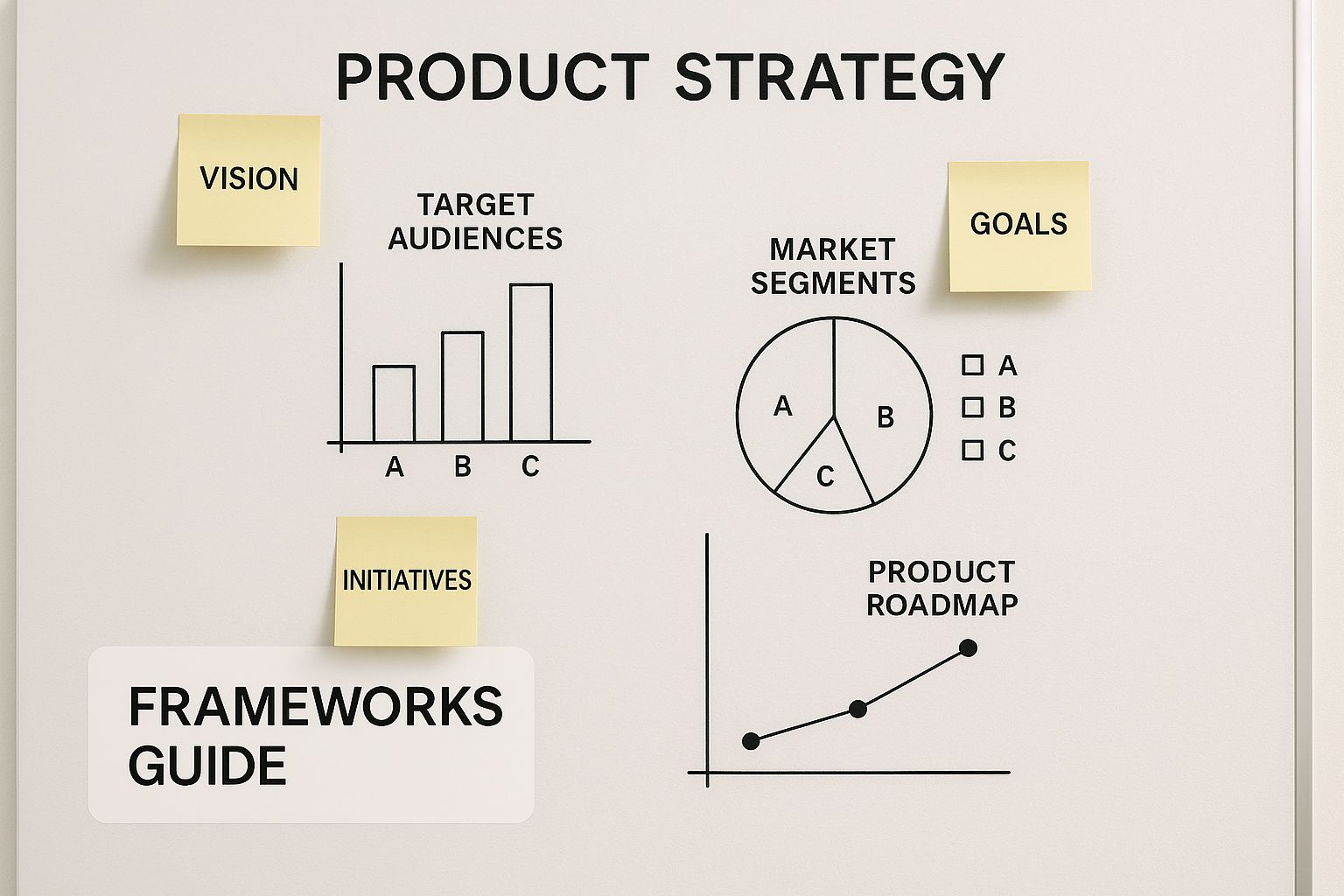
A product strategy framework isn't a theoretical document you create once and forget. It's your playbook—the actionable system that connects your company’s vision to the daily work of your product team. It stops you from just building features and starts you building the right features that solve real customer problems and drive business growth.
This is the tool that elevates you from a feature manager to a strategic leader. A strong framework is what you'll use at Google, Meta, or any high-performing tech company to make defensible decisions, align stakeholders, and justify your roadmap.
Your Playbook for Strategic Leadership
For any Product Manager, from an aspiring APM to a VP of Product, a product strategy framework is your dynamic playbook. It’s how you answer the three critical questions that define your success:
- What game are we playing? (Your vision, market, and competitive landscape.)
- How do we win? (Your unique value proposition and strategic bets.)
- What moves do we make next? (Your prioritized roadmap and success metrics.)
Without this structure, teams fall into the "build trap"—shipping features without a clear connection to business goals, leading to wasted engineering cycles and market irrelevance. This framework is your primary tool for avoiding that fate and advancing your career.

The Core Components of a Strong Framework
At its heart, any solid product strategy framework is built on just a few non-negotiable pillars. These are the inputs you absolutely need to create a coherent plan that your engineering, marketing, and sales teams can actually understand and get behind. Before you even look at specific product models, it's worth understanding what makes up a general strategic framework—it truly is your battle plan.
A good framework should be a living document, not some static plan gathering dust in a forgotten folder. As a PM at a place like Meta or Google, I’d expect my team to constantly be referencing and tweaking these core components.
A simple table can really help break down what goes into a framework. Here’s a quick-reference guide to the essential pillars, what they are, and why they matter for a Product Manager.
Core Components of an Actionable Product Strategy Framework
| Component | Core Question It Answers | Key Output for a PM |
|---|---|---|
| Vision | Where are we going and why? | A clear, aspirational statement that serves as the team's North Star. Example: Tesla's "to accelerate the world's transition to sustainable energy." |
| Market & Customer Insights | Who are our customers and what do they really need? | Deep analysis of the target audience, jobs-to-be-done, and competitive landscape, including TAM/SAM/SOM. |
| Goals & Metrics | How will we know if we're winning? | Specific, measurable outcomes (OKRs) that define success in terms of business impact (e.g., increase MAU by 15%), not just output (e.g., ship feature X). |
| Strategic Initiatives | What are the big bets we'll make to reach our goals? | High-level themes of work, like "Expand into the European market" or "Overhaul the user onboarding experience to improve Day-7 retention." |
This table covers the fundamentals, but remember that the magic is in how you connect these pieces into a compelling narrative.
A great strategy is a story about the future. It’s a narrative that explains how your product will evolve to create immense value for your customers and, in turn, for your business. It provides clarity and inspires action.
Getting these fundamentals right is the crucial first step. If you want to go a layer deeper, you can explore more about what product strategy is and why it matters in our detailed guide. Honestly, mastering this will completely change how you build products and push your career forward.
How Product Strategy Evolved Over Time
To really get a grip on modern product strategy, you have to understand where it came from. The frameworks and agile mindsets we see at places like Google and Netflix didn't just pop up out of nowhere. They’re the result of decades of moving away from rigid, slow, and—frankly—broken planning models.
Not that long ago, product development was a completely different beast. Most companies ran on the waterfall model, which meant creating enormous, inflexible plans. We're talking five, sometimes even ten-year roadmaps that tried to detail every feature and timeline in advance. The "Product Manager" in that world was more of an overseer, just making sure the development train stayed on its pre-approved tracks.
The Shift from Rigidity to Agility
This old way of doing things started to crack under the pressure of faster-moving markets and tougher competition. Technology cycles got shorter, customer expectations soared, and suddenly, those long-term plans felt like a ball and chain. How could a strategy locked in for years possibly react to a new competitor, a sudden market shift, or a flood of user feedback?
It couldn’t. The result was often products that were dead on arrival—completely missing the mark with the people they were supposed to serve. It was a painful lesson, but it forced the industry to change.
The whole concept of product strategy had to evolve. By the 2000s, only about 13% of companies were still bothering with detailed product roadmaps longer than a year. Fast forward to today, and that trend is the new standard. A full 66% of businesses now tie their company strategy directly to their product development process, as highlighted in these insights on the evolution of product strategy from Gaussian.
This wasn't just a small tweak; it fundamentally changed what it meant to be a product manager. The role went from a simple project coordinator to a strategic leader driving the entire product lifecycle.
The Rise of the Strategic Product Manager
The modern PM is now expected to be the expert on the customer, the market, and the business—and to weave all of that insight into a living, breathing strategy. This shift is what gave birth to the product strategy framework as we know it today.
A modern product strategy framework isn't a static document collecting dust on a shelf; it's an adaptive system. It's built to take in new information—market data, user feedback, competitive moves—and translate it into smart adjustments, keeping the product pointed toward its North Star.
This history lesson explains why the best frameworks today all have a few things in common:
- Adaptability: They are designed to pivot and change as you learn more.
- Data-Driven Decisions: They force you to rely on evidence and metrics, not just gut feelings and opinions.
- Continuous Feedback Loops: They bake customer feedback right into the strategic planning process.
Understanding how we got here is essential for any PM, whether you're just starting out or have been in the game for years. It gives you the "why" behind the way we work and shines a light on the skills that separate the good PMs from the great ones: navigating uncertainty, making data-backed bets, and constantly steering the ship toward success.
Popular Frameworks You Can Use Today
Theory is great, but as a Product Manager, your real value is in application. Knowing which tool to pull from your toolkit for a specific problem is what separates seasoned PMs from junior ones. This is where you have to move from abstract ideas to a concrete product strategy framework.
We're going to break down three powerful frameworks that I've seen used to great effect at top tech companies. These aren't just academic exercises; they are practical, battle-tested systems for making better, more customer-focused decisions.
This infographic gives you a quick visual guide to the frameworks we'll cover, helping you see their core purpose at a glance.
As you can see, each framework is designed to answer a different strategic question—from digging into customer motivation to figuring out which features will actually move the needle.
Christensen's Jobs to Be Done (JTBD)
Clayton Christensen's Jobs to Be Done (JTBD) framework is an absolute game-changer for getting to the why behind customer behavior. It forces you to stop asking, "What product features do they want?" and start asking, "What 'job' are they hiring my product to do?"
The core idea is simple: customers don't buy products, they "hire" them to make progress in their lives. Think about it. Nobody buys a drill because they want a drill. They buy a drill because they want a quarter-inch hole in their wall. The drill is just the tool for the job.
"Upgrade your user, not your product. Don’t build better cameras—build better photographers." – Kathy Sierra
This quote from Kathy Sierra nails the JTBD mindset. Your goal isn't just to pile on features; it's to understand the user's desired outcome. When you focus on the "job," you uncover the real, often unspoken, needs that drive a person to buy something. That kind of insight is pure gold for your strategy.
How to Put JTBD Into Practice
- Uncover the "Job": Run customer interviews, but focus on the circumstances that led to the purchase. Ask questions like, "Take me back to the moment you first realized you needed something like this. What was going on?" or "What else did you try before you found our solution?"
- Write the Job Story: Use this simple format to bring clarity: "When [situation], I want to [motivation], so I can [expected outcome]." This structure forces you to connect the context to the goal.
- Analyze the Four Forces: Every decision is a tug-of-war. You have the push of the current problem and the pull of your new solution. But you also have the anxiety about switching and the habit of the old way. Your product has to be compelling enough to overcome the latter two.
Intercom is a classic example of a company built around JTBD. They figured out that businesses weren't hiring software to "manage customer conversations." They were trying to "build better relationships with their customers." That subtle shift guided their entire product strategy and turned them into a powerhouse.
The Kano Model
So, you’ve got a long list of potential features. Now what? How do you decide what to build first?
The Kano Model is a brilliant framework for prioritizing features based on how they affect customer satisfaction. Developed by Professor Noriaki Kano back in the 1980s, it's still one of the most useful tools a PM can have.
The model sorts features into three core categories:
- Basic Features (Must-haves): These are the things customers just expect. Having them won't win you any awards, but not having them will cause serious dissatisfaction. Think of Wi-Fi in a coffee shop or brakes on a car. They're table stakes.
- Performance Features (Satisfiers): With these, more is better. The more you deliver, the more satisfied your customers become. For an electric car, this would be a longer battery range. For a laptop, a faster processor.
- Attractive Features (Delighters): These are the unexpected, delightful surprises. Customers don't know to ask for them, so their absence causes no dissatisfaction. But their presence creates a "wow" moment that builds loyalty. The original iPhone's pinch-to-zoom was a perfect delighter.
By categorizing your backlog this way, you can make much smarter investment decisions. You have to cover your basics, compete on performance, and then strategically sprinkle in delighters to stand out.
Gibson Biddle's DHM Model
How do you make sure your product strategy actually helps the business win? Enter the DHM Model, a simple but potent framework from Gibson Biddle, the former VP of Product at Netflix. It’s designed to help you build a sustainable competitive advantage.
DHM is an acronym that stands for:
- Delight Customers: How will your product create genuine value and delight for your users? This is where you track metrics like Net Promoter Score (NPS), engagement, and retention.
- Hard to Copy: What’s your moat? What makes it difficult for competitors to replicate what you do? This could be network effects (like Meta), proprietary technology (like Google's search algorithm), or massive economies of scale (like Amazon).
- Margin Enhancing: How does your work contribute to the bottom line? This is all about driving revenue, reducing costs, or increasing customer lifetime value.
The real power of DHM is how it forces you to connect the dots between customer happiness, your competitive moat, and business health. As a PM, you should constantly be asking how your initiatives score across all three pillars. A feature that delights customers but is easy to copy and hurts your margins is, ultimately, a weak strategic move.
Choosing Your Product Strategy Framework
Picking the right framework depends entirely on the problem you're trying to solve. There's no single "best" one; the key is knowing which tool to use for which job. This table breaks down when to reach for each of the frameworks we've discussed.
| Framework | Best For | Key Outcome | Example Company Use Case |
|---|---|---|---|
| Jobs to Be Done (JTBD) | Early-stage discovery, understanding root customer motivations, and finding new market opportunities. | A deep, empathetic understanding of why customers buy, leading to more innovative solutions. | A startup trying to disrupt the personal finance space uses JTBD interviews to discover people's real "job" is reducing financial anxiety, not just budgeting. |
| The Kano Model | Prioritizing a backlog of features, resource allocation, and balancing customer satisfaction with development effort. | A clear roadmap that balances must-have features with performance improvements and delightful innovations. | A mature SaaS company uses the Kano model to decide whether to invest in a requested "delighter" feature or fix a "basic" expectation that's causing churn. |
| DHM Model | Aligning product initiatives with long-term business goals, building a competitive moat, and ensuring profitability. | A product strategy that creates a sustainable business by linking customer value directly to competitive advantage and financial health. | Netflix uses the DHM model to evaluate new content investments: Does it Delight viewers? Is it Hard-to-copy (exclusive)? Does it Margin-enhance by driving subscriptions? |
Ultimately, these frameworks are lenses. They help you look at your product, your customers, and your market from different angles. The most experienced product leaders I know don't just stick to one; they mix and match them to get a complete picture before making a big bet.
How Winning Companies Apply Their Strategy
Frameworks are just theory on a whiteboard until you see them driving billion-dollar decisions. To really get a feel for how powerful a product strategy framework can be, you have to look at how the best in the business turn abstract ideas into products that dominate the market.
Just as importantly, we need to look at how strategic missteps lead to epic flameouts. These examples aren't just stories; they're packed with concrete lessons on what to do—and what to avoid.
Spotify: Speed Through Autonomy
Spotify’s famous organizational model of "Squads, Tribes, Chapters, and Guilds" isn't just a quirky naming scheme. It's the physical manifestation of their entire product strategy. At its core, their strategy has always been about one thing: moving fast. They prioritized innovation speed, adaptability, and empowering small, autonomous teams to act like mini-startups.
The whole point of this framework was to slash bureaucracy and give teams a deep sense of ownership.
- Squads: Think of these as small, cross-functional teams with a specific mission, like "improve the search experience."
- Tribes: These are just collections of squads working in a related area, for instance, everything related to the music player.
- Chapters & Guilds: This is the glue that holds it all together. They ensure knowledge and best practices are shared across different squads, maintaining quality without a heavy-handed, centralized command structure.
This entire structure flows directly from a strategy that values decentralized decision-making above all else. By giving squads the freedom to build, test, and release features on their own, Spotify can run experiments on a massive scale. It allows them to constantly adapt to user behavior and market shifts far faster than any top-down organization ever could. It’s a masterclass in aligning how you work with what you want to achieve.
Airbnb: Belonging Anywhere
Airbnb's transformation from a quirky air-mattress rental site to a global travel powerhouse is a story of a deeply held, vision-led product strategy. Their vision, "Belong Anywhere," became the North Star for every single product decision. It guided them through massive global expansion and even helped them navigate an existential crisis like the COVID-19 pandemic.
Their framework wasn't just about bolting on new features; it was about systematically building trust and human connection.
The most successful strategies are built on a deep, almost philosophical understanding of the customer's core need. For Airbnb, it wasn't just a place to stay; it was the desire for authentic, local experiences.
When the pandemic brought global travel to a screeching halt, their "Belong Anywhere" vision didn't shatter—it adapted. They quickly pivoted their product strategy to focus on "Online Experiences" and long-term stays for the new wave of remote workers. This wasn't a panicked reaction; it was a logical extension of their core strategic principle. The framework empowered them to ask, "How can we help people belong, even if they can't travel?" This question led to innovations that kept the business alive and relevant. For another look at how a clear strategy fuels growth, the Stripe product framework offers a great example of similar strategic clarity.
A Cautionary Tale: Quibi
And then there's the other side of the coin. Quibi is a powerful, painful lesson in what happens when a product strategy is fundamentally disconnected from how people actually live and use technology. The company raised a staggering $1.75 billion with what seemed like a clear strategy: deliver high-quality, "quick bite" video content made exclusively for mobile, targeting people during their "in-between" moments, like commuting or waiting in line.
The strategic failure wasn't the vision itself, but its rigid, unyielding execution. The framework was built on a foundation of flawed assumptions:
- Context Misread: They launched in April 2020, just as the pandemic vaporized the very commuting and "in-between" moments their entire strategy was built on.
- Consumption Habits Ignored: The strategy bizarrely forbade watching on TVs and made it difficult to share clips on social media, completely cutting them off from viral marketing and how people prefer to watch and share content.
- Value Proposition Mismatch: They asked people to pay a premium for content that was competing with an endless firehose of free, highly engaging video on platforms like TikTok and YouTube. They never proved their content was worth the price tag.
Quibi's collapse after just six months is a stark reminder that a product strategy framework has to be tested against the messy reality of user behavior. A brilliant idea isn't enough. The strategy must be flexible and deeply rooted in how people actually use things. To see how broader strategic approaches can build success from the ground up, check out this guide on effective small business growth strategies. These examples make it clear: strategy is about making the right bets, not just having a plan.
Common Pitfalls and How to Avoid Them
Look, even the most beautifully crafted product strategy framework can shatter the second it hits the reality of execution. I’ve seen countless strategies succeed and fail, and I can tell you this: the framework is only half the battle. The real test is navigating the messy, human side of an organization.
The most common point of failure isn't a bad idea. It's the silent killer of good ideas: a lack of organizational alignment. You can have a genius plan, but if engineering, marketing, sales, and leadership aren't all rowing in the same direction, you're dead in the water. This is where great strategies go to die.
The Challenge of Scaling Alignment
This problem doesn't just grow with your team—it multiplies. Data shows that over 50% of large product teams (we're talking 50+ people) really struggle to keep their processes and roadmaps consistent across departments. This isn't just a headache; it's a cash bonfire. Unclear company strategies are to blame for a staggering 23% of product development investment failures worldwide. You can dig into these product development statistics to see just how common—and costly—these issues are.
When teams drift into their own silos, you start seeing the classic symptoms of a strategic breakdown:
- Marketing is out there promoting features that engineering hasn’t even started building.
- Sales is selling a dream version of the product that has no connection to the actual roadmap.
- Engineering is busy gold-plating a low-priority feature while a critical initiative is starving for resources.
These aren't signs of bad employees. They're symptoms of a broken strategic connection. As a Product Manager, your job is to be the connective tissue holding it all together.
Diagnosing and Fixing Strategic Misalignment
A weak or fuzzy company strategy is poison. If the leadership team hasn't clearly defined what "winning" looks like for the business, how can you possibly build a product strategy to help them get there? You can't. Your product decisions become unmoored, guided by gut feelings or whoever yells the loudest, not by a clear, unified purpose.
To fight this, you have to become a master diagnostician of your company’s strategic health. Your job is to sniff out misalignment and fix it before it completely derails your work.
The role of a product leader isn't just to create a strategy, but to relentlessly communicate and reinforce it. You have to make sure every single person touching the product understands not just what they are building, but why it matters to the company's success.
Use this checklist to find and fix the strategic gaps in your own organization.
Strategic Alignment Checklist for PMs
- Can You Articulate the Company Vision? Can you and your team members—right now, from memory—state the company’s high-level mission and its 1-3 year business goals? If not, the foundation is already crumbling.
- Does Your Roadmap Directly Map to Company OKRs? Pull up your product roadmap. Now, try to draw a literal line from each major initiative to a specific company-level Key Result. If you can't find a clear connection, that initiative is a prime candidate for the chopping block.
- Are Your Cross-Functional Partners Aligned? Set up quick, regular check-ins with your counterparts in marketing and sales. Ask them point-blank: "What are your top priorities this quarter? How do they connect to the product roadmap we've discussed?"
- Is Your Team Speaking the Same Language? Just listen in meetings. When your engineer, designer, and marketer talk about a new feature, do they describe its purpose and value in the same way? If the answer is no, your internal story is fractured.
Implementing Your First Product Strategy

Alright, you understand the frameworks. Now for the hard part—and the fun part. Putting a framework into practice is where you really earn your stripes as a Product Manager. This is a hands-on process that demands structure, crisp communication, and a relentless focus on the customer. It's about translating those high-level strategic ideas into a plan your team can actually get behind and build.
The stakes are incredibly high. According to the U.S. Bureau of Labor Statistics, a staggering 23.2% of private businesses fail within their first year, often because of a wonky or nonexistent product strategy. But companies that truly commit to a strategic framework flip the script, building in feedback loops and adaptation from the very beginning. You can dig into more data on product development strategies from Trinetix to see just how big the impact is.
From Vision to Actionable Initiatives
First things first: anchor everything to a clear, compelling product vision. This isn't just some fluffy mission statement; it’s the North Star that guides every single decision you and your team will make.
Once you have that vision locked in, the real work begins. It’s time to break it down into tangible pieces.
- Go Deep on Research: This is your foundation. We're talking about deep market analysis and user research—not just surveys. Get on the phone for qualitative interviews, dissect your competitors, and dig into behavioral data to find those juicy, unmet needs.
- Define Your Strategic Pillars: Based on your research, identify 2-4 high-level themes or pillars. These are your big bets. A pillar might sound like "Achieve Market Leadership in the SMB Segment" or "Drive Engagement Through Hyper-Personalization."
- Turn Pillars into Initiatives: Now, break each pillar down into specific, measurable initiatives. If your pillar is "Improve User Retention," a concrete initiative could be "Overhaul the New User Onboarding Experience."
Setting Milestones and Measuring Success
With your initiatives defined, you need to know what "done" looks like. This is where you connect your strategy to the real world of execution using milestones and Key Performance Indicators (KPIs).
A product strategy without metrics is just a collection of opinions. KPIs are what ground your vision in reality and force honest conversations about what's working and what isn't.
For every initiative, you need to establish crystal-clear success metrics.
- Set Clear Milestones: Break down big, hairy initiatives into smaller, tangible milestones. This builds momentum and gives you regular checkpoints to make sure you’re still on track. An onboarding overhaul could have milestones like "User Research Complete," "Prototype A/B Test Launched," and "Full Feature Rollout."
- Pick the Right KPIs: Choose KPIs that measure the outcome you want, not just the team's output. Forget tracking "features shipped." Instead, focus on things like "Day 7 Retention Rate," "Time to First 'Aha' Moment," or "User Onboarding Completion Rate."
This whole process is iterative, often kicking off with a Minimum Viable Product (MVP). The point of an MVP isn't just to launch fast; it's to launch, learn, and adapt. This feedback loop is what saves you from building the wrong thing and keeps your strategy nimble. To get this right, you'll need to know how to prioritize a roadmap to perfectly align these initiatives with your big-picture goals.
Product Strategy Framework FAQ
Here are a few of the most common questions I get from Product Managers when they're trying to wrap their heads around product strategy frameworks.
How Often Should I Revisit My Product Strategy?
Your core product vision? That should be your north star, something that stays pretty stable over the long haul. But your strategy and roadmap need to breathe.
As a general rule, you should be doing a comprehensive strategy review every quarter. This is your chance to react to what the market is doing, what new user data is telling you, and whatever moves your competitors just made.
Now, if you're an early-stage startup or your product lives in a super volatile market, you might need to bump that up to a monthly check-in. The goal is to be responsive to new information without being reactive to every little tweet or blip on the radar.
What's the Real Difference Between a Product Strategy and a Product Roadmap?
I love this question because it gets to the heart of it all. It's easy to confuse the two, but they serve very different purposes.
Think of it like this: your product strategy is the "why" and the "how." It answers the big questions: Who are we building this for? What specific problem are we solving better than anyone else? This is your game plan for winning.
The product roadmap is the "what" and the "when." It's the tangible, time-based plan that shows which features, epics, and initiatives you'll actually build to bring that strategy to life. The strategy always sets the direction for the roadmap; the roadmap makes the strategy real.
How Do I Get My Team and Leadership to Buy Into a New Product Strategy?
Getting buy-in from leadership is less about the framework itself and more about framing the outcome. No one gets excited about a new process for process's sake. They get excited about results.
Instead of saying, "We need to adopt a new product strategy framework," try this: "I've put together a plan to de-risk our big bets and directly connect our team's work to hitting our Q3 revenue goals."
Come armed with data. Show them the pain points you're trying to solve—maybe it's missed targets, features with dismal adoption rates, or a team that feels directionless. Then, clearly connect the dots, showing exactly how a structured strategic approach will fix those specific problems and give everyone a more predictable path to success.
Always lead with the business value. The "how" will follow naturally once they're bought into the "why."
