Product strategy frameworks are what turn a product manager's hunch into a concrete, data-backed plan. They give you a repeatable process for making those high-stakes decisions, getting your team on the same page, and—crucially—justifying your roadmap to leadership.
Think of it like this: an architect would never start building without a blueprint. Frameworks are your blueprints. Without them, you’re just guessing, and that's not a path to a Senior PM title at Google. A recent search on LinkedIn for "Senior Product Manager" roles at companies like Atlassian and Adobe shows that over 70% of job descriptions explicitly mention "strategic planning" and "data-driven prioritization." Frameworks are the tools you use to demonstrate those skills.
Why Frameworks Separate Great PMs from Good Ones
Back when I was a hiring manager at Google and Meta, I saw a clear line between the good PMs and the truly elite ones. The difference wasn't raw intelligence or charisma. It was the ability to bring a systematic approach to strategic chaos. A good PM might get a salary of $140,000, but a great PM who can articulate and defend a strategic vision using established frameworks commands offers upwards of $190,000 + equity.
Good PMs have ideas. Great PMs have a process for validating, prioritizing, and executing those ideas.
Too many roadmaps are built on shaky ground. They’re driven by the loudest voice in the room (often a senior stakeholder) or a fleeting gut feeling, and this approach almost always fails. Product strategy frameworks are your best defense against that chaos. They provide a common language and a logical structure that your whole team can rally behind.
From Feature Manager to Product Strategist
Without a framework, you risk becoming a "feature manager"—just taking orders and shipping features without any clear tie to business outcomes. Frameworks force you to step back and ask the hard questions. You shift from "what are we building?" to "why are we building this, and how does it move our core objectives forward?"
This is the single most critical leap you can make in your PM career. It’s what separates a junior PM from a true product leader.
Mastering these tools shows you have the strategic mind that VPs and C-suite execs are looking for. It’s not just about building stuff; it's about building a sustainable business advantage. If you want to dive deeper into these core principles, check out our guide on what a product strategy is.
The single biggest differentiator for a top-tier Product Manager is their ability to move beyond a feature list and articulate a coherent, defensible strategy. Frameworks are the tools that make this possible, turning ambiguity into a clear action plan.
Ultimately, these tools are about much more than just staying organized. They are about making better, more informed decisions that lead to winning products and, in turn, accelerate your own career growth.
Mastering the Core Product Strategy Frameworks
If you want to build products people actually need, you have to get past your own assumptions and dig into what truly motivates them. This is where a few foundational product strategy frameworks become your most valuable tools. Forget abstract theory—these are the practical methods used every day at places like OpenAI and Meta to decode what customers want and make smart bets.
We're going to zero in on three essentials that form a solid foundation for any product manager's toolkit: Jobs-to-be-Done (JTBD), the Kano Model, and good old SWOT Analysis. Getting a handle on these will give you a repeatable process for validating ideas, a skill that's non-negotiable in tough PM interviews and crucial for success on the job.
Uncovering Customer Motivation with Jobs-to-be-Done (JTBD)
The Jobs-to-be-Done framework is built on a deceptively simple idea: customers don't "buy" products; they "hire" them to get a specific job done. Think about it. Someone doesn’t buy a drill because they want a drill; they buy it because they want a quarter-inch hole in their wall.
This mental shift—from focusing on product features to focusing on customer outcomes—is everything. It forces you to get to the "why" behind what a user is doing. What progress are they trying to make in their life? What's the real job they're hiring your product for?
Intercom, the customer messaging platform, is a classic example of a company practically built on JTBD. They didn't start by trying to build a better live chat widget. They focused on the "job" of helping internet businesses have personal, scalable conversations with their customers.
This visual from Intercom shows how they frame a "Job Story," a core part of the JTBD framework.
The magic here is the focus on context ("When…"), motivation ("I want to…"), and desired outcome ("So I can…"). This gives engineering and design teams far richer detail than a standard user story ever could, helping them build solutions that actually hit the mark.
Actionable Steps for JTBD Interviews
To really apply JTBD, you have to get out of the office and talk to customers. Your goal isn't to ask what features they want. It’s to get the story behind their purchase.
- Find Recent Buyers: Use your company's CRM (like Salesforce or HubSpot) to identify customers who signed up in the last 30 days. These are gold. Their memory of the decision-making process is still fresh.
- Focus on the "Switch": The interview should revolve around the moment they decided they needed to make a change.
- Ask Probing Questions: Use questions that peel back the layers to reveal the underlying job.
Sample JTBD Interview Questions:
- "Take me back to the day you first realized you needed a better way to handle [problem area]. What was going on?"
- "What else did you try before this? What did you like or hate about those other solutions?"
- "When you signed up, what were you hoping to accomplish? What was the outcome you pictured in your head?"
- "Was there anything that almost made you not choose this solution?"
This process reveals the deep, human forces at play: the push of their current frustration, the pull of your new solution, the anxiety of making a change, and the comfortable habit of sticking with what they know.
Classifying Features with the Kano Model
Okay, so your JTBD research has inspired a whole backlog of feature ideas. Now what? How do you prioritize? The Kano Model offers a brilliant way to categorize features based on how they affect customer satisfaction.
The model sorts features into three main buckets:
- Basic Needs (Must-haves): These are table stakes. If you have them, customers are neutral. If you don't, they’re incredibly dissatisfied. Think of Wi-Fi in a coffee shop—you don't get excited that it’s there, but you’d be pretty annoyed if it wasn’t.
- Performance Needs (Linear): With these, more is simply better. The more you invest, the happier customers get. A car's gas mileage is a perfect example—40 MPG is clearly better than 30 MPG, and customers will be proportionally more satisfied.
- Delighters (Exciters): These are the unexpected, innovative features that create pure delight. Customers aren't expecting them, so their absence causes no dissatisfaction. But when they're present, they can create loyal fans and a huge competitive edge. The first time you experienced noise-canceling headphones was a true delighter.
Key Insight: The Kano Model teaches us that not all features are created equal. Piling on more 'Basic' features brings diminishing returns, but a single well-executed 'Delighter' can set you apart from the entire market.
To put the Kano model into practice, you run a specific type of survey using tools like SurveyMonkey or Typeform. For each potential feature, you ask a pair of questions:
- Functional: How would you feel if you had this feature? (Answers range from "I like it" to "I dislike it.")
- Dysfunctional: How would you feel if you did not have this feature? (Same range of answers.)
By cross-referencing the answers on a special evaluation table, you can accurately classify each feature and start making much smarter roadmap decisions.
Assessing Your Strategic Position with SWOT Analysis
While JTBD and Kano are all about the customer and the product, a SWOT analysis (Strengths, Weaknesses, Opportunities, Threats) forces you to zoom out and look at your strategic position in the wider market. It’s a classic for a reason—it’s simple, powerful, and used everywhere from business schools to boardrooms.
- Strengths (Internal): What does your company do exceptionally well? Do you have unique tech, a powerful brand, or an all-star team?
- Weaknesses (Internal): Where are you falling short? Are you burdened with technical debt, missing key talent, or struggling with distribution?
- Opportunities (External): What market trends can you jump on? Is there an underserved customer segment or a new technology on the horizon (e.g., advances in generative AI)?
- Threats (External): What external factors could hurt you? Are new competitors popping up, regulations changing, or consumer habits shifting?
The best product strategies are born from solid market research. The work you do gathering data for a SWOT, for instance, directly fuels better innovation. When product managers do their homework—collecting real data on customers, competitors, and market trends—they're able to build unique value propositions that actually connect with users.
For a deeper dive, check out these 10 essential product strategy frameworks, which cover concepts like Jobs-to-be-Done and the North Star Metric in more detail. By combining these core frameworks, you get a multi-layered view that allows you to build products that solve real problems and win in the market.
Translating Strategy into Action with Prioritization Frameworks
A brilliant product strategy is useless if it just lives in a slide deck. The real magic—and the hardest part—happens when you translate that high-level vision into the day-to-day work of your engineering team. This is where most strategies fall apart, lost in the gap between the "why" and the "what."
This section is all about bridging that gap. We're going to dive into the prioritization frameworks that turn your vision into a tangible, actionable plan. Think of these not as more red tape, but as tools for instilling discipline and objectivity into your decision-making. They help you shift conversations from subjective debates to data-informed choices—a critical skill for any PM with their eye on a leadership role.
Driving Objectivity with RICE Scoring
One of the most effective and widely used frameworks out there is the RICE scoring model. Its beauty is in its simplicity. It forces you to put numbers to your assumptions and weigh features against each other on a level playing field.
The formula is straightforward: (Reach x Impact x Confidence) / Effort.
Let's break that down:
- Reach: How many people will this feature actually touch in a given timeframe? Be specific. Don't just say "a lot of users." Say "5,000 customers per quarter" or "50,000 transactions per month." Pull this data from your analytics tools like Amplitude or Mixpanel.
- Impact: How much will this move the needle for an individual user? This one can be a bit squishy, so it helps to use a simple scale. A common one is 3 for massive impact, 2 for high, 1 for medium, and 0.5 for low.
- Confidence: This is your gut check. How sure are you about your Reach and Impact numbers? Be honest. Use percentages: 100% for high confidence (you have solid data), 80% for medium (you have some evidence), and 50% for low (it's more of a hunch).
- Effort: How much time will this cost your product, design, and engineering teams? Get estimates from your engineering lead. Keep it simple by estimating in "person-months." A small tweak might be 0.5 person-months, while a major new feature could be 4 or 5.
The final RICE score gives you a single number for every potential project. This completely changes the conversation from "I feel like this is important" to "This feature has a RICE score of 120, while that one is only 45 because it reaches 10x more users."
RICE in Action: A Slack Example
Let's say you're a PM at Slack trying to decide between two features for the next quarter:
- Feature A: New Asana Integration. A deep, two-way integration with a popular project management tool.
- Feature B: Improved Notification Snoozing. Adding more granular options for pausing notifications.
Here’s how you might score them using RICE:
| Feature | Reach (users/month) | Impact (0.5-3 scale) | Confidence (50%-100%) | Effort (person-months) | RICE Score |
|---|---|---|---|---|---|
| New Asana Integration | 500,000 | 2 (High) | 80% | 4 | 200,000 |
| Improved Snoozing | 3,000,000 | 0.5 (Low) | 100% | 1 | 1,500,000 |
Look at that. The Asana integration feels like a big, strategic win. But the improved snoozing feature blows it out of the water.
Why? It reaches a massive user base with minimal effort, delivering a much higher return on investment this quarter. This is the kind of ruthless, objective clarity RICE brings to the table. It's an essential skill when you're learning how to prioritize a roadmap effectively.
Aligning Teams with Objectives and Key Results (OKRs)
While RICE is fantastic for prioritizing individual features, Objectives and Key Results (OKRs) are what get your entire team—and company—rowing in the same direction.
An Objective is your inspirational, "where are we going?" statement. The Key Results are the hard, quantifiable metrics that tell you if you've actually arrived.
A well-crafted OKR framework ensures your team isn't just shipping features; they are driving measurable business outcomes. The goal is not to have a "green" status on a project, but to move a key metric.
Here’s the breakdown:
- Objective: What do we want to achieve? This should be ambitious and qualitative. Example: "Become the go-to communication tool for remote-first companies."
- Key Results: How will we know we did it? These have to be measurable and verifiable. Example KRs for the objective above:
- Increase weekly active users in companies under 50 employees by 15%.
- Achieve a Net Promoter Score (NPS) of 60 with newly onboarded teams.
- Reduce time-to-first-message for new signups by 20%.
Every feature on your roadmap—prioritized with RICE—should directly map to moving one of these KRs. If it doesn't, you have to ask the hard question: why are we building it?
Measuring User Experience with the HEART Framework
Once your product matures, the game often shifts from pure growth to keeping your existing users happy and engaged. This is where Google's HEART framework shines. It gives you a user-centric report card on your product's health.
HEART is less about choosing what's next and more about evaluating how well the current experience is working.
It stands for:
- Happiness: How do users feel about your product? You measure this with things like satisfaction surveys, NPS, and app store ratings.
- Engagement: Are people sticking around and using the product deeply? Look at metrics like frequency, intensity, or depth of interaction.
- Adoption: Are people trying the new things you build? This tracks the number of new users for a specific feature or the product as a whole.
- Retention: Are users coming back over time? This measures the rate at which existing users return.
- Task Success: Can people get stuff done easily and without errors? This is measured by efficiency (time to complete a task) and effectiveness (percentage of tasks completed).
A PM at YouTube could use HEART to keep a pulse on the search feature. They'd monitor Task Success (how quickly users find a relevant video), Engagement (how many videos they watch from search), and Happiness (user ratings on search quality).
Tracking these metrics reveals pain points and opportunities for improvement that frameworks like RICE or OKRs might miss on their own. It ensures the core product remains a delight to use for millions of people.
Thinking Like a Leader with Portfolio and Growth Frameworks
As you climb the PM ladder from an entry-level PM to a Director or VP, your vantage point has to change. You're no longer just fine-tuning a single feature or even a single product. You're now a portfolio manager, and that requires a completely different way of thinking.
You need mental models that help you make the big, high-stakes calls: where to double down, where to milk the profits, and where to cut your losses.
This is the language spoken in the C-suite. Getting fluent in portfolio and growth frameworks is how you earn your seat at that table. It shows you can think beyond this quarter's metrics and shape the company's long-term position in the market.
Managing Your Product Mix with the BCG Growth-Share Matrix
The Boston Consulting Group (BCG) Matrix is a classic for a reason. It’s a beautifully simple tool for mapping out your entire product portfolio across two critical dimensions: market growth rate and your relative market share. It forces you to slot every product into one of four boxes, and each box comes with a clear strategic playbook.
-
Stars: These are your champions in high-growth markets where you also have a big slice of the pie. They bring in a ton of revenue but also demand heavy investment to keep growing and fight off competitors.
-
Cash Cows: These are your reliable workhorses. They dominate mature, low-growth markets. The best part? They don't need much investment and just keep generating the steady cash flow that funds everything else—especially your Stars.
-
Question Marks (or Problem Children): Here’s where things get interesting. These are products in booming, high-growth markets, but you have a tiny market share. They're the big gambles. With the right investment, they could become the next Star. Or they could just burn through cash and fizzle out.
-
Dogs: With low share in a slow-moving market, these products are often just treading water or, worse, losing money. The tough call here is whether to divest, phase them out, or maybe find a tiny, profitable niche they can own.
Apple's Portfolio Strategy in Action
Look at how a company like Apple manages its lineup through this very lens. It's a masterclass in portfolio strategy.
The iPhone is the undisputed king of Cash Cows. The smartphone market isn't growing like it used to, but the iPhone's market share is colossal. It prints money, generating obscene profits that Apple funnels into its next big adventures.
Speaking of which, the Apple Vision Pro is a textbook Question Mark. It lives in the brand-new, high-growth "spatial computing" market, but for now, its market share is minuscule. Apple is pouring billions into it, betting they can nurture it into the next Star. This is a massive risk, funded directly by the profits from their Cash Cow.
The BCG Matrix isn't just an academic chart. It's a resource allocation machine. It helps leadership decide exactly where to direct the profits from the Cash Cows. Do you feed the Stars, gamble on the Question Marks, or is it time to let the Dogs go?
Charting Growth with the Ansoff Matrix
If the BCG Matrix helps you manage what you've got now, the Ansoff Matrix is your map for figuring out where to go next. It lays out four core growth strategies by looking at your products (new vs. existing) and your markets (new vs. existing).
-
Market Penetration (Existing Product, Existing Market): This is all about grabbing more market share. Think aggressive pricing, slick loyalty programs, or a massive ad blitz to sell more of what you already make to the people who already buy it.
-
Product Development (New Product, Existing Market): This strategy involves creating new things to sell to your loyal customer base. Apple is brilliant at this, selling AirPods, Apple Watches, and a whole suite of services to its enormous base of iPhone users.
-
Market Development (Existing Product, New Market): Here, you take a product that's already working and introduce it to a whole new audience. That could mean launching in a new country or targeting a completely different customer segment.
-
Diversification (New Product, New Market): The riskiest move of all. You're building something brand new for a market you know nothing about. High risk, but potentially massive reward.
Spotify’s big push into podcasts is a perfect Market Development play. They took their existing audio platform (existing product) and expanded into a new content category—podcasts—to pull in new types of listeners and get their current users to stick around longer. The Ansoff Matrix and BCG Growth-Share Matrix are two of the most trusted product strategy frameworks out there, and for good reason. Each offers a unique lens for making smarter strategic choices.
By combining these frameworks, you can build a powerful narrative that not only optimizes your current business but also lays out a clear, compelling vision for the future. To go even deeper on building a sustainable engine for expansion, check out our comprehensive framework for growth.
Building Your Custom Framework Stack
Top-tier Product Managers never try to jam a single, favorite framework into every problem they face. They get that a tool for sniffing out product-market fit is totally useless for steering a mature, billion-dollar product line.
The real craft is in building a custom "framework stack." It's about mixing and matching different tools for different stages and challenges, moving from just following a recipe to making a strategic diagnosis. First, you figure out the situation, then you pick the exact tools that will cut through the noise and drive the best decision for that specific context.
Matching Frameworks To Your Company Stage
The single biggest clue for which framework to grab is your company's maturity. The goals of a seed-stage startup trying to survive are worlds apart from a public company defending its turf. Your strategic toolkit has to reflect that reality.
A classic rookie mistake I see is when a junior PM applies a complex model like RICE to a product that doesn't even have users. Their focus is completely off. They're optimizing for a future that might not exist.
Here’s how you can think about stacking frameworks based on where you are:
-
Aspiring/Entry-Level PM (Hunting for Product-Market Fit): Your life is consumed by big, existential questions. Who is our customer? What problem are we really solving for them? Your whole stack needs to be geared toward learning and validation, fast.
- Primary Framework: Jobs-to-be-Done (JTBD) is non-negotiable here. It’s the framework that pushes you out of the office to uncover the deep, underlying reasons why customers would "hire" your product.
- Secondary Framework: A quick SWOT Analysis gives you a reality check on the competitive landscape you’re stepping into.
-
Mid-Career PM (Taming the Growth Beast): You’ve found product-market fit—congrats! Now the problem is scaling without everything catching on fire. The roadmap is bursting at the seams, and you need a structured way to handle the flood of requests and keep a growing team pointed in the same direction.
- Primary Framework: OKRs (Objectives and Key Results) become your North Star. This is how you align everyone, from marketing to engineering, on the handful of goals that truly matter.
- Secondary Framework: RICE Scoring brings an objective, data-informed lens to prioritization. It helps you rank features based on how much they’ll actually move your Key Results.
-
Senior PM/Leader (Optimizing a Mature Portfolio): The game has changed. Your focus shifts from explosive growth to sustained optimization, keeping your massive user base happy, and making smart bets across your portfolio. You're defending market share and hunting for efficiencies.
- Primary Framework: The HEART Framework acts like a user-centric dashboard. It helps you monitor the health and happiness of your users at scale, tracking things like engagement, retention, and task success.
- Secondary Framework: The BCG Matrix is your tool for high-level portfolio strategy. It helps you classify your products—Stars, Cash Cows, Question Marks, Dogs—so you can make ruthless decisions about where to invest, maintain, or divest.
This decision tree shows how your scope—whether you're working on a single feature or a whole portfolio—changes the game.
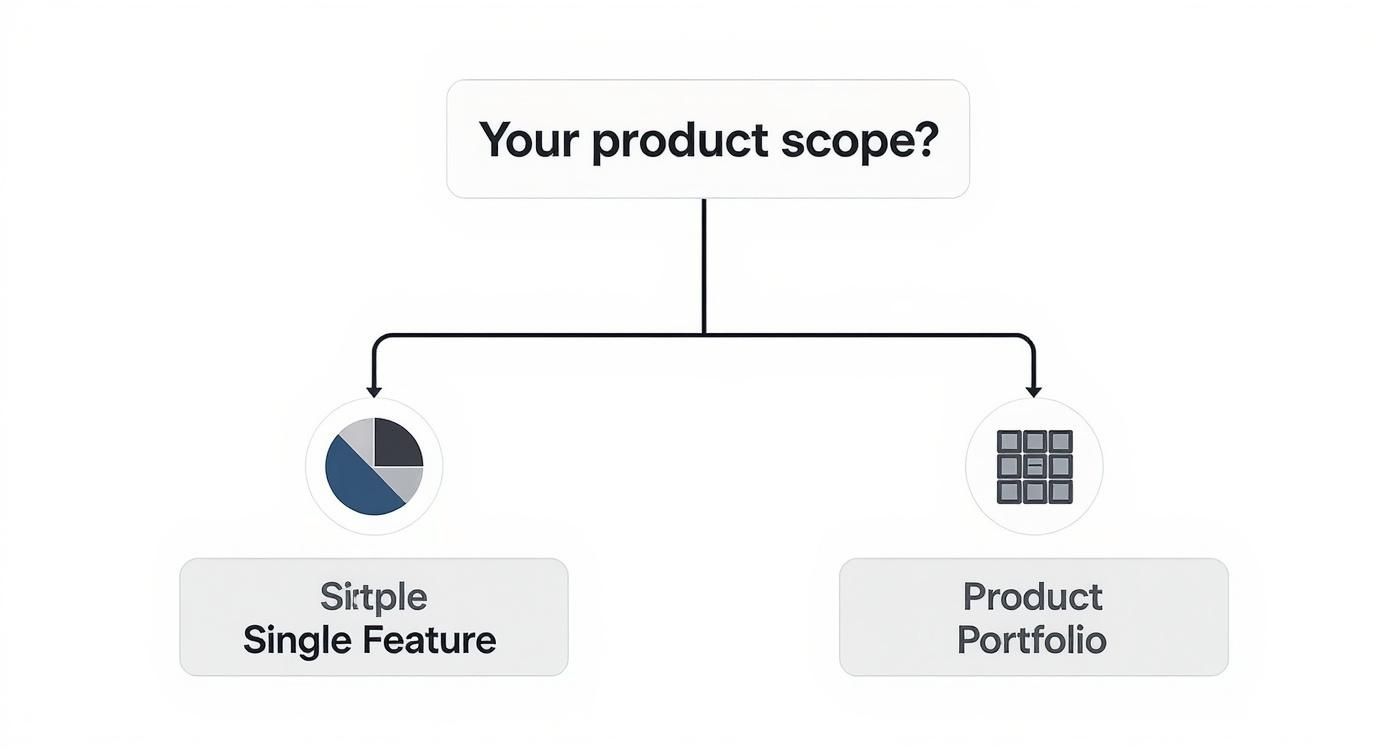
The key takeaway is that decisions for a single product are fundamentally different from managing a diverse portfolio. They simply require different tools.
To make this more concrete, here's a quick cheat sheet to help you stack your frameworks based on your immediate goals.
Your Product Strategy Framework Decision Matrix
| Scenario / Goal | Recommended Primary Framework | Recommended Secondary Framework | Key Considerations |
|---|---|---|---|
| Discovering a new product idea | Jobs-to-be-Done (JTBD) | SWOT Analysis | Focus on deep customer needs, not features. Understand the competitive terrain before you start building. |
| Aligning teams on quarterly goals | OKRs (Objectives and Key Results) | Kanban or Scrum | OKRs set the "what" and "why." Agile methods manage the "how" and "when." Don't confuse them. |
| Prioritizing a crowded feature backlog | RICE Scoring | Kano Model | Use RICE for data-driven ranking, but use Kano to ensure you have a healthy mix of basic, performance, and delight features. |
| Improving user experience on a mature product | HEART Framework | A/B Testing | HEART tells you where to look for problems (e.g., low adoption). A/B testing helps you validate solutions. |
| Deciding market entry strategy | Ansoff Matrix | PEST Analysis | Use Ansoff to map out growth options (e.g., new market vs. new product). Use PEST to vet the viability of that new market. |
| Allocating budget across a product portfolio | BCG Matrix | Financial Modeling | The BCG Matrix gives you the strategic buckets (Invest, Hold, Harvest). Financial models provide the hard numbers to back it up. |
This matrix isn't rigid, but it's a solid starting point for making more intentional choices instead of just grabbing the framework you know best.
Getting Buy-In and Dodging the Traps
Trying to roll out a new framework can feel like an uphill battle. Your engineering lead might see it as more process getting in the way of coding. Your head of sales might worry it'll slow down their pet feature requests.
Your job is to sell it not as a new bureaucratic hoop to jump through, but as a better way to make decisions together. It's about creating clarity, not building spreadsheets.
Pro Tip: Never introduce a framework in a big, all-hands meeting. That’s a recipe for resistance. Start small. Use it privately to organize your own thoughts first. Then, try it out with a single trusted engineer or designer on one small decision. When they see how much clarity it brings, organic adoption will start to happen.
Finally, watch out for these common pitfalls that can turn a helpful tool into a pointless exercise:
- Analysis Paralysis: The framework is there to help you make a decision, not to become the work itself. Don't let endless analysis delay a choice that needs to be made.
- Treating Scores as Gospel: A RICE score isn't a final verdict handed down from on high. It's an input designed to kickstart a conversation, not replace your team's critical thinking and gut instinct.
- Forgetting the "Why": Always, always tie your framework back to the customer problem or the business goal. If you can't draw a straight line from your Kano analysis back to a user need, you're just going through the motions.
A Few Common Questions I Get Asked
Once you start trying to use these frameworks in the wild, the rubber meets the road. Theory is clean, but reality is messy. You’ll run into team dynamics, shifting priorities, and a healthy dose of skepticism. It’s totally normal.
Here are the most common questions I hear from the PMs I mentor, along with my straight-up answers.
How Often Should I Revisit My Product Strategy?
Your product strategy is a living document, not a stone tablet. The right rhythm for revisiting it really depends on where your company is at and how chaotic your market is.
- Early-Stage Startups: You should be checking in on your strategy almost constantly. I’d recommend a formal review at least monthly. Your main job is to learn as fast as possible, and your strategy needs to evolve with every new piece of customer feedback you get.
- Scale-Ups and Mature Companies: A quarterly strategy review hits the sweet spot. This lines up nicely with most OKR cycles and lets you make course corrections without giving the engineering team whiplash. It’s also smart to do a much deeper dive once a year for long-range planning.
But listen, regardless of your regular schedule, a major market event—like a new competitor launching a killer feature or a technology like GPT-4 dropping—should trigger an immediate strategy review. Don't wait for the calendar invite.
How Do I Introduce a New Framework to a Skeptical Team?
Whatever you do, don't walk in and announce, "Hey everyone, this is the new process we're all following now." That’s a surefire way to get instant eye-rolls and resistance.
Instead, frame it as a small experiment to solve a specific pain point everyone is feeling.
Try something like this: "I've noticed we’ve been struggling to agree on what to build next, and our meetings feel like they're more about opinions than data. I came across a simple scoring method called RICE that might help. What if we try it out on just these next two features and see if it brings more clarity?"
When you start small and prove the value on a real, current problem, you let the framework sell itself. You’ll win over one engineer or designer at a time until, eventually, it just becomes part of how the team works. It feels organic, not forced.
Can I Combine Different Product Strategy Frameworks?
Absolutely. In fact, you should. The best PMs I know don't just stick to one framework; they build a hybrid "stack" that’s perfectly suited to their product and team. Relying on a single framework is like a carpenter deciding to only use a hammer—you're just limiting yourself.
The real skill isn’t in mastering one framework, but in knowing how to blend them. You might use JTBD to nail the customer's 'why,' then use RICE to prioritize the 'what,' all while using OKRs to track if any of it is actually working. That’s a powerful, multi-layered approach.
For example, you could use the Kano Model to make sure your backlog has a healthy mix of must-haves and surprise-and-delight features, but then pull out RICE to figure out the exact order you'll build them in this quarter.
How Do I Balance Quantitative and Qualitative Insights?
This is where the art of product management really comes in. Frameworks like RICE are fantastic for bringing some much-needed quantitative discipline to your decisions, but they are not a substitute for your judgment. The numbers are just one input into a bigger conversation, not the final word.
Your RICE score might point to Feature A as the clear winner. But maybe your last five user research calls (your qualitative data) uncovered a deep, emotional pain point that only Feature B can solve. In that situation, you might make the call to build Feature B, even with its lower score.
The trick is to document your thinking. In your product spec, you can write something like: "While Feature B has a lower RICE score, our qualitative interviews show it addresses a critical trust and safety concern for our highest-value users, making it a strategic priority." This shows you're using both sides of your brain to make a smart, well-rounded decision.
Ready to move from a feature manager to a true product strategist? In my newsletter, Aakash Gupta shares actionable insights on growth, management, and career advancement used by leaders at top tech companies. Join the community to get the frameworks and mental models you need to accelerate your career.
