Maintenance work was killing me.

Based on Miro’s latest research, I wasn’t alone. People spend 3 hours on maintenance for every 1 hour of creative work. 83% tackle their most important work outside business hours.
That’s insane.
Here’s the tactical breakdown I promised, mixing the mindset shifts that actually work with the tools that amplify them:
Tactic 1: Master the Art of Strategic NO
This isn’t about being difficult. It’s about protecting your creative capacity.
Before saying yes to anything, I ask: “Does this move the needle or just keep the lights on?”
I’ve created what I call a “maintenance audit” where I literally track what percentage of my week goes to upkeep versus creation. It’s embarrassing at first. Last month I was at 70% maintenance, 30% creative. This month I’m flipping that ratio.
When someone asks me for something now, I respond with: “Happy to help. Here’s what I’d need to drop to fit this in…” You’d be amazed how often people suddenly realize their request isn’t that urgent.
Real example: Instead of responding to Slack immediately (my old addiction), I have three designated times: 9am, 1pm, 4pm. Everything else waits. The world doesn’t end. In fact, most “urgent” things resolve themselves in those 2-4 hour windows.
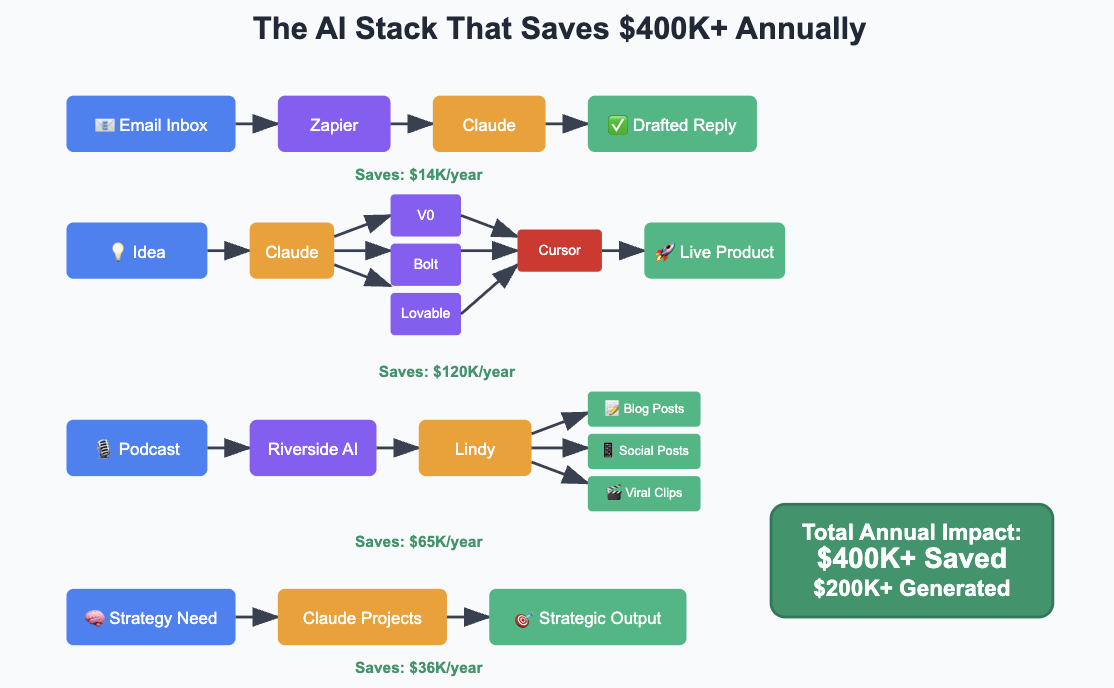
But here’s where it gets interesting. I use Zapier + Claude to handle the email volume that comes with saying no more strategically. Zapier checks my inbox every 2 minutes. Claude categorizes emails into buckets like purchasing power parity requests, podcast pitches, sponsorship inquiries, or general stuff. Each category gets a different system prompt.
The real magic? Zapier’s co-pilot builds the branching logic for me. I just say “add another filter for newsletter partnership requests” and it creates the workflow. It’s like having an assistant train another assistant.
Cost: $20/month for Zapier, maybe $10 for Anthropic credits. This replaces what used to be a $1,200/month VA. That’s $14,000 in annual savings just from being more strategic about email.
Tactic 2: Timeboxing Like Your Life Depends On It
Time expands to fill the space you give it. I don’t give it much space.
Every single task gets a timer. I use the Be Focused app, but any timer works. Phone goes in another room during focus blocks. Not on silent. In another room. The friction of walking to check it usually breaks the impulse.
Notifications stay off from 9-11am and 2-4pm. These are my sacred focus windows. I hold “office hours” for quick questions from 11:30am-12pm daily. People adapt faster than you think.
Here’s the thing though – when I do need to build something, I don’t hire out anymore. I’ve developed this parallel prototyping workflow that’s honestly changed everything.
I start with Claude to engineer the perfect prompt. Not just “build me an invoice app” but detailed specifications about features, design system, user flow. Then I feed that exact prompt into V0, Lovable, AND Bolt simultaneously. It’s like getting three different architects to bid on the same house.
V0 usually wins on speed. Bolt is sometimes more creative. Lovable handles complex interactions better. I pick the winner and export the code to Cursor.
Last week I built a $3/month invoice generator in 30 minutes. The same thing would have cost me $5,000 on Upwork and taken two weeks minimum. I’m saving over $120,000 annually just in avoided developer costs.
The breakthrough isn’t the individual tools. It’s the workflow of parallel creation plus rapid iteration.
Tactic 3: Surface Issues, Don’t Suffer in Silence
I used to grind through problems thinking that’s what good leaders do. Turns out, good leaders make problems visible so teams can solve them together.
Now I run weekly “friction audits” with my team. Simple question: what slowed us down this week? We keep a shared document called “stupid stuff we keep doing” (yes, that’s the actual title).
We also hold 15-minute weekly team huddles focused only on removing obstacles. Not status updates. Not new initiatives. Just: what’s in our way and how do we remove it?
The real game-changer is turning every friction point into content. I use Lindy for this. Meeting notes automatically become blog posts. Team insights transform into LinkedIn posts. Podcast conversations convert into newsletter content.
Example: We discovered everyone was duplicating client research. Frustrating, right? But that insight became a viral LinkedIn post about team inefficiency that got 50,000 views. The problem became the product.
Lindy costs me $50/month. A marketing team would cost $3,400/month. I’m saving $40,000 annually while actually getting better content because it’s based on real problems.
The pattern here is important: surface the problem, systematize the solution, scale through automation.
Tactic 4: Do Less, But Better
This is the hardest tactic because it feels counterintuitive. We’re trained to think busy equals productive.
I stopped attending meetings where I’m not making decisions. I stopped perfectinng deliverables that are already good enough. I stopped saying “let me think about it” when I mean no.
Instead, I doubled down on deep work blocks. 2-4 hours of uninterrupted focus time. High-impact projects that actually move the business forward. Content that drives real results instead of vanity metrics.
When I do create content now, everything’s changed because of Veo3. I use Gemini 2.5 Pro to craft the perfect video prompts. Generate 5 different concepts simultaneously. Pick the winner and iterate scene by scene.
Cost: $20/month versus $10,000 per professionally produced ad. I’ve created viral shorts that outperformed $50,000 agency productions. The quality difference is getting scary narrow.
But the real insight is this: doing less doesn’t mean being lazy. It means being ruthless about what deserves your attention.
Tactic 5: Automate the Automation
This is where it gets fun. I’ve built workflows that build workflows.
My n8n setup includes a Project Health Monitor that checks status across all my tools and flags delays before they become emergencies. A Content Pipeline that takes my voice notes, transcribes them, and organizes everything by project. A Meeting Prep Bot that pulls relevant documents, previous notes, and agenda items 30 minutes before any call.
For podcasting specifically, everything runs through Riverside now. What used to take me 4 hours to edit now takes 10 minutes. Their Magic Audio feature replaced my $2,000/month audio engineer. Auto-clip generation saves me another $1,500/month on editing.
Total podcast production: $5,500/month reduced to $49/month. That’s $65,000 in annual savings.
But here’s what nobody talks about: the revenue side. These tools didn’t just save me money. They enabled revenue streams I couldn’t have managed before. My podcast now generates $18,000/month because I can actually focus on content and guests instead of production logistics.
Tactic 6: Build Your Strategic Brain
This is how everything connects. I use Claude Projects as my “Podcast Co-pilot” that handles guest research, interview prep, title optimization, and cold outreach.
The setup process matters. I feed Claude specific context: 45K Spotify subscribers, 261K LinkedIn followers, what topics perform best, which guests have the highest engagement. Then I let Claude improve its own instructions. Seriously. I ask it to write better prompts for itself.
I also add competitor analysis. What makes Lenny’s podcast work? How does Lex Fridman structure interviews? What can I learn from Dwar’s approach? Claude synthesizes patterns across successful shows.
This setup replaces three roles: podcast strategist ($1,000/month), guest booking service ($1,000/month), and research prep ($1,000/month).
But the real value isn’t cost savings. It’s the quality of output. Cold messages that actually book A-list guests. Research that goes three layers deep. Interview questions that create viral moments.
The Reality Check
None of this happened overnight. It took me 3 months to see real results. I still slip back into old patterns sometimes. Last Tuesday I found myself answering emails at 9pm like the old days.
But here’s what’s different now: I actually finish creative projects. I have energy for work that matters. I usually wrap up by 6pm. I’ve saved over $400,000 annually and generated $200,000+ in new revenue.
The maintenance work still exists. It always will. But now it’s contained, automated, or eliminated entirely.
Your Next Move
Don’t try to implement everything at once. That’s just another form of maintenance work.
Pick ONE tactic from this guide. Implement it this week. Email automation is the easiest win. Timeboxing plus one tool is manageable for week two. Then automate your biggest time drain in week three.
The goal isn’t efficiency for its own sake. It’s reclaiming your creativity. Getting back to work that actually moves the needle.
Want the complete technical setup? I break down every tool and configuration in my AI tools breakdown and AI PM course.
What’s the biggest time drain in your workflow right now? Let’s tackle it.

One reply on “Reclaim Creative Time: Eliminate Busywork & Stop Working Late”
[…] Related: cutting the actual busywork out of a PM’s week. […]