Landing a remote product manager job isn’t just about tweaking your resume. It’s about proving you can drive business outcomes without a shared office. As a hiring manager at companies like Google and startups, I’m looking for PMs who are already wired to thrive in an asynchronous, high-trust environment. The market is competitive, but the rewards are significant—think six-figure salaries and the freedom to work from anywhere.
This guide provides a step-by-step framework you can use today to position yourself for top-tier remote PM roles. We’ll cover salary benchmarks, resume optimization, interview tactics, and a 90-day onboarding plan you can steal.
The Landscape of Remote Product Management Roles
Before you jump into the job boards, it’s crucial to understand the market dynamics. Demand for remote product leaders has exploded, but companies have become far more selective. They aren't just filling a seat; they’re hiring PMs who can operate autonomously across time zones and drive results with a distributed team.
This isn't a pandemic leftover; it's a strategic shift. Companies from early-stage startups to giants like Spotify and Dropbox leverage a remote-first model to access a global talent pool. This competition for top-tier talent is precisely why compensation packages are so compelling.
US Salary Benchmarks: A Competitive Edge
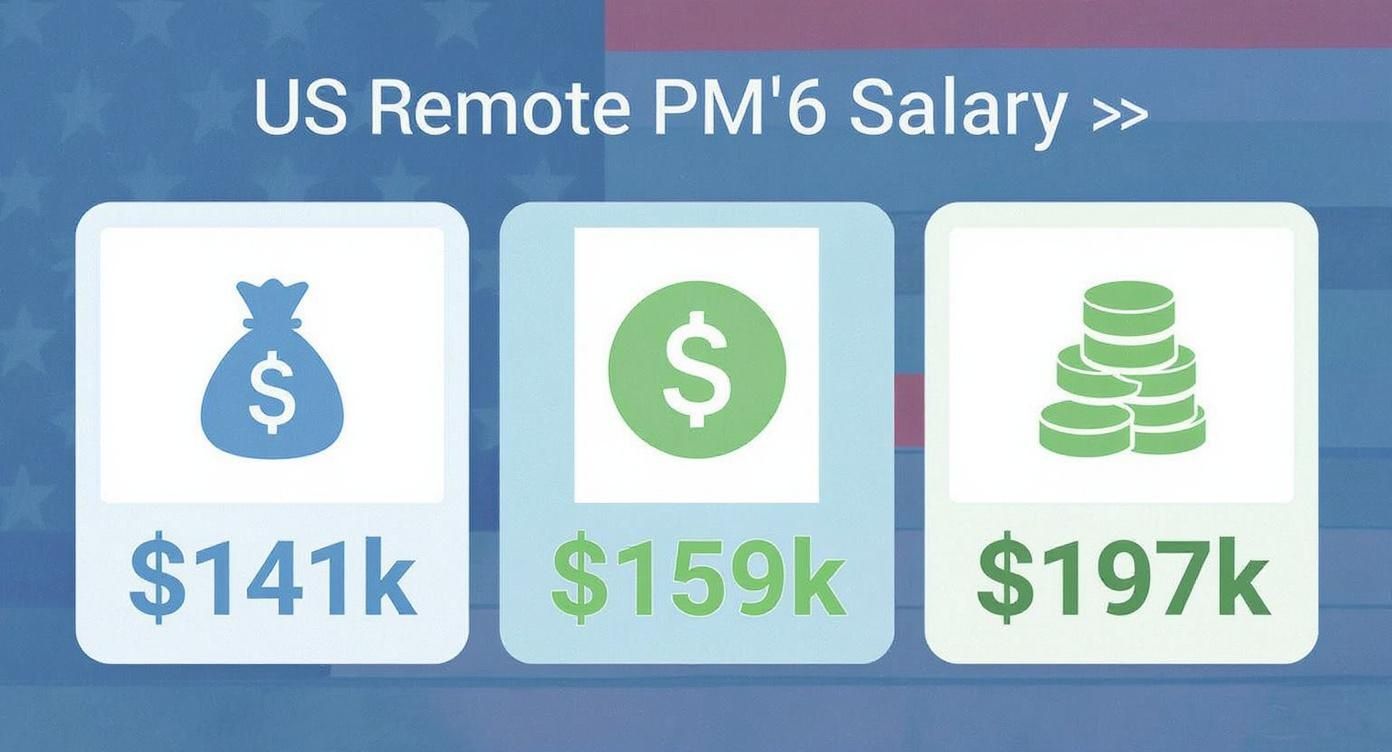
Let's talk numbers. The salary landscape for remote product managers in the United States is robust. Median annual salaries consistently exceed $150,000. As of mid-2024, the average base salary for a Remote Product Manager is $159,405, with a typical range falling between $141,000 (25th percentile) and $197,000 (75th percentile).
That $56,000 delta between salary bands tells a clear story: your specific experience, niche skills (e.g., AI/ML, fintech), and negotiation strategy are massive value drivers. You can explore the full salary data on ZipRecruiter for a granular view.
Remote PM Salary Benchmark: US Market
This table breaks down compensation ranges for remote product managers in the US, providing a clear view of potential earnings based on performance and experience.
| Percentile | Annual Salary | Key Differentiator |
|---|---|---|
| 90th | $214,500 | Top-tier talent, specialized expertise (e.g., AI PM) |
| 75th | $197,000 | Senior roles, high-impact project leadership |
| 50th (Median) | $159,405 | Mid-level experience, proven track record |
| 25th | $141,000 | Aspiring or entry-level, strong potential |
Even at the 25th percentile, the compensation is strong. But for senior PMs with a track record of shipping impactful products, total compensation can push well past $200,000 when you factor in equity and bonuses.
Key Industries and Regional Hotspots
While the pay is attractive, opportunities are concentrated in specific sectors that are ahead of the curve in remote hiring.
- SaaS & Enterprise Software: Companies like GitLab and Atlassian are often remote-native or remote-first, making them prime targets.
- Fintech: The rapid pace of innovation at companies like Stripe and Brex has created a huge need for PMs who can manage complex products from anywhere.
- Healthtech: The digital health boom continues, creating a steady stream of remote PM roles at companies focused on telehealth and digital therapeutics.
From my experience as a leader, the highest demand is for remote PMs with deep domain expertise in one of these high-growth sectors. If you can specialize in something like B2B SaaS or AI-driven fintech, you immediately become a much more compelling candidate than a generalist.
Regionally, the US remains a primary hotspot, but the European Economic Area (EEA) has seen a massive increase in remote PM listings. This shift reflects the new nature of work, a trend you can explore by reading about Packy McCormick, the face of post-COVID careers.
Understanding these industry and geographic trends is the first step to strategically positioning yourself for success.
Building Your Remote-Ready Professional Brand

When you apply for remote product manager jobs, your digital footprint—your resume and LinkedIn profile—is your opening pitch. Remote-first companies like GitLab and Zapier don't just scan for keywords; they actively look for evidence that you can drive projects, influence stakeholders, and communicate with clarity in a distributed setting.
Optimizing Your Resume With A Remote-First STAR Method
The classic STAR method (Situation, Task, Action, Result) is still the gold standard for resume bullet points, but you must infuse it with remote-specific context. For every accomplishment, ask yourself how you achieved it without a shared office.
Here's a concrete example of how to frame an achievement for a remote role:
- Situation: Managed a cross-functional team across North America, Europe, and Asia to launch a new mobile feature.
- Task: Achieve roadmap alignment and secure leadership buy-in without a single in-person meeting.
- Action: Implemented a documentation-first approach in Notion and used asynchronous Loom video updates for status reporting, reducing meeting time by 40%.
- Result: Launched the feature on schedule, driving a 15% increase in user engagement in the first quarter.
These details prove to hiring managers that you are fluent in the workflows of a high-performing distributed team. For more examples, review this battle-tested product manager resume template.
Using AI To Sharpen Your Professional Narrative
AI tools like ChatGPT can be powerful for refining your messaging, but only if you provide specific, context-rich prompts. Start with your LinkedIn summary—it's the first thing recruiters read.
Pro Tip: Treat your summary as the abstract of your career, highlighting 2-3 key achievements that demonstrate remote work competencies.
Here is a specific prompt you can use to generate a strong first draft:
Act as a VP of Product at a remote-first SaaS company like Figma. I am a Product Manager with 5 years of experience in [Your Industry, e.g., B2B Fintech]. My top 3 achievements are:
1. [Your Achievement 1 with metrics]
2. [Your Achievement 2 with metrics]
3. [Your Achievement 3 with metrics]
Write a 150-word LinkedIn "About" section for me. Emphasize my skills in asynchronous communication, cross-functional collaboration with distributed teams (engineering in Eastern Europe, design in the US), and data-driven decision-making. Mention my proficiency with tools like Notion, Loom, and Miro. The tone should be authoritative but collaborative.
Use the AI's output as your starting point, then refine it to match your authentic voice.
Finally, demonstrate your commitment to continuous learning. Referencing insights from leading product podcasts in conversations or on your profile signals to employers that you’re not just a candidate—you’re an evolving product professional ready for a distributed role.
How to Find and Target High-Quality Remote Jobs
Stop wasting hours on generic job boards. As a hiring manager, I can tell you that the best remote product manager jobs are rarely found on massive aggregators. High-quality opportunities are on niche platforms where serious remote-first companies find talent.
The screenshot from FlexJobs illustrates a key principle: curated environments filter out the noise. Your job search should be a targeted campaign, not a volume game.
Niche Job Boards and Communities for Remote PMs
Focus your energy on platforms where remote-native companies like GitLab, Doist, and Zapier actively recruit.
- We Work Remotely: A premier board for remote-only listings from established tech companies.
- Remotive: Features a curated job board and an active Slack community, often with roles at fast-growing SaaS and fintech startups.
- Wellfound (formerly AngelList): The undisputed hub for startup roles. If you want to join an early-stage company with significant equity potential, start here.
Beyond job boards, embed yourself in the communities where product leaders and hiring managers gather. Slack groups like "Mind the Product" and "Product Collective" are goldmines for networking and discovering roles that are never publicly posted.
Advanced Search and Proactive Targeting
Move beyond simple keyword searches. Use Boolean operators to pinpoint roles that match your specific expertise.
Actionable Search Strings:
- For a senior role:
("Senior Product Manager" OR "Product Lead") AND ("B2B" OR "SaaS") AND "remote" - For a fintech role:
"Product Manager" AND "fintech" AND ("fully remote" OR "distributed team")
This level of precision filters out irrelevant roles, allowing you to invest your energy in applications where you are a high-conviction candidate.
The single most effective strategy I've seen is proactive outreach. Identify 10-15 remote-first companies you genuinely admire, follow their product leaders on LinkedIn, and start engaging with their content. When a role finally opens up, you're not just another random applicant—you're a familiar name who has already shown real interest.
Tapping Into Global Remote Job Markets
While the US is a massive market, don't overlook emerging global hotspots. The European Economic Area (EEA), for instance, has seen explosive growth.
As of April 2025, remote listings constituted 28% of all PM jobs in the EEA—the highest proportion globally. That's a staggering 111% increase from just six months prior, while hybrid roles declined by 17%. While most of these roles are mid-level (72%), this trend highlights a significant opportunity. You can dive deeper into the European PM job market on Recruited.tech.
As you explore different ways to find and target these jobs, it helps to use every tool at your disposal. You might even find some useful tips on using your phone for your career search in this guide on making your iPhone a business and job platform. By combining targeted searches, proactive networking, and a sharp eye on global trends, you put yourself in the best possible position to land a great opportunity.
Acing the Remote Product Manager Interview
The remote interview process is a different beast. When I’m hiring for a distributed team, I’m not just evaluating your product sense; I’m stress-testing your ability to communicate, build trust, and drive influence through a screen. Every interaction is a proxy for how you’ll perform in the role.
Your camera is the window into your professional world. A messy background or unstable internet signals a lack of preparation—a major red flag for a role that demands autonomy.
Your Pre-Flight Tech Checklist
This is non-negotiable. Run through this checklist 15 minutes before every call.
- Lighting: Position a light source (window or ring light) in front of you.
- Audio: Use a dedicated microphone or quality headset. Test it with a friend.
- Camera Angle: Place your camera at eye level to create a direct connection.
- Internet: Test your speed and have a mobile hotspot as a backup.
- Background: Use a clean, professional, real background. Virtual backgrounds are distracting and often glitchy.
Decoding Remote-Specific Behavioral Questions
Hiring managers for remote product manager jobs are looking for specific signals of autonomy, proactive communication, and asynchronous leadership.
Expect questions designed to probe these capabilities. A remote-first interviewer won't ask, "Tell me about a time you had a conflict." They'll ask:
"Describe a situation where you had to gain alignment from a distributed team across multiple time zones on a contentious roadmap decision. How did you use asynchronous tools to facilitate the discussion and document the outcome?"
This question tests stakeholder management, async collaboration fluency (with tools like Loom, Slack, or Notion), and your ability to drive decisions without meetings.
A Model Answer Framework
Your response must be a specific, structured story, not a generic platitude.
- Acknowledge the Challenge: "Aligning our engineering team in Kyiv with marketing in San Francisco on a last-minute feature pivot was tough, especially since live meetings were impossible."
- Detail Your Asynchronous Strategy: "I drafted a detailed proposal in Notion, outlining the data, trade-offs, and a clear recommendation. I then recorded a 5-minute Loom video walking through the document to provide context and tone."
- Showcase Proactive Communication: "I shared it in our team's Slack channel, tagging key stakeholders and setting a 24-hour deadline for feedback. I actively managed the thread, responding to questions to keep momentum."
- Highlight the Outcome and Documentation: "We reached a consensus within 48 hours. I updated the Notion doc with the final decision and rationale, creating a permanent source of truth for everyone."
This framework proves you have a repeatable system for remote collaboration. For more structured advice, our collection of product manager interview tips offers deeper frameworks.
Conquering the Take-Home Assignment
The take-home assignment is your chance to demonstrate how you work remotely. Don't just submit the final deck. Document your entire process in a shared tool like Google Docs or Notion. Show your thought process, your assumptions, and your communication plan. This transforms a simple task into a powerful simulation of your remote work habits.
Negotiating Your Offer and Planning Your First 90 Days
You received an offer for a remote product manager job. This is a critical moment. How you handle the negotiation and onboarding plan sets the tone for your entire tenure.
As a hiring manager, a candidate who presents a data-backed negotiation and a proactive onboarding plan immediately signals foresight and ownership—two non-negotiable traits for any successful remote PM.
Securing a Top-Tier Remote Compensation Package
Negotiating a remote offer is about total compensation, not just base salary. You're building a package that supports a high-performance, distributed work life.
- Anchor to National Benchmarks: Your salary should be based on national data for remote PM roles, not your local cost of living. Start your research at the 75th percentile for your experience level and build your case from there.
- Quantify Non-Salary Perks: A $1,500 home office stipend, a $200 monthly wellness allowance, and a $100 internet reimbursement add up to over $5,000 in tax-free value annually. Factor this into your total compensation analysis.
- Leverage Equity: For startups, ask for the total number of shares outstanding to calculate your ownership percentage. A small bump in equity can be worth far more than a minor salary increase over the long term.
When a candidate presents a thoughtful, data-supported counteroffer, it signals they are a strategic thinker who understands their market value. It's a sign of confidence, not entitlement.
Justifying Your Value with a Data-Driven Script
When asked for your salary expectations, provide a well-reasoned range, not a single number.
Here’s a script you can adapt:
"Thank you for the offer; I'm incredibly excited about the opportunity. Based on my research into national averages for senior remote product manager roles with expertise in B2B SaaS, a competitive total compensation package would be in the $185,000 to $200,000 range. Given my track record of increasing user retention by 15% in my previous role and my deep experience leading distributed teams, I believe my value aligns with the upper end of that range. I'm also interested in learning more about the home office and professional development stipends to ensure I can be successful in this role."
This script anchors the conversation high, justifies it with data and past results, and opens the door to discussing the full benefits package.
Architecting Your Remote 30-60-90 Day Plan
Presenting a 30-60-90 day plan after accepting the offer but before day one is a power move. It shows you’re already thinking about delivering value. In a remote world, this proactive approach is priceless.
The FlexJobs Remote Work Economy Index recently noted that while remote job postings saw a slight dip, opportunities in technical fields are climbing, and 66% of remote jobs target experienced professionals. The competition is fierce. A strong onboarding plan is a key differentiator.
This framework focuses on three pillars: learning, connecting, and delivering.
Remote PM 30-60-90 Day Onboarding Plan
| Phase | Key Focus Areas | Success Metrics |
|---|---|---|
| First 30 Days | Learn & Connect: Schedule 1:1s with all key stakeholders (Eng, Design, Marketing). Deep dive into product docs, analytics, and customer feedback. Master the team's communication norms. | – Met with 10+ key stakeholders. – Can articulate the product's core value prop and key metrics. – Actively contributing in team Slack channels. |
| Days 31-60 | Align & Contribute: Identify and ship a small, early win (e.g., a process improvement, a minor feature). Present initial observations and a draft roadmap proposal to your manager. | – Shipped one small feature or process improvement. – Presented a data-backed product insight to the team. – Received positive feedback on collaboration style. |
| Days 61-90 | Own & Deliver: Take full ownership of your product area. Finalize and gain alignment on the next quarter's roadmap. Establish a clear cadence for team communication and reporting. | – Secured roadmap buy-in from key stakeholders. – Established clear success metrics for your first major initiative. – Recognized as the go-to person for your product area. |
By strategically negotiating your offer and presenting a proactive plan, you arrive not just as a new hire, but as a product leader ready to make an immediate impact.
Common Questions About Remote Product Manager Jobs
Making the leap to a fully remote PM role brings up critical questions. As someone who's hired and managed distributed PMs for years, I’ve heard them all. Here are direct answers to the most common concerns.
How Can I Get a Remote PM Job with No Prior Remote Experience?
This is a common hurdle, but it's solvable. You must reframe your existing experience to highlight "remote-ready" skills like autonomy and asynchronous communication.
Go through your resume and identify projects you drove with minimal supervision. Frame your accomplishments to emphasize this. Instead of "Led a project," write: "Independently drove a six-month project from kickoff to launch, coordinating a cross-functional team entirely through detailed Confluence docs and asynchronous Slack updates, resulting in an on-time release."
In interviews, proactively explain how you use tools like Jira, Slack, or Asana to maintain alignment without constant meetings. This demonstrates you already operate with a remote-first mindset.
What Are the Biggest Red Flags in a Remote Job Posting?
Not all remote jobs are created equal. Be vigilant for these red flags:
- Vague Job Description: If it lacks detail on the product, team structure, or core responsibilities, it suggests a lack of clarity and strategy for the role.
- Rigid Online Hours: A true remote-first culture values asynchronous work and output, not just being "online." A requirement to be logged in from 9 AM to 5 PM often signals a micromanagement culture disguised as remote work.
- Lack of Remote-Specific Benefits: Companies serious about supporting distributed teams offer perks like a home office stipend, an equipment budget, and a wellness allowance. If these are missing, the company may not be fully invested in the remote model.
Are Remote PM Salaries Lower in Low Cost of Living Areas?
It depends entirely on the company's compensation philosophy. There is no single industry standard, so you must clarify this early in the process.
Some companies, like GitLab, use a location-based pay model that adjusts salary based on a cost-of-living index.
Conversely, an increasing number of companies, including Reddit and Spotify, have adopted location-agnostic pay, offering the same salary for the same role regardless of location (within a specific country).
Your strategy should be to anchor your salary negotiation to the national average for remote product manager jobs, grounding your value in the role itself, not your zip code.
Which Tools Are Essential for a Remote Product Manager?
Beyond standard PM tools like Jira, mastery of the asynchronous collaboration stack is what separates great remote PMs from the rest.
- Communication Hubs: Deep proficiency in Slack, including workflows, huddles, and channel integrations.
- Video Messaging: Fluency in Loom for recording product demos, providing design feedback, and sharing complex ideas without scheduling a meeting.
- Virtual Whiteboards: The ability to lead effective brainstorming, planning, and retro sessions in Miro or FigJam is non-negotiable.
- Documentation Platforms: Expertise in building a single source of truth in tools like Notion or Coda is a remote PM superpower.
When a hiring manager sees you are fluent in this modern stack, they have confidence that you possess the operational skills to thrive in a distributed team.
Ready to accelerate your product career? Aakash Gupta provides in-depth analysis, frameworks, and career advice to a community of over 100,000 product builders. Subscribe to the newsletter and podcast for insights from one of the leading voices in product management. Join us at https://www.aakashg.com.
