A powerful product strategy isn't a slide deck you present once a quarter. It's a living system for making smart, fast decisions that aligns your entire organization. For a Product Manager, this is your primary tool for securing resources, influencing stakeholders, and driving outcomes that matter. It's what separates top-tier PMs who get promoted from those stuck executing someone else's vision.
This guide provides three battle-tested sample product strategy documents that you can adapt and use immediately. We'll cover an early-stage AI startup, a growth-stage consumer app, and an enterprise platform expansion—real scenarios you will face in your career.
The Strategic Framework Elite PMs Use to Win
Before we jump into sample strategies, you need to understand the foundational framework that top-tier PMs at places like Google, Meta, and OpenAI swear by. This isn't about listing features on a timeline. It's about building a compelling, data-backed narrative that connects every engineering cycle to a clear business objective. Without this structure, even the most brilliant ideas fizzle out.
The consequences of a weak strategy are brutal. Research shows that 23% of product development investments fail outright because of fuzzy company strategies. That's a massive waste of time, money, and engineering talent. For an aspiring PM, a portfolio project demonstrating this framework is a huge differentiator. For a Senior PM, mastering it is table stakes for career progression.
Mastering strategic planning—and the modern tools that enable it, like Aha! or Productboard—is a massive career accelerator. Data shows that teams with a consistent strategic process can launch new products up to 30% faster. That's a metric that gets executives to listen and allocate budget.
The Five Core Components of a Winning Strategy
A winning product strategy is built on five pillars. Each one answers a fundamental question, guiding your team from a 30,000-foot vision down to a daily stand-up. Skipping one creates a fatal blind spot in your plan.
Here's a simple way to visualize the flow that top PMs follow, moving from the big picture down to the specific, tactical work.
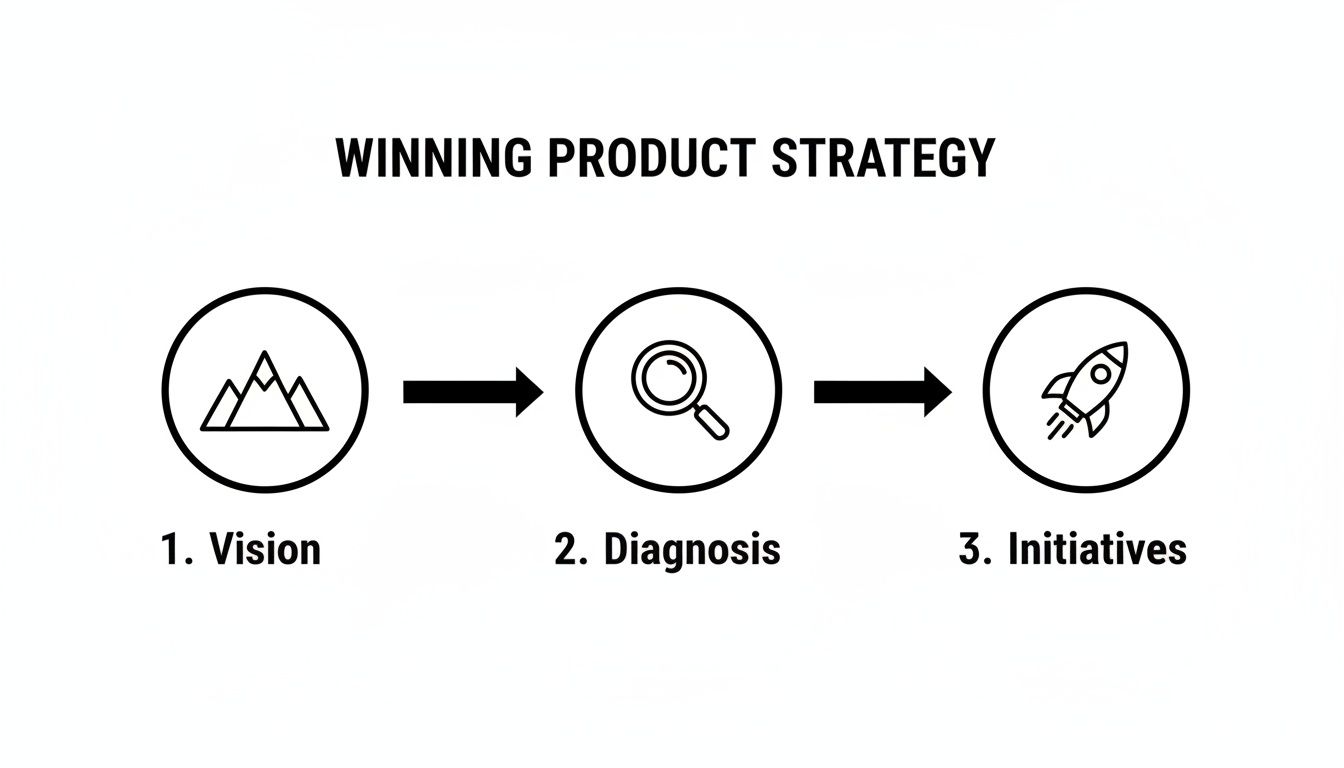
This diagram gets one thing absolutely right: a strong diagnosis of market reality is the bridge between an inspiring vision and the concrete initiatives that actually get results.
Below is a quick-reference table breaking down these five essential pillars. Use this as a checklist for building your own strategy.
Core Components of a Winning Product Strategy
| Component | Key Question It Answers | Example KPI for a Senior PM |
|---|---|---|
| Product Vision | Why does this product need to exist? | Customer Lifetime Value (LTV) |
| Guiding Principles | How will we make decisions along the way? | Team Alignment Score (Survey) |
| Market Diagnosis | What challenge or opportunity are we tackling? | Market Share Growth (%) |
| Strategic Initiatives | What are our big bets to achieve the vision? | New Market Penetration (%) |
| Actionable Roadmap | What are we building and when? | Velocity or Cycle Time |
This table maps out how you connect the high-level "why" to the measurable "what."
- Product Vision: Your North Star—the ultimate purpose and impact you're aiming for. It must be ambitious, inspiring, and focused on the long term. A great vision answers: Why does this product need to exist?
- Guiding Principles: The guardrails for your decision-making. A small set of memorable rules that help your team make consistent choices without micromanagement. Examples: "Simplicity over feature-bloat" or "Privacy by design."
- Market Diagnosis: Your unfiltered, honest assessment of the world. It involves a deep dive into customer problems (quantified with data), competitive threats (supported by analysis), tech trends (especially AI), and internal weaknesses. It answers: What is the core challenge or opportunity we're really going after?
- Strategic Initiatives: The big, thematic bets you'll make to realize your vision. Not just features, but focused efforts like "Win the SMB market" or "Build a self-service onboarding flow powered by AI."
- Actionable Roadmap: Where the rubber meets the road. The sequence of features, epics, and releases that bring your strategic initiatives to life, translating the 'what' and 'why' into the 'how' and 'when'.
As a hiring manager for PMs, the most common failure I see is candidates jumping directly to the roadmap without a coherent vision and diagnosis. This creates a "feature factory"—shipping a ton of stuff that doesn't move the needle on key business metrics. This is a red flag in any interview.
By building your strategy on this five-part foundation, you create a powerful tool for alignment and execution. To see how these components fit together in a broader context, you can learn more about this powerful product strategy framework.
Sample Strategy for an Early-Stage AI SaaS Startup
Let's get practical. Imagine you’re the first PM at a seed-stage B2B startup building an AI analytics tool. Your market is filled with clunky, legacy software. This is the strategy doc you'd create to align your co-founders, inspire your first engineers, and walk into investor meetings with a compelling narrative.
The big idea? An AI tool that doesn't just show charts—it automatically generates insights. Before writing a line of code, you must how to validate a startup idea. Once validated, this strategy is your playbook.

Vision and Market Diagnosis
First, you need a compelling, long-term vision—your North Star.
- Product Vision: Become the indispensable AI co-pilot for mid-market data analysts, automating 80% of their manual reporting work.
This is specific. We're an AI co-pilot for a defined persona: mid-market data analysts. The vision includes a quantifiable outcome. It’s ambitious but grounded.
With the vision set, it's time for a reality check—a clear-eyed diagnosis of the market.
- Competitive Landscape: The market is dominated by legacy BI tools like Tableau and PowerBI. They are powerful but complex visualization tools; they don't do the thinking for you. Newer AI-native competitors are emerging but lack enterprise-grade connectors.
- Underserved Niche: Mid-market analysts spend 80% of their time wrangling data and building dashboards and only 20% finding insights. This is a massive, painful gap we can solve. Our initial target is companies with 200-1000 employees in the tech and e-commerce sectors.
Strategic Initiatives and Q1 OKRs
Now we lay out three big bets for the next 12–18 months. Each is tied directly to Objectives and Key Results (OKRs) for the next quarter.
1. Nail the "Aha!" Moment Instantly with AI
If a user can't see the magic within five minutes, they're gone. We must deliver a jaw-dropping insight from their own data immediately.
- Objective: Drive immediate user activation and prove value instantly.
- Key Result: Increase Day 1 user activation rate from 15% to 40%.
- Key Result: Reduce time-to-first-insight from an average of 3 hours to under 5 minutes.
2. Build a Defensible Data Moat with Proprietary Models
Wrapping a third-party LLM isn’t a durable business. Our long-term advantage will come from proprietary models trained on unique user interaction data. Every query a user makes must make our product smarter for everyone else. This feedback loop is core to a successful AI SaaS product. To learn more, explore how to build a SaaS app with AI and create these durable advantages.
- Objective: Develop a proprietary AI asset that creates a network effect.
- Key Result: Launch V1 of our proprietary insight-generation model.
- Key Result: Achieve a 10% higher relevancy score on generated insights compared to the baseline GPT-4 model, measured by user feedback.
3. Ignite a Community-Led Growth Loop
Analysts trust other analysts, not ads. Growth will come from empowering our earliest users to become champions. We'll create a viral loop where sharing valuable insights naturally brings in new users.
- Objective: Establish a product-led growth engine driven by community.
- Key Result: Generate 1,000 new user sign-ups from shared, public insight reports.
- Key Result: Achieve a viral coefficient (k-factor) of 0.2.
As a leader at an early-stage startup, your strategy must be ruthless in its focus. You can't do everything. These three initiatives provide a clear filter: if a feature request doesn't directly support activation, our data moat, or community growth, it's a "not now."
Six-Month Actionable Roadmap
This roadmap translates the strategy into what the team will build. It’s a logical sequence, not a rigid timeline.
- Q1 Focus (Activation & Core Tech):
- AI-Powered Query Builder: Let users ask questions in plain English. Use GPT-4 via API for initial version.
- One-Click Snowflake & BigQuery Integration: Kill the friction of connecting data sources.
- Initial Dashboard & Insight Templates: Deliver value right out of the box with pre-built analysis for common use cases (e.g., churn analysis).
- Q2 Focus (Moat & Growth Loop):
- User Feedback System for AI Insights (Thumbs Up/Down): Start collecting the labeled training data for our proprietary model.
- "Share Insight" Feature: Make it dead simple to share a sanitized report on social media or with a public link.
- Beta Launch of V1 Proprietary Model: Begin routing 10% of queries to our in-house model to test and gather performance data.
Revitalizing a Growth-Stage Consumer Mobile App
Here's a scenario mid-career PMs often face. You've inherited a consumer fitness tracker app that was once a rising star but has hit a growth plateau. User acquisition is okay, but engagement is flat, and 30-day retention is dipping. The old playbook of shipping more features isn't working.
The strategy must shift from acquisition to engagement. The goal is to reignite growth by turning casual users into committed, high-LTV fans.
Vision and Diagnosis
First, re-center the team around a motivating vision that speaks to user outcomes.
- Product Vision: To be the daily motivation partner for a healthier life, powered by personalized AI coaching.
This re-frames the product. We're not a passive tracker; we are an active partner. This guides every product decision.
Next, a data-driven diagnosis. Cohort analysis reveals a massive user drop-off after Week 2. People sign up, use the app intensely for a few days, and then churn. The novelty wears off fast.
The diagnosis is clear: our core loop isn't engaging enough to build a lasting habit.
Strategic Initiatives and OKRs
We'll define three strategic initiatives to fix our leaky bucket and create new value.
1. Gamify the Core Experience to Drive Habit Formation
We must make daily engagement more rewarding and socially sticky, transforming the app from a passive tracker into an active, compelling experience.
- Objective: Increase short-term user retention and habit formation.
- Key Result: Improve Week 2 user retention from 45% to 60%.
- Key Result: Increase the average number of sessions per user per week from 3 to 5.
2. Launch an AI-Powered Premium Tier for Monetization
We will introduce a paid tier ($9.99/mo) that delivers a fundamentally new, personalized experience driven by AI, not just unlocking existing features.
- Objective: Create a new revenue stream and increase user LTV.
- Key Result: Achieve a 5% free-to-paid conversion rate by the end of Q4.
- Key Result: Generate $500k in new ARR within the first six months post-launch.
3. Expand the Hardware Ecosystem for Stickiness
To become a true health partner, we must integrate seamlessly with the devices users already own.
- Objective: Increase data richness and user stickiness through integrations.
- Key Result: Launch integrations with the top 3 smartwatches (Apple Watch, Fitbit, Garmin) by Q3.
- Key Result: Achieve a 20% adoption rate of hardware integrations among active users.
A critical mistake I see teams make is focusing solely on acquisition when their real problem is a leaky bucket. Pouring more users into a product that can't retain them is how you burn through your marketing budget. This strategy wisely prioritizes engagement first.
This pivot reflects a broader market trend. The consumer products industry outlook from Deloitte shows that 80% of executives plan to ramp up investment in new services to combat stagnant growth. Data-driven strategies that revitalize a portfolio can boost sales by 3-5 percentage points.
Six-Month Actionable Roadmap
This roadmap balances improving the core experience while launching a major new revenue stream.
- Q1 Focus (Gamification & Core Loop):
- Personalized Weekly Challenges: Use AI to generate achievable goals based on a user's activity history.
- Social Leaderboards: Let users compete with friends, adding a powerful social dynamic.
- Badge & Achievement System: Reward key milestones and streaks to encourage consistency.
- Q2 Focus (Premium Tier & Ecosystem):
- AI Personalized Coaching (Premium): Launch the MVP of our AI coach, offering tailored workout and nutrition tips via a chat interface. (Prompt for GPT-4: "You are a friendly, encouraging fitness coach. Based on this user's data [activity, goals, preferences], provide a personalized workout plan for tomorrow and a healthy dinner suggestion.")
- Smart Watch Integration (V1): Connect with Apple HealthKit and Google Fit to pull in essential data.
- Premium Subscription Paywall: Build, test, and roll out the in-app purchase flow.
For PMs navigating this stage, understanding the real drivers behind engagement is everything. For more tactics, see our guide on how to increase monthly active users.
Expanding an Enterprise Platform into a New Market
This is a high-stakes scenario for Senior PMs. You run the product org for a successful enterprise compliance platform in financial services. The C-suite has greenlit an ambitious expansion into US healthcare. This is a multi-quarter chess match demanding deep domain expertise, surgical stakeholder management, and a de-risked strategy. The margin for error is razor-thin.
Vision and Market Diagnosis
First, a vision that's both ambitious and specific.
- Product Vision: Become the most trusted compliance automation platform for the US healthcare market.
“Trusted” is the key word. It signals that security, reliability, and airtight adherence to regulations are non-negotiable.
Next, a rigorous diagnosis of the new market. This is where most expansion efforts fail.
- Regulatory Hurdles: HIPAA (Health Insurance Portability and Accountability Act) is the biggest barrier. It dictates how Protected Health Information (PHI) is handled. HIPAA compliance isn't a feature; it's the price of admission.
- The Integration Ecosystem: Healthcare tech is dominated by Electronic Health Record (EHR) systems like Epic and Cerner. Any new platform must integrate seamlessly with them to be viable.
- Brand New Personas: Our buyer is no longer a Chief Compliance Officer at a bank. We must understand Hospital Administrators, CISOs terrified of data breaches, and clinical department heads. Their workflows and success metrics are entirely different.
As a PM leader who has navigated these expansions, I can tell you that entering a regulated market like healthcare is less about having the 'best' product on day one and more about being the 'safest' and most 'integrated' product. Trust is your most critical feature.
Strategic Initiatives and OKRs
We'll map out three core strategic initiatives for the next 18-24 months.
1. Nail Foundational Compliance & Security Certifications
We cannot sell a single license until we are verifiably compliant and secure. This is the bedrock for everything else.
- Objective: Establish market-entry readiness by meeting all core healthcare compliance standards.
- Key Result: Attain HITRUST CSF Certification by the end of Q3.
- Key Result: Successfully complete three independent third-party security audits with zero critical vulnerabilities found.
2. Build a "Healthcare Connector" for Epic & Cerner
We will build a dedicated connector that makes our platform feel like a native extension of the EHRs hospitals already use. This transforms us from a siloed tool into integrated, mission-critical infrastructure.
- Objective: Enable seamless data flow with major EHR systems to drive adoption.
- Key Result: Launch a certified Epic App Orchard integration by the end of Q4.
- Key Result: Process 1 million patient records via the Cerner API connector in our beta program with 99.9% uptime.
3. Launch a Targeted Go-to-Market with a Lighthouse Customer Program
We will partner deeply with 3-5 innovative healthcare systems to co-create our solution, ensuring perfect product-market fit and building powerful case studies. This requires a detailed market assessment. PMs can use a competitive analysis framework and template to structure this research.
- Objective: Validate product-market fit and generate early proof points with influential customers.
- Key Result: Sign three design partners to our Lighthouse Program by the end of Q2.
- Key Result: Co-develop and publish one major customer success case study for our public launch.
How to Present Your Strategy and Get Buy-In
A brilliant strategy is useless if it sits on your hard drive. The skill that separates a good PM from a great product leader is the ability to sell that strategy—to build enthusiasm and secure the resources you need. You must tailor your narrative to your audience.
Pitching to Executives
When you walk into a room with leadership, they have three questions: How does this make us money? How does it beat the competition? And what will it cost?
I coach my PMs to build a tight, six-slide deck. Your goal is to tell a compelling story backed by data.
Here’s the structure I rely on:
- Slide 1: The Big Picture. Your vision and the market opportunity in one powerful sentence.
- Slide 2: The Problem. Use clear data to show the customer pain or market gap. Make it visceral.
- Slide 3: Our Solution. Introduce your high-level strategic initiatives.
- Slide 4: Why We Win. Your unique differentiator and competitive moat.
- Slide 5: The Business Case. The numbers—projected revenue impact, TAM, or cost savings.
- Slide 6: The Ask. Be direct. State the specific resources (headcount, budget) you need.
When presenting to executives, lead with the 'so what' for the business. Start with the outcome—"This strategy will capture a $50M market by addressing the #1 unmet need for our target persona"—and then fill in the details. Never bury the lede.
To master this critical skill, dig into this detailed guide on how to present to executives.
Aligning Your Engineering Team
Your engineering team needs something different. Forget revenue projections. They need to understand the why behind the work—a clear, logical line connecting their daily tasks to the company’s vision.
Translate the high-level strategy into a prioritized roadmap. Connect every epic back to a strategic initiative. When a developer understands that building the "AI-powered query builder" directly supports "Nail the 'Aha!' Moment," their engagement and problem-solving skyrocket. Show them the customer pain with quotes, user videos, and hard data. This transforms work from closing tickets to making a difference.
Handling Tough Questions
Skepticism isn't a roadblock; it’s a gift to pressure-test your thinking. When hit with tough questions, don't get defensive. Use collaborative phrases:
- "That's a great point. Here's the data that led us to this conclusion…"
- "I agree that's a risk. Here’s how we plan to de-risk that assumption in the first quarter."
- "Can you help me understand your concern a bit better?"
Mastering these conversations turns a document into a movement.
Answering Your Top Product Strategy Questions

Even with the best frameworks, turning theory into practice is tricky. Let's dig into some of the most frequent questions I get from PMs at all levels.
How Often Should I Really Update My Product Strategy?
Your strategy is a living guide, but not all parts move at the same speed.
Here’s the cadence I’ve found works best:
- Your Vision: This is your North Star. It should be durable, providing direction for 1-3 years. If you're changing this quarterly, you don't have a vision.
- Strategic Initiatives: These are your big bets. Check in on them quarterly to rigorously assess if they're still the right bets based on new market data, competitor moves, and progress.
- Roadmap: This is the most dynamic piece. Review and adjust it monthly, or even weekly at an early-stage startup.
My teams run a formal, deep-dive strategy review with leadership every quarter, with a lighter monthly check-in with the core product and engineering teams.
What's the Difference Between a Product Strategy and a Roadmap?
This trips up a ton of new PMs. They are deeply connected but serve different functions.
Your Product Strategy is the why and the what. It articulates the market to win, the customer problems to solve, and the high-level initiatives to get there. It’s your game plan.
Your Product Roadmap is the how and the when. It's the tangible, time-based plan that translates strategic initiatives into features, epics, and releases that engineering can build.
I think of it like planning a cross-country road trip. Your strategy is deciding to drive from New York to Los Angeles via the scenic southern route to see the Grand Canyon. The roadmap is the turn-by-turn itinerary for the first leg of the journey—which highways to take and where you'll stop for gas.
One gives context to the other. Without a strategy, a roadmap is just a list of features.
How Can an Aspiring PM Practice Building a Strategy?
This is my favorite advice for breaking into the field. You don’t need a PM title to think like one.
Pick a product you use every day—especially one with flaws. Build a product strategy for it from the outside.
- Diagnose the Problem. What's clunky? What’s frustrating? Go beyond personal preference.
- Analyze the Business. What’s their business model? Who are their real competitors? What market trends are affecting them?
- Craft a New Strategy. Propose a fresh vision and two or three bold strategic initiatives to tackle the core problems.
- Mock Up a Roadmap. Sketch out a high-level, six-month roadmap showing how you'd sequence the work.
Package it in a sharp slide deck or a well-structured memo. This is a killer portfolio piece that demonstrates strategic thinking far better than any resume bullet point. It’s also fantastic prep for any product case study interview.
How Should I Integrate AI Into My Product Strategy?
Stop thinking of AI as a strategy. It's not. It's a powerful enabler of your strategy. The biggest mistake is deciding to "add some AI" to a product. That approach is backward and leads to gimmicky features.
Instead, look at your existing strategic initiatives. Then ask where AI can create a step-function improvement.
- Can AI create a 10x better user experience through radical personalization?
- Can it automate a painful core workflow, giving you a massive efficiency advantage?
- Can AI unlock entirely new insights from your data, building a competitive moat?
AI shouldn't be a standalone initiative. It should be a key component within your initiatives. For example, instead of "Build an AI feature," your initiative is "Become the Market Leader in User Personalization." A key result might be, "Implement an AI recommendation engine to increase user engagement by 25%." Always tie AI back to a clear user benefit and a measurable business outcome.
