A product strategy is the high-level plan that connects your company’s vision to the product you build. It answers the fundamental why: Why are we building this? Who are we building it for? And how will it help us win? For a Product Manager, mastering strategy is the single biggest differentiator for career growth. A sharp strategy acts as a compass, guiding every decision from feature prioritization to market positioning, and it's what separates a junior PM executing tasks from a senior leader driving business outcomes.
What Is a Product Strategy
In my years hiring and mentoring PMs at companies like Google and Meta, the ability to articulate and execute a clear product strategy is the clearest signal of a top-tier candidate. Without a strategy, a product team becomes a "feature factory," shipping code without a clear purpose. With a solid strategy, the entire organization aligns, turning chaos into focused execution.
It's the crucial link that translates a massive company vision (like Google's "to organize the world's information") into a concrete plan for a specific product (like Google Search's strategy to deliver the most relevant, fastest results).
The Core Components of Strategy
A product strategy isn't a vague mission statement or a 50-page document. It's a concise, actionable plan built on three key pillars that every PM must own:
- Target Audience & Problem: Who are the specific customers you're obsessed with serving? What are their deepest, most frustrating unsolved problems? (e.g., "Mid-career professionals struggling to collaborate on complex projects remotely").
- Value Proposition & Differentiators: How will your product solve that problem in a way that is uniquely and demonstrably better than any competitor? (e.g., "By providing an AI-powered workspace that automates project summaries, unlike manual tools like Asana or Trello").
- Business Goals & Metrics: What are the measurable business outcomes your product needs to achieve? (e.g., "Achieve $10M ARR and 25% market share in the remote collaboration space within 2 years, measured by MRR and user retention >40%").
These components ground your strategy in reality—for both customers and the business. A great strategy also connects to other key plans. For instance, a strong talent management strategy ensures you have the right engineering and design talent to execute your technical roadmap.
Strategy vs Vision vs Roadmap vs Tactics
One of the most common trip-ups for junior PMs is confusing strategy with other critical documents. Getting the hierarchy right is essential for leading a team effectively. They each answer a very different question.
Strategy vs Vision vs Roadmap vs Tactics
| Concept | What It Answers | Example (For an EV Company) |
|---|---|---|
| Vision | "Where are we going?" | "Accelerate the world's transition to sustainable energy." |
| Strategy | "How will we get there?" | "Create a desirable, affordable, mass-market electric vehicle by leveraging battery innovation to achieve a sub-$30k price point." |
| Roadmap | "What are we doing now & next?" | "Q1: Finalize battery design. Q2: Scale production line. Q3: Launch marketing." |
| Tactics | "How do we do it?" | "Run A/B tests on the reservation page to optimize conversions by 15%." |
A powerful vision inspires, a smart strategy guides, a practical roadmap organizes, and precise tactics execute. This separation is how you turn a huge goal into a series of deliberate actions your team can deliver.
The Three Pillars of a Winning Product Strategy
A powerful product strategy isn't built on guesswork; it's engineered on three concrete pillars. As a hiring manager, I can spot a weak strategy a mile away when a product manager can't clearly articulate these core elements. Mastering them is non-negotiable if you want to advance from a PM to a Senior PM or Group PM role, where salaries often range from $180k to $250k+.
Your strategy needs to be a grounded, defensible plan that draws a straight line from what customers need to what creates business value. This visual shows exactly how strategy fits into the bigger picture, sitting right between the high-level company vision and the tactical roadmap.
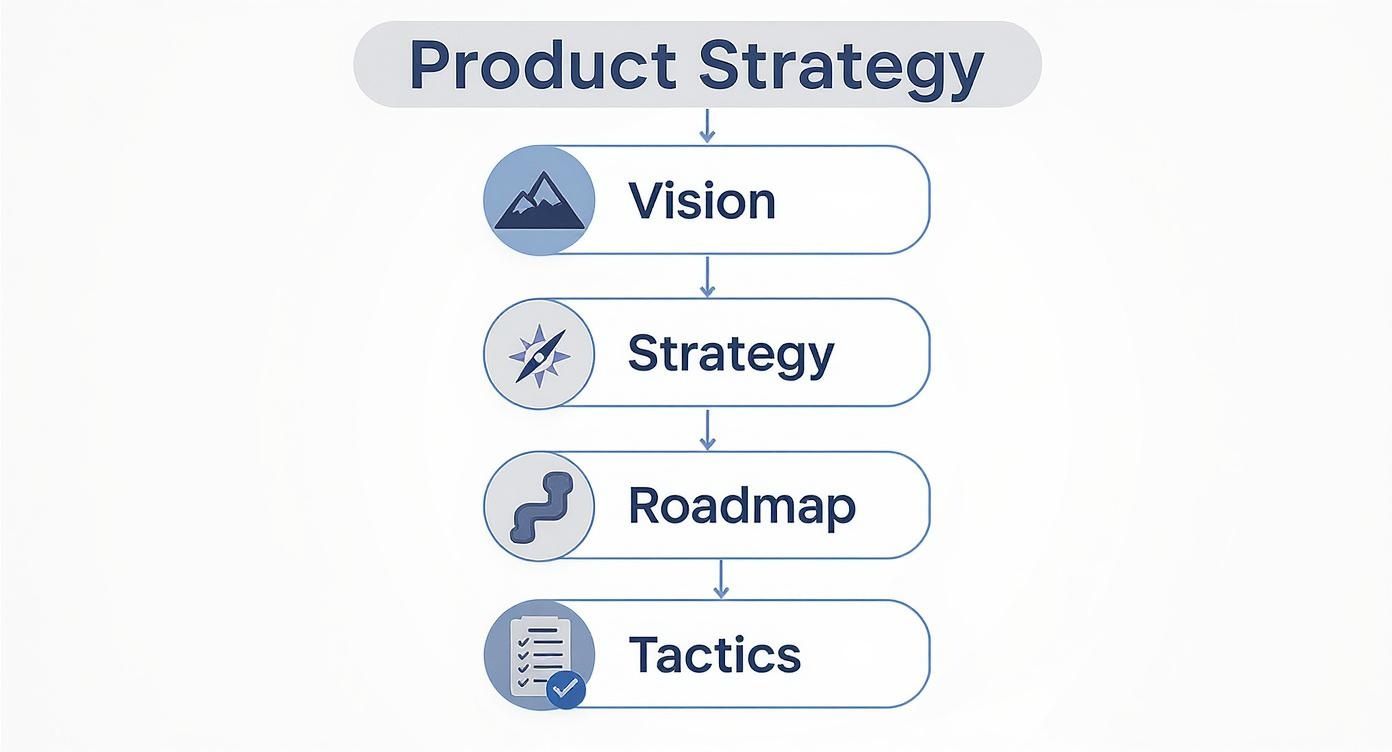
This hierarchy is critical for any effective product leader to internalize. The vision guides your strategy, the strategy informs your roadmap, and the roadmap dictates the day-to-day tactics. It’s a simple, powerful flow.
Market and Customer Needs
The first pillar is an obsessive focus on the market. This goes deeper than creating generic user personas. You must identify a specific, painful problem for a well-defined group of people.
Top-tier PMs at places like Airbnb don't just know who their users are; they understand the deep-seated "job" those users are hiring the product to do. They live in the data, conduct relentless customer interviews, and dissect the competitive landscape to find gaps.
A classic mistake is building a solution in search of a problem. A winning strategy always starts with an underserved need. Your job is to know your customer's pain better than they do.
Company Goals and Capabilities
Next, your strategy must be brutally realistic about what your company can actually pull off. A brilliant plan that ignores your organization's strengths, weaknesses, and core business objectives is just a fantasy.
You have to ask yourself these hard questions:
- Business Alignment: How does this product directly contribute to the company's revenue, market share, or other strategic goals? Can you draw a straight line from your product's success to the company's bottom line?
- Unique Strengths: What's our unfair advantage? Is it proprietary data (like Google's search index), a beloved brand (like Apple's), unique engineering talent, or a massive distribution channel (like the Microsoft ecosystem)? Your strategy must leverage these moats.
- Resource Reality: What are our genuine constraints in terms of budget, headcount, and technical capabilities? A strategy that requires resources you simply don't have is doomed from the start.
Differentiators and Market Positioning
The final pillar is all about defining how you will win. This isn't just about having more features; it's about carving out a unique and defensible position in the market.
Think about Slack. When it launched, the world was crowded with messaging tools. Slack’s strategy wasn't just to be "another chat app." Its key differentiator was creating a central hub for work communication that integrated deeply with other tools. This created a powerful network effect that competitors found nearly impossible to replicate.
To see how other top companies tackle this, check out these insightful examples of product strategy in action.
Ultimately, your positioning must answer one question: Why should a customer choose us over every other option, including doing nothing at all? A crystal-clear answer, rooted in the first two pillars, is the foundation of a strategy that doesn't just compete—it dominates.
Essential Frameworks to Build Your Strategy
A brilliant strategy is useless if it’s just a concept in a slide deck. As a product leader, your value is translating that vision into a concrete plan your team can execute. Frameworks are the bridge. They give your strategic thinking structure, force clarity, and help align everyone from engineering to sales.
These are battle-tested tools used daily by PMs at top companies. Let's dig into three you can use right away.
Jobs-to-be-Done (JTBD)
Forget traditional user personas. The Jobs-to-be-Done (JTBD) framework reframes how you see your customers. It shifts the focus from who the user is to the "job" they are trying to get done when they "hire" your product.
For instance, a PM at Netflix isn't just targeting "males aged 18-34." They're solving for the "job" of unwinding after a long day, or the "job" of finding an activity the whole family can do together. This focus on motivation reveals deeper insights. Suddenly, your competition isn't just other streaming services—it's reading a book, going for a walk, or scrolling through TikTok. Getting to the core "job" is the bedrock of a winning strategy.
Simplified SWOT Analysis for Product Decisions
SWOT (Strengths, Weaknesses, Opportunities, Threats) is a classic, but the old-school version is often too slow. A simplified, product-centric SWOT is more actionable. Narrow the focus to your specific product:
- Strengths: What unique assets do we have? Proprietary data, a loyal user base, a key technical edge.
- Weaknesses: Where are we vulnerable today? Technical debt, a confusing onboarding flow, a glaring feature gap.
- Opportunities: What market shifts can we jump on? A competitor changed their pricing, or a new technology (like a new API from OpenAI) opens up an integration.
- Threats: What could derail our progress? A new startup, changing regulations, growing user privacy concerns.
This sharp, focused approach helps you quickly pinpoint critical factors shaping your strategic decisions. For a deeper dive, check out this guide on product strategy frameworks.
The Product Strategy Canvas
Developed by product expert Melissa Perri, the Product Strategy Canvas is a fantastic one-page tool for team alignment. It visually connects your vision to the practical steps needed to get there.
The canvas forces you to nail down key components in a single view:
- Vision: The big, overarching goal.
- Challenge: The main business or customer problem you're tackling right now.
- Target Condition: A measurable outcome that proves you've overcome that challenge (e.g., "Reduce user churn from 5% to 2% by EOY").
- Current State: Where you are today, backed by hard data.
The canvas is a powerful communication tool. It crystallizes your thinking and makes the strategy easy for everyone to understand—from engineers to the C-suite—creating real organizational alignment.
How AI Is Reshaping Modern Product Strategy
If your product strategy doesn't have a serious answer for Artificial Intelligence, you're building for a market that no longer exists. Ignoring AI is a critical failure in strategic planning. We've moved past the buzzwords; AI is now a core driver of who wins.
The real shift is about making smarter, faster, data-backed decisions. At places like Meta, PMs use AI tools to run competitive and sentiment analysis at a scale unimaginable just a few years ago. This transforms your strategy from a static document into a living plan.
From Mass Market to Hyper-Personalization
One of the biggest game-changers AI brings is true hyper-personalization. The old "one-size-fits-all" product is dead. AI lets you analyze user behavior in real-time, creating unique journeys that drive retention.
This isn't just a nice-to-have. Deloitte Digital's 2025 marketing insights show that brands delivering personalized content drive stronger loyalty and revenue growth. For PMs, this means using AI is non-negotiable for making quick, informed decisions.
Tactical AI Integration for Product Managers
The key is to see AI as a tool that augments your skills. Here are actionable starting points:
- Automated Data Synthesis: Instead of spending weeks sifting through feedback, use AI tools to analyze thousands of support tickets, app reviews, and social media comments.
- AI Prompt: "Analyze these 1,000 customer support tickets [paste data]. Identify the top 5 most common user complaints and categorize them by theme. Provide direct quotes for each theme."
- Predictive Analytics: Lean on machine learning to forecast user churn, identify high-value customer segments, and predict which features are most likely to move the needle on engagement.
- Generative AI for Ideation: Use large language models (LLMs) to brainstorm user stories, draft initial product specs, or even generate rough wireframe concepts.
- AI Prompt: "Acting as a Senior Product Manager, write 5 user stories for a new feature that allows users of our project management tool to get AI-generated status updates. Follow the format 'As a [user type], I want [action] so that [benefit].'"
AI fundamentally changes the speed and depth of your strategic inputs. It allows a single PM to operate with the analytical power of a small research team, focusing their energy on high-judgment decisions rather than manual data crunching.
Understanding how to manage AI-powered products is quickly becoming a core competency. If you're looking to get ahead, digging into the specifics of AI product management is a crucial next step for your career.
Bringing Your Product Strategy to Life
A product strategy that just lives in a slide deck is a failure. I’ve seen it happen too many times: a brilliant strategy withers because the PM couldn't translate it into action. Your critical next step is to make that strategy a living force that guides your organization. This is the part of the job that separates managers from true leaders.

This isn't just about sharing a document. It’s about building a shared understanding and commitment across every single team.
Securing Buy-In from Key Stakeholders
Your first job is to become the chief evangelist for your strategy. You need to earn buy-in from the C-suite down to the individual engineers. Tailor your communication to each audience:
- For the C-Suite: Connect your strategy directly to business outcomes. Show them exactly how your plan drives revenue, grows market share, or cuts costs. Focus on financial and market impact.
- For Engineering Leads: Translate the "why" of the strategy into the "what" of the technical challenges. Frame it as an exciting problem to solve. Highlight opportunities for innovation and the direct impact their work will have on customers.
- For Sales and Marketing: Give them their narrative. Explain the target customer, the unique value proposition, and the key differentiators that will help them win deals and craft compelling campaigns.
A product strategy gains power when others adopt it as their own. Your goal is to make it so clear and compelling that stakeholders don't just agree with it—they champion it for you when you're not in the room.
Translating Strategy into a Prioritized Roadmap
With buy-in secured, it’s time to connect your high-level plan to the day-to-day work. This is where the product roadmap comes in. A roadmap is not a list of features; it's a statement of intent that shows how you plan to achieve your strategic goals over time.
Organize your roadmap around strategic themes, not just features. For example, instead of a roadmap item like "Build new dashboard," frame it as "Improve user retention by giving customers actionable insights." This shift keeps everyone focused on the outcome, not just the output. It ensures every sprint serves the larger purpose defined by your strategy.
Establishing KPIs and Success Metrics
Finally, you must define what success looks like in clear, measurable terms. A strategy without metrics is just a collection of opinions. Establish Key Performance Indicators (KPIs) that tie directly back to your strategic objectives.
- If your strategy is to win a new market segment, your KPIs might be new user acquisition and market share percentage.
- If your goal is to increase user engagement, you’ll track metrics like daily active users (DAU), session duration, and feature adoption rates.
These metrics make success tangible and hold the team accountable. They are the scoreboard that tells you if your strategy is actually winning.
The evolution of that strategy is heavily influenced by consumer behavior. Global internet penetration has hit 5.56 billion people, and with 87% of mobile users on smartphones, your metrics must reflect how you capture and serve this vast digital audience. Find out more about how businesses are building strategies to engage global audiences.
Answering Your Top Product Strategy Questions
Even seasoned PMs get tripped up by the nuances of strategy. It’s simple on the surface but incredibly challenging to master. I get these questions all the time from PMs I mentor. Let's tackle them with straight, actionable answers.
How Often Should a Product Strategy Be Updated?
Your product strategy isn't set in stone, but it shouldn't be flapping in the wind. A formal review and refresh should happen annually or semi-annually, aligning with business planning cycles.
However—and this is critical—it must be continuously validated. You can’t just write it and forget it. If a huge market shift happens (like a new AI model release), a competitor makes a game-changing move, or your core assumptions are proven wrong by new data, you must be ready to revisit it immediately.
A great strategy gives your team stability, but it’s a living document, not a museum piece. It has to evolve when you get new, high-quality information.
What Is the Difference Between Product and Business Strategy?
Nailing this distinction is critical for your career. Business strategy is the company's grand plan for winning—how the entire organization will achieve its mission.
A product strategy is a vital piece of that puzzle. It zooms in on how a specific product or product line helps the company win. For example, if the business strategy is to capture more of the European market, your product strategy would define the specific features, pricing, and partnerships needed to make your product a success there. One flows directly from the other.
Can a Startup Have a Strategy Without a Product Yet?
Absolutely. In fact, you must have one. For a pre-product startup, the "product strategy" is a set of well-researched, high-conviction hypotheses. It's your blueprint for learning.
It must clearly define:
- The Target Customer: Who, specifically, are you building this for?
- The Problem: What is their burning, hair-on-fire problem?
- The Value Proposition: How are you going to solve that problem in a way no one else is? What makes you unique?
- Go-to-Market: How will you get this into the hands of your first users?
This strategy is the guiding force behind your MVP (Minimum Viable Product). Its purpose is to articulate the core assumptions you need to test and validate the second you go live.
Ready to dive deeper into product management and accelerate your career? The newsletter from Aakash Gupta provides expert insights, growth strategies, and job-searching tips directly to your inbox. Join the top-ranked PM community today.
