Your product strategy is the high-level game plan connecting your grand company vision to the actual product you build. It’s all about answering the most important question: why are we building this specific thing, for these specific people? It lays out the path to hitting your business goals.
The Foundation of Product Success

Without a solid product strategy, teams just drift. They end up building features without a clear purpose, reacting to every single customer request, and completely losing sight of the bigger market opportunity. A strong strategy is your North Star. It makes sure every decision—from tiny bug fixes to massive feature launches—moves the product in the right direction.
Let’s try a road trip analogy. You wouldn't just jump in the car and start driving west, hoping for the best, right? Of course not. You'd pick a destination, map out the best route, and plan your major stops.
In this scenario:
- Your Vision is the final destination (e.g., "Become the #1 project management tool for creative agencies").
- Your Product Strategy is the route you choose to get there (e.g., "We'll win by focusing on a simple, visual interface that integrates perfectly with design software").
- Your Product Roadmap is the turn-by-turn navigation, detailing the features you'll ship each quarter.
A product strategy isn’t a feature list. It's a series of deliberate choices that position your product to win in a specific market by solving a particular problem for a defined audience.
Strategy vs Vision vs Roadmap A Quick Comparison
It's easy to get these terms tangled up, but knowing the difference is critical. Each one serves a distinct purpose, building on the one before it.
| Concept | Core Question It Answers | Primary Function |
|---|---|---|
| Vision | Why do we exist? What future do we want to create? | To inspire and provide a long-term direction |
| Strategy | How will we win in our market? | To guide decision-making and focus resources |
| Roadmap | What will we build and when? | To communicate the plan and coordinate execution |
Think of it as a hierarchy: the Vision is the ultimate goal, the Strategy is the plan to achieve it, and the Roadmap is the set of steps to execute that plan.
Aligning Teams and Driving Focus
One of the most powerful things a product strategy does is create alignment. When everyone from engineering to marketing to sales understands the "why," they can make smarter, more independent decisions. This is what keeps you from becoming a "feature factory," just churning out code that doesn't create real value.
A huge piece of your strategy is clearly stating the unique value of your product and focusing on why your product matters to your customers. It forces you to answer the tough questions early on, like who you are building for and—just as important—who you are not building for.
This ruthless focus is what separates the products that lead their markets from the ones that try to be everything to everyone and end up pleasing no one.
How a Strong Product Strategy Drives Growth

A great product strategy is so much more than a document that sits on a shelf collecting dust. It's the engine for sustainable, long-term growth.
Without one, teams inevitably find themselves in a reactive loop, becoming what we call a "feature factory"—building things just for the sake of building, with no clear purpose tying it all together. A well-defined strategy is the antidote to this chaos. It brings clarity.
It provides a framework that gives every team, from engineering to marketing, the context to make smarter, more autonomous decisions. The conversation shifts from "What should we build next?" to a much more powerful question: "What will get us closer to our goal?" This fundamental alignment ensures every dollar spent and every hour worked is an investment in something that actually moves the needle.
A strong product strategy prevents wasted effort on features nobody wants and focuses finite resources on what delivers maximum value to customers and the business. It's the ultimate unfair advantage in a crowded market.
This intense focus creates a ripple effect across the entire organization, leading to real business outcomes that build on each other over time.
From Vague Ideas to Measurable Impact
A clear strategy is the connective tissue between your day-to-day tasks and your high-level business objectives. It makes success something you can actually measure. Think of it as the bridge between an ambitious vision and the specific outcomes that tell you you've won. Instead of chasing vanity metrics, teams can finally concentrate on what truly matters.
Here are a few key areas where a solid strategy drives measurable growth:
- Increased Market Share: By zeroing in on a specific customer need and positioning your product as the absolute best solution, you can carve out and dominate a niche.
- Enhanced Customer Loyalty: A focused strategy allows you to solve customer problems deeply, building trust that turns casual users into passionate advocates who stick around.
- Improved Profitability: It forces you to direct investment toward high-impact features and, just as importantly, prevents resources from being poured into low-value projects. This has a direct impact on the bottom line.
This level of clarity doesn't just improve metrics; it's a huge boost for team morale and innovation, fostering a culture that's proactive and goal-oriented.
Empowering Teams and Aligning the Organization
One of the most powerful benefits of a great strategy is organizational alignment. When the plan is crystal clear, everyone understands the mission and exactly how their role contributes to it. This shared context is non-negotiable for scaling a business and positioning it effectively in the market.
Take personalization, for example. A focus on creating personalized experiences is a direct result of a solid strategy. A Deloitte Digital study found that brands who get this right see customers buy more frequently, which supercharges loyalty and lifetime value. It shows how a single strategic choice can directly impact revenue, which is why 56% of marketing leaders are investing heavily in it.
This alignment is a core principle of effective product development, something you can explore further in our guide on what is product growth.
Ultimately, a product strategy makes sure the entire company is rowing in the same direction. It transforms a collection of disjointed efforts into a unified force for growth, maximizing momentum and accelerating you toward your most important goals.
The Building Blocks of a Winning Product Strategy
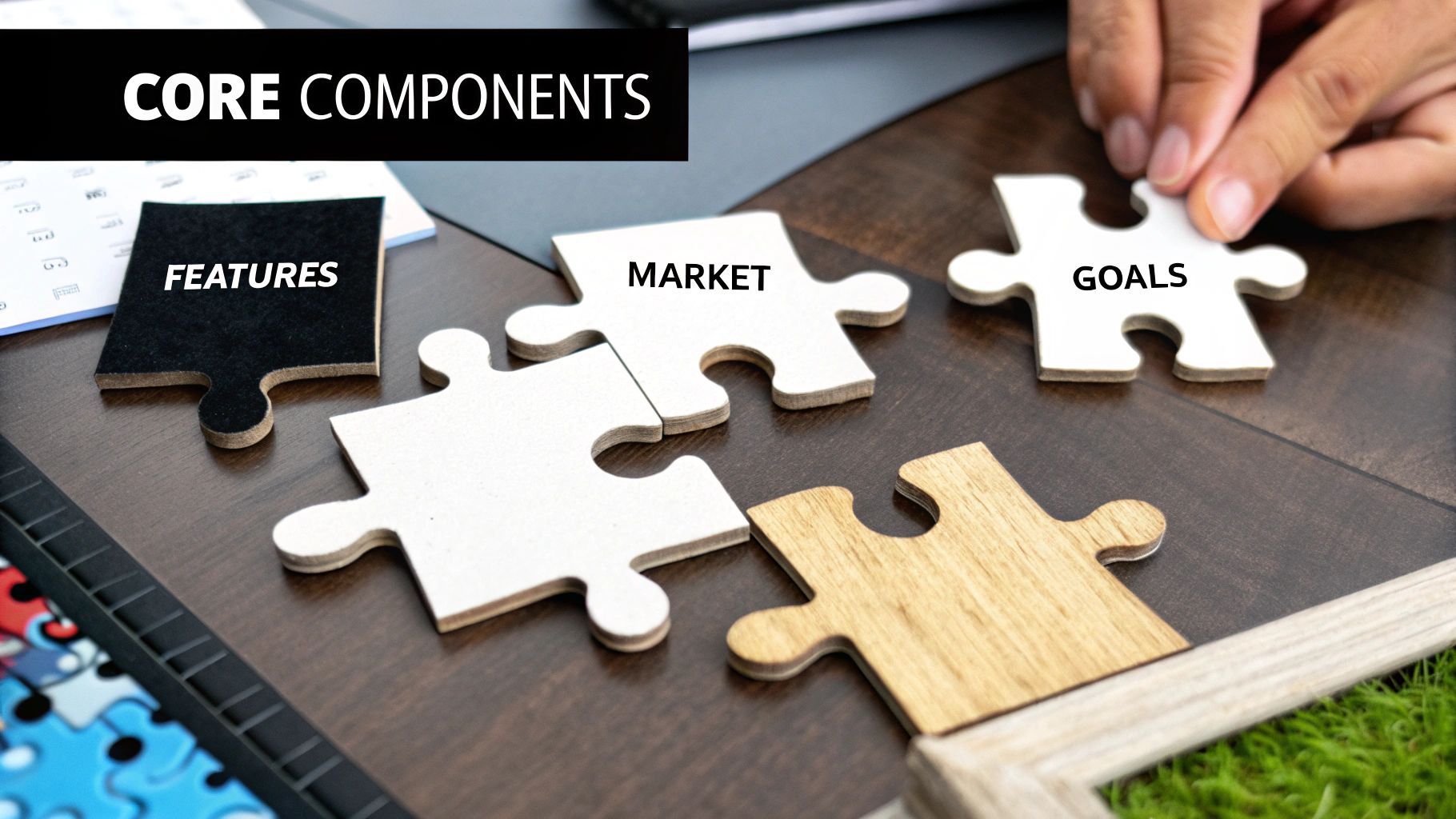
A powerful product strategy isn't some vague, aspirational mission statement you stick on a wall. It's a concrete plan, built from distinct, interconnected parts.
Think of it like building a house. You can't just start throwing up walls and hope for the best. You need a solid foundation and a detailed blueprint. Each piece has to be carefully defined and placed to support the entire structure.
To really get what product strategy is, you have to break it down into these essential building blocks. By nailing each element, you turn a high-level dream into an actionable guide your entire team can actually rally behind and execute.
The Product Vision Statement
The vision is the cornerstone of your entire strategy. It’s a short, inspiring statement about the future you’re trying to create with your product. It answers the biggest question of all: "Why do we even exist?"
A strong vision acts as your North Star, the fixed point on the horizon that guides every single decision, even when the market gets chaotic.
Take Slack, for example. Their vision is "To make work life simpler, more pleasant, and more productive." It's broad enough to allow for innovation but specific enough to give their team clear direction.
A product strategy without a clear vision is like a ship without a rudder—it might be moving, but it has no deliberate direction. The vision ensures every strategic choice serves a higher purpose.
Target Audience and Problems to Solve
You absolutely cannot be everything to everyone. A winning strategy clearly defines who your product is for and, just as crucially, who it is not for.
This means creating detailed user personas that go way beyond basic demographics. You need to get into their heads—understand their motivations, their behaviors, and the deep-seated pain points that keep them up at night.
Once you know your audience inside and out, you have to lock onto the specific, high-value problem you're solving for them. What's the nagging challenge they'd pay to make go away? And how does your product address that pain point better than any other option? A great product isn't just a collection of features; it's a genuine solution.
Market Analysis and Competitive Landscape
No product exists in a vacuum. A huge part of your strategy involves deeply understanding the market you're playing in. This means analyzing the market size, following the trends, and keeping an eye out for potential threats or opportunities on the horizon.
This also demands a brutally honest competitive analysis. Identify your direct and indirect competitors. Size them up. What are their strengths? Where are they vulnerable? The goal isn't to copy them—it's to find your unique, defensible position in the market. Where are the gaps they've left wide open? What can you do that nobody else can? That's where you find your sustainable advantage.
Goals and Success Metrics
A strategy without measurable goals is just a wish. You have to define what success actually looks like in numbers to track your progress.
Frameworks like Objectives and Key Results (OKRs) are perfect for this. An Objective is your qualitative goal (e.g., "Become the go-to tool for remote teams"). Your Key Results are the quantitative metrics that prove you're getting there (e.g., "Increase daily active users by 30%").
These goals create a direct line from your team's daily work to the grand vision, making sure every single initiative drives a meaningful outcome. They're also the foundation for your product roadmap, a topic we cover in our guide on how to prioritize a roadmap.
At the end of the day, setting clear metrics is the only way you’ll ever know if your strategy is actually working.
Choosing the Right Framework for Your Strategy
You don't need to invent your product strategy from scratch. Thankfully, you can stand on the shoulders of giants by using a proven framework. These structured approaches give you a reliable starting point, helping you ask the right questions and organize your thinking.
Think of these frameworks as different lenses. Each one helps you see your product, your customers, and your market from a unique and valuable angle. The trick is picking the right one for the specific challenge you're facing.
This diagram shows how a high-level vision breaks down into actionable objectives and initiatives—a structure that many of these frameworks help organize.
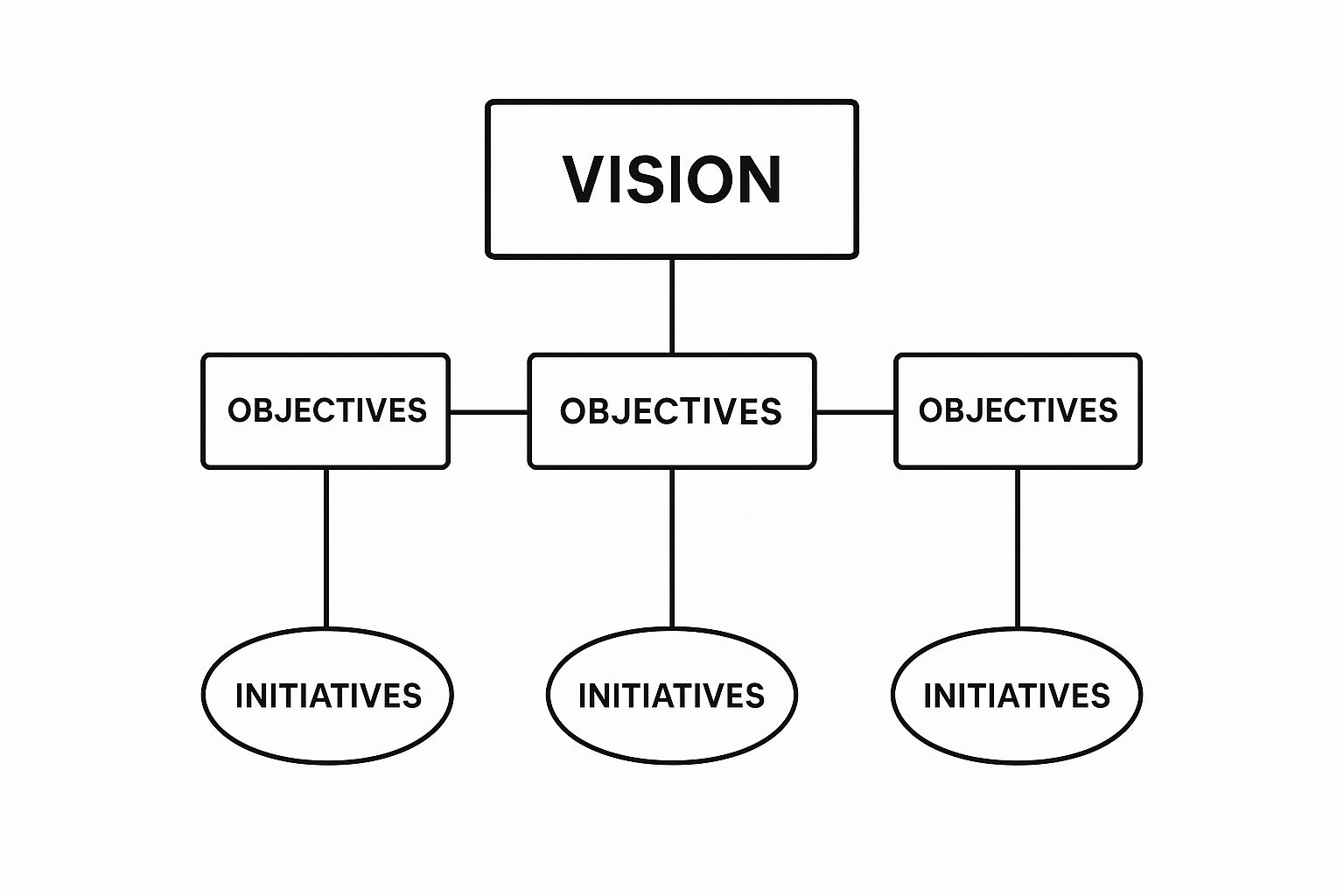
This kind of hierarchy is crucial. It ensures the day-to-day work (your initiatives) is always pushing your strategic goals (your objectives) forward, all in service of the company's ultimate purpose (the vision).
The Kano Model for Customer Delight
The Kano Model is a fantastic tool for prioritizing features based on how they actually impact customer satisfaction. It forces you to think beyond a simple "what do they want?" mindset and get into the emotional response different features can create.
This model sorts features into three buckets:
- Basic Expectations: These are the absolute must-haves. If they’re missing, customers will be furious, but just having them doesn’t create any real excitement. Think brakes on a car.
- Performance Payoffs: With these, more is definitely better. The more you deliver, the more satisfied your customers become. Think better gas mileage in that same car.
- Delighters (or Exciters): These are the unexpected, wow-factor features that create genuine delight. They can quickly become a massive competitive advantage. Remember the first time a car had a backup camera? That's a delighter.
Using the Kano model helps you balance your resources, making sure you nail the basics while still investing in those special features that will truly surprise and please your customers.
Jobs-to-be-Done for User Motivation
The Jobs-to-be-Done (JTBD) framework completely shifts your focus from the product itself to the customer's real, underlying motivation. The core idea here is that people don't "buy" products; they "hire" them to do a specific "job."
"Upgrade your user, not your product. Don’t build better cameras — build better photographers." – Kathy Sierra
It sounds simple, but it's a profound shift. A customer doesn't buy a drill because they want a drill; they hire it for the job of creating a hole. This perspective forces you to understand the real-world context and the ultimate outcome your users are chasing. JTBD helps you innovate beyond your current solution and discover what your customer is truly trying to accomplish.
North Star Framework for Company Alignment
The North Star Framework is all about rallying your entire organization around a single, critical metric. This North Star Metric (NSM) represents the core value your product delivers to customers, and it acts as a leading indicator of sustainable, long-term growth.
For a company like Airbnb, the NSM is "nights booked." For Slack, it might be "messages sent." Suddenly, every single team can see exactly how their work contributes to moving that one crucial number. It provides immense clarity and stops teams from accidentally working at cross-purposes.
Choosing The Right Product Strategy Framework
With so many options, how do you pick? Each framework has its strengths depending on your product's stage and the specific questions you're trying to answer. This table breaks down a few of the most popular ones to help you get started.
| Framework | Best For | Key Outcome |
|---|---|---|
| Kano Model | Prioritizing features when you have limited resources and need to balance must-haves with "wow" factors. | A feature roadmap that maximizes customer satisfaction and competitive differentiation. |
| Jobs-to-be-Done (JTBD) | Early-stage innovation, market discovery, or when you need to understand the deep, unmet needs of your users. | Powerful insights into customer motivation that lead to more innovative, market-fitting solutions. |
| North Star Framework | Scaling companies that need to align multiple teams around a single, unifying goal for growth. | A clear, measurable metric that focuses the entire organization on delivering core customer value. |
This isn't an exhaustive list, of course. Many other valuable models exist, and it often pays to combine elements from different frameworks. The goal is to find the approach that best illuminates the path forward for your product and your market.
For an in-depth look at another practical approach, you can explore the LNO framework for product managers.
How AI Is Reshaping Product Strategy
Artificial Intelligence has officially moved from a "someday" concept to a "right now" tool that's fundamentally changing how product teams get work done. For anyone crafting product strategy today, AI isn't just another feature to toss in the backlog. It’s the engine that lets you make smarter, faster, data-backed decisions at every single stage of the product lifecycle.
Imagine the old way of understanding your customers. You'd have to manually slog through thousands of support tickets, survey responses, and app reviews. It would take a team weeks, and even then, you'd only scratch the surface. An AI-powered tool can now chew through that mountain of qualitative data in minutes.
It spots recurring pain points, flags emerging trends, and even gauges customer sentiment with startling accuracy. This capability flips product strategy on its head—moving it away from gut feelings and small sample sizes to something grounded in comprehensive, real-time user feedback.
AI doesn't replace a product manager's intuition; it supercharges it. By handling the heavy lifting of data analysis, it frees up strategic thinkers to focus on what truly matters: understanding the "why" behind the data and making bold, creative leaps.
This is how teams finally break free from being feature-driven and become genuinely outcome-focused.
Augmenting Strategic Decision-Making
The real magic of AI in product strategy is how it enhances, not replaces, human intelligence. Think of it as an incredibly insightful assistant, helping product leaders connect dots they might otherwise miss and validate their hunches with rock-solid evidence.
Here’s how AI is already making a real-world impact:
- Smarter Feedback Loops: AI can instantly categorize and tag incoming feedback from dozens of channels, creating a live dashboard of what your customers actually need. This lets teams prioritize based on volume and urgency, ensuring they’re always working on what matters most.
- Predictive Market Intelligence: By crunching market data, competitor moves, and social media chatter, AI algorithms can start to forecast market shifts before they become obvious. This gives your team a critical head start in adapting your strategy and jumping on new opportunities.
- Deep Personalization: AI makes it possible to create deeply personal user experiences that scale. It can tailor content, recommendations, and even UI elements to individual user behaviors, which is a massive driver of engagement and retention.
The Growing Investment in AI
This isn't some far-off trend; it's happening right now. Integrating AI has become a must-do for any forward-thinking product organization that wants to stay competitive.
According to a recent report, a whopping 76% of product leaders expect to increase their investment in AI within the next year, signaling a major industry-wide shift. You can discover more insights about these product management trends and see how this focus is pushing companies away from just shipping features and toward generating real revenue.
For modern product strategy, embracing AI is quickly becoming non-negotiable.
Winning Product Strategies in the Real World
Theory is great for building blocks, but nothing cements an idea quite like seeing it work in the wild. Let's break down the brilliant product strategies of two giants—Netflix and Slack—to see how making bold, clear choices can lead to absolute market domination.
These aren't just interesting stories. They're case studies that show how a well-defined strategy isn't just a plan; it's a competitive weapon.
Netflix: From DVDs to Streaming Dominance
Netflix’s journey is a masterclass in strategic evolution. Their first move was simple: use the internet to beat Blockbuster at the DVD rental game. That was it. But their true genius was realizing the plastic disc in the red envelope was just a temporary vehicle for the actual product—entertainment.
That single insight led to their audacious pivot to streaming. They knowingly cannibalized their own cash-cow DVD business to pour money into a future they saw coming a mile away. This new strategy zeroed in on:
- Accessibility: Content had to be instant, available on any device you owned. No more waiting for the mail.
- Data-Driven Content: They started using viewership data to figure out what original shows to greenlight, which famously led to hits like House of Cards.
- Subscription Model: This created a predictable, recurring revenue stream that let them fund a massive, ever-growing content library.
This foresight gave them an almost insurmountable lead before competitors even realized the game had completely changed.
Slack: Conquering Organizations From the Inside Out
Slack’s product strategy was a masterful play of the bottom-up approach. Instead of schmoozing executives and trying to land huge enterprise deals, they focused on making an indispensable tool for individual teams.
Their entire strategy was built on one idea: make team communication simpler, more pleasant, and more productive than the nightmare of internal email chains. By offering a free, genuinely useful version, they let small teams jump in without needing a single permission slip from corporate.
Slack didn’t sell a product; they solved a team’s immediate communication pain. Once one team was hooked, it organically spread to others until the entire organization couldn't live without it.
This approach turned happy users into internal champions who did the selling for them, from the inside. It’s a powerful lesson in understanding what product strategy is at its most clever—it’s not just about what you build, but also about the crafty way you get it into your customers' hands.
Common Product Strategy Questions Answered
Even with the best plan in hand, the real world always has questions. Let's tackle some of the most common things people ask about product strategy once the rubber meets the road. Getting these sorted will help you move forward with a lot more confidence.
How Often Should a Product Strategy Be Updated?
A product strategy isn’t something you carve in stone and forget about. The market shifts, customer needs evolve, and new competitors pop up. It’s just the nature of the beast.
A good rule of thumb is to formally review it quarterly and plan for a more significant refresh annually. Think of it less like a permanent blueprint and more like a living guide for your team.
The real goal here is to stay agile. If a major disruption happens—say, a game-changing technology emerges out of nowhere—you shouldn't wait for your next calendar invite. You need to re-evaluate your strategy right then and there.
Your product strategy should provide stability without causing stagnation. Regular check-ins ensure it remains relevant and effective, guiding your team toward the right long-term goals.
Can a Small Startup Have a Product Strategy?
Not only can they, they absolutely must. For a startup, a clear product strategy is even more critical than for an established company. When you're running on limited time, money, and people, focus is everything. A strategy forces you to make the hard calls on where to place your bets.
It gives you a clear, compelling story that is vital for a few things:
- Aligning your small team so everyone is rowing in the exact same direction.
- Communicating your vision to investors and your first crucial hires.
- Winning your first customers by solving one specific problem better than anyone else out there.
Without a strategy, a startup risks burning through its precious resources trying to be everything to everyone. That's a fast track to nowhere.
Ready to deepen your expertise and accelerate your career? Aakash Gupta provides world-class insights and coaching for product managers at every level. Explore the resources trusted by product leaders worldwide. Learn more at https://www.aakashg.com.
