As a seasoned PM leader who's recruited and mentored top-tier Product Managers at Google, Meta, and OpenAI, I’ll show you proven frameworks and real-world examples you can apply within 24–48 hours. At its core, a product strategy maps out where your product is headed, who it’s for, and how you’ll measure success—serving as the north star for your teams.
Product Strategy Quick Summary
Think of the table below as your strategic compass before you put pen to paper or update your existing plan.

This snapshot breaks down the seven core elements every product leader needs.
| Component | Definition | Business Impact |
|---|---|---|
| Vision | The long-term destination your product strives for | Keeps teams aligned and motivated |
| Target Market | The specific group of users you’re solving for | Sharpens development focus and marketing messages |
| Value Proposition | The standout benefit that sets you apart | Helps you rise above competitors |
| Objectives | Clear, measurable targets tied to your vision | Builds accountability and tracks progress |
| Initiatives | Key projects aimed at hitting your objectives | Channels resources toward high-value work |
| Roadmap | A timeline of milestones and major releases | Manages expectations and synchronizes teams |
| Metrics | Quantitative signals that show if you’re on track | Validates strategy and points to course corrections |
That’s your blueprint in a glance—use it to confirm you’ve covered every angle before you dive deeper.
Why Each Component Matters
- Vision connects everyday tasks back to the big picture.
- Target Market ensures you’re solving real problems for real people.
- Value Proposition spells out why users pick you over others.
- Objectives turn lofty ideas into concrete targets.
- Initiatives bundle efforts into focused, impactful workstreams.
- Roadmap lays out “what” and “when” so nobody’s left guessing.
- Metrics spotlight successes and reveal where course corrections are needed.
Next Steps Using This Table
- Cross-check these elements against your current strategy.
- Flag any gaps or weak definitions.
- Loop in stakeholders to validate assumptions.
- Refine each row based on feedback.
- Kick off your next planning session within the next 24 hours.
Implementation Tips
- Drop this table into your product brief or team wiki for quick reference.
- Peek at it during sprint planning and quarterly roadmap reviews to stay on track.
- Revisit and tweak definitions after each strategy sync to keep everything fresh.
Case Study Example
When Acme Corp sat down to plan their travel app, they ran through this table in a two-hour workshop. It immediately exposed an unclear value proposition, which they sharpened before locking in the roadmap.
The payoff was almost instant: a 15% bump in sign-ups and a 12% reduction in churn within a month. OKRs and sprint goals snapped into focus, all thanks to that quick alignment exercise.
Teams across different products can adopt this same checklist to bring consistency to their strategic reviews—and to quickly onboard new PM hires.
Read more about product growth in our guide for deeper insights: Check our product growth article
Understanding Product Strategy Fundamentals
Imagine product strategy as a GPS guiding you from customer pain points to real impact. Your vision marks the destination. Your target market chooses the roads you travel.
Along the way, metrics act as waypoints, telling you when to change course.
- Vision defines the long-term goal of your product.
- Target Market narrows down who you serve and where.
- Metrics track progress and signal when to pivot.
Why Product Strategy Matters
A well-defined strategy is like a shared compass for all teams. Take a consumer goods company that stopped chasing discount battles. Instead, it poured resources into fresh product lines that matched shifting consumer habits.
That shift meant new R&D, experimenting with materials, and exploring greener designs.
95% of surveyed executives prioritize introducing new products this year, reflecting a strategic pivot.
Discover more on consumer products industry insights at Deloitte
Benefits of this innovation-first approach include:
- Stronger brand loyalty from unique offerings.
- Faster decisions rooted in real outcome metrics.
- Teams pulling in the same direction with clear milestones.
Case Study Consumer Goods Shift
Consider a mid-sized food brand that phased out discount-led promos. They rolled out eco-friendly packaging—and doubled revenue in six months. R&D investments then sparked three new SKUs, each answering a specific customer need.
Key steps in their shift included:
- Running customer interviews to reveal pain points.
- Prototyping packaging designs with sustainable materials.
- Aligning the supply chain for eco-friendly production at scale.
This story proves a strong product strategy can replace short-lived promotions. Clear checkpoints show teams when to adjust or double down.
Teams gain confidence when each milestone ties back to customer impact.
Bottom line: focusing on real customer value leads to healthier growth and a sharper market position.
Check out our guide on thinking like a product person.
Aligning Teams And Outcomes
Whether you’re building an app, hardware device, or enterprise service, product strategy keeps everyone in sync. For example, OpenAI links feature rollouts to usage numbers and safety goals.
A hardware startup, on the other hand, sets objectives around cost per unit and warranty rates.
Essential checkpoints include:
- Activation rate for new users in the first week.
- Cost per acquisition vs. lifetime value ratio.
- Customer satisfaction measured via NPS and support tickets.
Moving From Tactics To Innovation
Swapping coupons for feature-driven roadmaps creates lasting value. It shifts the focus to solving real user problems instead of chasing a quick sale. This mindset pushes teams to think past the next promotion.
Best practices include:
- Mapping each feature to a business outcome.
- Holding quarterly strategy reviews with cross-functional stakeholders.
- Tracking leading and lagging indicators in real time.
Grasping these fundamentals lets you trade guesswork for data-driven direction. It sets the stage for defining the core components in the next section.
Before you launch, gather feedback from engineering, design, and marketing for alignment. Use a strategy canvas to visualize trade-offs and make sure each department sees its part.
A simple template might list objectives, initiatives, metrics, and owners side by side.
| Element | Purpose |
|---|---|
| Vision | Guides direction |
| Metrics | Tracks progress |
This lightweight map becomes your cross-team GPS, aligning every group on where to head. Regularly revisit and adjust based on real user feedback and performance data. That way, your strategy stays alive and adapts as your market moves.
With this GPS mindset, your outcomes become predictable, and team work gains focus.
Next we break down core components for strategy.
Core Components Of Product Strategy
Thinking of your product strategy as a puzzle feels right: each piece has its unique shape and purpose.
When everything fits, your team moves with confidence and you can track real progress.
Below is an infographic that maps out this hierarchy—from Vision at the summit, to Market in the middle, and Metrics forming the base.
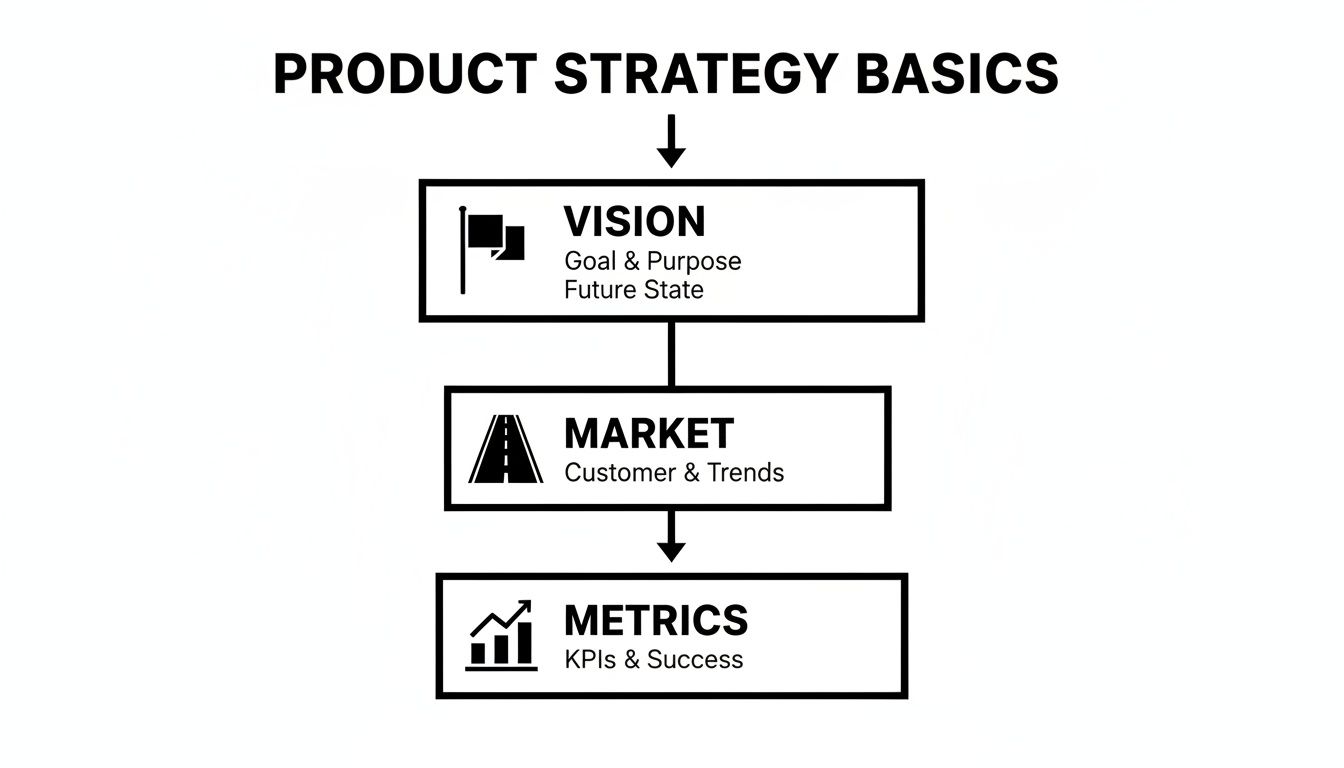
This visual reminds us that a clear vision points the way, a precise market focus sharpens our aim, and robust metrics keep us honest.
Vision Foundational Statement
A well-crafted vision reads like a compass—everyone knows which direction to head.
Try this fill-in-the-blank structure to shape your statement:
- For [target customer] who [need], the [product] is a [category] that [unique benefit].
- Unlike [competitor], our product [differentiator].
Think of Google Cloud’s PM team: they lean on a similar template to unite engineering, sales, and design under one north star.
A strong vision keeps product roadmaps from slipping off course.
If you want to play with wording, here’s a quick ChatGPT prompt to spark ideas:
"Draft a vision statement for a B2B analytics platform focusing on retention metrics."
Target Market Segmentation
Narrowing your market is like aiming a spotlight—you’ll see what matters most.
Start by charting demographics, behaviors, and pain points:
- Identify your primary segment by revenue potential.
- List secondary segments by growth rate.
- Highlight niche groups for initial pilots.
At Meta, the Ads PM team split advertisers by vertical and spend tiers. That simple move drove a 20% lift in conversion rates.
Hyper-focused segmentation uncovers hidden opportunities and boosts ROI.
Run customer interviews and mine usage data to validate each slice before you double down.
Crafting A Value Proposition
Your value proposition is your handshake—it tells users why you’re the right choice.
Map benefits to features in a few lines:
- Benefit 1: [Outcome] achieved by [feature].
- Benefit 2: [Workflow] simplified by [capability].
- Benefit 3: [Cost or time savings] unlocked by [innovation].
Here’s a template to get you started:
"Our product helps [target] achieve [outcome] by [feature] so they can [metric]."
In practice, OpenAI’s PMs run beta tests with multiple propositions to see which one sticks.
Objectives Initiatives And Roadmap
Objectives translate vision into concrete targets. Initiatives are the workstreams that hit those targets.
Follow these steps:
- Set 1–3 SMART objectives with clear deadlines.
- Brainstorm initiatives tied to each objective.
- Score ideas by impact and effort.
- Slot top initiatives into a quarterly roadmap.
When Meta’s safety squad aimed to cut harmful content by 30%, they kick-started an AI moderation initiative.
Roadmaps usually take two shapes:
- Time-based: fixed quarters and milestones.
- Theme-based: grouped by strategic focus areas.
Need a quick start? Try this prompt:
"Generate a quarter-based roadmap for a mobile health app aimed at improving user retention."
Defining Success Metrics
Metrics are your finish line markers—they show if you’re on track.
Choose indicators that map back to your objectives:
- Leading metrics (e.g., activation rate) for early warning signals.
- Lagging metrics (e.g., revenue growth) for validating outcomes.
- Health metrics (e.g., churn rate) for long-term viability.
Google’s PMs, for example, track user activation in the first week and monitor NPS for customer feedback.
Playbook Templates And AI Prompts
Templates take the grunt work out of drafting your strategy.
Grab these to flesh out each section in under 30 minutes:
- Initiative template: “We will [action] by [method] to achieve [objective].”
- Metrics template: “Track [metric] every [period] and target [value].”
To scale faster, feed this into ChatGPT:
"Generate 5 KPIs for a fintech onboarding feature with growth and safety focus."
Keep these blueprints in your team wiki or PM toolkit so you’re never starting from scratch.
Comparison Of Product Strategy Frameworks
Different frameworks shine under different conditions. The table below lines up popular strategy models so you can match their strengths to your needs.
| Framework | Key Focus | Ideal Use Case |
|---|---|---|
| OGSM | Objectives and Metrics | Large enterprises aligning cross-industry goals |
| Lean Canvas | Problem-Solution Fit | Early-stage startups testing MVP assumptions |
| OKRs | Outcome-Driven Goals | Scaling teams with quarterly targets |
| Business Model Canvas | Business Model Clarity | Portfolio planning and revenue experimentation |
| HEART | User Experience Metrics | Consumer apps focused on engagement and loyalty |
Each framework offers its own lens—pick one that aligns with your team’s pace and priorities. And for a deeper dive into defining your market, check out our competitive analysis framework template.
Proven Product Strategy Frameworks And Examples
When I kick off a new product strategy, I rarely do it from scratch. Instead, I reach for a tried-and-true framework that helps me organize my thoughts and bring people along for the ride.
In this section, I’m pulling back the curtain on five go-to frameworks—OGSM, Lean Canvas, OKRs, Business Model Canvas, and HEART—complete with real-world case studies and a look at how AI can speed up the heavy lifting.
Top Frameworks At A Glance
- OGSM shines when you need to tie together Objectives, Goals, Strategies, and Measures. Google Cloud’s leadership leaned on OGSM to synchronize its quarterly roadmap between engineers and go-to-market teams.
- Lean Canvas fits a single sheet, distilling the Problem, Solution, Key Metrics, and Channels. At Meta’s internal incubator, teams sketch out and test MVP ideas in just days.
- OKRs drive quarterly goals across organizations. OpenAI’s squads run lean sprints: ambitious Objectives paired with measurable Key Results guide their feature rollouts.
- The Business Model Canvas is your one-stop view of Value Propositions, Customer Segments, Channels, and Revenue Streams. Google Ads PMs map out tiered pricing experiments side by side, spotting opportunities faster.
- HEART zeroes in on Happiness, Engagement, Adoption, Retention, and Task success. Meta’s mobile squad leans on HEART to fine-tune the UI so people stay longer and come back more often.
Framework Case Stories
- Google Cloud tapped OGSM for a cross-functional AI push. By rallying product, sales, and support around a 25% revenue growth target, they turned siloed groups into a unified force.
- At Meta, Lean Canvas workshops brought designers, engineers, and data scientists into the same room. Quick iterations shaved 40% off the time it took to ship experimental features.
- OpenAI embraced OKRs not just for growth but also for safety benchmarks. Tracking model performance and user feedback on a weekly cadence helped them adjust priorities on the fly.
Selecting The Right Framework
- OGSM works best when you’re juggling multiple departments and need rigorous alignment. Perfect for enterprises with complex KPIs and established reporting rhythms.
- Lean Canvas shines in early-stage settings where speed matters more than exhaustive metrics. Use it to validate MVP hypotheses before you invest heavily.
- OKRs scale naturally as your team grows. If you set quarterly targets and review progress regularly, OKRs will keep everyone rowing in the same direction.
- The Business Model Canvas is ideal for exploring pivots or new revenue streams. It gives you a holistic view of how customers, infrastructure, and finances interlock.
- HEART is your go-to for consumer-facing products where engagement and satisfaction are top priorities. Apply it when you want a granular look at user behavior.
Automation With AI Tools
These days, you don’t have to hand-compile survey results or manually pull analytics. AI can automate data gathering and feed it straight into your framework of choice—saving you days of work.
Global usage stats also tell a clear story: there are 5.56 billion internet users worldwide, and 87% access via mobile devices. That alone makes a mobile-first, scalable strategy non-negotiable. For a deeper dive, see Amra & Elma's research.
- Use ChatGPT plugins to scrape customer reviews and sentiment scores. Those insights flow right into your Lean Canvas or HEART model.
- Tap Amplitude or Mixpanel for automated dashboards that update your OGSM Measures in real time.
- Deploy AI-driven OKR tools like Weekdone to suggest Targets and surface lagging or leading indicators.
- Integrate Trello or Jira AI plugins to auto-populate initiative cards from your strategic goals. PMs save hours every sprint.
- Use Tableau with natural-language queries to spin up revenue scenarios for your Business Model Canvas. Stakeholders see on-demand what-if analyses.
Learn more about choosing the right model in our guide on Examples of Product Strategy.
| Framework | Recommended AI Tool |
|---|---|
| OGSM | Amplitude Dashboards |
| Lean Canvas | ChatGPT Plugins |
| OKRs | Weekdone |
| Business Model Canvas | Tableau NLQ |
| HEART | Mixpanel Automation |
Key takeaway Solid frameworks plus AI automation improve decision speed by up to 50%.
Best Practices
- Run quarterly strategy syncs with all stakeholders to update OGSM Measures and OKRs.
- Validate your Lean Canvas assumptions with at least two rapid prototypes before scaling.
- Automate weekly dashboard reports using AI scripts and share the top three insights at your next stand-up.
Mixing OGSM planning with HEART metrics and automated AI inputs consistently creates a robust strategy pipeline across teams.
Implement these frameworks with AI support, and you’ll have a refined, actionable strategy in under a week. Start today with confidence.
Build Your Product Strategy Step By Step

This section lays out a six-step workflow you can run through in 48 hours, taking you from market insights all the way to a prioritized roadmap.
Along the way, you’ll find tool suggestions, precise ChatGPT prompts, and real examples of stakeholder workshops, OKR setting, and customer validation.
Step 1 Market Research
Begin by mapping out user needs and spotting gaps in the market. Use UserTesting AI or SurveySparrow to sift through survey results in minutes.
ChatGPT Prompt: “Summarize top customer pain points from these interview transcripts.”
For a deeper dive, check our guide on conducting market research.
Also, pull trend data from SEMrush to see which keywords are heating up. Collect at least 5 direct quotes from potential users for context.
- SEMrush trend heatmaps
- AI summaries of LinkedIn Poll responses
- Sentiment scores on user reviews via ChatGPT
Step 2 Competitive Analysis
Turn your attention to competitors: where they shine and where they stumble. Tools like Crayon and Brandwatch can scan social media chatter and feature lists in real time.
Sentiment analysis often uncovers frustrations that product specs alone can’t.
Sketch a simple matrix to compare:
- Competitor A: strengths, weaknesses
- Competitor B: feature set, sentiment score
- Competitor C: pricing tiers, user feedback
Run a ChatGPT prompt: “Analyze these pricing tiers and suggest angles for differentiation.” Slot the insights into a SWOT framework in Google Docs.
- Live pricing data via scraper bots
- Sentiment charts in Tableau
- SWOT tables embedded alongside your notes
Step 3 Draft Outcomes Document
Now, distill your research into a one-page outcomes document. Include:
- Vision statement
- 3 SMART objectives with clear timelines
- Key metrics tied directly to business impact
ChatGPT Prompt: “Create an outcomes-focused strategy doc for a B2B SaaS aiming to boost retention by 10%.”
Use a Notion template to structure these sections, then circulate the draft for rapid leadership feedback.
- Notion outcomes template screenshot
- Feedback threads in Slack
- Comments tracked in Airtable
This page becomes your strategic blueprint.
Step 4 Align With Stakeholders
Host a 60-minute workshop with cross-functional teams. Your agenda:
- Review the outcomes document
- Gather feedback on objectives
- Assign initial OKRs and owners
Use real-time collaboration tools like Miro or Google Jamboard.
Capture a snapshot of OKR assignments and embed it in Confluence for full transparency.
- OKR assignment table
- Workshop summary deck
- Calendar invites with clear goals
This alignment session locks in shared accountability.
Step 5 Prioritize Roadmap
Rank your initiatives based on impact and effort. Apply a simple scoring model:
- Rate impact (1–5)
- Rate effort (1–5)
- Score = Impact – Effort
Platforms like Airtable or Roadmunk make visualization easy.
ChatGPT Prompt: “Sort these initiatives by priority using the scoring model above.”
Then estimate rough ROI for your top three ideas:
- Initiative A: projected revenue vs. cost
- Initiative B: cost-benefit analysis
- Initiative C: breakeven timeline
76% of product leaders plan to increase AI investments next year. Explore more in this Airtable industry report.
Step 6 Validate And Iterate
Finally, put your top ideas in front of real users. Run:
- In-app surveys
- Quick usability tests
- Short feedback calls
Log insights and revisit your outcomes document every two weeks. Connect results to dashboards in Amplitude or Mixpanel for continuous monitoring.
- Custom reports in Amplitude
- Alert triggers in Mixpanel
- Bi-weekly strategy review on your calendar
This feedback loop ensures your plan stays grounded.
Quick Checklist
- Market research completed
- Competitor analysis finalized
- Outcomes document drafted
- Stakeholders aligned on OKRs
- Roadmap prioritized
- Validation steps scheduled
- AI tool integrations noted
- Leadership feedback recorded
Key Takeaway
Strong alignment and fast feedback cycles give you the confidence to move forward.
Now you’ve got a clear, repeatable system to build your product strategy in under 48 hours. Revisit each step as fresh data arrives to keep your roadmap razor-sharp.
Common Product Strategy Mistakes To Avoid
Your product strategy is more than a roadmap—it’s the compass that guides every decision and measures success. Get it wrong, and you can waste 30% of your team’s effort chasing the wrong deliverables.
Below, you’ll find five frequent missteps, each paired with a practical checklist to keep your strategy sharp and your roadmap on point.
Mistake One – Confusing Outputs With Outcomes
When you focus on “features shipped” instead of real business impact, you end up with an impressive backlog—but no movement in your key metrics.
Checklist To Redirect Focus
- Define Outcomes tied to revenue, retention, or satisfaction.
- Map each feature to an OKR with a clear metric.
- Review Quarterly to ensure every deliverable moves at least one needle.
Mistake Two – Overloading Your Roadmap
A roadmap packed with too many initiatives can grind progress to a halt. Overcommitment breeds scope creep and leaves teams stretched thin.
Checklist To Streamline Your Roadmap
- Cap active projects at 3 per quarter.
- Score each initiative on a 1–5 Impact vs. Effort scale.
- Archive low-priority items in your backlog for later review.
Why Outcomes Matter
Outputs alone feel hollow if they don’t connect back to your objectives. A 15% bump in activation is far more meaningful than shipping ten minor features.
Focusing on outcomes shifts conversations from “What did we build?” to “How did we move the needle?” It also boosts team morale—people love seeing real results.
Mistake Three – Neglecting Quantitative Validation
Skipping data checkpoints is like driving blindfolded: you assume you know the way, but you can’t see what’s ahead.
Checklist For Quantitative Validation
- Capture baseline metrics before launch (e.g., activation rate).
- Run A/B tests on key flows with at least 500 users.
- Set up live dashboards in Mixpanel or Amplitude for real-time tracking.
Mistake Four – Relying Solely On AI Models
AI insights can be powerful—but no model replaces your domain expertise. Blind automation often produces irrelevant features and misleading signals.
Checklist For Balanced AI Usage
- Conduct human reviews on 20% of AI-generated suggestions.
- Combine user interviews with sentiment analysis.
- Cross-check AI outputs against your strategic metrics.
Quick Pitfall Summary
Use this table to compare each mistake with its corrective steps:
| Mistake | Correction Steps |
|---|---|
| Confusing Outputs With Outcomes | Define outcome metrics, map to OKRs, quarterly impact review |
| Overloading Your Roadmap | Limit to 3 initiatives, score impact vs. effort, archive backlog items |
| Neglecting Quantitative Validation | Baseline data collection, A/B test with 500 users, dashboard setup |
| Relying Solely On AI Models | Human review on 20% of outputs, blend interviews with sentiment, strategy alignment |
Key Insight Preventing these errors can save teams up to 50% of wasted effort and keep your roadmap laser-focused on true business goals.
Mistake Five – Ignoring Stakeholder Feedback
Building in a vacuum often leads to features that miss the mark. Skipping cross-functional input means surprising redesigns and frustrated partners.
Checklist To Elicit Stakeholder Feedback
- Host bi-weekly demos with design, engineering, and sales.
- Record feedback with clear owners assigned.
- Tie every piece of feedback back to your strategic objectives.
Embed Feedback Loops
Integrating regular check-ins bridges planning and execution, slashing rework and building trust.
Best Practices Include:
- Use a shared Miro board or Confluence page to capture input.
- Rotate a stakeholder spokesperson each cycle for fresh perspectives.
- Link feedback points directly to your outcome metrics in dashboards.
Adding this process can cut rework by 25% on average. It keeps surprises at bay and accelerates decision-making.
Stay aligned. Stay focused. Your strategy depends on it.
Product Strategy FAQ
What Is Product Strategy
Think of a product strategy as your North Star. It distills your vision, identifies the right audience, and defines the success metrics you’ll chase. With this blueprint in hand, lofty goals become clear, actionable plans—and the whole team rows in sync toward the same destination.
At its heart, strategy drives prioritization and ensures every decision aligns with the bigger picture.
Product Strategy Vs. Roadmap
A solid strategy tackles why you’re building something and what it should achieve. Your roadmap, on the other hand, maps out when and how each feature reaches customers. In other words, strategy is the GPS; the roadmap hands you the turn-by-turn directions.
“Review product strategy quarterly to adapt to market shifts.”
When To Revisit Strategy
No plan stays perfect forever. Block out time every quarter—or right after a major user-feedback cycle—to revisit your strategy and keep it fresh. Tying these check-ins to your OKR sessions makes sure any pivots remain measurable.
How To Align With OKRs
• Link each Objective to a core strategic pillar.
• Define 1–3 Key Results for every initiative.
• Hold weekly syncs to track progress and course-correct.
Choosing Monitoring Tools
• Use Mixpanel for activation and retention insights.
• Leverage Amplitude to understand user behavior deeply.
• Integrate Looker Studio for executive-level dashboards.
Key Takeaway: Clarity in strategy boosts execution speed by 35%.
How Can Mastering Product Strategy Advance My PM Career?
By owning and executing a robust product strategy, you'll differentiate yourself at every career level:
- Skills Differentiation: Showcase expertise in OGSM, Lean Canvas, OKRs, and AI-driven workflows. PM roles at Google and Meta now list these frameworks as core skills.
- Salary Benchmarks: Entry-level PMs average $90k–$110k, mid-level PMs $120k–$150k, and senior PMs $160k–$200k annually. AI PM roles command $130k–$190k.
- Course Recommendations:
• Coursera's Product Strategy Specialization (University of Virginia) – $79/month
• Udemy’s Certified Product Manager Bootcamp – $49 one-time
• Product School’s AI PM Bootcamp – $4,000 (includes mentorship) - Networking & Positioning:
• Join communities like Mind the Product and Women in Product.
• Publish case studies on LinkedIn outlining your strategy wins.
• Attend AMAs with PM leaders at Google, Meta, and OpenAI. - Job Search Tactics:
• Monitor openings on LinkedIn and Greenhouse for “AI Product Manager” roles.
• Tailor cover letters to highlight outcomes-driven achievements.
• Leverage referrals by engaging with PM alumni networks at your alma mater.
Actionable Next Steps:
- Build a one-page strategy case study from your current or past project.
- Share it in PM forums for feedback and credibility.
- Pitch yourself for stretch assignments that involve AI integration.
Explore More Resources
Dive deeper into product strategy and get fresh PM insights every week. Join our newsletter to stay ahead.
Aakash Gupta
https://www.aakashg.com
