The Anthropic PM interview has about six stages: a recruiter screen, a hiring manager deep dive, a take-home on some teams, panel interviews, a dedicated AI safety and ethics round, then references and team matching. My April 2026 guide puts the whole process at 3 to 8 weeks. Anthropic’s own rule on Claude lets you use it to prepare, but not on the take-home or in live interviews. As of Oct 11, 2026, 17 PM roles are open with posted salary ranges from $305K to $460K.
This page draws on my own interview guides and coaching debriefs (as of April 2026 I had coached 200+ PM candidates, and 30+ had landed AI PM offers at OpenAI, Anthropic, Google, Meta and Amazon in the prior 12 months), on Anthropic’s own pages, and on candidate reports from IGotAnOffer and Aced (formerly Exponent). I label each candidate report as one, because Anthropic has confirmed none of them. Where sources disagree, I show both.
The Anthropic interview process, stage by stage
No single source shows the whole loop, and it changes by team. This is the sequence reported most often, with who reported each piece.
| Stage | What happens | Reported by |
|---|---|---|
| Recruiter screen | A 30-minute call on your background, your motivation and “Why Anthropic?” Salary expectations often come up here. | IGotAnOffer, June 2026 |
| Hiring manager deep dive | 45 to 60 minutes on one or two past projects, prioritization, ambiguity, and your views on AI safety. | IGotAnOffer; my April 2026 guide |
| Take-home or case | Only on some teams. My April 2026 guide lists 3.5 to 5 hours. IGotAnOffer reports a written memo, a PRD or a presentation to the panel, based on Glassdoor reports. | My April 2026 guide; IGotAnOffer |
| Panel interviews | IGotAnOffer reports five panels of 45 to 60 minutes on one day: case deep dive, behavioral, product sense, analytical and execution, culture. My April 2026 guide lists three stakeholder panels plus one culture panel. | IGotAnOffer; my April 2026 guide |
| AI safety and ethics round | A dedicated 45 to 60 minute slot, often round 3 or 4. | My May 2026 guide |
| References and team matching | My April 2026 guide lists references requested up front. IGotAnOffer reports team matching takes two to four weeks, sometimes longer, and can stall even after you pass every technical round. | My April 2026 guide; IGotAnOffer |
Where the reports disagree. My April guide counts about six stages. IGotAnOffer’s June 2026 guide describes five panels in one final loop. Both can be true. Roles are posted team by team and candidates go through team matching, so a Safeguards loop and a Claude loop can differ. Ask your recruiter for the round list on the first call. Total time is 3 to 8 weeks in my April guide. IGotAnOffer says 4 to 8 weeks, sometimes 2 to 3 months, and describes team matching as the most opaque stage.
What Anthropic says about using Claude in your interviews
Anthropic published guidance on candidates’ AI use, last updated Jul 10, 2025. It sets one rule per stage:
- Application: write the first draft yourself, then use Claude to refine it.
- Take-home assessments: complete them without Claude unless Anthropic says otherwise.
- Live interviews: no AI assistance unless Anthropic says otherwise.
- Interview prep: use Claude to research Anthropic, practice answers and prepare questions for the team.
The page also rules out using Claude to create experiences you haven’t had. It lists no penalties, and I wouldn’t test that. My practical read: run your mock safety round and your “Why Anthropic?” answer against Claude, then close it before the take-home.
What 17 open PM roles say about the bar
I pulled every PM listing from Anthropic’s job board on Oct 11, 2026. Eleven post $305K to $385K. Five post $385K to $460K. One posts $305K to $460K. The teams span Claude, Billing, Safeguards, Cybersecurity, Public Sector and Research.
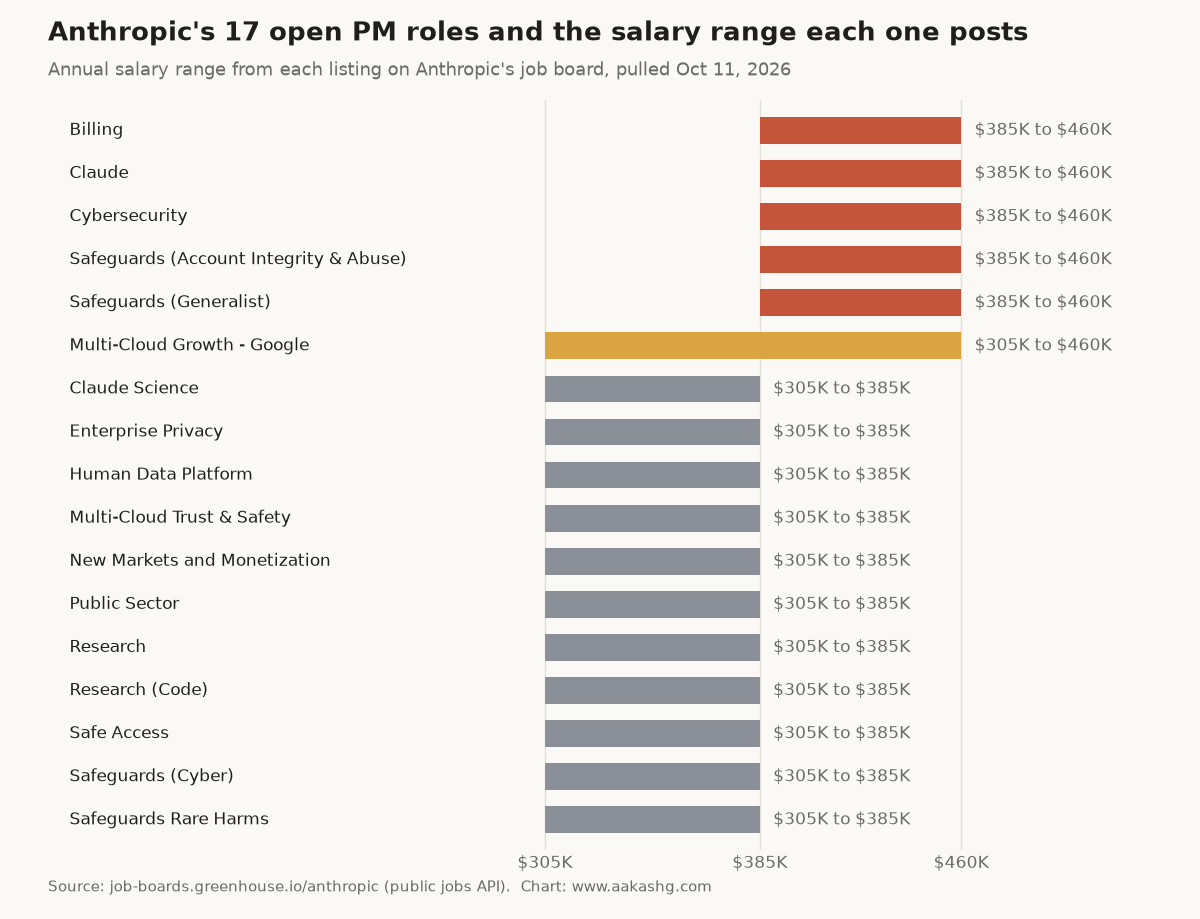
The listings don’t say which level maps to which band, so ask your recruiter. Levels.fyi shows a different measure. When I pulled its Anthropic PM page on Oct 11, it gave a total compensation range of $349K to $486K a year, with a common range of $374K to $440K, and said it needed two more Product Manager submissions. Salary and total compensation measure different things, so don’t subtract one from the other. For pay across labs, see my AI product manager salary guide.
Read the listing for your team as the rubric. That’s my read, and Anthropic hasn’t said it. The Claude PM listing, for the App Foundations team, which covers the core Claude experience and primitives such as memory, voice mode and artifacts, asks for experience on products with millions of users, product taste, fluency in experimentation, and the ability to turn early model capabilities into experiences people understand. The Safe Access listing asks for a strong executor who has owned a developer platform, identity or access-management product and writes clearly enough that an engineer, an executive and an external partner can each see the tradeoff. The Claude listing also says staff are expected in an office at least 25% of the time, and says Anthropic sponsors visas for some roles and candidates.
Anthropic PM interview questions candidates report
Every question below is candidate-reported, and Anthropic has confirmed none of them. Each line says who reported it.
Product sense
- How would you increase Claude Code weekly active users 10x? (Ankit Virmani’s AI PM job search, in my April 2026 guide)
- Design an AI feature for enterprise users of Claude. (IGotAnOffer)
- How would you improve Claude.ai for new users? (IGotAnOffer)
Analytical and execution
- How would you define success metrics for a new Claude feature? (My April 2026 guide)
- How would you measure success for Claude on a coding task? (IGotAnOffer)
- Daily active users of a Claude feature dropped 15% last week. How do you diagnose it? (IGotAnOffer)
- What evals would you run before shipping a new model to enterprise customers? (IGotAnOffer)
Safety and tradeoffs
- How would you prioritize a capability improvement against a safety improvement? (My April 2026 guide)
- How would you define a redline for a model capability? (IGotAnOffer, also in my technical interview guide)
- How would you handle hallucinations in a generative AI model deployed to users? (Aced (formerly Exponent), via my technical interview guide)
- How do you approach GenAI safety in consumer products? (Aced (formerly Exponent))
- What are the ethical risks of deploying agentic AI systems in high-stakes environments? (Aced)
Behavioral and culture
- Tell me about a time you had to make a difficult product decision with incomplete information. (IGotAnOffer)
- Walk me through a project you’re most proud of. What decisions did you make? (Ridhima Khurana)
- What are your thoughts on AI safety and the risks of advanced AI systems? (Ridhima Khurana)
IGotAnOffer organizes the behavioral rounds as User Centricity, Engineering Partnership and XFN Leadership. It says it has no verified Anthropic questions for the engineering round, so it borrows Google’s. Treat that round’s question list as a guess. Their guide is open about it.
In my April 2026 AI product sense guide, I wrote that Anthropic wants safety treated as a design constraint specific to each feature, not a paragraph at the end of your answer. So when you pick a segment, a version and a metric, say how safety changed the choice. The mock in that guide, on the Claude Code growth question, drew one piece of feedback about speed: a high-effort first version doesn’t match how fast Anthropic ships. My Q1 2026 teardown counted 120+ features in 90 days, so a phased first version with a quick win fits that pace.
The safety and ethics round is the one candidates underestimate
Across the rejections in my last two cohorts, safety was the round candidates underestimated. That’s from the guide I wrote in May 2026, when I had coached 80+ AI PM candidates across two cohorts and 22 had landed offers.
Here is what the debriefs from candidates I coached through Anthropic loops in 2025 and 2026 showed. The round was usually a dedicated 45 to 60 minute slot, often round 3 or 4. The panel was cross-functional, typically a senior researcher plus a PM, and the hiring manager wasn’t on it. The prompts were open-ended: “Tell us about a time you weighed a safety risk against a business goal.” And: “Walk us through how you would scope launch criteria for a model that can write code.”
The bar was engagement with Anthropic’s own work. Generic safety answers that would work at any lab came back graded lower. The fix from candidates who passed: read one Responsible Scaling Policy document, quote one researcher, and disagree with one position respectfully. Start here:
- Core Views on AI Safety
- Responsible Scaling Policy
- Claude’s Constitution
- Acceptable Use Policy
- Constitutional AI paper
Then tell your safety story as a system you built. Name the incident, what you did, and the mechanism you added so it didn’t repeat.
The framework I teach for this round is SHIR. Before you propose anything, size the problem on four dimensions:
- Severity: how bad is the worst case?
- Harm scope: how many people does it affect?
- Immediacy: is it happening today?
- Reversibility: can you undo it?
Ask for 30 seconds to write them down. In the live mocks for that episode, the panelists who did this scored higher than the ones who jumped to solutions. Reversibility should drive your design. Reversible actions ship fast with monitoring. Irreversible ones need confirmation gates and a human checkpoint. The top scorers went one step further and sized the business impact of each response option. I walk through two worked examples and the scored mocks in the full safety and ethics guide.
What the Anthropic culture interview looks for
Reports describe a 45-minute culture interview. IGotAnOffer calls it a values conversation and says heavily scripted STAR stories can backfire. It also folds AI safety judgment into this round. Ridhima Khurana’s March 2026 breakdown (a paid post, and I read the free preview) lists four things interviewers look for: handling complexity, admitting uncertainty, reasoning about second-order effects, and intellectual honesty. Her first question type is the AI safety reasoning question.
Prep the culture and safety conversations the same way. Pick one real incident, tell it as a system you built, and state the tradeoff you made. Pick one line in Anthropic’s Constitution you’d push back on. IGotAnOffer reports interviewers expect you to think critically and challenge parts of Anthropic’s approach.
How to answer “Why Anthropic?”
IGotAnOffer reports this question comes up at every stage. The principle from my guide: connect a specific pain point from your current work to something specific about Anthropic’s technical approach. Build the answer in four parts:
- A specific failure you saw in an AI product you worked on.
- What you wished existed upstream of it.
- The Anthropic approach or published document that addresses it.
- Why the role you’re applying for is where you would work on it.
Then run the test from my guide. If the answer works for OpenAI and Anthropic and Google without changing a word, it works for none of them. “I’m impressed by the pace of innovation” fails it.
A prep order for the Anthropic PM loop
- Read the five documents above and pick one position to push on.
- Write your “Why Anthropic?” answer from one real incident.
- Choose your safety story and tell it as incident, response, prevention.
- Practice product sense with safety changing the design. My AI product sense guide has the mocks.
- Use Claude as your mock interviewer for steps 2 to 4. Anthropic’s guidance allows prep.
- Line up your references early. My April guide lists them as requested up front.
- Do the take-home without Claude, unless Anthropic tells you otherwise.
Go deeper on each round
- The AI PM interview guide (paid): a full mock interview and the real questions companies ask in 2026.
- AI PM safety and ethics interviews (paid): the SHIR framework and live mocks with scores.
- AI PM technical interviews (paid).
- The AI PM behavioral interview (paid).
- What Anthropic shipped in Q1 2026 (paid), for product sense context.
Anthropic PM interview FAQ
How many rounds is the Anthropic PM interview?
My April 2026 guide counts about six stages. IGotAnOffer’s June 2026 guide describes a recruiter call and a hiring manager screen, then a final loop of five panels on one day. The loop varies by team, so ask your recruiter for the round list.
How long does the Anthropic PM interview process take?
My April 2026 guide puts it at 3 to 8 weeks. IGotAnOffer reports 4 to 8 weeks and sometimes 2 to 3 months, and says team matching alone can take two to four weeks.
Can I use Claude in the Anthropic interview?
For prep, yes. Anthropic’s guidance, last updated Jul 10, 2025, says to write your application draft yourself and then refine it with Claude, to complete take-homes without Claude, and to use no AI in live interviews, unless Anthropic says otherwise.
Does Anthropic give PM candidates a take-home?
Some teams do. My April 2026 guide puts it at 3.5 to 5 hours. IGotAnOffer reports a written memo, a PRD or a presentation to the panel, based on Glassdoor reports. Not every loop has one.
What does an Anthropic product manager earn?
On Oct 11, 2026, Anthropic’s 17 open PM listings posted annual salary ranges of $305K to $385K for 11 roles, $385K to $460K for 5 roles and $305K to $460K for 1 role. The Levels.fyi total compensation range was $349K to $486K.
What is the Anthropic AI safety and ethics round?
It’s a dedicated 45 to 60 minute slot, often round 3 or 4, with a panel that is typically a senior researcher plus a PM. It asks open-ended questions, such as a time you weighed a safety risk against a business goal. Answers that cited Anthropic’s own published work did better in the debriefs I’ve seen.
Pay, role count and Anthropic’s guidance were checked on Oct 11, 2026.
I break down AI PM interview loops, job search systems and PM playbooks every week in Product Growth. Free posts land in your inbox and paid members get the full guides. Subscribe at www.news.aakashg.com.
