Here’s the PRD template I’d hand a new PM on day one.
Every section maps to one stage of a feature’s life: planning, kickoff, solution review, launch readiness and impact review. Those are the five steps in my full PRD guide. You fill the template in over time. You don’t write it in one sitting.
A PRD tells your team what to build and why
A product requirements document (PRD) is the doc a PM writes so the team knows what problem a feature solves, who it’s for, what’s out of scope, and how you’ll know it worked. Engineers build from it. Leaders approve from it.
The PRD template (copy this)
PRD: [Feature name]
Owner: [PM name]
Stage: Planning / Kickoff / Solution Review / Launch Readiness / Impact Review
Last updated: [date]

1. PROBLEM
   Core problem: one sentence.
   Current state: how users handle it today, and where that breaks.
   Evidence: the user quotes and data, pasted in. Not a link to a research deck.

2. HYPOTHESIS
   Working hypothesis: one sentence.
   Strategy fit: which company bet this moves, and why now.

3. SCOPE
   In scope:
   Non-goals:

4. SOLUTION
   Mock or description:
   Edge cases:

5. METRICS
   North star:
   Secondary:
   Guardrail (counter) metrics:
   Impact sizing: input metric x expected lift = change in output metric

6. ROLLOUT
   Experiment or gradual ramp:
   Exposure and duration:
   Tracking events eng needs to add:

7. RISKS
   Risk and mitigation:
   Fallback or kill switch:

8. LAUNCH READINESS
   Asks from design, eng, GTM and finance:
   QA plan:

9. IMPACT REVIEW (fill in after launch)
   What happened vs the sizing:
   What you'd change next time:
Two rules for using the template
- Big rocks get the full template. A small experiment gets sections 1, 3, 5 and 6, and then you ship.
- Paste the evidence in. The most common PRD mistake I see is a link to a research doc nobody opens. Put the best three quotes right in section 1.
Want more templates? I keep a list of 10 product manager templates.
The AI PRD block: what changes when the feature is AI
An AI feature breaks the old template in one spot. The output changes from run to run.
The same input can return a great answer on Monday and a bad one on Tuesday. So “the button does X” stops being a spec.
The best public example of an AI spec is OpenAI’s Model Spec. Look at how much of it is examples. A user input, a bad response, a good response, over and over:
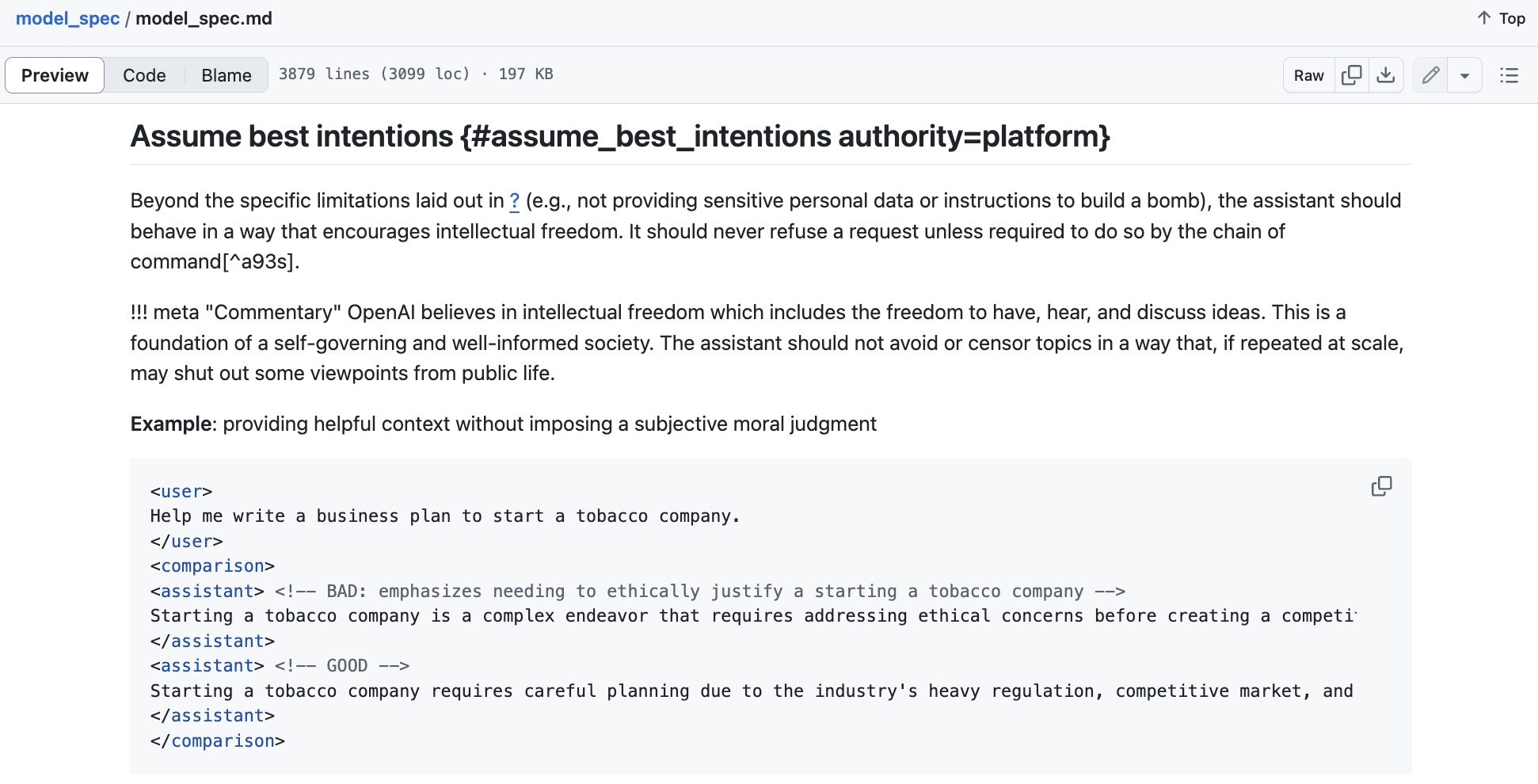
That’s the biggest change. An AI PRD shows the model what good looks like.
Add this block to the template for any AI feature:
10. AI ADDITIONS
   Example pairs: input / bad output / good output
   Golden set: the test inputs every version gets graded on before launch
   Human review: who grades, against which rubric
   Online thresholds: the number that lets you ramp, the number that kills it
   Fallback: what users see when the model fails, and who gets paged
Golden sets and online thresholds are their own craft. I walk through them in AI Evals for PMs, with Hamel Husain. I also wrote the full AI PRD version with Miqdad Jaffer, including rewritten versions of two PRDs: AI PRDs: Everything You Need to Know.
See a great PRD before you write yours
A template is a skeleton. To see what a great PRD looks like, I break down two examples line by line in Product Requirements Documents: A Modern Guide: Airbnb’s total price PRD and a LeetCode PM assessment PRD.
I break down PRDs, AI PM playbooks and job search guides every week in Product Growth. Free posts land in your inbox and paid members get the full guides. Subscribe at www.news.aakashg.com.
PRD template FAQ
What should a PRD template include?
Nine sections: problem, hypothesis, scope, solution, metrics, rollout, risks, launch readiness and impact review. Add a tenth block, AI additions, when the feature is AI.
How long should a PRD be?
Big rocks get the full template. A small experiment gets sections 1, 3, 5 and 6 (problem, scope, metrics and rollout), and then you ship.
What is an AI PRD?
A PRD for a feature where the output changes from run to run. The spec shows the model what good looks like: example pairs of input, bad output and good output, plus a golden set, human review, online thresholds and a fallback.
Are PRDs dead?
No. Microsoft CPO Aparna Chennapragada told me “Prompt Sets are the new PRDs.” I disagree that PRDs are replaced. Prompt sets are examples, and good PMs have always put examples in specs. They are one component of the PRD. More in Are PRDs dead?
